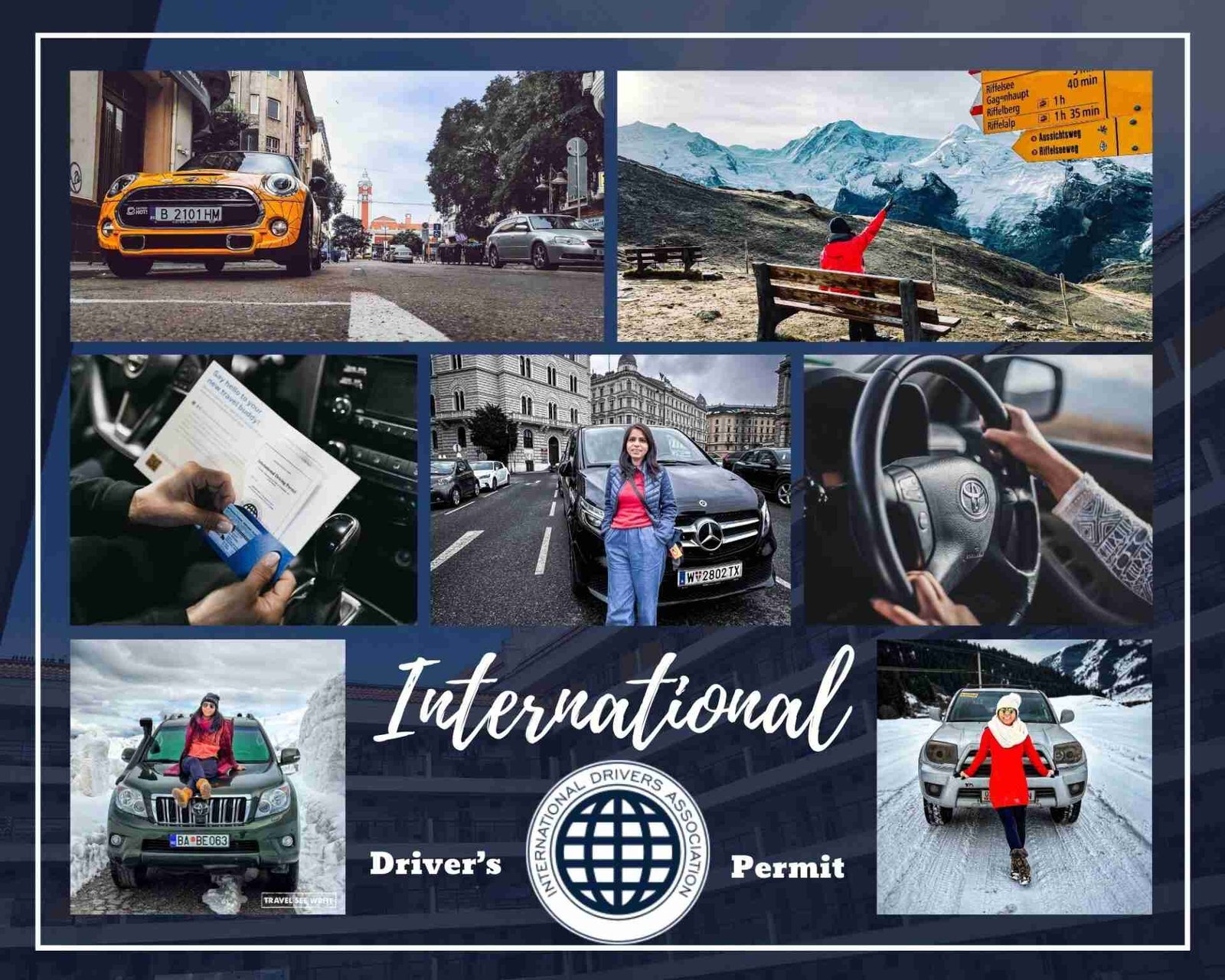
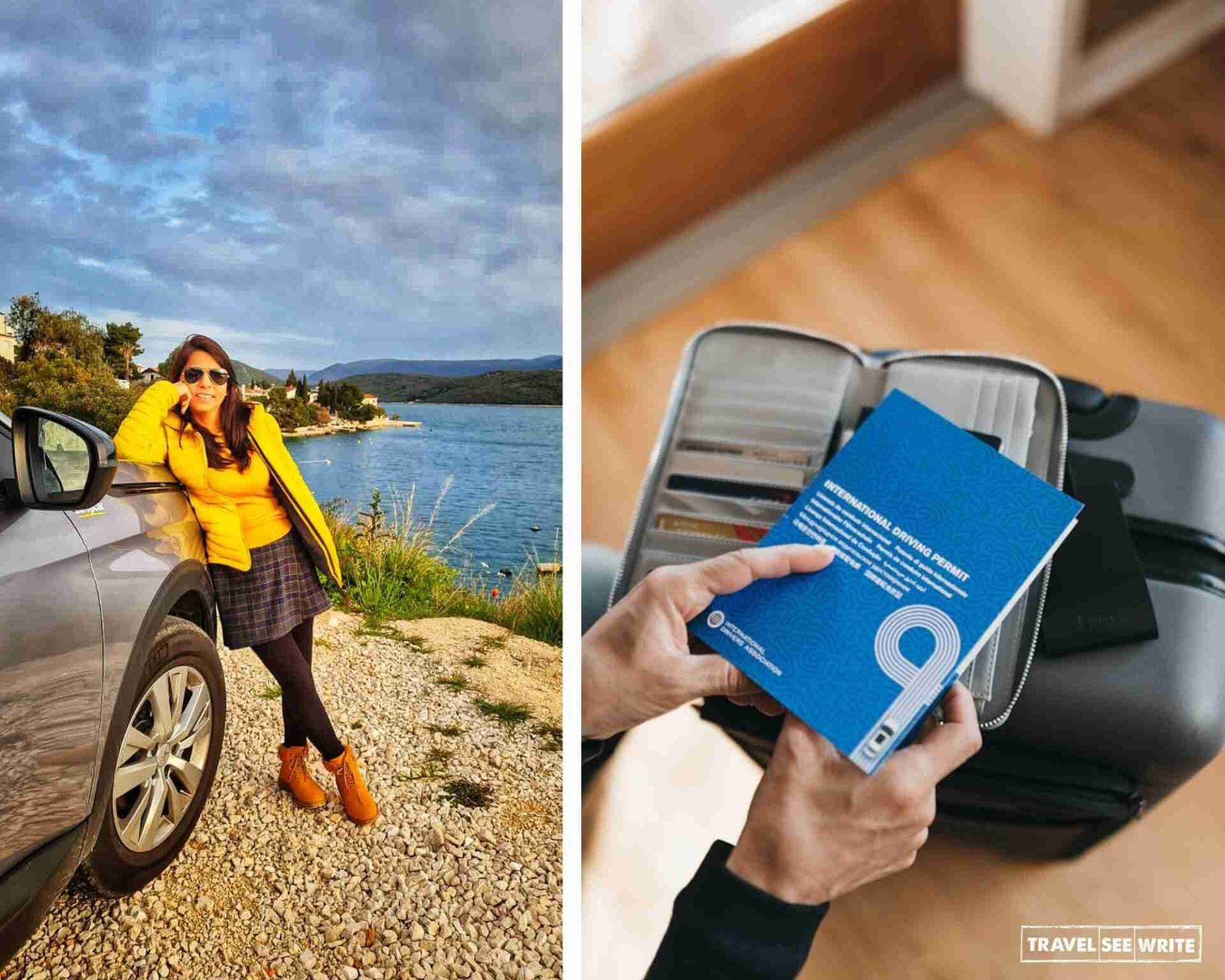
Explore the importance of an International Driver’s Permit (IDP) for global travelers. Learn about its application process, eligibility criteria, and how it facilitates legal driving abroad. Get ready for your next international journey with the right documentation.
Advantages, eligibility and the process of obtaining an International Driver’s Permit (IDP)
Being a frequent solo traveller, I have travelled around the world and used different transport modes. While I enjoy using public transport or trying more adventure activities like hiking or biking, driving is my most preferred means of transport because it gives wind beneath my freedom to go off the beaten track and take as many stops on the way as I wish to discover local hotspots and holes-in-the-wall that are neither covered in travel guides nor pinned on Google maps. This freedom is invaluable as a photographer, as some of my most stunning pictures have been captured in unexpected moments and places. Moreover, driving in a foreign land makes me feel more connected with that destination. I can dive deep into different cultures and see the world’s beauty from new perspectives at my own pace. While I’ve driven all around the globe – mastering both left-hand and right-hand drive, I discovered another layer of freedom- driving in a foreign land during my thrilling drive along the famous Pacific Coast Highway in California.
Exploring the Central Coast of California through a road trip in the USA
Driving liberates me from the shackles of following a regimented schedule! Nevertheless, freedom can only be tasted with legal papers. In some countries, your local driving license can work with you. However, it is always wise to have an International Driver’s Permit. Today, in this post, I will share all the information you need to get an International Driver’s Permit.
What’s an International Driver’s Permit?
The International Driving License, officially known as the International Driver’s Permit (IDP), is a document authorised by the United Nations and issued to people travelling to foreign countries. It certifies the holder has a valid driving license in their home country. IDP is an official document that translates your native driver’s license into a format that foreign authorities and car rental agencies can understand. While having a driver’s license in English (like those issued in India or the Philippines) can be sufficient for driving in the US or the UK, it’s essential to consider the legal requirements when driving in a foreign country. For example, while you can initially drive in Europe with an Indian driver’s license for six months, an International Driving Permit (IDP) is necessary for driving anywhere in Europe. It allows you to legally drive the vehicles listed in your IDP in foreign nations. The translation provided by an IDP is essential for ensuring compliance with local regulations.
What’s an International Driver’s Permit and why do you need it?
Translation of your license becomes exceptionally crucial when you have a driver’s license in your native language (apart from English) and are travelling to another country with a totally different language.
The International Driver’s Permit (IDP) is accepted in more than 150 countries worldwide, including popular destinations like Greece, Thailand, and Spain. It is available in various languages to ensure that your driving credentials are easily understood and recognised no matter where you go. If you are planning a trip to the USA or Europe, it is advisable to obtain an IDP. This permit contains essential identification information such as your name, photo, and driver details, all translated into multiple languages. This not only aids in communication with local authorities but also streamlines the process of renting vehicles in foreign countries. It is important to remember that the IDP is not a replacement for your national driver’s license but is meant to supplement it. Therefore, you will still need to carry your original license while travelling. So, you’ll still have to bring your original license with you and show the translated document when required.
Why do You Need an IDP?
An IDP opens up many opportunities to go around locally and offers peace of mind while exploring new places. Here’s why getting an IDP is a smart move for any traveller:
Helps in Communication
The IDP is translated into multiple languages, which is helpful if you need to show your driving license to local authorities. It protects you from misunderstandings, which is helpful in a country where your native language isn’t widely spoken.
This goes both ways. If you have a non-English driver’s license, you can have it translated into English to embark on a California road trip across the state’s central coast.
Acts as an Additional Form of ID
An IDP also serves as a form of identification. If you need to show who you are, an IDP can be valid. It has your photo and personal information, which can help in various situations, like checking into hotels or dealing with authorities. If you stay in a city for a longer time, you don’t need to carry your passport everywhere you go. You can leave it behind in your hotel unless it’s specifically asked for an activity you are partaking in.
Simplifies Car Rentals
With an IDP, you hold the key to a smooth car rental experience in your hands. Many car rental companies worldwide require an IDP before they hand over the keys to their vehicles. By having this document, you’re not only proving your legal driving status but also taking control of your travel plans, making them more flexible and convenient.
Check out this USA driving guide to learn more about renting cars in Uncle Sam’s land.
Offers Peace of Mind
Knowing you have an IDP gives you peace of mind. Without it, you could face serious legal issues if local authorities stop you. This could lead to fines, vehicle impoundment, or even being barred from driving in the country. Having an IDP allows you to focus on enjoying your travels instead of stressing about these potential problems.
Helps in getting Insurance
Driving abroad without Insurance can be very lethal for your wallet in case of an accident. An IDP is a must to get Insurance. Insurance companies require an IDP to cover drivers driving motor vehicles abroad.
IDP provides peace of mind to international travellers when it comes to getting car rentals or insurance
How can I get International Driving Permit in India?
Form 4A – Certificate that an individual is a competence rider
Form 1A – A form of medical fitness for the rider
Step 2: Provide details of driving license, identity and residential proof.
Step 3: Submit all the necessary documents with the forms.
Step 4: Take the driving test.
Step 5: Make a payment of ₹ 1,000 at the time of document submission.
Follow these simple steps to get your International Driving License (IDL) without hiccups. Your IDL will be dispatched to you in just 4 to 5 business days, ensuring a successful outcome.
The online application process has made it easier for everyone to apply for an IDL. However, if you prefer to apply offline, you can visit your Regional Transport Office (RTO), complete the necessary forms, pay the fees, and provide the required documents. The RTO will then translate your license into an international one.
Eligibility Criteria for Applying for an International Driving Permit
Certain conditions must be met in order to acquire an International Driving Permit. These conditions include being at least 18 years old, having a valid driving license from your country, and possessing a valid passport and visa.
What are the requirements for obtaining an International Driving Permit in India?
How can I get international driving permit in India?
If you wish to apply for an international driving permit (IDP) in India, you’ll require the following documents:
Forms 4A and 1A
Valid driver’s license copy
Copy of passport and visa
Duplicate air tickets for verification
Passport-size photographs as required
Certified proof of Indian citizenship
Copy of address proof
Copy of age-proof
Application fee of ₹ 1,000
The Open Road Awaits
IDP makes driving around the globe a lot easier for foreign travellers
Now that you know the importance of getting an International Driving Permit (IDP) and how to procure it, it’s time to head out from the quiet streets of your hometown to the big roads around the world. It’s not just any document; it’s your key to freedom, adventure, and memories that last forever.
Whenever I plan to go on a road trip across the globe, I always get an IDP. I suggest you do the same for your next trip. The world is huge, and there’s so much to see and do—one drive at a time.
Further Reading
If you are into road trips like me, do have a look at some of these road trips in India, USA, Europe and Asia:
Liked this post, pin these to your pinboards or save.
Learn about IDP’s application process, eligibility criteria, and how it facilitates legal driving abroad. Explore the importance of an International Driver’s Permit (IDP) for global travelers.Explore the criteria for an International Driver’s Permit (IDP) in India.Why do you need an International Driver’s Permit?
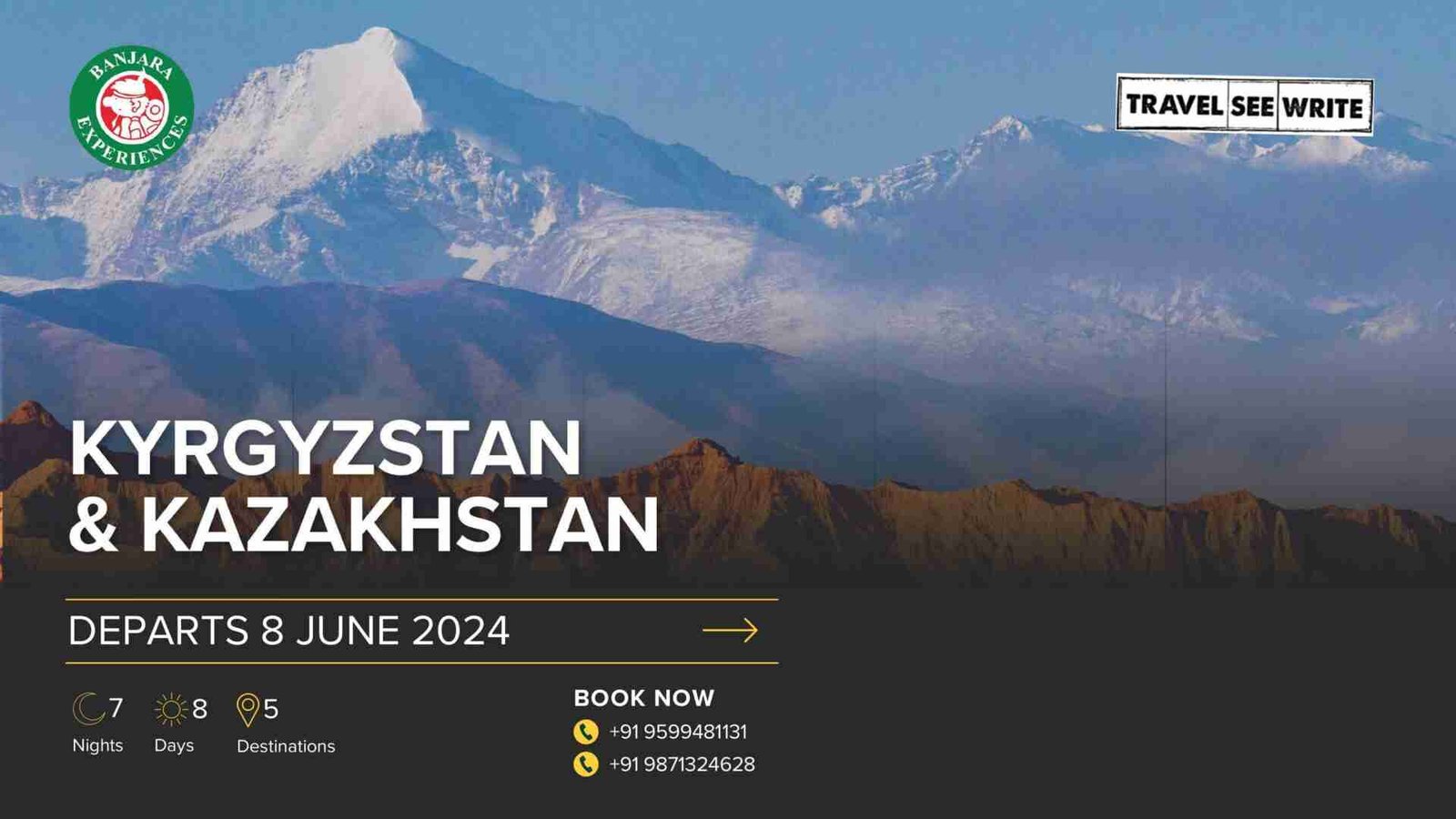
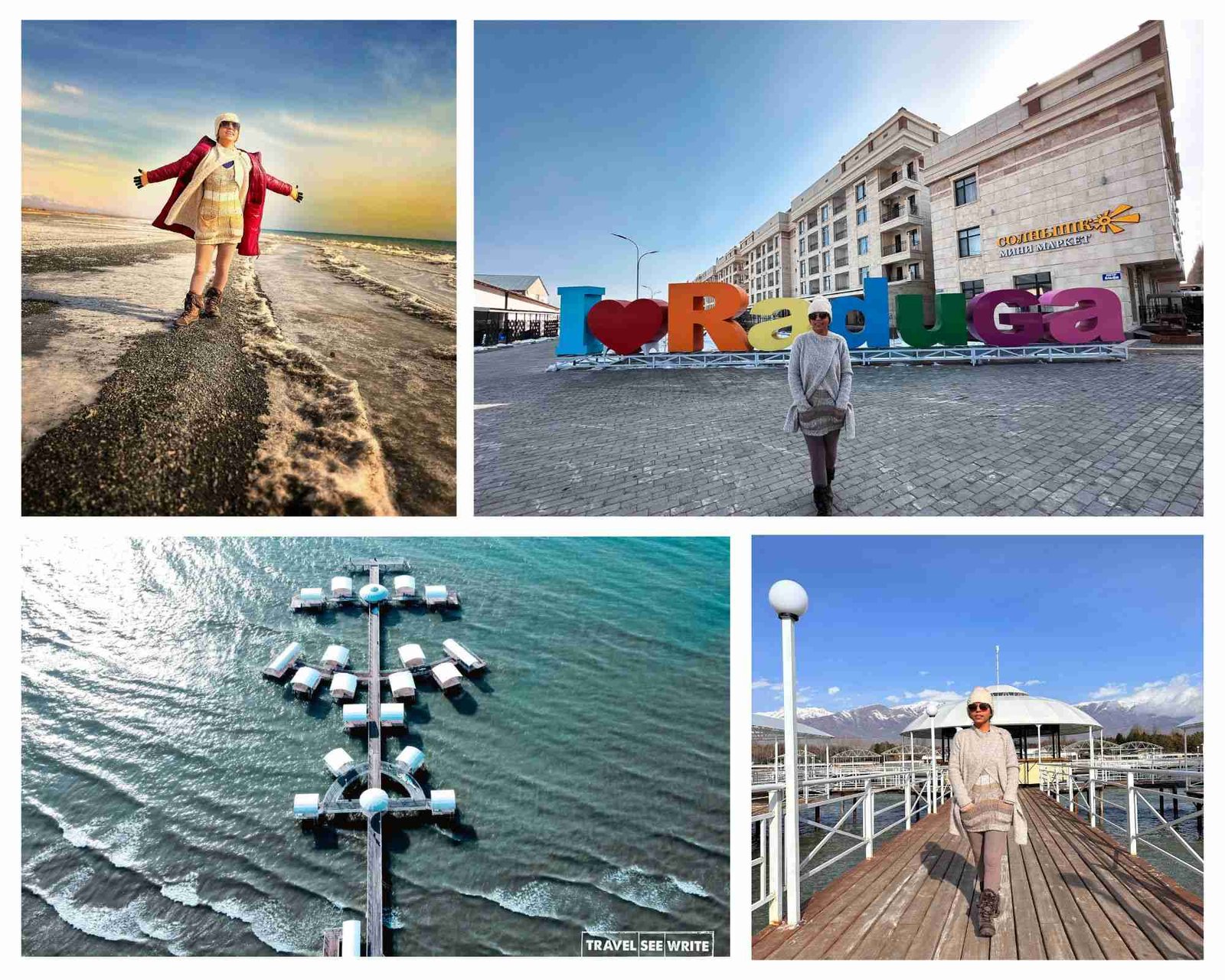
8-Day Adventure and Culture Tour of Kyrgyzstan and Kazakhstan
Are you ready for an incredible adventure across the heart of Central Asia? I, Archana Singh and Banjara Experiences, invite you to join us on an unforgettable adventure and cultural tour through Kyrgyzstan and Kazakhstan. You’ll be blown away by the vibrant cultures, breathtaking landscapes, and timeless traditions you’ll discover on this incredible journey. Don’t miss out on this once-in-a-lifetime opportunity!
8-Day Adventure and Culture Tour of Kyrgyzstan and Kazakhstan Tour by Banjara Experiences and Travel See Write
About Kyrgyzstan and Kazakhstan
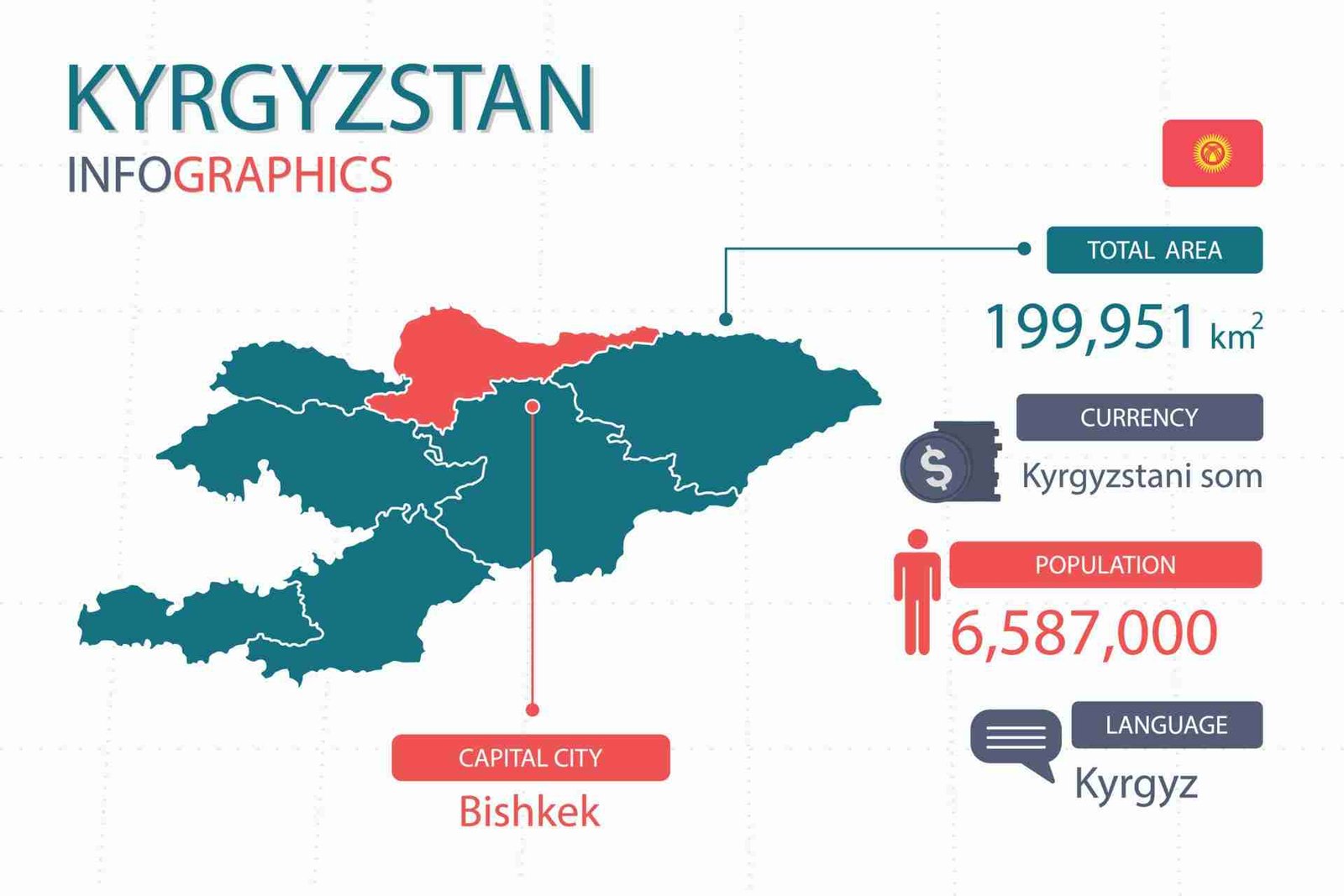
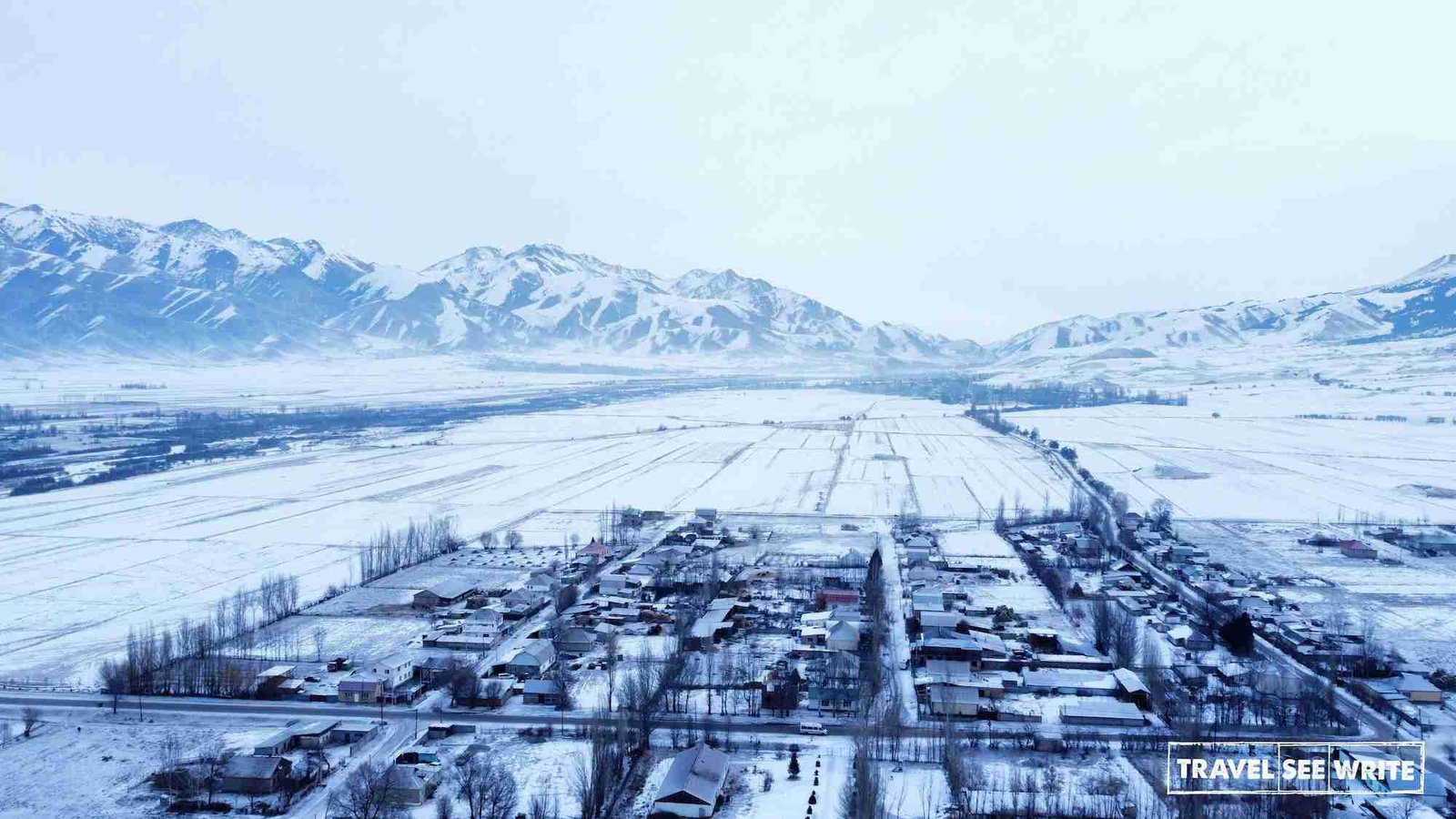
Kyrgyzstan was formerly part of the Soviet Union. It has now become a popular destination offering pristine natural beauty and unique experiences. The country spreads across 200,000 sq. km, and with just over 5.5 million people, it is one of the least crowded countries in the world. To put this into perspective, Delhi, the capital of India, which is home to 35 million people, is significantly more crowded. Kyrgyzstan’s charm lies in its natural splendour and deep-rooted equestrian culture, which are central to life in Central Asia. But that’s just the beginning—Kyrgyzstan also boasts the world’s second-largest high-altitude lake and nearly 2,000 other stunning lakes, each with unique charm.
Kyrgyzstan Tourism map
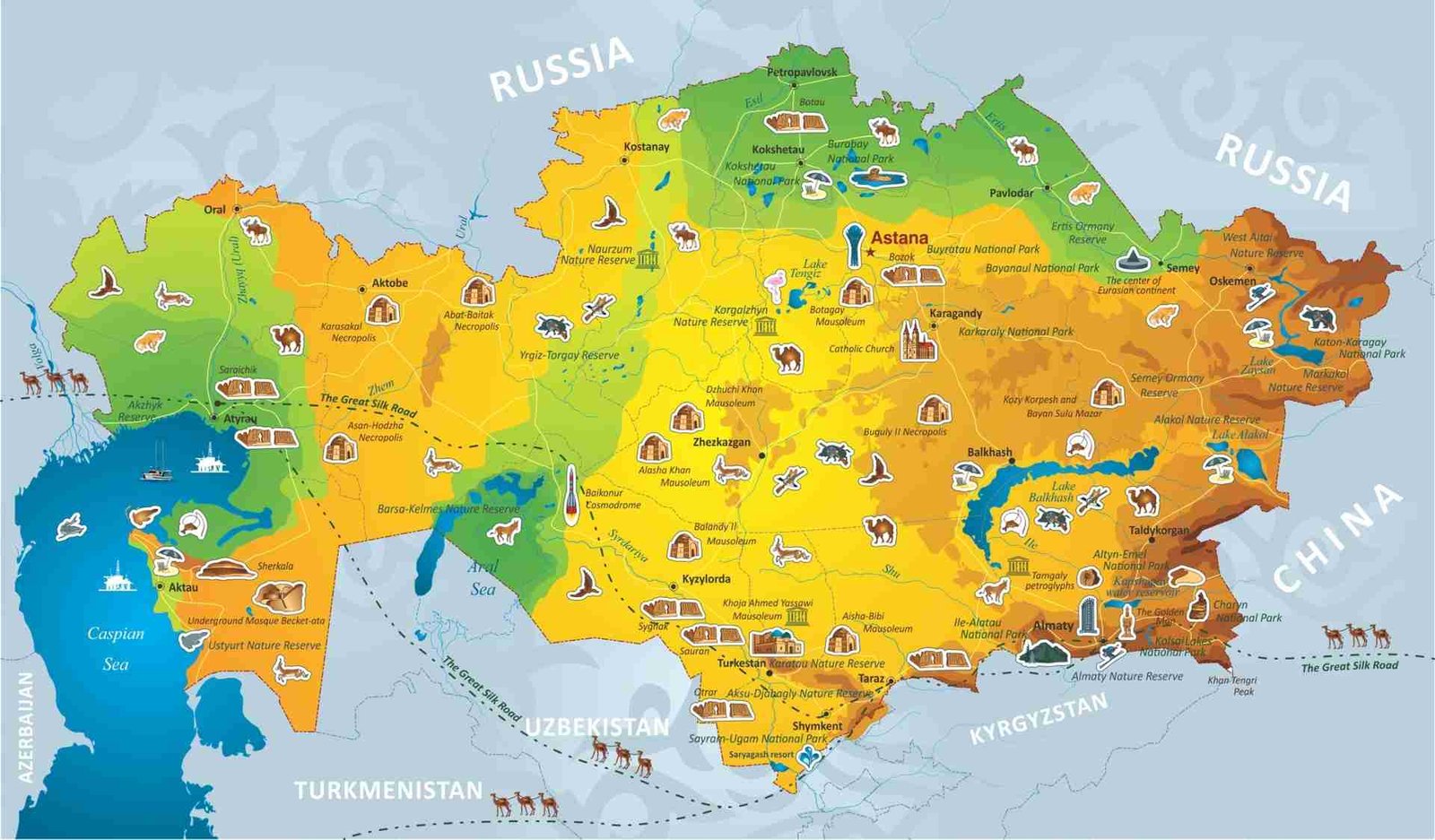
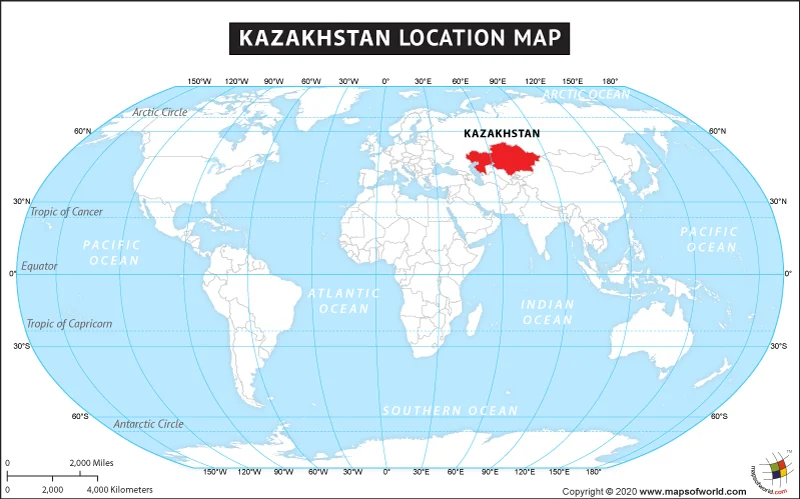
Kazakhstan, located in Central Asia, is the 9th largest country in the world, covering an area of over 2.7 million square kilometres. Despite being landlocked, it is the largest landlocked country in the world. Kazakhstan has been gaining popularity among Indian tourists due to its numerous attractions and visa-free travel policy for Indian citizens. From the bustling city of Almaty to the majestic mountains of the Tian Shan range, Kazakhstan offers travellers diverse experiences. The country also boasts a rich cultural heritage, with several UNESCO World Heritage Sites, such as the Mausoleum of Khoja Ahmed Yasawi and the petroglyphs of Tamgaly. Additionally, Kazakhstan is known for its hospitality and extremely friendly and hospitable people, making it a safe and welcoming destination for visitors worldwide.
Kazakhstan Tourism Map – Best Places to Visit
As someone who has explored these countries extensively, I’m excited to share my firsthand experiences and discoveries with like-minded travellers like you. Here’s an overview of my specially curated 8-day adventure and culture tour of Kyrgyzstan and Kazakhstan with Banjara Experiences.
Itinerary for an 8-day Adventure and Culture tour of Kyrgyzstan and Kazakhstan
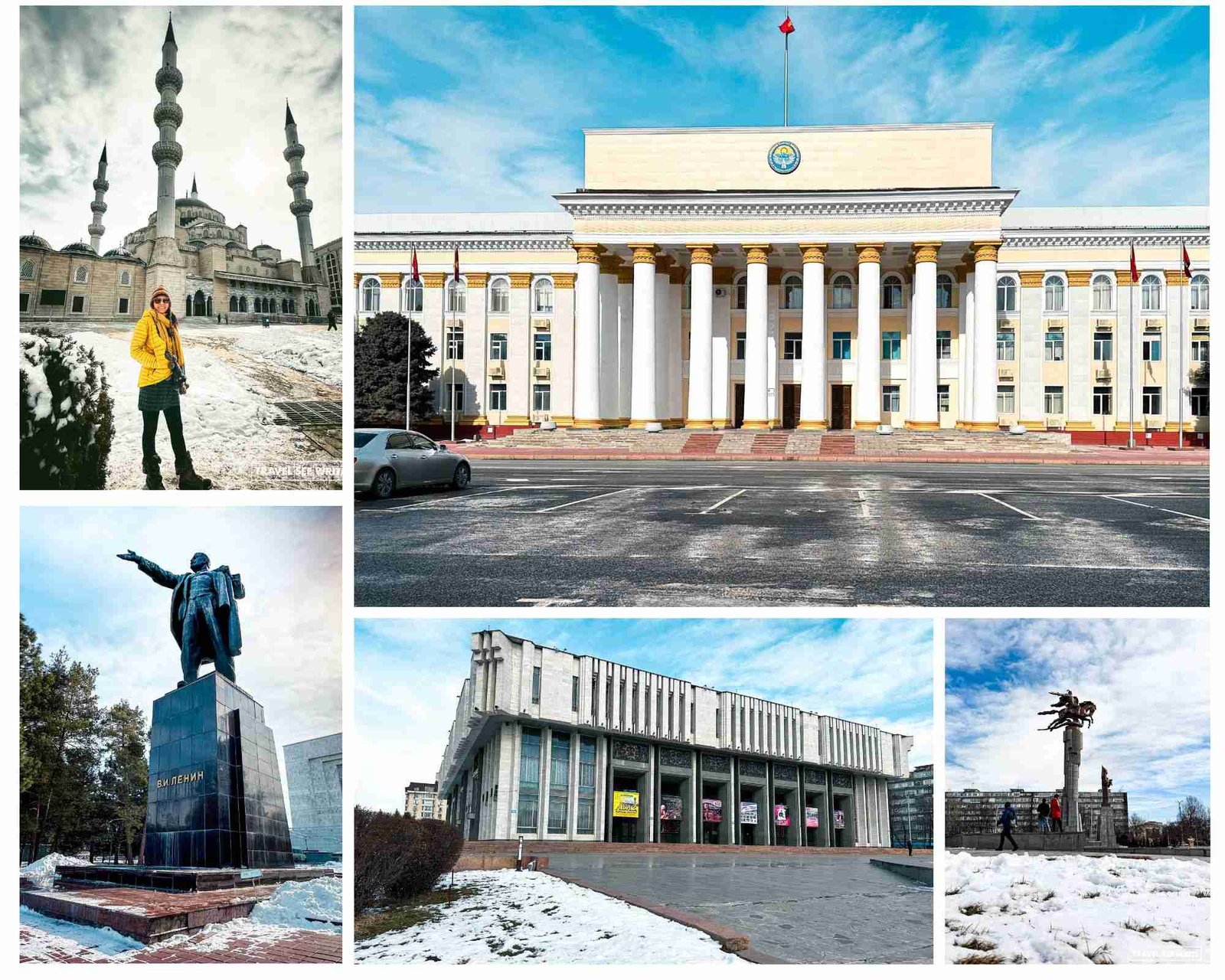
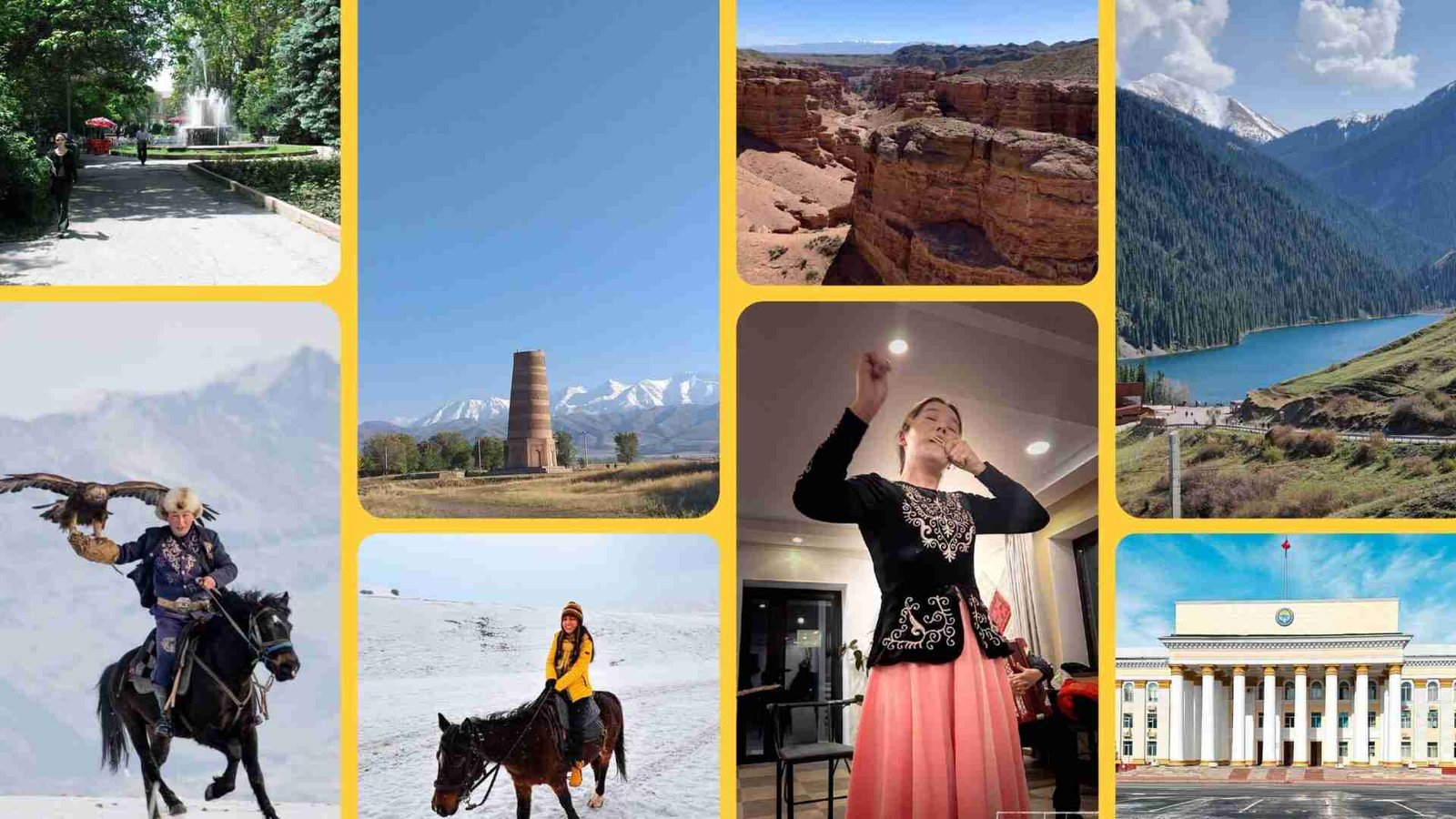
Day 1: Discover Bishkek, the capital of Kyrgyzstan
Our journey begins with a relaxed arrival in Bishkek, the charming capital of Kyrgyzstan. Take some time to unwind and recharge before we gather for a delightful welcome dinner at a local restaurant featuring captivating folklore performances and delicious local delicacies.
Exploring Bishkek on Day 1 of our 8-day adventure and culture tour of Kyrgyzstan and Kazakhstan
Day 2: Picturesque journey to Karakol
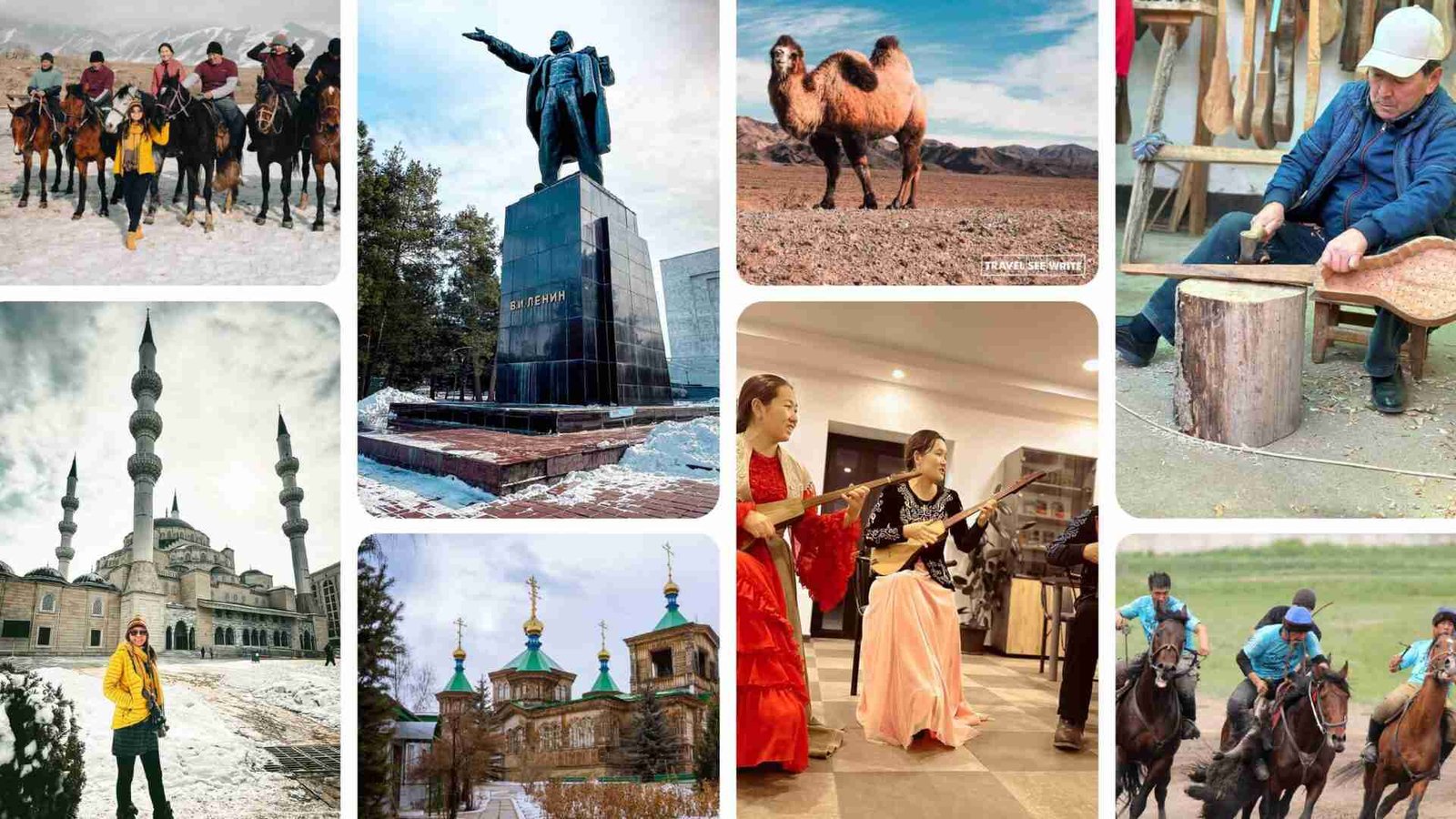
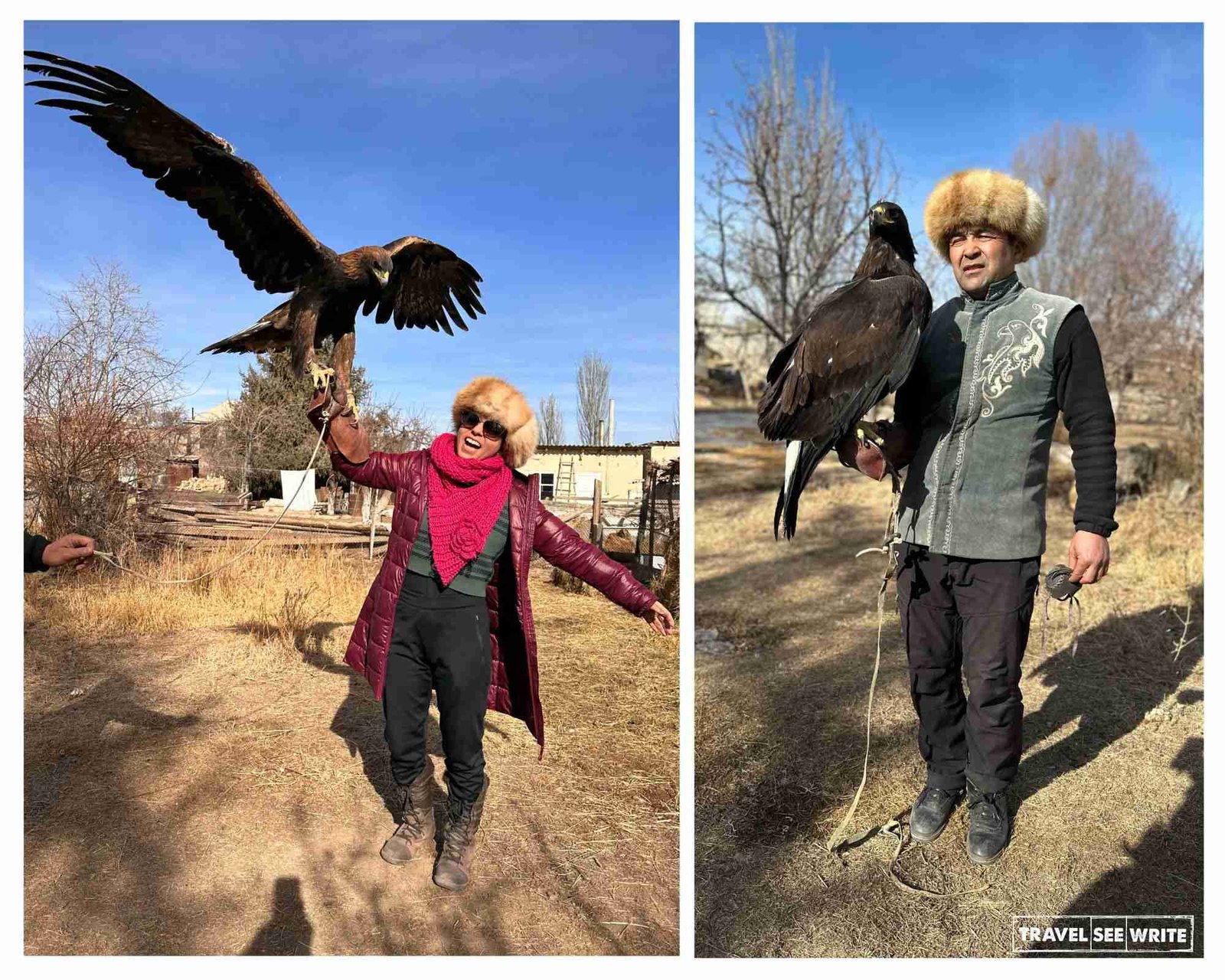
The next day, we embark on a picturesque journey to Karakol, tracing the southern shore of the stunning Issyk-Kul Lake. Along the way, we’ll delve into the region’s rich culture with immersive experiences—from witnessing the artistry of yurt-making in Kyzyl-Tuu to marvelling at the ancient skill of eagle hunting. Each stop promises to be a fascinating exploration of local traditions.
Our route takes us through the breathtaking Jety-Oguz Gorge, where legendary red rock formations await, including the iconic Broken Heart and Seven Bulls. Finally, we arrive in Karakol, a melting pot of diverse cultures.
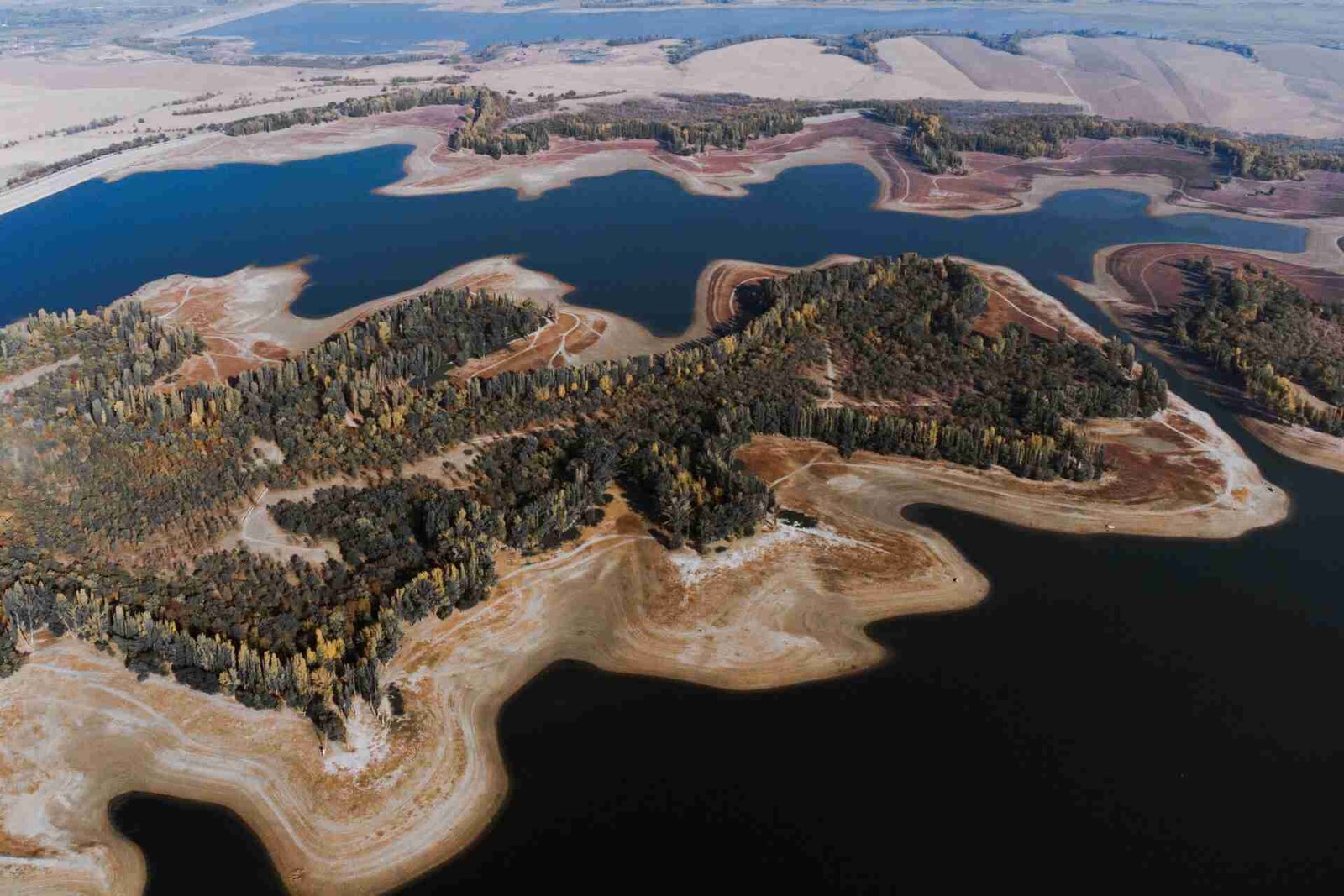
Issyk-Kul Lake in Kyrgyzstan
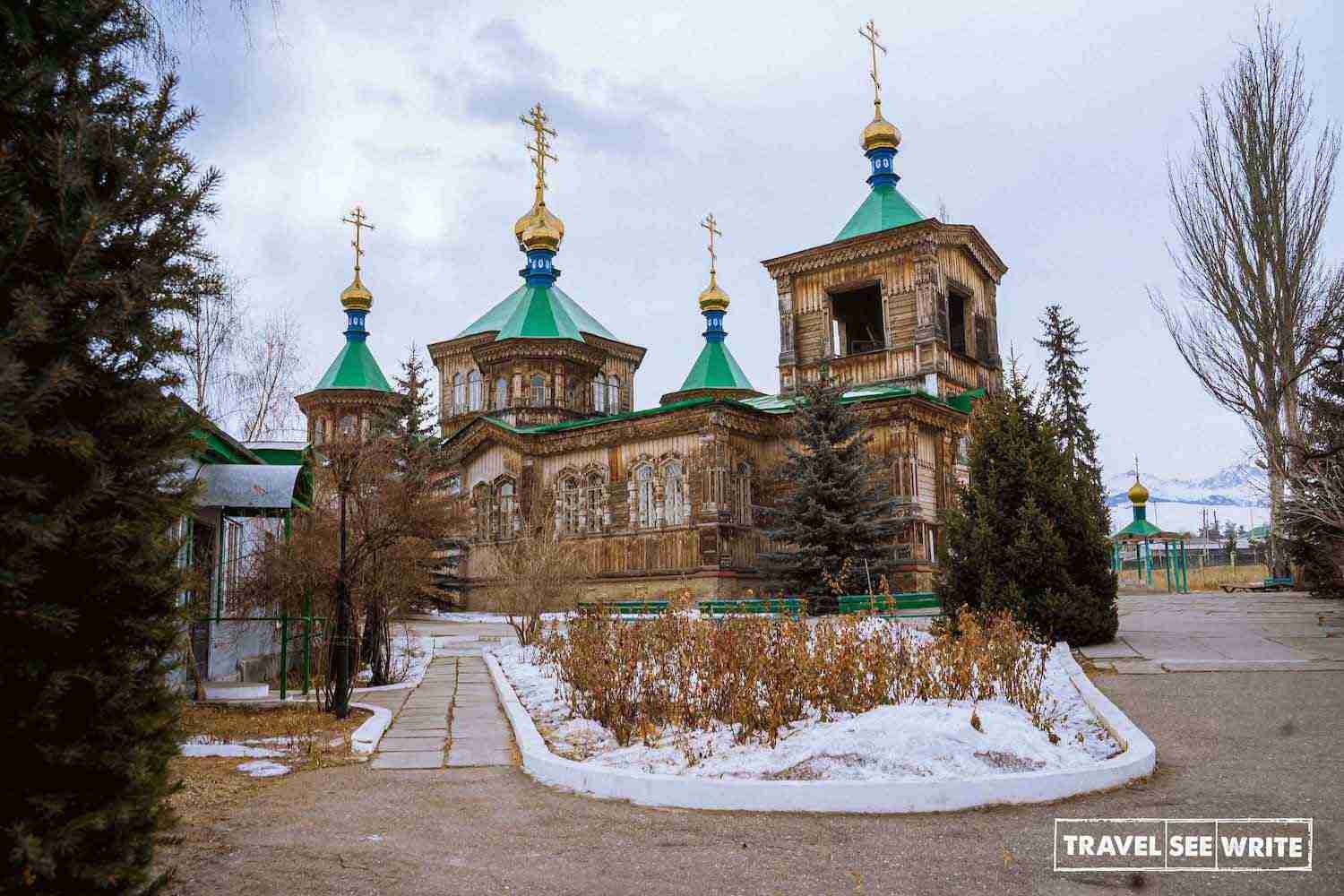
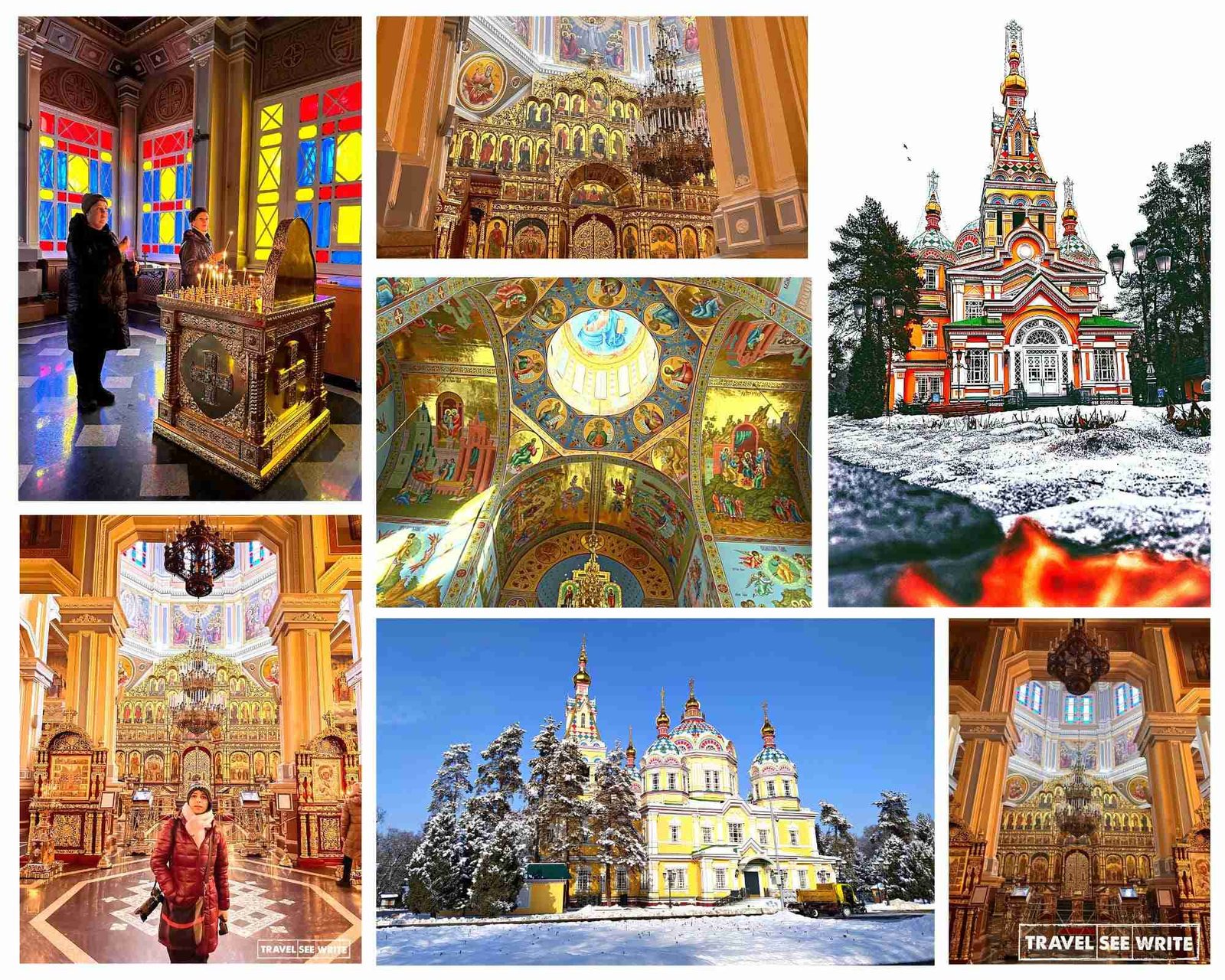
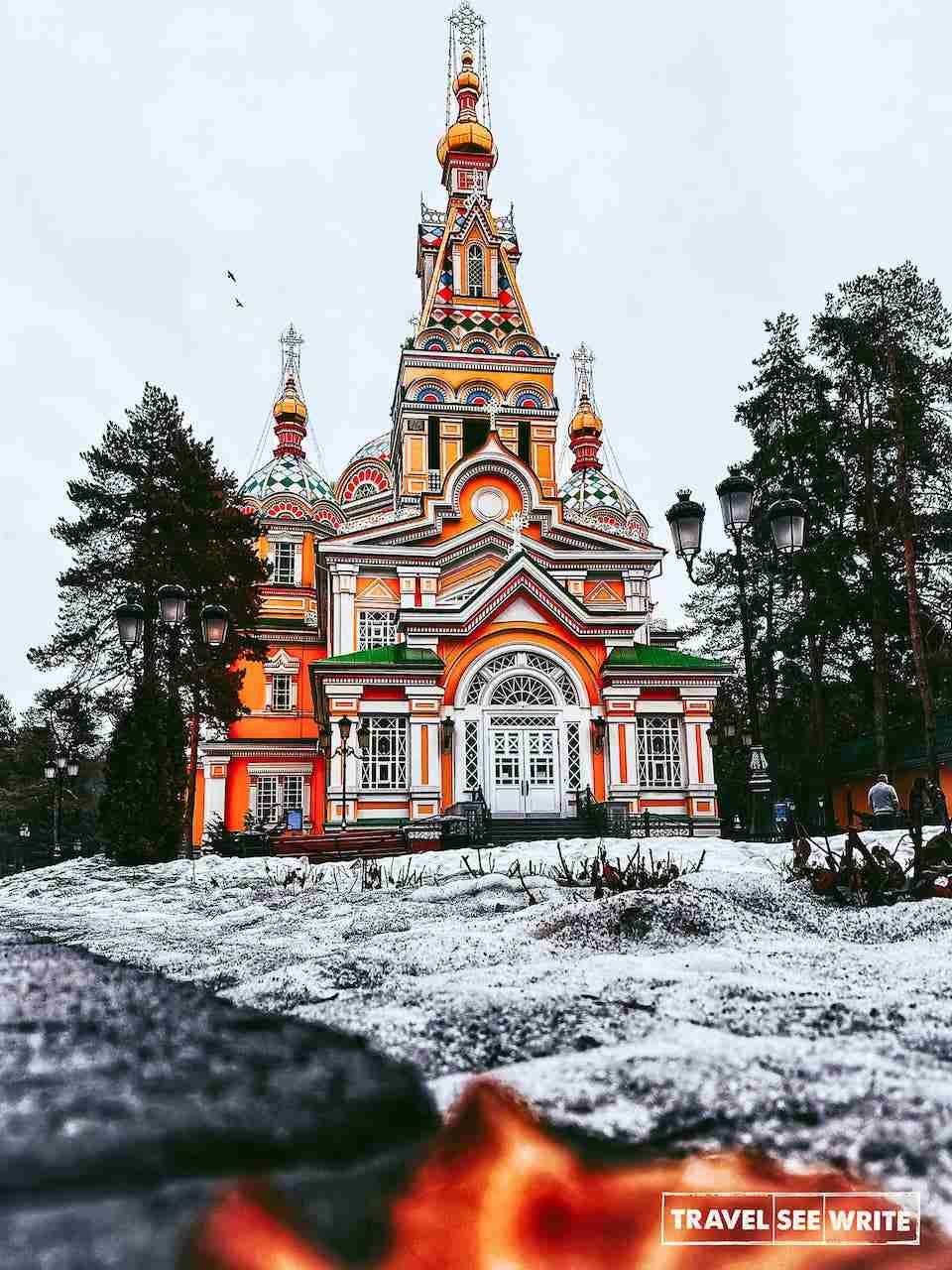
Russian Orthodox Church in Karakol
Day 3: Explore Karakol’s natural wonders
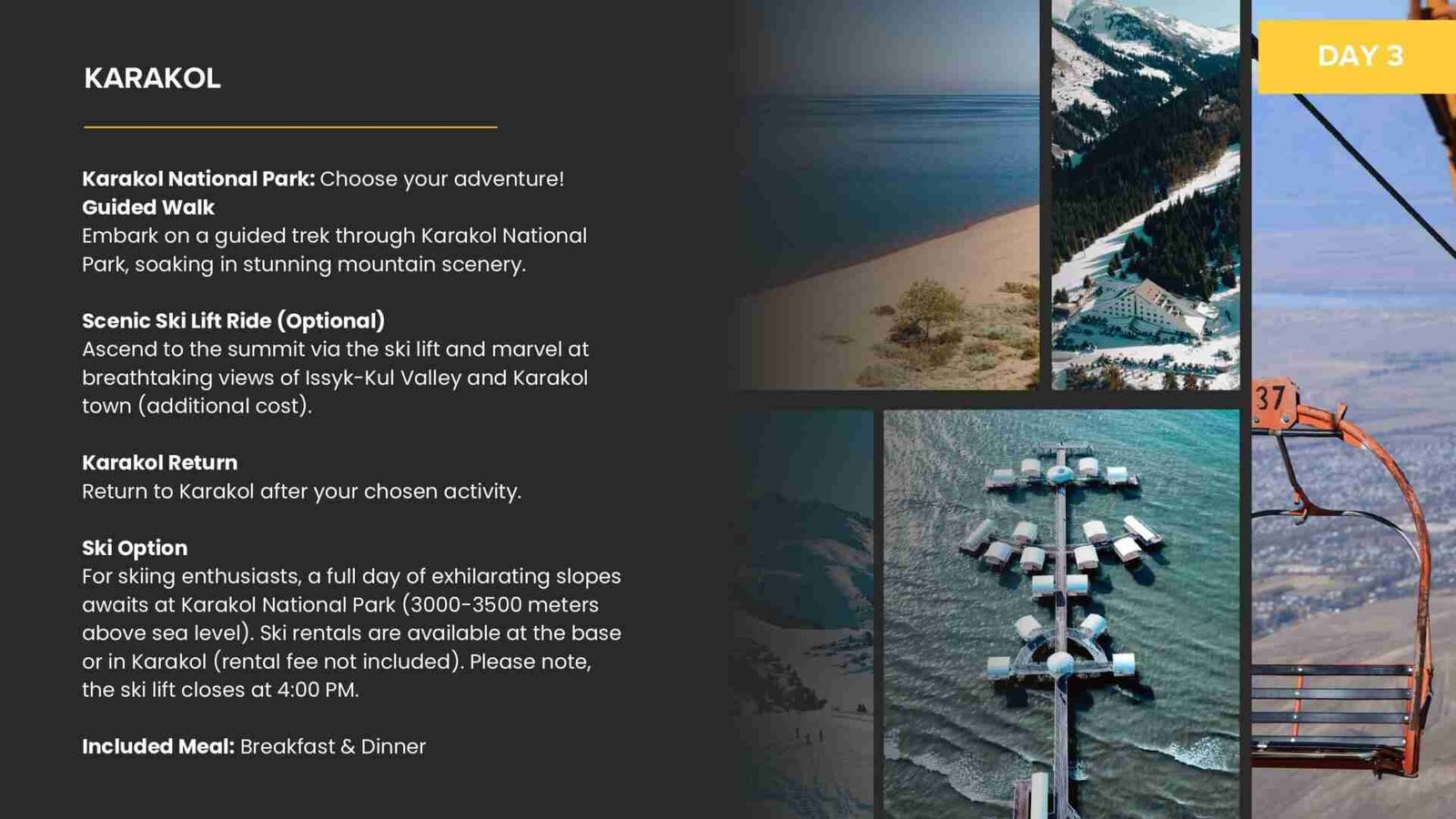
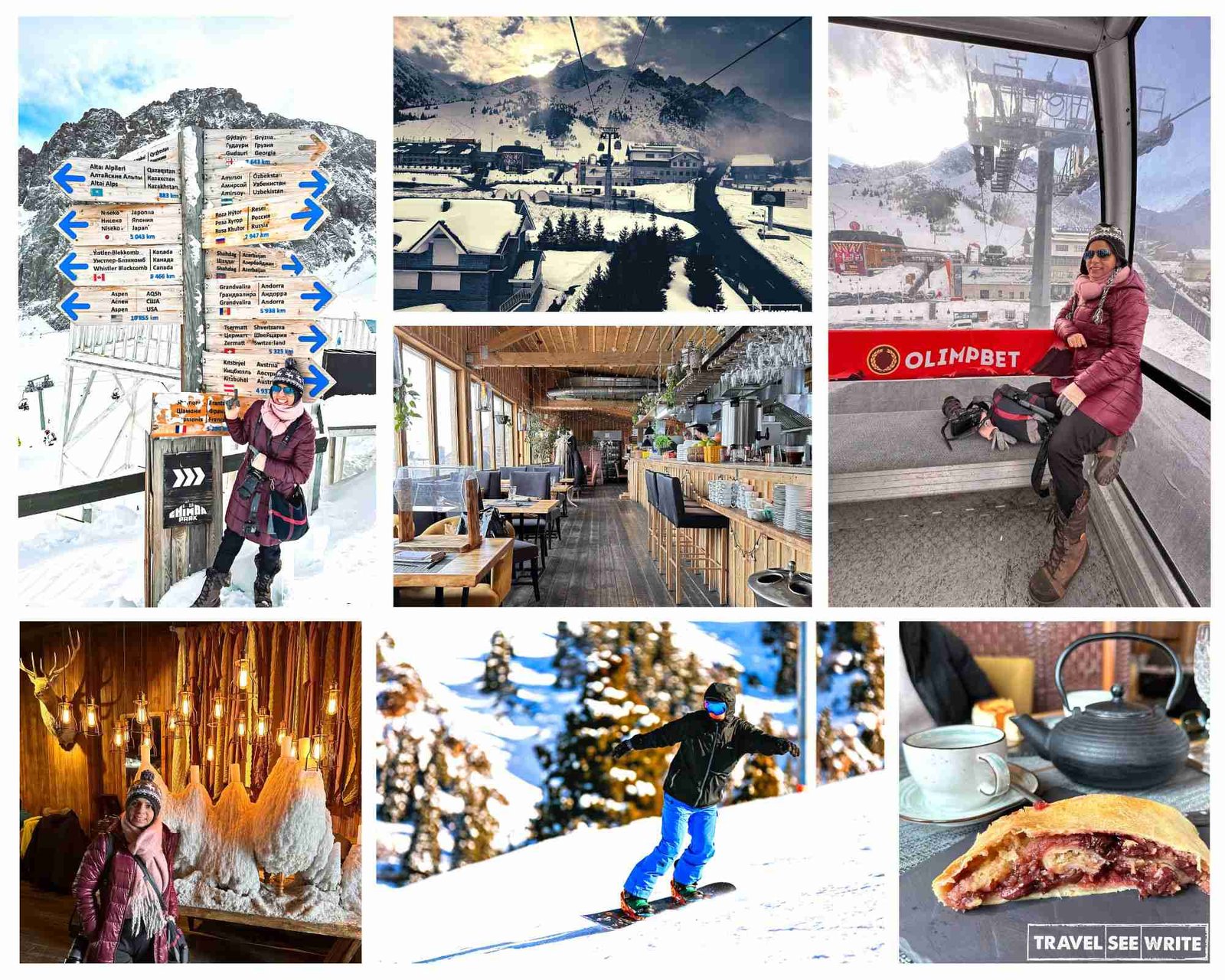
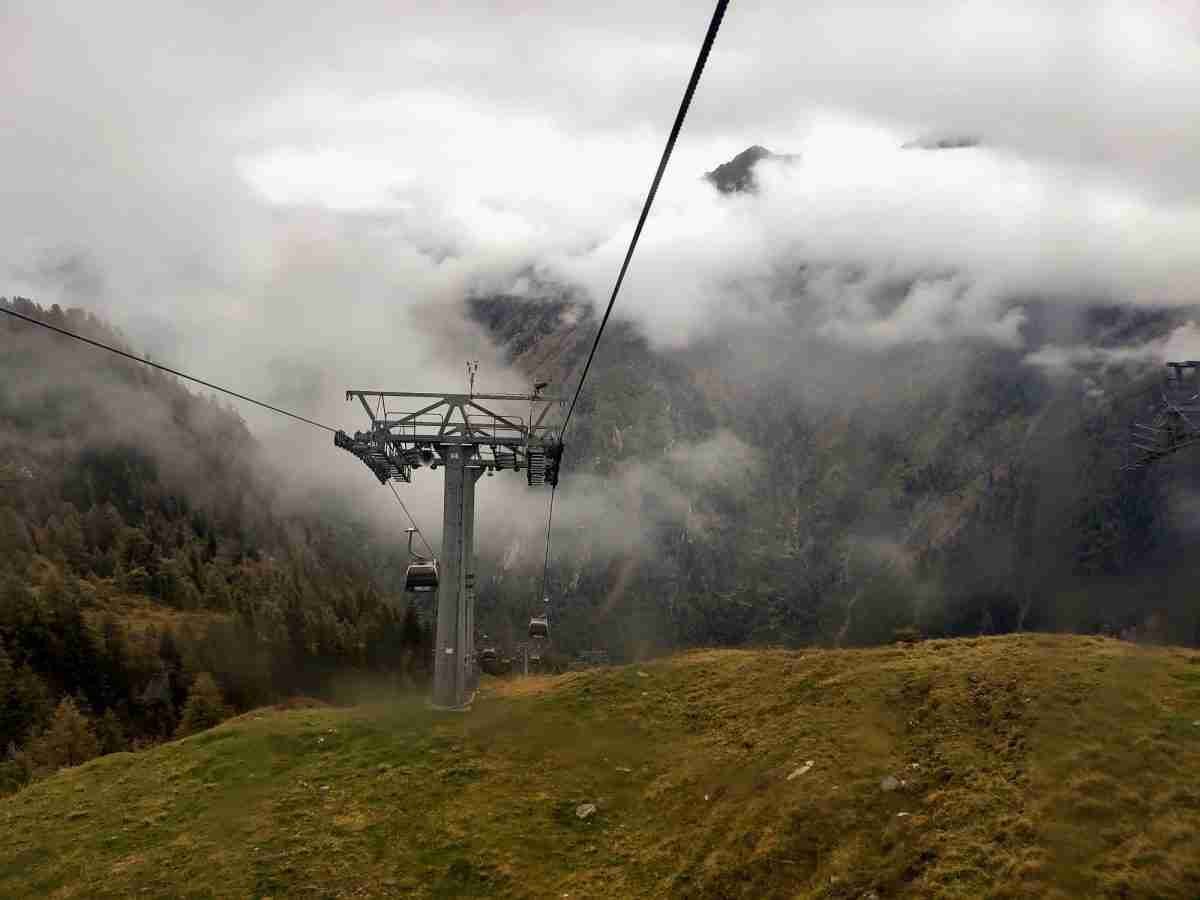
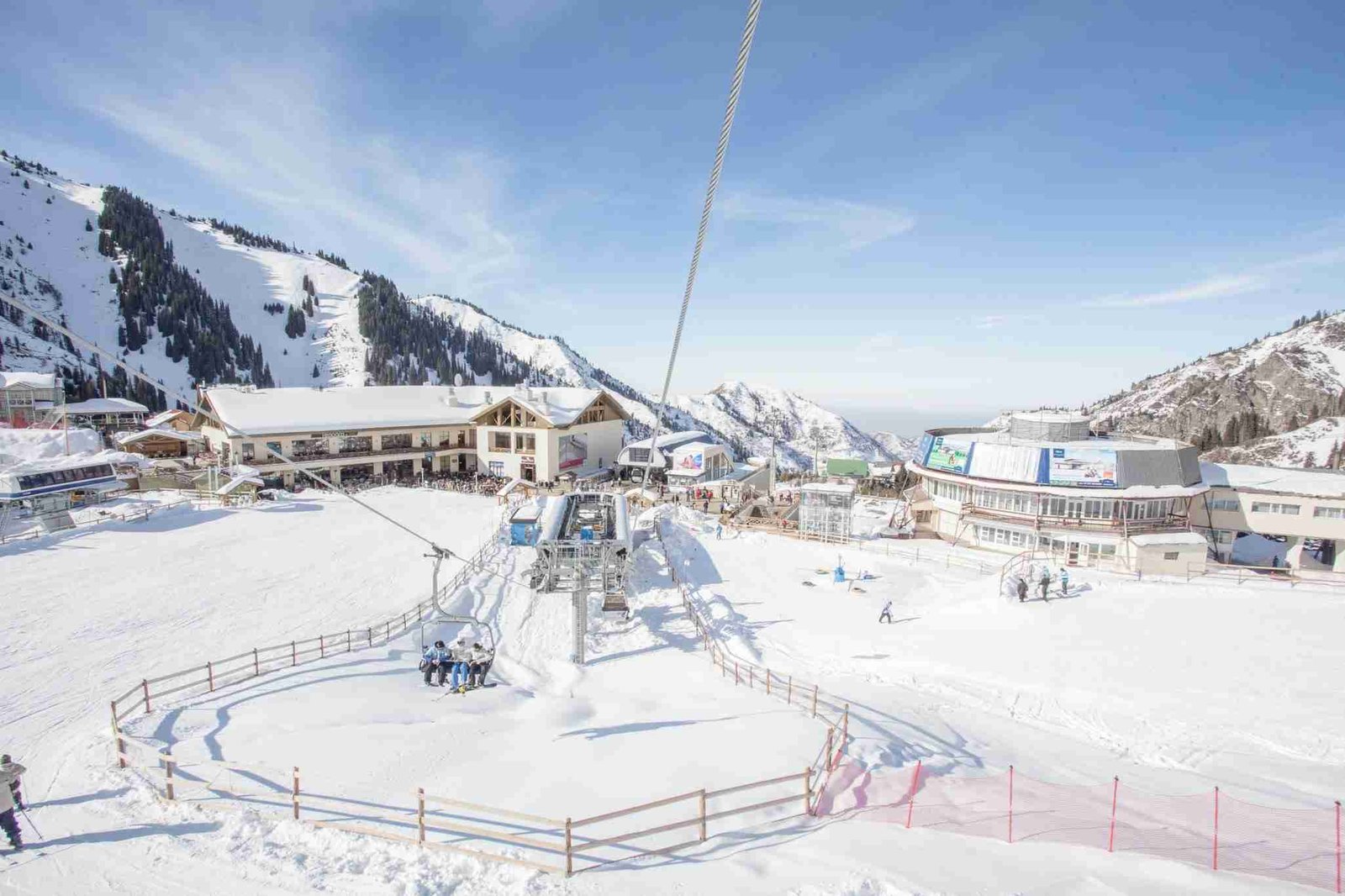
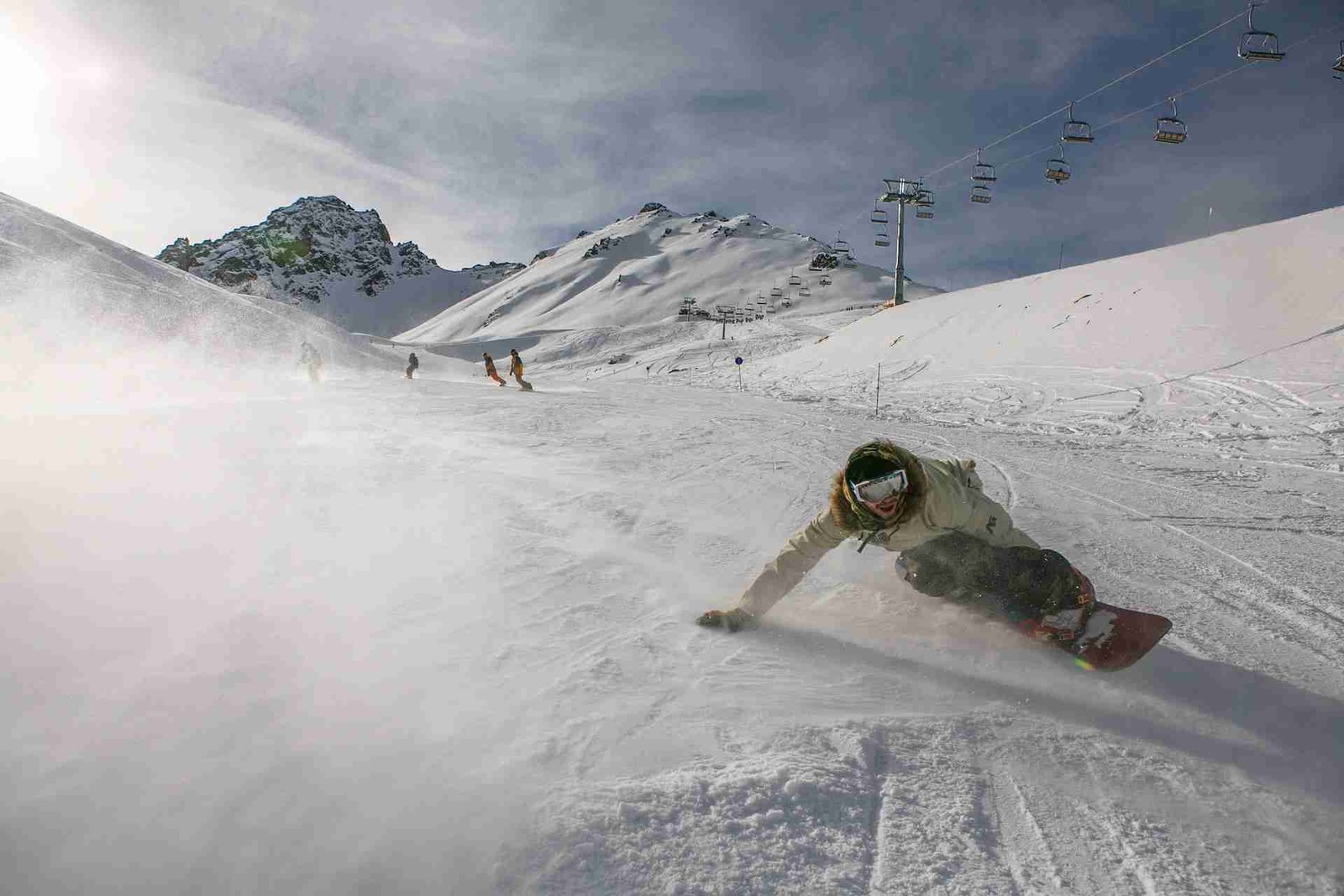
The third day is all about embracing Karakol’s natural wonders. Today, we venture into the Karakol National Park Ski Base for a guided walk amidst stunning mountain landscapes. For the adventurous souls, an optional ride on the ski lifts offers panoramic views of the majestic Issyk-Kul Valley. Whether you choose to ski or soak in the beauty of the surroundings, this day promises unforgettable moments in nature’s embrace.
Day 3 – Exploring Karakol adventures in Kyrgyzstan
Day 4: Journey to Chon Kenmin from Karakol
Next, we bid farewell to Karakol and set off towards the serene surroundings of Chon Kemin. Along the way, we’ll have the opportunity to marvel at the beauty of Issyk-Kul Lake and delve deeper into Kyrgyz culture at the Museum of Nomad Civilization. For those seeking relaxation, a visit to the “Keremet Suu” hot spring offers a rejuvenating break amid nature’s bounty. We’ll then arrive at Chon Kemin, where you’ll be welcomed with open arms to a charming guesthouse.
Chon Kenmin in kyrgyzstan is a trekkers paradise
Day 5: Welcome to Kazakhstan from Kyrgyzstan
Day 5 marks the transition from Kyrgyzstan to Kazakhstan by road as we journey towards the vibrant city of Almaty. Cross the Kyrgyz-Kazakh border at Kordai and soak in the picturesque landscapes. Upon arrival in Almaty, a brief city tour offers a glimpse into the cultural riches of this bustling metropolis nestled at the foot of the Tian-Shan Mountains.
Day 6: From Canyons to Pristine Lakes
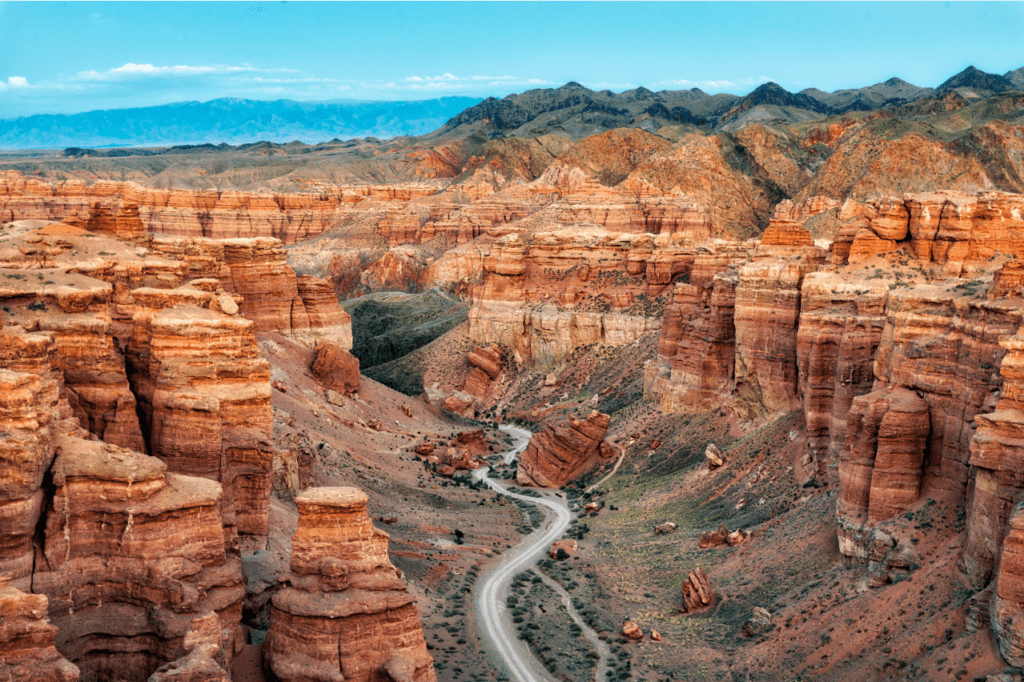
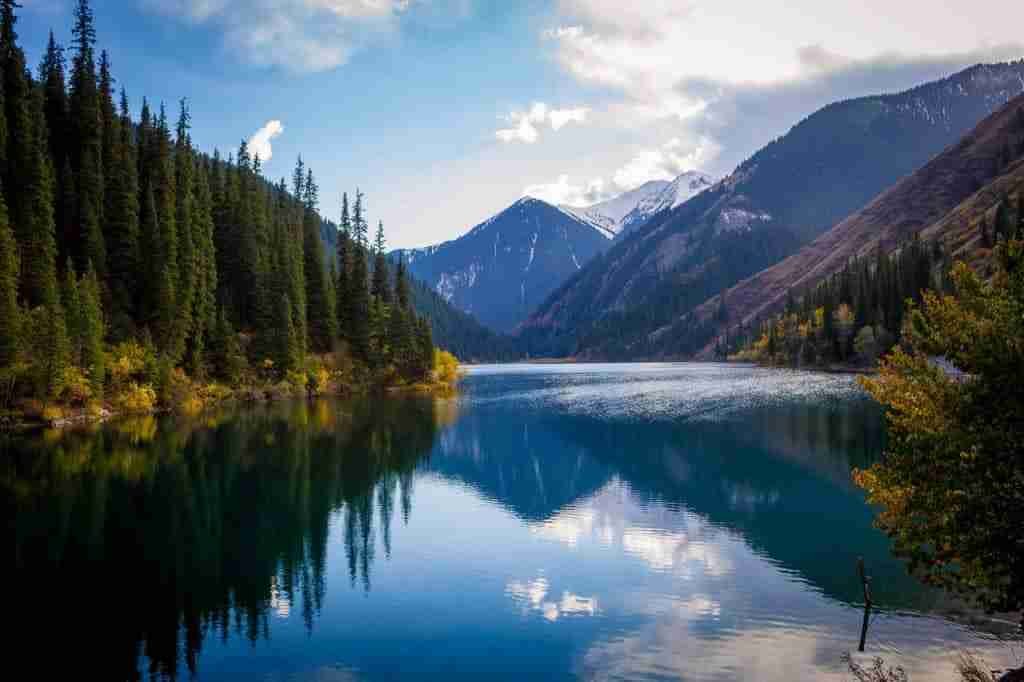
Next, we begin by exploring the stunning Charyn Canyon. Be prepared to be amazed by the incredible rock formations carved over millions of years, including the renowned Valley of Castles. Take your time strolling through this natural wonder, soaking in the breathtaking sights around you. Later, we’ll head to Saty, a tranquil retreat surrounded by nature’s beauty. Relax and recharge before we venture to the picturesque Kol-Sai Lake, where you can immerse yourself in the serene landscapes and enjoy leisurely exploration.
Charyn Canyon is the Grand Canyon of Kazakhstan
Kol-Sai Lake is one of the most stunning lakes found near Almaty in Kazakhstan
Day 7: Adventure and Breath-taking Vistas
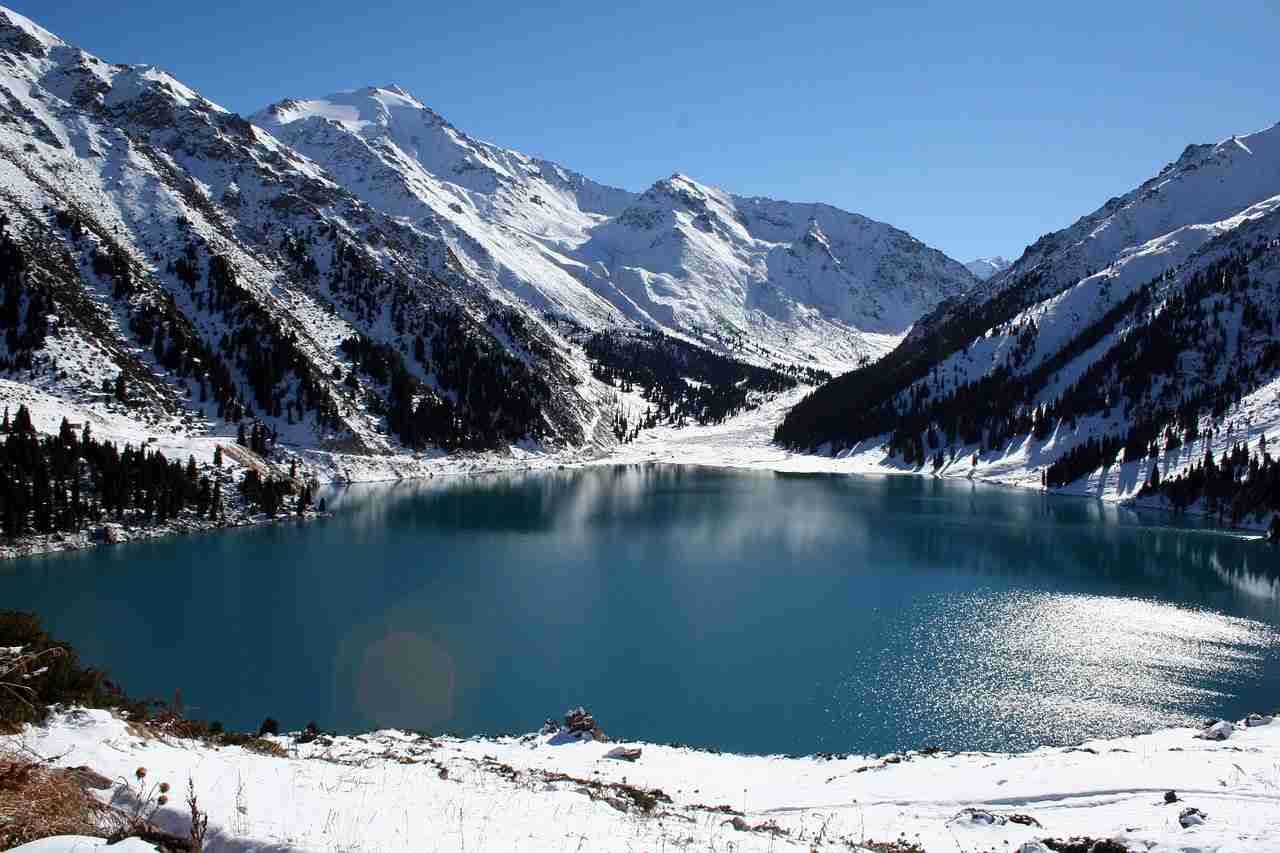
On our final day, we’ll discover Almaty, starting with a visit to the iconic Medeo Gorge near Almaty. Take panoramic city views and stroll to the top of Medeo Dam for breathtaking vistas. For the adventurous souls, an optional cable car ride offers an exhilarating perspective of the gorge.
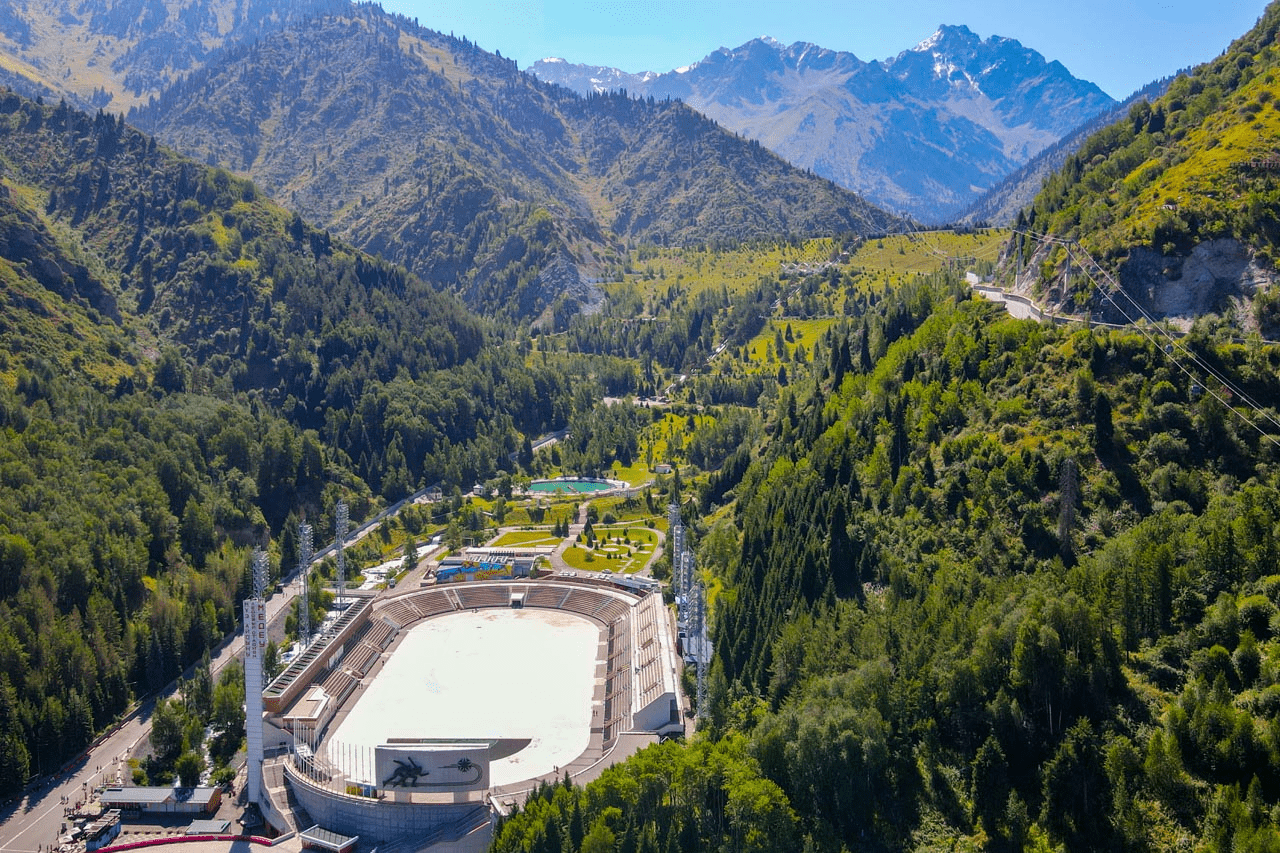
Medeo Gorge near Almaty
Day 8 – Departure to your home
After breakfast, we will bid you farewell. After check out, you’ll depart to the airport.
Day 8 – Departure from Almaty
Come join us for a summer adventure filled with warmth, wonder, and the joy of discovery in the heart of Central Asia. I can’t wait to welcome you on board for an experience of a lifetime!
Cost of a 8-Day Adventure and Culture Tour of Kyrgyzstan and Kazakhstan
₹1,77,000/- (2,050 USD)
Click hereor call +91 9599481131 or +91 9871324628 to book your spot for the upcoming departure!
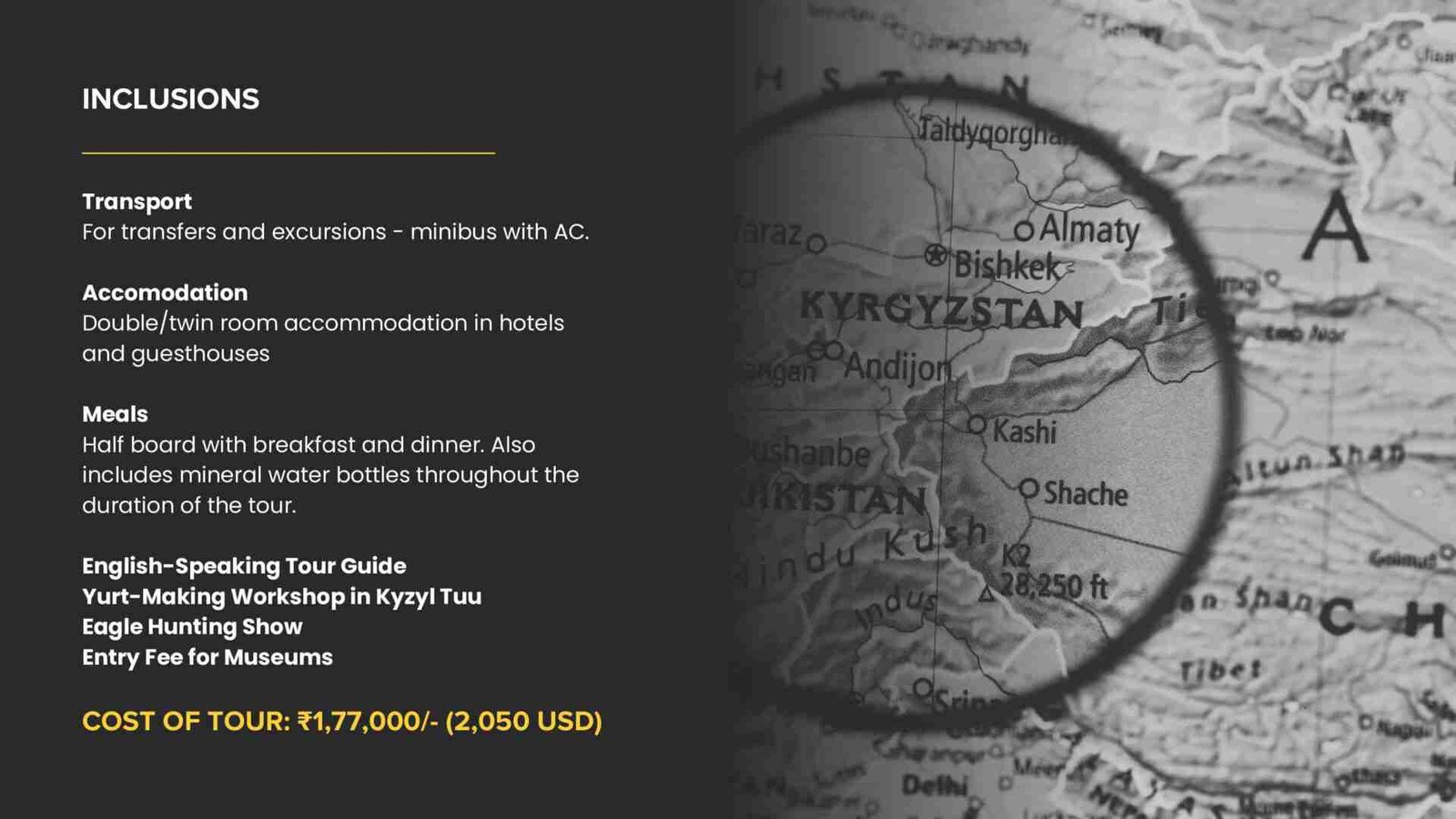
Kyrgyzstan and Kazakhstan Trip Inclusions
Transportation: A minibus with AC for transfers and excursions.
Accommodation: Double/twin room accommodation in hotels and guesthouses.
Meals: Half-board with breakfast and dinner, including mineral water bottles throughout the tour.
English-Speaking Tour Guide
Yurt-Making Workshop in Kyzyl Tuu
Eagle Hunting Show
Entry Fee for Museums
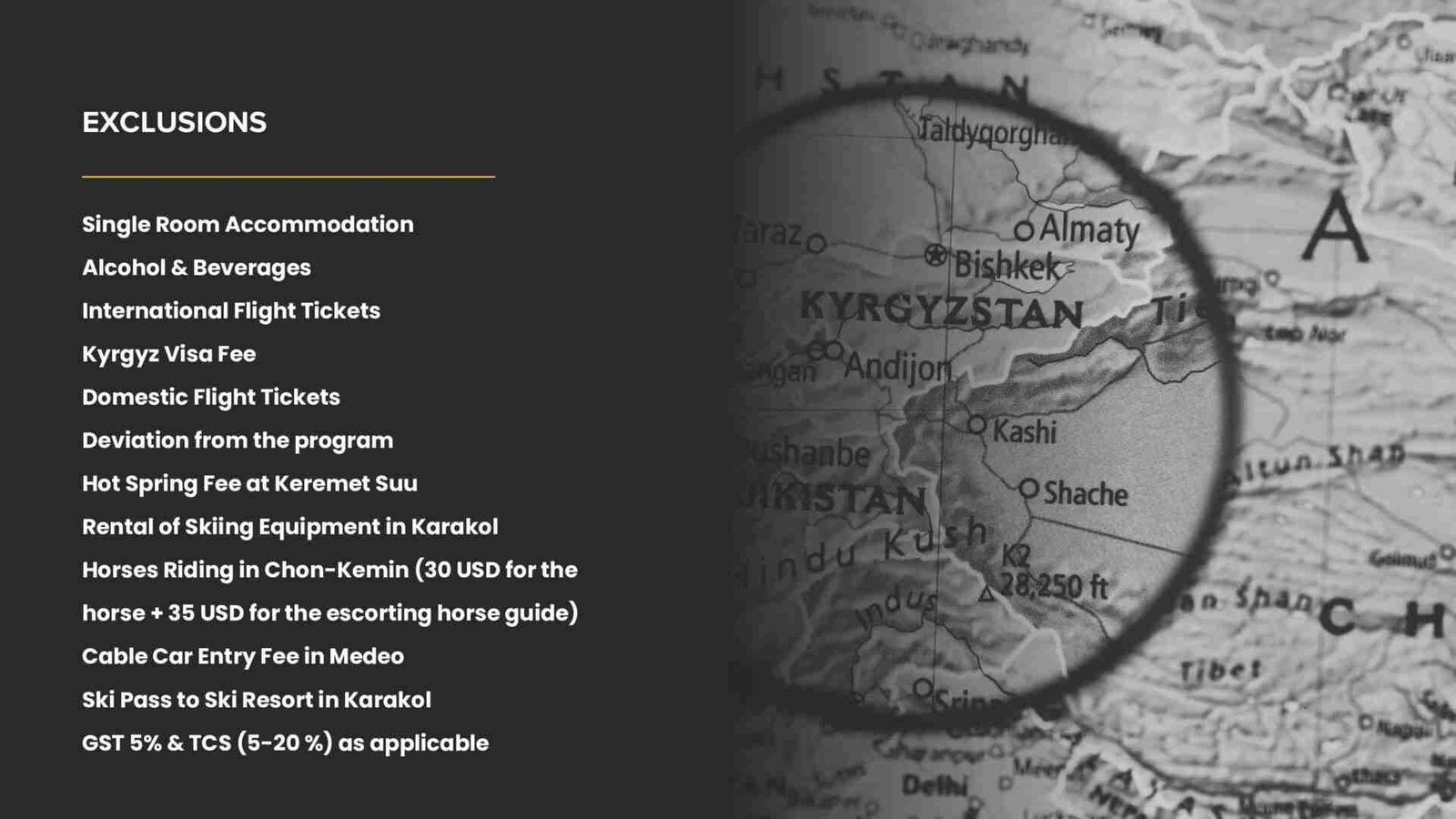
Kyrgyzstan and Kazakhstan Trip Exclusions
Single Room Accommodation if required.
Alcohol & Beverages
International Flight Tickets
Kyrgyz Visa Fee
Domestic Flight Tickets
Deviation from the program
Hot Spring Fee at Keremet Suu
Rental of Skiing Equipment in Karakol
Horses Riding in Chon-Kemin (30 USD for the
horse + 35 USD for the escorting horse guide)
Cable Car Entry Fee in Medeo
Ski Pass to Ski Resort in Karakol
GST 5% & TCS (5-20 %) as applicable
Have questions? Read our Trip FAQs
8-Day Adventure and Culture Tour of Kyrgyzstan and Kazakhstan Trip FAQs
BEFORE ARRIVAL
What is the difference between Kazakhstan and Kyrgyzstan?
Kazakhstan, primarily flat with vast steppes and deserts, contrasts Kyrgyzstan’s mountainous terrain dominated by the Tian Shan and Pamir ranges. Kazakhstan boasts a larger population of around 18 million compared to Kyrgyzstan’s 6 million.
Where is Kyrgyzstan, and what is it famous for?
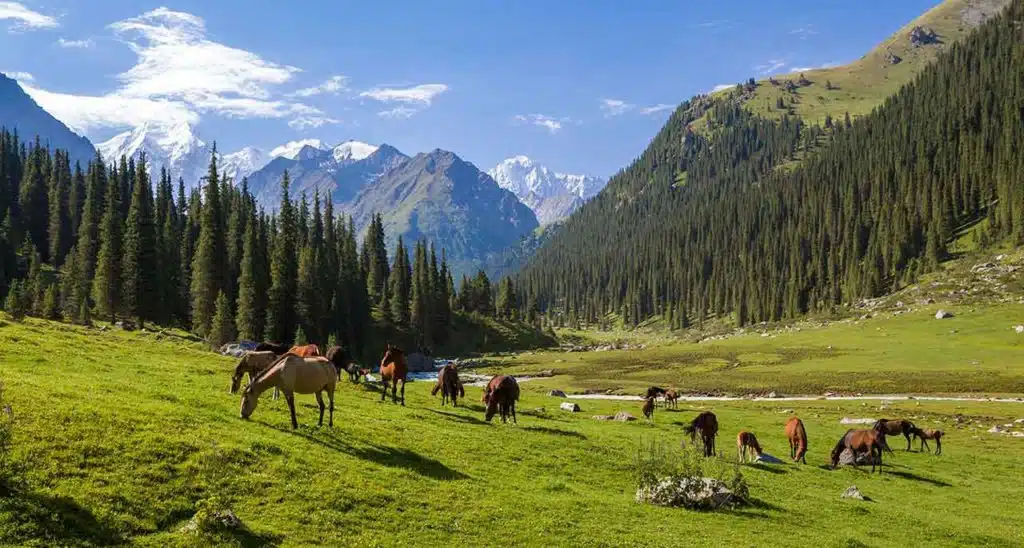
Kyrgyzstan, a landlocked country in Central Asia, is renowned for its striking natural beauty, encompassing mountains, lakes, and valleys. With over 90% of its landscape dominated by mountains, including the famous Tien Shan, Pamir, and Alai ranges, the country provides breathtaking views and activities like trekking, mountaineering, and skiing. Rooted in a rich nomadic heritage, Kyrgyzstan’s culture is shaped by semi-nomadic shepherd communities dwelling in yurts amid joyously untouched mountainscapes and rolling summer pastures known as jailoos.
Is it safe to travel to Kyrgyzstan and Kazakhstan?
Central Asian countries are considered some of the safest countries for
travel. However, staying alert and informed is crucial. Familiarize yourself with travel advisories and any specific safety concerns before embarking on your Kyrgyz adventure!
When is the best time to visit Kyrgyzstan and Kazakhstan?
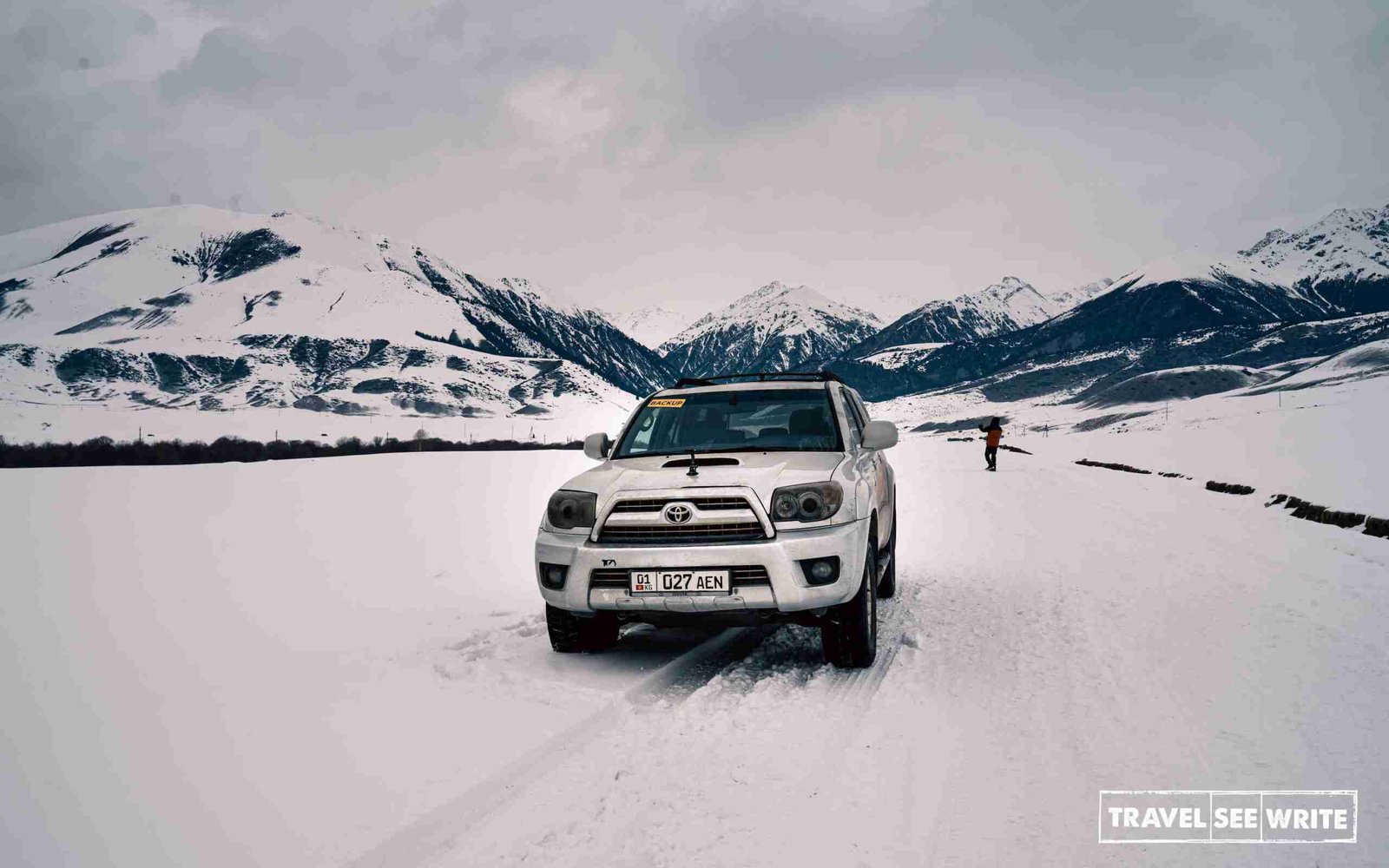
While Kyrgyzstan is gorgeous throughout the year, summer is the best time for hiking and road trips in Kyrgyzstan, where most roads are accessible. Midsummer attracts Kazakh and Russian tourists to the never-freezing beaches of Lake Issyk-Kul. From October to May, the lean season sees the closure of rural accommodations and alpine yurts. Winters, ideal for snowscapes, come with closed roads and the shutdown of small villages, homestays, guesthouses, and sights.
What are the visa requirements for Kyrgyzstan and Kazakhstan?
Visitors to Kyrgyzstan must obtain an e-visa unless they belong to one of the visa-exempt countries or are eligible for a visa on arrival. The good news is that Kazakhstan is visa-free for Indian passport holders and most other countries; you can enter the region for 14 days without any visa.
What should I pack for summer travel to Kyrgyzstan?
Kyrgyzstan has a highly varied climate. Even when travelling in summer, it’s essential to pack warm, waterproof layers, a sturdy jacket, and ample thick socks. While temperatures in Bishkek may reach 35 degrees, they can drop to just 10 degrees at Lake Son Kol. Nights can get quite frigid, particularly in the high plains and mountainous regions.
Here is a recommended summer packing list for clothes and shoes:
Socks, Sleepwear, Swimwear, Towel, Undergarments, T-shirts (should cover the shoulders), Thick sweater (for the mountains), Trek pants, Multiple shorts, Rain jacket, Hiking boots, Sneakers, and Sandals/flipflops.
Should I bring any medicines to Kyrgyzstan? What can I buy there?
If you take prescription medications, you should bring enough to last your entire trip. Prescriptions should be kept in the original container with your name on them. Over-the-counter medications can be easily found in Kyrgyzstan. However, They might not be the same as those found in India. We suggest you bring over-the-counter medications to treat common ailments, such as allergies, pain, or stomach problems, in their original packaging. This is advisable because it helps identify the medicine and its purpose efficiently.
Are you allowed to bring alcohol to Kyrgyzstan?
Visitors to Kyrgyzstan can bring 1.5 L of liquor and 2 L of wine and buy and drink alcoholic beverages.
AFTER ARRIVAL
Can I exchange INR for local currency in Kyrgyzstan and Kazakhstan?
You should carry dollars and exchange them for local currency at the airport or in big cities like Almaty or Bishkek.
Are credit cards accepted in Kyrgyzstan and Kazakhstan? Are ATMs available?
Most banks and hotels in major cities like Almaty and Bishkek readily accept Visa and MasterCard. While some shops may take cards, many prefer cash. In smaller towns and rural areas, transactions are predominantly cash, specifically in Kyrgyz som. ATMs are more accessible in cities and larger towns than in small villages. Carrying dollars or the local currency with you is advisable for convenience.
Is it safe to drink tap water in Kyrgyzstan and Kazakhstan?
In cities, tap water should be drunk only if equipped with a sludge filter; otherwise, it should be pre-filtered. In rural areas, water safety from wells and springs varies depending on the location. In certain places, water from these sources is safe for drinking, tastes good, and is considered healthy. But please check with your tour leader or local friend before drinking.
Which mobile operators are available in Kazakhstan?
International roaming works in Kyrgyzstan and Kazakhstan.
Where can I buy a local SIM card in Kyrgyzstan and Kazakhstan?
You can purchase a local prepaid SIM card at international airports, mobile provider stores, or convenience stores.
What currency do you use in Kyrgyzstan and Kazakhstan?
Som in Kyrgyzstan and Tenge in Kazakhstan
What languages do people speak in Kyrgyzstan and Kazakhstan?
Language can be a barrier when travelling in the interiors of Central Asia, as the two most widely spoken languages are Kyrgyz and. But don’t worry—you’ll always have a local guide who is fluent in English, and your team lead who will help with local communication. Learning a few basic phrases in Kyrgyz or Russian can go a long way in making connections with the locals.
Who is a tour leader? What is the difference between their responsibilities and those of the local guide?
While tour leaders handle logistics and group management, tour guides provide detailed information about specific attractions.
Is vegetarian food available in Kyrgyzstan and Kazakhstan?
Central Asia is primarily a meat-centric region with a significant nomadic population and challenging climatic conditions, so it may present challenges in finding vegetarian options, especially outside major cities. However, there’s no need to worry. If you inform us in advance about your dietary restrictions, we will ensure accommodations for your requests. Many restaurants and homestays are willing to be flexible by providing meatless or vegetarian options. It’s important to note that Central Asian cuisine tends to be less spicy than Indian food, so flexibility is appreciated. Additionally, you are free to bring along any pre-cooked Indian meal options.
What kind of food do locals eat in Kyrgyzstan and Kazakhstan?
Traditional Kyrgyz and Kazakh dishes feature a lot of meat, dairy products, and bread, but many other foods are also available. Horse meat and fermented mare’s milk are also part of the traditional diet. The three main types of meat available are lamb, beef, and chicken, as pork is difficult to find due to the majority Muslim population. Fresh fruits and vegetables are abundant, particularly during the summer. (wash them well before eating). Many restaurants also feature Russian, European, or Chinese dishes, especially in Bishkek.
How should you behave when in Central Asia?
Respecting the local traditions and customs is essential when visiting Kyrgyzstan or any other country. The people of Kyrgyzstan are known for their hospitality, so it’s customary to greet others with respect and politeness. Additionally, it’s necessary to dress modestly, especially when visiting religious sites.
What’s good etiquette for going to bazaars?
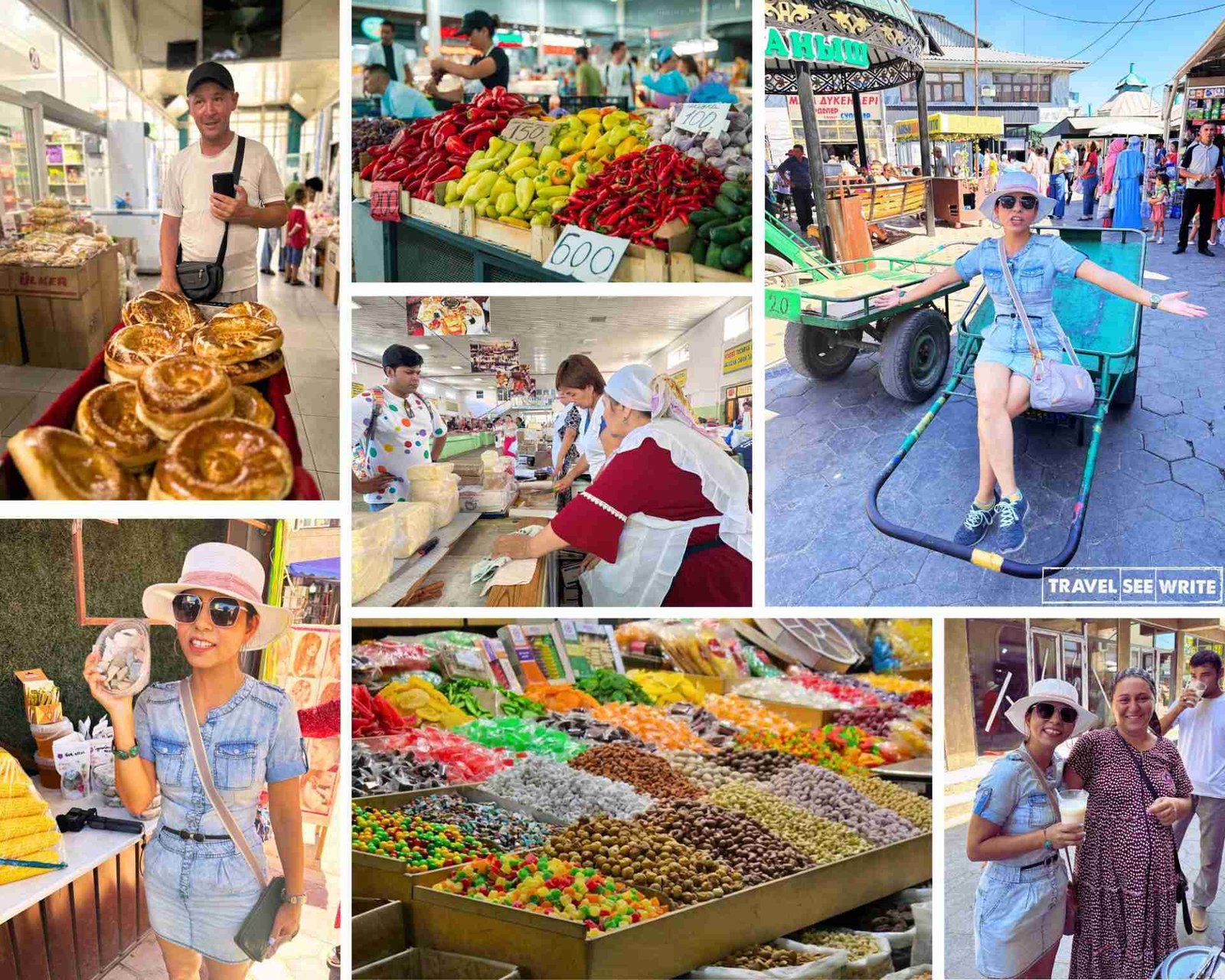
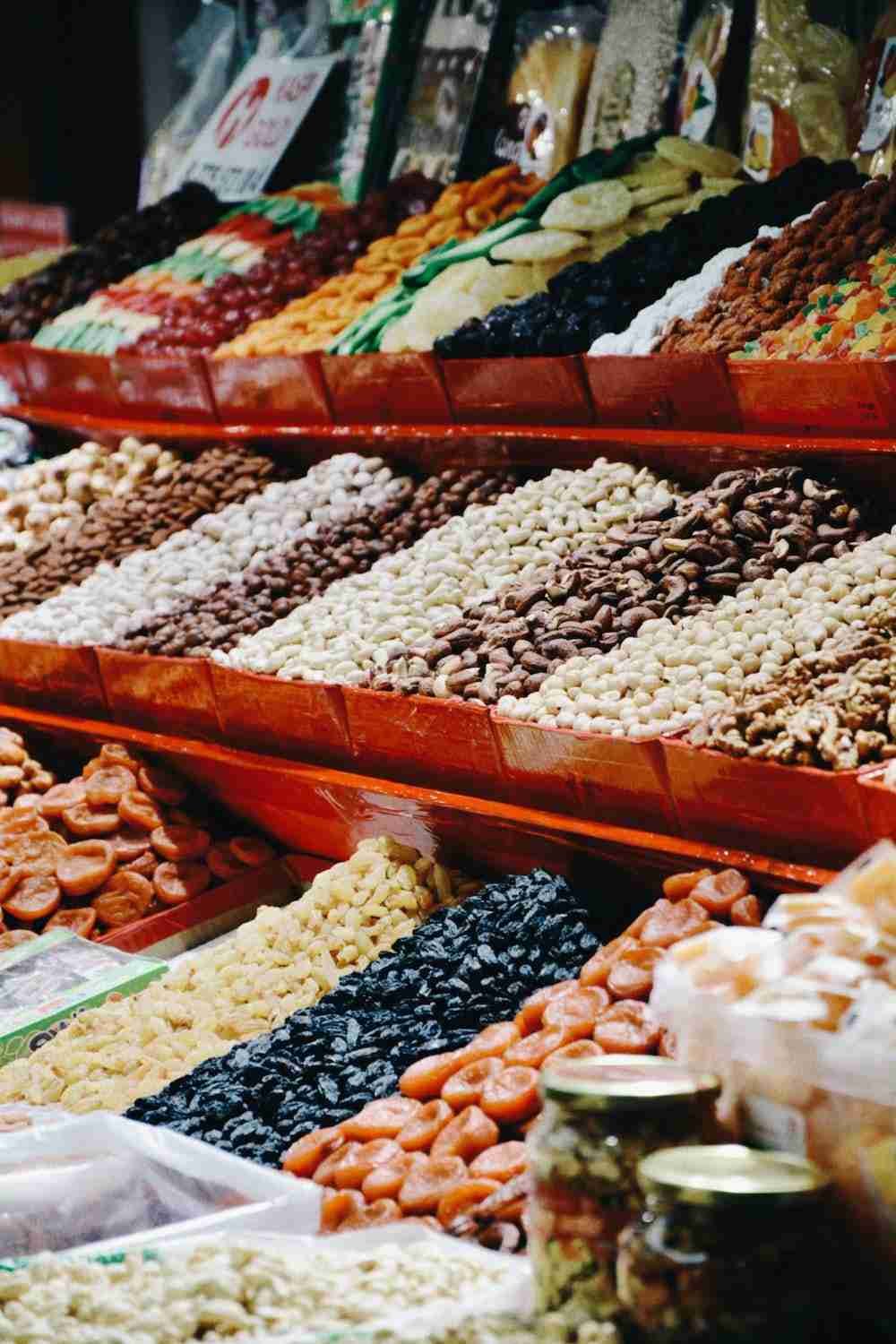
Local bazaars are a great way to experience Central Asian culture but can also create problems. Be aware of pickpockets and keep your belongings and documents safe. Bazaars can also be great places to do street photography, but please ask for permission before taking pictures of people.
What can you expect from homestays and yurt stays in Central Asia?
Homestays provide separate bedrooms with beds or mattresses, including blankets and towels. Shared toilets may be Western or squat. Breakfast is included, and extra meals can be purchased. Yurts lack beds but have thick mattresses, blankets (no towels), and shared accommodation for 4-5 people. Outdoor toilets are standard, with no hot water and often no electricity. Yurts at higher elevations may feature small stoves for night-time warmth, lit until morning.
What can I expect from toilets and restrooms in Kyrgyzstan?
Please be flexible when it comes to toilets while travelling. Restrooms can vary from Western-style toilets to basic outhouses and everywhere in between. Some places may require the use of squat toilets, while others may not have running water. When travelling, public restrooms are often available at cafes and gas stations and may cost between 5 and 10 som ($0.07 to $0.14).
The survival story of – Ainu– Japan’s Indigenous People.
Nestled in the northernmost part of Japan, Hokkaido is a serene and picturesque island that boasts breathtaking landscapes and untamed wilderness that leave visitors in awe. It is a sanctuary for adventurers and nature enthusiasts alike, who come from far and wide to witness its alluring beauty. However, amidst the natural beauty that Hokkaido offers lies a lesser-known treasure – Ainu, Japan’s Indigenous People. Their rich heritage is a precious gem that is often overlooked by many. Intrigued by their way of life, I had the privilege to journey to the heart of Ainu territory, thanks to the Adventure Travel World Summit in Hokkaido. This rare opportunity gave me the chance to immerse myself in their world and learn more about their customs, traditions, and way of life. It was an unforgettable experience that left me with a deep appreciation for their culture and the beauty of Hokkaido.
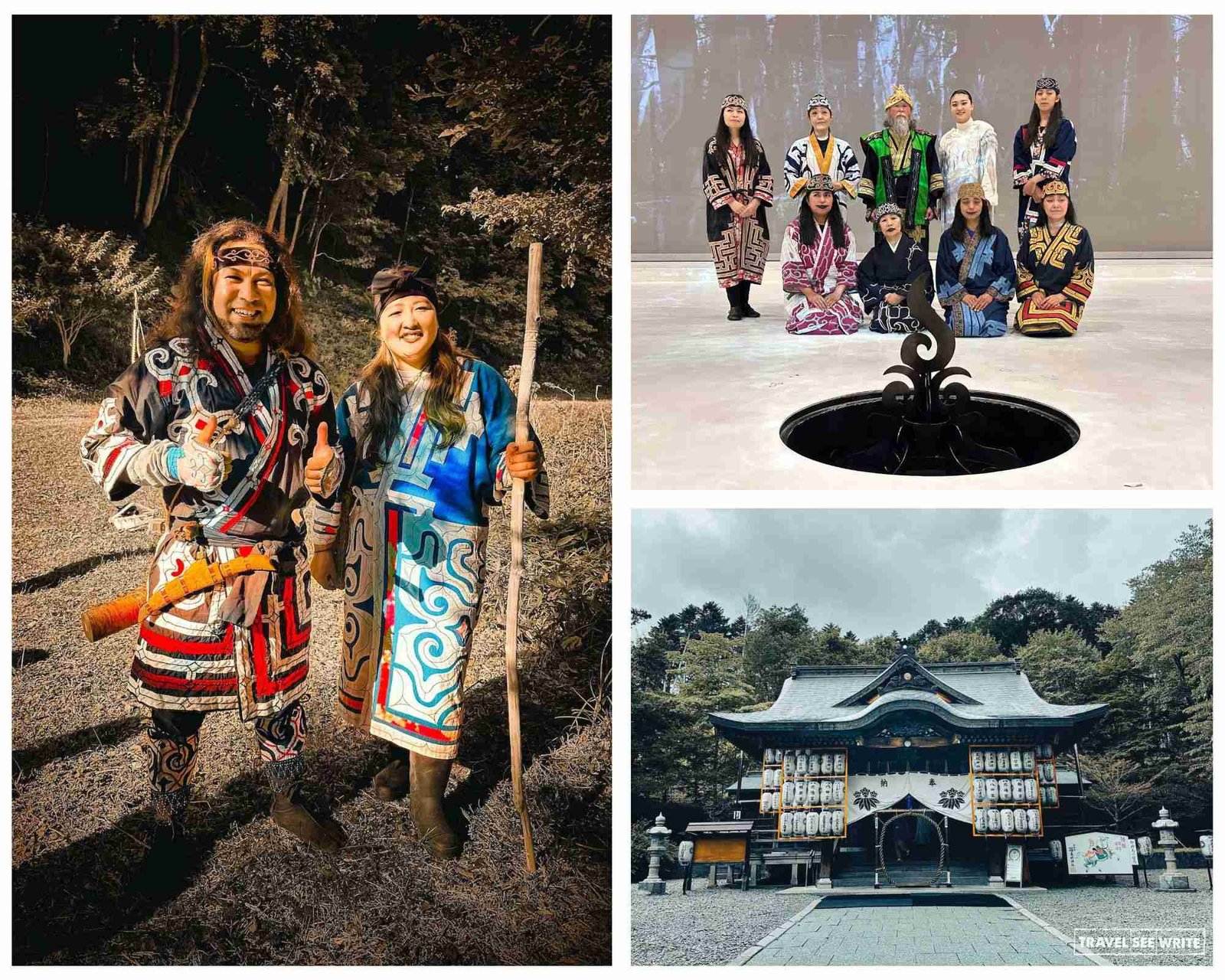
As I journeyed deep into the forests of Biratori in Hokkaido, Japan, I felt a sense of excitement and anticipation to uncover the ancient Ainu hunting techniques. Before entering this sacred space, a ritual began—pouring sacred sake (rice wine) onto the “inau,” a symbolic fire stick adorned with wood shavings. Guided by two Ainu experts, Tokuji Mombetsu and Misaki Kimura, both in their late thirties, clad in traditional ‘Amip’—an Ainu robe made from the bark of Manchurian Elm decorated with unique thread and cloth patterns and matching hairbands, I observed a centuries-old form of worship known as “Kamuinomi”, which underscored the deep spiritual connection that the Ainu people hold with nature and the divine. Tokuji explained to me,
Before we enter the forest or mountain, we pay our respect to our kumay (God) and seek their permission. Most importantly we don’t waste anything; we only take what we need.
Forest Walk with the Ainu people in Biratori campgrounds – (Left to Right, Top to Bottom) – Tokuji Mombetsu and Misaki Kimura sharing Ainu knowledgeabout local plants used by Ainu people, Tokuji san performing a prayer ceremony “Kamuinomi” to the spirit-deities (kamuy) before entering the forest, showing us an Ainu hunting shelter called a “kuca cise” and try our hands on using traditional hunting equipment.
For the next four hours after the ‘Kamuinomi,’ I delved into the Ainu hunting methods, learning about the traps they crafted to capture wild animals using bows and arrows. Despite modern restrictions on hunting and fishing, the pride in their Ainu heritage remained palpable. Tokuji can’t go back to his Ainu ways of living, but he is content with the fact that he doesn’t have to hide his identity anymore. This encounter marked my inaugural experience with Japan’s indigenous Ainu people, setting the stage for a deeper exploration of their culture and traditions.
Who are Ainu, and how are they different from the Japanese?
The Ainu, Japan’s indigenous people, have a fascinating history. They were the initial settlers of Hokkaido, situated in Japan’s northern region. They also inhabited the north of Honshu, the main island of Japan, and Sakhalin island in Russia. While there is no official record of their arrival in Japan, it is believed that the Ainu have been living in Sakhalin, the Kuril Islands, Hokkaido, and the northern Tohoku region since the 13th century. Many archaeologists consider the Ainu to be the last surviving descendants of the Jomon people, who lived throughout Japan from as early as 13,000 years ago. They once thrived in Hokkaido, but their population has dwindled drastically over time. According to my local guide, Yoshimi SATO, less than 24,000 Ainu are left in Japan today, although there are no official census figures. It is also known that many Ainu are hesitant to share their heritage. Most are mixed Japanese. Finding a pure Ainu is almost like finding a needle in the hay. Today, it may be hard to distinguish the lifestyle and culture of many Ainu from that of the rest of Japan’s people. Many can no longer speak Ainu fluently, and much of their traditional ways have been relegated to an occasional ceremony or cultural festival.
Despite the declining Ainu population, their culture remains rich and vibrant, characterized by a unique language, exquisite art, and traditional clothing adorned with Ainu patterns. When I first learned about Ainu, I wondered about the differences between them and the Japanese. Through my interactions with the Ainu people, I discovered that they have their own religion and strongly believe that there is a god (Kamui in the Ainu language) in everything. Traditionally, Ainu lived a simple life: hunting deer and salmon, gathering wild plants for food, performing traditional dances, and playing music. They were exceptional wood carvers and craftspeople, with distinctive Ainu patterns embroidered on clothes and wooden implements, from plates to swords.
The Ainu language is unique to their people and classified as Critically Endangered by UNESCO, putting it on the brink of extinction. It differs significantly from Japanese in various aspects, including syntax, phonology, morphology, and vocabulary.
The Japanese and the Ainu had a relatively peaceful coexistence until 1879 when the Meiji government enforced assimilation policies. These policies included banning the Ainu language, tattoos, and hunting practices. Despite the forced assimilation, Ainu culture continues to endure, standing as a testament to the resilience of Japan’s indigenous people.
Ainu Resurgence
In 2007, UNESCO recognised the Ainu as the indigenous people of Japan, followed by the recognition of the Japanese government in 2019. Initiatives to promote Ainu culture, like the manga series “Golden Kamuy” and developing new Ainu-centric tourism products like Ainu museums, “Kotans,” and Ainu tours, have helped revitalise Ainu communities and bring renewed appreciation for their culture.
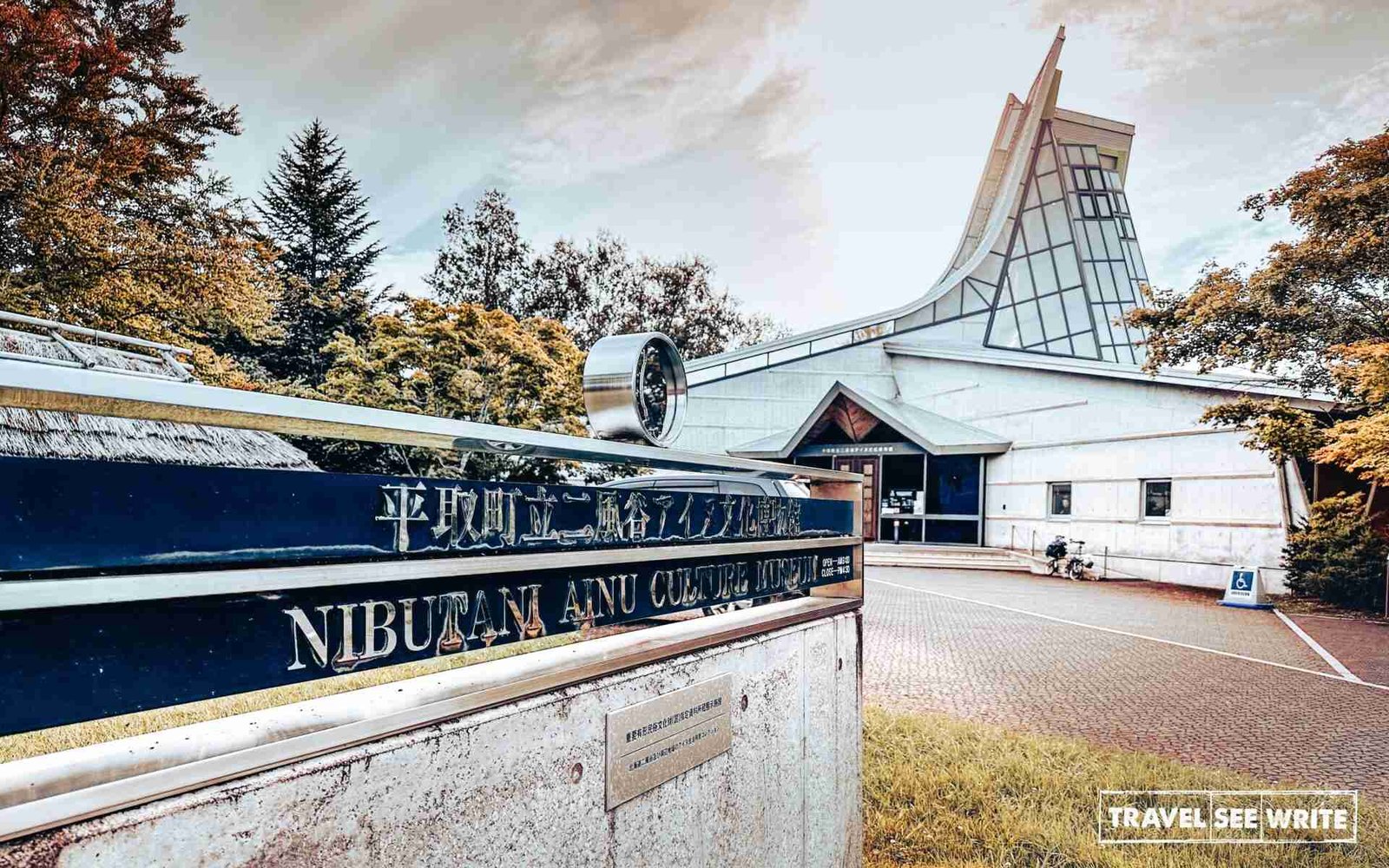
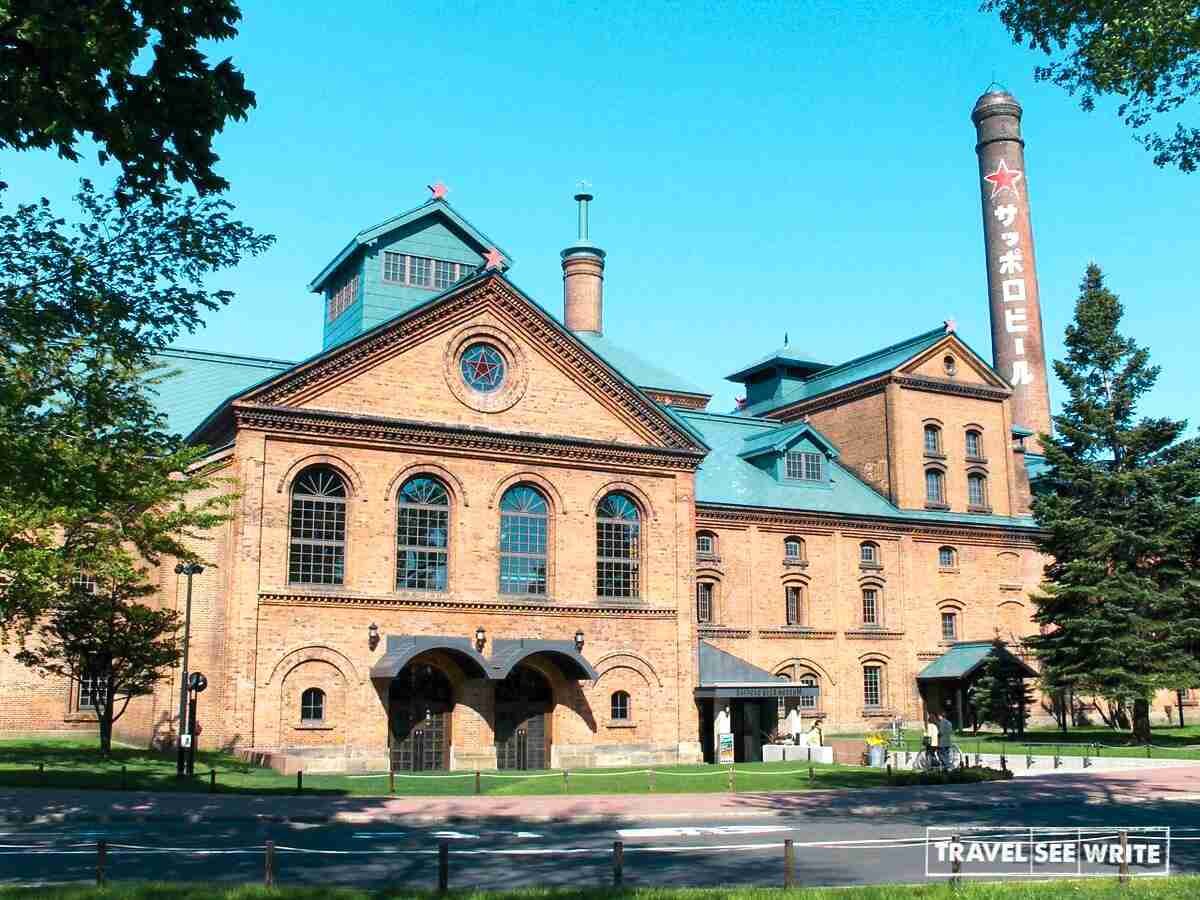
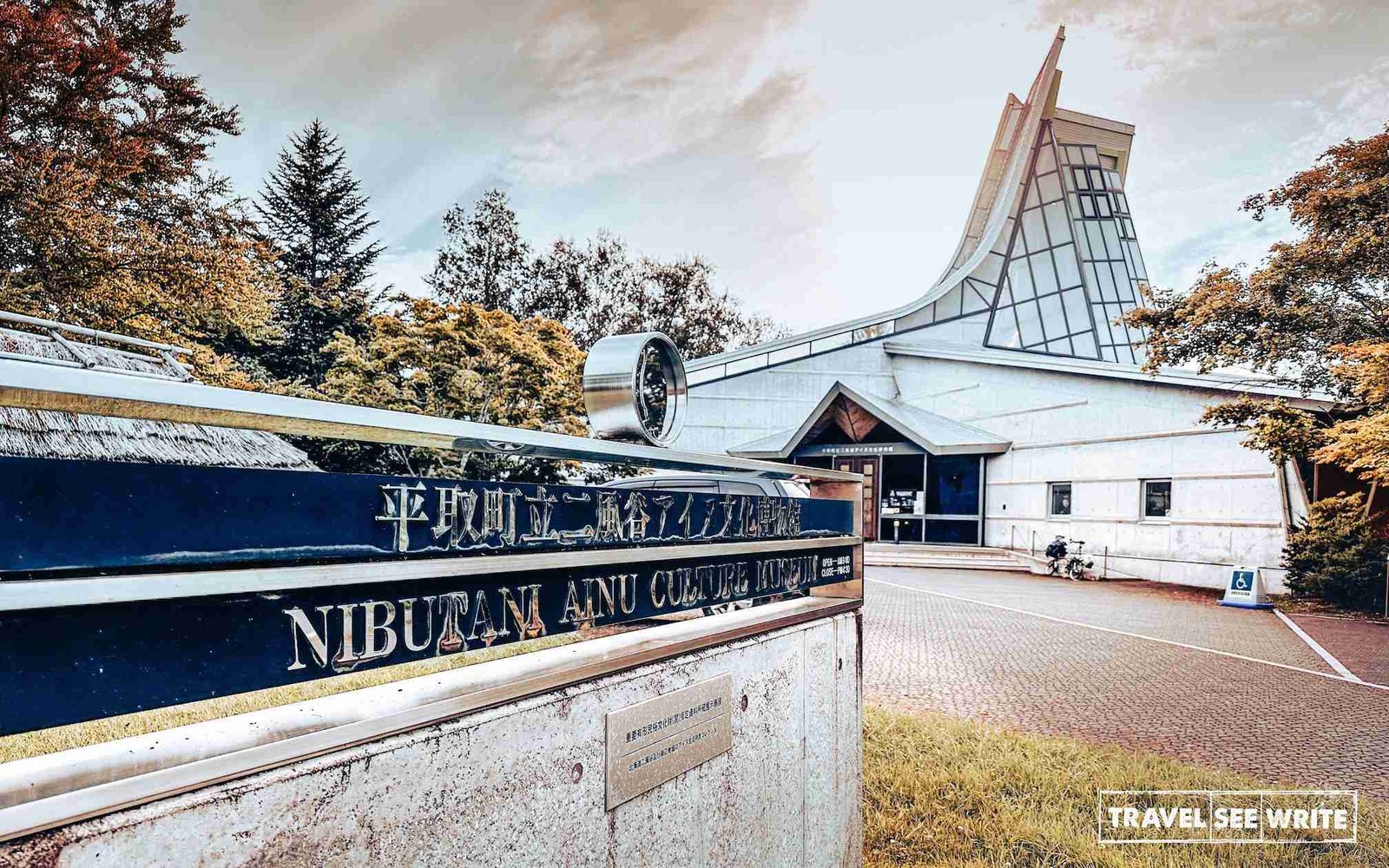
Biratori Municipal Nibutani Ainu Culture Museum in Central Hokkaido is a good place to learn about Ainu history and culture.
I had the opportunity to learn more about Ainu culture at several places in Hokkaido that have been developed to promote Ainu culture. One of those experiences was at the Biratori Municipal Nibutani Ainu Culture Museum, which houses more than 10,000 cultural artefacts, including Ainu clothing, toys and hunting implements. This immersive journey delved into the heart of Ainu history, offering insights into their traditions and artistic expressions. The museum has four different zones: the Ainu Zone (The Ainu Way of Life), the Kamuy Zone (Dramas of the Gods), the Mosir Zone (Blessings of the Earth), and the Morew Zone (A Tradition of Figurative Art). I was fascinated by rare items on display, such as salmon skin shoes and “Kuyoi” water bags made from animal bladders. Overall, the museum was well-organized and informative.
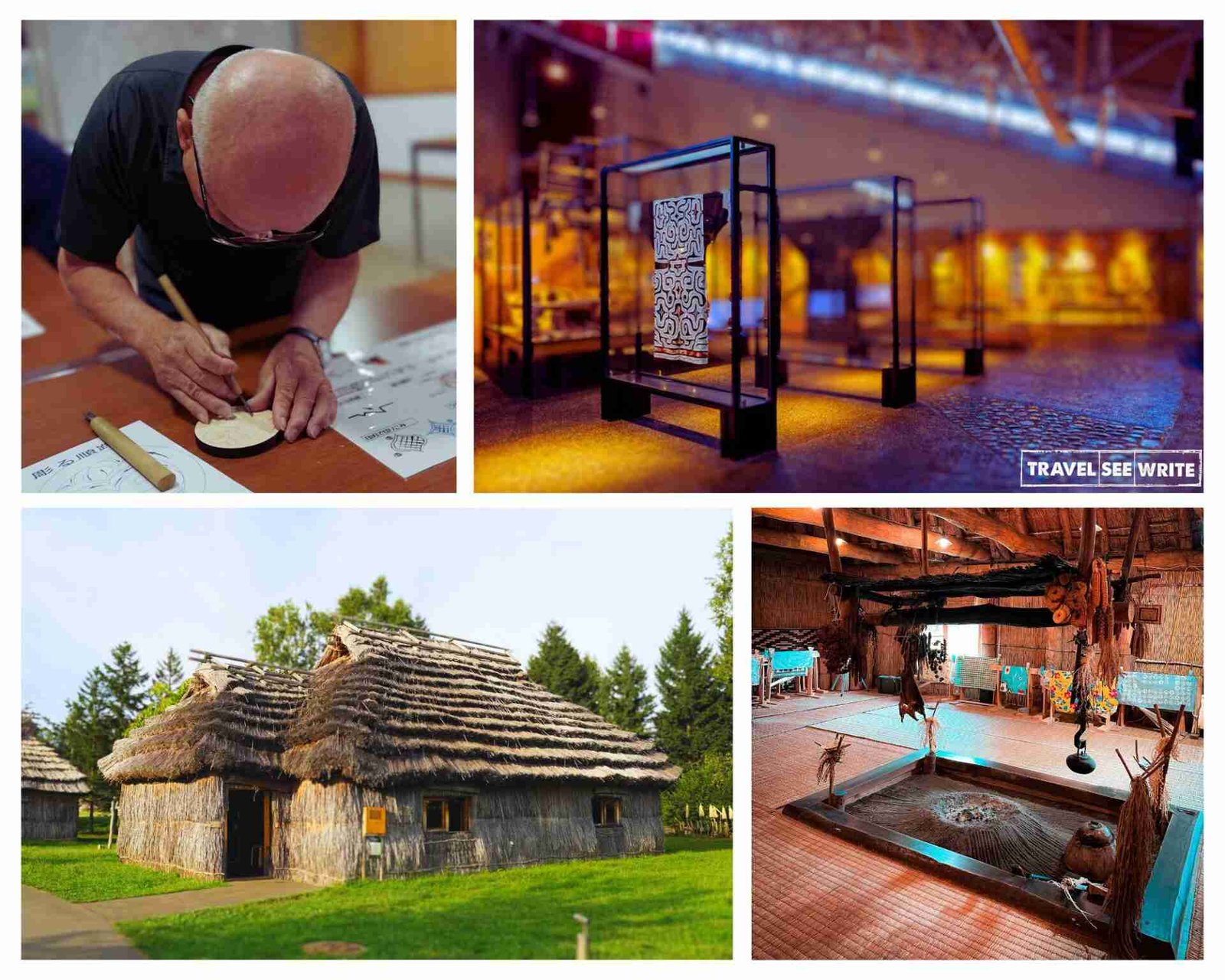
Inside Nibutani Museum (Left to Right, T to Bottom) – Visitors can learn Ainu carving at the Nibutani Museum Workshop area, Ainu artefacts displayed inside the Nibutani museum, traditional Ainu hut, and their central fireplace that doubles up as a heating place too.
Outside the museum, some traditional Ainu houses (cise) were on display, where I saw how Ainu once lived. The houses had a central fireplace that heated the whole house in winter. The cise are also venues where Ainu artisans demonstrate ita carving and embroidery on a rotating basis, and visitors can interact directly. It was quite an experience to learn the Ainu carving. It seemed easy from the outside but required a lot of patience and precision.
Summer at Lake Akan: A Vibrant Haven of Ainu Culture
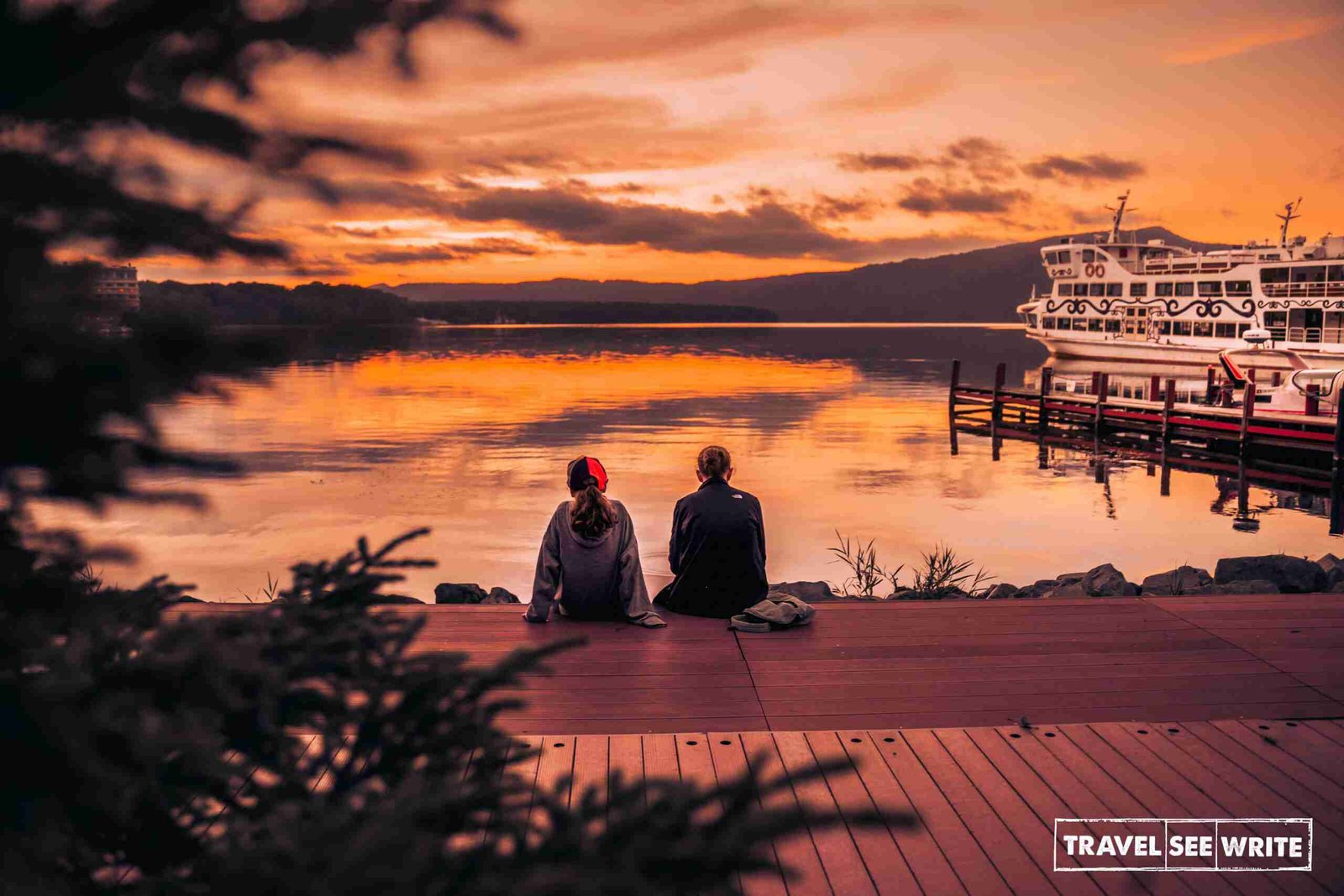
A typical summer evening at Lake Akan, Eastern Hokkaido
But our journey was far from over. After crossing the Biratori Forest and Nibutani Ainu Culture Museum, I found myself in the legendary forests of Lake Akan, where I participated in the ‘Kamuy Lumina’night walk while holding a rhythm stick. Kamuy Lumina is an interactive experience that combines local Ainu folklore, digital art, and the natural beauty of the area. During this 1.2-kilometre immersive cultural walk, I witnessed a popular Ainu legend, “The Tale of the Owl and the Jay Bird,” come to life through projected images, music, and special effects.
‘Kumuy Lumina’ night walk around Lake Akan is one the best immersive experience one can have to understand the Ainu culture in Eastern Hokkaido.
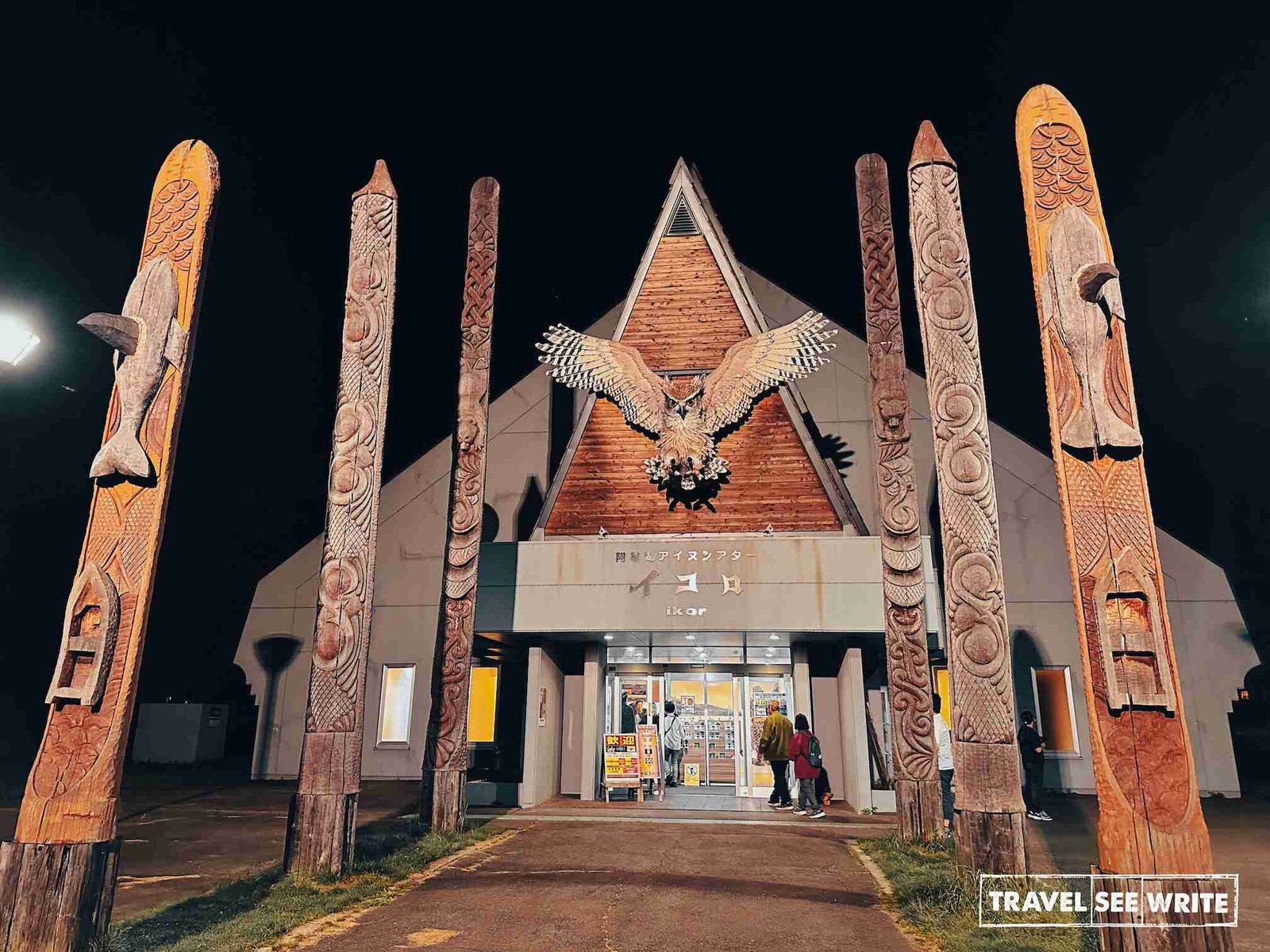
The next stop on this cultural journey was Akanko Ainu Kotan, the largest Ainu settlement with approximately 130 Ainu people and 36 buildings. It became a stage for captivating experiences. Inside the Akanko Ainu Theater, I witnessed a one-of-a-kind multimedia masterpiece called ‘Lost Kamuy.’ It fused Ainu ancient ceremonial dance, a UNESCO World Intangible Cultural Heritage, with cutting-edge digital art and contemporary dance.
Akanko Ainu Kotan is the largest Ainu settlement, with approximately 130 Ainu people and 36 buildings in Lake Akan, Eastern Hokkaido.
‘Lost Kamuy’ married Ainu ancient ceremonial dance with cutting-edge digital art and contemporary dance.
This short introduction to Japan’s Indigenous Ainu People ignited a quest to know more about them. So, after a three-month break, I continued my exploration of the Ainu people and their fascinating culture.
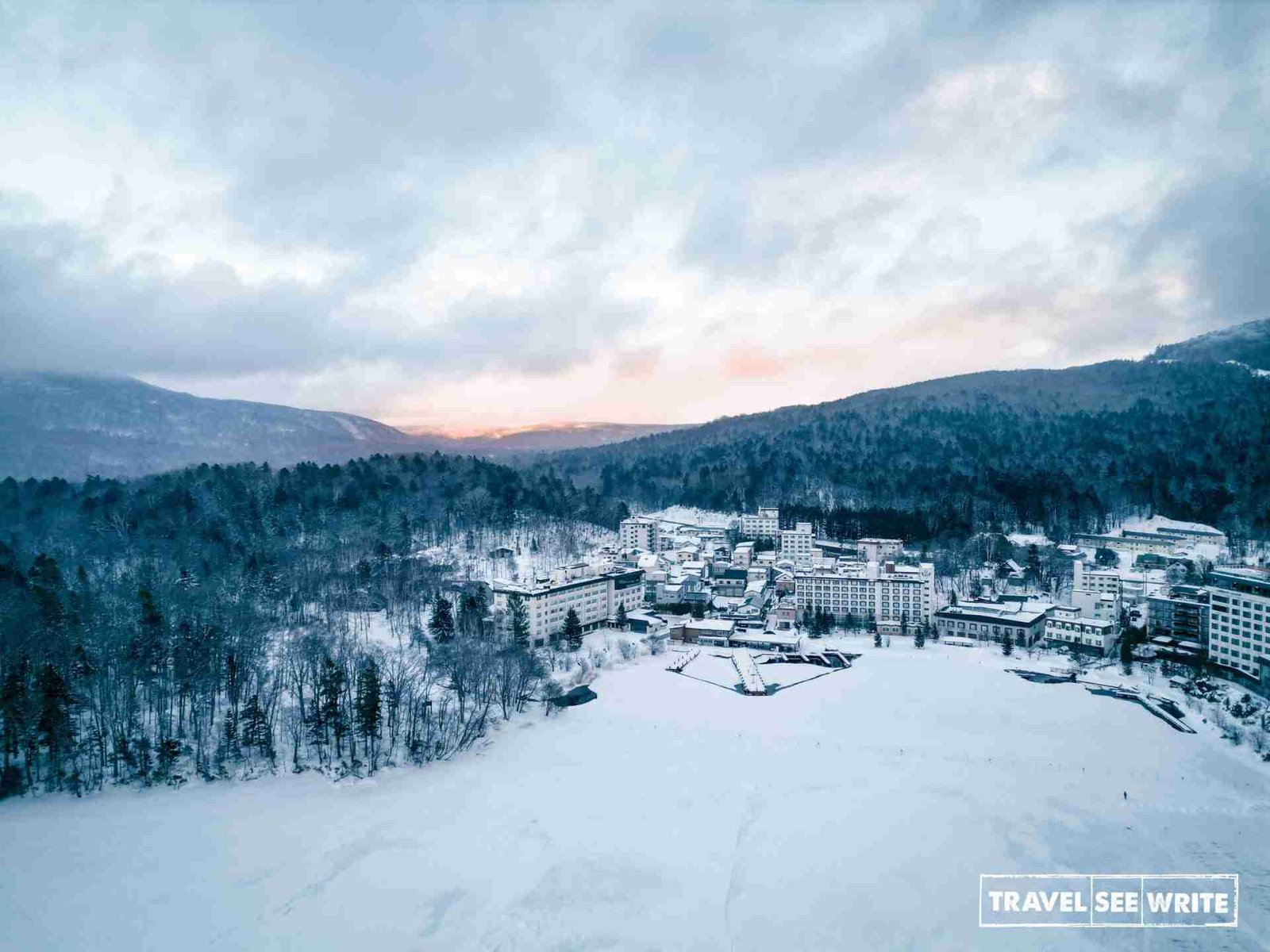
Winter’s Embrace: Deepening Connections at Lake Akan
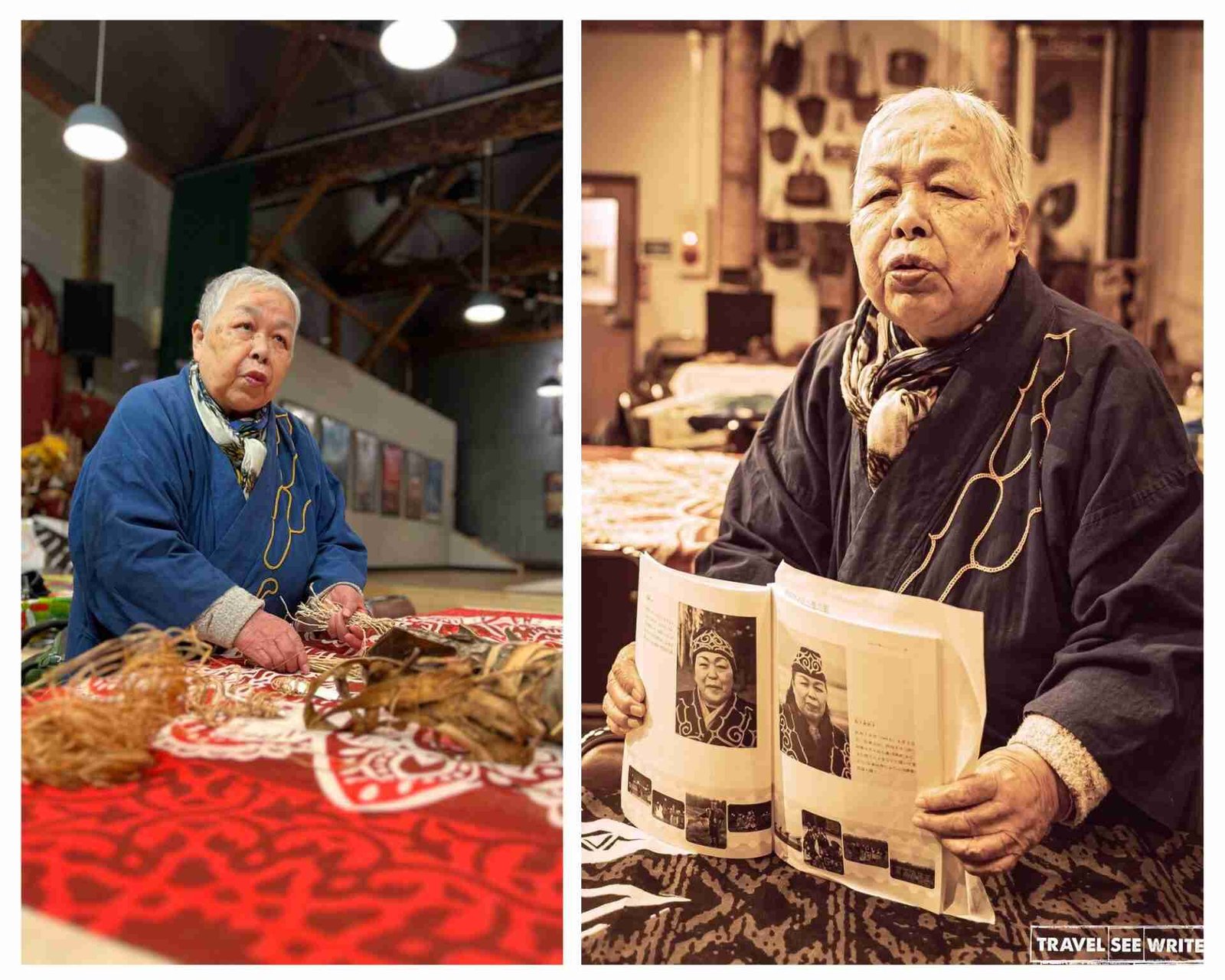
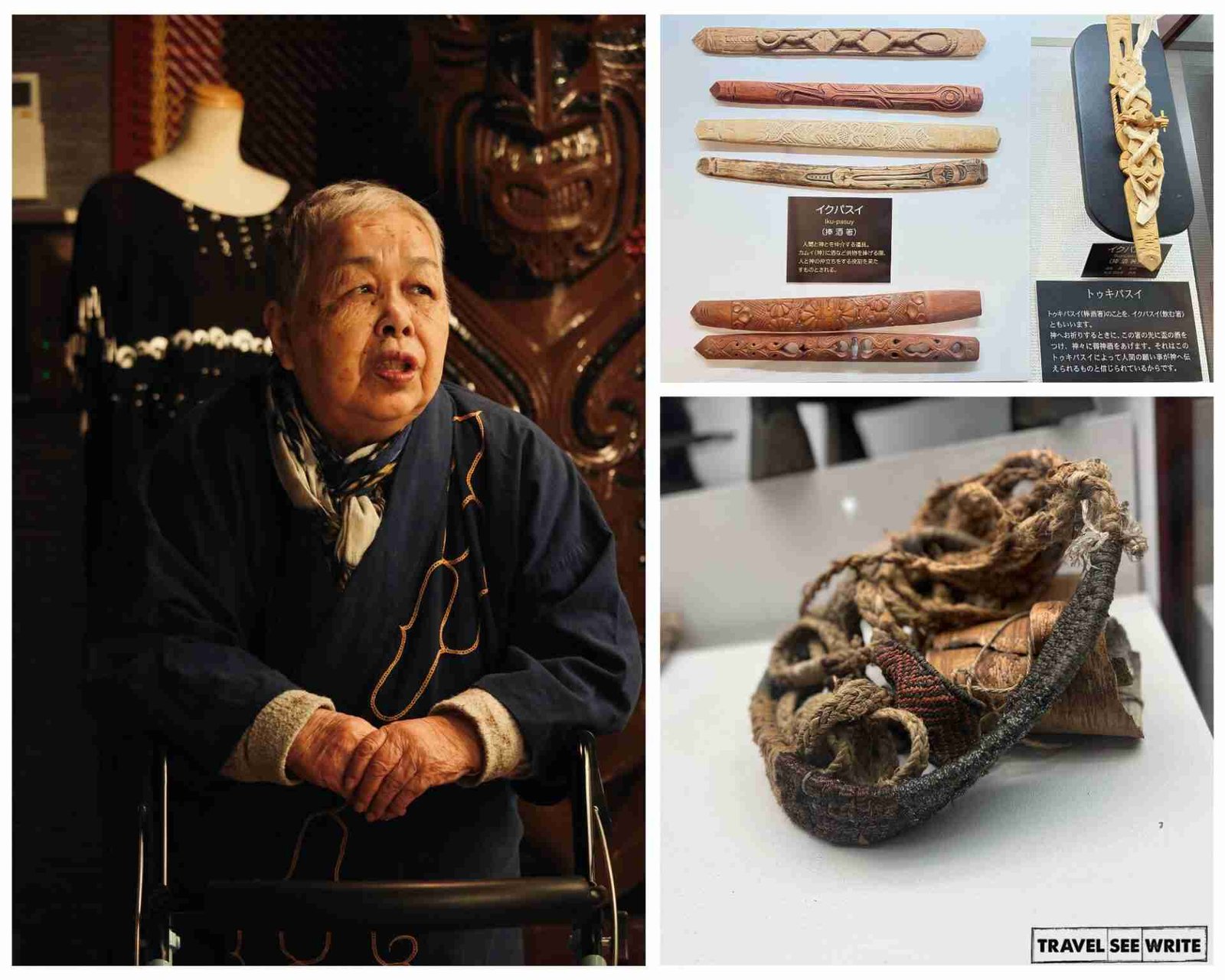
In January 2024, I visited Lake Akan to explore the rich and fascinating culture of the Ainu people. I had the privilege of meeting an 80-year-old Ainu woman, Miyako Sazaki San, also known as Miyachan. Her face had the lines of a life well-lived, and her eyes shone with an inner light that belied her age. As we talked, I was struck by her wisdom, warmth, and profound respect for the Ainu philosophy and way of life.
Miyako Sazaki San shared insights about the Ainu people, their culture, lifestyle, struggles, and triumphs.
Miyachan, who was born to an Ainu mother and a Japanese father, shared with me how her parents had taught her Ainu customs and traditions despite the hostile conditions and discrimination faced by her community. Sharing tales from her childhood said Miyachan:
I have been dancing since I was ten years old. This place used to be the original Ainu Cultural Theatre, a structure made of grass and wood that would get painfully cold in the sub-zero temperatures of winter. But I never stopped dancing.
Her unwavering love and dedication for Ainu dance and songs, passed down by her mother, was further passed down to the newer generation by her.
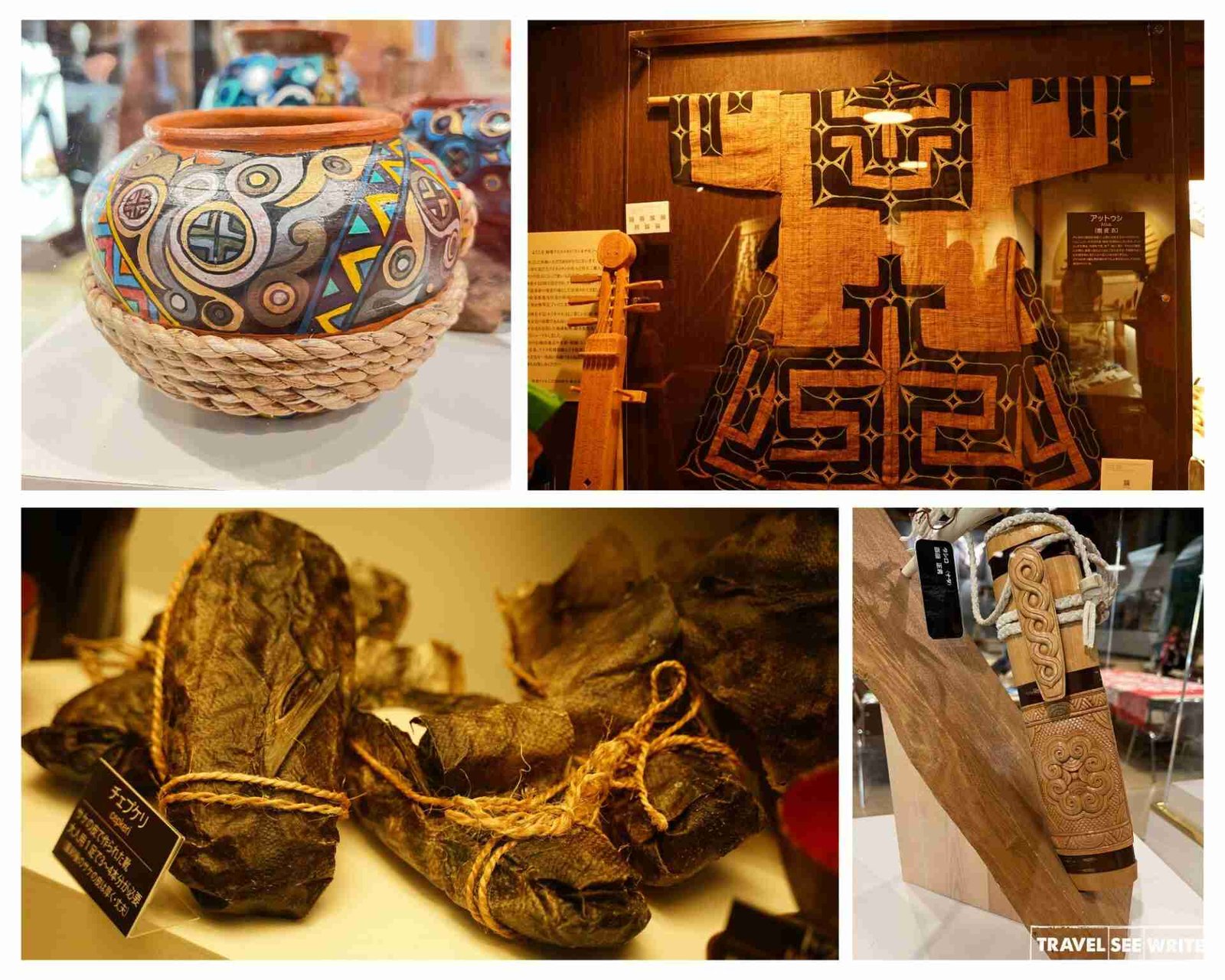
Miyachan shared stories about her childhood when only four Ainu people lived in the Lake Akan hot spring area without electricity or piped water. Her stories filled me with awe and humility as I learned about the resourcefulness and ingenuity of her ancestors. They crafted clothing from elm tree barks, footwear from salmon skins, and homes from reed straws and logs, showcasing their remarkable survival skills.
Miyachan had performed in the original Ainu Cultural Theatre for sixty years. Now, it functions as an Ainu Museum showcasing Ainu clothing, shoes, art and craft materials, hunting equipment, and much more.
Ainu Artefacts displayed at the Ainu Cultural Museum (L to R, T to B): Ainu pots, an elm tree bark-made robe, footwear made from salmon skins, and an ainu makiri (small sword) used for hunting.
In the afternoon, the same space that Miyachan had danced in became a classroom for Ainu embroidery, guided by the skilled artisan Kayoko Nishida. As she demonstrated the intricate thorn and spiral patterns, each symbolising protection from evil, I marvelled at the depth of Ainu’s craftsmanship. At 78, Nishida San had a perfect 6/6 vision, proving that age is just a number when you live in harmony with nature.
Kayoko Nishida runs an Ainu souvenir shop along with teaching Ainu embroidery to visitors.
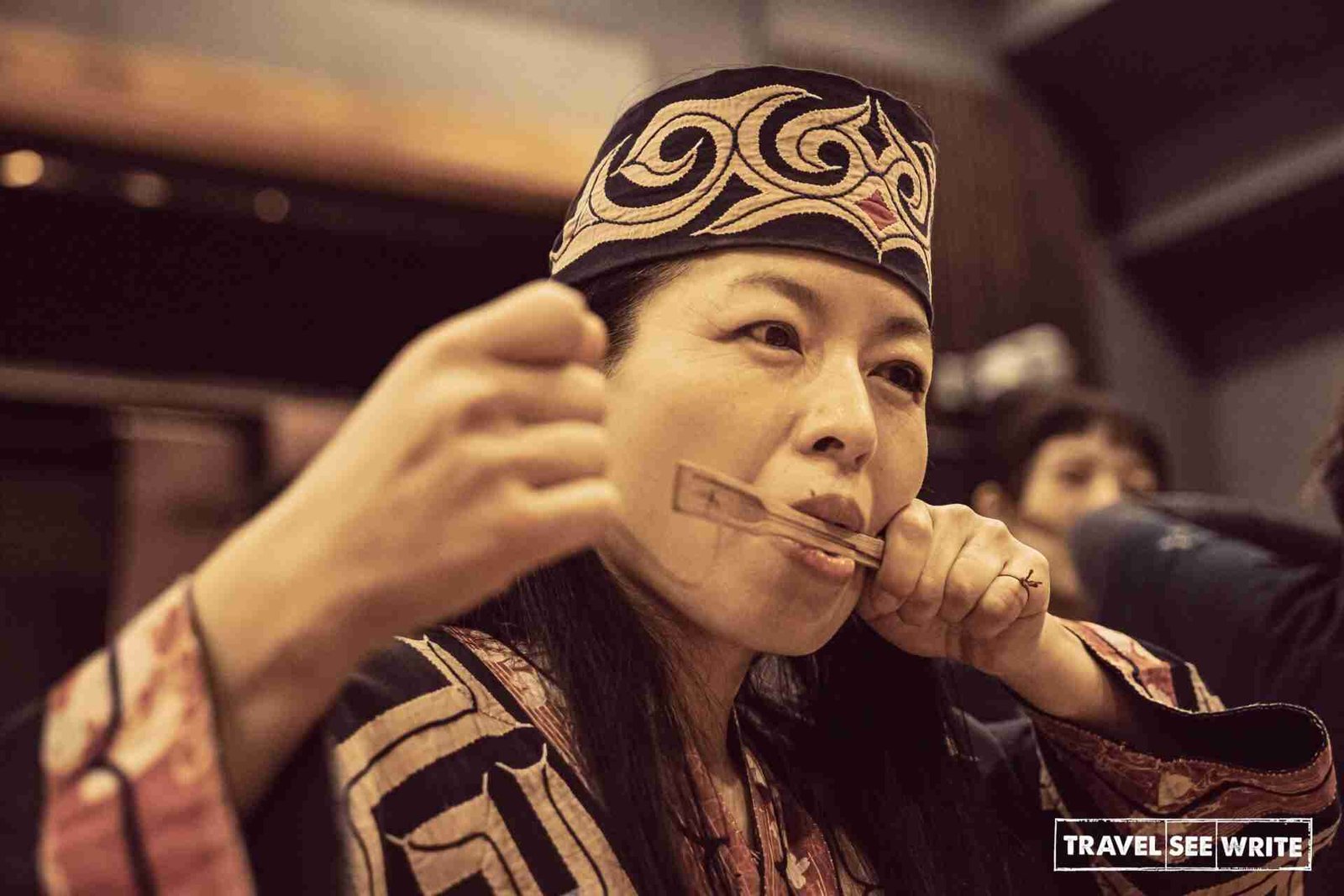
In the evening, I was introduced to the ‘Mukkuri’, a type of mouth harp, and Ainu traditional dance. Singing and dancing are core to Ainu culture and a key feature of Ainu festivals. These dances are used to express gratitude to the gods and celebrate life’s joys and sorrows. As I learned these dances, I felt a deep connection to the Ainu’s reverence for nature. Every song and dance was dedicated to the natural world; my favourite was the crane dance. In this dance, the mama crane teaches her baby how to fly by flapping its wings. It was a graceful tribute to the wonder of the animal kingdom.
An Ainu artist playing ‘Mukkuri,’ a traditional mouth harp made of bamboo) and string.
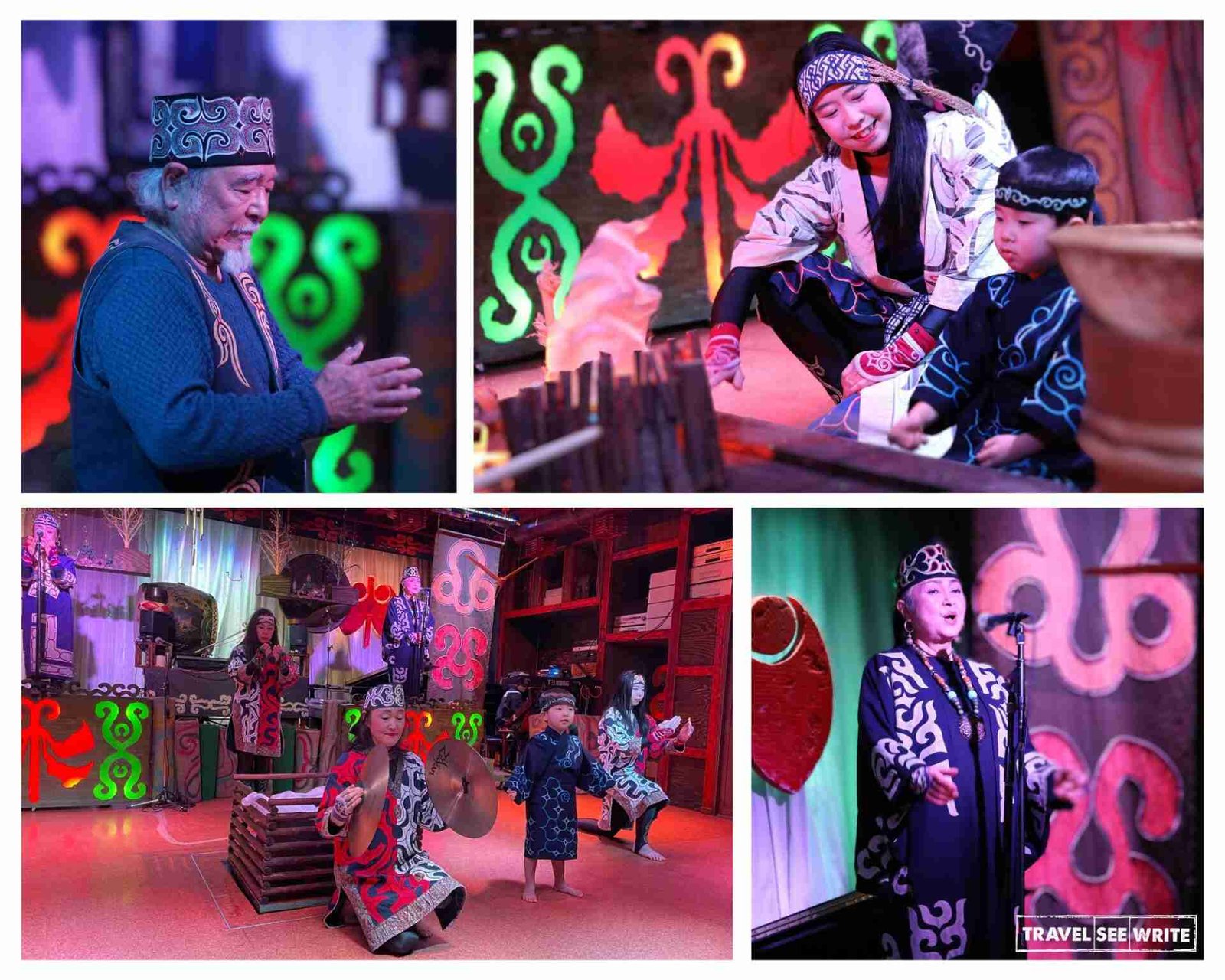
My journey into the Ainu culture ended at Marukibune, where Moshiri, a 12-piece supergroup led by the inspirational figure Atuy (whose legal name is Masanori Toyooka), gave a live performance. Atuy’s journey from being ostracised to becoming a composer, philosopher, entrepreneur, and spiritual leader was a powerful display of the Ainu people’s resilience and determination.
Moshiri, a 12-piece supergroup led by the inspirational figure Atuy to propagate Ainu culture
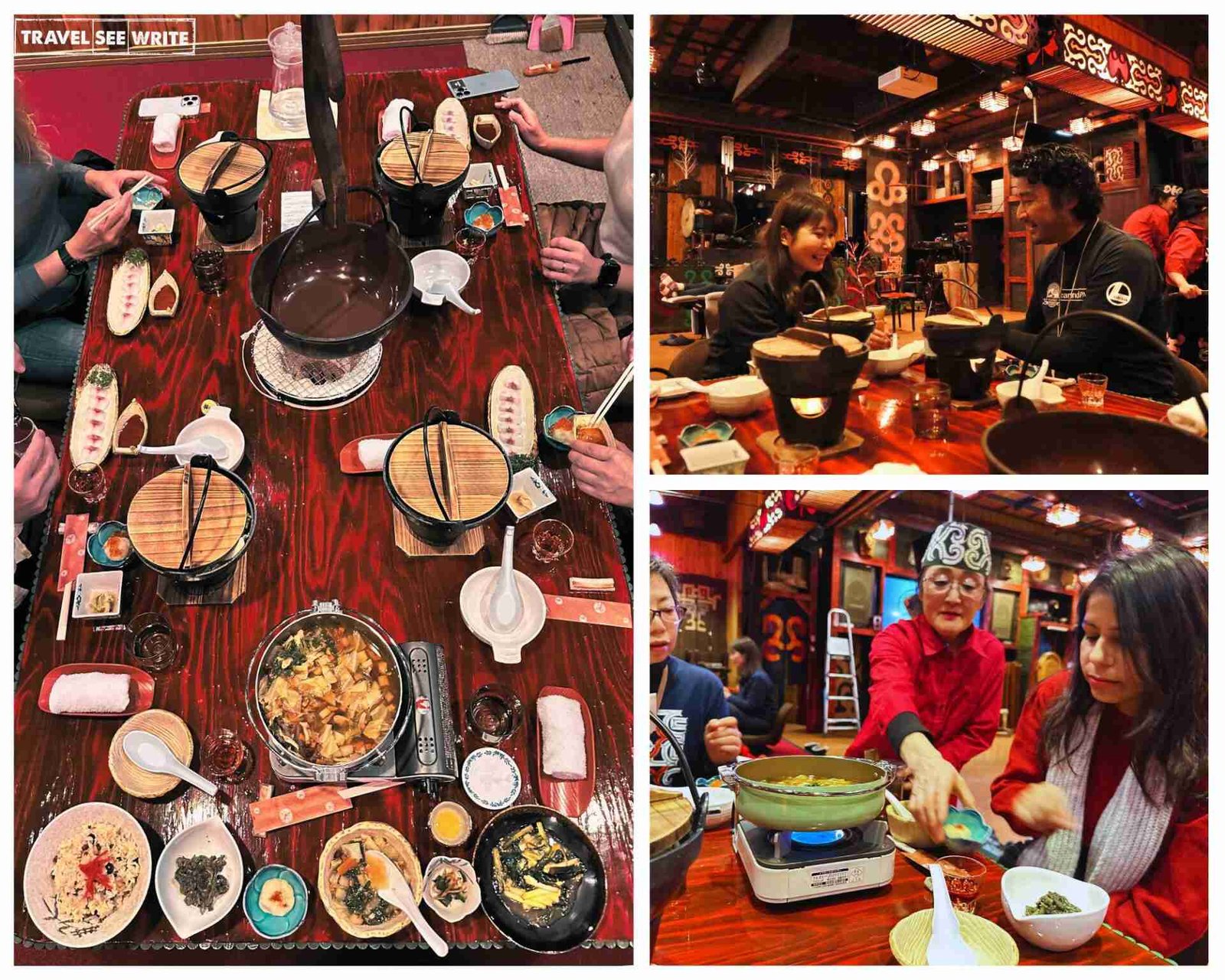
The Ainu cuisine that I experienced during my visit was a revelation. It boasted flavours and textures that I had never encountered before. The local Ainu vegetables in Jomon hotpot, wild beans with miso paste, wild garlic in egg, and seaweed salad were all a celebration of nature’s bounty. My friends who could eat seafood and meat had an even better multi-course Ainu cuisine. It consisted of Japanese plum wine, potato salad topped with salmon eggs, lake dace seasoned with miso and vinegar, frozen sashimi of lake dace, Jomon hot pot, grilled venison, Ohau (traditional Ainu stew with venison and vegetables), sushi with salmon and salmon roe, yaseidon (rice topped with venison), victory onion and egg, chaga mushroom tea, and shito (fermented potato dumpling).
Multi-course Ainu Cuisine dinner at Marukibune, Eastern Hokkaido, Japan
In Atuy’s world, women were at the forefront of everything, whether in the kitchen or on the stage. I was surprised to see that the women who graciously served and cooked dinner for me also showcased their talents as performers in Atuy’s 12-piece supergroup.
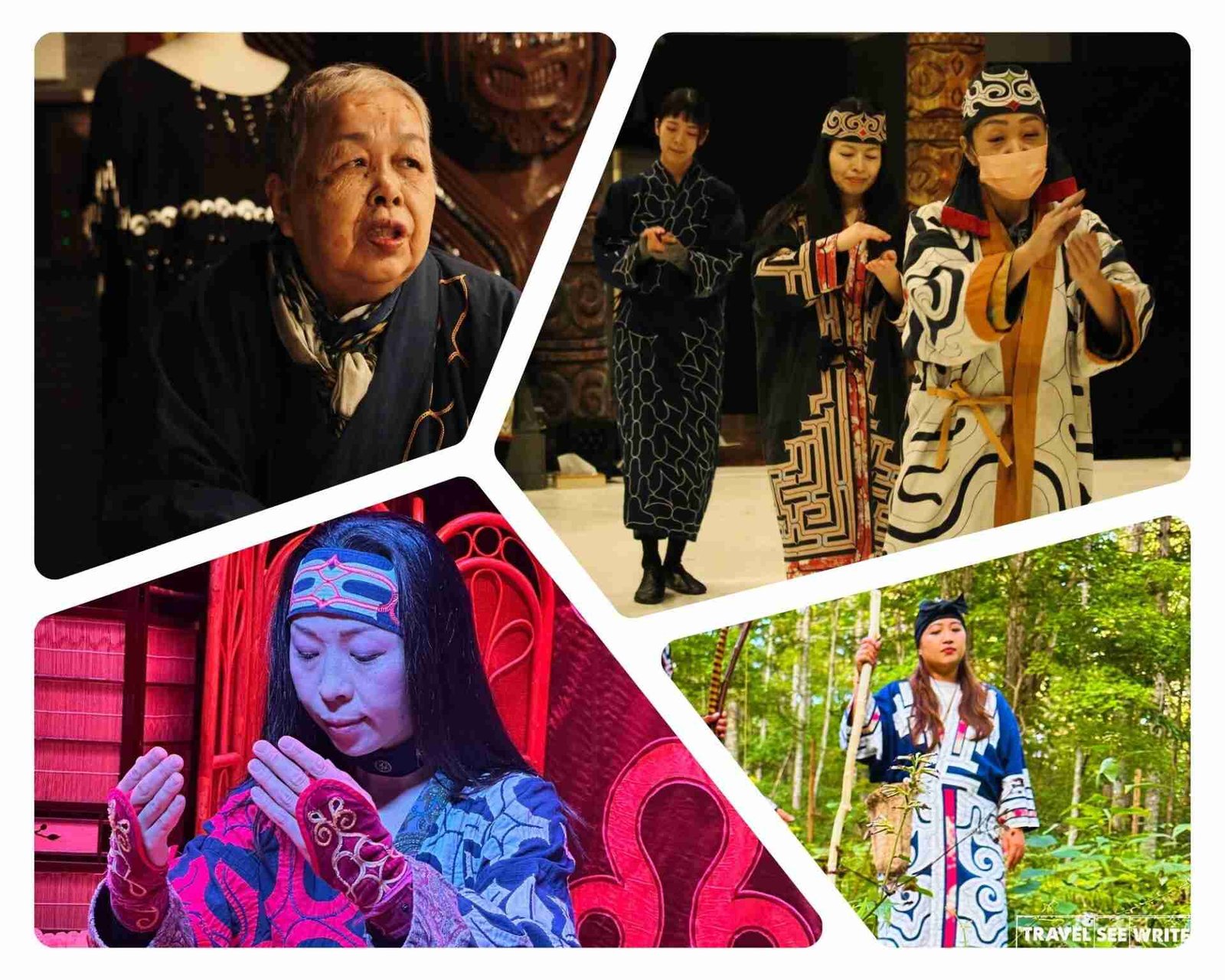
Through my numerous interactions with Ainu women, I came to realise that in Ainu culture, despite historical patriarchal norms, women have been the silent pillars upholding their traditions and cultural heritage. These interactions unveiled women’s pivotal roles in preserving Ainu customs, from passing down traditional dances and songs to mastering intricate embroidery techniques. What struck me most was witnessing the gradual shift in societal dynamics, where Ainu women increasingly step into leadership positions and actively participate in cultural propagation. This evolution underscores not only the resilience of Ainu culture but also the progressive adaptation to contemporary values of inclusivity and gender equality.
In conclusion, my journey to Ainu territory was unforgettable. It offered profound insights into their ancient culture, traditions, and beliefs. Japan’s Indigenous Ainu people’s deep connection to nature and their exquisite art left a lasting impression. Although Ainu culture is now officially recognised, a longstanding economic gap between this minority and its Japanese counterpart still exists today. Discrimination can still be found sometimes in schools, workplaces and marriage considerations. While uncovering the story of the Ainu people, I was also reminded of the challenges faced by indigenous communities in my country, India. Like the Ainu, these communities display remarkable resilience and pride in preserving their heritage despite adversity. By advocating for Ainu culture, I hope to promote greater respect for indigenous communities worldwide, including those in India.
Published on
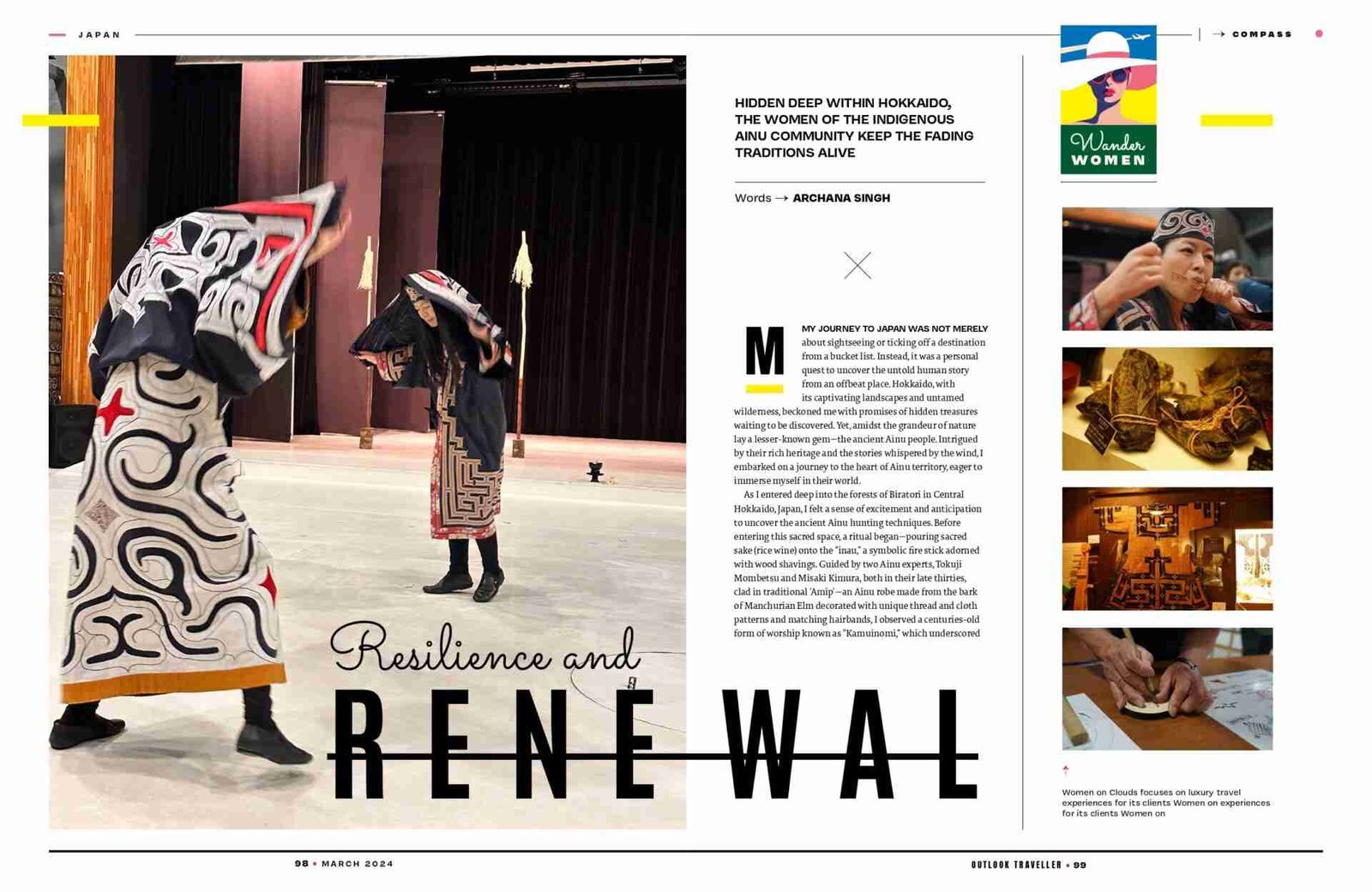
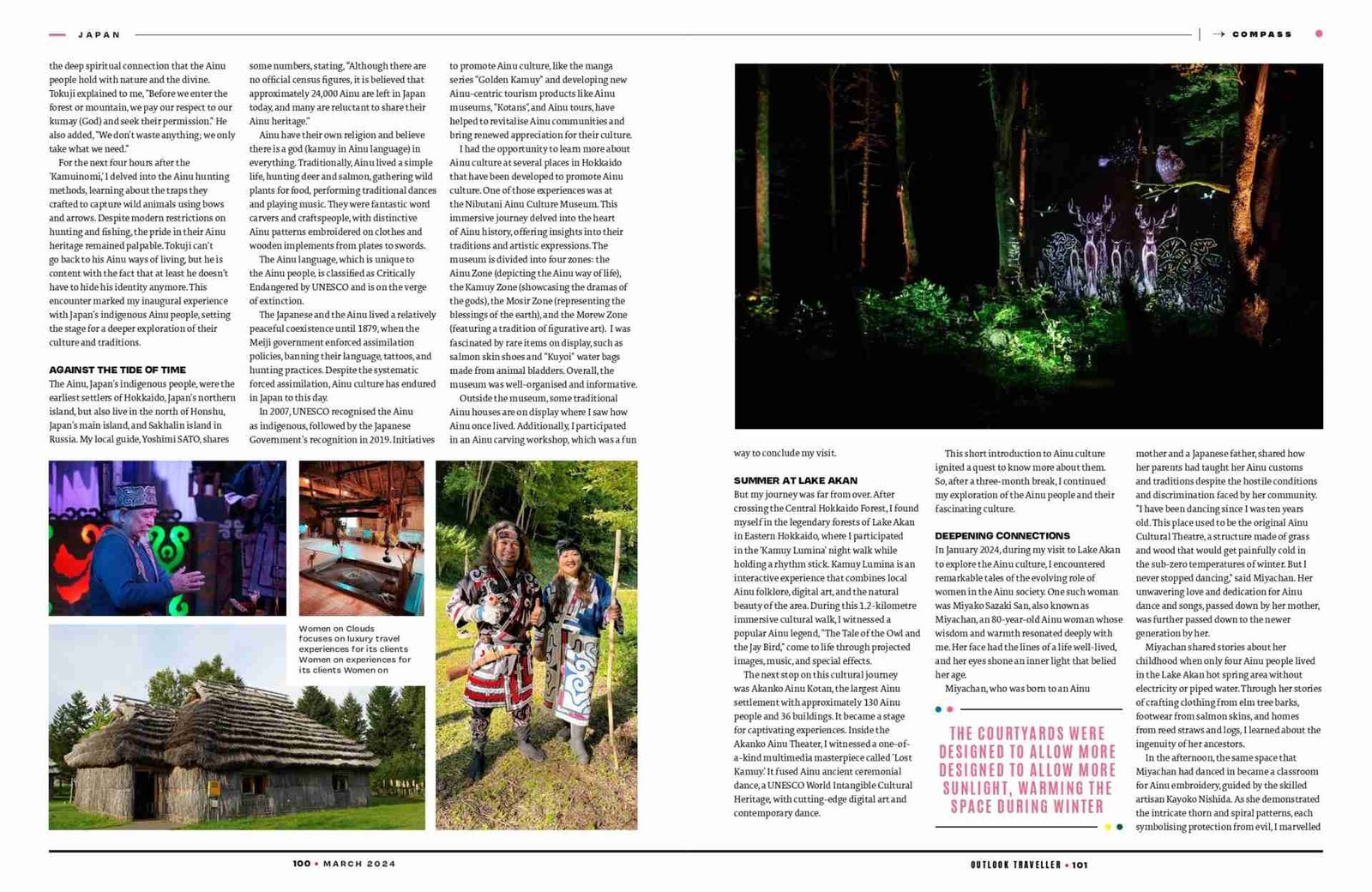
The abridged version of this story is published in the March-April issue of Outlook Traveller Magazine. Here’s how the story looked.
Where to experience Ainu culture in Japan
Here are some places in Hokkaido, Japan, where visitors can experience the culture of Japan’s Indigenous Ainu People:
Nibutani Ainu Cultural Museum: Located in Biratori, this museum showcases artefacts, tools, and artworks, offering visitors a glimpse into Ainu history and craftsmanship.
Ainu Kotan in Akan: This Ainu village near Lake Akan offers authentic cultural experiences, including traditional dance performances, craft demonstrations, and workshops.
Upopoy National Ainu Museum and Park: Recently opened in Shiraoi, this museum features interactive exhibits, workshops, and outdoor displays focused on Ainu history, culture, and traditions.
Ainu Cultural Promotion Center in Sapporo: This centre, located in Sapporo, hosts exhibitions, events, and workshops focused on Ainu culture, language, and crafts.
Ainu Cultural Center in Noboribetsu: Situated in Noboribetsu, this centre provides opportunities to learn about Ainu culture through exhibitions, workshops, and performances.
Ainu Crafts Museum in Asahikawa: This museum is dedicated to Ainu arts and crafts and features exhibitions of traditional and contemporary creations.
Ainu Village in Niseko: This Ainu cultural village in Niseko offers guided tours, demonstrations, and performances, allowing visitors to learn about Ainu customs, rituals, and daily life.
Shiraoi Ainu Museum (Porotokotan): Located in Shiraoi, this open-air museum offers insights into Ainu history, lifestyle, and traditions through reconstructed Ainu dwellings, artefacts, and cultural performances.
Ainu women lead from the front in saving and propagating the Ainu culture.
These destinations provide diverse opportunities for travellers to engage with Ainu culture, history, and heritage across different regions of Hokkaido.
Attending Ainu Festivals in Hokkaido
Festivals are an integral part of the Ainu culture. Japan’s Indigenous Ainu People celebrate several festivals annually, each dedicated to different aspects of their culture, traditions, natural cycles, and kumuy. Therefore, it is a good idea to plan your trip and keep in mind important Ainu festivals. Here’s an annual festival calendar of the Ainu in Japan:
Iomante (イオマンテ): Sometimes written as Iyomante (イヨマンテ), is one of the most critical Ainu ceremonies held in late January or early February. It marks the end of the hunting season and includes rituals to express gratitude to the gods for a successful hunt. Traditionally, this Ainu Bear festival (熊祭, kumamatsuri) involved the ceremonial send-off of a sacrificed bear’s spirit. Nowadays, the ceremony no longer involves the killing of an animal but is performed for wild animals that die in accidents or captive animals that die of old age. The atmosphere of the original ceremony is brought forward to the modern age with music and dancing.
Daisetsuzan Mountain Festival: Held yearly in Asahidake Onsen around the middle of June, this festival originated to celebrate the official start of the hiking season in the Daisetsuzan National Park. Both locals and visitors gather around a bonfire and watch traditional Ainu rituals as well as some dancing and singing, creating a fantastic atmosphere.
Sounkyo Fire Festival: Held on the last Saturday and Sunday of July, the Sounkyo Fire Festival honours and prays to the god of fire and mountains. Ainu tribal dances, religious services, and the performance of Himatsuri drums are the festival’s highlights, leading up to the fireworks finale in the canyon.
Kamuy Fuchi Festival: This summer festival, usually held in July or August, pays homage to the water deity Kamuy Fuchi, who is believed to protect rivers and streams. The festival includes prayers for abundant fish harvests, purification rituals, and offerings to the water gods.
Harvest Festival: Celebrated in autumn, typically around September or October, the Harvest Festival (known as “Kapar Ainu”) gives thanks for the bountiful harvest and honours the gods for their blessings. It involves rituals, feasting, music, and dance, symbolizing the Ainu’s close relationship with nature.
Salmon Fishing Festivals: Throughout the salmon fishing season that typically lasts from late spring to early autumn, various rituals and ceremonies are performed to honour the salmon and ensure a successful catch. These rituals involve prayers, offerings, and traditional fishing techniques passed down through generations. One of the notable Salmon festivals to attend is the Ishikari Salmon Festival, held on the last weekend of September in Ishikari, a former salmon fishing village. The festival’s closing event is the passage of a portable shrine (Mikoshi) through Benten Rekishi-dori, the historical street of old downtown Ishikari. Alternatively, you can also attend the Shiraoi Cep Festival, a celebration and thanksgiving for the blessings of the sea. The festivities include ancient Ainu dances and performances of the mukkuri (Jew’s harp), a demonstration of Malek fishing, an ancient Ainu method of fishing for salmon, the ever-popular bargain sale of salmon, and sales of Ainu salmon cuisine such as cep ohau (salmon soup) and chima cep (skewers).
Lake Akan Marimo Festival: Another unique Ainu festival is the Marimo Festival, which is held annually at Lake Akan from early to mid-October since 1950. While it’s not an ancient tradition, the idea behind this festival was initially to protect the local marimo (round algae balls) from further pollution. Significant members of the Ainu community conduct the festival, which includes the Ainu song and dance, a blessing festival, fireworks, and finally, the return of the chosen marina to the lake bottom. This is a truly unique and wonderful festival.
Ainu Day: Designated on November 24th, Ainu Day is a modern commemoration of Ainu culture, language, and heritage. The Ainu people showcase their traditions through cultural performances, exhibitions, workshops, and community events.
While these festivals are some of the most notable celebrations in the Ainu calendar, smaller local events, ceremonies, and gatherings are also held throughout the year within Ainu communities across Hokkaido and other regions of Japan. Each festival preserves and celebrates the unique identity and traditions of Japan’s Indigenous Ainu People.
I was invited by ATTA and Visit Hokkaido for ATWS 20023 and Hokkaido Treasure Island Travel for the winter trip to Eastern Hokkaido. However, the views and pictures shared above, were personally experienced by me in my last two visits to Hokkaido in 2023 and 2024. Please do not copy anything without any written permission.
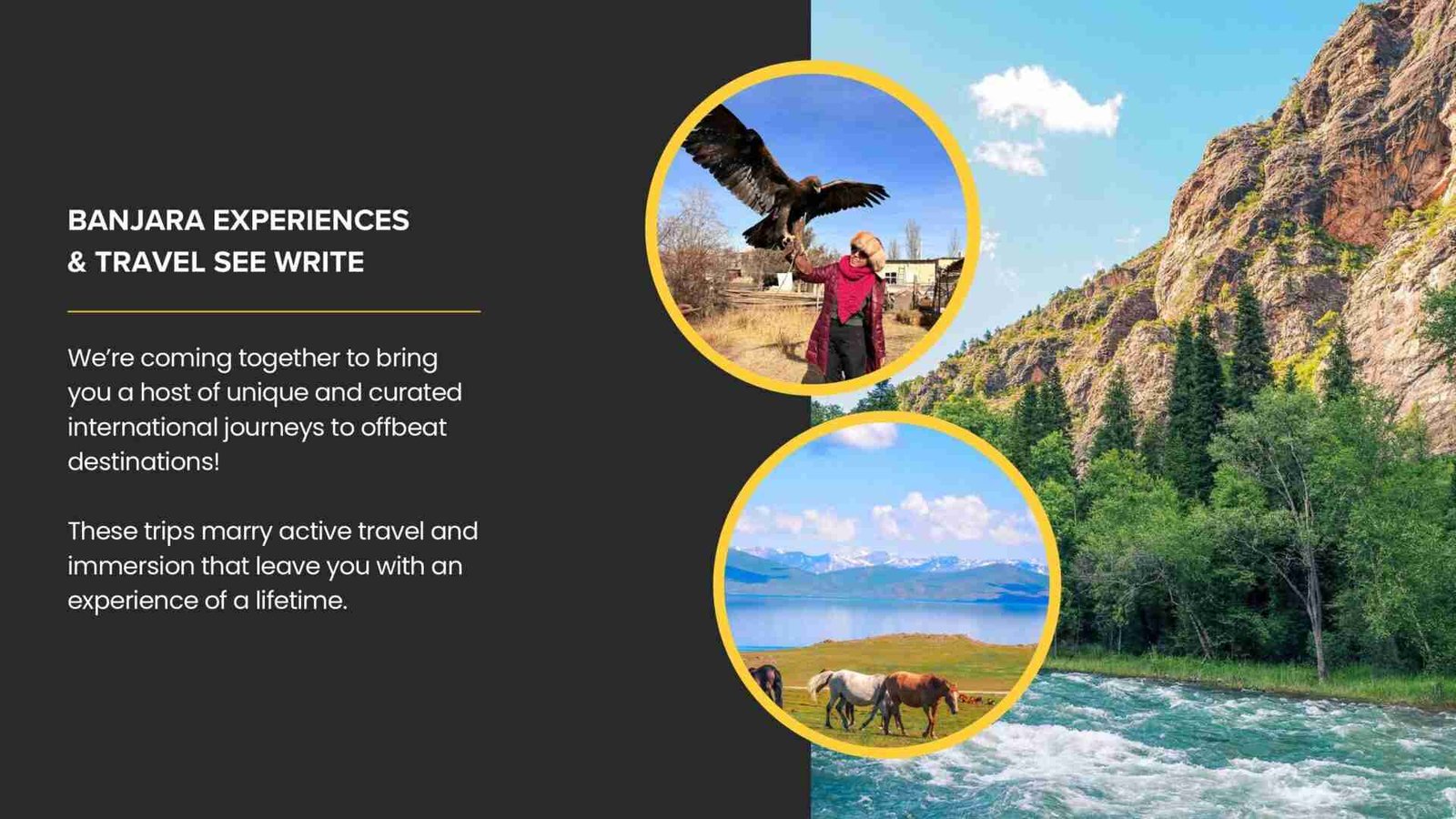
We are beyond excited to announce a groundbreaking partnership between two giants in the world of travel –Travel See Write and Banjara Experiences. Together, we’re set to revolutionize how you experience the world, offering a collection of meticulously curated international journeys to some of the planet’s most extraordinary and offbeat destinations. Prepare to embark on an adventure like no other, led by a team of seasoned travellers passionate about exploration and committed to delivering unforgettable experiences.
Explore the World with Travel See Write and Banjara Experiences.
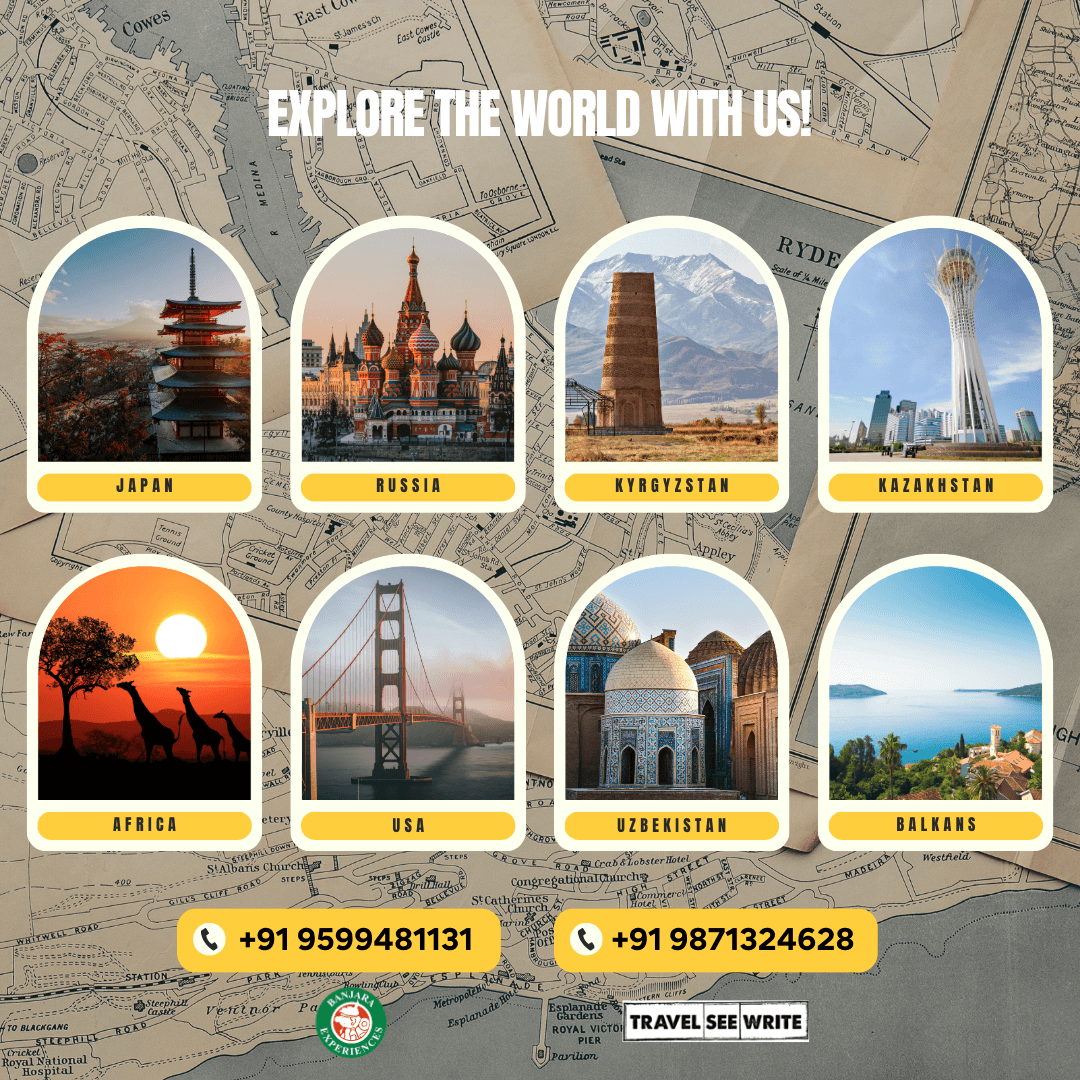
🗺️ Explore the World with Us! Upcoming Trips – 2024 and 2025 🗺️
Travel See Write Banjara Experiences Travel Calendar – 2024-2025
Kyrgyzstan and Kazakhstan, Central Asia, June 2024: Venture into the heart of Central Asia and discover the breathtaking landscapes, rich cultural heritage, and warm hospitality of Kyrgyzstan and Kazakhstan.
Japan, Asia, July 2024: Experience the juxtaposition of tradition and modernity as you explore Tokyo’s vibrant cities and the serene beauty of Hokkaido, Japan’s northern island.
Georgia and Azerbaijan, Europe, August 2024: Delve into Azerbaijan and Georgia’s charm and allure, where ancient traditions, mouthwatering cuisine, and stunning landscapes await at every turn.
Africa, September 2024: Embark on an unforgettable safari adventure through the wilds of Africa, where you’ll encounter majestic wildlife, awe-inspiring landscapes, and vibrant cultures.
Albania & Montenegro, Europe, 2024: Journey through the rugged beauty of the Balkans, where historic cities, dramatic landscapes, and warm hospitality come together to create an unforgettable travel experience.
Silk Route (Kazakhstan & Uzbekistan), October 2024: Follow in the footsteps of ancient traders as you traverse the legendary Silk Route, exploring the historic cities of Kazakhstan and Uzbekistan.
Kyrgyzstan and Kazakhstan, Central Asia, October 2024: Experience the magic of Central Asia once again as we return to Kyrgyzstan and Kazakhstan for another unforgettable journey.
Russia, December 2024- January 2025: Immerse yourself in Russia’s rich history, culture, and beauty, from the iconic landmarks of Moscow to the fairytale landscapes of Siberia.
Japan, Asia, February 2025: Return to Japan for a winter wonderland adventure, where you’ll experience the beauty of snow-covered landscapes, traditional winter festivals, and warm hospitality.
Travel See Write Banjara Experiences Journeys planned for 2024-2025
5 Reasons to Travel the World with Us!
Why you should travel with Travel See Write Banjara Experiences?
Award-Winning Team
Our journeys are led by a team of passionate professionals who have been recognized and trusted by travellers, tourism boards, travel companies, and service providers worldwide.
Tour led by experienced and passionate travel leaders.
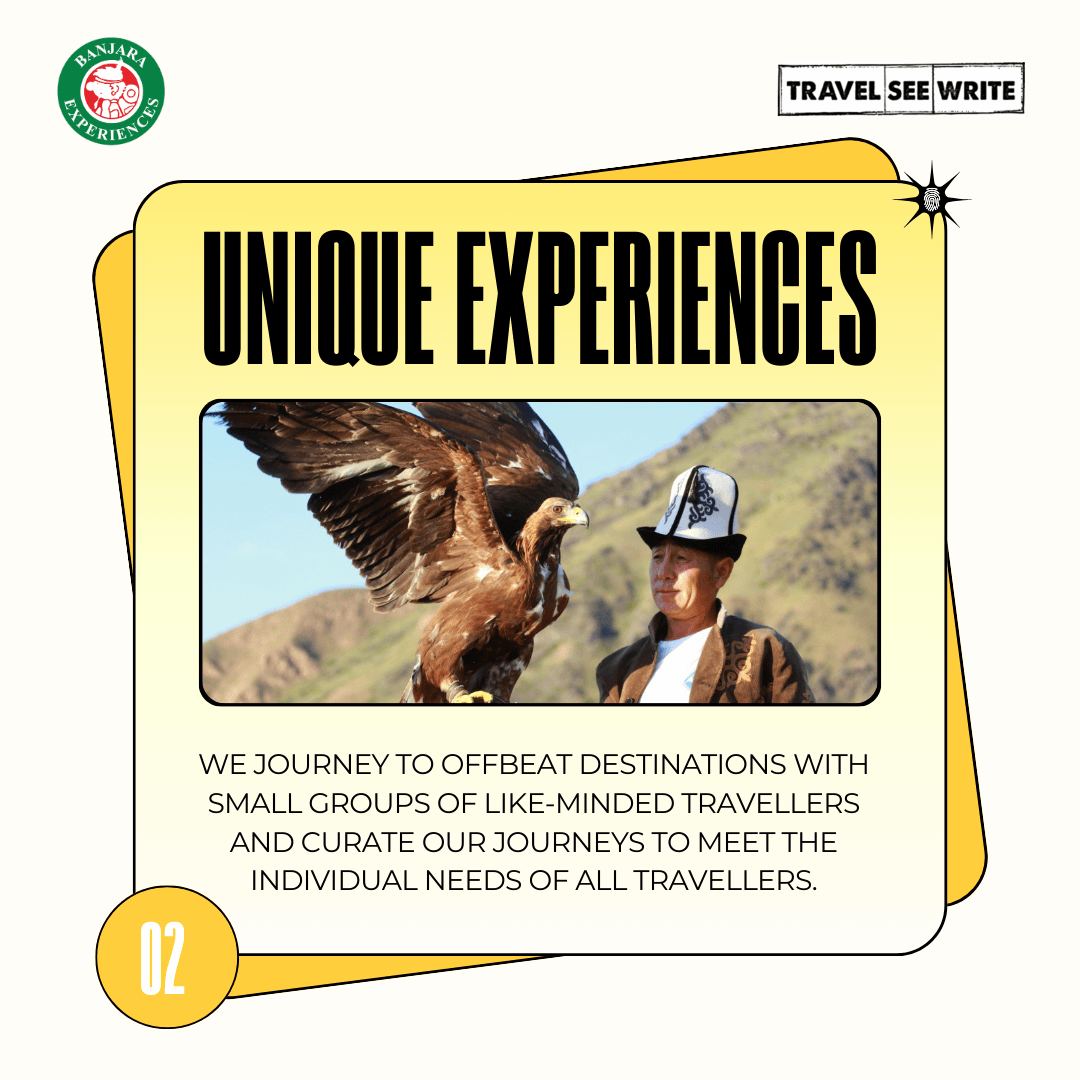
Unique Experiences
We specialize in offbeat destinations and small group travel, ensuring that each journey is unique and unforgettable, tailored to the interests and preferences of our travellers.
Hand-crafted unique experiences
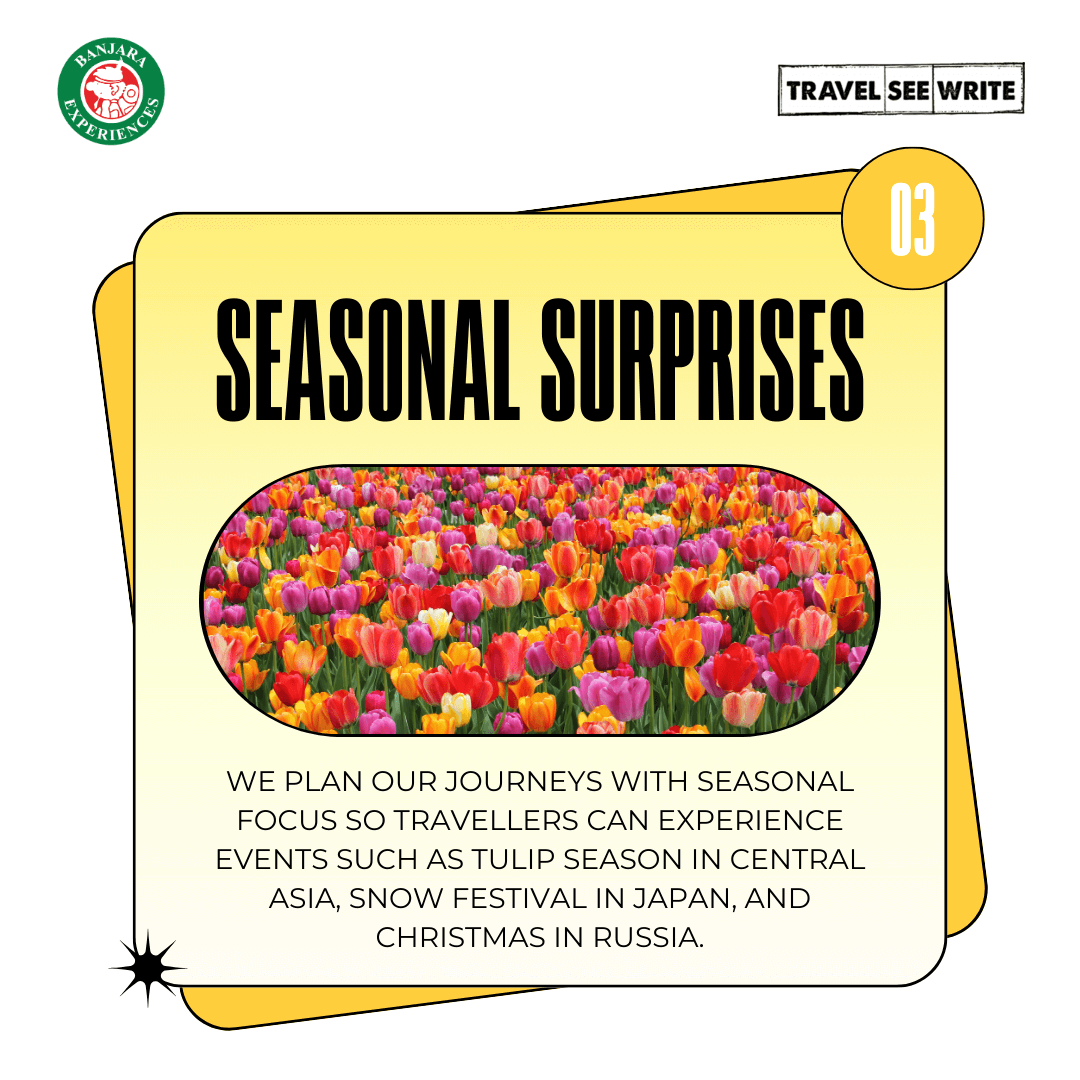
Seasonal Surprises
From tulip season in Central Asia to snow festivals in Japan and Christmas in Russia, our itineraries are designed to highlight the best of each destination, no matter the time of year.
Be ready to be bedazzled by seasonal surprises.
Worry-Free Travel
Sit back, relax, and let us take care of all the details. From transportation and accommodation to meals and activities, we handle everything so you can focus on enjoying the journey.
When you travel with us, leave your worries behind.
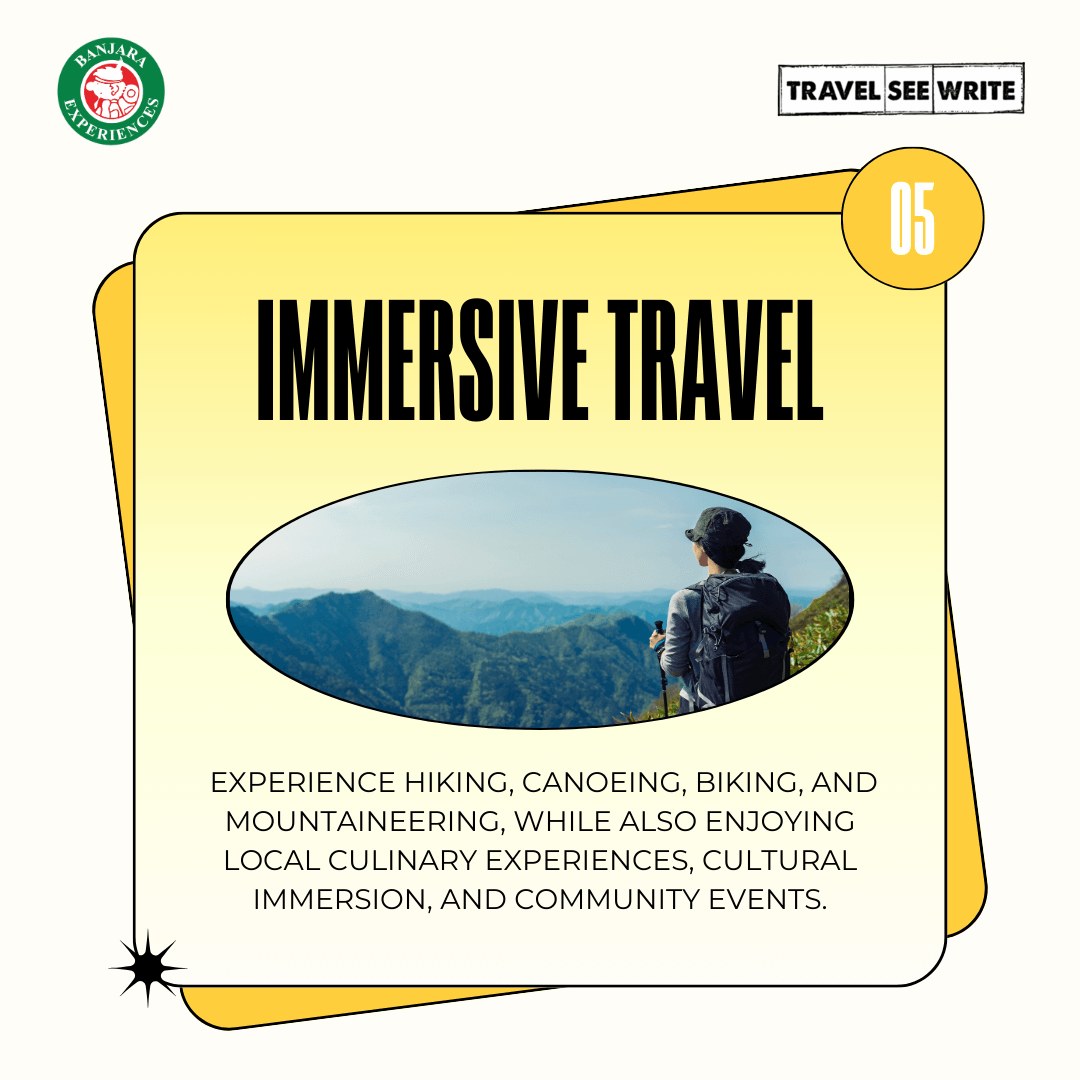
Immersive Travel: Whether hiking through pristine wilderness, sampling local cuisine, or immersing yourself in cultural traditions, our journeys offer a perfect balance of adventure and cultural immersion.
Immersive travel that marries both adventure and culture.
Get in Touch Now! 📞
Ready to embark on your next adventure with Travel See Write and Banjara Experiences? Contact us at +91 9599481131 and +91 9871324628 to reserve your spot on our upcoming trips. Our team is standing by to help you plan the journey of a lifetime, so don’t miss out on this incredible opportunity to travel the world with Banjara Experiences and TSW!
Travel See Write, and Banjara Experiences look forward to welcoming you to Kyrgyzstan and Kazakhstan.
Let’s make memories together, one journey at a time.
Happy Travels! 🌟
Beyond Pyramids! Visiting the best places in Egypt. Photo by Photo by Murat Şahin
A few years ago, while watching the iconic song “Suraj Hua Madham” from the movie ‘Kabhi Khushi Kabhi Gham’, I was completely stunned by the magnificent pyramids of Egypt in the background. The sight of Shah Rukh Khan and Kajol, one of Bollywood’s most famous onscreen couples, romancing amidst the golden sands of these ancient wonders ignited a strong desire within me to visit Egypt. But it wasn’t just the song that piqued my interest in the African nation; movies such as “Transformers”, “Death on the Nile”, “X-Men: Apocalypse”, “The Mummy”, “The Prince of Egypt”, “Scorpion King”, “Singh Is King”, and many others have indirectly played a role in motivating me to explore this ancient land of history and fantasy.
If you are someone like me, who has been fascinated by the allure of Egypt depicted on the silver screen, then you are in for a treat – as Egypt has much more to offer than just the iconic pyramids. From the bustling streets of Cairo to the calm waters of the Nile, Egypt is a country brimming with hidden treasures and cultural delights waiting for your arrival. In this Egypt Travel Guide, I will share some personally experienced insights on visiting some lesser-known but equally fascinating places in Egypt beyond the pyramids. But first, let’s start with the basics.
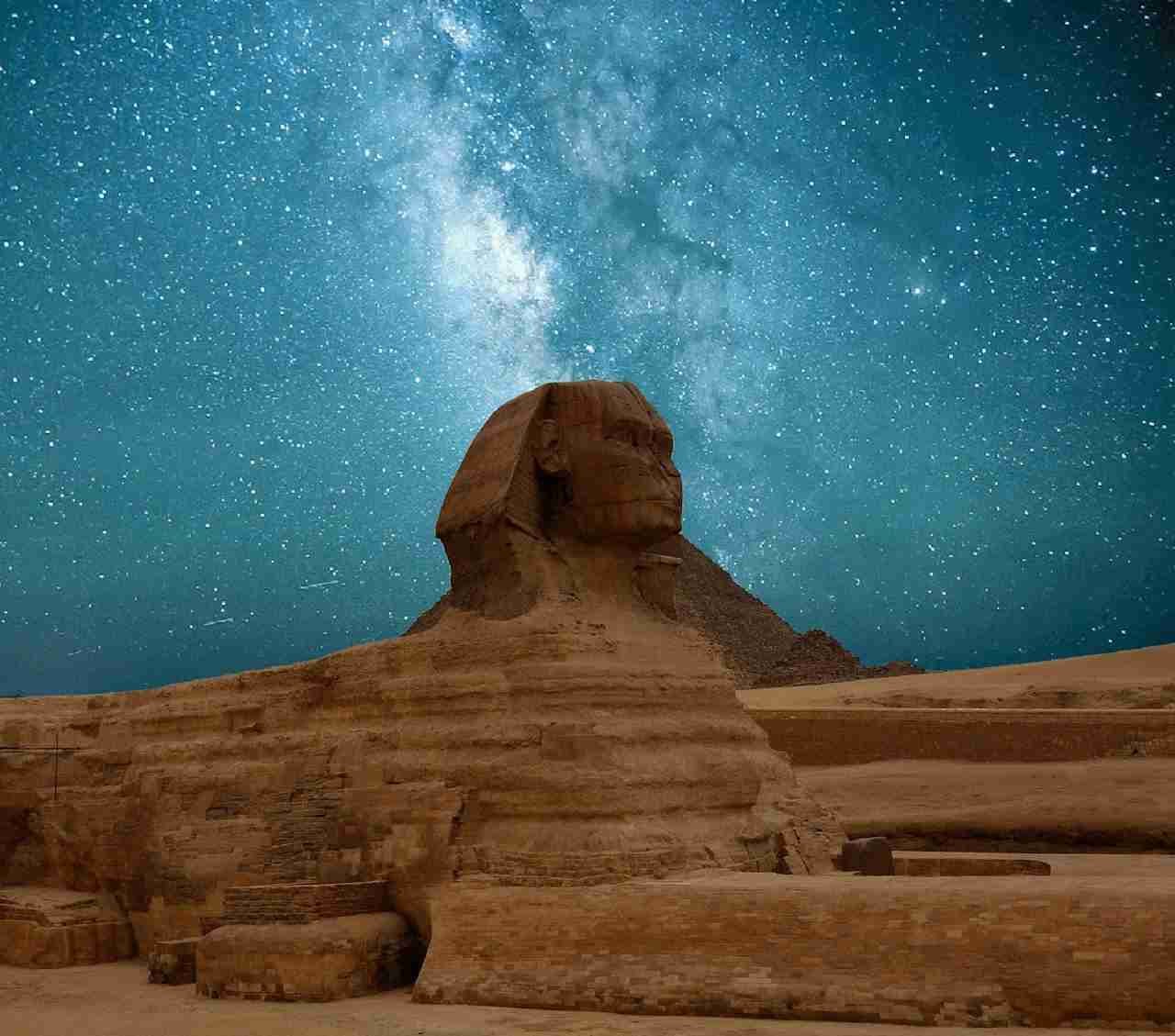
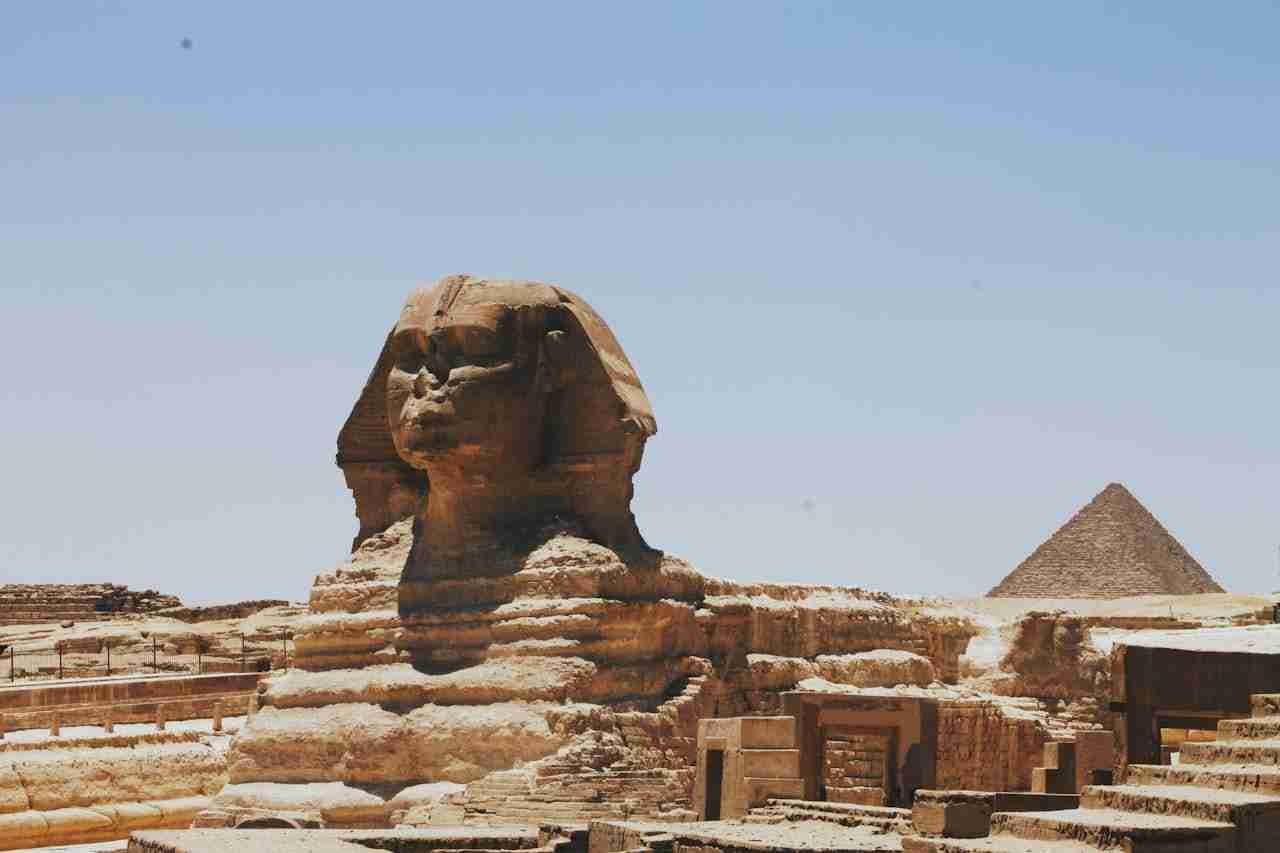
The Great Sphinx Of Giza is one of the most popular and best places to visit in Egypt. Photo by Pixabay
Where is Egypt located, and what is it famous for?
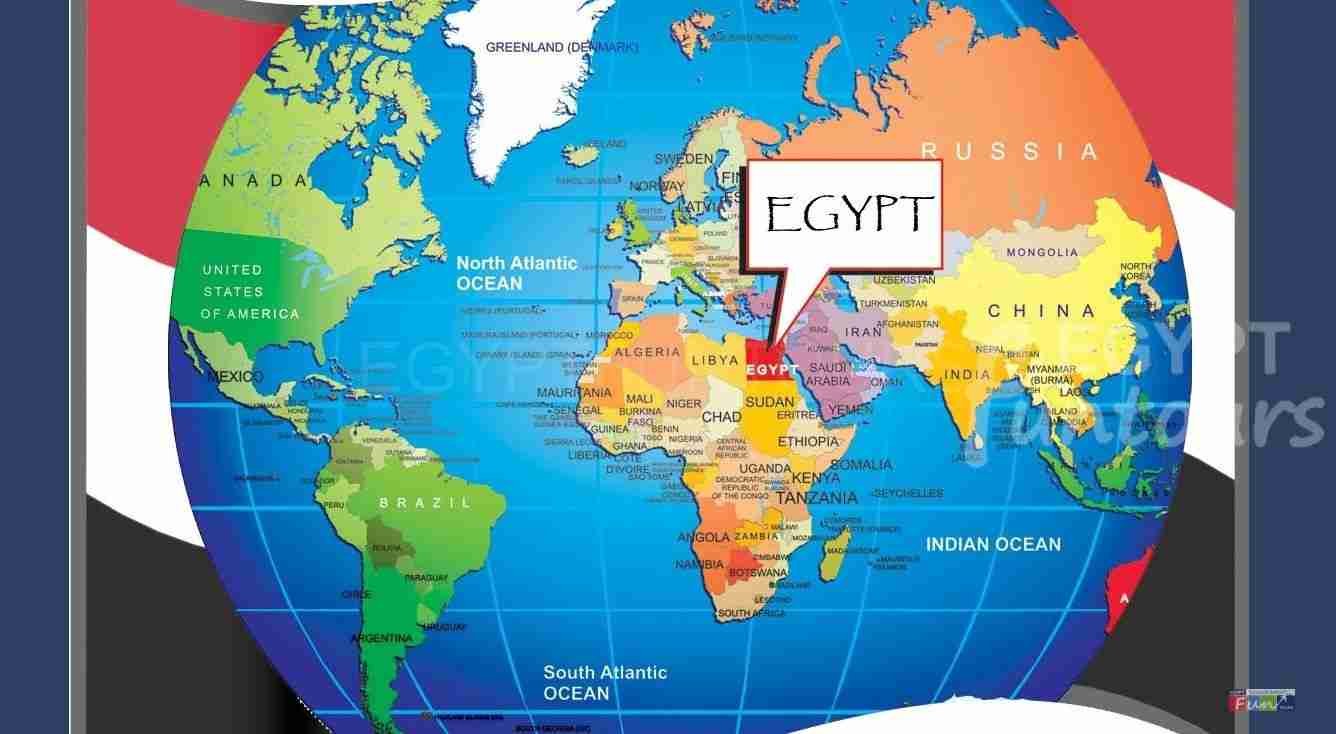
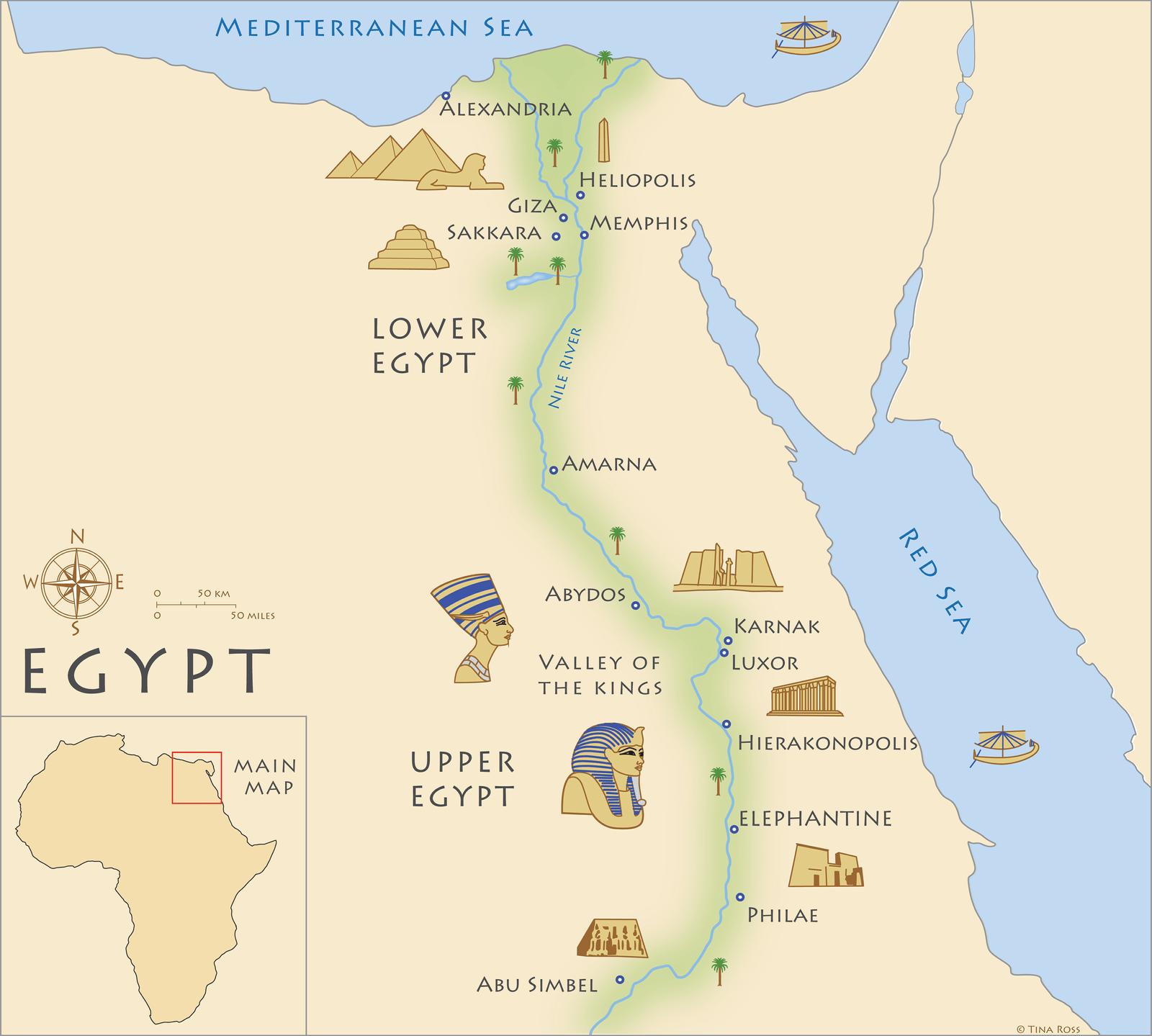
If you look at the world map, you’ll find Egypt in the northeastern region of Africa, hugged by the Mediterranean Sea to the north and the Red Sea to the east. It shares land borders with Libya to the west, Sudan to the south, and Israel and the Gaza Strip to the northeast. Cairo is the largest and capital city of the country.
Is Egypt a part of Africa or Asia? Egypt lies in the northeastern region of Africa
Since childhood, our history and fantasy books have both educated and enamoured us with the ancient Egyptian civilisation and its historic structures, such as the great pyramids. And, who could forget the great Nile River, which has been the lifeline of the desert? From the era of the pharaohs to modern times, this enchanting land has been a cradle of civilisation, a treasure trove of culture, and a testament to human creativity. Although the Great Pyramids are undoubtedly one of the world’s greatest wonders, attracting visitors from all over. Still, there is much more to discover beyond the majesty of the Great Pyramids of Egypt.
Best Places to Visit in Egypt – Beyond the Pyramids!
If you have set your heart on Egypt and are ready to embark on an Egyptian adventure with Travel See Write, let’s take a ride to some of the best places to visit in Egypt that are slightly offbeat but equally captivating.
Here’s a sneak peek of the best places to visit in Egypt
Luxor
Located in upper Egypt, Luxor (ancient Thebes) is often referred to as the world’s greatest open-air museum. If you are a history buff, you would love to visit Luxor, as it is home to some of the most extraordinary historic sites in the world. You’ll be in awe of this place, from the majestic Karnak Temple to the stunning Valley of the Kings. No wonder even 007 makers couldn’t resist showing this marvellous location in their 1977 hit Bond movie, “The Spy Who Loved Me.”
Luxor is one of the best ancient places to visit in Egypt. Photo by Alex Azabache
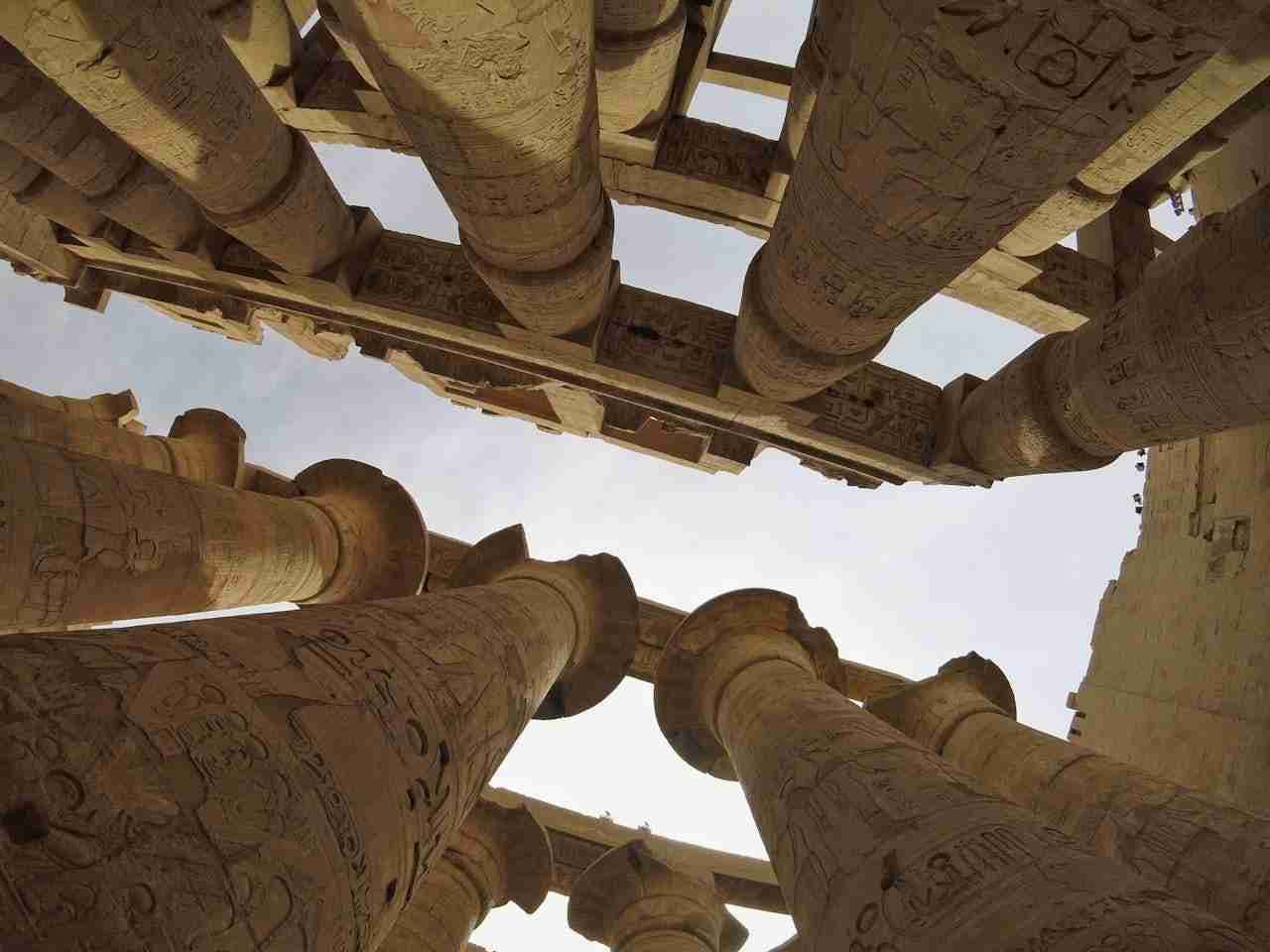
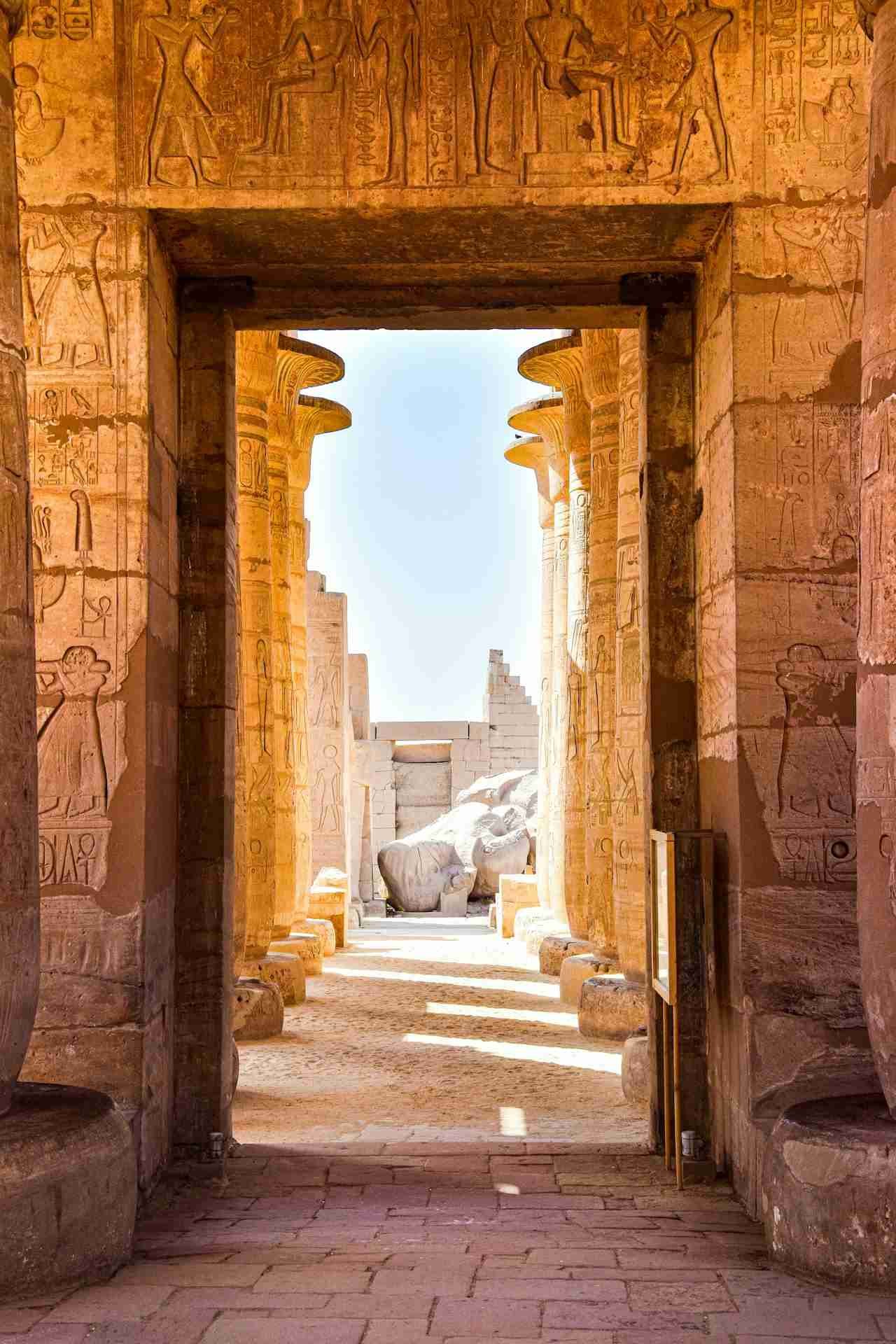
The main site in the city is the Luxor Temple, a massive complex of temples, statues, and courtyards dating back over 3,000 years. The temple is dedicated to the god Amun and is decorated with intricate pictographs and carvings reciting the story of ancient Egyptian religion, practices and mythology. Near Luxor stands the majestic Karnak Temple, whichis one of Egypt’s most beautiful and iconic temple complexes, spread over 100 hectares of area. The site includes several temples, chapels, and pylons, all embellished with impressive carvings and hieroglyphics. Dedicated to the god Amun, the temple took centuries to build, with each pharaoh adding to the complex. This place is so amazing that I could spend weeks here.
Karnak is one of Egypt’s most beautiful and iconic temple complexes. Photo by Ritchie Soto
Aswan
Perched on the banks of the River Nile lies Aswan, which is a serene and charming city that offers a glimpse into traditional Nubian culture. Like Luxor, this city is also home to some of Egypt’s most impressive ancient ruins, including the Temple of Philae and the Unfinished Obelisk.
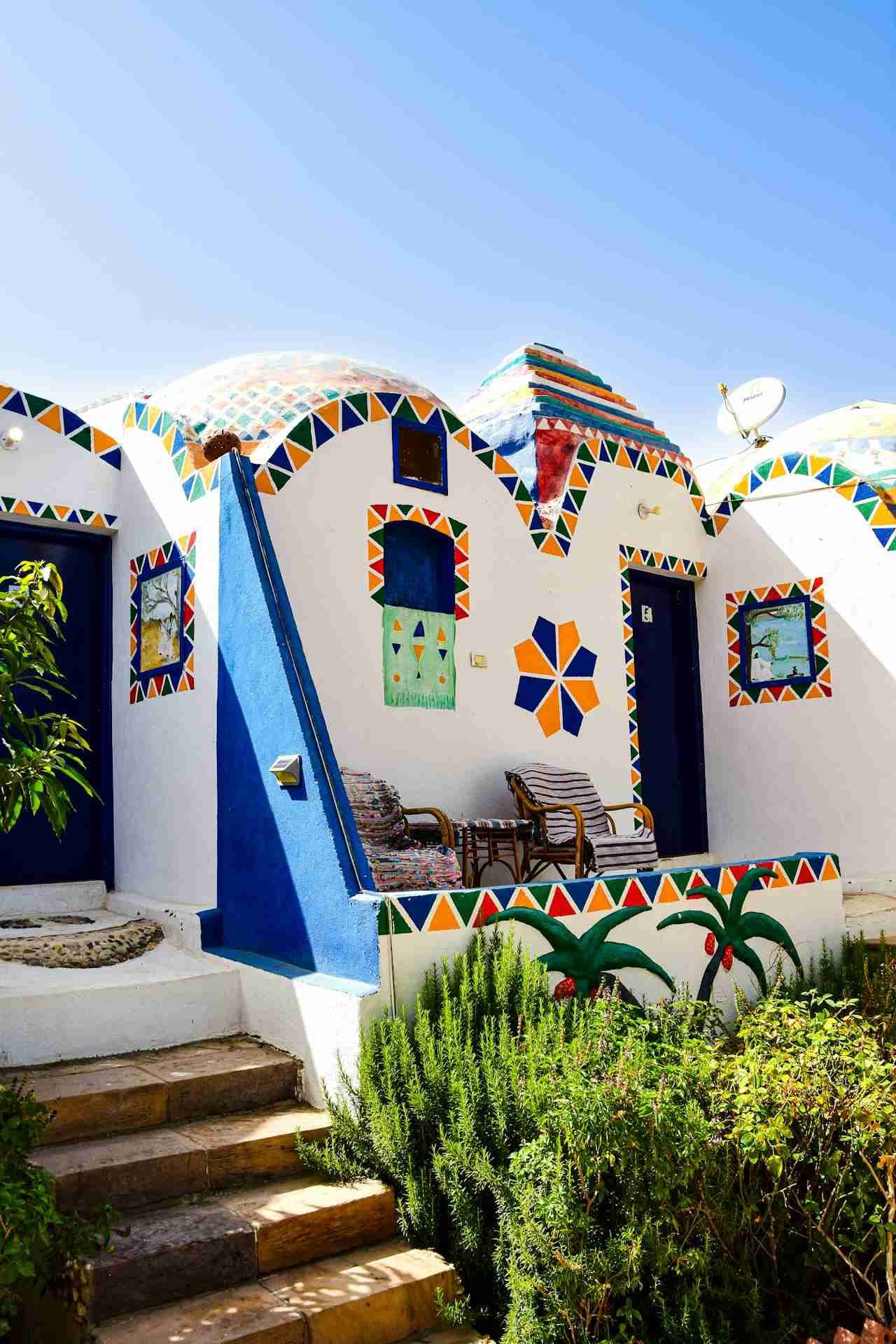
Colourful Buildings of the Artika Wadi Kiki Hotel, Aswan, Egypt – Photo by AXP Photography
Alexandria
Another ancient city steeped in history and philosophy, Alexandria was once the intellectual and cultural capital of the ancient world. You are magically transported to a bygone era when you explore the Bibliotheca Alexandrina, the Catacombs of Kom El Shoqafa, and the stately Montaza Palace.
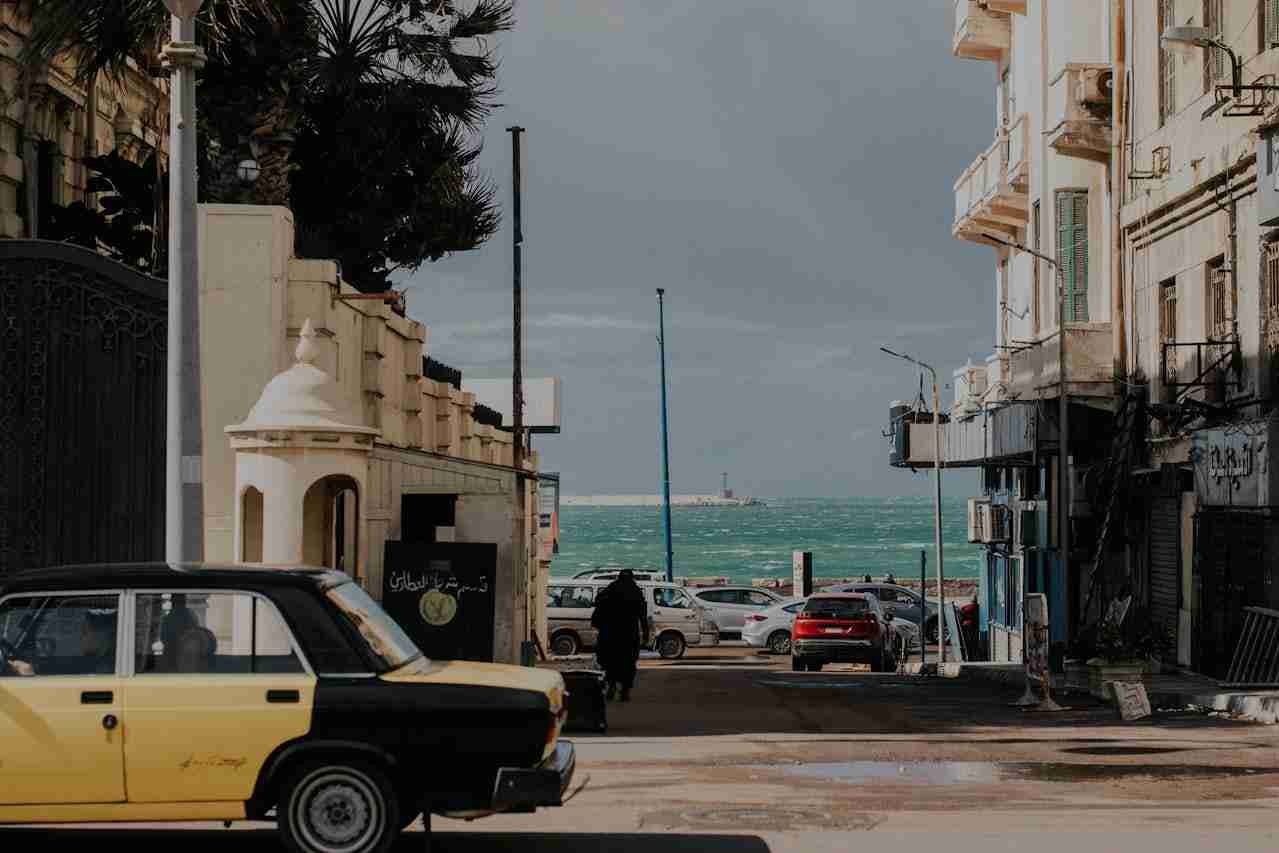
Alexandria, Sunny Street by the Sea in Egypt – Photo by fadi Ramzy
Siwa Oasis
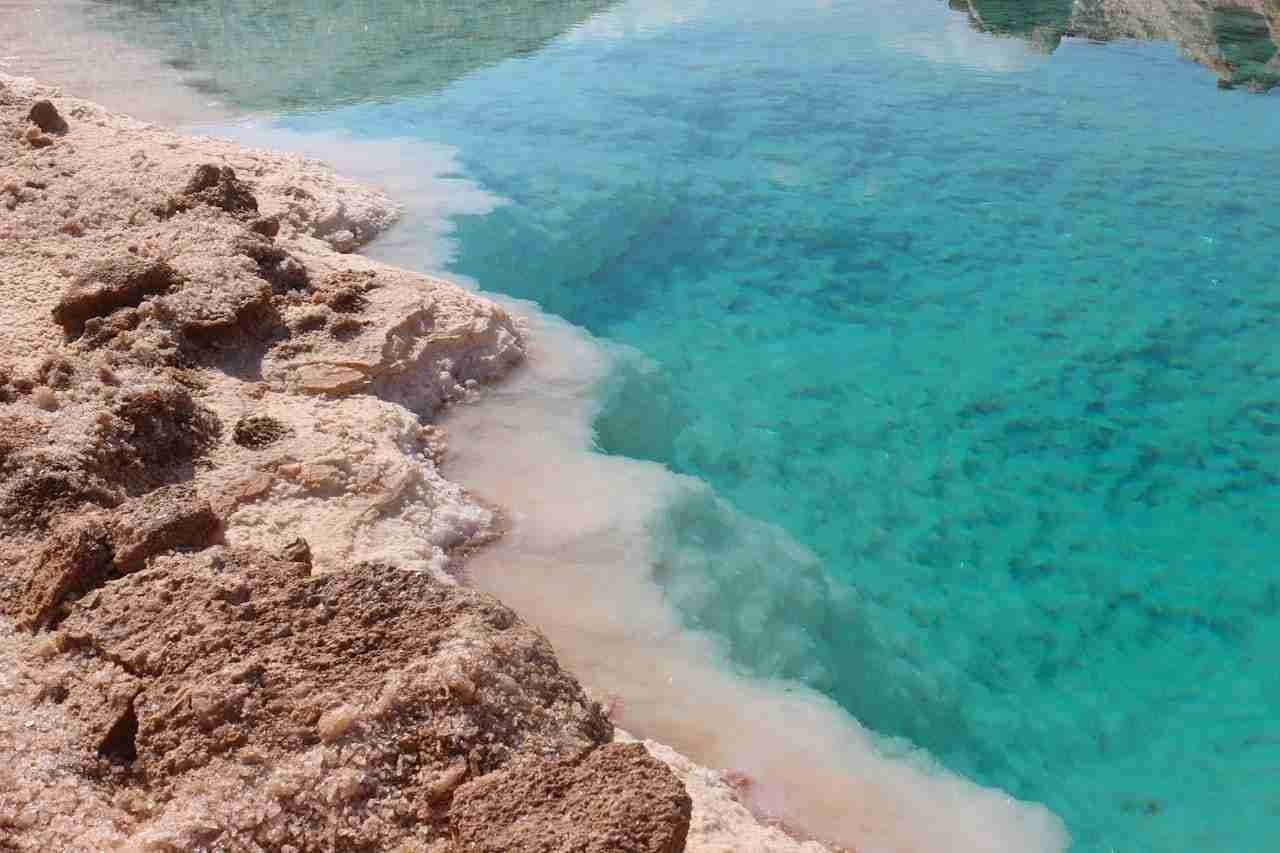
Hidden in the Western Desert, the Siwa Oasis is truly an urban oasis that provides an exclusive entry into the traditional Egyptian way of life that seems light years away from today’s AI-generated world. You can either marvel at the ancient ruins of the Temple of the Oracle or take a dip in the crystal-clear waters of the Cleopatra Pool and unwind in the natural hot springs. One day is definitely not enough for this sanctuary of nature and history.
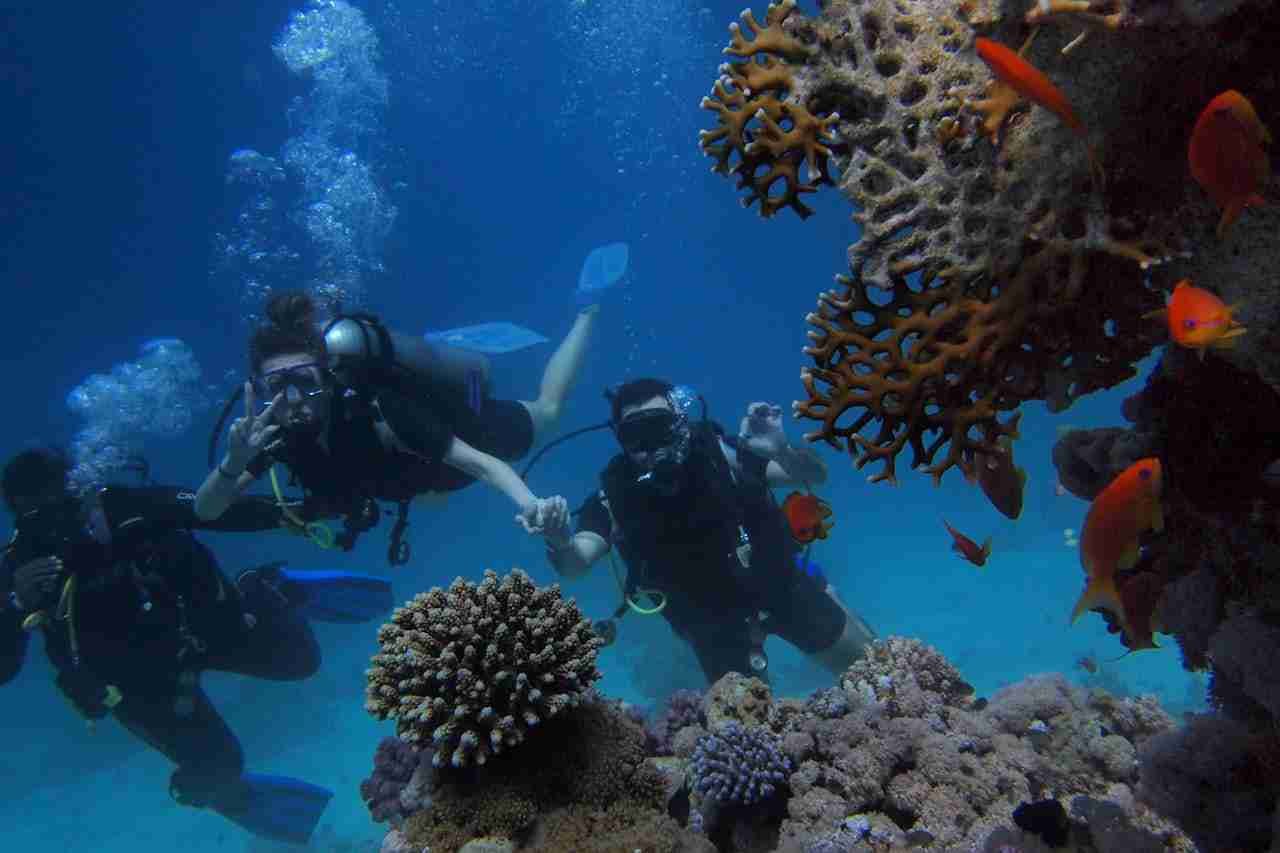
And, for someone who loves the sea and marine life, the Red Sea Coast is the place to be. Its crystal-clear turquoise waters, colourful coral reefs, and abundant sea creatures make it a true paradise for scuba divers and beach lovers alike. Personally, I consider Egypt’s Red Sea Coast diving experience to be one of the best in the world. Moreover, you can dive here throughout the year with the best diving conditions. Besides diving, you can engage in various other adventure activities, such as snorkelling, windsurfing, and kitesurfing. Or, you can just enjoy beach walks.
Red Sea Coast is one of the best places to visit in Egypt for the stunning marine life.
Abu Simbel
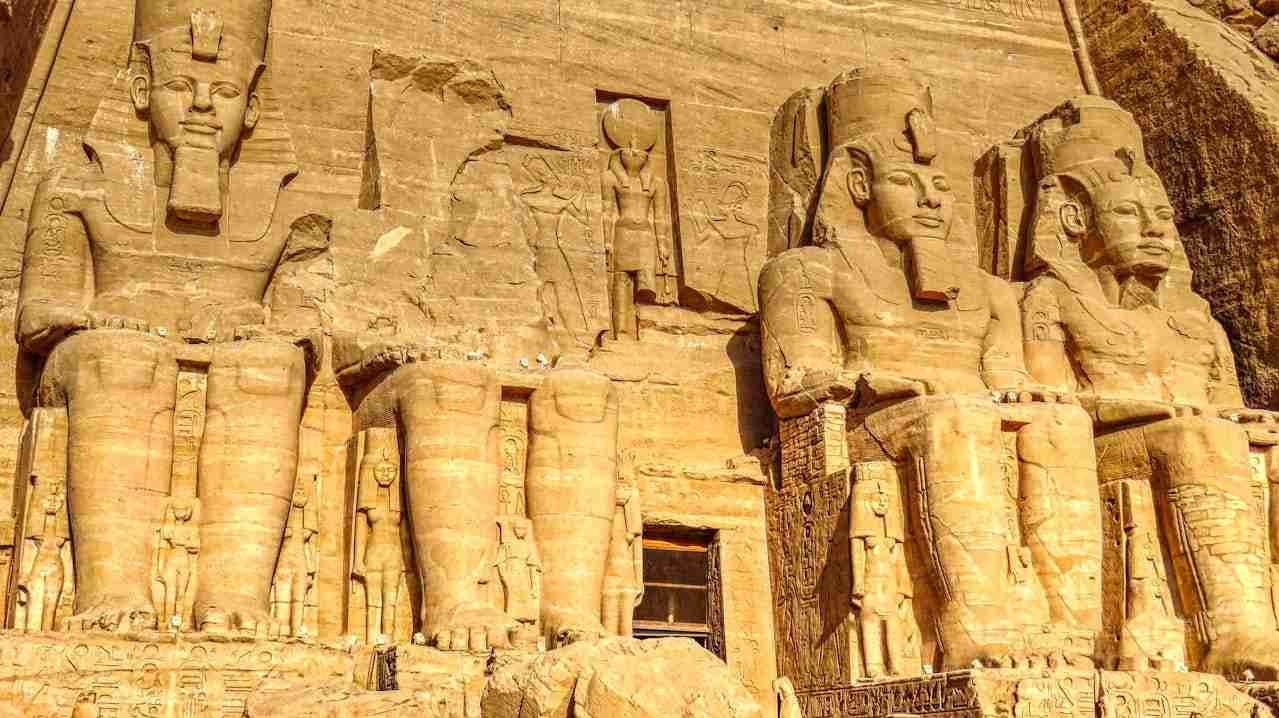
Situated on the southern side of Egypt near the border with Sudan, Abu Simbel is another historic site famous for the two massive rock-cut temples constructed by Pharaoh Ramses II in the thirteenth century BCE. The temple features four gigantic statues of the king, each towering over 20 metres. Both the exteriors and the interiors of the temple are impressive, with intricate paintings and carvings portraying scenes from the pharaoh’s life.
These are just a few of the best places to visit in Egypt. This African jewel boasts an incredible diversity of stunning landscapes, sure to leave you amazed.
Exploring the Diverse Terrains of Egypt via waterways
The mighty Nile River is the beating heart of this magnificent country, which has been the lifeline of Egypt for thousands of years. The Nile has been the cradle of the ancient Egyptian civilisation that once thrived along its banks. If you wish to immerse yourself in the beauty and serenity of this legendary river, there is no better way to do so than by taking a River Nile Cruise. You navigate through some of Egypt’s most historic towns and cities, bridging the gap between the past and the present.
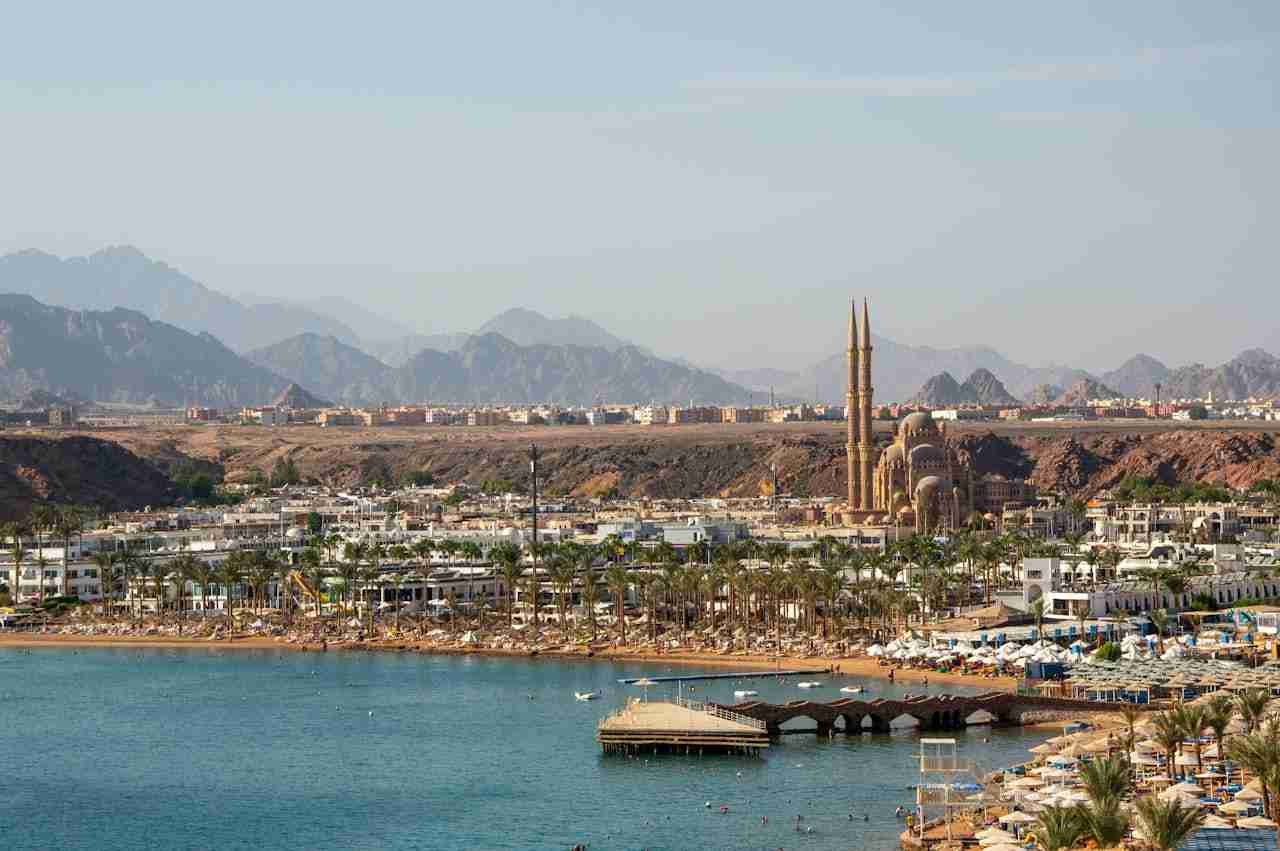
View of the Sharm El Maya Bay in Sharm El Sheikh, Egypt – Photo by Vika Glitter
However, let me warn you that your biggest challenge would be picking up the best River Nile Cruise itinerary. There are just too many options available – from a 3-night Nile cruise to exotic trips lasting 10 to 14 days. Whichever duration you choose, remember that most River Nile cruises travel from Luxor to Aswan or vice versa with frequent stops. The most popular River Nile Cruise itinerary covers about 200 km in three to four days. Still, depending on your preference, it can be slowed down or paced up. Both cities are well connected from Cairo by air; however, a far more enjoyable and sustainable option is to travel through an overnight sleeper train.
You can opt for a complete Cruise holiday in Egypt or include shorter cruise journeys as a part of a longer, land-based trip clubbed with other prominent destinations such as Cairo or Sharm el-Sheikh.
But whatever itinerary you pick up, remember selecting the best Nile Cruise is about choosing which boat you want to stay on and what sites and tours you want to cover.
Here’s a standard Aswan to Luxor Cruise Itinerary:
Day 1: Explore High Dam and Philae Temple
Day 2: VisitAbu Simbel (optional) and Kom Ombo
Day 3: Spend time at Edfu Temple, Karnak, and Luxor Temple
Day 4: Experience hot air balloon (optional), Colossi of Memnon, Temple of Hatshepsut, and Valley of the Kings.
Depending on your budget and time, you can choose a private or group tour. And you can even personalise your cruise experience. If you are hard-pressed for time, opt for Nile Air flights instead of doing a Nile River cruise.
Exploring the Varied Terrains of Egypt via its Deserts
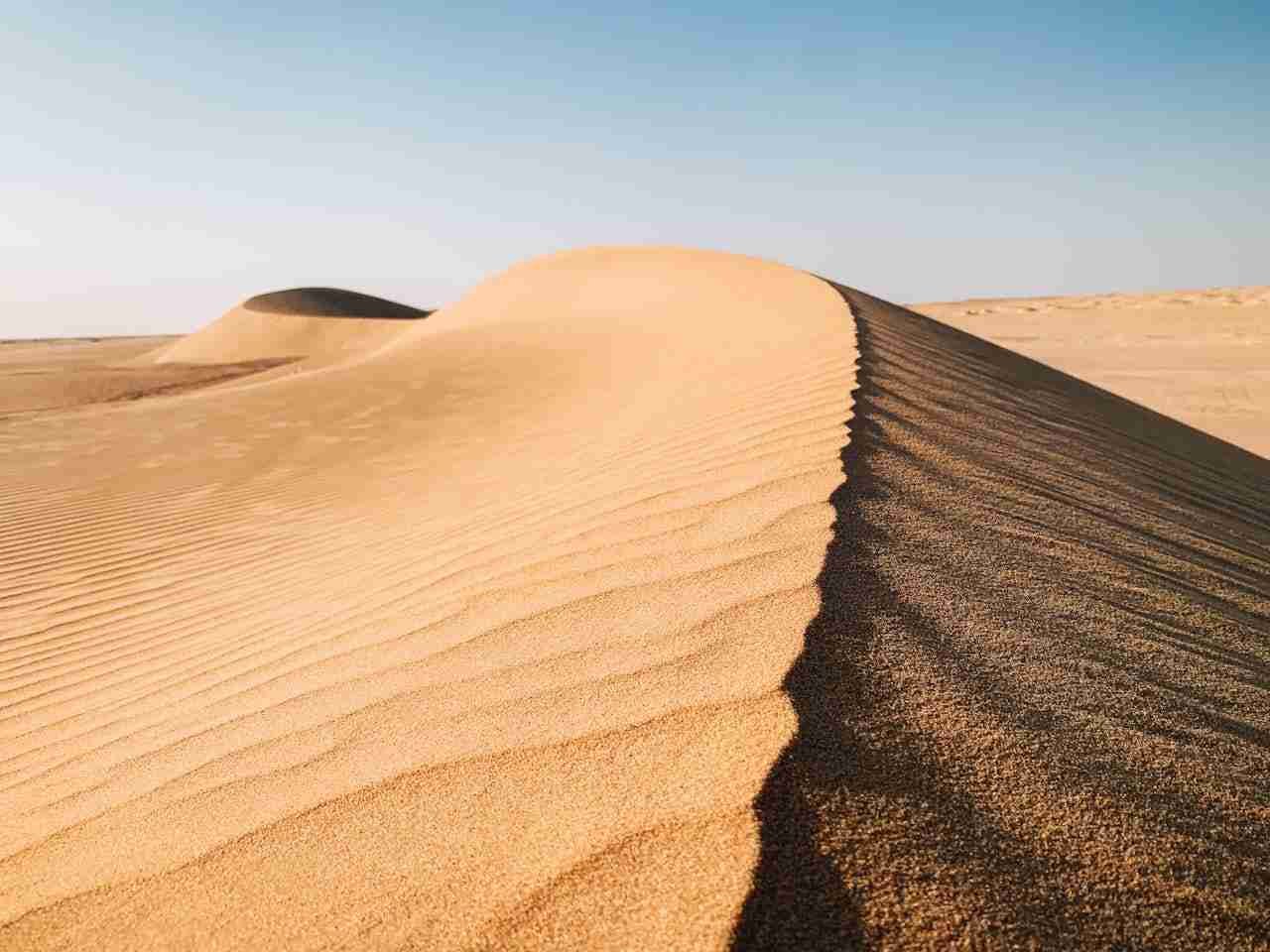
If you thought that Egypt’s natural splendour is limited to its water bodies, you would be mistaken. The deserts in the country are just as remarkable, each possessing its charm. From the allure of the White Desert to the vastness of the Sinai Peninsula traversing Egypt’s diverse landscapes through a desert, it promises an extraordinary journey of exploration and excitement.
A trip to Egypt is incomplete without exploring its deserts.
The Mysterious White Desert
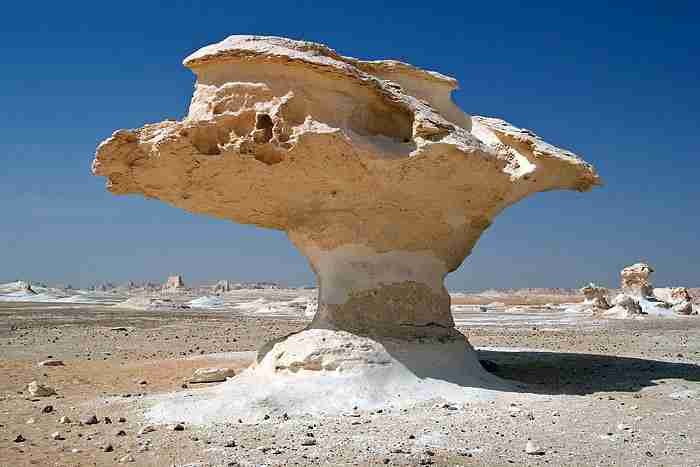
Situated in Egypt’s Western Desert, the White Desert is a landscape characterised by rock formations sculpted over centuries by the relentless forces of wind and sand. While wandering through this terrain, one encounters towering limestone columns and whimsical shapes that seem to defy gravity. These rocks take on a golden tint at sunset, enhancing the desert’s beauty and casting a captivating glow across the scenery. Spending a night camping beneath the stars in this marvel allows you to tune into the rhythms of the desert and witness the enchantment of the nocturnal sky.
White Desert is definitely one of the best places to visit in Egypt. Photo by Wikipedia. https://en.wikipedia.org/wiki/White_Desert_National_Park
The Majestic Sinai Peninsula
To the east lies the Sinai Peninsula, with its rugged mountains, pristine beaches, and vibrant coral reefs. I loved this wilderness paradise for its plethora of adventure activities, such as hiking through the rugged terrain of Mount Sinai and diving in the crystal-clear waters of the Red Sea. For those seeking spiritual enlightenment, a pilgrimage to Mount Sinai – believed to be the site where Moses received the Ten Commandments – is a profound experience. As the sun rises over the desert peaks, illuminating the landscape in a golden glow, you’ll feel a sense of awe and reverence that is both humbling and inspiring.
While exploring Egypt, do consider visiting the Suez Canal. This marvel of modern engineering has played a crucial role in global trade since its opening in 1869, and its strategic importance is still felt today. Whether you’re a history buff or simply curious, the Suez Canal is definitely worth a visit.
Immersion in the Local Culture and Traditions of Egypt
From the beginning, I have always believed that to experience the soul of a destination truly, one must become a part of their daily lives and experience day-to-day life as the locals do. Therefore, to truly experience the magic of Egypt, it is imperative you immerse yourself in its vibrant culture and century-old traditions. When you engage with the local Egyptian communities, sample their traditional cuisines, and participate in their cultural programs, you’ll get real insights into the soul of this ancient land. I bet you’ll never be able to forget the mouth-watering taste of savouring koshary (Egypt’s beloved national dish) in a bustling Cairo market or witnessing the larger-than-life spectacle of the Abu Simbel Festival. At the end of your trip, you’ll wish you had more time in hand as there’s no shortage of experiences to enrich your journey through Egypt.
Suggested 10-day Itinerary for Egypt
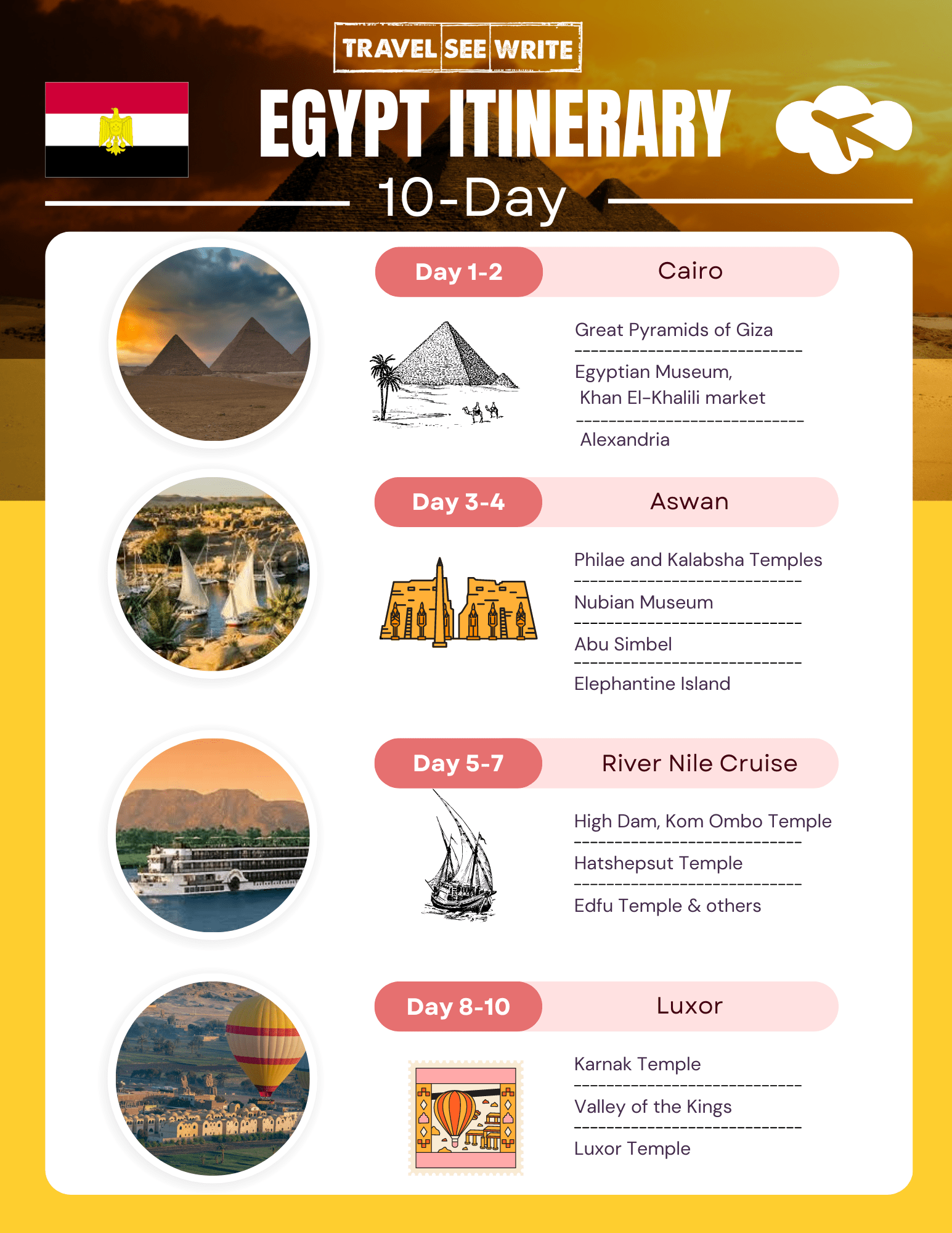
Whether visiting Egypt for the first time or returning to the enchanting land, consider at least a 10-day trip to cover some of the best places to visit in Egypt. Although even months are less to explore the beauty of Egypt, this 10-day trip will give you a reasonable amount of time to explore the beauty of the Nile and observe the daily life of the locals closely along its banks. Ideally, it would be best to start your Egypt holiday with a 2-day exploration of its capital – Cairo – and then head south to Aswan for another two days. Post that, you can enjoy a 3-day cruise on the Nile River before wrapping up your trip in Luxor with a 3-day stay.
Here’s what my Egypt itinerary looked like:
A suggested 10-day Itinerary to visit the best places in Egypt.
Day 1 to 2: Cairo
I started my journey by exploring the iconic attractions of Cairo, which obviously included the Great Pyramids of Giza (one of the world’s seven wonders), the Sphinx, Sakkara, the renowned Egyptian Museum, and the bustling Khan El-Khalili market. If you can afford it, I highly recommend staying at the Mamlouk Pyramids Hotel for an exceptionally great view of the Pyramids and the Sphinx illuminated at night. Or even a morning view with your tea and coffee overlooking these magnificent structures is fantastic. Alternatively, on the second day, you can visit Alexandria too.
Day 3 to 4: Aswan
After your heart is full of Cairo attractions (which I highly doubt), you next move to Aswan to discover the ancient gems such as the Philae and Kalabsha Temples. Either go on an island tour or explore the fantastic museums of Aswan. Both the Nubian Museum and Aga Khan Mausoleum are great. After that, go on a day trip to the remarkable Abu Simbel to witness the amalgamation of ancient architectural styles and modern engineering techniques that will blow your mind away. Also, I highly recommend staying at any of the West Bank guest houses to experience this ancient city’s authentic charm. I loved interacting with the locals during ferry rides across the Nile River.
Day 5 to 7: River Nile Cruise
Next, board the Aswan to Luxor multi-day Nile Cruise for a captivating journey down the Nile. You can choose a traditional felucca or a luxurious cruise ship, depending on your budget. This enchanting trip across the divine waters of Egypt will bring you up close to the greatest archaeological wonders ever created in this world. You’ll see the timeless beauty of Egypt’s landscapes and landmarks, such as the High Dam, Kom Ombo Temple, Hatshepsut Temple, Philae Temple, Edfu Temple and other historical landmarks.
Day 8 to 10: Luxor
Your Nile cruise journey will end at Luxor, where, once again, you’ll get an opportunity to explore more ancient wonders of the world. There’s so much to explore between Luxor’s East Bank and West Bank. You’ll be torn between what to choose – the stunning temples of the East Bank or the astounding tombs of the West Bank. Personally, even five days is too little to explore this magnificent city. Still, three days is the minimum you should keep for here. There are just so many sights to see. I definitely suffered from FOMO while exploring Luxor. The architecture of the awe-inspiring Karnak Temple, the mystical Valley of the Kings, the majestic Luxor Temple, and the enlightening Luxor Museum blew me away. And, if you really want to experience something totally outstanding – go for an early morning hot air balloon ride over the enchanting landscapes of Ancient Egypt. If you like to stay away from the crowd yet be close to the best places to visit in Egypt, stay in the quieter environs of the West Bank area.
I had a blast following this 10-day Egypt itinerary. I hope this personally curated itinerary will work for you, too, and you’ll have an unforgettable experience in Egypt.
Practical Tips for Travelers – Do’s and Don’ts in Egypt
When planning a trip to Egypt, remember that there are various logistics and practicalities to consider that can make or break your holiday. Here are some practical tips for you to follow:
To enjoy the best places in Egypt it’s important to know the Do’s and Don’ts before your visit.
Is it safe to travel to Egypt in 2024? One of the things that I always check before booking a trip to a new country is its safety rating. Despite the ongoing Israel-Gaza conflict, it is very safe to visit Egypt for tourists. However, please ensure that you book your trip through a reputed local tour operator and take precautions while travelling in the country. Do not flash your cash, valuables or jewellery; stay lowkey, stick to well-lit areas, remain vigilant of your surroundings in crowded places, and most importantly, be aware and smart about your surroundings.
What visa is required for Egypt: If you are an Indian citizen like me, you must get an e-visa or visa on arrival for Egypt. The process to get an Egypt e-visa is very simple and straightforward. All you have to do is visit the official Egypt visa website and submit the required personal and passport details. You’ll need to share your recent passport photograph and pay a visa fee, which is ₹2,350 for a single-entry visa. You will receive an electronic visa within eight business days (if approved). Alternatively, you can get a traditional visa through the nearest Egyptian embassy or consulate in India. If you have a valid US visa, you can get one in Egypt on arrival—don’t forget to research visa requirements and travel restrictions before planning your trip to Egypt.
How to reach Egypt: Many international airlines offer connecting flights from major Indian cities to Cairo or other airports in Egypt. Choose the airlines that suit your schedule, budget and preferences. While there are several international and Indian airlines flying to Egypt, Nile Air offers direct flights from several Indian cities to Cairo. Check their website for flight schedules and booking options.
What Not to Bring: To have a wonderful stay in Egypt, avoid making the usual mistakes tourists make by knowing what to bring and what not to bring in Egypt. While packing for your trip to Egypt, avoid packing clothes that are too skin revealing as the locals may not like. Definitely do not carry strictly prohibited items such as drugs, firearms (even toys), and pornographic items. Do not bring your drone unless you have secured flying permission from the authorities. Egypt has prohibited the use and trade of drones. You don’t want to land in jail trying to fly your drone around the Pyramids. Also, don’t carry a large amount of cash to avoid any problems at the customs. Instead, use a Forex card or Scapia credit card.
Dress code: Egypt is predominantly Muslim; therefore, as a traveller (especially if you are a solo female traveller), be mindful that it’s absolutely essential (not optional) to dress modestly. Respect the local customs and culture. You are visiting their land, and it’s your duty to adapt to their culture. Not vice versa. Wear something lightweight, easy to carry, and covers your shoulders, chest and knees. When entering temples or mosques, remove your shoes and avoid public displays of affection for your partner.
Public Transportation: Travelling within Egypt is very convenient as the country has an extensive and reliable network of trains, buses, and domestic flights. Overnight trains are good for long journeys, but be careful to carry your food if you are a vegetarian. Buses and taxis are a good option for shorter trips or commuting within cities. It’s easy to book an Uber, inDriver, easy taxi or any local cab in Cairo and other Egyptian cities.
Best Way to Explore Egypt: While there are hundreds of ways to explore Egypt, the best way to do so is by immersing yourself deeply and slowly into a perfect mix of heritage, culture, food, nature and adventure. Plan a trip that takes you to the best places in Egypt, including the ancient temples, cruise along the Nile, sample delicious Egyptian cuisine and interact with friendly locals.
Hiring a local guide: Guided tours with a knowledgeable local guide in Egypt can enrich your travel experience to several notches by providing insights into the country’s history, culture, and landmarks. You’ll be able to connect with the place and people more deeply. Therefore, before booking a trip, research finding reputable tour guides or local operators who can tailor an itinerary per your interests while delivering the best of their country.
Avoid Travel Scams: Don’t entertain random strangers or vendors on the road who try to sell you their tours. Always book from registered tour operators only.
Accommodation in Egypt: Another vital point to consider before travelling to Egypt is to book accommodation and transportation in advance. This comes in handy to get good deals and save money, especially when you travel during peak season when demand is high. If possible, travel in shoulder season. From high-end luxury resorts to cosy guesthouses, Egypt caters to all kinds of budget travellers. By booking in advance, you can ensure a comfortable and convenient place to stay throughout your trip.
Visiting Cairo: It is convenient to start your Egypt tour journey from Cairo, the bustling capital of Egypt. There are many iconic landmarks to cover, such as the Pyramids of Giza, the Sphinx, and the Egyptian Museum. But don’t forget to explore Old Cairo’s vibrant markets and neighbourhoods. If you have time, visit the City of the Dead or enrol yourself in a potter class. It’s pretty fun to do such activities.
Nile River Cruises: It is a must-do when visiting Egypt to experience the otherworldly beauty of Egypt’s ancient temples and diverse landscapes. Nile cruises typically last 3-4 days and include stops at Aswan, Luxor and other historic sites along the river.
Is it worth visiting the Suez Canal? While the Suez Canal may not feature on traditional Egypt travel itineraries, it is 100% worth visiting as it holds immense historical and economic significance in the growth of modern Egypt. You can opt for a guided tour or visit a few observation points to observe points to learn about the Suez Canal’s significance.
When is the best time to visit Egypt in 2024? Winter is the peak season to visit Egypt as the weather is cool and ideal for exploration. However, I recommend visiting during the shoulder seasons (spring and autumn) to enjoy the stunning sights without crowds and milder weather.
How many days are enough for Egypt Travel? Ideally, a 7-10 trip is good to explore the highlights of Egypt. However, on a tight schedule, you can still cover the major cities in 5 to 7 days. If you want to travel slowly and explore more off-the-beaten-track hidden gems of Egypt, keep 10 to 14 days.
I hope these travel tips help you plan an enjoyable and safe trip to Egypt.
Travel Sustainably through Egypt
As a responsible traveller, I urge you to prioritise sustainability over unsustainable practices. Respect Egypt’s cultural and natural heritage, support local communities and small business owners by buying local products and participate in initiatives to preserve Egypt’s natural and heritage treasures. Choosing adventure activities and travelling responsibly will help minimise your environmental impact and contribute positively to the local economy. And please don’t ride camels or horses.
Conclusion
Beyond the pyramids lies a world of the best places to visit in Egypt. Go visit!
Beyond the pyramids lies a world of wonder waiting to be explored. From the hustle-bustle of big cities to the tranquillity of the countryside, Egypt is a tapestry of history, culture, cuisine, and natural beauty. By taking the road less travelled and immersing yourself in the local customs and landscapes, you will gain a profound appreciation for this ancient land and its enduring legacy. I hope with this Egypt Travel Guide, you can go beyond the Pyramids and experience an unforgettable journey. So, pack your bags and get ready to discover the hidden gems of Egypt.
Discover the perfect Valentine’s Day gifts for your travel-loving partner. From useful gear to romantic experiences, craft a love story in every adventure.
Best Valentine’s Day gifts for your travel-loving partner should be thoughtful and useful.
Valentine’s Day, a celebration of love, often leaves many in contemplation as they search for the perfect gift for their adventurous significant other. In a world where moments are fleeting and landscapes ever-changing, the quest for an ideal Valentine’s Day gift can be challenging, particularly for those passionate about exploration. Traditional tokens of affection, such as red roses and chocolates, may fall short of capturing the heart of a traveller whose soul resonates with the call of distant horizons and new experiences. Having navigated the dilemma between needs and unwanted gifts personally, this guide aims to assist those seeking thoughtful and useful Valentine’s Day presents specially tailored for partners with an insatiable love for exploration. This updated list for 2025 includes fresh ideas to help you find the perfect Valentine’s Day gift for your adventurous soulmate.
1. Travel Clothing and Gear: Elevate the Journey
To enhance your partner’s travel experience, consider gifting sustainable and fashionable clothing and gear. Opt for items that go beyond trends and contribute to a more eco-friendly lifestyle. Renowned sustainable brands like Patagonia, Columbia, North Face, Decathlon, People Tree, or Amala Earth offer a range of options to build a stylish yet responsible travel wardrobe, ensuring comfort and sustainability on their journeys. I couldn’t have survived my Arctic to Antarctica Journey without Columbia Sportswear.
Best Valentine’s Day gifts for your travel-loving partner- sustainable travel clothing and gear
When choosing travel clothing and gear, think beyond aesthetics. Sustainable materials, durability, and versatility should be at the forefront. Brands like Patagonia emphasize environmental responsibility, offering clothing that not only looks good but also aligns with a commitment to ethical practices. From moisture-wicking hiking boots to stylish yet eco-friendly hats, each piece becomes a sustainable companion in their explorations, resonating with their love for both fashion and the environment.
2. Travel Bags or Accessories: A Stylish Companion on the Move
Acknowledge the wear and tear faced by frequent travellers by gifting a hardy and stylish travel bag like the Mokobara bag. Enhance their travel organization with accessories such as durable luggage tags, compact packing cubes, or multipurpose travel organizers. These additions ensure their adventures remain organized and enjoyable, making every journey a seamless experience.
Best Valentine’s Day gifts for your travel-loving partner- sturdy and stylish travel luggage and accessories.
The Mokobara bag, known for its durability and style, becomes more than just luggage; it’s a reliable companion on their journey. When considering accessories, think about the practicality and organization they bring to the chaotic world of travel. Durable luggage tags not only add a personal touch but also ensure their bags find their way back if ever lost. Compact packing cubes, with their ability to compartmentalize belongings, make packing and unpacking a breeze, transforming their travel routine into a well-organized adventure.
3. Scapia Card for Forex Exchange: Simplify Financial Adventures
Navigating foreign currencies can be a challenge for avid travellers. Gift them a Scapia card to simplify their financial experiences abroad. This thoughtful gesture ensures that they can focus on the joys of exploration without worrying about expensive forex exchange rates, providing financial ease and peace of mind.
Scapia is the best credit card for travellers.
The Scapia card becomes their financial passport, easing the complexities of international travel. Explain the convenience it brings, allowing them to spend without the stress of constantly calculating exchange rates. Emphasize the peace of mind it provides, knowing that their financial transactions are secure and efficient. This practical gift not only simplifies their journeys but also highlights your consideration for their seamless travel experiences.
I knew it was meant for me when I first read about its features. What truly won me over was the ZERO FOREX MARKUP it offers. In simple terms, cardholders like me won’t have to bear currency conversion charges when we use our Scapia credit card to pay for transactions in foreign currency. As someone who’s always travelling abroad, this is a game-changer. I have stopped carrying physical currencies and instead use my Scapia card wherever I go.
Another feature I love about Scapia is its unlimited lounge access across India after spending just 5000 INR a month. Earlier, I used HDFC Credit cards for lounge access, but after HDFC Bank Regalia Card changed its lounge access terms and conditions (increasing the minimum spend of Rs.1 Lakh or more in a calendar quarter, Scapia became my saviour.
Lounge Access is an important feature for travellers when choosing a credit card.
Also, for every online and offline spending, the card offers 10% off Scapia coins. On booking travel through the Scapia app, you receive 20% Scapia coins.
4. Photography Equipment: Capture the Moments Forever
For the photography enthusiast, consider investing in a telephoto or prime lens to capture the essence of their travel experiences. If budget constraints come into play, smaller accessories like mobile gimbals, ND filters, lights, or SSDs can still significantly boost their photography skills. Alternatively, a membership to photography apps or an online editing course provides a thoughtful opportunity for them to nurture their creative side.
Best Valentine’s Day gifts for your travel-loving partner – gift them the photography equipment they need.
Photography equipment becomes more than just gadgets; they’re tools that transform moments into memories. A telephoto lens allows them to capture distant landscapes with clarity, turning each photograph into a visual journey. When budget considerations arise, smaller accessories like mobile gimbals become the unsung heroes, ensuring smooth footage of their adventures. Investing in their photography skills with a membership to apps or online courses not only hones their craft but adds a layer of personal growth to their travel experiences.
5. Adventure Holiday: Elevate Wanderlust to New Heights
Surprise your partner with an adventure holiday to a destination they have yet to explore. Tailor the experience to their preferences, whether it involves adrenaline-pumping activities like skydiving or bungee jumping or more serene pursuits like wine tasting and cultural immersion. This gift not only satisfies their wanderlust but also creates lasting memories of a shared adventure, strengthening the bond between you.
Best Valentine’s Day gifts for your travel-loving partner – an adrenaline-filled adventure activity.
Choosing an adventure holiday involves delving into their travel dreams and desires. If they’re adrenaline junkies, consider destinations known for activities like skydiving, bungee jumping, or even rock climbing. For those who find solace in serene environments, a destination with wine tasting, cultural immersion, or nature retreats becomes the perfect canvas for creating memories. Tailoring the adventure to their preferences ensures that each moment is not just thrilling but deeply personal.
6. Memorabilia: Craft a Time Capsule of Shared Adventures
Celebrate the beautiful moments you’ve shared on past holidays by creating a personalized collage or planning a nostalgic date night. Compile photos, tickets, and mementoes from your travels together, crafting a tangible reminder of your adventures and the unique bond you share. This personalized touch adds sentimentality to your gift, reminding them of the countless memories created together.
Creating a time capsule of memories goes beyond the physical act of compiling photos and mementoes. It’s about curating an experience that reflects the depth of your connection. Consider including handwritten notes or anecdotes alongside the items, narrating the stories behind each memory. The result is not just a collage but a storytelling masterpiece that captures the essence of your journey together.
7. Destination-themed Dinner: A Culinary Expedition for the Palate
Indulge their taste buds with an authentic dining experience inspired by their favourite destination. Whether it’s savouring sushi in a quaint Japanese restaurant or indulging in tapas at a Spanish eatery, choosing a cuisine that resonates with their travel aspirations can turn a simple dinner into a romantic journey for the senses. This culinary adventure becomes a shared experience reminiscent of their favourite travel destinations.
Valentine’s Day gifts for your travel-loving partner – destination-themed dinner of their choice
A destination-themed dinner becomes a culinary expedition, an exploration of flavours that transport them to the heart of their favourite destinations. Dive into the details of the chosen cuisine, explaining the significance of each dish and its connection to their preferred travel spots. Consider going the extra mile by recreating a specific ambience or incorporating elements that mimic the destination, turning the dinner into a sensory-rich journey.
8. Travel-Inspired Home Decor
Help them bring travel vibes home by gifting thoughtful items such as wall art featuring their favourite destinations, globe-shaped fairy lights or stylish world map clocks. But my favourite is the scratch-off world map. Help your partner keep track of their travels with a scratch-off world map. Updated for 2025, many maps now include detailed regions, flags, and even notable landmarks. It’s a fun way to visualize future travel goals.
9. Travel-themed Puzzle: Bring Exploration Home
Bring the joy of exploration indoors with a challenging travel-themed puzzle. Featuring maps, landmarks, or breathtaking landscapes, each piece becomes a reminder of their love for travel. Perfect for cozy evenings at home or during downtime on their journeys, this gift adds an element of entertainment and relaxation to their travel-inspired lifestyle.
A travel-themed puzzle becomes a symbolic representation of their wanderlust-filled heart. Delve into the selection process, emphasizing the choice of maps, landmarks, or landscapes that resonate with their travel experiences. Describe how each piece becomes a small fragment of their adventures, creating a meditative and enjoyable pastime. This gift not only stimulates their minds but also provides a quiet moment of reflection, fostering a connection with the places they’ve explored.
10. Travel Gadgets for the Tech-Savvy Nomad
Keep their travel tech game strong with thoughtful gadgets:
Portable Power Bank: Ensure their devices stay charged during long trips. The portable power bank becomes a reliable companion, ensuring their devices stay charged to capture every moment of their adventures. Highlight the technological features, such as fast charging and multiple USB ports, that cater to the diverse needs of their gadgets.
Smart Luggage Tracker: Avoid the stress of lost baggage by getting Bluetooth-enabled tracking devices such as Pebblebee that help users locate personal items like keys, wallets, and bags.
Travel esim: Why spend thousands of dollars on international roaming when travel e-sims are available? Choose a company like Hubbing Ecom E-SIM that works in 120+ countries. Not only do they provide global coverage, but they also ensure you get the best price, as they partner with multiple local partners for affordable rates. Perfect gift for digital nomads & travellers!
Wireless Noise-Cancelling Earbuds: Perfect for flights or remote work on the go.
Language Translation Wireless headphones: If your partner is someone like me who travels a lot out of the country and struggles with language translation, then language translation wireless headphones or earbuds could be a great gift. They are advanced audio devices that offer real-time language translation through integrated software or apps, allowing users to communicate seamlessly across different languages.
Language Translator Earbuds Support more than 50 Languages & Accents
11. Travel-inspired Fragrance: A Scented Journey
Transport your partner to distant lands with a travel-inspired fragrance. Choose a perfume or cologne that captures the essence of their favourite destinations – whether it’s the refreshing scent of a coastal breeze or the earthy notes of a mountain retreat. Each spritz becomes a sensory reminder of their passion for exploration, adding a touch of wanderlust to their everyday routine.
A travel-inspired fragrance becomes more than just a scent; it’s a sensory journey that lingers on their skin. Dive into the selection process, describing the specific notes that encapsulate the essence of their preferred destinations. Discuss how each spritz becomes a personal ritual, a moment of escapism that transports them back to the places they love. This intimate and sensorial gift adds an extra layer of connection between their daily life and their travel experiences.
In the quest for the perfect Valentine’s Day gift, it’s essential to remember that it’s the gesture and thoughtfulness that truly matter. It is key to understanding your partner’s unique interests, embracing their adventurous spirit, and creating moments that resonate with the rhythm of their wanderlust-filled heart. With these ten thoughtful and useful gift ideas, you’re not just giving a present; you’re crafting a love story that unfolds in every new destination and shared adventure. As someone who has navigated through the maze of mismatched gifts, let this guide be your compass to find the ideal Valentine’s Day gift that resonates with the adventurous spirit of your travel-loving partner. After all, the best gifts are the ones that accompany them on their journey, weaving your love into the fabric of their adventures.
Discover why Moscow is so special in this article and what to know before visiting Russia.
In a world where media narratives often shape our perceptions, my journey to Moscow aimed to pierce through the veil of biases and discover the authentic essence of this iconic city during the festive season. Through this blog post, I will try to debunk many myths surrounding Russia and explain why you should visit Moscow, Russia. I will try to answer honestly whether it is worth visiting Moscow in December. And, if yes, then what are the dos and don’ts of visiting Russia for the first time? I hope this article serves as a testament to the unforeseen wonders that unfold when one sets aside preconceived notions and embraces the spirit of exploration. Join me on this enchanting journey as I recount the allure of Moscow, its unique Christmas and New Year celebrations, and a meticulous itinerary that unravelled the city’s winter magic and convinced me it’s totally worth visiting Moscow in December.
Find out everything you need to know about Christmas-New Year time in Moscow, Russia.
Why did I choose to visit Russia in December?
Moscow is theChristmas capital of the world, and celebrations here are a bit different and grander than in Western Europe.
Different people have different rituals and superstitions for the New Year; mine involves welcoming the New Year in an unexplored destination. Some fifteen years ago, I promised myself that I’d celebrate the new year in a new country as a mark of new beginnings. I have been able to follow this little promise until now.
In early November 2023, when Moscow Seasons extended an enticing invitation to visit Moscow and experience the Journey to Christmas celebrations in the Russian capital, curiosity got the better of me. Unfazed by media narratives, I was keen to witness the culture and traditions of a country that has been on my travel list for a long time. And the timing couldn’t have been better. Having traversed through Christmas markets across Europe, from the enchanting Strasbourg to the imperial Vienna, vibrant London to historic Berlin, picturesque Switzerland to the charming Zagreb and the Czech Republic, I was eager to discover the distinctive charm of Russian Christmas markets and traditions. This marked the genesis of my journey, a quest to unravel the unique tapestry of Russia during the festive season.
Best Christmas Destinations in Europe
Below, I am sharing my personal experiences about why should you visit Moscow, Russia, honest impressions, and a day-by-day itinerary capturing the enchantment of Moscow, especially during the renowned “Journey to Christmas” festival.
What is the journey to Christmas in Moscow?
“Journey to Christmas” is not just a festival; it’s a grand celebration that has been transforming the streets and squares of Moscow since 2013. As the festival marked its 10th anniversary, it unfolded as a colossal New Year and Christmas extravaganza from December 15, 2023 to January 8, 2024.
With 36 festival grounds across the city, “Journey to Christmas” amalgamated traditional Russian Christmas fairs with contemporary ideas, creating a Christmas fairy tale town with illuminations, art installations, ice shows, theatrical performances, and much more. It was a magical experience that I have not experienced anywhere else in the world.
Find out why Christmas and New Year is the best time to visit Moscow, Russia.
Now, let me drill down further and share my Moscow itinerary to give you a better idea of things to know before visiting Russia from India and the best places to visit in Moscow.
Day 1 – Arriving in Russia
I took a direct Aeroflot flight from Delhi to Moscow, Russia, which arrived at 10:30 am. Immigration was smooth and took around half an hour. However, some of my friends coming from Dubai and London had to wait for approximately two hours for a more stringent check. After collecting my luggage, it took me around 1.5 hours to reach my hotel due to the holiday rush.
I stayed at Moscow Hilton Leningradskaya in one of Moscow’s iconic Seven Sisters skyscrapers. Built in 1954 in the Stalinist neoclassical style, it married the Russian neoclassical style of using socialist realism art with the flare of American skyscrapers of the 1930s. The hotel was designed to be the finest luxury hotel in Moscow and, to date, is a prominent address in Moscow. It had an indoor heated pool with a Jacuzzi and sauna, a fitness centre, a restaurant, and a lounge bar.
From L to R – Aeroflot flight, queue at the Russian Immigration, Sheremetyevo Alexander S. Pushkin International Airport, and Moscow Hilton Leningradskaya
The best part was its location – less than half a kilometre from Leningradskiy Train Station and the Metro, a 15-minute metro ride from Red Square, the Kremlin, and St Basil’s Cathedral.
After a brief rest, I went on a Radisson Float Cruise to explore Moscow’s skyline. My knowledgeable guides, Daria and Timur, who were Spanish journalists turned passionate tour guides, accompanied me. The cruise was not just a journey on the Moskva River but an immersion into Moscow’s iconic sights, accompanied by a delightful dinner.
Onboard the Radisson Float Cruise and the Moscow Skyline seen from through the Moskva River.
Day 2 – Exploring Moscow’s Achievements in Economy and Space
Bundled in layers to combat the winter chill, I explored Moscow. Our first stop was the landmark Monument of Worker and Kolkhoz Woman (Lady Gardner and Worker), an ascent to the eighth floor offering a 360-degree view of the city.
The monument showcased a dynamic sculpted duo of two figures, a worker and a collective farmer, with their hands raised and touching, in which they hold a hammer and a sickle. Made of stainless chrome-nickel steel, it reached a height of 25 meters and weighed 185 tons; it was made to display at the 1937 World Exhibition in Paris. After the exhibition, it was installed here for public viewing, and today, it is one of Moscow’s symbols.
From there, we ventured to the exposition grounds of the International Russia Expo at VDNkH, adorned with festive decorations, snow sculptures, and digital tunnels. Our guide, Nataliia, informed us about the international exhibition and forum EXPO Russia being held from November 4, 2023, to April 12, 2024, at the VDNKh exhibition centre in Moscow. Its goal is to demonstrate Russia’s significant achievements in various sectors of the economy, with all 89 Russian regions participating. I spent some hours marvelling at Russia’s technological and economic strides.
The exposition grounds of the International Russia Expo at VDNkH were in a full festive mood.
89 Russian regions participated in the international exhibition and forum EXPO Russia.
The highlight of the day was the visit to the Model of Moscow, where a miniature version of the central part of Moscow came to life through VR technology. A captivating light show set to Russian music added a magical touch to the experience. When you are planning your Moscow itinerary, make sure to keep it as it is one of the best places to visit in Moscow.
Best things to do in Moscow – check out the Model of Moscow, where a miniature version of the central part of Moscow comes to life through VR technology
After the light show, it was time for lunch at “Moscow Sky“, where I was introduced to delightful culinary delights, including Russian fruit tea and honey cake. All my concerns regarding vegetarian food in Russia were put to rest here. The food and ambience were mind-blowing.
Later, I delved into Russia’s space history at the VDNkH Cosmonautics and Aviation Center, a giant exhibition chronicling the exploration of space and aviation development in Russia. Built in the 1930s, I learned the highlights of the Russian space program here. Yuliana, our guide, passionately narrated the Russian explorers’ past achievements, plans, and current space research. The Cosmos Pavilion museum consists of three major sections and more than 120 examples of space and aviation vehicles, including the originals used by the Russian astronauts. A 3D film about the Russian space program made me feel like an astronaut.
Cosmos Pavilion gives you an idea about Russia’s Space Program
The Cosmos Pavilion museum consists of more than 120 examples of space and aviation vehicles
The day concluded atop “The Sun of Moscow” Ferris wheel, providing a bird’s eye view of the city.
Day 3 – Moscow Zoo and Christmas Party
The adventure continued with a ride on the Moscow Metro to the Zoo, an architectural wonder designed by Stalin. The metro’s opulent stations resembled palaces and reflected Stalin’s vision of creating grand spaces for ordinary people.
Although I’m not a big fan of watching animals in captivity, I was told that Moscow Zoo is different. The Zoo, which opened in 1864, is the biggest in Russia and serves as a sanctuary for endangered species. The Zoo contains over 3,000 specimens of 550 species, from Siberian Tigers to endangered Russian leopards and adorable pandas. I was touched by the story of the Asian Elephants that were initially going to Cuba but were abandoned midway. If they had not been adopted by the Moscow Zoo, they would have been drowned in the sea by the ships carrying them. Thank goodness Moscow Zoo came to their aid.
Moscow Zoo is the oldest zoo in the country and has a great conservation history.
After a touching experience with animals, it was time to address the rumbling in my stomach. The Mediterranean-themed “Moro” restaurant at 5/6 Kamergersky Lane was the perfect remedy. The restaurant had a festive atmosphere and an open kitchen that served delicious vegetarian and non-vegetarian Mediterranean platters.
“Moro” restaurant is a great option for vegetarians and non-vegetarians in Moscow.
After lunch, I attended the “Moscow Tea Party” animation program at Tverskaya Square. It was a fantastic experience where I learned about the delicate art of Russian tea-making and the traditions that date back to the 19th century. Drinking hot tea from the ‘Samawar’ was an unforgettable moment. Adding spices and vitamin-C-enriched fruits like berries, oranges, and lemons makes Russian tea a unique and flavorful experience. Dariya, my local guide and a devoted tea drinker, explained that Russian tea is an expression of hospitality and a way for people to connect.
‘Moscow Tea Party’ is a great way to learn about traditional Russian Tea traditions in Moscow.
The entire atmosphere was festive and depicted a scene from an era long gone. Tverskaya Square resembled a tiny Christmas town, where children enjoyed riding the carousel, learned how to sew dolls, and cooked candies. Artists dressed in Tsar-era outfits and entertained guests with dance, music, and cultural activities.
Tverskaya Square is a big hit with kids and adults during Christmas time in Moscow.
The day concluded with a performance of the Russian national ballad “The Nutcracker”, an ice show presented by Russia’s finest figure skaters on Revolution Square. Aside from Revolution Square, 21 free skating rinks were available in various districts of Moscow.
One of the best things to do during Christmas time in Moscow is to see a traditional ballad performance such as “The Nutcracker.”
Following the ice show, we visited the Kremlin Square Christmas market, filled with the aroma of Christmas drinks, food, and laughter.
Red Square in one of the most visited venues during Christmas time in Moscow
Day 4 – Moscow Journey to Christmas Party
After experiencing the “Journey to Christmas” festival, I decided to explore more Christmas locations. My first stop was the Manezhnaya Square Christmas Fair and Designer Christmas trees near TSUM. At the square near TSUM Moscow, designers, digital artists, and students of creative universities created and installed 12 Christmas trees based on Samuel Marshak’s fairy tale “12 Months”. These were smart, tall fir trees decorated in the style of the New Year’s story about kindness and the triumph of justice.
I then went to Revolution Square, which was only 10 minutes away from TSUM, to learn a new sport – skating. After an hour of falling and standing, I barely knew how to stand still on skates. This experience made me realise how tough it is to be a figure skater.
Best Places for Christmas in Moscow – Manezhnaya Square and Revolution Square(Moscow in winter Photos
After the skating craze had subsided, it was time to visit Moscow’s most famous attraction – the Red Square, a UNESCO World Heritage Site. This prominent landmark is home to famous structures such as Saint Basil’s Cathedral, Lenin’s Mausoleum, and the GUM department store. Red Square has been the site of demonstrations, revolutions, executions, riots, parades, and speeches. However, during the Christmas season, the atmosphere is entirely different. Russia’s most renowned square is decorated with lights and ornaments and a festive market filled with antiques, art, and souvenir stalls. There were numerous traditional Russian snacks and Christmas drinks to savour and keep the chilly weather at bay.
What to do in Moscow in winter – visit the Red Square to see Christmas & NYR decorations.
At approximately 3:30 pm, I ate at the Soviet retro cafe named “Varenichnaya № 1” located on Nikolskaya Ulitsa Street, which became viral during the Russian FIFA World Cup 2018. I tasted traditional Russian dishes such as cabbage dumplings, soup, Napoleon cake, honey cake, etc.
Why should you visit Moscow, Russia, in winter – to get a taste of traditional Russian cuisine in Moscow at Varenichnaya № 1?
Later, at 6:00 pm, I went to the Moscow City “Panorama 360” observation deck. PANORAMA360 offers breathtaking views of Moscow from six-metre-tall windows. Unfortunately, it was foggy, and I couldn’t see anything. However, I enjoyed some ice cream and milk chocolates made in-house at the observation deck. The chocolate production facility is the highest chocolate production facility in Russia!
Moscow in winter – one of the best places to visit in Moscow, Russia, is PANORAMA360.
Day 5 – Exploring Red Square and GUM Again
Feeling drawn to Red Square and GUM, I returned to explore these iconic locations. But before visiting them, I went to see an Ice Cave experience that aimed to replicate the conditions of the ice caves at Lake Baikal in Russia. Although the 6-minute light and music show fell slightly short of my expectations, the Christmas market more than made up for it with its vibrant offerings.
Why should you visit Moscow, Russia? Definitely to see St. Basil’s Cathedral.
Afterwards, I visited St. Basil’s Cathedral and spent more hours at the Christmas market. It was a poignant moment, knowing that this very place had been targeted by Ukrainian drones in July 2023 during drone attacks. As night fell, I said goodbye to the hotel and embarked on a night train journey to St. Petersburg.
Day 6-9 – Visiting St. Petersburg and Novgorod
The following four days were spent exploring the captivating cities of St. Petersburg and Novgorod, each possessing their unique charm and cultural richness. Please check out the upcoming detailed posts about each city.
Day 10 – Returning to Moscow
On the final day of my trip, I returned to Moscow from Novgorod via a night train. The day was full of exciting experiences as I visited Ismailova Market for shopping, attended a Russian tree decoration workshop at Kremlin Square at 3:30 pm, and gained insightful knowledge from my visit to the Vodka museum. It is definitely one of the best places to visit in Russia in December or in summer.
As the clock struck 3:30 pm, it was time to say goodbye to Daria, my knowledgeable guide, and her mother, Ola, and prepare for my flight back home at 7:30 pm.
10 Russia Travel Tips – List of Tips for a Perfect Russia Trip
Is it worth visiting Moscow in December – absolutely, yes, if you love snowscapes.
How to apply for a Russian visa – If your country falls in the list of 55 foreign States, you can apply for a Russian e-visa, which is issued within four calendar days, including weekends and bank holidays. There is no need for any invitations or confirmations; fill in the application form on the website.
How to book accommodation in Russia– While you can book hotels through any popular booking engine, I would recommend Ostrovok as it is ranked number 1 and is the most visited Accommodation and Hotels website in Russia. Their customer service was prompt.
What currency to carry in Russia – International credit cards don’t work in Russia, but you can easily exchange US dollars or Euros for Roubles in most big cities.
What to pack for Russia Travel in Winter – Pack wisely for Russia by layering up. The first layer should be thermals, followed by a cotton t-shirt, sweatshirt/hoodie/sweater, and thick tights. Above that, wear a feather jacket and fleece windproof trousers. The top layer should be a windproof jacket or a thick fur coat. To keep yourself coldproof, wear at least two layers of woollen socks, gloves, thick-sole snow boots, a warm muffler, and a thick woollen or fur hat.
When is the best time to visit Russia – The peak season for tourists is summer (from June to August) when the temperature ranges from 11°C to 23°C. However, if you love snow-covered landscapes, then winter (December to February) is an ideal time to visit, with temperatures ranging from -16 °C to 05°C. Autumn (September-October, with temperatures ranging from -3°C to 16°C) and spring (March-May, with temperatures ranging from -8°C to 19°C) are also great times to plan a holiday to Russia. Remember that these seasons constitute the shoulder season in Russia and can be quite cold.
How many days are enough for Russia – If it’s your first time in Russia, keep at least 7-10 days to visit two key cities – Moscow and St. Petersburg.
Which apps should you download for Russia Travel– Download Yandex for taxi and Yandex.Metro for using Moscow Metro, Yandex.Translate and Google Translate for Russian language translation, WhatsApp and Telegram for staying in touch with people, Visit Russia for trip planning, Outline VPN for accessing banned websites such as FB, Instagram, and Twitter, Google Maps and Maps.me for navigation help.
What are the must-try foods and drinks in Russia – Definitely try Russian tea, vodka, and Kompot (made with dry fruits), a glass of Kvass (refreshing fermented beverage) with rye bread, Blini (Russian pancakes), Pelmeni (dumplings), Borscht (beet soup), Shchi (cabbage soup), pirozhki (baked or fried puff pastries), shashlyk or shashlik (Russian kebabs), honey cake, and Morozhenoe (ice cream). Don’t drink the tap water.
What are the must-shop souvenirs from Russia – Russian Matryoshka Dolls (a set of wooden dolls anywhere between three and 50), Russian hats and scarves, hand-painted wooden pins, brooches, and barrettes, baltic amber, khokhloma, lacquer boxes, and other traditional Russian folk art.
Can you travel in Russian without knowing the Russian language – Yes, you can if you have a local travel guide or the Google Translate app. However, I would strongly recommend learning some basic language.
Conclusion
I hope this article has answered your question about why you should visit Moscow, Russia,in December.
During my recent trip to Russia, I had the opportunity to immerse myself in the heart of the country and witness the enchanting Christmas and New Year celebrations. The “Journey to Christmas” experience helped dispel many misconceptions and allowed me to appreciate the genuine warmth of the Russian people. I can confidently affirm that it is safe to travel to Russia now. Armed with the above Russia Travel Tips, you can embark on a perfect trip without any hassles. I hope this Moscow travel guide answers your questions about why should you visit Moscow, Russia, and provides essential insights about important things to know before visiting Russia.
If you’ve been to Russia or have any comments, please share your valuable observations in the comment section below!
Coming Up
Stay tuned for more stories about my adventures in Moscow, St. Petersburg, and Novgorod. In these articles, I’ll delve into the nuances of Russian culture and daily life from a traveller’s point of view.
Further Reading
If you enjoyed reading this article things to do in Moscow in winters and are looking for similar destinations, do check out:
Winter activities in Moscow – Christmas Decorations at International Russia Expo at VDNkH, Moscow
Las Vegas is renowned for its electrifying New Year’s Eve celebrations, and the transition from 2024 to 2025 promises to be no exception. As yet another year comes to an end, there’s no better place to bid farewell to the old and welcome the new than the dazzling city of Las Vegas. This comprehensive travel guide will explore why celebrating New Year in Vegas is a unique and unforgettable experience. From the iconic fireworks on the Strip to the star-studded Vegas New Year’s Eve shows at iconic Vegas nightclubs, we’ll explore everything you need to know to make your New Year’s Eve in Las Vegas truly spectacular. But first, let me tell you why I chose Vegas, the 24/7 entertainment Mecca. Here’s an updated guide to the city’s most anticipated events and performances:
Why Celebrate New Year in Vegas?
Las Vegas New Year 2025 – what to expect and how to plan for an incredible experience.
People have new year resolutions; I have a year-end resolution – to ring in the new year in a new destination every year. And thankfully, I have been able to keep this resolution for at least 15 years now. So, last year, when I started thinking about where to celebrate New Year’s Eve, many destinations popped up, like Singapore, London, Dubai, Macedonia, Albania, Greece, and many more, but the United States won the race. Not that I had not seen the country before, but I had never been to Las Vegas. I had always avoided visiting it, thinking it was too mainstream and crowded. But fate had something different in store for me. Denise, my friend from Thailand, recommended Las Vegas; her reasons were enough to change my mind. When I asked her if Vegas was a good place to go for New Year, she replied, “Without a doubt, Vegas is a top-tier destination for New Year’s Eve. Its reputation for hosting world-class entertainment, coupled with the unmatched ambience of the Strip and attractive Las Vegas New Year’s Eve package, makes it a fantastic choice for us to ring in the New Year in style.”
Ringing in the New YearinLas Vegas – view from Bellagio Hotel.
After experiencing it firsthand, I now understand the big deal about celebrating New Year’s Eve in Vegas. Known for its vibrant nightlife and unparalleled entertainment, Las Vegas is a different city in December. It transforms into a glittering wonderland as the clock strikes midnight on New Year’s Eve. The city’s energy, enthusiasm, and the sheer scale of celebrations make it an irresistible destination for those seeking a memorable way to welcome the New Year. The spectacular Las Vegas, Nevada fireworks display is as epic as witnessing the Times Square Ball Drop in New York. You won’t find any list of the best places in the US for an epic New Year celebration without Vegas in it.
Now, let me rewind and share my Las Vegas Trip of 2023 with you.
My New Year’s Eve Trip to Vegas
Day 1 – San Francisco to Las Vegas Road trip with a night halt
Embarking on our road trip from San Francisco to Las Vegas on December 29th, my two friends and I opted for a self-drive adventure. Covering a distance of 570 miles via I-5 and I-15, the journey typically spans 9 to 10 hours. However, we chose to break it into two parts, considering the lengthy drive through diverse terrains, ranging from plains to mountains to deserts.
Starting in San Francisco, the southward drive unfolded through the scenic Central Valley, featuring rolling hills, orchards, vineyards, and vast farmlands. Passing through cities like Modesto, Merced, and Fresno, we continued southeast. The route then turned eastward towards Bakersfield, strategically chosen as a mid-point for a comfortable break. Our mid-drive pause at the DoubleTree by Hilton hotel in Bakersfield offered a cosy respite.
On the way from San Francisco to Las Vegas, we stayed overnight at Doubletree Hilton, Bakersfield, California.
Day 2 – Bakersfield to Las Vegas Road trip with a detour
Resuming our journey from Bakersfield to Las Vegas on the second day, we set out around 10 am, venturing through the Mojave Desert. The transition from the Central Valley to the Mojave Desert brought about a shift from fertile farmlands to arid desert landscapes, marked by expansive deserts, unique rock formations, and iconic Joshua trees. A brief detour took us to the Seven Magic Mountains, an art installation featuring colourful, stacked boulders standing over 25 ft. high, providing a burst of form and colour to the Ivanpah Valley.
On the way to Vegas from San Francisco or Los Angeles, visit the Seven Magic Mountains.
Approaching Las Vegas, the desert scenery gradually gave way to the iconic cityscape of the Las Vegas Strip, surrounded by desert mountains.
I wish we had a few more days in hand; I would have loved to take the scenic route through Yosemite and Death Valley National Parks.
Day 2 – Arrivingand Exploring Las Vegas
By 5:30 pm, we reached Blue Green Vacations Club 36, strategically located near the Vegas Strip. Our booked 1-bedroom Deluxe with a fully equipped kitchen provided a comfortable stay. After a quick refresh, we utilized the resort’s shuttle service to reach the Las Vegas Strip area. The shuttle, available every 30 minutes from 10 am to 11 pm, dropped us at the Planet Hollywood Hotel & Casino.
Exploring the famous hotels and casinos of Sin City, including Hard Rock Hotel, MGM Grand, Bellagio Las Vegas, Caesar’s Palace, Venetian Las Vegas, Palms Casino & Hotel, The Cosmopolitan of Las Vegas, Autograph Collection, ARIA Resort & Casino, Vdara Hotel & Spa, Paris Las Vegas, Horseshoe Las Vegas, and more, became a TikTok-worthy experience.
Las Vegas Strip – famous Hotels, Resorts and Casinos
Each hotel boasted a unique decoration theme, with Bellagio standing out as a personal favourite. The captivating fountain show, set to season festive music from Pavarotti to Sinatra, occurred every 15 minutes from 7 pm to 12 am, reaching heights of 460 feet.
After the fountain show, I entered the hotel to see the Atrium, which was done entirely for Christmas. The Bellagio’s Conservatory & Botanical Gardens transformed into a winter wonderland with the theme “Gingerbread Dreams, a Holiday Confection” added to the festive atmosphere. It featured a 42-foot-tall white fir tree with thousands of lights, a holiday village, a gingerbread house, and a bakeshop with elves and polar bear helpers.
After hours of marvelling at the hotel decorations, I caught the last shuttle back to the hotel around 11 pm.
Day 3 – Ringing in the New Year in Las Vegas
As the year drew to a close, we embraced a leisurely morning on the last day of the year, relishing a self-cooked brunch before venturing out to savour New Year’s Eve in the Entertainment Capital Of The World. However, the neon city, bustling with approximately 400,000 people, saw many road closures as the revellers congregated in this desert oasis to welcome the new year.
Ringing in the New Year in Las Vegas – Witnessing the fireworks of 2023 was a surreal experience.
How is the New Year Festival Celebrated in Vegas?
Reflecting on how New Year is celebrated in Las Vegas, it’s genuinely a sensory extravaganza of unmatched grandeur. The city transforms into an entertainment canvas, offering exclusive galas, themed parties, and world-class performances at renowned venues. From elegant ballrooms to lively street parties, there’s a celebration style catering to every taste and budget.
The Hottest Vegas Nightclubs to Ring in the New Year
Living up to its title as the ‘Entertainment Capital of the World,’ Las Vegas came alive on December 31st with performances from industry giants. The city’s stages hosted Bruno Mars at the Bellagio and Dolby Live, Adele at the Colosseum, The Killers and Superfrico at the Cosmopolitan, and Gwen Stefani, Freestyle Love Supreme, and NYE Dining at the Venetian. Other highlights included BIA, Gucci Mane, and E-40 with P-Lo at Drai’s, Martha Stewart’s The Bedford at Paris Las Vegas, Tenacious D at Virgin Las Vegas, and Resorts World featuring Kevin Hart, Pitbull, Tiësto, and NYE Dining. The Chainsmokers, Awakening, and NYE Dining at Wynn and Encore added to the star-studded line-up. Unfortunately, my last-minute plans and budget constraints meant missing out on these gala parties and the Las Vegas New Year’s Eve Party Package.
Las Vegas rocked with live performances from A-listerson New Year’s Eve.
Fireworks on the Strip
Yet, for late planners and budget-conscious travellers like me, the streets offered free entertainment, particularly the grand fireworks on the Las Vegas Strip at midnight. The nearly 4.2-mile(6.8km) stretch of the Vegas Strip transformed into a massive block party, with extravagant fireworks displays illuminating the night sky. Despite rain forecasts and a drizzle, 400,000 people gathered for the annual party. The eight-minute show featured over 11,000 pyrotechnics launched from eight iconic locations – MGM Grand, Aria, Planet Hollywood, Caesars Palace, TI, Venetian, Resorts World, and the Strat Hotel, Casino & SkyPod. Amid hugs, kisses, and “Happy New Year” shouts, the Las Vegas Strip skyline erupted into a dazzling display, welcoming 2023 in grand style. After the fireworks spectacle, we headed to Noodle Asia for a celebratory meal.
Ringing in the New YearinLas Vegas – a spectacular view from the Bellagio Hotel.
As we made our way back to the hotel, the aftermath of a grand party unfolded—lots of litter. However, the silver lining was the swift commencement of cleaning operations on the Strip as soon as the New Year’s Eve festivities concluded.
Day 4 – Lazy Brunch and a Day trip to Hoover Dam
On the fourth day of our Las Vegas escapade, we opted for a relaxed start, treating ourselves to a late brunch at ‘Makers & Finders’. Despite the New Year’s Day crowd, the wait for our vegan power bowl, avocado salad, and speciality coffee was well worth it.
Makers and Finders in Las Vegas Downtown is a good place to grab a coffee or have brunch.
Post-brunch, our destination was the iconic Hoover Dam, a popular day trip from the Las Vegas Strip. Just under 40 miles away, this colossal dam, nestled in Black Canyon on the Colorado River, boasts both beauty and accessibility. Recognized as a National Historic Landmark and acclaimed by the American Society of Civil Engineers as one of America’s Seven Modern Civil Engineering Wonders, the Hoover Dam has shaped the landscape and environment of the Southwest United States. Constructed on the Nevada-Arizona border, it regulates the Colorado River, irrigates over 1,500,000 acres of land, and provides water to more than 16,000,000 people. The history, engineering marvel, and natural beauty of the Hoover Dam and its surroundings made our nearly 4-hour visit a rewarding day tour from Las Vegas.
The Hoover Dam Day trip from Las Vegas is a good way to start the New Year.
Later in the evening, around 5 pm, we headed for dinner at Gordon Ramsay Pub & Grill. While my friend indulged in the New York Strip Steak, I settled for a green salad. However, I found the food slightly overrated, especially with limited vegetarian options.
After dinner, a Lyft took us back to our hotel, marking the end of our Las Vegas adventure as we prepared for the return journey to San Francisco the next day.
Reflecting on this New Year’s celebration in Las Vegas, let me share some travel tips for the upcoming year-end festivities.
What’s in Store for the New Year’s Eve of 2024-25?
Anticipating another star-studded line-up in Vegas for the New Year’s Eve of 2024-25, check out the Las Vegas New Year’s Eve events schedule for performances by renowned musicians, comedians, and entertainers across the city’s legendary venues. Most hotels offer Las Vegas New Year’s Eve Party Package. But the trick is to book in advance to get a great deal.
Prepare for an awe-inspiring display as Fireworks by Grucci returns for the 19th time to present America’s Party 2025. An eight-minute show will illuminate the sky, fired from eight iconic rooftops of the ARIA Resort, Caesars Palace, the MGM Grand, Planet Hollywood, Resorts World, The STRAT, Treasure Island, and the Venetian Resort.
Where to Watch the Fireworks: Best Spots and Hotels
Best Hotels and Spots for Fireworks
For optimal views of the fireworks, consider staying at hotels like the Bellagio, Cosmopolitan, or Venetian, which are known for their iconic rooftop displays. Additionally, secure a spot on the upper floors of parking garages or pedestrian bridges for a unique vantage point.
Free Spots to Watch Fireworks on the Strip
For an alternative view, explore these free spots to watch the midnight fireworks:
Parking Garages: Secure a spot on the upper floors of various parking garages for a fantastic view of the rooftop displays.
Pedestrian Bridges: Arrive early and enjoy an unobstructed view of the fireworks from any pedestrian bridges across the Strip.
Caesars Palace Front: Embrace the shoulder-to-shoulder crowd for a prime spot right in front of Caesars Palace, offering a spectacular view of the fireworks launching from its rooftop.
Beyond Las Vegas Strip – The Fremont Street Experience
Beyond Las Vegas Strip – you can buy tickets for the Freemont Street Experience.
Anticipated Events for New Year’s Eve 2024-2025
Las Vegas is set to host a star-studded lineup as we usher in 2025. Here are some of the highlights:
Bruno Mars at Park MGM The Grammy-winning artist will deliver a dynamic performance starting at 9:00 PM on December 31, 2024.
Imagine Dragons at The Venetian Las Vegas natives, Imagine Dragons, will rock the stage at 9:30 PM, bringing their high-energy show to their hometown audience.
Janet Jackson at Resorts World Kicking off her Las Vegas residency, Janet Jackson will perform at 8:30 PM, offering fans an unforgettable experience.
50 Cent at Planet Hollywood The iconic rapper begins his residency with a special New Year’s Eve show, promising a night filled with hits and surprises.
Fremont Street Experience – Time of Your Life Festival Downtown’s famous Fremont Street will host live performances from artists like Flo Rida and LOCASH, alongside a Silent Disco featuring dueling DJs.
11 Tips for Enjoying New Year’s in Las Vegas
To ensure you have the time of your life on New Year’s Eve in Las Vegas, follow these ten tips:
Wear Warm Clothes: The average night temperature in Vegas is 4 degrees Celsius (39 degrees Fahrenheit). Dress warmly, as the desert can get chilly at night. Also, wear comfortable clothes because you’ll be walking a lot.
Get to the Strip Early: With hundreds of thousands of people heading there on the same night, traffic gets ridiculously congested, and the best spots are taken early. Secure your spot early to immerse yourself in the pre-celebration excitement.
Be Aware of Road Closures: The Strip is shut down from 6 pm to midnight between Mandalay Bay and the STRAT Hotel to accommodate the 300,000 people who celebrate on the streets. So, plan your route in advance and stay informed about road closures to navigate the city seamlessly.
Don’t Drink and Drive: Opt for alternative transportation options to keep the celebration safe and enjoyable. Getting around Vegas on New Year’s Eve can be hectic, so plan your transportation wisely. Consider cab services such as Uber and Lyft, public transportation, or walking to navigate the city’s lively streets seamlessly.
Hit the Casinos: Las Vegas is home to some of the best casinos in the world, so be sure to spend some time gambling on New Year’s Eve.
Explore Other Options than the Strip: Las Vegas offers a variety of off-strip celebrations; consider exploring them for a unique experience, such as Downtown Vegas (where the locals go to ring in the New Year) and the Fremont Street Experience (a pedestrian promenade with live music, open-air bars, and a ceiling that’s the largest LED screen in the world).
Know What NOT to Bring: Familiarize yourself with prohibited items (such as Large bags or purses, strollers and wheelchairs, marijuana, firearms, etc) to breeze through security.
Make Reservations and Buy Tickets As Soon As Possible: With the city bustling with visitors, making reservations for accommodations, dining, and events is crucial. Secure your spot at famous venues and events by planning and booking beforehand.
Enjoy a fine evening at any of these high-end restaurants – Book in advance a Delicious Las Vegas New Year’s Eve dinner at any of these fine dining restaurants – Beauty & Essex at the Cosmopolitan, Aureole at Mandalay Bay, at the top of Paris Las Vegas, Eataly at Park MGM, and Wakuda at The Venetian.
Watch a Live Show: Watch at least one live show in Vegas, especially Cirque du Soleil, at the Bellagio Hotel & Casino, which critics hail as one of the best shows in Las Vegas. Another show worth watching is Absinthe, which represents Sin City entertainment at its finest. Absinthe is a renegade circus act set in a candy-striped Spiegeltent outside Caesars Palace.
Plan for at least a 4-5 day trip to Vegas: There is no point rushing in and out of Vegas. Besides spending time in the desert oasis, it is a good idea to plan day tours from Vegas (Hoover Dam, Goodsprings Ghost Town, Grand Canyon, Antelope Canyon, etc) and mid-way road trips to Yosemite, Death Valley, etc.
Conclusion
So, this was my experience of celebrating the new year in the world’s party capital. It is a must-do experience in life. With its unmatched energy, entertainment, and grand celebrations, Las Vegas is undoubtedly a top-tier destination for ringing in the New Year. As you prepare to bid farewell to the old and welcome the new in this dazzling city, use this comprehensive guide to make the most of your New Year’s Eve experience in Vegas. Whether you’re captivated by the fireworks, enthralled by the performances, or simply soaking in the vibrant atmosphere, Las Vegas promises an unforgettable celebration to kickstart your year with a bang! 🎇🥂
Ringing in the New Year in Las Vegas is one of my most memorable experiences in life.
What next?
After Sydney, Singapore, Dubai, London, Edinburgh, and Vegas, I thought it would not be easy to match up the New Year celebration. But my next destination is equally stunning and has been on my bucket list for ages. Stay tuned
Further reading
Read here about other great New Year Destinations:
Learn how you can travel on a budget and hassle-free with these 15 Japan Travel Tips.
Japan is often perceived as an expensive destination to explore. However, data from the Japan National Tourism Organization (JNTO) paints a different picture, revealing a staggering influx of nearly 20 million travellers in the first 10 months of 2023. This influx showcases an unprecedented eagerness to explore the captivating landscapes and cultural wonders that Japan has to offer. The significant number of visitors is noteworthy, especially considering that Japan fully opened its borders to international tourists only in October 2022. Notably, its major market, China, continues to refrain from allowing big travel groups out of the country. The timing of this surge is opportune, with the Yen currently at its weakest, newly established flight routes, and Japan extending a warm welcome to international tourists. For those harbouring a keen interest in visiting Japan, now is the perfect moment to embark on a journey through the Land of the Rising Sun. Consider this post your essential guide, offering crucial insights that first-timers might overlook, particularly those from the West. In this article, we unravel 15 essential Japan Travel Tips meticulously crafted to optimize your adventure, save you money, and ensure a seamless exploration of the country. Save this guide for a firsthand look at navigating the wonders of Japan.
15 Essential Travel Tips to save money and explore Japan hassle-free
1. Japan’s love for queues and efficiency
The Japanese have an innate love for queues, and it permeates every aspect of their country’s functionality. This was evident from the moment I disembarked the plane, stepping into the expansive realm of Tokyo Haneda International Airport. Rather than chaos, I was welcomed by the marvel of Japanese efficiency, transforming the immigration process into a seamless endeavour.
Japanese love to queue, so one important travel tip would be to always stand in a queue in Japan.
Navigating the airport’s immigration queues felt like participating in a well-choreographed dance. Despite the initial concern stemming from the length of the queues, the orchestration of movement was executed with surprising celerity. Witnessing the dissipation of queues left me in awe of the smooth entry into the heart of Japan.
In many international airports, travellers, especially those in a rush for layover flights or unfamiliar with new surroundings, often find themselves confused amidst the chaotic processes. However, in Japan, this is not the case. Anticipating the tendencies of international tourists, the Japanese have proactively assigned duties to airport staff, ensuring a guided path for alighting passengers and eliminating any potential confusion.
The immigration process in Japan is nothing short of a cakewalk. In stark contrast to the usual half-hour ordeal at other airports, it took me a mere five minutes to emerge from the airport’s embrace. This efficiency is a testament to Japan’s commitment to providing a welcoming and navigable experience for all visitors.
Immigration at Tokyo Haneda Airport was a breeze.
2. Travel Card Precision
As I ventured beyond the airport’s confines, my initiation into Japan’s commitment to precision took a tangible form—a rechargeable IC Card known as the Kitaca travel card, graciously offered by the Hokkaido Government. These little wonders become your passport to seamless travel among the ten major IC cards—Kitaca, Suica, Pasmo, manaca, TOICA, PiTaPa, ICOCA, Hayakaken, nimoca, and SUGOCA. They allow you to conveniently pay fares on public transportation and make payments at various vending machines, shops, and restaurants with a simple touch of the card on a reader for about one second.
For hassle-free public transportation in Japan, you can use any of the ten major IC cards— Kitaca, Suica, Pasmo, Manaca, TOICA, PiTaPa, ICOCA, Hayakaken, Nimoca, and SUGOCA.
These IC cards hold sway over virtually all trains, subways, and buses in Japan’s major cities, including Tokyo, Osaka, Kyoto, Nagoya, and Fukuoka. Embracing the use of an IC card doesn’t just save you time; it transforms your travel experience. No more fumbling for tickets every time you hop on a train, and you can swiftly make purchases without the hassle of carrying cash. Loading money onto your card is a breeze—whether through your Apple wallet, credit card, or even a 7/11 store.
For those inclined towards the digital realm, some IC cards offer a virtual version accessible via mobile phones. However, overseas tourists can now enjoy this convenience only if they own an iPhone and possess a credit card other than Visa. IC cards are readily available for purchase at ticket machines and counters of the issuing railway companies. And for iPhone users, the convenience extends further—you can add Suica, Pasmo, and Icoca cards to Apple Pay.
Another indispensable card for any traveller’s arsenal is the JAPAN RAIL PASS (JR Pass), a collaborative offering from the six JR Group companies. This pass is convenient and reasonably priced for traversing Japan by train. With your JR Pass, unlimited rides await on most shinkansen (bullet trains) and on rapid, express, and local JR trains. While it doesn’t cover municipal subways and private suburban lines in urban centres like Tokyo and Osaka, it’s the key to covering vast distances across the country. Currently, a 7-day JR Pass costs $343 per adult, a 14-day pass costs $544 USD, and a 21-day pass is priced at $679. Here’s everything you need to know about JR Pass.
Japan Travel Tips – Get a JR Pass before you travel to Japan.
Money-saving travel tip:
Depending on your travel period and itinerary, consider buying a 7/14 days JR Pass and a local IC card to minimise costs on your travel.
3. Efficient Luggage Transfer
Navigating Japan is a breeze, courtesy of the innovative systems embedded in the country’s fabric. A standout service that encapsulates this ease is the beloved “takkyubin” or baggage transfer service. This door-to-door marvel ensures the seamless shipping of packages and luggage across Japan, presenting a solution to the spatial challenges posed by the bustling public transportation.
Embracing the baggage transfer system allows you to bid farewell to the cumbersome task of lugging around large bags on trains and through busy stations. For a nominal fee of 2310 yen, my weighty 23 kg baggage embarked on its solo journey to my final destination. This liberation afforded me the luxury of savouring the immersive experience of Japan without the encumbrance of hefty belongings.
Even if your accommodation isn’t a sprawling hotel, fret not. You can conveniently drop your bags off at designated convenience stores for hassle-free dispatch. Alternatively, for those seeking a temporary storage solution, Japan provides an array of coin lockers in various sizes at most stations and tourist facilities.
Japan Travel Tips: Travel around Japan without lugging your heavy luggage by using the baggage transfer service
Money-saving Travel Tip in Japan:
The mantra of travelling light extends beyond convenience; it’s a savvy financial choice. Opting for a minimalist approach enhances your journey’s comfort and translates to significant savings on luggage delivery fees. Pack judiciously, and you’ll find yourself navigating Japan efficiently and economically.
4. Futuristic Taxis and Transportation Utopia
Japanese taxis proudly claim their position among the world’s most expensive. And, the public transport is so good in Japan that you will seldom use them. But if you must use them, be prepared to be happily surprised. Despite the cost, a ride in a Japanese taxi transcends the mundane notion of transportation, catapulting passengers into a realm where cleanliness, reliability, and futuristic conveniences reign supreme.
Japanese Taxis are amongst the most expensive in the world.
Immaculately clean interiors, doors that open and close seamlessly, language translation options, and a plethora of payment methods characterize the Japanese taxi experience. Every ride becomes an exploration of a future where transportation is synonymous with unparalleled convenience. However, navigating a taxi ride in Japan requires adherence to cultural etiquette. The driver exclusively handles the vehicle’s left rear door—opening and closing remotely. Passengers are expected not to engage in these actions themselves, and smoking or eating within the confines of a taxi is considered a breach of decorum.
When summoning a taxi, remember to approach designated taxi stands, typically found in front of train stations, or safely flag one down in appropriate locations. Many taxis accept credit card payments, with an increasing number accommodating IC cards like Suica. Keep an eye out for stickers on the door indicating accepted payment methods. For cash transactions, avoid tendering large bills for small amounts, and it’s crucial to note that tipping is not a customary practice in Japan.
Follow travel etiquette when hailing a taxi in Japan
Money-saving travel tip in Japan:
Exercise prudence by opting for public transportation whenever possible, as taxis in Japan can dent your travel budget. Embrace day passes for trains and buses to economically navigate and explore cities.
5. Convenience Store Culinary Havens
In the intricate tapestry of Japanese daily life, convenience stores emerge as vibrant threads woven to enhance life’s ease. With over 51,000 convenience stores—known as konbini or conbini in Japanese—scattered across the country, Japan embraces the ethos of making life more convenient for its people.
These hubs of convenience transcend the conventional, serving as culinary havens where gastronomic delights meet everyday necessities. Convenience stores offer an extensive array of meals, snacks, and sweets as veritable treasure troves. From onigiri (rice balls) and sandwiches to bread, chips, candy, obento (lunch boxes), instant ramen, microwave meals, and hot foods like fried chicken, nikuman, and oden, the options are as diverse as they are delectable. The versatility extends to heating up dishes like onigiri and ramen within the store premises.
In Japan, Convenience stores, true to their name, extend beyond culinary delights to offer daily necessities.
Quenching your thirst is a delightful journey with various hot and cold beverages, including coffee, tea, water, soda, sports drinks, juice, milk, and vitamin drinks. The selection evolves with the seasons, ensuring a dynamic experience for patrons. True to their name, convenience stores extend beyond culinary delights to offer daily necessities such as magazines, clothing, body care products, cosmetics, batteries, umbrellas, and even manga.
Key players in this convenience revolution— Seven Eleven, Family Mart, and Lawsons—face fierce competition, resulting in a constant stream of innovation in products and services. Their collective efforts transform Japanese convenience stores into dynamic, ever-evolving spaces. Here is a map of which convenience store chain dominates in Japan. There is no clear-cut winner.
In the northern realms of Hokkaido, Seicomart dominates. They also have lunch boxes and side dishes prepared in-store, and I feel like the people of Hokkaido love them! The reason for that is during the 2011 Japan earthquake when the entire region was hit by devastation, there was no electricity and food shortage was rampant; they kept their store open despite difficulties. That heroic act made them a beacon of solace for the community, earning locals’ unwavering pride and respect as a symbol of resilience.
Seicomart in Hokkaido has a cult image.
These convenience havens operate 24 hours a day, seven days a week and offer more than just a culinary escape. Some, especially outside city centres, even provide essential facilities like toilets, ATMs, postal service, bill payment and luggage delivery.
Money-saving travel tip in Japan:
Unlock the budget-friendly side of Japan by exploring the array of affordable meal options at convenience stores. Opting for their delicious bento boxes is a culinary delight and a savvy way to keep your food expenses in check.
6. Vending Machine Culinary Exploration:
As if the convenience store saga wasn’t enough, Japan unfolds another layer of its culinary tapestry with an awe-inspiring array of vending machines. Brace yourself for a revelation that surpasses mere admiration—Japan’s love for vending machines. With a staggering count of over 5,520,000 vending machines, the country boasts approximately one vending machine for every 23 people. This pervasive presence finds its roots in Japan’s enduring affection for all things robotic and an unwavering commitment to unparalleled convenience.
Vending Machines are ubiquitous in Japan and serve almost everything you can desire
In my exploration of these automatons, what began as a quest for a refreshing beverage evolved into an unexpected culinary odyssey. These vending machines, often associated with dispensing drinks, unveiled a world where culinary surprises awaited at the push of a button. Picture this—a piping hot bowl of ramen materializing before your eyes or the whimsical delight of cake in a can. The ordinary act of strolling through Japanese streets transformed into a culinary adventure guided by the unassuming vending machines.
One of the top Japan travel tips is to check out the Japanese Vending Machines.
Money-saving travel tip in Japan:
Elevate your culinary experience and save some yen by keeping an eye out for vending machine deals and combos. Opting for a bundled meal or beverage can be more cost-effective than purchasing individual items.
7. Ordering Food in Japan
As my journey through Japan unfolded, the culinary discoveries continued to amaze me, and the art of ordering food became a cultural exploration. Stepping into a Japanese restaurant, the initial step is crucial—communicate the size of your group to the staff, allowing them to tailor your dining experience accordingly. In smaller, family-run establishments, where servers are scarce, a short wait for the next available spot might be on the cards. Once comfortably seated, menus are swiftly distributed, making the ordering process quick and enjoyable.
Japan Travel Tips – Expect a short wait at Japanese restaurants to be seated.
While Google Translate can be a reliable ally, learning the Japanese phrase “Eigo no menu wa arimasu ka?” (“Do you have an English menu?”) can be an added advantage. However, the intriguing aspect that caught my attention was the unique practice of ordering food via vending machines. Displaying vivid photographs of the culinary offerings, these machines require patrons to select their preferred dish, insert money into the designated slot, and receive a ticket along with the change. Handing over the ticket to the staff or chef, the torn half serves as a marker on your table, ensuring seamless service. When you’ve savoured your fill, take the slip to the cashier at the restaurant’s entrance, paying before your exit—a testament to the customer’s autonomy in Japan’s dining culture.
In Japan, ordering food via vending machines is a common practice.
For fellow ramen enthusiasts, a pilgrimage to Sapporo’s Ramen Alley is a must. As the birthplace of Miso Ramen, this alley boasts 17 distinct ramen restaurants, each presenting its unique style and flavour. Here’s a pro tip: kick off your culinary adventure with gyoza and beer before immersing yourself in the diverse world of ramen.
Even in a predominantly fish-loving country, Japan extends its culinary embrace to vegetarians. Navigating through diverse vegetarian options became a delightful journey within Japan’s gastronomic tapestry. Whether savouring the delightful vegetarian spread at Veggy Way in Sapporo or UNO YUKKO in Kyoto, my vegetarian palate was met with authentic Japanese flavours. A fair warning, though—finding vegetarian options may require a bit of online exploration or assistance from apps like Happy Cow.
Though Japan is majorly a seafood country, there are good options for vegans and vegetarians.
Money-saving travel tip in Japan:
For an affordable culinary experience, explore lunch specials at ramen shops in Sapporo’s Ramen Alley. Additionally, delve into local markets, vegetarian-friendly izakayas, and eateries that offer budget-friendly options to make the most of your gastronomic journey in Japan.
8. Kit Kat Exploration and Chocolate Creativity:
Transitioning from the savoury delights of convenience stores and vending machines to the world of sweetness, Japan unfolds a unique celebration of creativity through Kit Kats. Kit Kat isn’t just a chocolate brand; it’s an artistic expression boasting over 400 varieties, some exclusive to the country. The Japanese rendition of Kit Kats is a canvas of uniqueness, offering diverse flavours but also serving as a canvas for Japan’s rich culture and innovative spirit.
Japan Travel Tips: try unique Kit-Kat flavours found only in the country.
Embarking on the Kit Kat exploration in Japan is a journey through tradition and avant-garde creativity. Each Kit Kat defies the ordinary – from the earthy notes of matcha green tea to the bold experimentations with soy sauce and wasabi. The seasonal line-up adds an extra layer of excitement, featuring delights like sakura (cherry blossom) flavoured Kit Kats or the warming embrace of ginger during winter. For festive occasions, the options extend to Halloween pumpkin and Christmas cake-flavoured Kit Kats, elevating celebrations to new heights.
Japanese Kit-Kat flavours – sakura (cherry blossom), ginger during winter, Halloween pumpkin and Christmas cake.
Delving into the world of limited editions, the elusive Sushi Kit Kats add a touch of whimsy and surprise. However, the uniqueness doesn’t end there—Japan introduces Gotochi Kit Kats, regional variations that capture the distinct flavours of different regions in the Land of the Rising Sun. These regional treats become not just confections but souvenirs that encapsulate the essence of each locality.
Money-saving travel tip in Japan:
While the temptation to collect them all is strong, consider opting for Kit Kat variety packs or souvenir boxes, which are often more cost-effective than buying individual bars. This way, you can savour the diverse Kit Kat flavours without burning a hole in your pocket. You can find all the cool Kit Kat flavours here.
9. Technological Marvel of Restrooms
Transitioning seamlessly from the delectable journey through Japanese culinary wonders, our exploration takes an unexpected turn into the technological marvels of public restrooms in Japan. Far surpassing mere functionality, these restrooms are a testament to Japan’s commitment to innovation, even in the most intimate spaces.
In Japan, restrooms come in two distinct styles: Japanese and Western. The latter, Western-style toilets, showcase the pinnacle of technological advancement. Some public restrooms feature automated panels outside, offering real-time updates on toilet availability. Inside, the experience is nothing short of magical—lights and lids operate with seamless precision, and washlets provide a spa-like cleansing experience.
The intricacies of Japanese toilet design go beyond the expected. Many Western-style toilets boast features like heated seats, built-in showers, and dryers for a comprehensive hygiene experience. The thoughtful details extend to utility trays for your belongings, ensuring a convenient spot for phones, tablets, and purses. A safety seat for infants while relieving oneself is a welcome touch for parents. It’s a restroom revolution, challenging preconceptions and redefining the concept of convenience with each flush.
Japanese Toilets come with heated seats, built-in showers, dryers, safety seat for infants, utility trays among many other useful features.
Visiting someone’s home, a minshuku, or a ryokan introduces another fascinating aspect—toilet slippers. These slippers are exclusively for use inside the washroom. A cultural nuance to remember is to leave your usual slippers outside the washroom and change back into them afterwards to avoid a commonly committed cultural faux pas.
For those with an affinity for toilets, a unique experience awaits at the TOTO Museum in Kitakyushu. Dedicated to the history of toilets and showcasing innovations from Japan’s leading toilet producer, TOTO, the museum provides an insightful journey into the evolution of this everyday essential.
Money-saving travel tip in Japan:
While many public restrooms in Japan provide toilet paper, carrying a small pack of tissues can be beneficial, especially in more rural or less frequented areas. This little travel hack ensures you’re always prepared, even in unexpected places.
10. Onsen Sanctuaries and Therapeutic Traditions
Our journey through Japan’s enchanting landscapes detours into the realm of rejuvenation—Onsens, the therapeutic hot springs that dot the country’s picturesque map. My personal rendezvous with Onsens began in 2016 at Jozenkie Onsen in Hokkaido, marking the inception of a love affair that transcends time.
Japan Travel Tips: soak yourself in Japanese onsens found across the country.
Onsens are not just hot springs; they are liquid sanctuaries of relaxation, each embracing you in the soothing waters steeped in centuries-old traditions. With its abundance of volcanoes, Japan boasts the world’s best hot spring destinations. The government survey proudly declares a staggering count of 27,671 Onsens scattered throughout the nation. Even at Sapporo’s Chitose Airport, a surprising oasis of relaxation awaits with its own Onsen, providing a glimpse into Japan’s commitment to the art of bathing.
Best and most popular places to visit Onsens in Japan
With their lower average body temperature (36 degrees Celsius) compared to the global average (37 degrees Celsius), the Japanese have elevated bathing to a rejuvenation ritual. Before indulging in this cultural immersion, it’s crucial to familiarize yourself with the Onsen Do’s and Don’ts, ensuring a respectful and enjoyable experience.
Many Western-style hotels and most Ryokan stays in Japan offer a yukata, a simplified version of the traditional Japanese Kimono. These lightweight robes, made of cotton or synthetic fabric, not only provide comfort but also add a touch of cultural elegance to your Onsen experience. Donned for baths, dinners, and even bedtime, yukatas symbolise relaxation and immersion in Japan’s rich cultural tapestry. In certain hot spring villages, wearing yukatas while strolling around town is also embraced, adding a charming layer to the experience. Remember, the correct way to wear a yukata is to place the left side against your body and fold the right over it.
When staying in a hotel or Ryokan, try wearing a Yukata, a simplified version of the traditional Japanese Kimono.
Money-saving travel tip in Japan:
Consider accommodations with in-house Onsens to eliminate the need for public ones that may charge entrance fees. Opting for a stay at Ryokans, traditional Japanese inns, often includes access to Onsens as part of the overall experience, providing both cultural immersion and cost savings.
Japan Travel Tips – To get an authentic taste of Japanese hospitality stay at a traditional Japanese Ryokan
11. Fashion Etiquette and Unspoken Rules
Our journey through Japan’s cultural tapestry now turns to the realm of fashion, where etiquettes and unspoken rules shape the shopping experience into a nuanced art.
In Japan, the shopping culture takes pride in transparency; negotiations for lower prices are not the norm. Expect to pay the listed price for an item, as haggling is not a common practice. When venturing into the fashion world, it becomes crucial to acquaint yourself with the subtle etiquette that defines the Japanese shopping experience.
Navigating a clothing store in Japan involves more than just picking out the latest trends. Follow these etiquettes to blend into the cultural fabric seamlessly: use a basket for your selected items, seek permission from the staff before trying on clothes, and inform them about the number of garments you intend to try. The fitting room experience involves slipping into easy-to-remove shoes, as shoes are a courtesy you extend by taking them off when entering the fitting room. Wearing the provided sheer white face cover is a considerate touch to prevent makeup from transferring onto clothes.
Japan Travel Tips: How to try clothes in Japanese Fitting Rooms
Japan Travel Tips – before shopping and trying out clothes learn about their shopping etiquette
Once you’ve completed your fashion exploration, you must not leave any clothing in the fitting room. Returning items can be done by handing them back to the associate or placing them on the returns rack near the fitting rooms. These unspoken rules reflect the respect embedded in Japanese culture, ensuring a harmonious shopping environment for everyone.
Money-saving travel tip in Japan:
Maximize your shopping budget by capitalizing on sales seasons, particularly during major holidays or at the end of the fashion season. Embrace Japan’s unique fashion culture while snagging fantastic deals during opportune times.
12. Clean Streets and Responsible Trash Disposal
As we tread the immaculate streets of Japan, the absence of litter paints a vivid picture of the nation’s commitment to cleanliness and responsible trash disposal.
Japan is one of the cleanest countries in the world.
A striking feature of Japanese streets is their pristine condition, devoid of any traces of discarded items. Unlike in many parts of the world, it’s rare to witness people walking while eating or drinking. During my explorations, my guide, Masako Endo, shared insights into Japan’s meticulous approach to waste management. Japanese citizens adhere to stringent trash segregation policies, contributing to the remarkable cleanliness that defines their public spaces.
Japan Travel Tips – Japanese are very particular about waste disposal. Segregate your waste before throwing.
Dustbins are not as ubiquitous in Japan as in other countries. You’ll encounter them at convenience stores, near vending machines, or in public restrooms. However, the scarcity of these bins is by design, encouraging individuals to carry their trash until they can dispose of it properly at home. This commitment to personal responsibility ensures that the streets remain unblemished, fostering a collective sense of pride in preserving the environment.
Money-saving travel tip in Japan:
Embrace eco-friendly practices by carrying a reusable water bottle and a small bag for your trash. Refilling your bottle at water fountains not only saves money on purchasing drinks but also aligns with Japan’s ethos of responsible waste disposal. This small gesture contributes to the nation’s ongoing efforts to minimize excess packaging and maintain the pristine beauty of its streets.
13. Collective Harmony and Unity
In the poignant closing ceremony of ATWS2023, the venerable travel writer Pico Iyer, a resident of Japan for over thirty years, eloquently captured the essence of the nation: “Japan is founded on the principle of collective harmony, and the country functions like the harmony of an orchestra. Each one doing its job perfectly.” These words echo the profound truth embedded in Japan’s cultural tapestry, where the heartbeat of the nation pulsates with collective harmony and growth.
I witnessed this philosophy in action during my hiking expedition in Hokkaido. The group dynamically adjusted its pace to accommodate the slowest hiker in a moment that epitomised unity and teamwork. It was a living testament to the prevailing ethos where individualism gracefully takes a backseat to foster a sense of togetherness.
Despite being the slowest hiker, I wasn’t left behind by my hiking group in Niseko.
Money-saving travel tip in Japan:
Immerse yourself in the collective spirit by considering group tours or activities. Beyond the cost-saving advantages, these experiences provide an opportunity to share moments with fellow travellers, enhancing your journey through Japan with camaraderie and connection.
14. Shared Silence in Public Transport
In Japan, the art of listening holds precedence over the chatter of conversation. It’s a realm where one learns the value of listening and, in a way, becomes invisible. This philosophy materializes vividly in the landscape of Japanese public transport—a domain where strangers seamlessly transition into companions on a shared journey through the cityscape, all connected by a profound and shared silence that resonates with unspoken understanding.
Important public transport rules to follow – maintain silence, don’t talk on the phone, eat or drink, and give seat to the elderly and more needy passengers.
As you navigate the intricate web of public transportation, immerse yourself in the tranquillity of the commute. Speak softly if needed, but always be mindful not to disturb the sacred silence that envelops your fellow passengers. And, if you are a male, don’t get into women-only compartments.
Money-saving travel tip in Japan:
Optimize your budget by investing in day passes or transportation cards for trains and buses. These passes offer unlimited travel for a fixed fee, not only providing substantial cost savings but also streamlining your commute, allowing you to explore the wonders of Japan without the constant concern of ticket expenses.
15. Best Apps for Japan Travel
In a country where technology seamlessly intertwines with tradition, navigating the intricate tapestry of Japan’s wonders can be made even more enchanting with the right set of Japanese travel tips and travel apps. To ensure your journey through the Land of the Rising Sun is a symphony of seamless experiences, consider downloading a curated selection of top-notch Japanese travel apps.
Japan Travel Tips – Some useful apps are Japan Official Travel, Hotels.com, Google Maps, Ecbo Cloak, Japan Restaurant Guide, and Google Translate.
Tailor your digital arsenal with applications catering to various aspects of your adventure—ranging from all-encompassing guides to navigation aids, sightseeing companions, and culinary and accommodation assistants.
Some of the standout apps in my recommended list include:
Japan Official Travel for comprehensive travel information, local insights, and essential tips on travelling in Japan.
Japan2Go helps tourists navigate Japan like a local with this travel companion, offering insights into local attractions, transportation, and more.
Japan Travel by NAVITIME is the ultimate guide for seamless navigation, ensuring you can easily explore Japan.
Hotels.com, Booking.com, and Agoda for the best deals on accommodation
Google Maps, maps.me, and Tokyo Subway Navigation for navigation
Ecbo Cloak to find nearby storage options
WeatherJapan for real-time weather updates
Japan Restaurant Guide, OpenTable app, GuruNavi, and Happy Cow to discover delectable meals and restaurants during your journey
Google Translate or VoiceTra for seamless communication, especially for those not well-versed in Japanese.
Harnessing the power of these apps can elevate your travel experience, providing invaluable insights and assistance to explore Japan like a seasoned local. So, equip your device with these digital companions, and let your journey through Japan unfold with the perfect blend of tradition and technology.
Summing it up
In conclusion, these 15 Japan travel tips offer a strategic guide for a memorable and budget-friendly exploration of Japan. From navigating queues to embracing cultural nuances, we’ve covered it all. Whether it’s the efficiency of travel cards, the culinary delights of convenience stores, or the unique world of Kit Kat exploration, these insights extend beyond practicalities. They unveil the essence of Japan—its collective harmony, shared silences, and technological marvels. We’ve delved into the nation’s heart from clean streets to responsible trash disposal. Culminating in a guide to essential travel apps, this compendium ensures your Japanese adventure is nothing short of extraordinary. As you bid farewell to the land of the rising sun, may these insights linger as cherished memories of a journey enriched by tradition and contemporary wonders. Safe travels!
Further reading on Japan
Are you looking to dive deeper into Japan? Here is a selection of travel guides and itineraries for travelling to Japan:
Explore the best places to visit in Southern Kazakhstan’s Shymkent, Sayram and Turkistan. Uncover top attractions, from historical marvels to vibrant markets. Discover why Shymkent is a must-visit and get insider tips on things to do. Plus, plan your journey from Shymkent to Tashkent, Almaty and Nur Sultan seamlessly. Embark on your adventure today!
Wondering what are the best places to visit in Shymkent? Read this post.
Shymkent – The Jewel of South Kazakhstan
The famous adage, “Never judge a book by its cover,” rings true not only for individuals but also for nations. When I first visited Kazakhstan, my perception of the country was limited to its picturesque mountainous landscapes. However, upon revisiting in August 2023 and exploring the southern regions of Shymkent, Sayram, and Turkistan, I was pleasantly surprised by the country’s diversity. From snow-capped peaks to the sun-soaked plains of the Silk Road, Kazakhstan revealed a rustic and rural side that felt like discovering a whole new country.
Shymkent, Sayram, and Turkistan are some of the best places to explore in Southern Kazakhstan.
But therein lies the beauty of travel—it has the power to exceed expectations and challenge preconceived notions. I found myself captivated by both the rugged beauty of the mountains and the rustic charm of the southern plains. In this article, I will share my impressions of south Kazakhstan and the best places places to visit in Shymkent, Sayram, and Turkistan.
Firstly, where is Shymkent, and what is it famous for?
Nestled amidst the rugged landscapes of southern Kazakhstan, Shymkent stands as the region’s third-largest city, following Nur Sultan and Almaty. Often referred to as the “Jewel of South Kazakhstan,” this vibrant city serves as a melting pot of cultures, traditions, and history. From its historical significance as a vital stop along the ancient Silk Road to its present-day status as one of Kazakhstan’s bustling urban centres, Shymkent offers a unique blend of past and present.
Location of Kazakhstan on world map
Where is Shymkent located in Kazakhstan?
While exploring southern Kazakhstan, I learned fascinating insights about the country from my local guide, Yerzhan Orynbassarow. He enlightened me with the symbolic significance of Kazakhstan’s name, where “Kazak” signifies freedom, and “Tian” represents Tengri, the god of the blue skies. Despite its predominantly Muslim population, Kazakhstan proudly upholds secular values, making it one of the safest countries globally. The Kazakh prioritize humanity above all else, embodying a code of ethics that shuns drinking and stealing while emphasizing communal support, reflected in their unique approach to orphan care. Furthermore, as descendants of Genghis Khan, the Kazakhs hold a storied legacy, with “Mongol” denoting a thousand soldiers and Mongolians themselves being of Turkic origin. Kazakhstan’s rich heritage is further accentuated by being the birthplace of apples, tulips, horses, and blacksmithing—a testament to its cultural significance.
Is Shymkent Worth Visiting?
Without a doubt, Shymkent’s allure is undeniable. Its ability to seamlessly blend ancient mausoleums with bustling markets creates an atmosphere that intrigues and fascinates visitors. Whether strolling through the historical core or indulging in culinary delights, Shymkent leaves an indelible mark on all who venture within its borders.
Is Shymkent worth visiting in Central Asia?
Best places to see in Shymkent:
The third-largest city in Kazakhstan, Shymkent, is not to be overshadowed by its counterparts Nur-Sultan and Almaty. In Shymkent, the possibilities for exploration are boundless. Here’s a closer look at some of the city’s best places to see and top attractions that you should not miss in Shymkent:
Citadel of Shymkent
Shymkent is one of Kazakhstan’s most ancient cities, dating back to the 12th century and situated at the crossroads of the Great Silk Road. While much of the old city has faded into history, the Citadel of Shymkent remains a testament to its storied past. Perched atop a hill, with a height of up to 25 meters, the citadel occupies an area of approximately 4 hectares and was once surrounded by defensive walls and moats.
The Citadel of Shymkent was an important stop along the Silk Road and is definitely among the best places to visit in Shymkent.
Archaeological evidence suggests that the citadel was crucial in safeguarding Sayram, an important stop along the Silk Road. While the exact date of its construction remains unknown, historical records first mention the citadel in 1366. In 1864, the citadel witnessed a significant turning point when Russian troops captured it under General Cherniaiev after a fierce battle. This event marked a dramatic shift in the city’s landscape, leading to the construction of the modern city centre and the establishment of Shymkent as the region’s capital.
Archaeological evidence suggests that the citadel was crucial in safeguarding Sayram, an important stop along the Silk Road.
In recent years, efforts to revitalize the old heart of Shymkent have breathed new life into the citadel. The ruins are undergoing extensive reconstruction, with the citadel opening its gates to the public in 2021. Restored to its former glory, the citadel now features landmarks such as the Stairway of Hope, the Tower of Love, the Tower of Alchemists, and ancient ovens used for firing and cooking. As I explored the Citadel of Shymkent, I was transported back in time, getting a crash course in this ancient city’s rich history and heritage. I learned the food habits of the people, their dressing style, marriage traditions, and a lot more.
Sayram and its mausoleums
Located just a short distance from the Citadel of Shymkent lies the historical city of Sayram (also spelt as Sairam), an essential stop for those seeking to uncover the hidden gems of southern Kazakhstan.
Karashash Ana Mausoleum is one of the most popular mausoleums in Sayram near Shymkent, Kazakhstan.
Nestled 10 kilometres south of Shymkent, Sayram boasts a history spanning over 3000 years. It once served as a bustling centre for trade along the Silk Road and played a pivotal role in the spread of Islam in Central Asia. Captured and destroyed many times, today, it stands as a suburb of Shymkent, yet its significance remains undiminished.
Sayram is renowned for its exquisite mausoleums, including those of the revered Sufi poet Khoja Ahmed Yasawi and his relatives. Pilgrims from Kazakhstan and beyond flock to Sayram, drawn by its spiritual ambience and historical resonance, earning it the “Mekkah of Kazakhstan.”
Minaret Khyzyr
Within the heart of Sayram lies the enigmatic Minaret Khyzyr, a hidden gem that offers a glimpse into the city’s storied past. Tucked behind a school and accessible by requesting a key from a nearby house, the minaret is a silent witness to centuries of history. Despite its modest stature (45 feet/15 meters tall), the minaret’s ruins from the 10th century exude a sense of mystery and intrigue, inviting visitors to climb its ancient steps and admire panoramic views of Sayram.
One of the best places to visit in Shymkent is 45 feet (15 meters) tallMinaret Khyzyr near Sairam.
Independence Park
Independence Park is a beloved destination in Shymkent. It was constructed in 2011 to commemorate the 20th anniversary of Kazakhstan’s independence. The park’s central monument is composed of 137 steel pillars, each representing one of the 137 nationalities that exist in the country. The park is particularly popular in the summer because of its musical fountain show and the blooming flowers that cover the grounds. Visitors can relax under small pavilions that are distinguished by their blue roofs. The park also has two notable monuments: the Arch of Independence and the Monument of the Opening of a Yurt.
Independence Park is one of the best places to visit in Shymkent.
The park’s central monument is composed of 137 steel pillars, each representing one of the 137 nationalities that exist in Kazakhstan.
Ordabassy Square
The Ordabassy Square is one of the main squares of Shymkent. The Ordabassy Square connects three main streets named after three wise men and leaders: Tole Bi, Ayteke Bi and Kazybek Bi. These three tribe leaders united their tribes in the 18th century in the village Ordabassy – just around 80 kilometres away from Shymkent. In the centre of the square is a 34-meter-high monument with an 8-meter-high female figure, Mother Earth (Kazakh: Zher-Ana). The three-edge red granite monument, a gift from a local Kazakh businessman, symbolizes national unity and was inaugurated in 2009. The designers were Nasir Rustemov and Bakhytzhan Ashirbayev. The fountains around the monument spend fresh air on the hot summer days in Shymkent, so Ordabassy Square is an excellent starting point to discover the famous sights of the city – the Koshkar-Ata River, the old citadel and the Independence Park. All these places are just around the corner. A large iron pedestrian bridge connects Independence Park to Ordabassy Square, symbolizing the transition from the city’s historical past to its modern history.
The Ordabassy Square is one of the main squares of Shymkent.
A large iron pedestrian bridge connects Independence Park to Ordabassy Square, symbolizing the transition from the city’s historical past to its modern history.
Abay Park or Park Abaya
The Abay Park is located in the heart of Shymkent. It is a serene, calm war memorial site where one can go for long evening walks or an ice cream break in summer. Within its proximity, you can find the Museum of Modern Arts, the Khakim Abay Museum and impressive monuments of World War II and the Soviet-Afghan War.
The best places to visit in Shymkent are Independence Park, Abay Park, the Museum of Modern Arts, the Khakim Abay Museum, and other World War II monuments.
Museum of Fine Arts
The Museum of Fine Arts (Khudozhestvennaya Galereya) is located close to the north entrance of Abay Park. It has many collections of local artists from South Kazakhstan, with modern portraits and architectural, historical, and landscape pictures.
Khakim Abay Museum
The Khakim Abay Museum is located at the south entrance of Abay Park. It has a detailed collection of personal items of Kazakhstan’s national poet and philosopher Abay Qunanbaiuly.
Techno Park “Kiyal Alemi”
Do you need a little bit of amusement in the centre of Shymkent? Go to the Fantasy World (Kazakh: Kiyal Alemi), also known as Techno Park. It offers a Ferris Wheel, a Roller-coaster, an Upside-Down House, Sleds and other attractions.
Historical and Cultural Complex “Shymkent Arbat”
The Arbat is the new heart of Shymkent and is located next to Techno Park. Step back in time as you wander through the bustling streets of Shymkent Arbat. Lined with traditional houses, restaurants, cafes and vibrant shops, this pedestrian-friendly area offers a glimpse into Shymkent’s past while showcasing its modern charm. The colourful light installation of flying angels and umbrellas above the head transforms the Arbat at night into a street anywhere in Europe. You can often listen to local musicians who show their skills and performance and play live music. One stand-out feature for me was a larger-than-life wall art in Arbat that came alive as you used a QR code. The area had a lot of multi-cuisine restaurants, including an Indian restaurant called Taj Mahal Kafesi.
Arbat is the beating heart of Shymkent, lined with traditional houses, restaurants, cafes and shops.
Tulip Fountain
The Tulip Fountain is an emblematic monument of Shymkent and is located in the city centre, at the corner of Tauke Khan and Momyshuly avenues. The Tulip Fountain refers to the region of Shymkent as the cradle of the Tulip Flowers. The shape of the Tulip fountain is modelled after the wild tulip Greigii, which grows naturally around Shymkent in Aksu-Zhabagly and Sayram-Ugam National Parks. During spring, thousands of wild tulips pop up from the ground in the wild meadows, the steppe and the mountains around Shymkent. But also, the city of Shymkent is doing a great job, and you will see tulips in the flowerbeds along the streets and parks. The huge red tulip with green leaves and blue basin also gives nice fresh air to their visitors during the hot summer days of Shymkent.
The Tulip Fountain is one of the best places to visit in Shymkent, Kazakhstan.
Shamshi’s World
The Park Shamshi’s World (Russian: Мир Шамши) is a beautiful place for the music lovers. The park is dedicated to the Kazakh composer Shamshi Kaldayakov. He is called the Father of the Kazakh Waltz and Kazakh Pop. He is also the composer of My Kazakhstan: The National Anthem of the Republic of Kazakhstan. The centrepiece is a golden statue of the composer, and next to it starts a Walk of Fame of famous Kazakh musicians who followed in the footsteps of Shamshi Kaldayakov. The park also offers a lovely water fountain and trees to protect visitors from the intense Kazakh sun.
‘Shamshi’s World’ Park is dedicated to the Kazakh composer Shamshi Kaldayakov.
Bajdibek Monument or Baidibek Bi Monument
The 23m tall Bajdibek Monument is the largest statue in Kazakhstan. Walking up the hill to the monument takes a lot of work. But after hundreds of steps, you will be happy to do this walk. The Bajdibek Monument is one of the best places to view Shymkent, the Karatau, and the Western Tian Shan Mountains.
The 23m tall Bajdibek Monument is the largest statue in Kazakhstan
White Mosque
The Shaikh Khalifa Bin Zayed Al Nahyan Mosque is well known as the White Mosque (Kazakh: “Ak Mechit”), which can accommodate 6,000 worshipers. It is the largest mosque in Shymkent. The mosque was opened in 2013 and is a gift from the President of the United Arab Emirates. It is located west of Shymkent between the city centre and the International Airport. The modern architecture inside and outside is worth a visit.
Shymkent’s largest and most popular mosque – Shaikh Khalifa Bin Zayed Al Nahyan Mosque, is known as the White Mosque.
Qyrgy Bazaar
Shymkent’s biggest and most popular bazaar is the Qyrgy Bazaar between Ordabassy Square and Shamshi’s World. It is definitely one of the best places to visit in Shymkent if you want to glimpse how the Silk Road bazaar looked in the bygone era. You can watch the merchants trade with their customers about the price and the best goods. You can buy practically anything here – from clothes and bags to shoes and food items – cooked and raw. The best items to buy here are dry fruits, fresh fruits, honey, souvenirs, and local dairy products such as Qurt (dried cheese), Chak-Chak or Kumis.
Qyrgy Bazaar is one the best places to visit in Shymkent for shopping.
Another local market worth visiting is Aina Bazar, located at Zhusipbek Aymauytov St 143, Shymkent, KZ.
Fontan Aquapark, Shymkent
Beat the heat and make a splash at Fontan Aquapark in Shymkent. It is said to be an international-level water park in the very centre of Shymkent, located in the same complex as the Shymkent Grand Hotel. With thrilling slides, relaxing pools, and fun-filled attractions, this aquatic paradise is perfect for visitors of all ages. Another water park worth checking is Waterpark Dolphin.
One of the best places to beat the heat and make a splash in Shymkent is Fontan Aquapark.
Shymkent Zoo
Although I am not a big fan of animals in captivity but if you have young kids, then maybe they would;d like getting up close and personal with various exotic animals at Shymkent Zoo. From majestic lions to playful monkeys, the zoo offers a unique opportunity to learn about wildlife conservation while enjoying a day of family fun.
Mega Planet
Immerse yourself in a world of entertainment at Mega Planet. This sprawling complex features an array of shops, restaurants, and entertainment venues, making it the perfect destination for a day of shopping and leisure.
Aksu-Zhabagly Nature Reserve
Embark on a journey into the heart of nature at Aksu-Zhabagly Nature Reserve. Home to diverse flora and fauna, including rare and endangered species, this pristine wilderness offers endless opportunities for hiking, birdwatching, and photography.
River Koshkar Ata and Mausoleum
Are you looking for a way to cool down during a hot day in Shymkent? Do you want to take your kids swimming for free? If so, you can head over to Koshkar Ata, the river that flows through the city. The best spot to swim is at the Central Mosque near Independence Park. There are public bathing places with cabins to change clothes along the crystal-clear river, but remember that the water is fresh and cold! After your swim, we recommend visiting the small Koshkar-Ata Mausoleum, located on the left bank of the river halfway between Ordabassy Square and the spring of Koshkar Ata River.
Ethno Park “Ken Baba”
Ken Baba Park is a lovely recreational spot located in the heart of Shymkent. It offers various attractions for children, including a small pond with a beautiful waterfall and four elegant swans. Additionally, you can enjoy delicious Kazakh cuisine at some of the nearby restaurants.
Dendropark
The Dendrological Park, or simply the Dendropark, is a massive park located in the South of Kazakhstan that emulates a natural forest. Visitors are required to pay a small entry fee before entering the park. As you stroll along the small river, you’ll come across several stations that offer pedal boat rentals, providing a chance to unwind and relax after a busy day exploring Shymkent.
One of the best places to visit in Shymkent for a leisurely nature walk is Dendropark.
Metallurgists’ Park
The Metallurgist’s Park is a beautiful attraction in Shymkent, founded in 1934 by Metallurgist workers who lived and worked nearby. This small yet beautiful park is home to giant old trees and is the oldest park in Shymkent. Visitors are particularly drawn to the ancient giant Lenin statue, a popular attraction among foreigners. In many former communist cities, statues of communist leaders were dismantled; however, the statue still stands in this park, serving as a reminder of when workers tried to improve their environment during their free time, known as Subbotniks. But the Lenin statue is one of many art pieces worth seeing in the park. There are many other attractions in the Metallurgist’s Park.
Lenin statue in Metallurgist’s Park, Shymkent, Kazakhstan.
Beyond Shymkent: Exploring Nearby Destinations
While Shymkent offers a wealth of attractions and experiences, venturing beyond the city limits unveils even more treasures waiting to be discovered. Here are some nearby destinations worth exploring:
Shymkent to Sairam-Ugam National Park
Located just a short distance from Shymkent, Sairam-Ugam National Park is a must-visit national park for outdoor enthusiasts and nature lovers. Explore the park’s extensive network of hiking trails, which wind through lush forests, verdant meadows, and towering mountains. From leisurely strolls to challenging treks, there’s a trail for every skill level and interest. Be sure to watch for the park’s abundant wildlife, including rare and endangered species such as snow leopards, lynx, brown bears, wolves, and many rare birds. Sairam National Park is the perfect destination for a day of outdoor adventure and exploration with its stunning vistas and serene atmosphere of more than 1,600 species of plants, including 62 from the Red Book of Endangered Species. The park has 604 kilometres of equestrian and hiking routes – 187 hiking trails, 231 kilometres of horseback, and 186 car routes.
Sairam-Ugam National Park is a must-visit national park for outdoor enthusiasts and nature lovers near Shymkent and Tashkent.
The park also encompasses several important cultural and historical sites, including ancient petroglyphs and stone monuments. The Great Silk Road passed through the park’s territory, leaving a trail of historical monuments along the entire route of the caravans.
The most convenient way to get to Sayram-Ugam National Park is by car, taxi, or on an organized tour from Shymkent, which is 70 km away.
For a day trip to the park, including the transportation, guide and entrance fee, we paid 60,000 tenge ($133) for a small group tour of 3 people. The entrance fee to the park is approximately 500 tenge ($1) per person. The best time to visit the Sayram-Ugam National Park is from May to October when the cool mountain temperature is approximately 20 degrees Celcius. Although, Let me warn you, it gets super hot in summer. We had severe sunburns hiking in August.
Shymkent to Turkistan
Another place that you must explore from Shymkent is Turkistan, a historic city steeped in legend and tradition. History buffs like me love to visit its ancient monuments, including the mausoleum of Khoja Ahmed Yasawi, a UNESCO World Heritage Site, and its storied past.
Just a short walk from the Yasawi Mausoleum lies Karavansaray, a crossover between a shopping mall and a theme park that will remind you of Dubai or Venice. Its canals have earned it the moniker of Kazakhstan’s Venice. Karavansaray has a shopping mall, luxury restaurants, two hotels, and an entertainment centre. It is especially popular among local day trippers and people from Tashkent, Bishkek, Almaty and Astana.
Turkistan is a must-visit one or two-day tour from Shymkent, Kazakhstan
There are multiple entertainment programs – I loved watching the daily show “Parade of Boats”, which presented a famous love story of Tolegen and Kyz Zhibek, a Kazakh poetic folklore from the legend of the 16th century.
Karavansaray also features Kazakhstan’s first-ever multi-sensory 8D flying theatre in the Golden Egg cinema. The experience lasts about 15 minutes, and the mythical bird known as Samruk takes you on a thrilling ride through time, helping you relive the whole history of Kazakhstan.
Turkistan warrants at least two days of exploration to fully appreciate its main attractions. Owing to its location at the heart of Kazakhstan’s Silk Road, Turkistan is one of the best places to see the Silk Road architecture. It is an easy day trip and one of the top things to do near Shymkent. From Shymkent, Turkistan is accessible by both road and rail. You can take a bus or hire a taxi for a scenic journey that typically takes a few hours.
Don’t forget to visit the Ruins of Otrar, located 120 km northwest of Shymkent and 50 km from Turkestan. The Otrar archaeological site is a unique monument of ancient Turk archaeology, history, and culture. Otrar played a significant role in the history of Central Asia and was situated on the borders of settled and agricultural civilizations. It was the centre of a large oasis, a political district, and strategically connected Kazakhstan with China, Europe, the Near and Middle East, Siberia, and Ural.
Cross the border into neighbouring Uzbekistan and explore the vibrant capital city of Tashkent. Discover its bustling bazaars, magnificent mosques, and rich cultural heritage as you delve into the heart of Central Asia. Tashkent is a larger city with numerous attractions, so plan to explore its main sights for at least a few days. From Shymkent, you can reach Tashkent by train or bus, with the journey taking several hours, depending on the mode of transportation.
Shymkent to Almaty, Kazakhstan
Travel north to Almaty, Kazakhstan’s largest city, and discover its cosmopolitan charm and natural beauty. From its bustling markets to its stunning mountain vistas, Almaty offers a wealth of attractions for visitors to enjoy. Almaty is a major urban centre with numerous attractions, so plan to spend several days exploring the city and its surroundings. From Shymkent, you can reach Almaty by air or take a long-distance train or bus.
It’s very easy to travel to Almaty from Shymkent via road or flight.
Where and what to eat in Shymkent, Kazakhstan?
Indulging in the culinary delights of Shymkent is an essential part of experiencing the city’s vibrant culture and rich flavours. Shymkent offers diverse options to tantalize your taste buds, from traditional Kazakh dishes to international cuisine.
Beshbarmak, a traditional dish made with dough bread, horse meat, and vegetables, is a must-try in Shymkent.
During your stay, explore the city’s dining scene and sample some of its most mouthwatering creations. One notable establishment is the “Piala” Restaurant in Sairam, where you can savour the flavours of plov or pilaf, an oriental dish based on boiled rice. The pilaf’s distinctive friability, achieved through meticulous rice-cooking techniques and adding animal or vegetable fat, ensures a tantalizing culinary experience.
Must-try food in Kazakhstan – Beshbarmak, Samsa, Pilaf (pilov), local bread, and fresh fruit.
Beshbarmak, a traditional dish made with dough bread, horse meat, and vegetables, is a must-try in Shymkent. The city is also known for other famous dishes such as şaşlık kebab, Kazak soup, Kazakh mantı, Uzbek Pilaf, and Lagman. If you’re looking for a local drink, try camel milk or kumiss, as they are the fundamental beverages of Shymkent.
Here are some of the famous places where you can try the local flavours of Shymkent:
– Bozjyra Shymkent: a national cuisine restaurant
– Ulttyq Tagamdar
– “Kebeje” Restaurant: a must-visit for those seeking traditional Kazakh cuisine. Here, you can indulge in a syringe from horse meat, a beloved Kazakh delicacy that offers a unique blend of flavours and textures.
– Kazakhasia
– Bar Villa
– Kok Saray
If you want to dance until the wee hours with excellent DJ sets, delicious dishes, and drinks, visit Craft Terrace at Torekulova, 183 Shymkent.
For a taste of international cuisine with a stunning view, don’t miss “Chechil Pub – Terrace Pub.” This charming establishment offers a variety of vegetarian dishes alongside breathtaking vistas, providing the perfect setting for a memorable dining experience.
Best places to visit in Shymkent – for delicious international cuisine with a stunning view, don’t miss “Chechil Pub – Terrace Pub.”
Suppose you want to try some local beer; give Shymkent beer a chance. Our local guide explained that the Shymkent Brewery plant has continuously produced beer in Kazakhstan since 1976. The production capacity of the plant is 20 million decaliters per year. Today, the company produces four varieties of draft beer and one variety of bottled beer.
If you are a dairy product lover, try Borte Milka products. I visited their milk plant in the industrial area, away from the city centre.
Whether you’re savouring the rich flavours of Kazakh cuisine or exploring international fare, Shymkent’s culinary scene promises to delight even the most discerning palate.
Practical Travel Tips for Shymkent, Sairam and Turkistan:
Before embarking on your journey and exploring the best places to see in Shymkent, here are some practical tips to ensure a smooth and enjoyable experience:
1. What Visa is required to travel to Kazakhstan from India?
Travellers from India can enjoy visa-free travel to Kazakhstan for short stays, simplifying the entry process for Shymkent and other destinations in the country. However, checking the latest visa regulations and requirements before planning your trip is advisable.
2. When is the best time to visit Shymkent in Kazakhstan?
If you plan to visit Shymkent, it’s best to go during spring (April to June) or autumn (September to November), when the weather is mild and perfect for outdoor activities. Both seasons offer unique charms and exploration opportunities. If you’re visiting in March, make sure to catch Kazakhstan’s spring festival, Nowruz, which takes place towards the end of the month. Shymkent hosts the largest celebrations in the country, complete with traditional horse games at the Hippodrome. While it may rain in April and May, this is also the time when Aksu Zhabagly comes to life with blooming wild tulips.
It is advisable to avoid summers as they can get scorching, winters can be very cold, and it will be challenging to visit nature parks.
3. What language is spoken in Kazakhstan?
While Kazakh and Russian are widely spoken in Shymkent, English may be less prevalent. Therefore, you could face problems in simple day-to-day life, such as ordering food at a restaurant or buying something at a mall. Consider learning some basic phrases in Kazakh or Russian to facilitate communication with locals. And, definitely keep Google Translate handy.
4. What currency should you carry to Shymkent, Kazakhstan?
The currency used in Kazakhstan is the Kazakhstani tenge (KZT). Be sure to exchange currency before your trip or withdraw cash from ATMs upon arrival.
5. How to reach Shymkent?
Shymkent has direct flights to six international destinations: New Delhi, Istanbul, Antalya, Moscow, Kutaisi, and Dubai. And, within the country, it has direct flights with four regions of Kazakhstan – Astana, Almaty, Aktau, and Atyrau.
The fastest way to get from India to Shymkent is to Fly Arystan, which takes eight hours and 46 minutes and costs ₹12,000 – ₹35,000. However, this low-cost airline flies directly from Delhi to Shymkent only once a week, and the airport is tiny. So, baggage collection takes time. Many Indian students go to Kazakhstan for medical studies, so don’t be surprised if you find a flight full of Indian students.
If you come from within Kazakhstan or neighbouring countries such as Uzbekistan, it’s best to travel to Shymkent by train. There are overnight trains to most cities in Kazakhstan, including Nur-sultan (20 hours high speed) and Almaty (13 hours high speed). From Astana, there is a daily night train leaving at 23:35 and arriving at 15:30 the next day.
If you are travelling to Tashkent, you can take the Kaznetwork bus from Shymkent in Kazakhstan. There are daily buses between Shymkent and Tashkent, and the journey takes 5 hours. The border is easy nowadays without too much hassle.
6. How to travel in and around Shymkent, Kazakhstan?
Getting around Shymkent is relatively easy, with taxis, buses, and private cars available for hire. It is easily navigable on foot. Consider downloading a transportation app or obtaining a map of the city to navigate its streets more efficiently. If you prefer to travel by taxi, you can use Yandex—the Russian version of Uber.
7. How is the weather in Shymkent and Turkistan?
The weather in Shymkent and Turkistan can vary depending on the season, with hot summers and cold winters. Be sure to pack appropriate clothing and accessories based on the time of year you plan to visit. It can be super hot and humid in August, so be sure to wear sunscreen. And, super snowy in winter. So, pack appropriately.
8. How safe is it to travel in Shymkent and Turkistan?
Kazakhstan is considered one of the safest countries in Central Asia, with low crime rates and a welcoming attitude towards tourists. However, it’s always wise to exercise caution and be aware of your surroundings while exploring Shymkent and its environs.
9. Where to stay in Shymkent and Turkistan?
If you’re planning a trip to Shymkent, there are several hotels to choose from, ranging from budget-friendly options to luxurious accommodations. Some popular hotels in the city include Rixos Khadisha Shymkent, Hotel Shymkent, Saraichik Hotel, and Aksunkar Hotel. Each hotel offers comfortable rooms, modern amenities, and easy access to the city’s top attractions. Whether you’re a budget traveller or looking for a luxurious stay, you will find a hotel in Shymkent that fits your needs.
I stayed at the Megapolis Hotel, known for its excellent service and modern amenities. My room was spacious, clean, and well-equipped, with everything you need for a comfortable stay. The hotel is conveniently located near many popular attractions and restaurants, making it an ideal choice for travellers exploring the city. Overall, I highly recommend the Megapolis Hotel Shymkent to anyone looking for a pleasant stay.
To visit the best places in Shymkent, it’s important you stay at a hotel that’s centrally located, like Megapolis Hotel Shymkent.
In Turkistan, you can choose from a variety of accommodation options to suit your preferences and budget. For a comfortable stay in the city centre, hotels like Hampton by Hilton Turkistan and Hotel Samruk offer modern amenities and convenient access to major attractions. Budget-conscious travellers may opt for guesthouses like Aruana or hostels such as Hostel Samal, providing affordable accommodation with a communal atmosphere. For a more immersive experience, homestays with local families or yurts in the surrounding countryside offer a glimpse into Kazakh hospitality and nomadic life. Utilizing online platforms like Booking.com or Airbnb can help travellers find the perfect accommodation option for their stay in Turkistan.
10. What to shop from Shymkent or Turkistan?
In Shymkent, travellers can immerse themselves in the vibrant atmosphere of the Qyrgy Bazaar, Aina Bazaar or Zelenyy Bazaar, where they’ll find a diverse array of goods, including fresh produce, spices, textiles, and traditional Kazakh garments like the charmingly adorned Shapan robes. Artisanal items such as intricately woven carpets, colourful felt products, and beautifully crafted leather goods are also popular purchases, showcasing the region’s rich cultural heritage.
Shopping in Kazakhstan – Central Asian bread, different types of clay, fresh vegetables and fruit, Qurt or Kurt (dry cheese made of fermented milk), herbal teas, and exotic dried fruits. You must try their national drink, Kumys (Kumis), an alcoholic beverage made from fermented mare’s milk.
Meanwhile, in Turkistan, visitors can explore bustling markets like the Chorsu Bazaar, renowned for its bustling energy and diverse offerings. Here, travellers can browse through stalls selling handmade ceramics, embroidered textiles featuring intricate designs, and locally produced rugs that reflect Turkistan’s artisanal traditions. Additionally, the bazaars offer an abundance of aromatic spices, fragrant herbal teas, and exotic dried fruits, providing a sensory delight for shoppers eager to experience the flavours of Kazakhstan. You must try their national drink, Kumys (Kumis), an alcoholic beverage made from fermented mare’s milk and Qurt (Kurt). A Central Asian dry cheese made of fermented milk, qurt is a versatile treasure of nomadic people’s ingenuity.
Wondering what are the best places to visit in Shymkent? Visit Qyrgy Bazaar to buy dry fruits, sweets and souvenirs.
Both Shymkent and Turkistan boast a variety of culinary delights, with local specialities such as Baursaks (fried dough treats), Samsa (savoury pastries), and traditional Kazakh sweets like Chak-Chak and Kurt. These delectable treats not only make for delicious souvenirs but also offer travellers a taste of the region’s rich culinary heritage, making their visit to Shymkent and Turkistan a truly memorable experience.
Budget – Is it expensive or cheap to visit Shymkent?
For a week-long trip to the best places to visit in Shymkent, Turkistan, and Sairam, budget wisely to maximize your experience without overspending. Here is what I spent on a 7-day trip to Shymkent, Turkistan, and Sairam. I stayed for five nights in Shymkent and one night in Turkistan, with a day trip to Sairam.
Accommodation: Budget accommodations in Shymkent range from $20-$30 per night, while mid-range hotels may cost $40-$80 per night. I stayed in a mid-range hotel costing around $75 per night in Shymkent and $85 per night in Turkistan. My total seven-night stay cost approximately 600$.
Transportation: Budget $50-$200 for transportation within each city and between destinations, including taxis, public buses, and intercity travel.
Food: Expect to spend $20-50 per meal (including drinks) for mid-range dining in Shymkent and Turkistan, totalling $200-$500 for the week.
Activities: Allocate $50-$100 for activities like museum visits and guided tours. Set aside $50-$100 for souvenirs and unexpected expenses.
Total Estimated Budget Range: $600-$1000 for a Shoestring budget, $1100-$1800 for Mid-budget and $2000 and above for a Luxury trip.
Please remember these are only rough estimates; expenses may vary depending on your travel style, preferences, and local prices. Planning and budgeting wisely allows you to enjoy a memorable and fulfilling trip to the best places to visit in Shymkent, Turkistan, and Sayram without breaking the bank.
Conclusion
In conclusion, it’s hard to pick the best city in Kazakhstan, but Shymkent and its neighbouring destinations, such as Turkistan and Sairam, offer a captivating blend of history, culture, and natural beauty waiting to be explored. From ancient mausoleums to bustling markets, there’s no shortage of the best places to visit in Shymkent and around this vibrant southern region of Kazakhstan. Whether you’re delving into Shymkent’s rich heritage or venturing beyond its borders to explore nearby destinations such as Sairam-Ugam National Park or Turkistan, the experiences you’ll encounter will leave a lasting impression. So pack your bags, embark on an adventure, and discover the wonders of Shymkent and its surroundings.
Further Reading For Central Asia
Are you looking to dive deeper into Central Asia? Here is a selection of travel guides and itineraries for travelling in Central Asia:
Experience the thrill of Kyrgyzstan Winter Travel in a 4X4 SUV.
Embark on an exhilarating 8-day road trip through the winter wonderland of Kyrgyzstan, where every turn reveals stunning landscapes, local traditions, and the warmth of Kyrgyz hospitality. From the bustling streets of Bishkek to the tranquil shores of Issyk Kul Lake, this journey is a testament to Kyrgyzstan’s incredible diversity, even in February’s frosty embrace. Let me share my first-hand experience on how you can plan this 8-day Kyrgyzstan travel itinerary with minimum budget and effort. But firstly, let’s find out on a map where Kyrgyzstan is and why you should visit it.
Where is Kyrgyzstan? And is it worth visiting Kyrgyzstan?
Kyrgyzstan is one of the ‘stans’ of Central Asia that, for the better part of the 20th century, was in the shadow of the USSR. A landlocked country in Central Asia with a total area of 199 949 km2, it is bordered in the north by Kazakhstan, in the east and southeast by China, in the southwest by Tajikistan and the west by Uzbekistan. It became independent from the Former Soviet Union in August 1991.
Kyrgyzstan Map – where is Kyrgyzstan located on the world map?
And, yes, it is worth visiting! Over 90% of Kyrgyzstan is covered by mountains. Therefore, its major attractions are its stunning mountain ranges. Kyrgyzstan’s most famous mountain ranges include the Tien Shan, Pamir, and Alai Mountains. These towering peaks offer breathtaking views and opportunities for trekking, mountaineering, and skiing. Here, joyously unspoilt mountainscapes, stark craggy ridges, and rolling summer pastures (jailoos) are brought to life by semi-nomadic, yurt-dwelling shepherd cultures.
Add to this natural beauty a well-developed network of homestays and the recent introduction of visa-free or e-visa travel, and it’s easy to see why Kyrgyzstan is rapidly becoming the gateway of choice for world travellers in Central Asia. But bear in mind that in a country where the majority of attractions are rural and high altitude, the timing of your visit is crucial to your experience. Summer is ideal for hiking and even for road trips; most roads are accessible. Midsummer is pretty famous among neighbouring Kazakh and Russian tourists converging on the beaches of never-freezing Lake Issyk-Kull Lake. October to May is a lean season when most rural accommodations and yurts in the alpine vistas close down. So think twice about a winter visit unless you’ve come to ski or Snow Drive like I did.
Come on board and relive the 8-day Kyrgyzstan travel itinerary with me vicariously.
My 8-day road trip through Kyrgyzstan in winter
My 8-day itinerary ofKyrgyzstan Winter Travel
Day 1: Delhi to Bishkek via Almaty – Tour of Almaty
Taking a midnight flight of Air Astana, I reached Almaty at 6:30 am. My flight to Bishkek was at 6 pm, so I explored the city. Known for its mountains and historical landmarks, Almaty offered a perfect introduction to the region. I started my exploration with beautiful and chirpy Valentina, who had hazel green eyes and a flawless complexion. She had guessed correctly that I was starving. She first treated me to a lavish breakfast at once iconic Hotel Kazakhstan, followed by a trip to Shymbulak Ski Resort. Despite sub-zero temperatures, there was a good amount of people going up the slopes via cable car. Thanks for being a weekend and a good sunny day. The Tralgar Pass stood majestically, and after soaking in the snowy beauty for half an hour, I descended to explore the rest of the attractions, such as the Central State Museum of Kazakhstan of Musical Instruments, Zenkov Cathedral, and the Kok-Tobe Hill. You can read more about how to spend a day in Almaty here and see a video about my experience here.
A day of adventure and exploration in Almaty during my Delhi to Bishkek layover flight
By the time I was done exploring the key attractions of Almaty, it was time to board my Almaty to Bishkek flight, which took just 45 minutes. Rifat, my guide for the entire Kyrgyz Snow drive, welcomed me along with several other adventurers who were my companions on this ride of my life. We stayed at the Novotel Hotel, which is conveniently located and offers comfortable accommodation in the heart of Bishkek, the capital city of Kyrgyzstan. Bishkek is about 800 meters (2,600 ft) near the northern range of the Kyrgyz Ala-Too range, an extension of the Tian Shan mountains.
I was tired from an overnight flight and a full day sightseeing in Almaty. I called it a night early that day to be fully rested for the upcoming Kyrgyz snow drive.
The following day, Rifat, our guide, meticulously outlined the route we would traverse and briefed us on what lay ahead. Our team comprised 11 individuals navigating the route in a convoy of five Toyota 4Runners, featuring a lead vehicle and a backup at the rear. Each SUV accommodated pairs from various corners of the country. Rifat and the driver led in the front vehicle, while Sachin (a fellow traveller), Sujal (our trip leader), and I occupied the backup car. We adopted a cautious pace, acquainting ourselves with the unique right-hand-drive system of Central Asia, eventually accelerating on the Bishkek to Naryn highway, constructed and managed by the Chinese under the Belt and Road initiative.
Kyrgyzstan Winter Travel is the travel of your dreams.
The journey unfolded through picturesque landscapes, showcasing snow-draped mountains and frozen rivers in the distance. Following a few pitstops at petrol pumps, we arrived at our destination for the day – Kemin. Rather than heading straight to our lodgings, we proceeded to an open ground teeming with well-maintained horses and their riders. My excitement soared as I anticipated some equestrian activity, and my intuition proved correct. Rifat informed us that we were about to witness one of Kyrgyzstan’s most popular national horse games, Kok-Boru. This traditional Kyrgyz game played for centuries, holds immense cultural significance.
Horses are an integral part of Kyrgyz culture. Make sure you watch a game of Kok-Boru.
A team comprising eight men and one young woman on horseback engaged in a spirited competition, aiming to score points by carrying a deceased goat or sheep carcass, known as “buzkashi,” and hurling it into the opposing team’s goal area. Despite being a friendly exhibition match for visitors, the game exhibited moments of intensity and physical demand as riders manoeuvred their horses to obstruct and challenge opponents, vying for possession of the carcass. In the 21st century, with access to modern technologies, horses remain an integral part of Kyrgyz culture.
Watching a game of Kok-Baru should be on your Kyrgyzstan Winter Travel itinerary.
Kok-Boru transcends being just a sport, a cultural tradition deeply woven into Kyrgyz life. Celebrating the country’s nomadic heritage and strong equestrian culture, the game is a fixture at special events and festivals. It even plays a role in Kyrgyz marriage rituals, where a suitor must showcase his horsemanship to win a girl’s hand, outriding and kissing her. In competitive scenarios, multiple suitors may contend on horseback, with the last man in the saddle emerging victorious. Witnessing this first-hand, despite my vegetarian inclinations, I respected the preservation of a country’s heritage and culture.
A suitor must win in Kok-Boru to win a girl’s hand in a marriage. It’s not just a sport but a cultural tradition deeply woven into Kyrgyz life.
After the riveting horse games, we retired to our accommodation for the day – Ashu Guest House, a welcoming family-run establishment nestled in Shaddan village within the picturesque Chon Kemin Valley. Despite its Hindi name, ‘Ashu,’ which means a mountain peak in Kyrgyz language, the guest house exuded warmth and comfort.
Aerial View of Shaddan village in the picturesque Chon Kemin Valley of Kyrgyzstan.
For lunch, we savoured a blend of traditional homemade Kyrgyz and European dishes featuring hot lentil soup, salad, an assortment of bread, flat noodles, and concluding with Kyrgyz tea. The fare at Ashu was both delectable and abundant. As we concluded our meal, Sujal teased a surprise awaiting us in a nearby village. A 10-minute drive led us to a local villager’s house, where we were treated to a horseback riding experience amidst falling snow. Despite the chilly weather, the thrill of riding a horse in a snow-covered landscape was irresistible, and I gladly volunteered. The scene was surreal – the entire expanse blanketed in powdery snowflakes gently kissing my cheeks.
Horse Riding in Kyrgyzstan is a must-do activity during your Kyrgyzstan Winter Travel.
Forty-five minutes of horseback riding in the snowy Kyrgyz outdoors left my cheeks flushed, and I yearned for the comforting warmth of a heated room. With the snowfall intensifying, we returned to our hotel. Dinner featured local delicacies such as manty (dumplings filled with meat or potatoes) and shashlyk (grilled meat skewers). Post-dinner, we retired for the night, anticipating another day of adventure on the road!
Enjoying a local Kyrgyz dinner at Ashu Guest House in Kemin Cho, Kyrgyzstan
Impression: Kemin’s horse games and Ashu Guest House began an intimate immersion into Kyrgyz traditions.
Day 3: Kemin to Naryn – 211 km
Our journey unfolded into an exhilarating off-road adventure, leading us from Kemin to Naryn, a town draped in a pristine blanket of snow. En route to Naryn, a significant pause awaited us at Kochkar, recognized as a gateway community to Song Kul, Tash Rabat, Kyzyl-Oy and Ferghana Valley. However, our stop in Kochkar had a distinctive purpose. The town is renowned for its women’s handicraft cooperative, Altyn Kol (Kyrgyz for ‘golden hand’). Established in the mid-1990s to offer an alternative income source for struggling rural nomadic families, Altyn Kol has gained global recognition for its handcrafted felt carpets known as shyrdaks. The intricate process of crafting these carpets involves the collaborative effort of 5 to 10 women in Kyrgyzstan. It’s not just a task; it’s a community endeavour. As they engage in this work, they weave female unity into the very fabric of these carpets, playing a significant social and economic role in their lives. Our time in Kochkar included a lesson in the meticulous process of creating shyrdak and visiting their souvenir shop, preceding a delightful Kyrgyz lunch arranged at a nearby home.
Altyn Kol, a women’s handicraft cooperative, has been helping Kyrgyz women to sell their handcrafted Kyrgyz carpets known as Shyrdaks.
A generously laid dining table adorned with dostorkon (a white cloth) showcased an array of fruits, candies, biscuits, salads, soups, and freshly prepared Kyrgyz delicacies. Local favourites such as Lagman (boiled, hand-pulled wheat noodles, with mutton and fried vegetables in a profoundly aromatic broth), Kuurdak (mutton alongside large chunked potatoes and onions), Oromo (rolled and coiled pasta filled with various stuffing), Dimlama (onions stewed in a large wok along with cabbage, carrots, eggplant, sweet peppers, potatoes with a small portion of meat), bread basket with my favourite being Borsok (Kyrgyz fried bread), and Plov (a staple food of Central Asia consisting of rice with various finely chopped vegetables and meat) graced the table. Despite being a vegetarian, special arrangements were made to ensure I enjoyed a fulfilling meal.
Enjoying a traditional Kyrgyz lunch in Kochkar, Kyrgyzstan
With satisfied appetites, we resumed our journey to Naryn. Along the way, we encountered Kyrgyz cemeteries, nomad yurts, and intermittent traffic jams caused by mountain goats and sheep. The thin layer of snow dust gradually transformed into a thick blanket, and on my right-hand side, a giant red-orange ball cast a golden glow over the landscape.
Winter Sunset in Kyrgyzstan on the way to Naryn from Kemin
Around 6 pm, we reached the Grand Khan Tengri hotel. After refreshing, we convened for dinner at their restaurant, which doubles as a banquet hall. Sujal shared anecdotes about the lively atmosphere she had experienced during previous visits, resonating with the sounds of “Jimmy Jimmy… aa jaa aa jaa.” Mithun Chakravarthy’s songs are popular in Central Asian countries, and locals still love to dance to his tunes.
As a renowned hotel in the region, Grand Khan Tengri boasts an extensive menu featuring international cuisines and local delights like beshbarmak and kuurdak. We took full advantage of the culinary offerings.
Impression: Naryn, the highest city in the country, positioned conveniently near Son Kul Lake, Kel Suu Lake, and Tash Rabat, emerges as an ideal exploration base and a strategic stop between treks.
Day 4: Naryn to Kochkor via Son Kul – 265 km
In the chilling embrace of -8°C, our intrepid group embarked on another thrilling off-road expedition, charting a course from Naryn to Kochkor via the breathtaking Son Kul Lake. As the largest freshwater lake in Kyrgyzstan, Son Kul is perched at an elevation of 3016 m in the northern Naryn Region. However, before our journey, our trip leader, Sujal, issued a cautionary note – reaching Son Kul Lake in winter is not guaranteed. The lake’s surface freezes, measuring 1-1.2 m ice thickness. The route becomes perilous and impassable due to heavy snowfall and plummeting temperatures as low as -20°C.
On the way to Son Kul Lake from Naryn, Kyrgyzstan
At approximately 10:30 am, our snow drive adventure to Son Kul Lake commenced. With only Kyrgyz horses dotting the wintry landscape, we tried to traverse a challenging 100 km stretch. Despite our sturdy 4X4 Toyota 4Runner, we had to reconsider when the driving conditions became treacherous, covering around 70 km. Unanimously, we decided to turn back and redirect our course towards Kochkor. Not before, however, savouring a picnic lunch featuring paav Bhaji, daal roti, noodles, and piping hot tea and coffee.
We had a little picnic lunch on the way to Son KulLake, Kyrgyzstan.
By 6:30 pm, the Nomad Lodge in Kochkor welcomed us, unveiling a delightful surprise – a local Kyrgyz music performance. Adorned in traditional Kyrgyz attire, two women and one man showcased their prowess with Kyrgyz folk instruments, including the fold kyl kiak (qyl-qyiyak), a two-stringed upright bow instrument, sybyzgy, a side-blown flute, chopo-choor, and the temir ooz komuz (mouth komuz), akin to a jaw harp in some countries.
Kyrgyz Traditional Folk Music performance at Nomad Lodge in Kochkor, Kyrgyzstan
Despite the language barrier, their musical talents left an indelible impression. It was a testament to the universal language of music. This unique cultural encounter allowed us to delve into Kyrgyzstan’s rich heritage, immersing ourselves in the captivating tunes and dances integral to the country’s nomadic traditions. Undoubtedly, this cultural revelation marked a pinnacle in the journey, offering a captivating glimpse into traditional Kyrgyz life.
A must-do activity during your Kyrgyzstan Winter Travel – attend a Kyrgyz folk music performance
Impression: The vastness of Son Kul and the cultural revelations unfolded during this leg of the journey, creating an unexpected treasure trove of memories.
DAY 5 Kochkor to Karakol – 255 km
Much like the previous day, today promised to be an extended journey. At approximately 10:30, we embarked on a circuit around Issyk Kul Lake. The ongoing road construction lent a dusty hue to our route, slightly slowing our pace. However, time lost on the journey was compensated with a remarkable sighting – a gathering of 30–40 wild Bactrian Camels.
Bactrian / Double Humped Camel of Central Asia that I saw during my Kyrgyzstan Winter Travel
As we progressed towards Bokonbayevo, the route unfolded more breathtaking landscapes, accentuated by snow-clad peaks providing a mesmerizing backdrop. Stops at high mountain passes allowed us to capture the unfiltered beauty of Kyrgyzstan.
Bokonbayevo, situated on the southern shore of Issyk-Kul Lake, greeted us with its tranquil ambience. After roughly two hours on the road, we arrived at the home of a local eagle hunter in Bokonbayevo, where we shared a meal. As a trapper, the hunter’s front yard also showcased fox pelts drying in the sun. This unique experience offered an intimate look at these magnificent birds and provided insights into Kyrgyzstan’s traditional art of eagle hunting.
Top activity to do in your Kyrgyzstan Winter Travel: visit the Eagle Hunters of Bokonbayevo village.
Following a satisfying lunch, our journey led us to the captivating Barskoon Valley, adorned with a frozen waterfall that stirred our senses. Along the way, Rifat shared the narrative of the Canadian Kumtor Goldmine, nestled in the same region and a source of contention between Kyrgyzstan and Canada’s Centerra Gold. Situated at a breathtaking 4,000 meters above sea level amidst the permafrost and glaciers of the Tien-Shan Mountains, this goldmine ranks second-highest in the world.
Barskoon Valley, with a three-tiered waterfall, is a top destination in Kyrgyzstan.
Although our initial plan to explore Skazka Canyon, also known as Fairy Tale Canyon, was derailed by diminishing daylight, we decided to return to Karakol, nestled at the eastern tip of Issyk-Kul Lake, known for its unique fusion of Russian and Chinese architectural influences.
By approximately 6:30 pm, we reached the Greenyard Hotel in Karakol, where the comfort of our accommodations, a delectable dinner, and a warm atmosphere awaited us.
Impression: Karakol’s harmonious blend of nature, culture, and history painted a vibrant portrait of Kyrgyz heritage, fostering a profound connection to the land.
Day 6: Karakol to Issyk Kul – 190 kms
The following day, our exploration led us to the remnants of the Russian Empire in Karakol. While renowned as a prominent tourist destination, serving as a gateway to high-altitude adventures such as hiking, trekking, skiing, and mountaineering in central Tian Shan, Karakol boasts cultural richness with a diverse population including Dungan, Uyghur, Kalmak, Uzbek, Russians, and Kyrgyz ethnic groups. Karakol’s history traces back to its establishment as a Russian military outpost on July 1, 1869, with Russians constituting the largest ethnic minority group in the region (17.0%, 2009 census).
Russian Orthodox Cathedral of Holy Trinity in Karakol is a great example of Russian influence in Kyrgyzstan.
Our first stop was the Russian Orthodox Cathedral of Holy Trinity, originally constructed from stone in 1872 but later rebuilt with wood on a brick base following an earthquake in 1890. Over the years, the cathedral served various purposes, from an educational centre to a sports hall, theatre, dance hall, and even a coal store, before reclaiming its status as a church in 1991 after Kyrgyzstan gained independence from the Soviet Union. In contrast to the opulent cathedrals of Western Europe, Karakol’s Russian Orthodox Church stood as a modest structure – a simple rectangular building made of brown wood with four green tented conical piers and a golden cross atop each. Internally, it maintained a straightforward design with no elaborate murals or wall paintings.
Leaving Karakol, our journey unfolded into the captivating Kyrgyzstan mountains, where the spirit of playfulness emerged, with ten adults engaging in spontaneous snow fights in Karakol Gorge. It was fascinating to envision the same snowy landscape transforming into a lush green valley during the summer. Karakol Gorge (Altyn Arashan), translated as golden spring, is one of Kyrgyzstan’s most popular tourist spots due to its unique natural beauty, hot springs, spruce forests and breathtaking views. Even in winter, it looked damn pretty.
Karakol Gorge is one of the most beautiful and picturesque places in Kyrgyzstan.
A swift picnic lunch preceded our visit to another picturesque locale – Kyrchyn Gorge, a significant tourist site in summer and autumn. Stretching 30 km, the gorge featured the tumbling Ak-Suu mountain river, with majestic Tian-Shan spruces adorning the slopes, mostly frozen with a thin line of flowing water devoid of visible cars.
Kyrgyzstan Winter Travel is for hardcore adventure lovers
Kyrchyn Gorge with tumbling Ak-Suu mountain river near Issyk Kul Lake, Kyrgyzstan
After a day filled with joy, we returned to the breathtaking Issyk Kul Lake, ranking as the 10th largest lake globally by volume, the 7th deepest, and the 2nd largest saline lake. As we traversed the lake’s shores, the captivating scenery drew my attention, prompting thoughts of its summertime beauty with lush greenery. By approximately 6 pm, I arrived at the Raduga Resort Beach, a beachfront hotel in the lakeside resort town of Cholpon-Ata, Kyrgyzstan, featuring a spa and outdoor pool. As the night unfolded, I reflected on the incredible experiences of the preceding days.
Not all the hotels in Kyrgyzstan are open during winter. So, check before planning a winter trip.
Travel Tip: Once a passage for caravans of the Great Silk Road, Cholpon-Ata remains a renowned resort town on the shores of Lake Issyk-Kul. Given its popularity, hotels fill up quickly in summer, so advance booking is advisable.
Day 7: Issyk Kul to Bishkek – 250 km
After indulging in a hearty breakfast, I explored the captivating beauty of Issyk Kul Lake, renowned as the world’s second-most transparent lake after Lake Baikal. Despite the winter chill, the lake emanated a serene charm that mesmerised me. Its sheer vastness momentarily made me feel as if I were gazing at a sea rather than a lake. Despite ranking as the second-largest mountain lake globally, only surpassed by Lake Titicaca in South America, where temperatures average around -3 degrees Celsius, Issyk Kul never freezes due to its saline nature.
Issey Kul is a year-long destination that should be a part of your Winter or Summer Travel.
The biting cold wind compelled me to seek shelter indoors. With a tinge of reluctance, I bid farewell to the enchanting Issyk Kul Lake, marking the commencement of the final stretch of our road trip back to Bishkek. As snowfall commenced, visibility plummeted, making it challenging to see beyond 50 meters. We briefly stopped at a local food plaza for a swift lunch during our journey. Around 6:30 pm, we finally arrived at the Novotel Hotel in Bishkek.
For dinner, we opted to experience the offerings of a local Indian restaurant named Gandhi. The restaurant impressed us not only with its decent interiors but also with the quality of its food.
Travel Tip: Commence your journey early from Issyk Kul Lake to avoid being caught in the evening traffic of Bishkek.
DAY 8 Bishkek Sightseeing
After seven days of traversing the picturesque Kyrgyzstan countryside, the time had come to delve into the nation’s heart – Bishkek, its vibrant capital. Contrary to the nomadic landscapes encountered earlier, Bishkek stands as a bustling modern city, showcasing a stark contrast in lifestyle between its urban dwellers and the mountain-dwelling nomads.
My exploration commenced with a visit to Osh Bazar, a bustling market renowned throughout Kyrgyzstan for its diverse products. This iconic market is a treasure trove for tourists seeking souvenirs, offering everything from food, milk, and cheese to clothing, musical instruments, wooden trunks, and more.
Kyrgyzstan Winter Travel must-do on your itinerary – visit Osh Bazaar in Bishkek
The architectural beauty of Bishkek unfolded as I explored landmarks like the Manas Statue, Victory Square, Ala-Too Theatre, and the State History Museum. The Kyrgyz National Philharmonic, adorned with a giant statue of the legendary figure Manas, pays homage to Toktogul Satylganov, a prominent figure in Kyrgyz arts and literature.
Victory Square commemorates the end of WWII with its monuments and eternal flame. At the same time, the State History Museum, a UNESCO-recognized institution, unfolds the rich tapestry of Kyrgyzstan’s culture and history from the Stone Age to the present era.
Ala-Too Square, named after the surrounding Ala-Too mountain range, is a central hub for various events and celebrations. The vibrant square boasts beautiful fountains, colourful flower beds, and benches against impressive structures like the Manas Statue and Ala-Too mountain range.
The change of guard ceremony at the National Flagpole on Ala-Too Square left a lasting impression, showcasing the precision and discipline of the National Guard.
Bishkek offers ample green spaces, such as Panfilov Park and Togolok Moldo Park, providing families with walking paths, fountains, playgrounds, and a bust of Kyrgyz poet Togolok Moldo.
Borborduk Mosque reminded me of Turkey. Central Asia’s largest, funded by Turkey and inaugurated in 2018, reflects the city’s cultural diversity.
Top things to do in Bishkek – visit landmarks like the Manas Statue, Victory Square, Ala-Too Theatre, the State History Museum, and the Kyrgyz National Philharmonic.
Things I missed in Bishkek:
Despite the vibrant exploration, a few gems were missed due to time constraints. Bishkek’s nightlife, with its bars, clubs, and restaurants, remains on the wishlist for future visits. Additionally, Ala-Archa National Park, a mere 30-minute drive from the city, promises a natural escape with its lush landscapes, snow-capped peaks, and flowing rivers. Visiting Ala-Archa National Park in Kyrgyzstan is not just one of the top things to do in Bishkek but probably one of the top things to do in Kyrgyzstan. There are more than 20 glaciers and 50 mountains.
For enthusiasts of the Silk Road history, Burana Tower, 80 km east of Bishkek, stands as a poignant reminder of the ancient city of Balasagun, dating back to the 9th century.
Total cost of the 8-day Kyrgyzstan Winter Travel
The 8-day Kyrgyzstan trip, encompassing flights, city tours, and a self-drive adventure with Embarq, incurred approximately 2,75,000 INR (around 2100 US Dollars). Here’s the breakup:
Delhi to Bishkek return Flight: Approximately 36,000 INR
Almaty city Tour with food, sightseeing, attraction tickets and guide – 10,000 INR
The 8-day self-drive tour with Embarq is 2.25 Lakh per person on twin sharing cost.
Total cost: 2,75,000 INR (Approximately 2100 US Dollars)
It was a self-drive, semi-luxurious trip, with everything taken care of by the agency once you arrived in Kyrgyzstan. If you do it yourself, you can do it more expensively and cheaply, depending on your budget and what you want. Just bear in mind the season – due to the harsh winters, everything was arranged specially for us – whether it was the accommodations, food, or activities. If you too want to enjoy Kyrgyzstan Winter Travel, check out – Kyrgyzstan Snow Drive.
So, should you travel to Kyrgyzstan in winter?
Absolutely, yes! Kyrgyzstan travel in winter exudes a different kind of beauty you’ll never forget. My eight-day winter expedition through Kyrgyzstan was a tapestry woven with warmth from the locals, shared meals, and ancient customs. While the winter charm captivated me, the allure of Kyrgyzstan’s summer awaits exploration. A detailed Kyrgyzstan Travel Guide is available for those planning similar ventures, and we are open to further suggestions for inclusion or refinement. Here’s my Kyrgyzstan Travel Vlog:
Further Reading For Central Asia
Are you looking to dive deeper into Central Asia? Here is a selection of travel guides and itineraries for travelling in Central Asia:
As I share my travel tales in upcoming blog posts, let’s dive into the Japan Travel Series by uncovering the top 10 reasons why Hokkaido deserves a prime spot on every adventurer’s bucket list. Join me on this odyssey, where each landscape unfurls as a visual marvel, and every exploration is a story waiting to be shared.
Top 10 reasons to visit Hokkaido in Japan
1. Sapporo’s Cultural Charms
Embark on a virtual journey to Hokkaido, where the captivating city of Sapporo serves as the perfect starting point to answer the question: Is Hokkaido worth visiting? This bustling capital seamlessly blends modernity with tradition, painting a vibrant tapestry for adventurers like you. As you navigate the pedestrian-friendly streets of Tanukikoji Shopping Street or Susukino, the local buzz, tempting street food aromas, and unique charm set the stage for an epic exploration.
One of the must-visit places in Sapporo is Tanukikoji Shopping Street
Discover must-visit places in Sapporo, from the panoramic views of Mount Moiwa to the sweet allure of Shiroi Koibito Park’s chocolate factory, shop, and museum. Odori Park, at the city’s centre, offers a scenic escape, with the illuminated Sapporo TV Tower standing tall at its eastern end.
Delight in the world-famous Sapporo Beer at the Sapporo Beer Museum, providing a taste of Hokkaido’s history and craftsmanship. Indulge in Sapporo’s iconic miso ramen, a culinary masterpiece that originated in the city and is a must-try on your Hokkaido itinerary. Ramen Alley presents a variety of mouth-watering options, each bowl telling a unique tale of flavours, including vegetarian and allergy-friendly choices.
Whether you are a beer lover or not, a visit to Beer Museum in Sapporo is a must.
For sports enthusiasts, explore the legacy of the 1972 Winter Olympics at Okurayama Observatory and the Sapporo Winter Sports Museum, highlighting the city’s role in hosting iconic sporting events. The ATWS2023 launch party at this historic location became a memorable encounter with the original Ski Jump champion from 1972, adding a unique touch to the array of tourist attractions in Hokkaido.
ATWS2023 launch party was held at this historic location of Okurayama Ski Jump Stadium
2. Ainu Culture Immersion
Despite visiting Japan twice earlier, I had not heard about the indigenous people of the region – Ainu. It was quite a surreal and humbling experience to learn about them. Therefore I would highly recommend you to continue your Hokkaido journey with an immersion into Hokkaido’s rich Ainu culture. Begin your understanding at the Nibutani Ainu Culture Museum, where insightful exhibits and hands-on experiences await. Engage in Ainu dancing, crafting the traditional mouth harp (mukkuri), and carving Ainu patterns onto wooden coasters, adding unique things to do in Hokkaido to your list.
At Nibutani Ainu Culture Museum, visitors can learn and experience the Ainu culture of the Saru River basin through four different zones: Ainu Zone (The Ainu Way of Life), Kamuy Zone (Dramas of the Gods), Mosir Zone (Blessings of the Earth), and the Morew Zone (A Tradition of Figurative Art).
If you have time and inclination, extend your exploration to the Ainu Kotan village in Lake Akan, a living testament to Ainu traditions. Here, approximately 120 residents in 36 residences breathe life into ancient customs. The air resonates with the rhythms of Ainu dance performances, providing a glimpse into the tales woven through generations. This cultural immersion has become one of the must-visit places in Hokkaido.
In the Akan Ainu Kotan (village) in Eastern Hokkaido, there is a permanent theatre that pays tribute to the beauty of Ainu performance art. “Lost Kamuy”
Another place worth visiting is the Hidaka area, a historical haven for the Ainu people. The revered Mt. Apoi stands as a sacred monument, steeped in Ainu legends that unveil their profound spiritual connection with nature, a unique thing to do in Hokkaido. Engage in a spectrum of Ainu cultural experiences, from participating in prayer ceremonies to the spirit-deities (kamuy) to barbecuing with the Ainu people, allowing you to absorb the vibrant traditions of this age-old culture, solidifying it as a must-visit place in Hokkaido.
You can learn about the Ainu, Japan’s indigenous people, at several places in Hokkaido – (LtoR) – Biratori’s campground, “Lost Kamuy” theatre performers at Ainu Kotan village in Lake Akan and Yoshitsune Shrine in Biratori-cho.
3. Akan Mashu’s Serenity
Looking for things to do in Hokkaido beyond the city? Venture to Akan Mashu National Parkfor natural wonders. Akan Mashu National Park is an area of volcanic craters and forests, covering 90,481 hectares. The park is famous for its crystal clear lakes, its hot springs, and its unique large-sized marimo, a rare algae species that forms itself into beautiful green balls. It is the only place where marimo of appreciable size form naturally in Japan. A must-visit attraction that you would love to add to your Hokkaido tourist map. Just watching the sun go down on the banks of Lake Akan is such a feast for the senses.
While Kushiro is ranked among the world’s top three for beautiful sunsets, the golden hour beauty at the nearby Lake Akan is equally magical.
The park is well known for its three beautiful lakes: Lake Akan, Lake Mashu and Lake Kussharo. Lake Mashu is of particular fame. One of the must-do activities here is hiking Mount Meakan, an active volcano in Akan Mashu National Park, offering some of the most spectacular volcanic landscapes in all of Japan.
The Kushiro Wetlands National Park, Eastern Hokkaido’s vast marshland, stands as Japan’s largest, encompassing the Kushiro River and its tributaries. As you traverse the boardwalks, the pristine ecosystems come to life, showcasing Hokkaido’s commitment to preservation. Here, the red-crowned cranes, once on the brink of extinction, find a year-round sanctuary.
Kushiro Wetlands is a haven for nature and bird lovers.
Learn about the remarkable work of Keisuke Saitoand his team working for the Institute for Raptor Biomedicine Japan on conserving the Japanese endangered raptors (eagles/hawks) in Hokkaido. It was such a humbling experience to learn from Saito San how the institute has created innovative solutions to rescue and rehabilitate endangered raptors such as Blakiston’s Fish Owl(Ketupa blakistoni), Steller’s Sea Eagle (Haliaeetus pelagicus) and White-tailed Eagle (Haliaeetus albicilla) among others. It is one of its kind of institutes where doctors, vets and researchers from around the globe come to learn about the solutions that Keisuke Saito has created.
Frankly, I had not even heard about Kushiro before ATWS2023 but once I visited this under-the-radar destination, I felt it is 100% one of the must-visit places in Hokkaido.
5. Hiking in Hokkaido
Whether you’re a seasoned hiker seeking the challenge of Hokkaido’s highest peaks or a nature lover craving a tranquil escape from Sapporo’s bustle, the island offers a myriad of hiking options.
One of the top reasons to visit Hokkaido is to hike in its untouched wilderness
Delve into the volcanic wonders of Daisetsuzan, Mt. Tokachi, and Biei, each trail weaving through untouched wilderness, answering the query, “Best things to do in Hokkaido.”
Embark on a day hike to Mt. Meakan, where a smoking crater and hardy alpine flowers create a sensory feast, becoming one of the best things to do in Hokkaido in September and other times of the year. Traverse the rugged terrain of Mt. Shari, Mt. Rausu, Atosa-nupuri, Mt. Poroshiri, Mt. Tomuraushi, Mt. Rishiri, Mt. Yotei, and Mt Annupuri, each peak offering panoramic views that extend beyond the summit, making them must-visit places in Hokkaido.
Hokkaido is the adventure playground of Japan with a lot of adventure options, especially Hiking
For those seeking off-the-beaten-path adventures and looking to go beyond must-visit places in Hokkaido, the trails of Mt. ApoiUNESCO Global Geopark Park unveil rare geology and a unique ecosystem in a half-day hike. Every step becomes a testament to Hokkaido’s untamed spirit, inviting you to connect with the island’s natural beauty.
Mt. Apoi stands is a sacred monument for the Ainu People and also a UNESCO Global Geopark
6. Coastal Charms in Hakodate and Otaru
Explore the maritime charm of coastal cities like Hakodate and Otaru, where history, architecture, and ocean flavours converge, adding more to your Hokkaido tourist map.
Built in the 1920s, Otaru Canal was once a hub of port trade and the warehouses that stand along the banks of the waterway were once used to load and unload cargo. Today it is one of the best places to visit in Hokkaido, and rightly so, how picturesque it is with its shimmering retro lights, old industrial architecture and views of distant mountains on the horizon. While the entire year is a great time to visit Otaru, if possible, plan your trip in February when the Otaru Canal hosts the Otaru Snow Light Path Festival, an eight-day event that sees the town being decorated with candles, lights and snow structures. The festival usually coincides with the Sapporo Snow Festival, which is also well worth visiting in winter.
Otaru Canal is one of the most photogenic places in Hokkaido, Japan
Otaru Canal’s historic architecture becomes a picturesque backdrop, while Mount Hakodate offers panoramic views that capture the essence of Hokkaido’s diverse beauty. At 334 metres, the sensational lookout on Mount Hakodate is one of Japan’s most iconic and celebrated lookouts, it offers breathtaking views day and night. The summit is accessible via cable car, bus, taxi and car, and has observation platforms and a restaurant and café.
While I visited Hakodate for its views, it is quite a hit for its seafood as well. Indulge in ocean flavours at its bustling seafood markets, where the catch of the day ranges from squid to crab, contributing to the best things to do in Hokkaido.
Hakodate morning seafood market
Hakodate, a vibrant harbour gateway, stands as a fusion of Japanese and Western influences, offering a delightful blend of tasty seafood, relaxing onsens, and breathtaking night views. Being the oldest city in Hokkaido, it is 100% among the must-visit places in Hokkaido.
Hakodate is one of the must-visit places in Hokkaido, Japan
7. Year-round Festivals in Hokkaido
Immerse yourself in the vibrant tapestry of Hokkaido’s year-round festivals, where each season brings celebrations, from summer to winter and everything in between. Don’t miss the spectacle of the Sapporo Snow Festival in winter, where the city transforms into a winter wonderland adorned with dazzling ice sculptures, one of the best things to do in Hokkaido in winter. Explore other winter festivals like the Asahikawa Winter Festival and the Otaru Snow Light Path Festival, each offering a unique blend of tradition and spectacle, making them standout attractions in Hokkaido.
Sapporo Snow Festival is a must-visit event in Hokkaido.
As seasons change, dive into the Sakura Night Illuminations at Goryokaku Park in April/May or the Higashimokoto Shibazakura Festival in June. Experience the rhythmic beats of the YOSAKOI Soran Festival in June and the traditional vibes of the Hokkaido-Jingu Shrine Traditional Festival in June. Summer brings the Toyohira River Fireworks Show and the Otaru Ushio Festival in July, while August boasts events like the Noboribetsu Jigoku Festival and the Hakodate Port Festival. September is the month of Sapporo Autumn Fest. The festivals paint a kaleidoscope of Hokkaido’s cultural richness, inviting you to celebrate each season in style.
8. Winter Sports in Hokkaido:
Japan stands tall among the world’s top destinations for skiing and snowboarding, and Hokkaido is at the heart of this winter sports paradise.
Hokkaido receives some of the world’s highest snowfall thanks to the cold winds from the Sea of Japan, creating ideal conditions for winter sports enthusiasts. From the renowned Niseko, the largest ski resort in Hokkaido, to smaller resorts nestled in hot-spring villages, Japan caters to all levels of expertise. Whether you’re a beginner, an expert, a family with young children, or a couple seeking adventure, Hokkaido’s ski resorts offer a perfect blend of culture, nature, and exceptional skiing and boarding opportunities, answering the query, “Best things to do in Hokkaido for young adults.”
Even if you’re not into skiing or snowboarding, Japan’s winter adventures extend to cultural experiences, outdoor activities, and superb cuisine. The snowy landscapes, outdoor hot springs, and seasonal food create a captivating winter atmosphere, making it one of the best things to do in Hokkaido in winter. Explore the powder snow and carve lines on the slopes of Niseko, Hakuba, the Japan Alps, and traditional hot spring towns, adding more to your Hokkaido tourist map.
Beyond skiing and snowboarding, discover other winter activities like icebreaker cruises and red-neck crane watching in Kushiro and Lake Akan, adding layers of adventure to Hokkaido’s winter wonderland.
9. Culinary Odyssey Across Hokkaido:
Embark on a gastronomic journey across Hokkaido, where every meal becomes a reflection of the island’s culinary excellence, another must-try thing in Hokkaido.
Enjoying vegetarian Soba Noodles and Tempura of Biratori’s famous tomatoes at Teuchi Soba Fuji
Start in Sapporo, where street-side delicacies at Nijo Market and hidden gems like Ramen Alley beckon. Dive into local favourites like Jingisukan (grilled lamb) and soup curry, each bite offering a taste of Hokkaido’s unique flavours. If you are a vegetarian or vegan, I highly recommend you to visit Veggy Way in Sapporowhich places a real emphasis on eating for health.
Ramen Alley is a must-visit place in Sapporo for its Ramen.
For vegetarians and vegans, there are many good restaurants in Sapporo such as Veggy Way.
Venture to Kushiro’s Nishikicho Wet Market, a sensory delight of fresh seafood and local produce. Immerse yourself in the vibrant atmosphere as you sample the region’s finest catches, exploring more attractions in Hokkaido.
If you are a seafood lover, you’d love Kushiro’s Nishikicho Wet Market, Kushiro, Japan
In Biratori, experience the traditional flavours of Robata’s barbecue, where skilled chefs grill high-quality meats to perfection, creating a smoky and succulent feast, a unique culinary experience in Hokkaido.
Explore Nibutani’s Ainu culture through Yuk Ohaw, a hearty soup featuring venison, wild vegetables, and grains—a true embodiment of local Ainu cuisine and a must-try thing in Hokkaido. Indulge in Amaya’s Makunouchi-bento, a visually appealing Japanese boxed meal that harmonizes Hokkaido’s seasonal ingredients in a delightful ensemble, contributing to your culinary journey across Hokkaido.
At Urakawa Yushun Village AERU, savour the communal joy of Genghis Khan, a barbecued lamb and mutton dish that brings people together over a shared feast, showcasing Hokkaido’s diverse culinary offerings.
Culinary delights from all over Hokkaido, Japan
Navigate Hakodate’s seafood markets for a diverse array of fresh catches, from squid to crab, and savour local specialities like grilled scallops and kaisendon, adding more to your list of things to do in Hokkaido. Hakodate, known as the “city of gourmet food,” has become a haven for those seeking culinary delights surrounded by the ocean’s bounty, making it one of the best things to do in Hokkaido.
If you are a whisky or wine lover, you must go on a tasting adventure in Yoichi, sampling local libations at the Yoichi Distillery, sake breweries, and wineries, each sip infused with Hokkaido’s distinct terroir.
10. Hokkaido – A Hot Spring and Ryokan Paradise:
Did you know that Hokkaido, Japan’s northern gem, is a hot spring haven with 251 Onsen areas? These hot springs are nestled in breathtaking locales, from scenic coastlines to evergreen-speckled valleys, enhancing your Hokkaido itinerary.
Whichever part of Hokkaido you may explore, visiting an Onsen is non-negotiable. Here’s the Hokkaido Onsen mapfor your reference.
Discover the variety of hot spring water types, each with its unique composition. Jozankei Onsen, Shikotuko Onsen, Toyako Onsen, Noboribetsu Onsen, Niseko Onsen, and Asarigawa Onsen are among the most famous, making them must-visit places in Hokkaido. Each onsen presents an abundance of hot water and a distinct spring quality, creating a therapeutic experience that adds to the unique things to do in Hokkaido.
Pic (L to R, Top to Bottom) – Onsen Do’s & Don’ts, Tsutomu Sato (one of the Five Onsen Masters in Japan), Jozankei Onsen and Biratori Onsen Yukara.
Fun fact: it would take 251 days to explore them all! But what makes Hokkaido’s Onsen culture truly special?
Meet the unsung heroes of onsen culture – the Onsen Masters and Onsen Sommeliers. With just 5 Masters in all of Japan and an impressive 26,000 Sommeliers, they’re the experts guiding us through onsen etiquette and unlocking the full benefits of these natural wonders. During my visit to Oyunuma Onsen in Niseko, I had the opportunity to meet Tsutomu Sato, one of the five Onsen Masters in Japan.
He shared his onsen wisdom, teaching the art of relaxation and divulging the secrets of onsen manners, along with the science behind their therapeutic benefits. When queried about Japan’s profound onsen culture, he cited two reasons: Japan’s abundance of volcanic activity. Moreover, Japanese people boast a slightly lower average body temperature of around 36°C, in contrast to the global average of 37°C. This unique trait amplifies the harmony of soaking in Hokkaido’s geothermal onsens.
Noboribetsu Onsen in Hokkaido is one of the must-visit places in Hokkaido to enjoy hot springs.
Take your hot spring adventure further by indulging in a stay at a Ryokan, a traditional Japanese inn that offers an authentic cultural experience. The journey begins on arrival, where you trade your shoes and clothes for slippers and a comfortable Yukata robe. Relax in a tatami mat room, savour green tea, soak in the onsen’s soothing waters, and enjoy seasonal kaiseki cuisine, making it one of the best things to do in Hokkaido.
Want to experience an authentic Japanese lifestyle? Stay at a Ryokan.
Final Verdict
In conclusion, the exploration of Hokkaido transcends the ordinary. From dynamic city life to tranquil natural reserves, Hokkaido beckons every adventurer to unlock its treasures and go beyond the must-visit places. Is Hokkaido worth visiting? Absolutely, and this comprehensive guide is your key to an immersive journey filled with contrasts and discoveries, echoing the spirit of adventure. Stay tuned for more articles that capture the essence of Hokkaido’s beauty and excitement.
Hokkaido is a paradise for nature and adventure lovers. When are you visiting Hokkaido?
I was invited by ATTA & Visit Hokkaido for ATWS 20023. However, the views and pictures shared above were personally experienced by me in my last two visits to Hokkaido. Please do not copy anything without any written permission.
Life isn’t about waiting for the storm to pass but learning to dance in the rain.
Enjoying the Monsoon Magic of Dalhousie and Khajjiar in 4 days
When Himachal Pradesh witnessed unprecedented rainfall over four days, resulting in flash floods, landslides, and widespread destruction, it also washed away my plans to visit the Himalayan state in July. But I am not a person who gives up quickly. Instead of cancelling my trip entirely or waiting for the monsoon to end, I persevered, postponing my trip by two weeks. This decision led me to explore the captivating monsoon beauty of Kangra and Chamba districts, away from the more flood-prone regions of Kullu-Manali. In my previous post on Himachal diaries, I shared the fascinating tales of my stay at Fortune Park Moksha Hotel in McLeod Ganjand my explorations of the vibrant towns of McLeod Ganj and Dharamshala.
Exploring McLeod Ganj and Dharamshala in the Monsoon season.
Now, I invite you to join me as I delve into the picturesque realm of Dalhousie and the mesmerising beauty of Khajjiar. In this article, I will recount my adventures of exploring Dalhousie and Khajjiar in 4 days and provide practical tips for an unforgettable trip. I’ve covered everything, from must-visit places and ideal stay options to the best time to visit and a tentative budget.
WHY TRAVEL TO HIMACHAL IN THE MONSOON?
Embarking on a journey to Himachal Pradesh in the monsoon season is akin to stepping into a dream. Lush green valleys, towering mountains, and serene landscapes come together, creating an ethereal experience under a veil of fluffy cottony clouds. Additionally, the monsoon is considered a shoulder season for hill stations in Northern India, offering better travel deals and fewer crowds at tourist spots.
Monsoon is a perfect time to explore the ethereal beauty of hill stations sans heavy crowds.
DAY 1 – MCLEOD GANJ TO DALHOUSIE BY ROAD
Around 3 PM, I left Dharamshala to start my journey to Dalhousie. Overall, it took four and a half hours (4.5 hrs) to cover an approximately 121 km distance. It became a captivating experience unfolding through winding roads, verdant valleys, and panoramic vistas. My drive was peppered with breaks to capture the lush beauty of Himachal that is only visible during monsoon season. The ongoing roadwork created opportunities for photo stops. Along the way, River Ravi accompanied me. I couldn’t stop stopping at Lahru, a small village in Bhattiyat Tehsil of Chamba district, Himachal Pradesh. The orange and amber sunset over the Ravi River’s meandering banks was too mesmerising to miss. Each pitstop was a chance to take in the region’s natural beauty and build anticipation for the delights that awaited me in Dalhousie.
Dharamshala to Dalhousie on the way scenery, Himachal Pradesh
Arriving in Dalhousie
As I reached Dalhousie around 7:30 PM, I found myself welcomed by the luxurious embrace of Fortune Park Dalhousie. This newly constructed four-star hotel, nestled amidst the picturesque Pir-Panjal range, was a haven of comfort and elegance. The hotel’s location, overlooking the valley, was nothing short of enchanting. A dense cover of pine trees framed the stunning panorama, casting a serene charm over the entire place. This strategic positioning also meant that the hotel was delightfully removed from the hustle and bustle of the town’s Gandhi Chowk, ensuring tranquillity and seclusion.
Staying at Fortune Park Dalhousie feels like staying in the lap of nature.
Upon stepping into the lobby, echoes of the colonial town’s charm greeted me through the aesthetic design and decor of the hotel. Vibrant colours, a huge round sofa, and a cosy fireplace created a warmth and welcome ambience. Fortune Park Dalhousie boasts 57 plush rooms and suites, most offering breathtaking views of the pristine valley. This attention to detail ensured that leisure travellers like me could fully immerse themselves in the natural beauty of the surroundings.
Rooms and other amenities of Fortune Park Dalhousie Hotel, Himachal Pradesh
The amenities at Fortune Park Dalhousie added to the experience of wellness and relaxation. An indoor swimming pool with a view, a well-equipped fitness centre, and a restful spa promised rejuvenation.
When it came to dining, Fortune Park Dalhousie did not disappoint. The all-day dining restaurant, Zodiac, and the well-equipped bar, Neptune, ensured that culinary desires were well catered to. However, The Oak Lounge, a terrace space overlooking the untouched wilderness, truly stole my heart. As I gazed out into the misty hues and untouched vistas, I felt a sense of calm wash over me.
View from my Balcony at Fortune Park Dalhousie
In addition to its stunning accommodation, Fortune Park Dalhousie was equipped for hosting events. With banquet spaces and a gazebo-adorned terrace, it accommodated conferences, social events, weddings, and memorable gatherings.
During my stay at the hotel, I was fortunate enough to experience the lavish comfort of a plush room. The cosy elegance of the room complemented the natural beauty outside the window. But the indulgence did not stop there. The culinary delights that I savoured during my stay were beyond compare. From savouring the flavours of the local Chamba Thaali to enjoying a barbecue dinner in the mesmerising gazebo, each meal was a journey of taste and delight. And who could forget the joy of waking up to a valley-facing breakfast, a feast for the senses and the soul?
Food at Fortune Park Dalhousie is heavenly.
What truly set Fortune Park Dalhousie apart, however, was the impeccable hospitality of its staff. The dedicated and caring team, led by General Manager Prakash Mahato and F&B Manager Bappa, made every effort to ensure that my stay was not just comfortable but truly memorable. Their warmth, attentiveness, and commitment to guest satisfaction were evident in every interaction.
While Fortune Park Dalhousie holds a special place in my heart, I must also mention that other fantastic accommodations are available in Dalhousie, catering to different budgets and preferences. From cosy homestays to luxury hotels, the town offers a range of choices for travellers.
DAY 2 – EXPLORING DALHOUSIE
After indulging in a hearty breakfast at Fortune Park Dalhousie, I was ready to set out and explore the town and its surroundings. While there are more than ten places to visit in Dalhousie, being a nature lover, I gravitated towards areas filled with natural beauty and tranquillity. Also, being a slow traveller, I spent quality time at fewer destinations rather than hurrying from one place to another.
Chamera Lake, 34km from Gandhi Chowk, Dalhousie
My first stop was Chamera Lake, which beckoned with its monsoon magic. A 38 km drive from Fortune Park took me to this serene water body. The stillness of the lake was a balm for the soul, and I spent a peaceful morning soaking in the beauty of nature.
One of the most popular day adventure from Dalhousie is Chamera Lake
Situated in the Chamba district, this pristine lake offers a perfect retreat for those seeking tranquillity and natural beauty. The drive to Chamera Lake from Dalhousie takes around 45 minutes, leading you through winding roads that offer glimpses of the stunning landscapes. The lake looks even prettier during winter and spring, with snow-clad mountains hugging its emerald-green water. Its serene waters reflect the surrounding lush greenery and towering mountains, creating a postcard-worthy scene that’s a delight to capture on camera.
Chamera Lake is an artificial reservoir created due to the Chamera Dam project. The lake serves as a source of hydroelectric power and doubles as a picturesque attraction for tourists. Its calm waters provide the perfect setting for boating, and visitors can rent paddle boats and enjoy leisurely rides across the lake. For adventure enthusiasts, there are opportunities for water sports like jet skiing and speed boating, adding an extra layer of excitement to the visit. The rates for these activities can vary based on the type of watercraft and the duration of the activity.
Depending on your interests, you can spend anywhere from a couple of hours to half a day at Chamera Lake. Whether you’re captivated by the beauty of the surroundings, partake in boating adventures, or sit by the lake and let the tranquillity wash over you, the experience will be memorable.
There are plenty of adventure activities to do at the Chamera Lake
The lake spans an impressive area, with a width of approximately 1.5 kilometres and a depth that varies based on the season and water levels. The water level in Chamera Lake water reaches a maximum of 763 meters, while the minimum water level is 747 meters. When I had gone there, it was flowing higher than its regular mark; therefore, going near the lake waters was prohibited. Thus, I enjoyed my trip to Chamera Lake with a Maggi instead of boating.
Panchpula, Chamba – 3.5 km from Gandhi Chowk, Dalhousie
My next destination was Panchpula, a beautiful waterfall at the heart of Dalhousie. While it didn’t match the monsoon beauty of Bhagsu waterfall in McLeod Ganj, it remains popular among tourists. The waterfall is said to be formed by the confluence of five streams, some of which have medicinal properties that are very helpful for healing skin diseases. And, at one point, there were five naturally made bridges. When you climb the stairs of the waterfall to reach its top, you can’t help but get mesmerised by the tall deodar and pine trees. The soaring clouds, the fleeting fog, and the drizzle over the swaying bright colour Buddhist prayer flags made the area even more surreal. They lent a mystical aura to the picnic spot. Some mini adventure sports, such as hanging Burma bridge, zipline, etc., were also offered. Restaurants and souvenir shops accompanied the 200-metre mini-trek. The Panchpula Waterfall is a base for several treks of Dalhousie as it is very near to the central city.
Panchpula Waterfall once had five naturally made bridges
But what I loved the most was the sound of rushing water that felt like a soothing melody, and I couldn’t help but feel a deep connection with nature.
Throughout my explorations in Dalhousie, I was struck by the town’s tranquillity and serenity. Each corner held hidden gems, where time stood still, and the beauty of the surroundings took centre stage.
As the day ended, I returned to Fortune Park Dalhousie, where a surprise barbecue dinner awaited. The staff’s attentive service and genuine care made me feel truly at home, surrounded by friends who prioritised my comfort and happiness.
DAY 3 – DALHOUSIE TO KHAJJIAR AND MIDWAY SIGHTSEEING
After a hearty breakfast at Fortune Park Dalhousie, I bid adieu to the hotel that had become my haven of comfort and luxury. My next destination was Khajjiar, renowned for its natural beauty and captivating landscapes. As I embarked on the journey, I couldn’t help but feel a mixture of excitement and a tinge of nostalgia for the memories I had made a decade and a half ago on my maiden trip to Chamba.
Scenic Route from Dalhousie to Khajjiar via Dalhousie Public School
The journey from Dalhousie to Khajjiar offered a picturesque route that showcased the region’s natural beauty. As I embarked on this journey, l found myself driving through winding roads that grew narrower as we started climbing altitude and revealing even prettier sweeping vistas of mountains, forests, and valleys.
One notable route I can’t forget was the path passed by Dalhousie Public School. A well-manicured Serpentine Road was blooming with purple and white coloured hydrangea flowers, which peaked in the rainy season. The misty veil of white clouds kept making the journey even more vivid. Here is an interesting piece of trivia for you – hydrangea is said to be the chameleon in the world of flowers. Depending on the soil’s acidity, the same seedling’s colour will be different. It turns blue in acidic soils, red in alkaline soils, and purple in neutral soils.
The Dalhousie to Khajjiar road is very scenic, especially near the Dalhousie Public School
This route offered an opportunity to witness the charm of the school and its surroundings, all while enjoying views straight out of a postcard. The serene beauty of the landscape and the fresh mountain air made me envious of the students and the teachers who experience it daily.
Before reaching Khajjiar, I made a few stops to make the most of my journey. The first stop was Dainkund Peak, a mountain peak that offered stunning panoramic views of the surrounding area.
Dainkund Peak and the Legend of Pohlani Mata Temple
The journey to Dainkund Peak, often called the “Singing Hill,” is an adventure that rewarded me with breathtaking panoramic views. At the peak of Dainkund, I found an 800-plus-year-old Pohlani Mata Temple dedicated to the local deity. The legend of Pohlani Mata is steeped in mythology, and locals believe that she protects the region and its inhabitants. The name “Dainkund” is derived from the term “Dain-Kund,” meaning a lake where witches lived. According to a local legend, this hillside was infested by witches and demons who were later slayed by none other than Goddess Kali herself. The hillside is also called the Singing Hill, owing to the sound of the wind rustling through the woods. The temple’s serene surroundings and the sense of spirituality that envelops the area make it a peaceful place for reflection and worship.
The hike to Dainkund Peak is an adventure that promises natural beauty and a sense of accomplishment.
The hike to Diankund Peak is approximately 3 kilometres
The hike to Dainkund Peak is an adventure that promises natural beauty and a sense of accomplishment. The total hike distance is approximately 3 kilometres, and the time taken to cover it varies based on your pace and the number of breaks you take. On average, reaching the summit can take around 1 to 1.5 hours.
The hike to the Dainkund Peak is an easy hike and full of beautiful vantage points.
The trail took me through dense forests and scenic pathways. It occasionally revealed stunning vistas of the surrounding valleys and mountains. As I ascended, I was surrounded by the refreshing scent of pine trees and the gentle whisper of the wind. The moderate difficulty level ensures the hike is accessible to most fitness levels, and the reward is well worth the effort.
At Dainkund Peak, you’ll find an 800-plus-year-old Pohloni Mata Temple dedicated to the local deity
The legend surrounding Dainkund Peak and the challenging yet invigorating hike made this a truly unforgettable experience. The panoramic views of the surrounding valleys, mountains, and forests were a testament to the splendour of Himachal Pradesh’s natural beauty.
Keep aside at least one day for hiking when spending 4 days in Dalhousie Khajjiar
Kalatop Wildlife Sanctuary
My next stop was the Kalatop Wildlife Sanctuary, a haven for nature enthusiasts and wildlife lovers. While the cloudy weather obstructed some of the views, it added an air of mystery to the sanctuary. I embarked on a nature walk, immersing myself in the dense forests and listening to the sounds of the wild. Even though I didn’t encounter any animals and couldn’t do any adventure sports activities during my visit, the sanctuary’s serene atmosphere and diverse flora left me with a sense of peace and connection with nature.
Kalatop Wildlife Sanctuary, a haven for nature enthusiasts and wildlife lovers
You can try different adventure activities at Kalatop Wildlife Sanctuary
As I continued my journey towards Khajjiar, I couldn’t help but marvel at the region’s diverse landscapes. The road wove through dense forests, picturesque villages, and open meadows, offering a glimpse into Himachal Pradesh’s beauty.
Arriving in Fortune Park Khajjiar
As I arrived in Khajjiar, I was greeted by the enchanting beauty of Fortune Park Khajjiar. Situated in the foothills of the Dhauladhar ranges of the Western Himalayas, this hotel was a true gem. Located approximately 24 kilometres from Dalhousie, the hotel offered panoramic views of the surrounding meadows and forests.
The biggest draw for Fortune Park Khajjiar Hotel is its location – right next to the Khajjiar Grounds.
My stay at Fortune Park Khajjiar was marked by the same level of luxury, comfort, and impeccable service that I had experienced in Dalhousie. With 35 plush rooms and suites, the hotel provided a haven for relaxation and rejuvenation. The Deluxe Suite I stayed in was a spacious retreat, providing all the comforts of home while surrounded by the beauty of nature.
Fortune Park Khajjiar is a newly refurbished property at Khajjiar and has all the required amenities
Culinary Delights and Hospitality
One of the highlights of my stay at Fortune Park Khajjiar was undoubtedly the culinary experience. Chef Naresh Sharma’s creations were a feast for the senses, capturing the region’s flavours and presenting them in a way that delighted both the palate and the soul. From smoking hot sizzlers to Tibetan dim sums, each meal was a journey of taste and exploration. The food blended traditional recipes and modern presentations, making each meal an unforgettable experience.
The food served at Fortune Park Khajjiar is outstanding
The impeccable service and warmth of the staff, led by F&B Head Imtazul Islam, added to the overall experience. Their genuine care and attention to detail ensured that every moment of my stay was truly memorable. Whether it was a quiet meal overlooking the Khajjiar meadows or a friendly chat with the staff, every interaction left me feeling truly valued and welcomed.
DAY 4 – EXPLORING KHAJJIAR AND AROUND
My time in Khajjiar was a tapestry of exploration and adventure. With Fortune Park Khajjiar as my base, I set out to explore Khajjiar’s mesmerising beauty.
Jot Pass – 18km from Khajjiar
I visited Jot Pass or Chowari, a place known for offering one of the best 360-degree mountain views, which was also a shooting location of the blockbuster Bollywood film “Gadar: Ek Prem Katha.” Located approximately 8000 ft above sea level on the Kanthli Dhar over the Dhauladhar range of the outer Himalayas, the Pass connects the rugged Chamba Valley to the fertile Kangra Valley in Himachal Pradesh. The place provides 360-degree views of the mountains, including the famous Manimahesh Kailash Peak (18547 ft, ASL), Pir Panjal and Dhauladhar mountain ranges.
Nature Park at Jot is a great picnic spot near Dalhousie Khajjiar
The quaint surroundings and the warm hospitality of the locals made this a memorable stop. It was raining and mist-laden with abysmal visibility; therefore, I couldn’t go hiking to its peak. But plan B was alright, too. This place is famous for khoya barfi(milk dessert). Trust me, I don’t have a sweet tooth, but I couldn’t help gulping down a few. Incredibly soft and very fresh with no harmful preservatives. Pure creamy condensed milk dessert. Another thing that this place is famous for is its pickles, specifically the CHUKH chillies pickle, which is found only in this region. If you ever go to Jot Pass, remember to buy some local pickles and sweets from Jot Dhaba, supporting the local economy and savouring the region’s flavours.
Don’t forget to buy their Chukh green chilli pickle and sweet at Jot Pass, Dalhousie
Nature Park, Jot – 17km from Khajjiar
Visiting Nature Park, Jot, allowed me to experience it in a different light. Though the weather was still cloudy, the sanctuary’s serene beauty and the possibility of encountering wildlife added an element of excitement to my visit. Despite the lousy weather, families and kids were playing in the park. The park had a children’s playground and many life-size replicas of wild animals. The monsoon clouds kept playing hide and seek with the expansive valley views.
Nature Park at Jot is a great picnic spot for families near Dalhousie and Khajjiar
Nature Park at Jot – must-visit places when visiting Dalhousie and Khajjiar
Shiva Statue, 1 km from Khajjiar
While returning from Jot, we stopped at the Shiva statue, one of the tallest 85 ft (25m) Lord Shiva Statue in Khajjiar, Dalhousie in Himachal Pradesh. It is about a km southeast of the Khajjiar meadow towards Chamba District. One of the most unforgettable moments of my trip occurred when my drone got stuck in a tree near the Shiv Statue. The dedication and hard work of the villagers, who worked tirelessly for two hours to retrieve it, left me humbled and grateful. This incident was a testament to the sense of community and helpfulness of strangers that defines life in these tranquil regions.
Shiva Statue – one of the must-visit places in Dalhousie and Khajjiar in 4 days
Khajjiar Ground
I witnessed a magical sunset at the crown jewel of Khajjiar, often referred to as the “Mini Switzerland of India,” at the Khajjiar Ground. This meadow was a canvas of natural beauty, surrounded by dense forests and framed by the majestic Dhauladhar ranges. As I walked on the lush green grass and soaked in the serenity, I couldn’t help but feel a deep sense of connection with the Earth.
Khajjiar Grounds bask in a golden glow at sunrise and sunset.
Khajjiar offers various adventure activities such as ziplining, paragliding, and horse riding. These activities allow visitors to engage with the pristine landscapes in unique ways. Since I was short on time, I couldn’t engage in any of those.
As the night pulled a curtain on a glorious day, I made my way to my hotel. And, to make my stay even more special, Fortune Park Khajjiar organised a special candlelight dinner. As the stars glittered in the night sky and the soft glow of candles illuminated the surroundings, I felt a sense of enchantment that words could hardly capture.
DAY 5 – HOMEWARD BOUND
After seven days of immersing myself in the beauty of Himachal Pradesh, it was time to bid farewell. With a heart full of cherished memories, I embarked on the journey back to Delhi. The distance between Khajjiar and Amritsar Airport is approximately 227 km, and it took me almost 5.5 hours to reach the airport. The time to cover this distance varies based on traffic conditions and your chosen route. My route took me through Pathankot, each turn revealing yet another glimpse of the region’s natural splendour. As the mountains receded in my rear-view mirror, I couldn’t help but feel a sense of gratitude for the experiences I had enjoyed and the beauty I had witnessed.
Looking for a place to unwind? Spend 4 days in Dalhousie and Khajjiar.
PRACTICAL TIPS FOR EXPLORING DALHOUSIE AND KHAJJIAR
As you plan your adventure to these enchanting destinations, here are some practical tips to help you make the most of your journey:
How Many Days Are Enough in Dalhousie and Khajjiar?
To fully immerse yourself in the beauty and experiences that Dalhousie and Khajjiar offer, I recommend dedicating at least 2-3 days to each destination, thus spending 4-5 days in both the places. This will allow you to explore the main attractions, savour the local culture, and engage in adventure activities.
What is the best Time to Visit Dalhousie and Khajjiar?
The ideal time to visit Dalhousie and Khajjiar is during the spring (April-May) and autumn (September-October) seasons. The weather during these months is pleasant, perfect for outdoor activities and sightseeing. The monsoon season (July to September) offers a unique charm with lush green landscapes. However, both destinations have unique charms during all seasons, so the best time to visit ultimately depends on your preferences.
How do you reach Dalhousie and Khajjiar?
Dalhousie and Khajjiar are well-connected by road, and reaching these destinations by private car or public transport is convenient. The nearest airports are Gaggal Airport (Dharamshala) and Amritsar. Pathankot railway station offers easy access, ensuring a smooth and hassle-free journey.
Reaching Dalhousie and Khajjiar is pretty easy.
Where to stay in Dalhousie and Khajjiar?
While there are no five-star hotels, Fortune Park Dalhousie and Fortune Park Khajjiar offer luxurious stays with stunning views. Booking in advance is recommended, especially during peak tourist seasons. However, if you are tight on budget, you can find many cheap hotels in Dalhousie and Khajjiar as low as one thousand rupees.
You can stay 2 days in Dalhousie and 2 days in Khajjiar Hotels
Must-Visit Places and Activities in Dalhousie and Khajjiar
While I’ve shared my personal experiences, be sure to explore other attractions. In addition to the places I mentioned, consider visiting Kailash, engaging in treks that allow you to immerse yourself in the stunning landscapes, and discovering local handicrafts and flavours that reflect the region’s rich culture.
What are the most popular things to do in Dalhousie with children?
Families with kids can go to Gandhi Chowk, Chamera Lake, Panchpula, Dainkund Peak, and Khajjiar Grounds, among other places.
There are enough activities to enjoy with your family when you visit Dalhousie and Khajjiar in 4 days
What are the best places to visit in Dalhousie for couples?
Dalhousie is a honeymoon destination, and you’ll spot many newly married couples roaming in Dalhousie. The best places in Dalhousie for couples are Chamera Lake, Panchpula, Dainkund Peak, Mall Road, Satdhara Falls, and Khajjiar Grounds, among other sites.
Itinerary for exploring Dalhousie and Khajjiar in 4 to 5 Days
Day 1: Arrive in Dalhousie. Visit Gandhi Chowk or go for a walk amongst the trees.
Day 2 – Visit Chamera Lake and Panchpula; if you start early, you can also cover Chamba.
Day 3 – Hike to Pallohni Mata temple from Diankund, visit Kala Top Wildlife sanctuary
Day 4 – Visit Jot Pass, Shiva Statue and Khajjiar Grounds
Day 5 – Return home
Many people come to Dalhousie from Punjab and Himachal just for the weekend. So, when they are looking for places to visit in Dalhousie in 1 day or 2 days, I always recommend they sit back and enjoy the Pir Panjal Valley view from their balcony.
What local Cuisine you must-try in Dalhousie and Khajjiar?
Take advantage of the opportunity to savour Himachali Cuisine. Try dishes like Dham, Chana Madra, and Babru.
What clothes to pack for Dalhousie and Khajjiar?
The weather in Himachal can be unpredictable, so pack layers and be prepared for rain during the monsoon season.
What is the Local Culture of Dalhousie and Khajjiar?
Respect the local culture and traditions, especially when visiting temples and religious sites.
What Adventure Activities can you do in Dalhousie and Khajjiar in 4 days?
If you’re an adventure enthusiast, consider trying activities like paragliding and ziplining in Khajjiar.
Is Hiking good in Chamba?
Both Dalhousie and Khajjiar offer excellent hiking opportunities. Ensure you have the proper footwear and carry essentials like water and snacks.
Tentative Budget for Exploring Dalhousie and Khajjiar in 4 Days
Accommodation – 1,500 INR to 22,000 INR, depending on your budget
Transportation – 3000 INR for a full-day taxi hire
Food – 500 INR -2000 INR, depending on where you eat.
Activities – Free to 1000 INR per person
For a couple, a tentative budget of 50,000 INR should be sufficient to cover accommodation, meals, transportation, and activities. However, remember that prices may vary based on your preferences and choices.
Conclusion – Is it worth visiting Dalhousie and Khajjiar in 4 days?
Of course! My journey of exploring Dalhousie and Khajjiar in 4 days was a symphony of natural beauty, heartfelt hospitality, and unforgettable experiences. From the luxurious comfort of Fortune Park Dalhousie to the panoramic views of Fortune Park Khajjiar, each moment was a testament to Himachal Pradesh’s magic. As you plan your adventure to these destinations, I encourage you to embrace every opportunity to connect with nature, immerse yourself in the local culture, and create memories that will last a lifetime. Whether you’re seeking serenity, adventure, or a perfect blend of both, Dalhousie and Khajjiar are destinations that will capture your heart and leave you yearning for more.
Dalhousie and Khajjiar in 4 days will showcase the highlights of the region.
Where to stay and best things to do in McLeod Ganj and Dharamshala in Himachal Pradesh
Monsoon paints a whole new picture in the charming landscapes of McLeod Ganj and Dharamshala. Raindrops dance on leaves, mist wraps around mountains, and the scent of wet earth fills the air. It’s a season of magic, and I couldn’t resist exploring these Himachali gems during this time. But with the rain-soaked beauty also comes the need for a cosy retreat. While there are hundreds if not thousands of accommodations to choose from, the best place to stay is in McLeod Ganj – whether you are looking for luxury hotels in McLeod Ganj with the best view or offbeat places to stay in McLeod Ganj. Whether you are a couple looking for some privacy, a family looking to bond, a luxury seeker looking for 5-star hotels or a budget traveller searching for the cheapest homestays, McLeod Ganj has an option for every budget and requirement. Join me as I share my personal journey of discovering the hidden allure of McLeod Ganj and Dharamshala in the monsoon and finding the perfect nest to nestle in amidst the showers.
Finding the best place to stay inMcLeod Ganj Dharamshala
Nestled amid the enchanting Strawberry Hills, Satobari, near Dal Lake, McLeod Ganj, Himachal Pradesh, Fortune Park Moksha beckoned me with promises of tranquillity and luxury. Join me on a personal journey as I recount my unforgettable monsoon getaway, where nature’s beauty harmonizes with modern indulgence, offering an experience that truly soothes the soul.
Location of Fortune Park Moksha McLeod Ganj- a Monsoon Oasis
As the last week of July unfolded, I found myself enveloped by the serene embrace of Fortune Park Moksha. Located just 5 km from the vibrant heart of McLeod Ganj, the hotel’s unique position near Dal Lake and Strawberry Hills offered a monsoon escape unlike any other. The allure of the Dhauladhar range, untouched by the chaos of the city, cast a spell on me, reminding me of the serenity that only nature can provide. Waking up to a valley view adorned with fluffy clouds became a cherished city-dweller’s dream.
Sustainable Luxury in Every Corner
Upon entering my junior suite, I immediately felt comfort and elegance. General Manager Arun Kumar personally welcomed me, and I was greeted with a local welcome drink before a seamless check-in process.
My junior suite in Fortune Park Moksha Hotel, McLeod Ganj
The spacious layout and meticulous attention to detail created an ambience that felt like a home away from home. A valley-facing view added a touch of magic to each moment, inviting me to savour the sights and sounds of nature. Fortune Park Moksha’s dedication to sustainability shone through its initiative to plant 15 trees monthly, underscoring its commitment to preserving the pristine beauty surrounding me.
Rooms and Other Amenitiesfor a Luxury Stay
Fortune Park Moksha is a 4-star property featuring 59 well-appointed rooms, including 36 Standard Rooms, 20 Fortune Club Rooms and 3 Suites. The rooms are spread across three blocks: White Mountain Block, Riflehorn Block and Christmas Block, each with its charm and offering an ideal retreat-like experience for city dwellers like me looking for relaxation and peace in the lap of mountains.
There are three blocks in Fortune Park Moksha Hotel McLeod Ganj.
I stayed in a junior suite in the White Mountain Block. The tasteful decor and ample space catered to couples or families, complete with a valley-facing view. My room featured essential in-room amenities such as an LCD TV, Wi-Fi, an electronic safe, tea and coffee maker, toiletries, a hairdryer, a daily newspaper, a fruit basket, and snacks, among other thoughtful conveniences.
My room featured all the essential in-room amenities required for a comfortable stay.
Room service was available from 11:00 AM to 11:00 PM. The hotel offered foreign currency exchange services and a dedicated travel desk for foreign travellers to address all travel queries.
Indulgence and Rejuvenation: A Spa Experience Like No Other
After a hectic schedule preceding my McLeod Ganj visit, my body craved the soothing touch of a massage. Thankfully, the outsourced Wellness centre at Fortune Park Moksha became my haven of relaxation. An hour-long deep tissue massage, expertly administered by the skilled masseuse Pratima, transported me to a realm of tranquillity. The use of rejuvenation oil, coupled with the serene ambience of the spa, nurtured both body and soul, leaving me revitalized and ready to embrace each day’s adventure.
After a tiring day, don’t forget to get a massage done at the wellness centre at Fortune Park Moksha.
Besides the rejuvenating wellness centre, the hotel boasts an outdoor swimming pool with a dedicated kid’s pool, steam and sauna rooms, a gym, a conference hall, and a Recreation Zone featuring table tennis, chess, carom, PlayStation 3, and Xbox.
A Gastronomic Affair: Savouring Every Bite
My culinary journey at Fortune Park Moksha was an exploration of flavours that spanned continents. From relishing the rich tapestry of local Himachali cuisine to embarking on a gastronomic adventure through Lebanon, Tibet, and South India, every dish was a revelation. While everything I ate was delicious, I loved the Himachali Thali (Kangri Dham), Colocasia leaf fritters (patrode pakoras) and the Lebanese platter Executive Chef Roshan Thakur prepared. Not to be forgotten, the monsoon-special “patriwali chai” experience – savouring roasted bhutta (corn), cutting chai, and piping hot pakoras – a culinary indulgence mirroring the enchantment of the season.
Food was the biggest highlight at Fortune Park Moksha Mcleod Gang
A Warm Welcome: A Personal Touch to Hospitality
I have always believed that staff is the soul of any property. Their warmth and care can either make or break a holiday experience. Fortunately, the staff at Fortune Park Moksha embodied genuine hospitality and were always ready to assist. The heart-warming hospitality of Fortune Park Moksha’s staff elevated my stay to an extraordinary level. General Manager Arun Verma’s leadership was evident throughout the property. Chef Roshan Thakur’s culinary expertise, F&B Executive Satish Parmar’s attentive service, and the warm interactions with the accommodating Driver, Permod, added an authentic touch to my experience. Their dedication and care fostered a sense of belonging, elevating my stay to an unforgettable memory.
The heart-warming hospitality of Fortune Park Moksha McLeod Ganj’s staff elevated my stay to an extraordinary level.
Exploring the Monsoon Charms of McLeod Ganj and Dharamshala
While Fortune Park Moksha cocooned me in luxury, the allure of McLeod Ganj’s surroundings enticed me to explore. In the three days I spent in McLeod Ganj, I explored almost all the highlights of McLeod Ganj-Dharamshala. Each destination unveiled a different facet of the region, from the cultural enchantment of Barnet Village to the serene mystique of Dal Lake. Naddi Point’s sweeping panorama and the captivating Bhagsu Waterfall immersed me in the captivating beauty of the Himalayas.
The best places to visit in McLeod Gang (L to R) – Barnet Village, Tea Gardens, Dharamshala Town, and Bhagsu Waterfall
My curiosity led me to the Bhagsu Temple, McLeod Ganj market, St. John’s Baptist Church, Dharamshala Temple,Dharamshala Ropeway, Himalayan Brew Tea Gardens, and the Dharamshala Stadium, each contributing to a rich and vibrant cultural experience.
The best places to visit in McLeod Gang (L to R) – Dharamshala Ropeway, Dal Lake, Dalai Lama Temple, and Bhagsu Waterfall
A Safe Haven: Monsoon Escapade Minus the Worry
As I revelled in the monsoon magic, it was reassuring to know that Fortune Park Moksha remained unaffected by the landslides that often impacted other regions, such as Manali. This added layer of safety allowed me to fully immerse myself in the beauty of the surroundings without any concerns, making my stay even more enjoyable.
McLeod Ganj Dharamshala are relatively safer hill stations to visit in Himachal Pradesh during monsoon.
Conclusion: A Monsoon Serenade to Remember
My departure from Fortune Park Moksha was bittersweet, as I carried with me a treasure trove of memories and experiences that would forever be etched in my heart. The hotel’s unique blend of luxury, nature, and warmth created a monsoon escapade beyond comparison. It was not merely a stay but a symphony of indulgence, relaxation, and exploration that left me yearning for more.
Fortune Park Moksha beckons with open arms for those seeking a monsoon retreat that encompasses luxury, safety, and the unspoiled beauty of the Himalayas. To embark on your own monsoon odyssey, I encourage you to visit Fortune Hotel’s website or contact their reservation desk. Your personalized monsoon escape awaits amidst the captivating embrace of McLeod Ganj’s serenity.
How to book Fortune Park Moksha, McLeod Ganj
Whether you’re seeking solace, adventure, or simply an escape from the ordinary, Fortune Park Moksha offers a monsoon experience like no other. Book your stay now and let the enchantment of the Himalayas captivate your senses. You can book the hotel directly by visiting the Fortune Hotel’s website or through any third-party OTA such as MakeMyTrip, TripAdvisor, Booking and many more.
Practical tips on exploring McLeod Ganj- Dharamshala
How to reach: With close proximity to Delhi/ NCR/ Chandigarh, McLeod Ganj has excellent connectivity by air, rail and road. I flew from Delhi to Gaggal Airport, Dharamshala, from where it just took 45 mins (24 km) to reach the hotel. Planning a road trip will take approximately 6 hours (270 km) from Chandigarh and 11 hours (510 km) from New Delhi.
When is the best time to visit McLeod Ganj? McLeod Ganj is a year-round destination that can be visited any time of the year, but most people visit during the summer months (March to June) and the pre-winter months. (September to November). However, I loved my stray during the monsoon season as there was less crowd, and everything was cheap. Personally, I cherished my monsoon visit for its smaller crowds and affordability. However, note that McLeod Ganj is one of India’s wettest places, and it experiences daily rain during the monsoon season.
How many days are enough for McLeod Ganj – Keep 3-5 days to explore the area. Here is a day-wise itinerary:
Day 1 – Arrival in Mcleodganj, visit the Dal Lake and Barnet village, and watch a sunset at the Naddi Point.
Day 2 – Start your day by visiting St. John’s Baptist church, then trek to Bhagsu temple and waterfall. While returning, spend some time in the McLeod Ganj market and watch the sunset at Himalayan Brew Tea Gardens.
Day 3 – Visit the Dalai Lama Temple, Dharamshala Ropeway and Dharamshala stadium.
Day 4 – Early start for the Triund Trek and camp at the peak for a night.
Day 5 – Engage in paragliding before departure.
What next?
After McLeod Ganj, I embarked on a journey to explore the beautiful hill stations of Dalhousie and Khajjiar, which I had visited twenty years ago. Stay tuned for upcoming articles as I rediscover these destinations two decades after my first visit, gauging their transformations over time.
I had the privilege of being hosted by Fortune Park Moksha McLeod Ganj. However, everything mentioned above is rooted in my personal experience at the property. Kindly refrain from using any content without my written permission.
Dive into the world of Sri Lankan cuisine and discover its renowned flavours and dishes. From the national food of Sri Lanka to the best local dishes, explore 10 must-try delicacies and uncover the unique taste that sets Sri Lankan food apart. Whether you’re seeking vegetarian options, authentic recipes, or top restaurants, this article is your guide to savouring the diverse and vibrant culinary scene of Sri Lanka.
Sri Lankan food
Arriving in Sri Lanka for the first time
Sometimes, the universe conspires to bring you closer to things you subconsciously wished for but never deliberately looked for. Visiting Sri Lanka was one such serendipitous experience. Until I landed, I had no clue that the English word serendipity (meaning pleasant surprise) came from Serendib, an old name given by Arab Traders in Sri Lanka. Though the lush, tropical island paradise has sported many identity cards over centuries, for me, it will always be the Serendipity island. The truth is when I boarded the Sri Lankan Airlines for my maiden trip to the pearl of the Indian Ocean in 2017; I had no expectations. In fact, due to its proximity to India, I was hoping for it to be like India. However, I was amazed at how unique it was: a stellar combination of imposing World Heritage sites, unrivalled history, abundant wildlife, pristine beaches, lush tea estates, luxuriant spice gardens, mist-wrapped mountains, rich 2,500-year-old culture, spic and span streets, friendly people, and most importantly an extraordinary cuisine that could start a riot of flavours with its first bite.
Let me rewind the time wheel and take you back to relish the serendipitous journey of flavours in Sri Lanka. Hopefully, by the end of this article, you’ll learn what to eat and drink in Sri Lanka on your next trip to the island nation.
Introduction to the Sri Lankan cuisine
The Sri Lankan Airlines’ simple yet flavourful meal was an apt entré for my upcoming feast for the senses. At 38000 feet above the ground in a 5.10 am flight, I was treated with a lip- smacking Sri Lankan breakfast consisting of a Dosa, Sambhar, and Vadai, along with English breakfast items. The food looked similar to the southeast coastal food of India, but the flavours and curry were remarkably different. I could feel the taste of cinnamon, pepper, coconut milk, cardamom, and other spices in every bite. But this was just the start of my about-to-start love affair with Sri Lankan cuisine.
Srilankan Airlines Flight Review: Enjoying my inflight meal
Early in my life, I learnt a valuable lesson – the best way to understand the culture of a place is to taste it. However, when you taste Sri Lankan cuisine, you can savour not just one culture but a melting pot of culinary heritage emanating from myriad historical, cultural, geographical and other elements. Over the centuries, the island has been visited, colonised, traded with and inhabited by different nationalities like Indians, Arabs, Malays, Dutch, Portuguese, and English. All of them left their indelible influence on the local cuisine that, over the course of time, evolved into one of its kind. A unique medley of local produce with recipes and spices brought to the island by visitors. Rice, coconut and spices (staples of the Sri Lankan cuisine) will cue in the Indian influence, lamprais will bring back the Dutch Burgher community memories, Wattalappam will strongly connote the Malay influence, and chillies will remind you of the Portuguese colonisation.
Before arriving in Sri Lanka, I had done some bit of my research about what is the famous food of Sri Lanka and what vegetarian food I should not miss when I am in the country.
After reading so much about the famed cuisine, it was time to find out what Sri Lankan food tastes like and savour some of the best dishes myself. 38 km away from the Colombo Airport, my culinary journey started at the Jetwing Beach Resort, Negombo. The cool breeze of the Indian Ocean revived my fatigued body and soul. My eyes gleamed with elation when I saw the unending exquisite buffet spread of Sri Lankan, American, and Continental cuisines and the innovative health corner featuring never-before specials like Kola Kanda (Herbal Soup).
The highlight for me was the Sri Lankan breakfast corner. The freshest seafood and vegetarian food were elegantly served in walang (traditional clay pot) and coconut shell spoons. It was here the modest wonder food of Sri Lanka, Hopper, battered its way into my heart. Meet the hopper – the love child of crêpe and a crumpet, a crispy, bowl-shaped pancake made with rice flour. Golden and crispy at the edges and doughy in the centre. A favourite way to eat one is with a whole egg baked into the base, then topped with spicy chutney or sambol. Along with the traditional Hopper, I tried String Hoppers, Dhal Curry, Kiri Hodi, Milk Rice, Polos curry, Red Rice and Sambol of different varieties.
String Hoppers of Sri Lanka
While having my breakfast, I bumped into Saminda Perera, then General Manager of Marketing of Sri Lankan Airlines. Answering my question of the secret behind the rich flavours of Serendip Island, he said,
For us, Sri Lankan cuisine reflects our culture and traditions. Our culinary culture is such that it has preserved the old ways of preparing food whilst being flexible enough to adopt methods from other culinary traditions. This is the secret behind the rich variety of food that one may find in Sri Lanka; some of which originated right here whilst others have been brought into the island and evolved into something that became Sri Lankan over a period. We are also a country that is privileged to have a plentiful supply of spices and fresh produce, which has inspired us to be creative with what we put on the plate.
I wasn’t surprised to hear why Sri Lankan food was his favourite food in the world,
Having experienced and liked many global cuisines, my favourite is still the Sri Lankan cuisine. I just can’t have enough of the string hoppers, spicy coconut sambol and Sri Lankan crab curry, a combination that I would recommend to anyone who tries Sri Lankan food for the first time as it epitomizes beautifully the culinary legacy that we have been preserving as a country,
said Saminda, beaming with pride.
This brief interaction instilled an unflinching desire in me to know the centuries-old Sri Lankan food recipes and, in the process, also learn their names.
Experiencing the ancient cooking of Sri Lankan Recipies
After travelling four hours from Negombo, I reached Hiriwadunna. A tiny timeless village of 2500 people, where they produce their own food, barter their crops with neighbours and have remained uncorrupted by modernisation. When the whole area was basked in the golden dust of the sun, I crossed a little jungle rivulet by catamaran to reach a farmer’s simple “wattle and daub” house where the breakfast was made from everything that was grown on the farm itself – right from the freshly plucked tender coconut to crispy fresh veggies. Neither electricity nor gas stove has reached this house. Therefore, the food was still prepared on the traditional wood-fired cooking stove. A twenty-something lady served me a herbal drink, Konda kavum (a deep-fried wheat flour sweet), grated coconut sambol, Coconut Pol Roti (Flat solid bread infused with little pieces of coconut served with a very spicy dip made of chilli, onion, salt and finely blended) and Pol Sambola (a spicy mixture of shredded coconut, chilli powder or dried chillies, lime juice, red onions).
As the darkness enveloped the village and crickets started singing in unison, my ever-smiling-never-saying-no guide, Mr. Ranesinghe, asked me to leave before it became difficult to return to the hotel. With a stomach full of delish food and a heart swelled with love, I bid adieu to my generous hosts.
Taking a crash course in Spices
The sensory pleasure sparked a desire to explore the world-renowned spices at their source – Spice plantations. A trip to Matale Spice Gardens was planned to see the different types of spices and spice plantations in Sri Lanka is famous for. Sri Lanka was once described by a renowned botanist as simply one big botanical garden. Just 25 km from the hill capital of Kandy, the Matale spice gardens are among the best on the island. We started our tour with a sumptuous organic meal made from all fresh and fragrant ingredients sourced from the garden.
After satiating our hunger pangs, an experienced Botanist introduced me to different spices and revealed how some of these spices are grown and processed. Strolling in the fragrant greenery, I learnt about red pineapple (grown for medicinal purposes to burn fat), pepper (all three peppers, red, white and black pepper, grow on the same vine), nutmeg, clove trees and curry, aloe vera, vanilla, sandal, cinnamon, and the precious cardamom. While I was getting a crash course in spices, dark clouds registered their presence and brought heavy downpours, making our visit even more enchanting. I utilised the time to buy some locally produced products from the Garden’s cooperative store.
Enjoying the Sensational food everywhere
I am not a foodie, but it’s impossible not to become a diehard fan of Sri Lankan food. Good food is everywhere – from roadside cafes to five-star hotels and everywhere in between. My guide, Mr Rane, gave a great insight into the Sri Lankan National Dish – ‘Rice and Curry’,
You’ll find our national dish – rice and curry – everywhere but don’t mistake it for being just one dish. Behind a humble face lies a feast of small, spiced dishes made from vegetables, fish or meat (mostly chicken) and served with poppadum, chutneys and sambol. And, the side dishes come in a great variety too like sweet-and-sour eggplant, velvety dahl, marinated snake beans, curried beetroot, banana blossom, jackfruit or okra among many others.
Sri Lankan cuisine has as much vegetarian food options as non vegetarian
Listening to Mr Rane speak so passionately about Sri Lankan food, I was reminded of what Komal Seth, Director, LinkinPR said before I left for Sri Lanka,
My fight to detest food defies in Sri Lanka. Unlike many other countries, I love eating breakfast at the coffee shop of any hotel in Colombo. The aromatic soft fragrance of egg hoppers with Chilli sambal is an every day calling for me! The marriage of carbs with eggs topped by Chilli is a perfect breakfast for an Indian like me! I look extremely modern, but my stomach is purely desi! The typical Sri Lankan lunch is a blessing. Steamed beans and not very popular leafy vegetables with flavoured basic lentils accompanied with perfect jelly-like curd and several kinds of poppadum. Not to forget that there are no oil rivers and the taste of spice is more noticeable than the vegetable. Rice, which helps me go to the gym every day, is eaten like an appetising salad with the yummy offerings!
Sri Lankan cuisine is great for vegetarians, too. A sentiment echoed by a fellow traveller, Kreeti Singh,
“I particularly liked their curry Kiri Hodi, which I could pair with string hoppers or rice. I also got addicted to their different types of sambols. The polos curry made with jackfruit was something I have never had before.”
Having food in Sri Lanka was always an experience to cherish. Whether it was having a brunch at Pedlar’s Inn, the first coffee shop inside the UNESCO Heritage Site, Galle Fort or enjoying an alfresco dinner by the riverside under star-strewn skies and being serenaded by the sounds of the river at Mahaweli Reach Hotel in the famed hill station of Kandy. Not even once did I have a bad meal in Sri Lanka. The best thing about Sri Lankan food is that it is spicy, not chilly. Every spice that they use has a purpose in a dish. It is not a potpourri of randomly mixed spices. It is a masterpiece medley created by master chefs who exist in each and every corner of Sri Lanka.
To 10 must visit Sri Lankan Cuisine Restaurants
Pedlar’s Inn, Galle
Ministry of Crab, Dutch Hospital, Colombo
Semondu, Dutch Hospital, Colombo
Barefoot Cafe, Colombo
Lagoon, Colombo
The Nuga Gama, Colombo
The Sands, Negombo
The Empire Café, Kandy
Samara, Aamaya Lake, Dambulla
The Seafood Cove, Mount Lavinia
Top 10 foods to try in Sri Lanka
Hoppers (appa or appam) and string hoppers (Indi appa or idiyappam)
Pol Sambol (coconut relish) and Gotu kola sambol (pennywort salad)
Parippu (dhal curry)
Polos (green jackfruit curry)
Kottu roti (a flat, crispy bread)
Wambatu moju (eggplant/brinjals pickle)
Kiribath with lunu miris (a special type of rice, cooked with thick coconut milk
Fish ambul thiyal (sour fish curry)
Kukul mas curry (chicken curry)
Lamprais (a combination of meat, rice and sambol chili sauce, wrapped into a banana leaf packet and steamed)
Embark on a captivating 7-day journey through the beauty and culture of Sri Lanka. Discover diverse landscapes, from misty tea plantations to serene coastal havens, and delve into rich traditions and captivating wildlife. Explore top attractions, learn about travel safety, and indulge in unique experiences that define this enchanting island.
Sri Lanka holds a cherished spot in my heart within South Asia, and despite frequent visits in the past, each return feels like a rediscovery of its magic. So, when an invitation from Sri Lanka Tourism for a week-long escapade landed in my inbox, I leapt at the opportunity. I wanted to ascertain if it was safe to explore this gem again after the harsh economic crisis it suffered in 2022. In this narrative, I shall weave my personal voyage through this land, traversing its breadth and width. But before delving into my ri Lanka itinerary for 7 Days travelogue, let’s address the most crucial question:
Is it safe to travel to Sri Lanka now?
Without hesitation, I would say, “Absolutely, yes!” Without an iota of doubt, Sri Lanka is one of the safest countries to visit in Asia, if not the world. While the economic and political issues remain unsolved, they no longer have any impact in any way on travellers. All the hotels, travel agencies, restaurants, and tourist attractions are open. The locals need tourism more than ever, and they are leaving no stone unturned to make you feel safe and comfortable. I shouldn’t be saying this, but it is also very economical to travel now to Sri Lanka because of the devaluation in their currency. It costs almost half of what it used to cost before the pandemic. However, I do hope their economy bounces back soon. And the signs are already visible – Until May this year, the tourism industry has brought in $3.5 billion into the island, showing signs of bouncing back. Another good news is that Sri Lanka is considering the possibility of allowing the use of the Indian rupee for local transactions as the island nation struggles to build its depleted foreign reserves and to emerge from last year’s unprecedented economic crisis.
Now, as the safety issues are tackled, let’s dive into what all you can pack in your Sri Lanka itinerary for 7 Days.
Places to visit in Sri Lanka – My 7 days itinerary
My Sri Lanka 7 days Itinerary
My Sri Lanka 7 days Itinerary
Join me on a soulful and experiential journey through the enchanting island of Sri Lanka. This Sri Lanka 7-day itinerary will take you on a captivating adventure, immersing you in this vibrant country’s diverse landscapes, ancient traditions, and warm hospitality. From bustling cities to serene tea plantations, wildlife encounters to coastal retreats, this itinerary will leave you with unforgettable memories of Sri Lanka’s rich diversity.
Day 1: Arrival in Colombo – A Vibrant Welcome
As I arrived in Colombo, Sri Lanka’s bustling capital city, I was immediately embraced by the vibrant energy and warmth of the locals. I had taken an evening Sri Lankan Airlines flight from India, so by the time I reached Colombo, it was already dark. After settling into my accommodation – Movenpick Colombo, I decided to take it easy and rest for the upcoming six days of busy travelling.
Day 2: From Colombo to Kandy via Pinnawala Elephant Sanctuary – A Majestic Encounter
The following day, after a hearty breakfast at the Movenpick Hotel, I left the bustling city behind to embark on a scenic journey to Kandy, Sri Lanka’s cultural capital. I made a special stop at the Pinnawala Elephant Sanctuary along the way. As I walked among these gentle giants, observing them bathing in the river and interacting with their caretakers, I couldn’t help but feel a deep connection to these magnificent creatures. Learning about the sanctuary’s conservation efforts was a humbling experience. I enjoyed a traditional Sri Lankan buffet at the Elephant Bay Hotel.
Continuing my journey, I reached Kandy in the evening and was treated to a captivating traditional dance performance at the Kandyan Art Center. There were around 12 dance and musical instruments performances and a fire walking show from 5 to 6 PM. The rhythmic movements, vibrant costumes, and enchanting sound of traditional music transported me back in time, immersing me in the rich cultural heritage of Sri Lanka. I spent the night at Earl’s Regency Hotel, nestled amidst the city’s lush hills. It is a beautiful property surrounded by mountains; you get a 360° view of the mountains from wherever you may look, and it is very green and clean. The Mahaweli River, which passes through Kandy, is supposed to be the longest river in Sri Lanka – 335 km (208 mi).
Day 3: Kandy’s Cultural Splendours and Tea Gardens of Nuwara Eliya – A Spiritual and Scenic Retreat
My day in Kandy began with a visit to the revered Kandy Tooth Relic Temple, a place of deep spiritual significance for Buddhists worldwide. It is said that some 1700 years ago, the original tooth of Lord Buddha was brought to Sri Lanka. In Sri Lanka, Buddhism is the most widely practised religion – almost 70% of the population practises Buddhism, followed by Hinduism, Islam and other religions. We spent a couple of hours in the temple, seeing different places. There is a separate entrance for foreigners. You can easily spend 2-3 hrs here. As I entered the temple, the tranquil atmosphere and the golden glow of the sacred relic filled me with a sense of peace and reverence. Unfortunately, I couldn’t time my visit around prayer time. I missed witnessing the mesmerising rituals performed by devotees, an experience that touched my soul when I last visited Kandy in 2018. Plan your trip by keeping in mind the Pooja times – 5.30 AM, 9.30 AM and 6.30 PM. The entrance fee for the Temple of the Tooth is LKR 1500 for visitors from SAARC countries and LKR 2000 for visitors from other countries. It is religious, so dress modestly – no sleeveless or shorts.
Besides the main temple, there are many museums on the temple premise. So you can time your visit accordingly. You will get a vibe of Connaught Place of Delhi or Colaba of Mumbai as you come out. There is also a hotel called Queens Hotel which looks precisely like Connaught Place in Delhi.
After immersing myself in the spiritual ambience, I indulged in a delectable lunch in Kandy, savouring the authentic flavours of Sri Lankan cuisine at Mahaweli Reach Hotel. The hotel’s location was phenomenal, but the service could have been better.
After bidding goodbye to Kandy, I embarked on a picturesque two-hour road journey to Nuwara Eliya, known as Little England. The winding roads took me through emerald-green tea plantations, mist-covered hills, and cascading waterfalls. We reached Blue Fields Teagarden, a 200-year-old tea estate with more than 150 workers. The Estate Manage gave us a field visit and showed us the entire tea-making process. I was curious to know how the estate got its name. Apparently, at one point in time, the estate fields stretched from the bottom of the valley to the blue sky, giving an impression of one field, and hence it was called Blue Fields.
I didn’t even realise when a couple of hours passed at the Blue Fields Teagardens and the factory witnessing the entire tea production, from plucking the leaves to the delicate process of blending and packaging. Lastly, to wind up the visit, we had the Ceylon Tea Tasting of 12 different kinds of tea – from strong to very mild and expensive teas. I was surprised to know that silver and gold tips, which have no caffeine, are the most expensive teas in the world. According to my travel guide, Theeksana Weerasinghe, tea with more caffeine is considered cheaper. How could I leave the estate without shopping for teas? So I shopped for almost 29,000 Sri Lankan Rupees (approx. 8000 INR). After shopping and roaming around in the tea estate, we got into our bus to cover the rest of the journey.
We drove for another one and a half hours before reaching our abode for the night – the Heritance Tea Factory Hotel, a fully functional tea factory until 1996. Established during the British colonial era, Heritance Tea Factory combines history, natural beauty, and luxury. Today’s hotel looks exactly the same as when it was built in the 19th Century. Situated within the luscious green tea plantations of Nuwara Eliya, its secluded location on top of a hill offers a unique experience – unwind, appreciating unforgettable views whilst enjoying the finest teas Sri Lanka provides.
What I loved about the hotel was how it brought to life the concept of a tea factory. Passing through the tea gardens as you enter the hotel, you are welcomed with a refreshing face towel with the smell of green tea leaves, and your welcome drink is tea and refreshment condiments such as cardamom, sugar candy and cumin seeds. The reception is decked up with different items used in the tea factory, such as tea leaves weighing machine. The machine used for drying the leaves doubles up as the coffee table. In fact, a big fan used originally to dry the tea leaves is used even today to cool off the building. Everything in the hotel was unique, whether a unique dining experience in a 1930s narrow-gauge railway carriage restaurant or sleeping in tastefully decorated tea-garden-facing rooms.
Day 4: From Nuwara Eliya to Yala National Park via Ella – Nature’s Grandeur and Historical Charms
I woke early to take in the freshness of Nuwara Eliya and enjoy a sumptuous breakfast. With a heavy heart, leaving behind the misty hills of Nuwara Eliya, I embarked on an adventurous journey to Yala National Park, with a delightful stopover at the scenic town of Ella. Arriving in Ella, I couldn’t resist the allure of the 200-year-old Grand Hotel, a colonial-era gem nestled amidst picturesque surroundings. I indulged in a leisurely lunch, savouring the flavours of Sri Lankan cuisine while soaking in the tranquillity of this hillside haven.
After lunch, I set out to explore the area’s natural wonders, starting with a visit to Sitamata temple in Ashok Vatika, believed to be the place where Sita, from the Indian epic Ramayana, was held captive. The temple’s serene ambience and the fascinating legends associated with it added a touch of mystique to my journey. Next, I marvelled at the breathtaking Ravana Fall, cascading down from great heights and enveloping the surroundings in a veil of mist. I felt a profound connection to the natural world as I stood in awe of nature’s grandeur.
Continuing my journey, I reached Yala National Park, where I would embark on an unforgettable wildlife adventure the following day. The Cinnamon Wild Hotel, situated at the park’s border, provided a comfortable and immersive experience, allowing me to feel genuinely connected to the surrounding wilderness.
Day 5: Wildlife Safari in Yala and Serenity in Ahungalla via Galle – A Thrilling Encounter with Nature
The anticipation of a wildlife safari filled the air as I woke up early and set off for a 5 AM expedition in Yala National Park. The rugged landscapes, home to an incredible array of wildlife, unfolded before my eyes as our jeep navigated through the dense vegetation. From elephants gracefully roaming in herds to a pair of foxes stealthily observing their surroundings, the park showcased the true magnificence of Sri Lanka’s wildlife. Unfortunately, the elusive leopards remained elusive. Although, I did see many birds and other wild animals filling the skies and ground, adding vibrant colours to the wilderness. Our driver cum naturalist, Sudarshan, was quite excited to show us wild animals. We managed to see water buffaloes, spotted deer, sambar deer, mongoose, rabbit, crocodile, white Kingfisher, langur, wild boar, jackals, wild cat, peacocks, and wild peafowl, the national bird of Sri Lanka). One of the highlights of the safari was a picnic breakfast after an exhilarating safari near the Indian Ocean in the park. Although it was pretty hot and humid – at 8 AM, it was 42 degrees Celsius.
As the day progressed, I bid farewell to Yala and went to Ahungalla with a stopover lunch break at Radisson Galle. Finally, I arrived in Ahungalla and checked into the luxurious Heritance Ahungalla Hotel, a tranquil retreat nestled along the pristine coastline.
Day 6: Whale Watching, Coconut Hill, and Turtle Conservation Sanctuary – A Day of Nature’s Wonders
As the sun rose on the sixth day, I embarked on an awe-inspiring whale-watching and dolphin tour from Marissa Harbour, situated close to Ahungalla (2 hours by road). It was raining cats and dogs, yet our trip didn’t get cancelled. Boarding a boat and venturing into the deep sea, I was filled with anticipation. The sight of mighty blue whales and playful dolphins gracefully swimming alongside the boat left me in awe of the sheer magnificence of these marine creatures. The vast expanse of the ocean served as a reminder of our planet’s immense beauty and biodiversity. The only thing I detested was the presence of a 40+ Gujju family who first blasted my eardrums with besura singing and then dirtying the boat deck with vomit.
After the whale-watching adventure, I went to Coconut Hill, a spot known for its panoramic views of the coastline and the towering coconut palm-fringed landscapes. Standing atop the hill, the rhythmic sound of the waves and the gentle breeze against my skin created a moment of pure serenity. I captured the beauty of the surroundings in photographs, wanting to preserve the memory of this breathtaking vista. We enjoyed a delicious Italian meal at Anantara Peace Haven Resort & Spa for lunch. The location of this hotel was mind-blowing – set on a cliff in a large coconut plantation with panoramic sea views.
In the afternoon, I visited the Kosgoda Turtle Conservation Sanctuary, where I had the opportunity to observe endangered sea turtles up close. Learning about the conservation efforts to protect these magnificent creatures was educational and heartwarming. Watching baby and grown-up turtles being taken care of filled me with a sense of hope for the future of these endangered species.
Returning to Ahungalla, I spent the evening walking along the pristine beach, listening to the soothing sounds of the waves and cherishing the beauty of the sunset as it painted the sky with vibrant colours.
Day 7: Back to Colombo for Shopping and Nightlife – A Farewell Celebration
As my journey neared its end, I participated in another adventure activity – the Madu River Mangrove Safari. This activity of two hours took me on a journey through exciting passages weaving in between mangrove forests, giving an insight into one of Sri Lanka’s remaining wetland ecosystems. We made two small pitstops – at the cinnamon island, I learnt about the herb and how cinnamon sticks are made from the plant. Our next pitstop was for the invigorating fish spa. There was even a tiny restaurant in the middle of the river.
Lunch at Taj Bentota was a culinary crescendo, an ode to Sri Lankan flavours with a global twist. After lunch, I returned to Colombo to shop at Arcade Independence Square, where I discovered a treasure trove of handicrafts, clothing, gems, and spices. The vibrant colours, the aromas of herbs, and the intricate craftsmanship of the local products immersed me in the cultural tapestry of Sri Lanka.
In the evening, I headed to the Dutch Hospital area, a refurbished colonial building that has become a vibrant hub for nightlife. The atmosphere was electric, with trendy bars, live music venues, and exquisite dining options. I danced the night away at The REPUBLK, savouring the last moments of my journey and creating memories that would stay with me forever.
As the night ended, I retired to the luxurious Cinnamon Lakeside Hotel in the heart of Colombo, feeling a mix of nostalgia and gratitude for the soulful experiences and unforgettable moments Sri Lanka had offered me.
Conclusion – is Sri Lanka worth visiting for 7 days?
Definitely, yes. This 7 days itinerary through Sri Lanka allowed me to witness the country’s rich diversity in all its splendour. From the vibrant streets of Colombo to the misty hills of Nuwara Eliya, from the captivating wildlife of Yala National Park to the serene coastal retreats, each day was a testament to the country’s natural beauty, ancient traditions, and warm hospitality. The trip was made extra special because of the presence of a knowledgeable and extremely humble travel guide – Theeksana Weerasinghe, who ensured every small and big request of mine was taken care of, whether it was finding a King Coconut during a road trip or partying in Colombo. If you ever visit Sri Lanka, do reach out to him. He can be reached at +94 71 923 1010. This experiential journey left an indelible mark on my soul, reminding me of the interconnectedness of nature, culture, and the human spirit. Sri Lanka’s diverse landscapes and remarkable experiences gave me moments of wonder, reflection, and appreciation for the beauty in every corner of this enchanting island.
Helpful Travel Tips and information for Sri Lanka Itinerary for 7 days
Do you Indians require Visa For Sri Lanka: Yes. However, Sri Lanka offers visas on arrival for Tourists (including Indians) travelling to Sri Lanka; you must ensure you’ve got the Sri Lanka ETA beforehand and ensure your passport is valid for at least three months from your departure date.
How to reach Sri Lanka: Sri Lanka is well connected with flights from all the metros. I flew in from Delhi with Sri Lankan Airlines, and it was a wonderful experience both ways – Economy from Delhi to Colombo and business class from Colombo to Delhi. The airline staff was courteous, and I particularly liked their lounge at the Colombo airport.
What is the currency of Sri Lanka; The currency used in Sri Lanka is the Sri Lankan Rupee. Exchange rates are approximately 1 USD = 320.92 LKR and 1 INR = 3.996 LKR.
What to pack for Sri Lanka: Sri Lanka is a tropical country; therefore, pack lightweight clothes in natural fabrics like cotton or linen. Carry comfortable footwear, sunscreen, sunglasses, swimsuit, raincoat/umbrella, day backpack, and water flask to stay hydrated.
What language is spoken in Sri Lanka: Sinhala is the main language, followed by Tamil. A simple “Ayubowan” can work wonders.
Mobile connectivity: Dialog, Mobitel, and Airtel are the three main mobile operators in Sri Lanka, with Dialog being the best. I used my Airtel international roaming.
What food to try in Sri Lanka: Before my first trip to Sri Lanka in 2017, I had imagined Sri Lankan cuisine to be similar to Indian cuisine due to its proximity to India. However, I was amazed at how unique it was. Don’t miss Hoppers, Pol Sambol, Kottu roti, and Fish ambul thiyal.
Where to stay in Sri Lanka: Sri Lanka is quite economical when it comes to stay. You can get an excellent five-star hotel at the price of a two-star hotel in your country. My favourite hotels to stay were Movenpick Colombo and Cinnamon Lakeside in Colombo, Earls Regency in Kandy, Heritance Tea Factory in Nuwara Eliya, Cinnamon Wild at Yala National Park, and Heritance Ahungalla at Ahungalla.
When is the best time to visit Sri Lanka: December to April offers sunny skies and lush green landscapes.
How many days are enough for Sri Lanka: There’s a lot to see in Sri Lanka— Two weeks are ideal, but even a week offers a fulfilling experience.
How much does a 1-week trip to Sri Lanka cost: The average price of a 7-day trip to Sri Lanka is $1,627 for a solo traveller, $2,899 for a couple, and $1,473 for a family of 4. Sri Lanka hotels range from $32 to $207 per night with an average of $59, while most vacation rentals will cost $40 to $400 per night for the entire home. However, these are just tentative costs. Depending on your choices and budget, you can make trips at much cheaper and higher rates.
Have you been to Sri Lanka? How was your experience? Please share in the comment box below.
Disclaimer
I was invited to Sri Lanka by Sri Lanka Tourism. However, everything expressed above is based on my personal experience. Please do not copy or share anything without my permission.
Austria: Where the hills are alive with the sound of music, and the puns are just as melodious.
This is not just a saying but a solid fact about Austria – a land of picturesque landscapes, rich history, and cultural treasures waiting to be explored! If you are a first-time traveller to this enchanting country, you’re in for an unforgettable experience. Having visited Austria five times, my love for this Central European gem multiplies with each visit. Situated in the heart of the Alps, Austria might be a favourite destination for skiers and hikers, but it also boasts an exceptional musical legacy – from Mozart, Haydn, Liszt, and Mahler to the Von Trapp family, whose life inspired the movie “The Sound of Music.” On a map, pear-shaped Austria might appear small, but it packs a punch when it comes to attractions. In this ultimate Austria Travel Guide, I will take you on a journey to the top 5 must-visit places in Austria – Vienna, Salzburg, Hallstatt, Zell am See, and Innsbruck. Get ready to discover the must-see attractions, travel tips, ideal itineraries, budget-friendly options, and everything you need to know for a seamless exploration of Austria. Whether you are a nature enthusiast, a history lover, or an adventure seeker, Austria has something special for everyone. Let’s dive in and uncover the wonders of this magnificent country!
Top 5 Places To Visit In Austria
Vienna
Vienna is not just one of the top 5 places to visit in Austria but probably in the world.
Vienna, the former capital of Austria-Hungarian Empire, is famous for its elegant architecture, rich history, and vibrant cultural scene. It’s a city that seamlessly blends the past with the present, offering visitors a glimpse into Austria’s imperial past while also home to a thriving arts and music scene.
Must-See Attractionsin Vienna
Schönbrunn Palace: This magnificent palace was once the summer palace of the Habsburg monarchs and is now converted into a UNESCO World Heritage Site. The palace’s stunning gardens and intricate interiors are a must-see.
St. Stephen’s Cathedral: Located in the heart of Vienna, this Gothic cathedral is an iconic landmark and offers breathtaking city views from its towers.
Vienna State Opera: One of the world’s most famous opera houses, the Vienna State Opera is a must-visit for music lovers.
Naschmarkt: This bustling outdoor market is a food lover’s paradise, offering various international foods and drinks.
Hofburg Palace: This vast complex of imperial palaces and museums offers visitors a glimpse into Austria’s rich history.
Travel Tips for Vienna
While Vienna is beautiful in every season, the best time to visit the Austrian capital is in the spring or autumn when the weather is mild, colourful flowers and leaves are everywhere, and the crowds are smaller. If you visit during the summer, be prepared for high temperatures and larger crowds.
Vienna is a walkable city, but public transportation is also efficient and easy to use.
For the city’s best views, head to the top of St. Stephen’s Cathedral or climb up to the viewing terrace at the top of the Danube Tower.
To experience Vienna’s famous coffee culture, head to one of the city’s traditional coffeehouses like Café Central, Demel, Cafe Landtman, and Hotel Sacher.
For a unique experience, take a ride on the Wiener Riesenrad. This giant Ferris wheel offers panoramic views of the city.
Where to Stayin Vienna
Vienna has many accommodations, from budget hostels to luxurious hotels. If you’re looking for a centrally located hotel, I’d recommend staying at Hotel Bristol as it is centrally located and is near many of the city’s top attractions.
How to Reach Vienna
Vienna is well-connected by air, train, and bus. The city’s main airport is Vienna International Airport, about 20 km from the city centre. You can take a train or bus from the airport to the city centre.
Recommended Days to Stayin Vienna
I recommend spending at least three to four days in Vienna to see the top attractions and get a feel for the city’s vibrant culture.
Salzburg
Sound of Music made Salzburg immortal and is 100% one of the top 5 places to visit in Austria.
Salzburg, located in western Austria, is a beautiful city known for its stunning Baroque architecture, association with Mozart, and breathtaking mountain scenery.
Must-See Attractions in Salzburg
Hohensalzburg Fortress: This medieval fortress sits atop a hill overlooking the city and offers stunning views of the surrounding countryside.
Mirabell Palace and Gardens: These beautiful gardens were featured in the movie “The Sound of Music” and are a popular spot for wedding photos.
Getreidegasse: This historic shopping street is home to several beautiful buildings and is where you can find Mozart’s birthplace.
Salzburg Cathedral: This stunning Baroque cathedral is the most significant church in Salzburg and features beautiful artwork and architecture.
Hellbrunn Palace and Trick Fountains: This Baroque palace features beautiful gardens and unique water features, including hidden fountains that surprise visitors with unexpected sprays of
Travel Tipsfor Salzburg
The best time to visit Salzburg is in the summer when the weather is mild, and the city is bustling with outdoor events and concerts.
If you’re a music lover, be sure to attend a performance at the Salzburg Festival, which takes place each summer and is one of the world’s most famous music festivals.
For the city’s best views, take the funicular to Hohensalzburg Fortress or hike up to the Kapuzinerberg viewpoint.
To experience Salzburg’s culinary scene, try some local specialities like schnitzel, dumplings, and strudel at traditional restaurants like St. Peter Stiftskeller or Zum Fidelen Affen.
For a unique experience, take a guided tour of the Salzburg salt mines or explore the city’s many Baroque churches and palaces.
Where to Stay in Salzburg
Salzburg has a range of accommodations, from budget hostels to luxury hotels. For a central location and stunning city views, I’d recommend Hotel Sacher Salzburg.
How to Reach Salzburg
Salzburg has a small international airport and is easily accessible by train or bus from other major European cities.
Recommended Days to Stay in Salzburg
We recommend spending at least two to three days in Salzburg to see the top attractions and explore the city’s charming streets and gardens.
Hallstatt
Hallstatt is an Instagram-worthy town andone of top 5 places to visit in Austria.
Hallstatt, located in the Salzkammergut region of Austria, is a picturesque village known for its alpine scenery, historic salt mines, and charming architecture.
Must-See Attractionsin Hallstatt
Hallstatt Skywalk: This viewing platform offers stunning views of the surrounding mountains and Lake Hallstatt.
Old Town: The charming streets of Hallstatt’s Old Town are lined with colourful buildings and offer plenty of opportunities for shopping and dining.
Hallstatt Ossuary: This tiny chapel is home to over 1,200 human skulls and is a unique and eerie attraction.
Lake Hallstatt: This pristine alpine lake is famous for swimming, boating, and hiking.
Hallstatt Salt Mine: This historic salt mine dates back to the Celtic era and offers visitors a glimpse into Austria’s rich mining history.
Travel Tips for Hallstatt
The best time to visit Hallstatt is in the summer when the weather is mild, and the village is alive with outdoor activities and events.
To avoid the crowds, consider visiting Hallstatt in the shoulder seasons of spring or fall.
Consider renting a bike or kayak to explore the surrounding mountains and lakes.
Try some traditional dishes like Kasnocken or Wiener Schnitzel at Gasthof Zauner or Gasthof Simony for a taste of local cuisine.
For a unique experience, take a boat tour of the lake or visit the nearby Dachstein Ice Cave.
Where to Stayin Hallstatt
Hallstatt has a range of accommodations, from cosy guesthouses to luxury hotels. For a charming and centrally located option, I recommend Seehotel Grüner Baum.
How to Reach Hallstatt
Hallstatt is accessible by car, train or ferry from nearby towns like Salzburg or Vienna.
Recommended Days to Stayin Hallstatt
We recommend spending at least one or two days in Hallstatt to see the top attractions and enjoy the stunning alpine scenery.
Zell am See
Zell am See, a resort town, is one of top 5 places to visit in Austria.
Zell am See, located in the Austrian Alps, is a beautiful resort town known for its stunning lake, mountain scenery, and outdoor activities.
Must-See Attractions in Zell am See
Lake Zell: This stunning alpine lake is famous for swimming, boating, and hiking.
Schmittenhöhe Mountain: This mountain offers stunning views of the Alps and is home to several hiking trails and ski slopes.
Kitzsteinhorn Glacier: This glacier offers year-round skiing and snowboarding and stunning views of the surrounding mountains.
Old Town: The charming streets of Zell am See’s Old Town are lined with historic buildings and offer plenty of shopping and dining options.
Kaprun High Mountain Reservoirs: These reservoirs are located high in the mountains and offer stunning views of the surrounding glaciers and peaks.
Zell am See-Kaprun is quite a popular alpine town and one of 5 places to visit in Austria.
Travel Tipsfor Zell am See
The best time to visit Zell am See is in the summer when the weather is mild, and the lake is perfect for swimming and water sports.
Winter sports enthusiasts should visit when the ski slopes and ice rinks are open in winter.
For a unique experience, take a boat tour of Lake Zell or hike up to the nearby Schmittenhöhe Peak.
To experience local cuisine, try some traditional dishes like Kaiserschmarrn or Tiroler Gröstl at restaurants like Restaurant Feinschmeck or Gasthof Limberg.
To save money on ski passes, consider purchasing the Zell am See-Kaprun Summer Card, which includes access to several attractions and ski areas.
Where to Stay in Zell am See
Zell am See has a range of accommodations, from budget hostels to luxury hotels. For a comfortable and centrally located option, I recommend Hotel Berner.
How to Reach Zell am See
Zell am See is easily accessible by train or bus from nearby cities like Salzburg or Vienna.
Recommended Days to Stay in Zell am See
We recommend spending at least two to three days in Zell am See to see the top attractions and enjoy the stunning alpine scenery.
Innsbruck
Innsbruck is undoubtedly one of the top 5 places to visit in Austria.
Innsbruck, located in the Austrian Alps, is a historic city known for its stunning architecture, winter sports, and alpine scenery.
Must-See Attractionsin Innsbruck
Golden Roof: This historic balcony in the heart of Innsbruck’s Old Town is covered in gold tiles and is one of the city’s most iconic landmarks.
Ambras Castle: This Renaissance palace is home to an impressive art collection and offers stunning views of the surrounding mountains.
Nordkette Cable Car: This cable car offers stunning views of the Alps and is a popular spot for hiking and winter sports.
Old Town: The charming streets of Innsbruck’s Old Town are lined with historic buildings and offer plenty of shopping and dining options.
Bergisel Ski Jump: This ski jump was designed by famed architect Zaha Hadid and offers stunning views of the surrounding mountains.
Travel Tips for Innsbruck
The best time to visit Innsbruck is in the winter when the ski slopes and ice rinks are open or in the summer when the city is alive with outdoor activities and events.
For a unique experience, ride on the Hungerburgbahn funicular or hike up to the nearby Hafelekar Peak.
To experience local cuisine, try traditional dishes like Tiroler Speckknödel or Wiener Schnitzel at restaurants like Gasthaus Anich or Café Munding.
For a cultural experience, attend a performance at the Innsbruck Festival of Early Music or visit the Tyrolean Folk Art Museum.
To save money on attractions, consider purchasing the Innsbruck Card, which includes access to museums and cable cars.
Where to Stay in Innsbruck
Innsbruck has a range of accommodations, from budget hostels to luxury hotels. For a central and comfortable option, I recommend the Hotel Innsbruck.
How to Reach Innsbruck
Innsbruck has a small international airport and is easily accessible by train or bus from nearby cities like Munich or Vienna.
Recommended Days to StayinInnsbruck
I recommend spending at least two to three days in Innsbruck to see the top attractions and enjoy the Austrian alpine beauty.
Suggested itineraries and budget for all five cities:
3 Days in Vienna
Day 1: Visit the Hofburg Palace, St. Stephen’s Cathedral, and the State Opera. Enjoy a traditional Viennese meal at one of the many local restaurants.
Day 2: Explore the Schönbrunn Palace and its beautiful gardens. Visit the Belvedere Palace and Museum, followed by a visit to the Naschmarkt.
Day 3: Stroll through Prater Park and ride the famous Ferris wheel. Visit the Kunsthistorisches Museum and end the day with a classical music concert.
Budget: For a 3-day trip to Vienna, budget around €600-€1500 per person for accommodations, food, transportation, and entrance fees to attractions.
3 Days in Salzburg
Day 1: Explore the historic Old Town, including the Mirabell Palace and Gardens, Mozart’s Birthplace, and the Salzburg Cathedral. Enjoy dinner at a local restaurant.
Day 2: Visit the Hohensalzburg Fortress and take in the stunning views of the city. Take a Sound of Music tour and visit the locations of the famous movie.
Day 3: Take a day trip to the nearby Eagle’s Nest and the Berchtesgaden Salt Mines.
Budget: For a 3-day trip to Salzburg, budget around €500-€1000 per person for accommodations, food, transportation, and entrance fees to attractions.
3 Days in Hallstatt
Day 1: Take a boat ride on Lake Hallstatt and explore the charming Old Town. Visit the Hallstatt Salt Mines.
Day 2: Hike up to the nearby Dachstein Ice Cave and enjoy the stunning views of the surrounding mountains. Take a scenic drive along the Hallstättersee.
Day 3: Visit the nearby town of Bad Ischl and enjoy a spa day at one of the local thermal baths.
Budget: For a 3-day trip to Hallstatt, budget around €600-€1500 per person for accommodations, food, transportation, and entrance fees to attractions.
3 Days in Zell am See
Day 1: Take a boat ride on Lake Zell and explore the charming Old Town. Enjoy a traditional Austrian meal at one of the local restaurants.
Day 2: Spend the day skiing or snowboarding at the nearby Kitzsteinhorn Glacier. Visit the Kaprun High Mountain Reservoirs.
Day 3: Take a day trip to the nearby town of Saalbach-Hinterglemm and enjoy the stunning alpine scenery.
Budget: For a 3-day trip to Zell am See, budget around €500-€1000 per person for accommodations, food, transportation, and ski passes.
3 Days in Innsbruck
Day 1: Visit the Golden Roof, the Nordkette Cable Car, and the Bergisel Ski Jump. Enjoy dinner at a local restaurant.
Day 2: Explore the Ambras Castle and Museum. Ride on the Hungerburgbahn funicular and visit the Tyrolean Folk Art Museum.
Day 3: Spend the day skiing or snowboarding at the nearby ski resorts. Enjoy a traditional Tyrolean meal at one of the local restaurants.
Budget: For a 3-day trip to Innsbruck, budget around €300-€350 per person for accommodations, food, transportation, and ski passes (if applicable).
How many days are enough to explore Austria
To explore all 5 cities in Austria, you should stay at least 15 days. Here is a suggested itinerary:
Day 1-3: Vienna
Day 4-6: Salzburg
Day 7-9: Hallstatt
Day 10-12: Zell am See
Day 13-15: Innsbruck
Total Budget –how much would a trip to Austria cost?
Austria is less expensive than Switzerland, France, and Italy but more expensive than Belgium, Portugal, and Croatia. Luckily, Austria can be done on a reasonable budget, and the average solo traveller spends around 822 EUR (907 USD) a week, assuming double occupancy and budget travel.
For a 15-day trip to Austria, budget around €1500-€2500 per person for accommodations, food, transportation, and entrance fees to attractions. This budget assumes mid-range accommodations and meals and includes transportation between cities by train or bus. To save further, you can travel in the off-season months to Austria, typically January, February, November and December. These are the coldest months of the year and the least popular for tourism. Although, the Christmas markets of Austria are worth visiting.
Of course, the above itinerary and budget are just suggestions. You can adjust it based on your interests and budget. Remember to book your accommodations and transportation in advance, especially during peak season, and leave for unexpected detours and spontaneous adventures sometime in your itinerary.
No matter what your itinerary looks like, Austria is a country that is sure to capture your heart with its stunning alpine scenery, rich cultural heritage, and warm hospitality. Happy travels!
Closing note
Whether you’re a culture vulture, a nature enthusiast, or simply seeking a tranquil escape, Austria has it all. From immersing yourself in the rich heritage of Vienna to marvelling at the surreal beauty of Hallstatt, this First Timer’s Travel Guide covering the top 5 places to visit in Austria will help you create unforgettable memories and experience the best of Austria. Stay tuned for our comprehensive itineraries, travel tips, budget-friendly options, and how to reach these incredible destinations. So pack your bags and get ready for an adventure like no other!
How to become a successful travel influencer on Instagram and choose the Right Digital Camera.
Ready to level up your photography game? Discover the essential factors for choosing the perfect digital camera – be it a compact point-and-shoot, versatile bridge, powerful DSLR, or innovative mirrorless camera. From autofocus and image stabilization to zoom, Wi-Fi, and Bluetooth connectivity, our comprehensive camera buying guide will help you make the right choice and capture breathtaking shots like a pro!
As a content creator whose livelihood depends on capturing moments, a digital camera is the most crucial arm in my arsenal. In today’s digital age, capturing life’s precious moments for work and leisure is no longer daunting. With technological advances, modern cameras have become more accessible, affordable, and user-friendly than ever before. But with so many options out there, choosing the perfect digital camera for photography and video can be overwhelming.
Which camera is best for personal use? What factors are important in choosing what camera to buy? What factors are most important when taking a photo with a digital camera? Do you need a compact point-and-shoot or a professional-grade digital camera? What features should you look for? And how do you make sure you’re getting the best value for your money? From image quality and camera size to budget, there are many things to consider when making a decision. So, whether you want to capture family portraits, breathtaking landscapes, or a beautiful sunset on your next getaway, let’s look at the different types of cameras on the market today.
Camera Buying Guide – Types of digital cameras
How to choose the best digital camera for you?
Currently, there are several types of cameras, each with unique features and benefits. Here are the most common types of digital cameras available:
Compact cameras for beginners
Compact cameras or point-and-shoot cameras are easy to operate and light to carry.
Compact cameras, also known as point-and-shoot cameras, are an excellent option for those looking for a small, lightweight, and easy-to-use camera. They are designed for simplicity and can easily fit in your pocket or purse, making them an excellent choice for everyday use or quick snapshots on the go.
Point-and-shoot cameras typically have smaller sensors than other digital cameras, which means they may have a different image quality than more advanced models. Many compact cameras, however, now have high megapixel counts, allowing for decent image quality.
Bridge cameras for beginners and amateur Photographers
How to choose the best bridge camera?
Bridge cameras are a step up from compact cameras, offering more advanced features, better image quality, and low-light performance. They are called ‘bridge’ cameras because they bridge the gap between compact and digital SLRs. One of the main advantages of these cameras is their versatility, as they can provide a wider range of manual controls for more creative freedom. They also come with more camera lenses and focal length options than compact cameras, making them ideal for anyone just starting. However, bridge cameras can be bulky and heavy, making them less portable than compact ones. Here is an article talking about the best bridge cameras of 2023.
Digital SLRs for Beginners and Professionals
Canon and Nikon are the market leaders when it comes to Digital SLRs.
Digital SLRs, such as Canon or Nikon digital SLR cameras, are most often referred to when discussing digital cameras in most contexts. They are intended for professional photographers and serious enthusiasts who demand the best image quality and performance and an extensive range of manual controls for complete creative control. When upgrading from Point and Shoot Cameras to DSLR cameras, Canon EOS 60D was my first professional-level camera to learn photography before graduating to a more high-end mirrorless full-frame camera.
Digital SLR cameras typically come with larger sensors, such as full-frame sensors, which result in better low-light performance and more detail in your images than other types of digital cameras. They also offer a vast collection of interchangeable lenses, allowing you to choose the perfect camera lens for your shooting needs or preferences.
Mirrorless Cameras for Professionals
Archana Singh at Bir-Billing trying Panasonic Lumix Cameras
Mirrorless cameras are a relatively new type of digital camera that offers many of the same features as digital SLRs. They are often called ‘compact system cameras’ because of their interchangeable lenses and lightweight design. This is one of their biggest selling points over other digital cameras, as they provide many of the same features as digital SLRs, such as image quality, low-light performance, autofocus and tracking, and image stabilisation, but in a smaller, more compact package. However, mirrorless cameras can be quite expensive, and their lens selection is also more limited than other digital cameras. I’ve been using the Sony A7 series and the Pansonic Lumix S5 & S5MII for the last five years. You can also click here to browse the full range of mirrorless cameras.
Related:
Here are two videos of my experience choosing a perfect digital camera for a content creator.
Camera Buying Guide -what factors are important in choosing a camera?
When choosing a digital camera, besides knowing what camera type to buy, it can be helpful to know the basics, so you know which camera features to prioritise based on your photography needs. Here are some of the most important features to consider :
Megapixels
Camera Buying Guide: Higher the megapixels of your camera more details you get in your picture.
Megapixels refer to the number of pixels, or dots, that make up an image. A higher megapixel count typically means more detail in your pictures. However, it is important to note that megapixels are not the only factor in determining image quality—sensor size, lens quality, shutter speed, and autofocus system all play a role. In most cases, a higher megapixel density is beneficial if you plan on printing your images or cropping them extensively.
Image stabilisation
The image stabilisation feature helps in giving you crisp and sharp images.
Image stabilisation is a standard feature in most digital cameras that helps reduce shake and blur in your images. Most models come with either optical image stabilisation, which compensates for camera shake using a mechanism in the lens such as a gyroscope, or digital image stabilisation, which uses advanced software and algorithms to stabilise the image. Optical image stabilisation is typically preferred over digital by most photographers.
Zoom
The optical zoom of a camera makes use of the lens to enlarge the subject.
Zoom refers to the camera’s ability to magnify distant subjects. Similar to image stabilisation, zoom can be optical or digital, where optical zoom makes use of the lens to enlarge the subject. In contrast, digital zoom magnifies the image electronically. When choosing a digital camera, prioritise optical zoom over digital because the latter can result in image quality loss or blurry images for distant subjects, especially in cameras with poor image stabilisation.
Autofocus
The Autofocus feature automatically adjusts the focus of the lens to ensure your subject is sharp and in focus.
Autofocus (AF) is another essential feature of digital cameras that automatically adjusts the focus of the lens to ensure your subject is sharp and in focus, whether stationary or moving. Several AF modes are available depending on the camera brand and model, including single-point, multi-point, and continuous autofocus. It’s a good idea to look for a fast and accurate autofocus camera. Also, single-point autofocus is best for stationary subjects, while continuous autofocus is ideal for tracking moving subjects.
Wi-Fi and Bluetooth connectivity
Pairing your smartphone with your camera through wifi and Bluetooth connectivity
Wi-Fi and Bluetooth connectivity are beneficial features in a digital camera because they allow you to wirelessly transfer your images to your smartphone or computer, making it easier to share your pictures and videos in real-time on social media or with friends and family.
Final words
Choosing a digital camera can be difficult, with so much jargon and technical specifications to learn. Still, they can help you identify the best camera suited to your style and needs. It can also be helpful to consider your budget and desired features when choosing a camera, such as accurate autofocus and tracking or Wi-Fi and Bluetooth connectivity. Whether you’re a professional photographer or simply looking to capture memories of your family and friends, there’s a digital camera out there that’s perfect for you. I hope this Digital Camera Buying Guide was helpful to you.
Discover the top things to do in Almaty, Kazakhstan, including its connection to apples, cultural treasures, snowy adventures at Shymbulak, and deeper insights into Almaty’s cultural tapestry. Plan your trip with this comprehensive Almaty travel guide.
Largely untouched by mass tourism, Almaty, the largest city in Kazakhstan, offers a remarkable journey through the seasons. This Central Asian gem is a land of obscure corners yet to be mentioned in travel guides and villages so remote that even Google Maps will give up. But that’s what makes it so alluring for offbeat travellers like me. The ‘stans have seduced great explorers and merchants for over two millennia through Silk Route. In this travel guide, I’ll share the fantastic things to do in Almaty, discover its fascinating history, and delve into its cultural tapestry. Whether you’re wondering about the best time to visit, safety concerns, or the top attractions, this guide has you covered.
Kazakhstan and Soviet Union Connection
With an area of 2,717,300 km2, the Kazakh SSR was the second-largest republic in the Soviet Union
Before diving into Almaty’s wonders, let’s explore the historical context. Until 1991, Kazakhstan, along with other Central Asian countries 9 Kyrgyzstan, Tajikistan, Turkmenistan and Uzbekistan), was an integral part of the Soviet Union (or the Union of Soviet Socialist Republics – USSR). However, since gaining independence in mid-December 1991, Kazakhstan has steadily established itself as one of Central Asia’s most economically successful republics. Today, it plays a pivotal role in the Belt and Road Initiative.
Where is Kazakhstan?
Unsurprising, Kazakhstan, the world’s largest landlocked country, often remains unexplored by travellers. However, it is a destination that deserves a spot on your bucket list. Larger than Western Europe, Kazakhstan is the world’s biggest landlocked country and the ninth largest on Earth. This Eurasian nation is so huge it could easily fit Vietnam, Cambodia, Laos, Singapore, Malaysia, Thailand and Myanmar on its border. It’s an awfully vast place to be so unknown to so much of the world. Whenever I said the word ‘Kazakhstan,’ most people would give me a blank look and ask questions like, “Is this country?”, “Where is it located?”, “what’s there to see in Kazakhstan?”, “Is Kazakhstan a part of Russia?”, “Is Kazakhstan in Asia Or Europe?”, “What is Kazakhstan famous for?”
Why should people visit Kazakhstan?
Its size, harsh winters, and anonymity put many travellers off. But this is a destination that should be on your bucket list. Imagine a vast Central Asian land embellished with incredible landscapes, fascinating archaeological wonders pointing to its long history of nomadic culture, curious underground mosques, stunning silk road monuments, Brutalist architecture, eco-tourism programmes, cities full of relaxed cafes and restaurants, international-level skiing and hiking, Soviet nostalgia and welcoming people. How many other places could you go skiing and camel-spotting in the same week?
Kazakhstan has a lot to see, and you could spend months exploring it. But since I was hard-pressed for time, I could only explore Almaty. In this post, I’ll mainly tell you about my experience in Kazakhstan’s most famous and cosmopolitan city.
What is Almaty known for?
Almaty is an offbeat destination that can be explored throughout the year.
Almaty, the cosmopolitan city at the foot of the Tien Shan ranges, is a gateway to the wonders of Kazakhstan. From incredible landscapes and archaeological wonders to eco-tourism programs and a vibrant food scene, Almaty offers something for everyone. But is it worth going to Almaty? Absolutely. And the best part is that Almaty is a destination that can be explored in all seasons, offering unique experiences throughout the year.
I will share a suggested itinerary for spending 1 to 3 days in Almaty in this travel guide, practical information, and a budget to help fellow travellers plan their Almaty escapades.
But before I share how to spend three days in Almaty, I want to share the unique relationship between apples and Almaty.
Almaty – The Birthplace of Modern Apples
Almaty is the birthplace of the modern apple we eat today.
Did you know that Almaty holds a fascinating connection to apples? Its name, “Almaty,” is derived from the Kazakh word “alma,” meaning “apple.” Legend has it that the wild ancestor of the modern apple originated in this region. My local guide Valentina told me that once Almaty had apples as big as one kilogram.
Exploring Almaty with my guide, Valentina
Today, the city proudly embraces its apple heritage, with apple orchards dotting the surrounding landscapes and an annual Apple Festival celebrating this connection.
So, while exploring Almaty, be sure to savour the local apples known for their exceptional flavour and variety.
How many days are enough for Almaty?
To truly experience Almaty and its surroundings, spending at least 3 to 4 days in the city is recommended. This duration allows you to explore the top attractions, indulge in outdoor activities, and immerse yourself in the local culture. However, you can still enjoy a memorable visit with a shorter 1-3 day itinerary if you have limited time.
How many days are enough for Almaty? At least spend 3 to 4 days in the city.
Is Almaty Safe?
Almaty is generally a safe city for travellers. Violent crimes are rare, and tourists are unlikely to encounter significant safety issues. However, taking standard precautions like avoiding isolated areas at night, keeping an eye on your belongings, and being cautious of pickpockets in crowded places is always advisable. Additionally, it’s recommended to check the current travel advisories and follow any guidelines or recommendations your government provides.
Top Attractions in Almaty
Panfilov Park and Zenkov Cathedral
Located in the heart of Almaty, Panfilov Park is a beautiful green space with the iconic Zenkov Cathedral, a stunning wooden structure known for its unique architecture. Built without the use of any nails, it is an architectural marvel and one of the city’s most iconic landmarks. Withstanding the test of time, the church has remained unscathed by both war and earthquakes. The cathedral’s intricate design and unique construction make it a must-visit attraction, offering a glimpse into Almaty’s rich history and cultural heritage.
Zenkov Cathedral (Russian Orthodox Church) is a stunning piece of architecture in the heart of Almaty.
Museum of Folk Musical Instruments in Almaty
The Kazak Museum of Instruments is named after Yevgeny Brusilovsky, a renowned Kazakh musician and composer. The museum boasts a collection of over 1,000 traditional musical instruments from Kazakhstan and Central Asia, including string, wind, and percussion instruments. It showcases the works of talented local artists and musicians, providing a platform for cultural preservation and artistic expression. The museum also highlights the strong connection between Indian and Central Asian music through exhibits and interactive displays, fostering cross-cultural understanding and appreciation.
One of the must-visit places in Almaty is the Kazak Museum of Instruments, which houses a diverse collection of traditional musical instruments from Kazakhstan and Central Asia.
Medeu Skating Rink
Medeu Skating Rink, situated at an altitude of 1,691 meters, is the highest skating rink in the world and a popular attraction located just outside of Almaty. Surrounded by stunning mountain peaks, it offers a unique and picturesque setting for ice skating and other winter activities. Whether you’re a skilled skater or a beginner, Medeu is a must-visit destination for those seeking outdoor winter fun in Almaty.
Medeu Skating Rink is the highest-altitude ice skating rink in the world, a must-visit attraction in Almaty.
Shymbulak and Talgar Pass
Take a cable car ride to Shymbulak Ski Resort and continue to Talgar Pass for breathtaking views of the snow-covered mountains and a memorable alpine experience. Shymbulak Ski Resort cable car offers breathtaking views of the snow-covered mountains. It takes you through three stations: Intersection Station, 20th Prop Station, and Talgar Pass Station. Each station provides a unique experience and stunning vistas.
Talgar Pass, at 3200m in height from sea level, offers breathtaking views of the snow-covered mountains.
Kok-Tobe Hill
Take a cable car ride to Kok-Tobe Hill, where you can enjoy panoramic city views, visit the mini zoo, explore the souvenir shops, and dine at the revolving restaurant.
Kok Tobe is the highest point in the city of Almaty, standing on a 1130 m hill.
Central State Museum
Discover Kazakhstan’s rich history and culture at the Central State Museum, which houses a vast collection of artefacts, including traditional costumes, archaeological finds, and ethnographic exhibits.
Big Almaty Lake
A short drive from the city, it is a picturesque mountain lake known for its turquoise waters and stunning surrounding landscapes. It’s a popular spot for hiking and picnicking. A fun fact about Big Almaty Lake is its colour turning milky blue during spring due to the melting snow. Also, please note that it is forbidden to swim in the lake, as it is the main water source for the residents of Almaty.
One of the best things to do in Almaty is to visit the Big Almaty Lake.
Green Bazaar
Immerse yourself in the vibrant atmosphere of the Green Bazaar, a bustling market where you can find fresh produce, spices, traditional crafts, and more.
Green Bazaar is a great place to do shopping in Almaty, Kazakhstan.
Arbat Street
Stroll along Arbat Street, a pedestrianised avenue lined with shops, cafes, and street performers. It’s a great place to soak up the local ambience and shop.
Cultural Experiences
While exploring Almaty, make sure to delve into its cultural tapestry. Try traditional Kazakh cuisine, which includes dishes like beshbarmak (boiled meat with pasta) and kazy (horse meat sausage). Attend a performance at the Abay Opera House, showcasing ballet, opera, and classical music. Visit the Central Mosque, a significant Islamic landmark, and learn about the local customs and traditions.
Now, let’s delve into the suggested itinerary for your Almaty adventure
Suggested 1 to 3 days itineraries for Almaty
How to spend 1-Day in Almaty?
Morning
Start your day with a buffet breakfast at Kazakhstan Hotel. Enjoy a variety of dishes and fuel up for a day of exploration. After breakfast, head to Shymbulak Ski Resort. Take a cable car ride to enjoy the stunning views of the Zailiyskiy Alatau Mountains. The cable car offers breathtaking views of the snow-covered mountains. It takes you through three stations: Intersection Station, 20th Prop Station, and Talgar Pass Station. Each station provides a unique experience and stunning vistas.
The cable car from Shymbulak Ski Resort has 3 stations – Combi 1, Combi 2 and Talgar Pass Station.
The highest point of the cable car is Talgar Pass, reaching an elevation of 3,200 meters (10,500 feet) above sea level. From here, you can marvel at the awe-inspiring view of the Bogdanovich glacier, creating a memorable experience in the heart of nature.
The highest point of the cable car is Talgar Pass, at 3,200 meters (10,500 feet) above sea level.
If you’re visiting during winter, you can try skiing or snowboarding. Even during other seasons, the resort offers beautiful scenery and hiking trails. Whether you’re a seasoned pro or a beginner, Shimbulak offers slopes suitable for all skill levels. Ski passes can be purchased at the resort, with prices varying depending on the duration and type of pass. Ticket prices are higher over the weekend. It’s advisable to check the official Shimbulak website for up-to-date information on ticket prices.
Whether you are a skier or not, make sure to visit the Shymbulak Ski Resort near Almaty.
Enjoy a delicious lunch at the restaurant located at Combi 1 or Combi 2 station, offering a variety of dishes to satisfy your appetite. Indulge in local specialities or opt for international cuisine while enjoying stunning views from the restaurant’s vantage point. After an exciting day on the slopes, take the cable car back to Medeu Skating Rink and Ski Resort. For lunch, you can try traditional Kazakh cuisine at a local restaurant—sample dishes like beshbarmak (boiled meat with noodles) or manty (steamed dumplings).
A trip to Almaty would be incomplete without visiting the Shymbulak Ski Resort.
Afternoon
Next, visit the State Museum of Folk Musical Instruments. Explore the museum’s collection of traditional instruments and learn about the rich musical heritage of Kazakhstan and Central Asia. Take your time to appreciate the exhibits and their historical significance.
One of the best things to do in Almaty is to visit the State Museum of Folk Musical Instruments
Afterwards, make your way to Martyr’s Park, also known as the Park of 28 Panfilov Guardsmen. This memorial park commemorates the soldiers who sacrificed their lives during World War II. Stroll through the park, admire the monuments, and learn about the heroic stories associated with the guardsmen. From there, proceed to Panfilov Park, where you’ll find the iconic Zenkov Cathedral. This beautiful wooden Russian Orthodox church is an architectural gem and a symbol of Almaty. Take your time to explore the park and admire the cathedral’s intricate details.
Don’t forget to visit the iconic Zenkov Cathedral in Almaty
Evening
In the evening, you can explore the city centre of Almaty or find a local restaurant to enjoy dinner. Alternatively, you can take a stroll along the vibrant Arbat Street. Explore the shops, cafes, and street vendors, and enjoy the lively atmosphere. You can also find a restaurant here for dinner and experience the local cuisine.
How to spend 2 days in Almaty?
Here’s a suggested two-day itinerary for exploring Almaty:
Day 1:
Same as above
Day 2:
Morning
Start your second day with a hearty breakfast. Head to the Big Almaty Lake, located in the Tian Shan Mountains. Enjoy the otherworldly beauty of the lake and the surrounding mountain view. Depending on your preferences, you can hike around the area or relax and take in the scenery. Remember, it’s forbidden to swim in the lake.
A must-visit place in Almaty is the Big Almaty Lake, located in the Tian Shan Mountains.
Afternoon
Return to the city and have lunch at a local restaurant, where you can try more Kazakh or international dishes. After lunch, visit Kok-Tobe Hill. Take a cable car ride to the top and enjoy panoramic views of the city. Explore the park and visit the famous Almaty TV Tower.
Evening
Visit the Almaty Central Mosque to admire this important religious site’s architectural beauty and peaceful atmosphere. To conclude your two-day itinerary, find a nice restaurant in the city centre to enjoy dinner and reflect on your time in Almaty.
How to spend 3 days in Almaty
Here’s a suggested three-day itinerary for exploring Almaty:
Day 1 & 2:
Same as above
Day 3:
Morning
After breakfast, you can return for half a day of adventure at Shymbulak Ski Resort or shop at Green Bazaar. In this bustling market, locals gather to buy and sell fresh produce, spices, textiles, and traditional handicrafts. Immerse yourself in the vibrant atmosphere, engage with friendly vendors, and pick up some souvenirs to remember your time in Kazakhstan.
Afternoon
Head back to the city and have lunch at a local restaurant, where you can try more delicious Kazakh cuisine. In the afternoon, visit the Almaty Zoo. Explore various animal species and enjoy a leisurely walk in the park.
Evening
Stroll around Panfilov Park and soak in the peaceful atmosphere. You can also revisit the Zenkov Cathedral to see it illuminated at night.
Remember to plan your day according to the opening hours of the attractions and consider the travel time between each location. Additionally, it’s a good idea to check for any special events or closures that may affect your visit. Enjoy your day exploring Almaty!
Where to stay in Almaty, Kazakhstan?
Almaty has accommodation options for all kind of budgets.
When visiting Almaty for a 1-3 day holiday, there are several areas and accommodations to consider for your stay. Here are some popular options:
City Center: Staying in the city centre puts you close to major attractions, restaurants, and shopping areas. You’ll find a range of hotels, from budget to luxury, catering to different preferences and budgets.
Medeu District: This area is near the Medeu Skating Rink and offers beautiful mountain views. It’s a great choice if you’re interested in outdoor activities and want to be close to nature while still within the city centre’s reach.
Al-Farabi District: Situated near Al-Farabi Avenue, this district offers a mix of residential and commercial properties. It provides a quieter atmosphere while still being well-connected to the city centre. You’ll find a variety of hotels and guesthouses in this area.
Bostandyk District: Located in the southern part of Almaty, Bostandyk District is known for its upscale residential neighbourhoods and modern amenities. This area offers a more luxurious accommodation experience and is ideal for a high-end stay.
Al-Farabi/Kazakh-British Technical University Area: This neighbourhood is popular among students and young professionals. Its vibrant atmosphere has numerous cafes, restaurants, and entertainment options. It’s a good choice if you want to experience the local student culture.
When selecting your accommodation, consider proximity to attractions, transportation options, and budget. Almaty offers various hotels, guesthouses, and serviced apartments to suit various preferences and budgets. It’s advisable to book your accommodation in advance, especially during peak travel seasons, to ensure availability and secure the best rates.
Cheapest and best way to explore Almaty and around
When it comes to travelling within Almaty and exploring the surrounding areas, you have several convenient and affordable options. Here are the best and cheapest ways to travel in and around Almaty:
Public Transportation: The public transportation system in Almaty is well-developed and cost-effective. The price for a single ride on a bus or tram is around 150 KZT (Kazakhstani Tenge), roughly USD 0.35. Metro tickets cost 80 KZT (around USD 0.18) per ride. You can purchase tickets at ticket counters near bus stops or metro stations. You can also use a rechargeable transport card called “Onay” for multiple rides. These cards can be purchased and recharged at various kiosks and ticket offices throughout the city.
Taxi: Although a bit expensive, taxis are a convenient way to travel around Almaty, especially if you prefer a more comfortable and direct mode of transportation. The starting fare for a taxi ride is typically around 500 KZT (approximately USD 1.15), and the cost increases based on the distance travelled. It’s recommended to use ride-hailing apps like Yandex. Taxi or Uber, as they provide reliable service and transparent pricing. These apps allow you to estimate the fare before booking the ride and pay electronically.
Marshrutkas: Marshrutkas are still a popular mode of transportation in Almaty, especially for shorter distances and travelling to nearby towns. A marshrutka ride within the city usually costs around 150-200 KZT (approximately $0.35-$0.45). You can find marshrutkas at designated bus stops throughout the city. The destinations and routes are usually displayed on the vehicle’s front window.
Walking: Walking remains an excellent option for exploring the city centre of Almaty, where many attractions, parks, and restaurants are nearby. It’s free and allows you to take in the city’s ambience. Just be aware of the traffic and follow pedestrian rules for your safety.
Bike Rental: Almaty offers a bike-sharing program called “Almaty Bike,” which allows you to rent bicycles for short periods. The bike rental price is around 300 KZT (approximately USD 0.70) per hour—Almaty Bike stations throughout the city, including popular parks and tourist areas. Download the Almaty Bike mobile app to rent a bike, register, and pay for your desired rental time. The app also provides information about station locations and bike availability.
Day Tours: If you’re interested in exploring the beautiful natural surroundings of Almaty, joining a day tour is a convenient option. Prices for day tours vary depending on the destination and the tour operator. It’s recommended to check with local travel agencies or online platforms that offer tour packages. Prices typically include transportation, a guide, and sometimes meals. Read reviews, compare prices, and book beforehand to secure your spot.
Remember that prices may vary slightly, and it’s always a good idea to check the latest rates and information before your visit. In Almaty, local tourism websites, travel forums, and tourism information centres can provide up-to-date details on transportation options and prices.
Is it expensive or cheap to visit Kazakhstan?
Kazakhstan is a reasonably economical destination for travel. For a 1 to 3-day itinerary in Almaty, the estimated mid to luxury budget per person ranges from $150 to $300, depending on your accommodation choices, dining preferences, and additional activities. This estimate includes accommodation, meals, transportation, attraction tickets, and incidental expenses. Remember that prices may vary based on the season and the specific establishments you choose. You can find more details about the estimated travel expenses for food, public transport, attractions entrance and accommodation here.
Is it expensive to travel to Kazakhstan?
Tentative budget (in INR) for Indian Travellers
The cost of visiting Almaty, Kazakhstan, from India can vary depending on various factors, such as the time of year, length of stay, type of accommodation, and mode of transportation. Here are some estimated costs for a one-person trip from India to Almaty:
Flights: The cost of a round-trip flight from a major Indian city to Almaty can range from around INR 20,000 to INR 50,000 or more, depending on the airline, time of year, and how far in advance you book.
Accommodation: The cost of accommodation in Almaty varies depending on the type of lodging you choose. Budget hotels and hostels can cost around INR 1,500 to INR 2,500 per night, while mid-range hotels can cost between INR 3,000 to INR 6,000 per night or more.
Transportation: The cost of transportation within Almaty can vary depending on the mode of transportation you choose. Taxis and public transportation are relatively inexpensive, with a one-way fare on the bus or metro costing around INR 50 to INR 100. Car rentals and private taxis can be more expensive, starting at around INR 2,000 daily.
Food and drink: The cost of food and drink in Almaty can vary depending on where you eat and drink. Street food and local markets can be relatively inexpensive, with a meal costing around INR 500 to INR 800. Restaurants and cafes can be more expensive, with a meal costing between INR 1,000 to INR 2,000 or more.
Overall, a one-person trip to Almaty, Kazakhstan, from India can cost between INR 40,000 to INR 100,000 or more, depending on the abovementioned factors.
Visa Requirements for Indians to Visit Almaty
Indian tourists can obtain a visa on arrival at Almaty International Airport. The visa-on-arrival facility allows for a stay of up to 30 days. To obtain the visa, you must present a valid passport with a minimum of six months’ validity from the date of entry, a completed visa application form, a return ticket, proof of accommodation, and sufficient funds to cover your stay in Kazakhstan. It’s advisable to check the official website of the Embassy of Kazakhstan for any updates or changes to the visa requirements.
Indians can obtain a visa-on-arrival in Kazakhstan.
What to Pack for Kazakhstan Trip?
When packing for your trip to Almaty, consider the season you plan to visit. In winter, temperatures can drop significantly from December to February, so pack warm clothing, including thermal layers, a heavy coat, hats, gloves, scarves, sturdy waterproof, and snow boots. Layering is still recommended in other seasons, as temperatures vary throughout the day. Remember to pack comfortable walking shoes, a travel adapter for charging your devices, and a small backpack for your day trips. Must-have essentials are a hat, sunglasses, and sunscreen for protection against the sun’s rays, even during colder months.
Which month is best to visit Almaty?
The best time to visit Almaty is from June to September. The weather remains moderate, ranging between 20-30 degrees Celsius.
How to Reach Almaty?
Almaty is well connected to major cities worldwide, including India. You can book direct flights from various Indian airports to Almaty International Airport. Airlines such as Air Astana, Air India, and IndiGo offer regular flights on this route. The flight lasts approximately 4 to 6 hours, depending on the route and layovers. Consider booking your flights in advance to secure the best deals.
Reaching Almaty is very easy as it’s well-connected with major cities around the world.
Where to Go Next?
Since I was hard-pressed, I could only visit Almaty during my visit to Kazakhstan. But if you have more time to explore Kazakhstan, there are several incredible destinations to consider. One such destination is the mystical city of Turkistan, renowned for its historical significance and architectural wonders. Another option is the breathtaking landscapes of the Altyn-Emel National Park, home to unique rock formations and the singing sand-dune, a natural wonder that emits a melodic sound.
Alternatively, you can venture to the beautiful city of Shymkent, which offers rich history, vibrant markets, and delicious cuisine. Many also visit Nur-Sultan (formerly known as Astana), the capital city. Nur-Sultan offers a unique blend of modern architecture, cultural attractions, and vibrant city life. You can reach Nur-Sultan via domestic flights or train services from Almaty.
One place on my list is a day trip to Charyn Canyon, a natural wonder located about 200 kilometres east of Almaty. Known as the “Grand Canyon of Kazakhstan,” this stunning landscape features dramatic rock formations, deep gorges, and breathtaking vistas.
I would also highly recommend visiting Kyrgyzstan. That place is still wild and largely unexplored. A week in Kyrgyzstan will make you fall for its raw appeal.
In conclusion, Almaty is an extraordinary city in the heart of Central Asia that invites you to immerse yourself in its rich culture, stunning natural landscapes, and warm hospitality. With its diverse attractions, from historical landmarks to winter sports, Almaty offers a unique and memorable experience for Indian tourists. Embrace the charm of this remarkable city, explore its hidden treasures, and create unforgettable memories that will last a lifetime.
Disclaimer
My Almaty trip was organised by Embarq, a luxury travel company focusing on organising self-drive tours in the most incredible places, Road Trips across the globe. They organise group drives with fixed departures and fully customised drives for any group. I thoroughly enjoyed my trip with them. Sujal is a rockstar when it comes to planning adventure trips to offbeat destinations. Everything expressed above is solely based on my personal experiences in the country. Please do not copy anything without permission.
Discover the enchantment of Zermatt in just 2 days! Explore the car-free village, enjoy the day excursions to Gornegrat and Matterhorn Glacier Paradise, immerse yourself in breathtaking sightseeing, and uncover essential tips for an unforgettable trip. Learn from the mistakes I madefor a flawless trip. Let Zermatt weave its magic and create lasting memories in this captivating Swiss village.
Zermatt was the destination I was most excited about. Despite visiting Switzerland 4-5 times in the past, somehow, I never got around to seeing this touristy place. When I told my friends I was planning a trip to Switzerland, they forced me to add Zermatt to my itinerary. They acted as if they were Zermatt’s ambassadors, whose sole purpose was to market the village. Their enthusiasm rubbed off on me, kindling excitement in me.
Zermatt, a small car-free village carefully preserved in its original essence, is one of the world-famous ski resorts that attract people worldwide. This village connects the world to the Majestic Matterhorn, the most famous and most photographed mountain globally.
My first impression of Zermatt
The exhaustion from 12 days of constant adventure in Geneva, Lugano and Interlaken kept me snuggled inside the comforters of Hotel Du Nord, Höheweg in Interlaken, because of which, I couldn’t board an early train from Interlaken to Zermatt. After replenishing my energy levels and lazing around, I took a much later train at around 12:30 PM, which was my first mistake. The train journey continued to be an extension of the magical trip, with windows framed with heavenly landscapes. Like a small kid, I was constantly glued to the window.
I reached Zermatt at around 2:45 PM. Due to my late arrival, I missed the opportunity to hail a funicular ride from the valley station in Zermatt to Sunnegga as it was only operational till 4–4:30 PM. If you missed that, you have to wait till the following day, which made me regret my decision to miss the 9 o’clock train.
Now coming onto the second mistake, which I committed way before the trip started. I was thrilled to find a Youth Hostel under my budget just 1.2 Km away from the Railway station. What a steal! But little did I know that the 1.2 Km was an incline and the hostel was at a hilltop.
In Lugano and Interlaken, the hotel was either close to the railway station or pedestrian-friendly, which was a huge relief for a heavy packer like me. Still, in Zermatt, it was a horror show when I saw the steepness of the cobblestoned street. I got mentally exhausted seeing it, and the scorching sun didn’t help either. But I had no other option than to tread the strenuous path. My heavy suitcase rubbed salt in the wound, which made the climb much more gruelling than it already was. I was dripping in extreme weariness when I reached the hostel, and my excitement converted into annoyance. I approached the receptionist with frustration taking control of my senses. I complained of them not mentioning the incline on the website, to which she replied in an unbothered tone, “You should have packed light.” Her words further twisted the knife in my wound, and the misery didn’t end there. I had to wait a few hours as check-in was around 5–6 PM.
So far, my experience in Zermatt has been the worst. I thought my friends pulled some terrible prank on me and sent me to a dreadful place where people were rude.
I frantically dialled my friend, who had earlier recommended this place and took out my frustration on her; she patiently listened to my cribbing and replied, “Hold on a little and let Zermatt flick its magic wand.”
Day 1 – Exploring the car-free village of Zermatt.
With her reassuring words, I took a deep breath and decided to give Zermatt another chance. After settling into the hostel and freshening up, I explored the village. As I walked through the charming streets lined with wooden chalets and colourful flowers, I couldn’t help but notice the breathtaking backdrop of towering mountains, including the iconic Matterhorn. The beauty of the place started slowly working into my heart, melting away my initial frustration.
Checking out the best attractions of Zermatt
I thought a good way to start my exploration of Zermatt would be by knowing its history. So, I decided to visit the Zermatlantis (Matterhorn Museum). Under the glass dome, next to the village church, a bygone era opened underground: Zermatlantis. It demonstrated how Zermatt evolved from a community of mountain farmers to the renowned ski resort we know today.
The museum showcases how the people lived in Zermatt in the 19th century. However, the most spine-chilling moment was learning about what happened on July 14, 1865, during the first ascent of the Matterhorn. The tale of victory and demise has baffled the world for a long. I was shaken to0 my core looking at the broken rope from the first ascent of the Matterhorn in 1865. Four of the seven climbers lost their lives at that time. I wonder what must have gone through their minds when they didn’t even have proper hiking gear and communication tools—only their grit and perseverance to scale the mighty Matterhorn. The Matterhorn Museum timings are 15:00 – 18:00 (timing changes as per season), and the entry fee is CHF 12.00.
After taking my history lessons, I stepped out to check out ‘Bahnhofstrasse’, Zermatt’s main street, where I enjoyed a delightful walk with my eyes carefully browsing through the luxury jewellery and clothing brands, bars, restaurants, boutiques, souvenir shops, bakeries and shops selling cakes and chocolates. I quickly grabbed my late lunch at McDonald’s (I was dying to have some crappy food), which cost me a bomb – 19 USD (17 CHF).
I think I walked to see Zermatt’s the village’s oldest street – ‘Hinterdorfstrasse.’ Situated near the main church, walking here with almost no tourists was lovely as I went in the off-season. I saw stables and barns built between the 15th and 19th centuries.
Additionally, I came across a memorial fountain honouring the legendary Ulrich Inderbinen, a mountain guide from Zermatt who made over 370 ascents of the Matterhorn. These sights portrayed how well the village persevered in their history and the people who embellished it.
As the sun was setting, I decided to capture one last look at the Majestic Matterhorn from Kirchbrücke Bridge, a famous vantage point to see the Matterhorn rising majestically into the sky. But not before spending some time at the adjacent Parish church of St Mauritius and Mountaineers’ Cemetery, where my eyes teared up seeing the graves of climbers who perished in the surrounding mountains in the 19th and 20th centuries.
As the golden hour approached, I plopped myself at the Kirchbrücke bridge, from where I witnessed the beautiful image of the Matterhorn soaring majestically into the sky to the southwest. The peak kept playing hide and seek through a cover of clouds and the sparkle of sun.
This short little walk around the Zermatt village revived a bit of my lost enthusiasm for Zermatt. Still, the next day was the day that made me a lifelong fan of Matterhorn.
Day 2 – Matterhorn Tours from Zermatt
Zermatt to Gornergrat Train Ride
I woke up early the next day to prepare for a fully packed day. I was super excited to ride Gornegratbahn – Europe’s highest open-air cog railway bringing passengers directly from Zermatt station (1,620 m) to the summit of the Gornergrat, 365 days a year. The ride takes 33 minutes and requires a vertical climb of 1,469 m. The line leads 9.4 kilometres over dramatic bridges, through galleries and tunnels, across forests of larch and Swiss stone pine, and past rocky ravines and mountain lakes.
Gornegratbahn – Europe’s highest open-air cog railway runs 365 days a year
To avoid huge crowds and get a clear picture of the Matterhorn, I took the first train at 7 AM from Zermatt station. I followed my local friend’s advice, and I got down at Rotenboden station (one station before Gornegrat) and walked for 10 mins to see the perfect reflection of Matterhorn in the still, quiet water of the Riffelsee Lake. The picturesque view compelled me to leave my camera aside and soak in the stunning scene playing in front of me. I realised why Matterhorn is so famous. I couldn’t get enough of its almost perfect pyramid shape. Its four-sided, ridged rocky peak towers 4,478 metres above sea level, in excellent isolation with no peaks around.
After spending half an hour at Lake Riffelsee, I boarded the next train to Gornergrat. It is one of those places everyone should visit at least once in a lifetime. The panoramic Swiss Alps and the glorious view of the Matterhorn are unforgettable from here. Especially the Gorner Glacier will stay with me forever.
I even tried ‘Zooom the Matterhorn’ wearing 3D glasses and sitting in a floating chair; I felt like I was experiencing a virtual paragliding flight over the Matterhorn throughout all four seasons.
The other attractions at Gornergrat worth checking are seeing the 29 mountains above 4,000 m, the Large sun terrace, the “Bernhard von Aosta” chapel, a Panoramic viewing platform and Photopoint to take ‘MyMatterhorn Selfie.’
How much does it cost to get from Zermatt to Gornergrat?
Trivia: The Matterhorn has appeared on Toblerone packaging since 1970
Zermatt to Matterhorn Glacier Paradise
After returning from Gornegrat, I returned to Zermatt village, where I had a quick lunch before taking a bus to witness the Majestic peak from a different angle- the viewing point of Matterhorn Glacier Paradise.
My ride to Matterhorn Glacier Paradise was Klein Matterhorn Aerial Tramway, the highest cable car in Europe. Through the glass shields, I saw a breathtaking panorama surrounding me from all directions. There were three pitstops at different heights to get to the top.
The journey started from Matterhorn Express from Zermatt village with lush green valleys with a touch of bright yellow leaves and streaks of golden rays. After moving a few miles upwards, the vegetation changed to naked hills with specks of green grass sparsely spread around.
The second stop was Trockener Steg mountain station, where I descended to get closer to the lake. It is an important location where various universes meet and mingle. The ski runs end there in the summer, and the hiking trails start; this is where skiers and hikers cross paths.
Then I continued my journey via the new Matterhorn Glacier Ride up to the Matterhorn Glacier Paradise. As we moved further upwards, the sparse green grass converted to a thick coat of snow that wrapped the entire mountain, indicating that I arrived at Matterhorn Glacier Paradise. Be it any season, Matterhorn Glacier Paradise is always adorning a garb of thick snow, 365 days, 365 nights. This place is open for visitors all year round. It took me around 45 minutes approximately to reach Matterhorn Glacier Paradise.
You can also experience a luxury ride in the four “Crystal Ride” cabins covered in Swarovski crystals. It’s the highlight of the modern cable car. The four unique cabins provide a breathtaking vista during the nine-minute trip.
The temperature at the top was slightly high the day I visited Matterhorn Glacier Paradise, with a clear blue sky and no fog in sight, which proved to be a blessing.
As I stepped on the soft layer of flawless white snow, my eyes widened in utter disbelief at the view displayed in front of me, a distinct but equally mesmerising view of Matterhorn in utter beauty against the clear blue sky with hues of orange floating in the air. It felt like a piece from heaven fell on earth and was named Matterhorn.
When my friends visited this place, fog blurred their view of Matterhorn and the surrounding Alps. Still, I got to see the majestic Matterhorn in its eternal elegance. It was as if Zermatt was making up for my first wrong impression when I arrived.
I saw the Alps from Switzerland, Italy, and France from this viewing platform, along with some 38 mountain summits and 16 glaciers. Since it was a sunny day with no fog, I could see Mont Blanc, the highest mountain in Europe, to the east and the Eiger, Mönch, and Jungfrau to the north.
The tranquillity I achieved that day with stunning views of Matterhorn will stay with me forever. Finally, I was happy I came to Zermatt. Though I wish I had more time to indulge in the adventure activities for which this place is known.
Matterhorn Glacier Paradise offers pleasant hikes in the summers and skiing, snowboarding and snow tubing throughout the year. When I was visiting Matterhorn Glacier Paradise, some famous skiers were present there to shoot an advertisement for the upcoming ski season. Witnessing the pros do what they excel at was an exceptional experience.
Apart from snow activities, you can also visit the Matterhorn Glacier Palace, constructed entirely of ice and snow.
Zermatt to Matterhorn Glacier Paradise Price
Broadly, two types of tickets are available to access Matterhorn Glacier Paradise. One is a full-fare ticket, and the other is a discounted fare ticket with a Swiss Travel Pass. A Swiss Travel Pass holder can purchase tickets at nearly half the rate. The ticket prices vary as per season. In peak season (July-Aug), a return ticket costs CHF 185.00, and in lean season (Nov-April), it costs CHF 135.00.
And, trust me, the expensive ticket price of Matterhorn Glacier Paradise is totally worth it.
Gornegrat Vs Glacier Paradise Express – which cable car excursion from Zermatt to Matterhorn is better?
Which is a better day excursion – Gornegrat vs Glacier Paradise
While I loved both the rides, if I had to pick one, I would have chosen the Matterhorn Glacier Paradise ride simply because it is the world’s highest 3S cableway, connecting Trockener Steg with Matterhorn Glacier Paradise at 3883 metres.
And the interesting is that you can do both rides on the same day if you take the Peak2Peak Ticket, which allows you to visit both Matterhorn Glacier Paradise and Gornergrat on the same day. First, you will visit Glacier Paradise. On the way back to Zermatt, you will ride the cable car to Riffelberg and then the Gornergrat railway to get to Gornergrat.
Other attractions worth checking out in Zermatt
Since I had only planned to spend two days in Zermatt, I couldn’t check many other things like going on some of the best Hikes in Zermatt, Switzerland or trying the paragliding or helicopter ride over the Matterhorn.
In case you have more than 2-days, please check out these.
Five Lakes Hike
Because I arrived late in Zermatt and couldn’t catch the last cable car from Blauherd at 4:30 PM, so I missed this adventure. But this nature walk should definitely be a part of your itinerary. The Five Lakes Hike is a moderately easy one that passes past five alpine lakes: Stellisee, Grindjisee, Grünsee, Moosjisee, and Leisee. The Matterhorn can be seen reflected in three lakes, and most of the walk provides undisturbed views of Switzerland’s most famous mountaintop.
Charles Kuonen suspension bridge
The spectacular Charles Kuonen suspension bridge is nearly 500 metres long with a transparent bottom. It is a newer version since the original bridge was demolished by an avalanche in 2017. The two-day walk trip known as the Europaweg includes this bridge in its itinerary. Additionally, it serves as a link between Zermatt and Grachen. The Europahütte, worth visiting, is located at the end of the bridge. It offers a fantastic backdrop of many shots and photos that can become your next dp or Instagram upload.
Practical Tips to Visit Zermatt
How many days in Zermatt is enough?
You should spend at least 2-3 nights in Zermatt to have two full days to explore Zermatt and take at least one of the famous cable car rides.
How to Reach Zermatt?
By Air
Zermatt doesn’t have an airport of its own, so the nearest Airports are- Zurich, Geneva and Sion, followed by a rail trip to Zermatt. Sion has a limited flight schedule, so Zurich and Geneva are preferred more by travellers. From Zurich or Geneva, you can hail a train ride of approximately 3 hours to Zermatt.
By Road – Bus or Car
Zermatt, being a car-free village, you have to get down at Täsch if you travel by bus or car. Täsch is around 7 kilometres from Zermatt, and you have to catch a train to reach Zermatt. The ride gets breathtaking as you approach Zermatt, with mountains towering.
By Swiss Trains
The most practical means of transportation to get to Zermatt is by train. It’s also the only way to get to the town since no cars are allowed there. Every hour, direct trains depart from the airports of Zurich and Geneva for Zermatt. You should purchase a Swiss Rail Pass to make your travel even more convenient and affordable. It offers many other benefits, such as discounts on cable cars, free entry to museums and many more.
Is it worth taking a Swiss Travel Pass?
Absolutely. The Swiss Travel Pass is acceptable on all public transport in Switzerland, and you get almost 50% off on all cable cars and trains.
Local Transportation
Although Zermatt is a car-free village, walking is the best way to explore this beautiful village. But there are alternatives: bicycle, eTaxi, or eBus that run on select routes. Check out the timetable of the Zermatt bus Red Line and Green Line here. With any ticket of Zermatt Bergbahnen AG, you travel free of charge on all lines of the electric buses in Zermatt, winter and summer.
Where to Stay in Zermatt?
Zermatt is one of the most expensive tourist towns, which shakes up every traveller’s budget. After extensive research on cheap stays at Zermatt, I came across hostels with a much lower prices than the hotels in Zermatt. Hostels are different in Zermatt than they are in India. Unlike Indian hostel, where only solo travellers and youth stays, Zermatt hostels host everyone from solo travellers to families offering separate rooms, a good restaurant with a house chef, a central location and excellent services. The purpose behind hostels is to provide affordable stays so that more Swiss people travel.
Zermatt is also home to various chalets, some very old and others relatively new, as well as more than 100 hotels. The Monte Rosa, the Grand Hotel Zermatterhof, and the Mont Cervin Palace are remarkable hotels. The Monte Rosa was the first hotel in Zermatt. Even non-residents can enjoy the warmth and charm that define Zermatt’s hotel legacy in any of the bars.
Visa Requirement
Every Indian traveller is required to hold a Schengen visa if travelling anywhere in Switzerland.
Currency
Zermatt accepts Swiss Francs (CHF), Euros, and Credit Cards.
What to pack?
No matter the season, wearing warm clothing, a windproof jacket, a walking stick, and sturdy shoes is needed. Of course, don’t forget your cap or headgear, sunglasses, and sunblock. Wearing warm gloves and a beanie or hat is essential, especially in the bitterly cold late hours.
How many days are enough in Zermatt?
Zermatt has 3-4 major attractions, which can be covered easily in 2-3 days.
1. Book your trip to Zermatt in the off-season: It gets too crowded and expensive in the summer and winter peak seasons.
2. Take cable cars: Some tourists visit the town and skip seeing Gornergrat and Matterhorn Glacier Paradise. Don’t make this mistake. Your trip to Zermatt will be incomplete without these two attractions offering stunning views of Matterhorn.
3. Hostel over Hotel: A tip to save money in Zermatt- Prefer Hostel over Hotels; eat at the hostel or from Departmental stores and save money on a cable car/cogwheel rides by hail ride to the top and then hiking down.
4. Use e-bus & e-taxi for local transportation – Make sure you check the location of your Hostel/Hotel before you make the bookings; if your accommodation is at an incline, then make sure to pack light and be mentally prepared to do the climb.
Is Zermatt Worth visiting?
My trip to Zermatt was like a rollercoaster, which had an extremely low point at the start, where my first impression of the village was unpleasant. But with the sunrise of day 2, my perspective began to change, ascend, and it continued to go further up. The different angle views of the majestic Matterhorn, gorgeous landscapes and the generosity of the Swiss people where the hostel cook went out of his way to cook food for me when the kitchen was closed, gave me a free dessert and booked a cab for me on the last day, all of this melted my initial bad impression and built an unbreakable bond with Zermatt. This town carved a unique space in my heart and topped my recommendation list.
As I left Zermatt, I carried a newfound appreciation for the power of perseverance and the magic beneath the surface. So, if you ever find yourself in Zermatt and encounter initial challenges or frustrations, remember to give it a chance. Let the village weave its spell, and you might discover a world that will leave a lasting impression on your heart.
I have explored Spain, Kenya, Sri Lanka, and Switzerland with Travel See Write. Every experience was customised as per my family’s requirements, and each trip was fully customised.
Vaibbhav Sud
Delhi
I travelled with my family to Finland using Travel See Write. The team went above and beyond to make our stay enjoyable. They were even available at 3 am for services beyond their usual duties. ”
Gautam Kriplani
Jakarta, Indonesia
This is not a typical luxury travel agency — this is travel with soul. They take care of the minutest details and customise the tiniest things for us. I have travelled with them to Japan, Finland, Costa Rica, Russia and the Philippines.
Vineet Nanda
Delhi
I have explored Spain, Kenya, Sri Lanka, and Mongolia with Travel See Write. Every experience was customised for my family, and each trip was special
Sunil Sharma
Delhi
This is not a typical luxury travel agency — this is travel with soul. They take care of the minutest details and customise the tiniest things for us. I have travelled with them to Japan, Finland, Costa Rica, Russia and the Philippines.
Aman
Mumbai
Latest Travel post
Lorem Ipsum is simply dummy text of the printing and typesetting industry. Lorem Ipsum has been the
industry's standard dummy text ever since
The ultimate 6-night Central India safari itinerary through Pench and Tadoba. Learn about top lodges, route map details, and the new safari phone ban rules.
Skip Rome, Florence, Venice, and drive through a quieter Italy. My 15-day slow travel itinerary through Umbria, Tuscany, Cinque Terre and Rome — trails, wine, olive oil, and zero tourist mobs.
I walked the Via di Francesco through Umbria — Assisi, Spello, Spoleto — and found the Italy nobody puts on a highlight reel. Here's what that actually looks like.
Discover how solo travelers find cheap flights to remote hiking trails — from flexible dates and multi-city routing to miles, price alerts, and budget airline hacks.