THE JOURNEY: 6-NIGHT CENTRAL INDIA SAFARI ITINERARY
Planning a wildlife trip to India usually brings two legendary parks to mind: Pench and Tadoba. Connected by a vital wildlife corridor, these two reserves offer completely distinct ecosystems—Pench with its open, dramatic teak canopies that inspired The Jungle Book, and Tadoba with its rugged, dry deciduous forests famed for incredible tiger densities.
This curated 6-night 7-day itinerary lets you experience both at an unhurried pace, staying at two of the region’s finest sustainable properties: Pench Tree Lodge and Waghoba Eco Lodge.
Before you pack your bags, there is one critical update you need to know about navigating these forests today.
CAN YOU BRING MOBILE PHONES INSIDE INDIAN TIGER RESERVES?
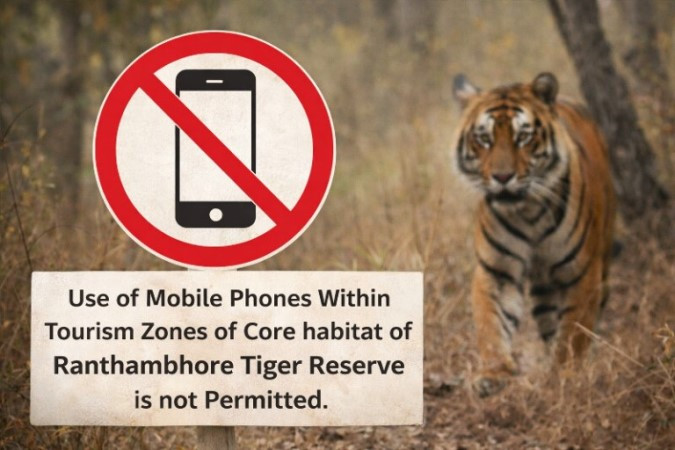
Following a Supreme Court of India directive, mobile phones are completely banned inside the safari zones of all major Central Indian tiger reserves. This rule was introduced to stop “tiger jams,” where drivers would alert each other via phone, causing dozens of jeeps to crowd a single animal.
Because you cannot use a smartphone camera inside the parks, a proper camera setup is essential. If you don’t own high-end gear, your lodge can coordinate rentals, or you can have lenses and bodies delivered directly to your transfer vehicle when you land in Nagpur.
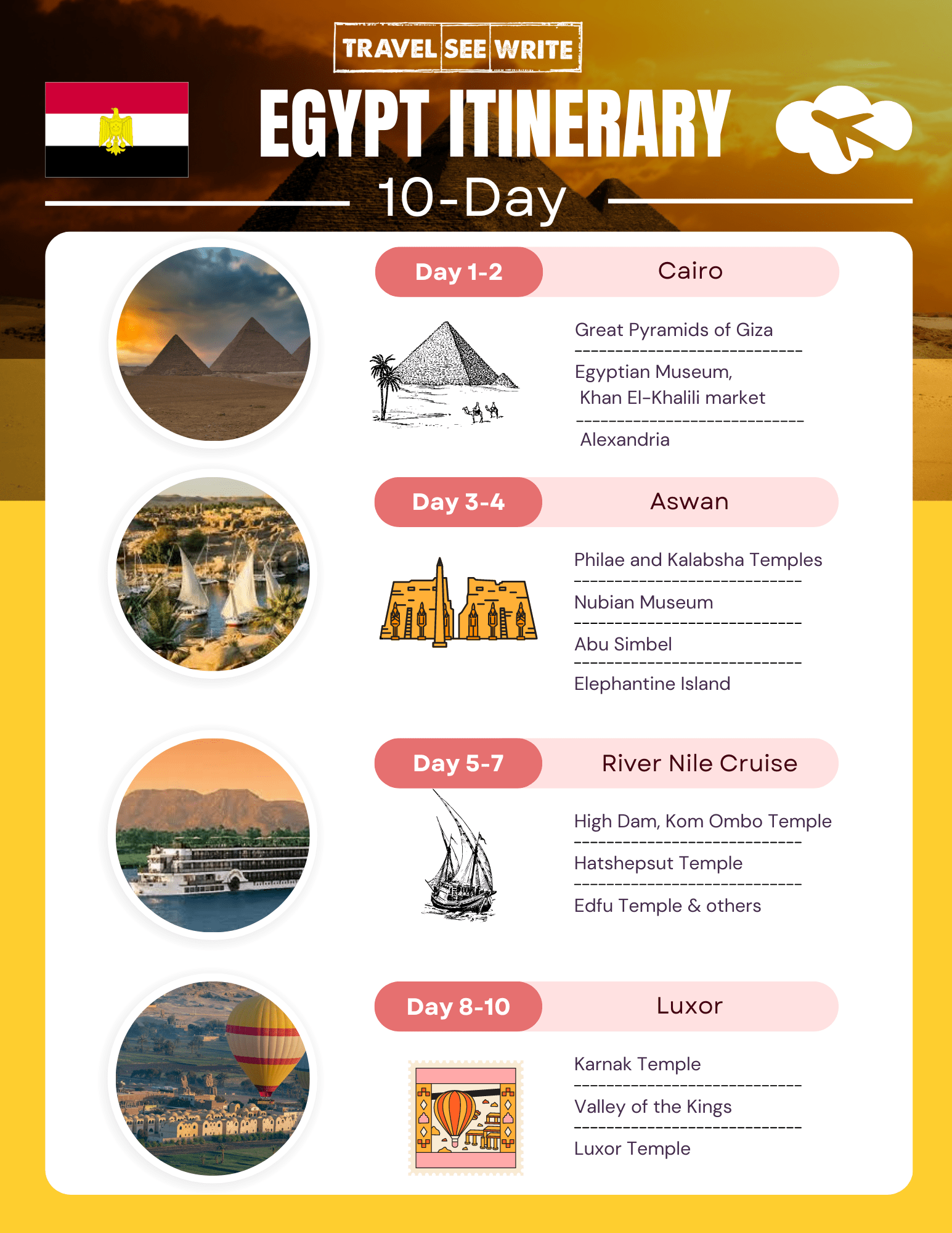
THE COMPLETE 6-NIGHT CENTRAL INDIA SAFARI ITINERARY AT A GLANCE
Day
Destination
Key Highlights
Where You’ll Stay
Day 1
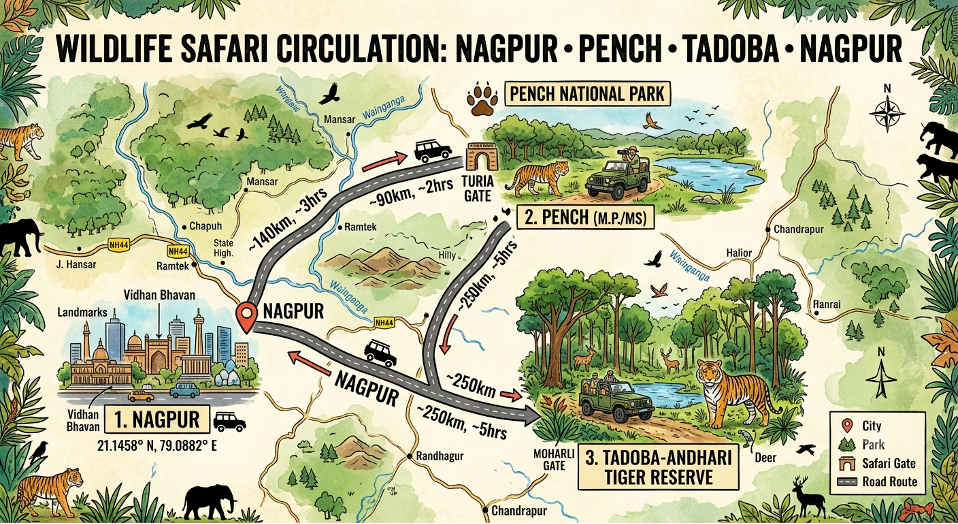
Nagpur to Pench
Private transfer, evening forest walk & bush dinner
Pench Tree Lodge
Day 2
Pench National Park
Core zone safari, afternoon at the underground Kipling Hide
Pench Tree Lodge
Day 3
Pench National Park
Morning and afternoon core safaris tracking tigers & dhole
Pench Tree Lodge
Day 4
Pench to Tadoba
Scenic road journey through the wildlife corridor, hill trek
Waghoba Eco Lodge
Day 5
Tadoba Tiger Reserve
Core zone tracking via Khutwanda or Moharli Gates
Waghoba Eco Lodge
Day 6
Tadoba Tiger Reserve
Core morning safari, afternoon high-activity buffer zone drive
Waghoba Eco Lodge
Day 7
Tadoba to Nagpur
Relaxed lakeside breakfast, private transfer to airport/station
Return Transit
DAY-BY-DAY ON THE TIGER CIRCUIT
Day 1: Into the Teak Forests of Pench
Your journey begins in Nagpur. Your private driver will meet you at the airport or railway station for the three-hour drive north into Madhya Pradesh. As the urban landscape thins out, the massive teak trees of Pench take over.
Check into Pench Tree Lodge, where your luxury treehouse sits elevated over forty acres of undisturbed, deciduous forest. Spend your late afternoon on a guided nature walk along the lodge’s private trails—learning to spot tracks and listen to the birds marking the forest edge. The day ends with a farm-to-fork bush dinner under a canopy of stars.
Days 2 & 3: Deep Core Tracking & The Kipling Hide
Mornings start early here. You will head out through the quieter Karmajhiri Gate into Pench’s core zone to track Bengal tigers, dhole (Indian wild dogs), and massive gaur, pausing for a hot bush breakfast inside the reserve.
Midday brings a treat for photographers: time in the Kipling Photography Hide. This professionally designed, underground bunker sits at eye-level with a wild reflection pond. It gives you an undisturbed, upfront view of birds and mammals coming down to drink without them ever knowing you are there. In the late afternoon, you’ll venture back into the core zones as the golden hour light breaks through the trees.
Day 4: Across the Corridor to Tadoba
After a lazy breakfast at Pench Tree Lodge, you’ll head south toward the Tadoba-Andhari Tiger Reserve. The four-hour drive takes you straight through the Pench-Tadoba wildlife corridor, a crucial strip of forest that allows genetic movement between the two tiger populations.
By afternoon, you will arrive at Waghoba Eco Lodge. Before dinner, take a short trek up Jamunbudi Hill right on the property to look out over the vast, rugged Tadoba landscape.
Day 5: The Pure Sounds of Tadoba
Without phones buzzing or drivers texting, safaris in Tadoba have returned to what they used to be: a true exercise in bushcraft. You will enter through the Khutwanda or Moharli gates, relying entirely on your naturalist’s ears to track big cats. You’ll learn to listen for the sharp, frantic alarm calls of langurs and spotted deer that signal a tiger or leopard is on the move nearby.
Day 6: The Secret Value of the Buffer Zones
While your morning will be spent tracking along Tadoba’s core lake perimeters, the afternoon safari takes you into the high-performing buffer zones like Devada-Adegaon or Agarzari. Because wildlife recognizes no artificial boundaries, these buffers see incredible, uncrowded predator action that frequently rivals the core zones. Celebrate your final night with authentic, fiery Vidarbha cuisine back at the lodge.
Day 7: Heading Home
Enjoy a final, quiet breakfast looking out over Waghoba’s lodge pond before your air-conditioned transfer back to Nagpur (about 2.5 to 3 hours) to catch your flight or train home.
BEST LUXURY LODGES IN PENCH AND TADOBA TIGER RESERVES
If you want to look beyond the Pugdundee properties highlighted above, the region offers incredible lodges tailored to different travel styles and budgets.
The Pench Alternatives
BAGHVAN, A TAJ SAFARI (Ultra-Luxury): Colonial bungalows right near the active Turia Gate. White-glove service, private salas, and exceptional dining.
JAMTARA WILDERNESS CAMP (Luxury Tented): Sleek safari tents are tucked away near the serene Jamtara Gate. Famous for its “Star Beds” built on raised platforms in local fields
PENCH JUNGLE CAMP (Premium Value): Sprawling 50-acre property close to Turia Gate. Great mix of stone cottages and tents at a gentler price point.
The Tadoba Alternatives
BAMBOO FOREST SAFARI LODGE (Eco-Luxury Concept): Located right on Maasal Lake near the Kolara Gate. This is the ultimate pick for travellers who want massive, standalone villas with private gardens and open-air bathtubs.
SVASARA JUNGLE LODGE (The Photographer’s Choice): Positioned just 300 meters from Kolara Gate. It is an authentic, wildlife-first premium lodge where the entire daily schedule is intensely focused on optimising your time in the park.
TADOBA JUNGLE CAMP (Classic Eco-Luxe): Elevated cottages built from local, sustainable materials on the southern side of the reserve, perfect for accessing the Moharli and Khutwanda zones.
BUDGET-FRIENDLY PLACES TO STAY NEAR PENCH AND TADOBA SAFARI GATES
You can easily experience this same route and gate structure without paying ultra-luxury lodge prices. If you want great comfort and excellent proximity to the gates at a much softer price point, look at these properties:
TIGER N WOODS (Pench): A classic, highly-rated 3-star resort just a kilometre from the main Turia Gate. It offers comfortable wooden machan-style rooms, a swimming pool, and a friendly, unpretentious atmosphere.
IRAI SAFARI RETREAT (Tadoba): Set near the edges of Irai Lake, this mid-range lodge sits roughly 3 kilometres from the Moharli Gate. You get well-appointed tents and cottages, a pool, and great local hospitality for a fraction of the cost of the luxury resorts nearby.
TSW Note: Keep in mind that mid-budget properties generally do not include the highly specialised, dedicated naturalists that accompany you from luxury lodges like Pugdundee or Taj. Your safaris at these properties will rely primarily on the park’s assigned local forest guides.
CENTRAL INDIA TIGER SAFARI FREQUENTLY ASKED QUESTIONS
What is the driving distance from Nagpur to Pench and Tadoba?
The drive from Nagpur north to Pench National Park is approximately 90 km to 140 km (~2 to 3 hours driving time) depending on your safari gate. The drive from Pench down south to Tadoba-Andhari Tiger Reserve is roughly 250 km (~4 to 5 hours driving time) via the main transit corridors. The return trip from Tadoba to Nagpur is around 150 km (~3 hours driving time).
Why are mobile phones banned on safari in India?
To protect wildlife and improve visitor safety, mobile phones are strictly prohibited inside central Indian safari zones. This prevents safari vehicles from coordinating real-time locations over cellular networks, which previously led to unsafe “tiger jams” and crowded animal habitats.
When is the best time to book a Pench and Tadoba safari?
The ideal window for a Central Indian tiger circuit runs from October to June. If your priority is pleasant weather and birdwatching, visit between November and February. If your primary goal is maximizing big cat and tiger sightings, the dry summer months of March through May are best, as animals frequent the remaining waterholes.
Download the full 6N7D Central India safari itinerary:
My rental car keys were sitting in my palm before I’d even processed that the main walking part of my trip was over.
Three days earlier, I’d started on foot, on the Via di Francesco, no schedule beyond the next town, no sound but gravel and wind and the occasional church bell from somewhere I couldn’t see. Now I was in my hotel holding the keys to an Audi Q5, and the next nine days of this trip were going to look nothing like the first three. Same country, same general direction toward Rome, completely different relationship with the ground under me.
That contrast turned out to be the whole point of this trip, and I didn’t plan it that way going in.
I’d been to Italy plenty of times before this. The Colosseum at golden hour, pasta in Bologna, gelato in Florence, Aperol Spritz on the Amalfi Coast, I’ve done the version everyone does, and loved it every time. But this May I wanted to know what it felt like to actually move through the country rather than sprint past it, so I built fifteen days around two completely different speeds. Three days walking the Via di Francesco, St. Francis’s ancient pilgrim trail through the heart of Umbria. Nine more on a self-drive through Umbria and Tuscany, the rest settling in and out of Rome on either end.
Walking showed me the grain of the place, the soil, the silence, the way a town reveals itself slowly when you arrive on foot. Driving showed me the scale of it, how quickly a 12th-century winery or a thermal square in the middle of a piazza is reachable if you’re willing to take the unmarked turn. Neither one alone would have given me the full picture. Together, they did.
I was invited by SloWays Travel to walk and document these routes as a content creator. Every experience, every feeling, every opinion in this post is mine. Nobody edited what I actually saw.
Here’s what my second leg of the fifteen-day Slow Travel in Italy actually looked like, day by day.
Day One: Spoleto on Foot, This Time With a Car Waiting
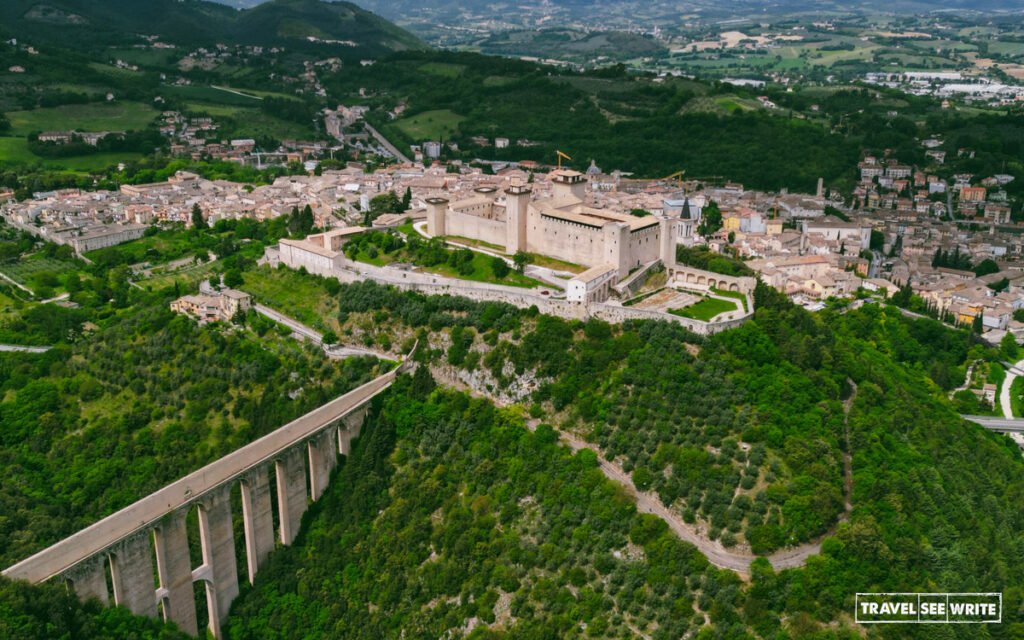
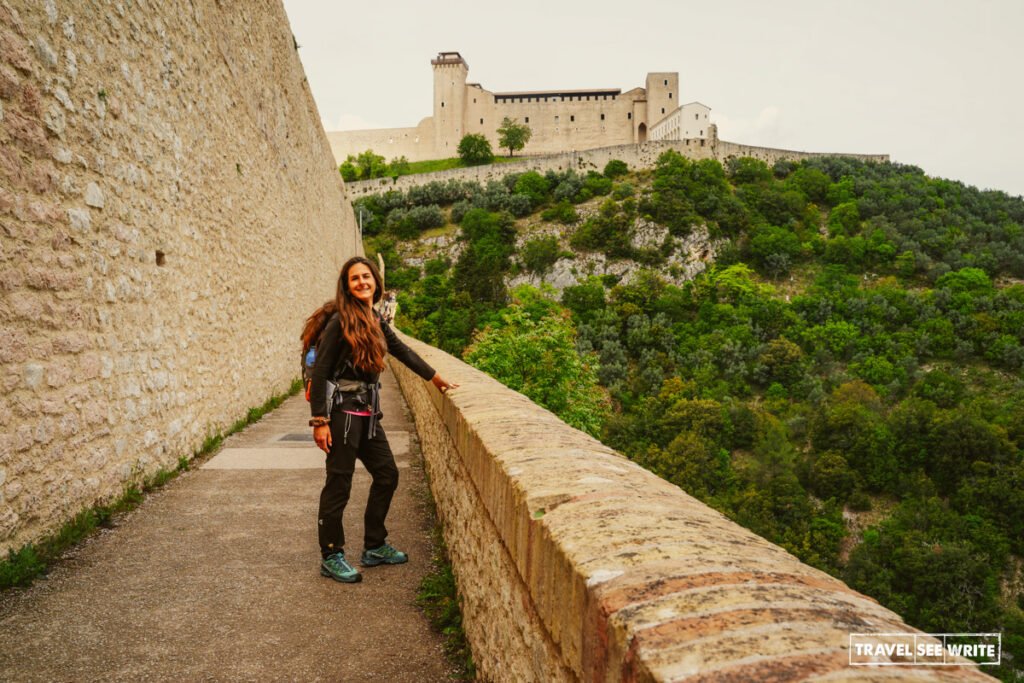
Spoleto: Ponte delle Torri connecting the Rocca Albornoziana, Umbria, Italy
If you want the full story of the walking leg, the caves at Eremo delle Carceri, the 19 kilometres to Spello, the Sacred Forest of Monteluco, I’ve written about it separately here. This post picks up right where that one left off, in Spoleto, car keys in hand.
After my girls’ gang departed, I walked the medieval centre alone at 6 pm, golden light hitting Roman ruins, the Ponte delle Torri visible at the end of a lane. It’s a proper town, the kind where people actually live, eat, and argue in the piazza rather than performing for anyone watching. Dinner that night was at a tiny place with four tables and truffle pasta so good I nearly cried.
I realised almost immediately that the next nine days were going to feel like an entirely different trip, and I was right.
Day Two: Trevi, the Olive Oil Capital Nobody Told Me About
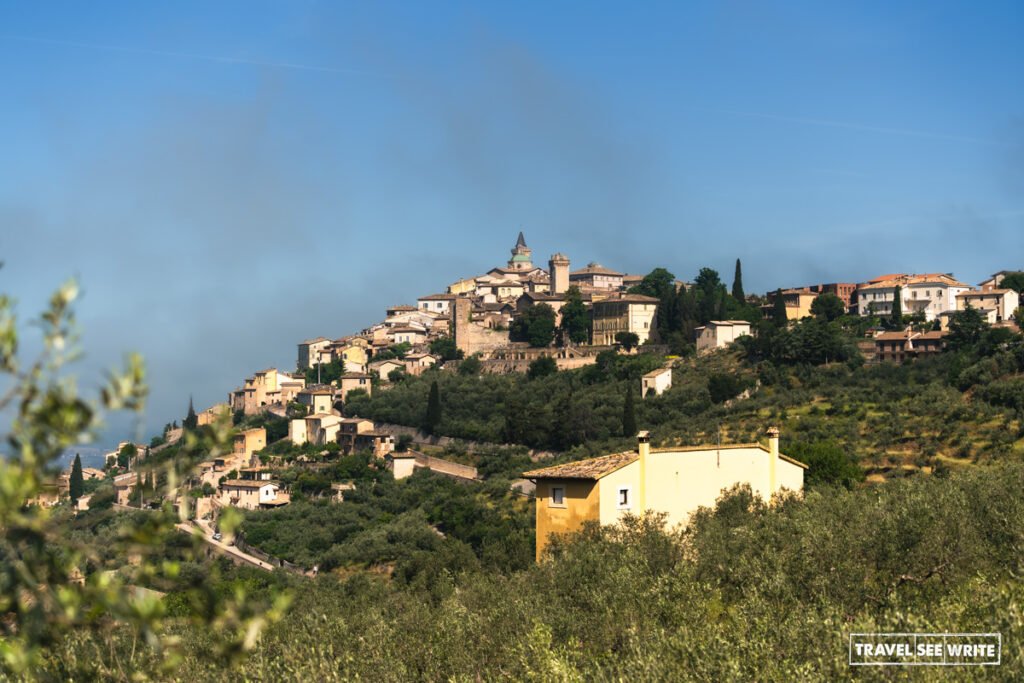
Trevi: a medieval town that’s called the olive oil capital of Italy.
Driving from Spoleto, I reached Trevi, which locals call the Olive Oil Capital of Italy, and the best way to actually see it is on foot, perched as it is on the slopes of Mount Serano. So that’s what I did. Six kilometres through olive groves and quiet medieval villages to reach the hilltop town itself, lunch in a family-run restaurant in a piazza barely bigger than a living room.
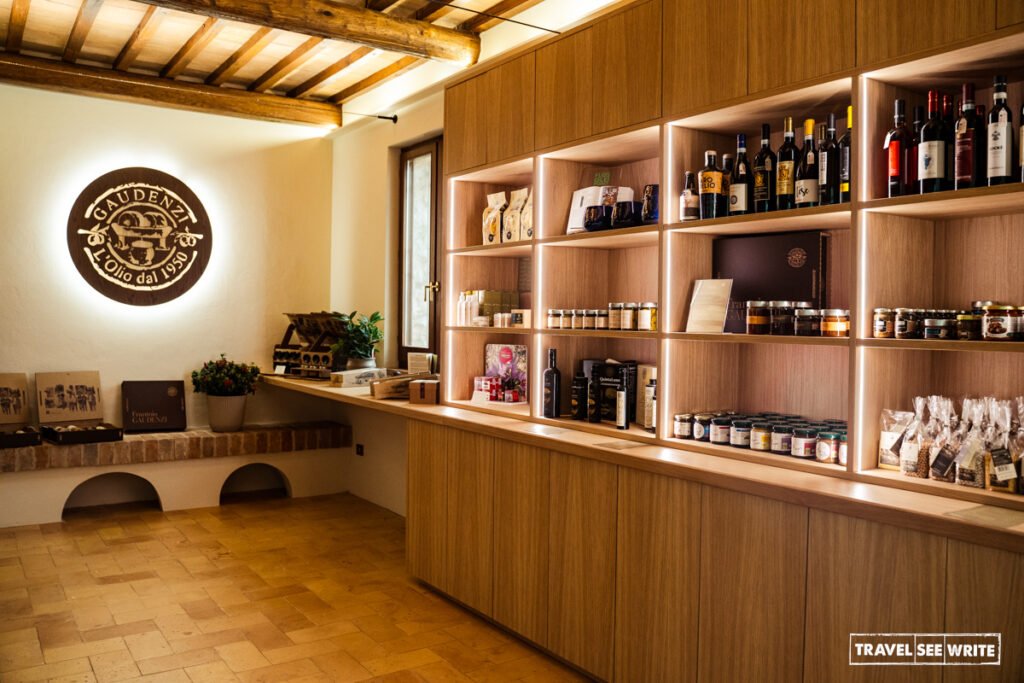
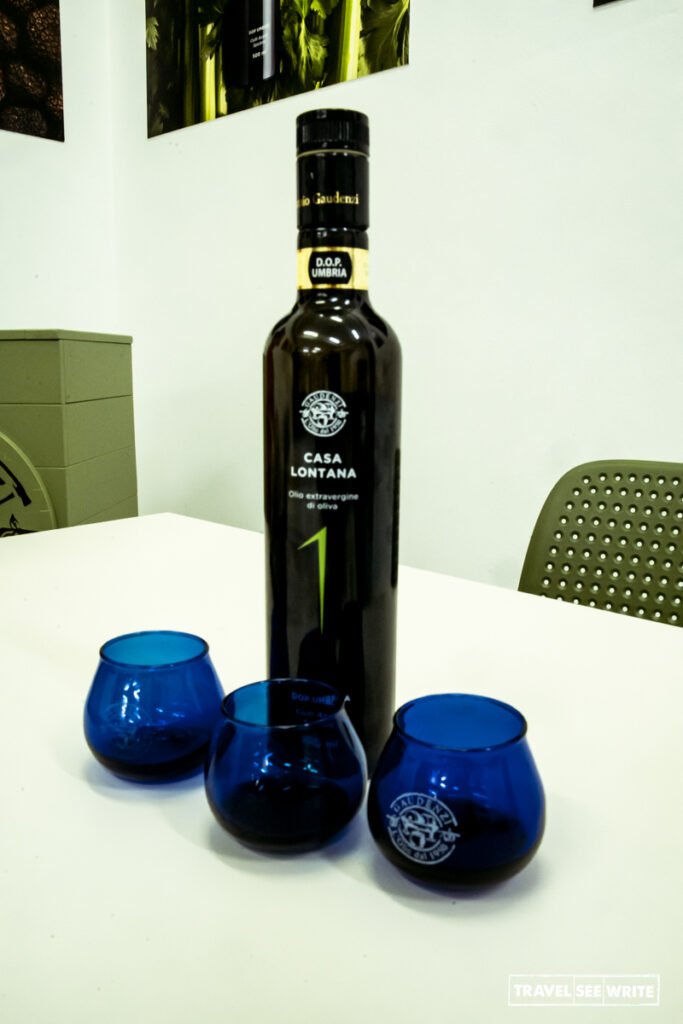
Then an olive oil tasting at Frantoio Gaudenzi, a three-generation Umbrian family producing certified extra virgin olive oil with the kind of obsessive care that makes commercial oil taste like something else entirely. We went through several oils side by side, different varieties, different harvest times, and different filtration levels. I came home with two bottles and zero regret about the excess baggage charges. Not a bad Friday.
A family-owned olive oil mill – Frantoio Gaudenzi in Trevi, Umbria, Italy
Olive oil tasting at Frantoio Gaudenzi in Trevi, Umbria, Italy
A family-owned olive oil mill – Frantoio Gaudenzi in Trevi, Umbria, Italy
Day Three: The Family That Makes 500 Bottles and Sells None of Them to Anyone Else
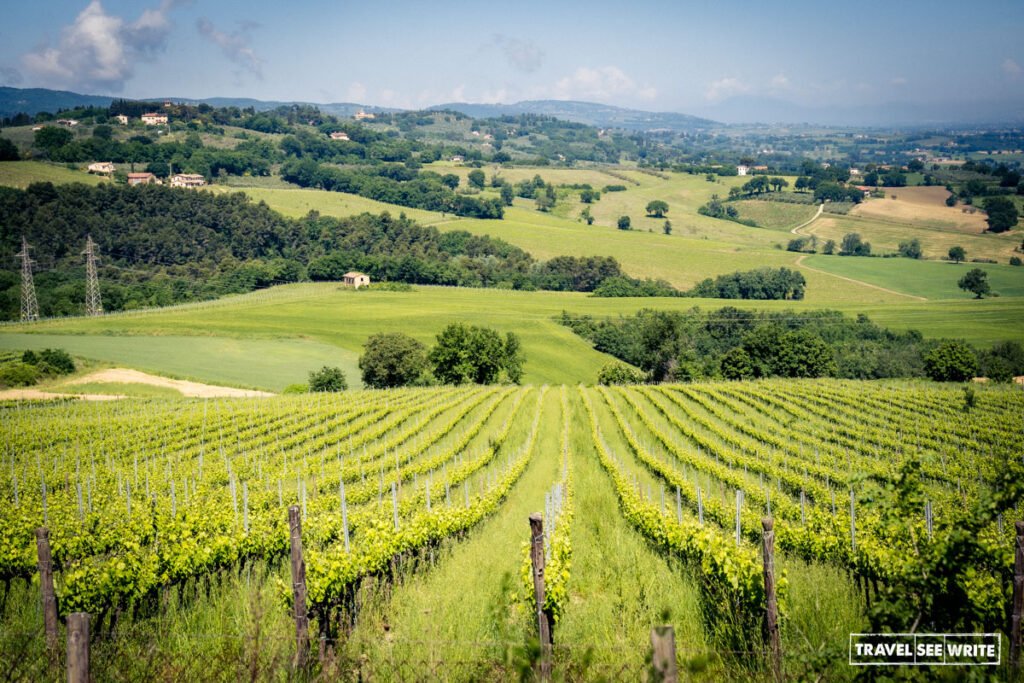
Vineyards of Montefalco, Umbria, Italy
The next morning I drove to Montefalco for a wine tasting that turned into one of the best hours of the entire trip.
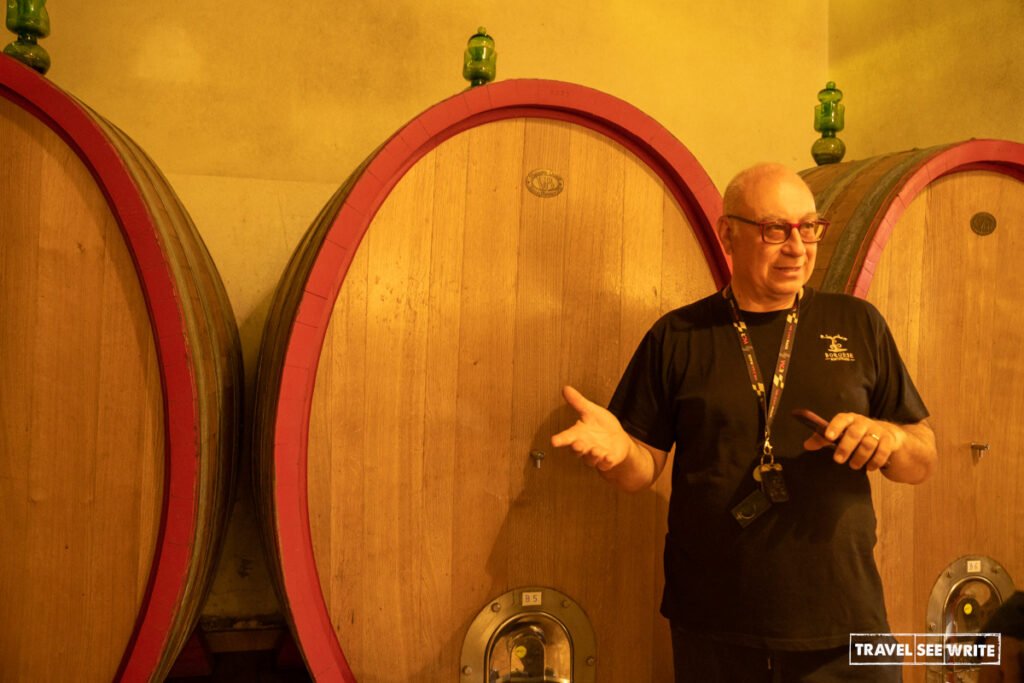
Azienda Agricola Borgese is a tiny family estate run by a couple, Massimo and Claudia. They make Sagrantino, one of Italy’s most tannic, age-worthy red wines, the kind that’s almost impossible to find outside this exact stretch of Umbria. Here’s the part that stayed with me: they make exactly 500 bottles a year, and they don’t sell a single one to a restaurant or a retail shop. If you want their wine, you buy it from them, in their cantina, in person. That’s the only way it exists in the world.
Massimo, the owner of Azienda Agricola Borgese, explains their wine-making process of Sagrantino wine Montefalco
While Claudia prepared the delicious tasting menu from scratch, Massimo walked me through their cellar, sharing their passion and process of making Sagrantino wine, a DOCG wine since 1992, grown only in this small zone around Montefalco. I tasted five wines across different vintages, ate food they’d made by hand that morning, and heard the story behind every bottle, which barrel it came from, which year had given them trouble, which one they were proudest of. It wasn’t a winery tour in the sense I’d experienced elsewhere. It was being let into someone’s actual life for an hour.
From there, it was ten minutes to Bevagna, a medieval village so perfectly preserved it feels like the rest of the world simply forgot to modernise it. Roman mosaic floors are still under the streets. The piazza hasn’t meaningfully changed in 800 years.
And here’s a fact about Umbria I didn’t expect to learn on a wine tasting day: Ed Sheeran reportedly owns a villa and vineyard in this region, said to have chosen it specifically over Tuscany to get away from the expat crowds. Whatever you make of that, it tells you something about which of the two regions is still quietly itself.
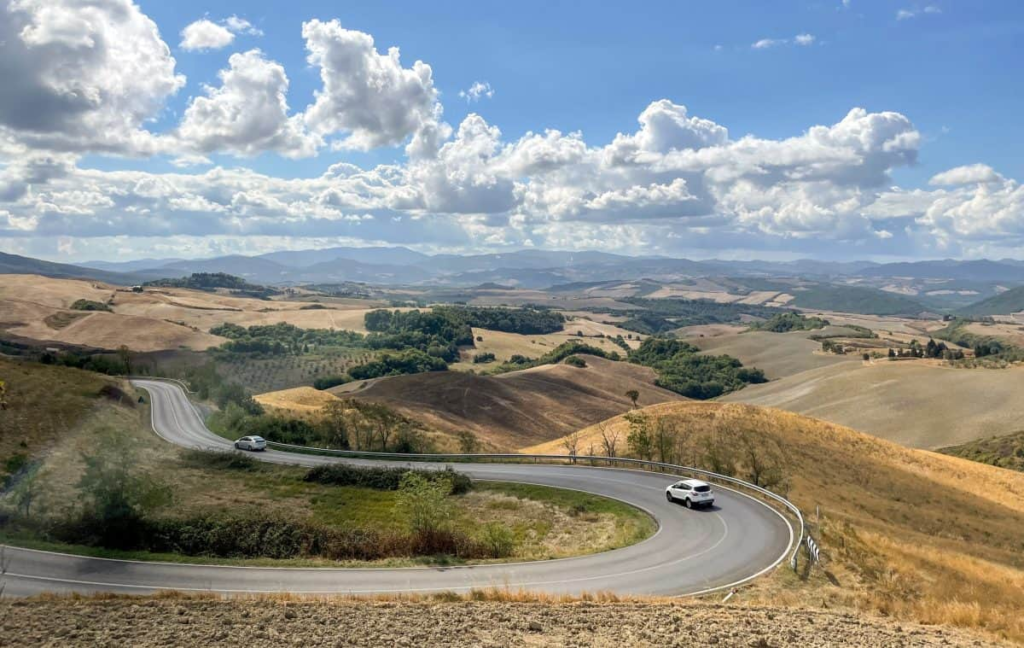
I wrapped up the day with a 2.5-hour drive to Florence, the Apennines drifting past in the late light, which is a visual feast in its own right even after a day this good.
Day Four: Cinque Terre Before the Tour Buses Find It
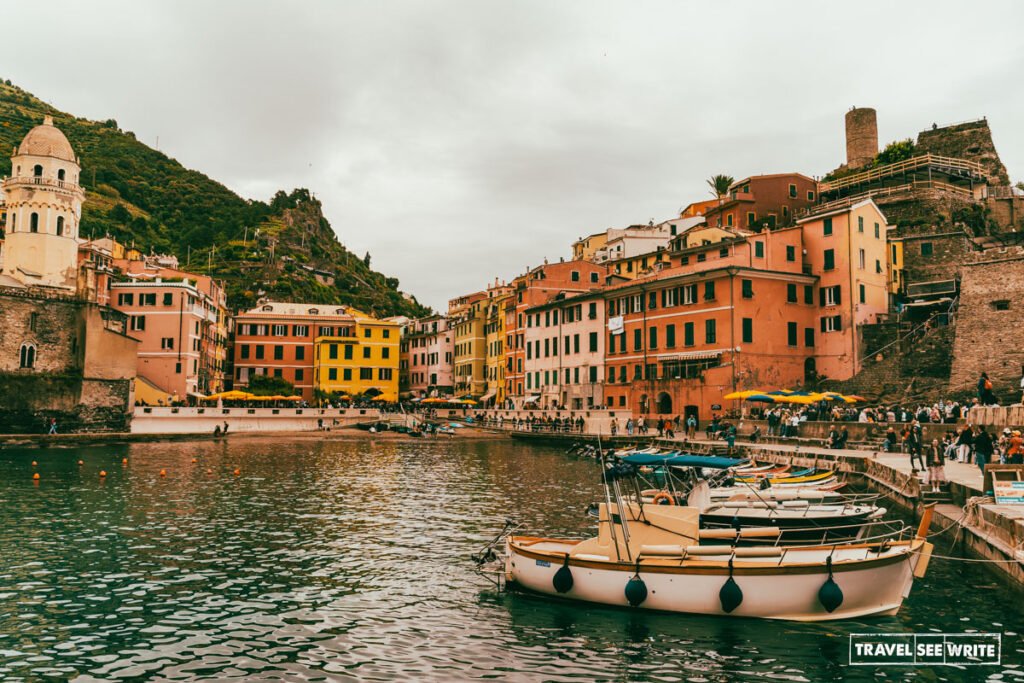
Vernazza – One of the five villages of Cinque Terre, Italy
Left Florence at 6 am. Worth every minute of lost sleep.
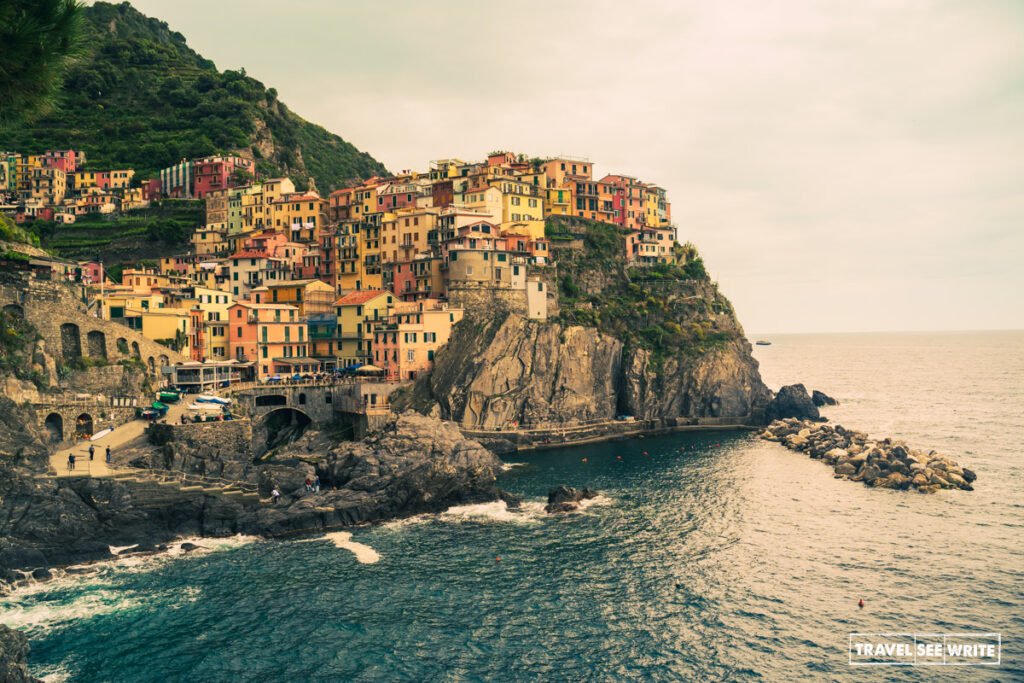
I drove to La Spezia, about 2.5 hours, parked near the station, and switched to train for the rest of the day using the Cinque Terre Card, which gets you unlimited travel between all five villages, Monterosso, Vernazza, Corniglia, Manarola and Riomaggiore, with no pre-booking and no ticket queues. I reached La Spezia by 9 am and had the first village almost entirely to myself. By 11 a.m., the tour groups had arrived in force. If seeing Cinque Terre without the crowds matters to you even slightly, that four-hour head start is genuinely the only way to get it.
Manarola – One of the five villages of Cinque Terre, Italy
I took the train between all five villages, lingered wherever I felt like it, ate pesto pizza and focaccia by the harbour, the food you’re supposed to eat here since pesto was born in this region. Drove back to Florence in the late afternoon with salt in my hair and the specific, satisfied exhaustion of a perfect day.
One practical note if you’re planning this yourself: unless you’re staying overnight in the villages, don’t bring luggage. The trains are packed and every village has its share of narrow vertical staircases.
Day Five: Florence, the Slow Way
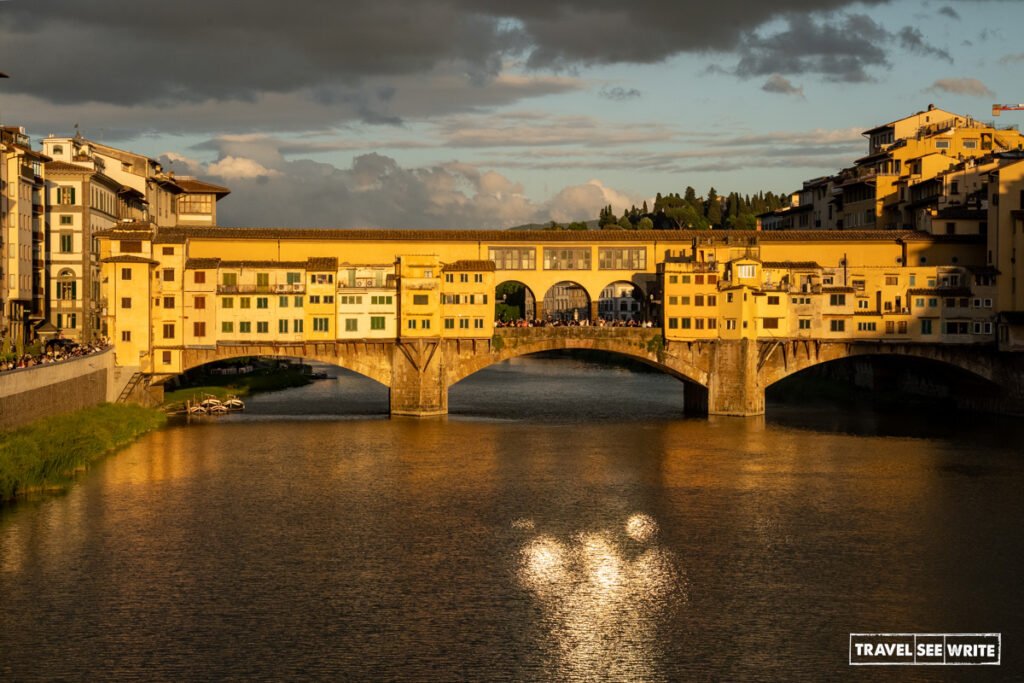
The Ponte Vecchio, a medieval bridge over the River Arno in Florence, Italy.
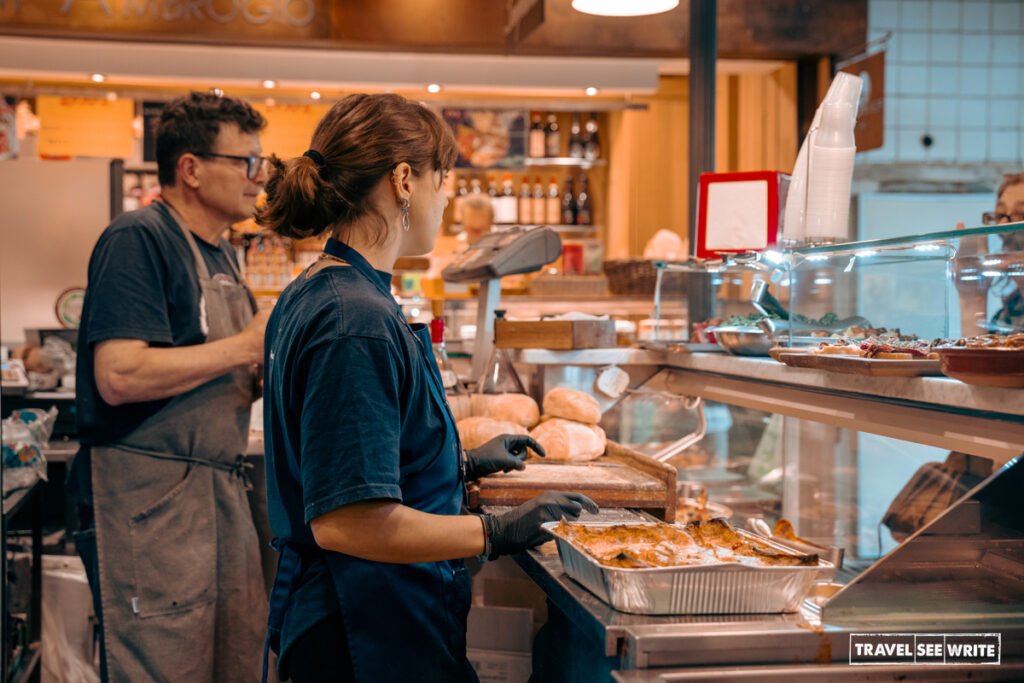
This was the most deliberately unhurried day of the whole trip. A shared food walking tour with Streaty Tours took us through local markets and neighbourhood spots, where residents actually eat it rather than the version created for tourists. It cut through the noise completely. I joined a small group tour with my guide, Alice, leading the way from the Sant’Ambrogio market.
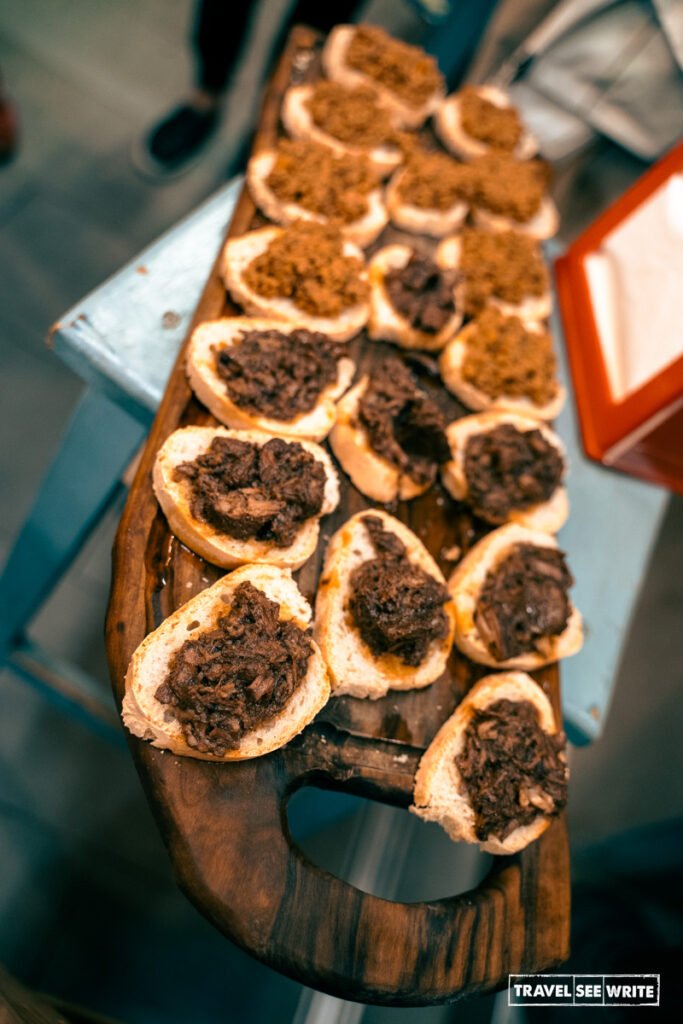
Food I tried during a food tour in Florence Italy
One of the local eateries in Sant’Ambrogio market where we had authentic local Italian food during our food tour in Florence, Italy
“Italians really are absolute marketing geniuses,” Alice told us as we walked. “We’ve convinced the whole world that pizza is this ancient, deeply native Italian thing, but it’s mostly a myth! Back in the 17th century, people in Sicily and Naples were actually eating something way closer to a panino. When Italians immigrated to Argentina, Brazil, and the US in the 19th century, they discovered canned tomatoes. That whole Americanized food culture didn’t even flood back into Italy until after WWII. In fact, Florence didn’t get its very first pizzeria until 1960! Even Carbonara, which everyone thinks is a classic, ancient staple, was just invented during WWII, and now it’s our most famous dish.”
“This is our real history,” she explained, pointing to our first stop. “We start with the heavy carbs—local bread with different meats, lasagna, pasta, and potatoes.” She poured us a glass, adding, “And of course, we drink local wine with everything.” Later, she led us right into the heart of the bustling Sant’Ambrogio market, pointing out some vibrant, bright yellow blossoms on a stall. “Look at these zucchini flowers! When you fry them, they get incredibly crunchy, though we aren’t eating them today. Instead, we are going to shop for our own fresh, local fruits and vegetables right here.
”After gathering our produce from the market, Alice walked us over to our final stop. “This is our aperitivo place,” she said, introducing us to the family running it. “It is completely off the grid—it’s not even on the map.” We sat down with more local wine as they took our fresh market haul to prepare it. “Here are the best starters,” Alice said proudly as a spectacular platter was brought to the table. “Beautiful black, yellow, and red heirloom tomatoes, local cheeses, marinated artichokes, homemade chutney, olives, and fresh strawberries.”
During the Sant’Ambrogio market tour, Alice highlighted seasonal products, shared traditional recipes, and interacted with vendors about the daily offerings. It was more than a food tour; it provided a rich cultural experience of Florentine history, traditions, and local crafts. We tasted local dishes at six different spots, most of which were quick stops.
The afternoon was free, and I spent most of it walking. Florence isn’t just art and leather bags. It has a real, complicated food culture that most visitors never get close to, and an afternoon with nothing scheduled turned out to be one of the better uses of my time in the city.
Food in Firenze
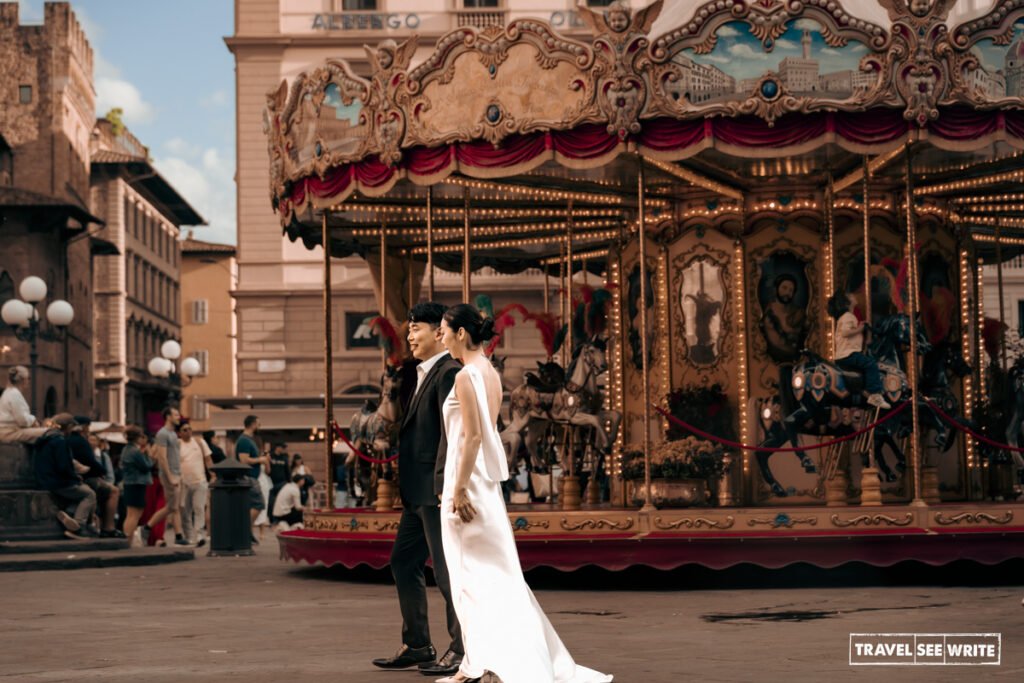
Located opposite Caffè Gilli, the Picci Family Carousel is a historic, hand-painted merry-go-round prized as a whimsical backdrop for a pre-wedding photo spot in Firenze, Italy
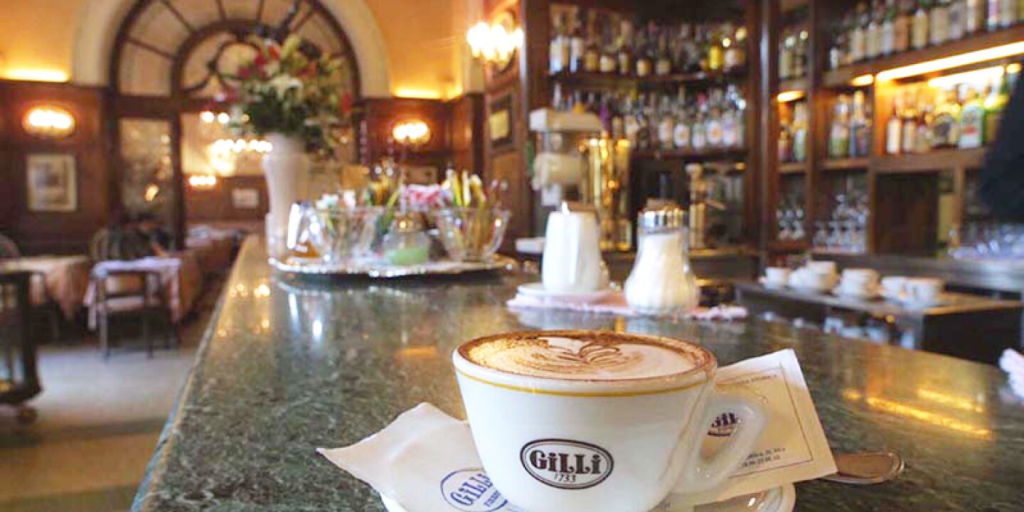
You honestly can’t miss Caffè Gilli for a classic tiramisu or their layered millefoglie pastry under the gorgeous chandeliers, and then you have to hit up Osteria Vecchio Cancello for their wild boar pappardelle or the truffle and mushroom mezzelune ravioli if you want something veggie. For a super authentic, old-school tavern vibe, go to Trattoria Le Mossacce where you can get amazing pork involtini, or a really comforting, classic Tuscan ribollita soup.
If you want to treat yourself to an insane bowl of pasta, you absolutely have to go to Osteria Pastella where they make their fresh truffle tagliatelle flambéed right inside a massive cheese wheel. Then, to top off the night, walk over to Gelateria dei Neri for a scoop of creamy pistachio or their rich chocolate-orange gelato—it is easily one of the best spots in town.
Day Six: Walking the Via Francigena Into San Gimignano
Walking a small stretch on Via Francigena through vineyards, Tuscany, Italy
This was my favourite day of the entire self-drive stretch.
I left the car at Monastero di Cellole and walked a short stretch of the Via Francigena, one of Europe’s oldest pilgrim routes, running from Canterbury all the way to Rome. Pilgrims have walked some version of this road since the 10th century. My section wound through vineyards and rolling Tuscan hills from a hamlet called Pancole. Four kilometres sounds short on paper. Walking it, with the vines just starting to leaf out in the May light, time stopped behaving the way it usually does.
San Gimignano – the Manhattan of medieval times
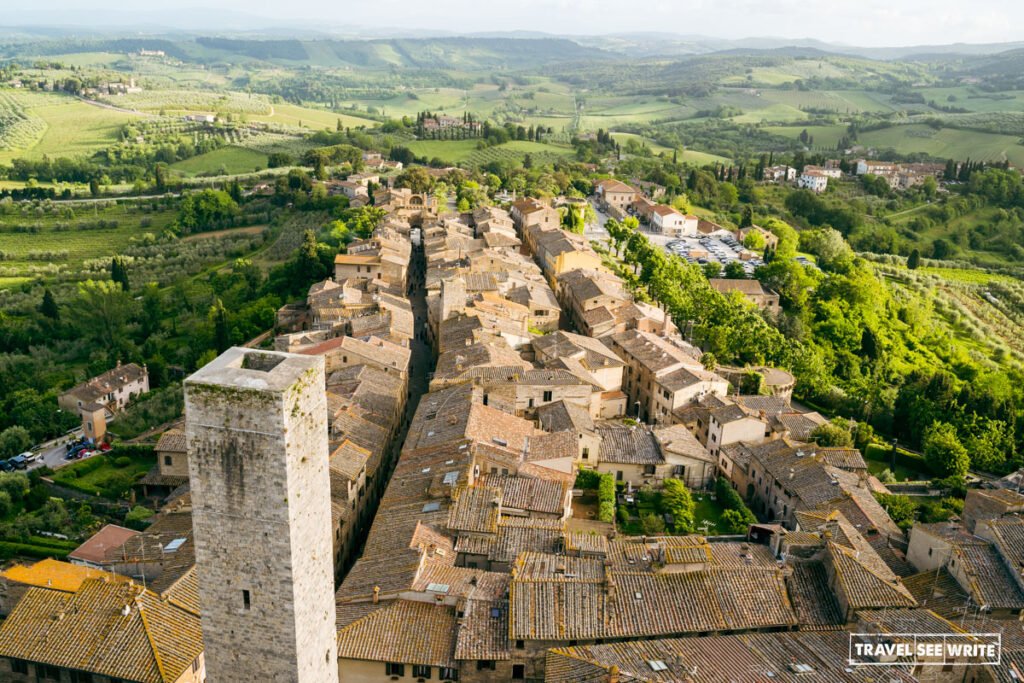
It was incredible stepping back into San Gimignano for my second visit, a place that truly earns its nickname as the “Manhattan of the Middle Ages.” At the height of its medieval power and intense family rivalries, the town boasted 72 original towers piercing the skyline, though today only 14 of those towers remain intact. Walking through the stone streets as it received me in the late afternoon, you can’t help but marvel at these soaring skyscrapers of the past, making the second trip feel just as breathtaking as the first.
I capped off the day with a wine tasting at Rocca di Montestaffoli, where the local Vernaccia—a crisp white wine this town is specifically known for—came with a view over the surrounding countryside that made the wine taste better than it probably needed to. My wine sommelier Andrea shared, “Vernaccia wine is called the white queen amongst red kings. It can only be grown from the Vernaccia grape variety in the San Gimignano area.” I followed it with gelato from Gelateria Dondoli, which has won international awards for good reason—the pistachio is genuinely life-altering—for dinner. No regrets.
Day Seven: Siena, Understood Through Its Rivalries
Sienna from the Fortezza Medicea (Medici Fortress) at sunet
The Contrade walk is what made Siena finally make sense to me, in a way no guidebook ever managed.
The city is split into 17 contrade, neighbourhood districts, each with its own identity, colours, symbols, and centuries of fierce loyalty, all of it centred on the Palio horse race. A local guide walked us through what that actually means day to day, not as folklore but as a living social structure. I went back afterwards and rewatched the Bond film Quantum of Solace just to spot the corners of the city I’d walked that morning.
The rest of the afternoon, wandering Siena alone with all of that freshly in my head, was a completely different city than the one I’d have seen without it. I even found a wonderful crowd-free vantage spot to watch the glorious sunset in Sienna, the Fortezza Medicea (Medici Fortress). Its elevated ramparts and outer walls offer sweeping, unobstructed views of the city’s terracotta rooftops, the Duomo, and the surrounding Tuscan hills, glowing fiery shades of orange and red as the sun goes down. What’s even more fascinating is that it is absolutely free.
Day Eight: Val d’Orcia, and the Driveways Italy Doesn’t Want You Photographing Anymore
Agriturismo Baccoleno, Val d’Orcia, Tuscany, Italy
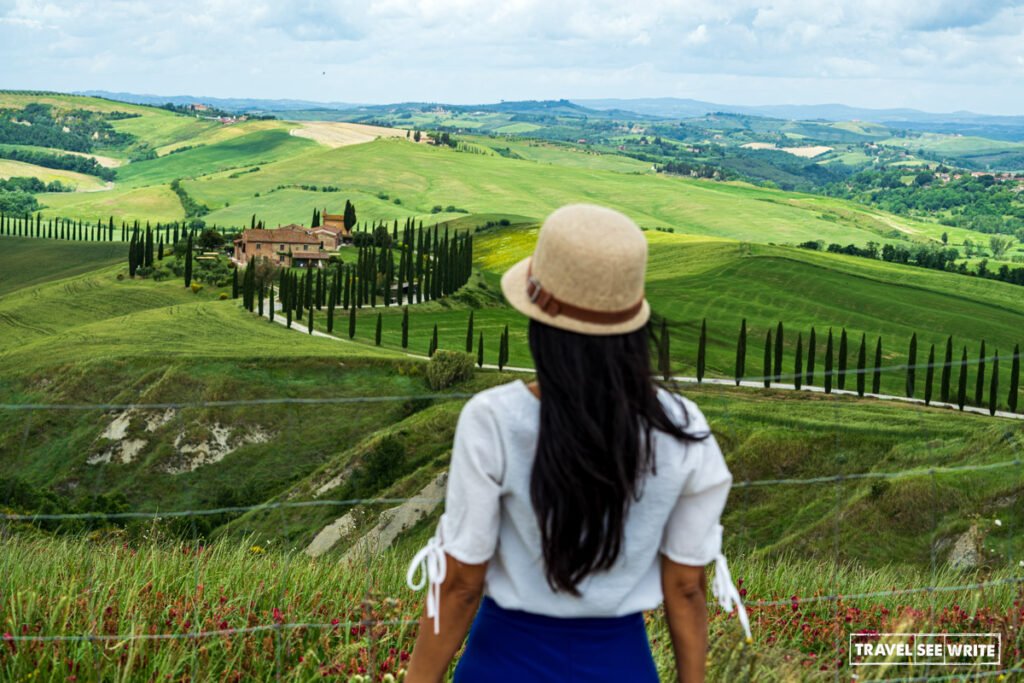
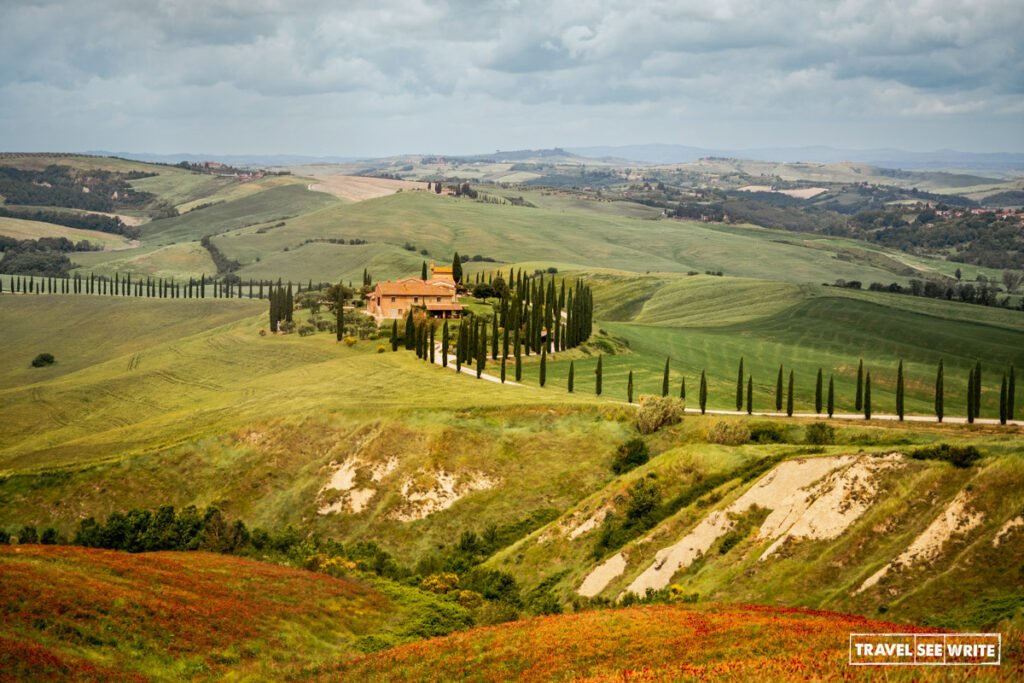
This is the drive you’ve already seen in a hundred Instagram photos. Cypress trees in perfect lines, rolling hills fading into blue, Brunello vines around Montalcino, thermal water sitting in the middle of a medieval piazza at Bagno Vignoni, Pienza’s Renaissance streets and its famous pecorino. Every single turn is a photo opportunity, which is exactly the problem.
I’d read about the cypress-lined driveways that show up endlessly in Italy content, the ones that make Val d’Orcia instantly recognisable even to people who’ve never been. What I hadn’t expected was to actually find one, Agriturismo Baccoleno, guarded by a permanent sign reading No Entry, No Photos, No Drones. Overtourism has pushed local estate owners to this point. People were blocking private roads to get the shot, often without asking, often without realising the driveway belonged to someone’s actual home.
I stood there for a minute, feeling slightly embarrassed on behalf of everyone who’d made that sign necessary. The valley is still completely magical. But the best way to experience Val d’Orcia in 2026 is to skip the cliché photo spots entirely and just let the countryside do what it does without you trying to capture it. I drove on to Rome in the late afternoon, full of the whole day.
Day Nine: Rome, Early and Empty
A private walking tour at 9 am, before the heat and the crowds arrived. The Colosseum without a queue. Basilica of Saint Mary of the Angels and Martyrs,
My 3-hour walking tour in Rome was absolutely unforgettable, starting off at the Basilica di San Pietro in Vincoli to see Michelangelo’s famous Moses. Barbara explained how this project became a 40-year nightmare, shrinking from a massive 40-statue mausoleum into a single wall tomb, forcing Michelangelo to brilliantly re-carve Moses’ neck and leg at the last minute just to fit the layout! From there, I took a very short walk down to the jaw-dropping Colosseum and wandered along the edge of the Roman Ruins, staring at the layers of columns and old stone temples.
“Rome is literally like a lasagna,” my guide Barbara laughed while showing me the Roman Ruins, explaining how the city is just stacked with centuries-old layers of history. It was such a perfect way to put it, thinking about how you’re walking on modern streets, but right beneath your feet are layers of medieval, Renaissance, and ancient Roman history all piled on top of each other. Next, she guided me up to a crowd-free vantage point near Capitol Hill called Terrazza delle Caffarelli, which had a fantastic view of medieval Rome. I then made my way to the Trevi Fountain, which was packed but totally mesmerising, and I threw my coin in over my shoulder. I wrapped up the entire journey at the stunning Basilica of Saint Mary of the Angels and Martyrs, where I got to see how Michelangelo completely transformed ancient Roman baths into a massive, breathtaking church.
Then a long, slow lunch, and a flight home the next day.
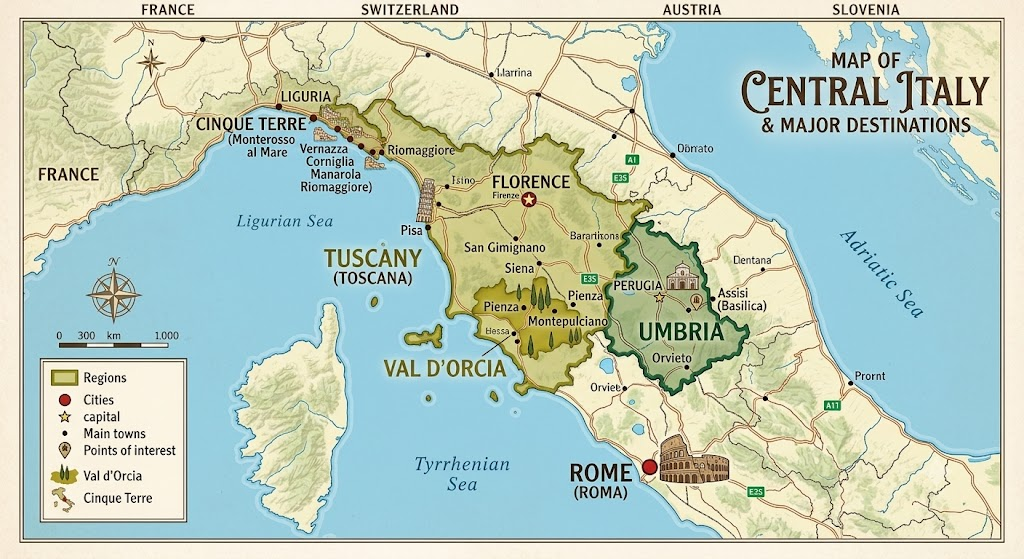
The Regions, If You’re Mapping This Yourself
Umbria is where this trip really lived. It’s landlocked, rolling, truffle scented, and doesn’t have Tuscany’s PR machine, which means it also doesn’t have Tuscany’s crowds. I’d heard of maybe one of the towns on this route before I left. By the end I was googling property prices in several of them.
Tuscany is Tuscany, you’ve seen the postcards, but this route stuck to its quieter corners: the Via Francigena near San Gimignano, Siena’s Contrade culture, Val d’Orcia’s cinematic, increasingly protective landscape.
Cinque Terre, a UNESCO World Heritage Site on the Italian Riviera, is five cliffside fishing villages with the kind of ocean views that explain the postcards. It’s also, as I learned over a pizza, the birthplace of pesto.
Rome bookended the whole thing, a stay at the start and a final morning at the end, and genuinely deserves its own separate post.
Walking the Via di Francesco and the Via Francigena
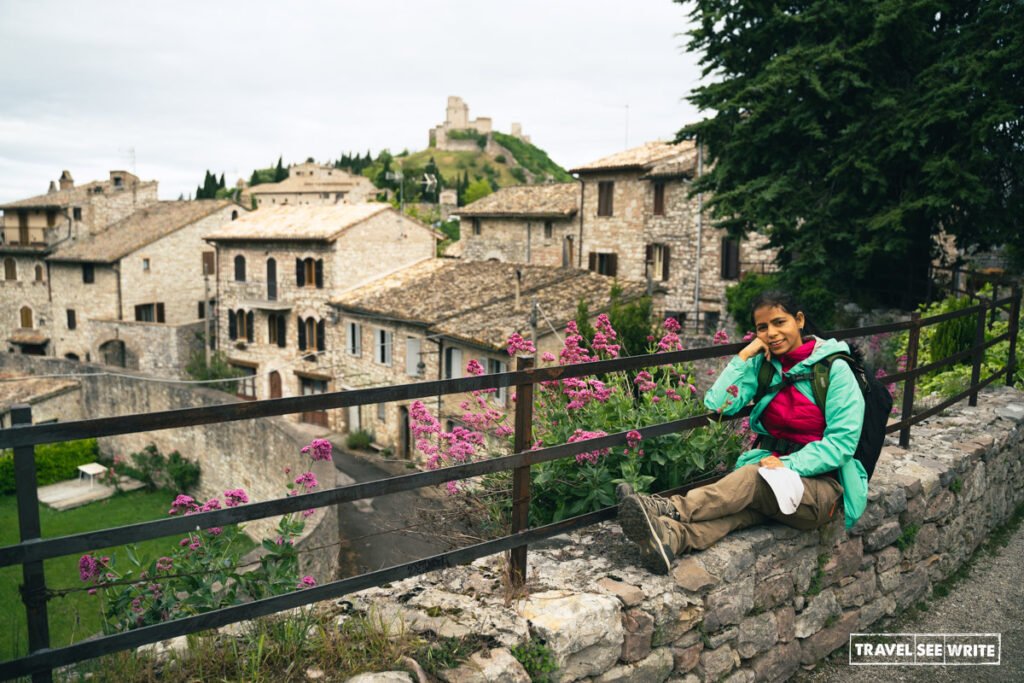
The Via di Francesco, St. Francis’s Way, is a medieval pilgrimage route winding through the hills of Umbria, connecting the towns and sanctuaries tied to the life of St. Francis of Assisi. It’s not a hardcore trekking route. You don’t need to be a serious hiker, just willing to slow down, since the whole trail is designed for walking, not rushing. I covered it from May 5th to May 7th, and the experience of moving through that countryside on foot, stone paths, wildflowers, distant church bells, is something I’m still turning over weeks later. People have walked versions of this trail for 800 years, and there’s a particular kind of quiet that comes with that kind of history.
The Via Francigena is one of Europe’s oldest long distance pilgrim routes, running all the way from Canterbury to Rome, walked in some form since the 10th century. The stretch I covered near San Gimignano, described above on Day Six, runs through vineyards and rolling Tuscan hills.
SloWays arranged private transfers to both trailheads so I could leave the car at the endpoint and just walk, no logistics stress at all. Their app also had a live GPS trail map that worked offline, which mattered more than I expected in a region with patchy signal.
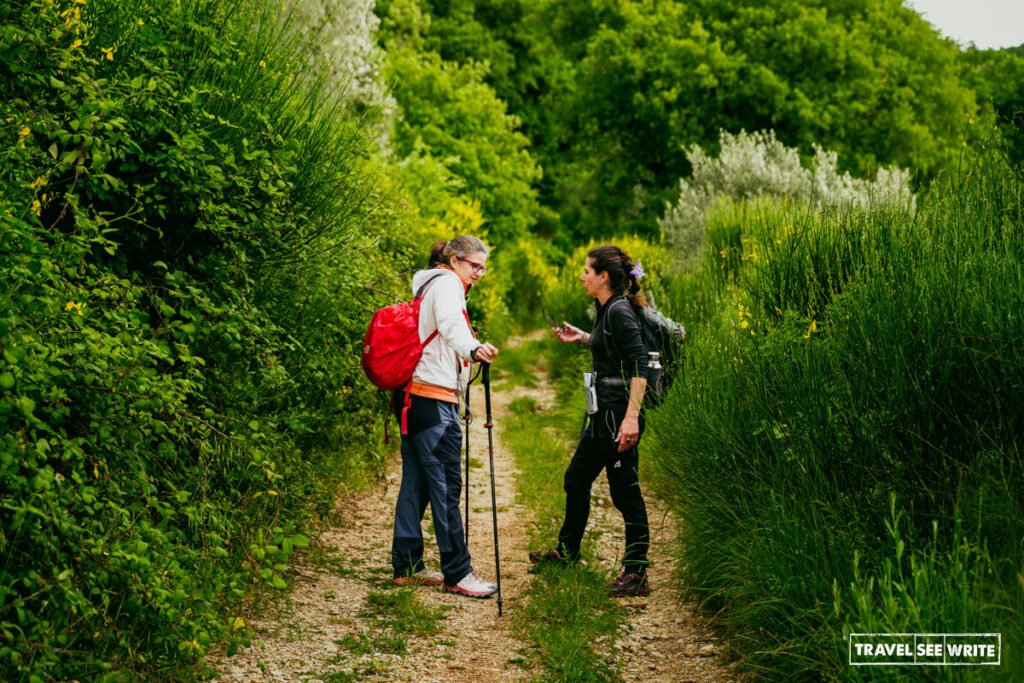
Practical note: both sections I walked were around 4 km each, on largely flat to gentle terrain. Proper walking shoes are sufficient, no hiking boots needed in May. Trekking poles are optional but useful on the cobblestones.
Self Driving Through Umbria and Tuscany: Why It’s Worth It
A self drive through Umbria and Tuscany isn’t just transport, it’s access. Access to a 12th century winery down a dirt road. Access to Bagno Vignoni’s thermal square on a quiet afternoon. Access to detours when you spot a sign for something that wasn’t on the itinerary at all.
The SloWays roadbook, a detailed day by day logistics document provided to every traveller, took the anxiety out of it completely. Parking addresses, hotel check in notes, local driver contacts, transfer timings, all laid out clearly enough that I never felt like I was figuring things out on the fly.
That said, I didn’t drive blindly everywhere. Some legs make far more sense by train, Cinque Terre being the obvious example, and the day by day above covers exactly how that worked. Parking is a genuine headache in touristy spots like Rome, Florence, Cinque Terre, Siena, and San Gimignano. SloWays either pre reserved parking for me or arranged a pick up and drop off at each location, which meant I never lost time circling a historic centre looking for a spot.
Practical note: San Gimignano’s hotel sits inside a medieval borgo with no car access. The hotel, La Cisterna, has a private parking spot outside the walls; you call ahead and they come to collect you and your luggage. It’s charming, not inconvenient.
What to Actually Eat: Stop Ordering Pasta Bolognese in Umbria
Here’s something that took me embarrassingly long to understand about Italy: every region has its own food, and that food doesn’t always travel. Bolognese is from Bologna. Carbonara is Roman. In Umbria, you’re eating black truffle on everything, cured norcineria meats from Norcia, and strangozzi, a thick, rough-cut pasta that holds sauce beautifully. In Siena, it’s pici and ricciarelli, almond biscuits. In Florence, lampredotto, ribollita, bistecca.
Beyond the olive oil tasting at Frantoio Gaudenzi and the wine afternoon at Azienda Agricola Borgese, both covered above, two more meals are worth flagging on their own. At Nessun Dorma in Cinque Terre, a cliffside spot in Manarola famous for its pesto making workshops, you don’t actually need to book the class. Just get a terrace seat, order a platter of burrata and local charcuterie with a glass of crisp Cinque Terre white, and watch Manarola’s pastel houses tumble into the sea below you. And at Rocca di Montestaffoli in San Gimignano, the Vernaccia tasting comes with a countryside view that genuinely improves the wine.
If you walk into a trattoria and order fettuccine Alfredo, they’ll probably make it for you. But you’ll miss the entire point of eating in this country. Ask what’s local. Point at what someone else is having. Order what you don’t recognise. That’s where the real food is.
Where I Stayed
Every property on this route was four star and boutique in character, no soulless chain hotels.
Hotel San Luca, Spoleto — right inside the old town walls, quiet and gracious.
Il Terziere, Trevi — a restored historic building, stone walls, excellent breakfast.
Hotel Cellai, Florence — great neighbourhood, private parking included, which is rare and invaluable in this city.
Hotel La Cisterna, San Gimignano — on Piazza della Cisterna, inside the medieval walls, a proper experience.
Hotel Athena, Siena — clean, comfortable, walkable to everything.
Hotel Duca d’Alba, Rome — central, well run, a reliable base on both ends of the trip.
None of these were flashy. All of them felt like they belonged exactly where they were.
The Practical Bit: What You Actually Need to Know
Best time to go: May is ideal, warm without being hot, everything green, vines just waking up, crowds not yet arrived. Late September and October are a close second, especially for harvest season. Avoid July and August in the hill towns if heat and tour groups aren’t your idea of a good time.
What to pack: layers, even in May, since mornings and evenings in the Umbrian hills can be genuinely cold. One proper pair of walking shoes, not trainers, not heels, for the trails and the cobblestones. A small daypack for trail days. Leave room in your suitcase for wine and olive oil, you will buy both and you will not regret it. A downloaded offline map is worth having too; signal in parts of rural Umbria is patchy even with a working SIM.
The car rental reality nobody mentions: if you’re flying into Rome, don’t book your rental from the airport or the absolute centre. Rates, especially insurance rates, are noticeably higher at Fiumicino pickup points compared to offices just 10 to 15 minutes away, for the exact same vehicle and the same insurance level. Twenty minutes of comparison shopping by location, not just by company, can save real money.
ZTL zones: many historic centres have restricted traffic zones enforced by camera, and the fines are real and often arrive months after the fact. Your roadbook or hotel will tell you exactly where to park. Follow it precisely.
Final Thought
There’s a version of Italy that Instagram sells you, perfect at every angle, crowded at every monument, checked off a list in three days. And then there’s this. The version where you walk into a hilltop town still slightly out of breath from the trail, and sit down to a glass of wine in a piazza where the afternoon light is doing something unreasonable to the stone. Where the people at the next table have lived here their whole lives and aren’t performing anything for anyone, including you.
That Italy takes longer to find. It asks for a slower pace, a willingness to drive down an unmarked road, and a genuine interest in eating and drinking whatever the land actually produces, not what you were expecting to order.
It’s worth the extra effort. I promise.
Disclaimer
I was invited by SloWays Travel and the Italian Pilgrim Routes 2026 project for this experience. All opinions and observations are my own. This isn’t a sponsored post in the conventional sense; they planned the logistics, and I had the experiences.
Walking the Via di Francesco Pilgrim trail in Umbria, Italy
There’s a moment on the trail, maybe 40 minutes outside Assisi, where modern travel just stops making sense to me.
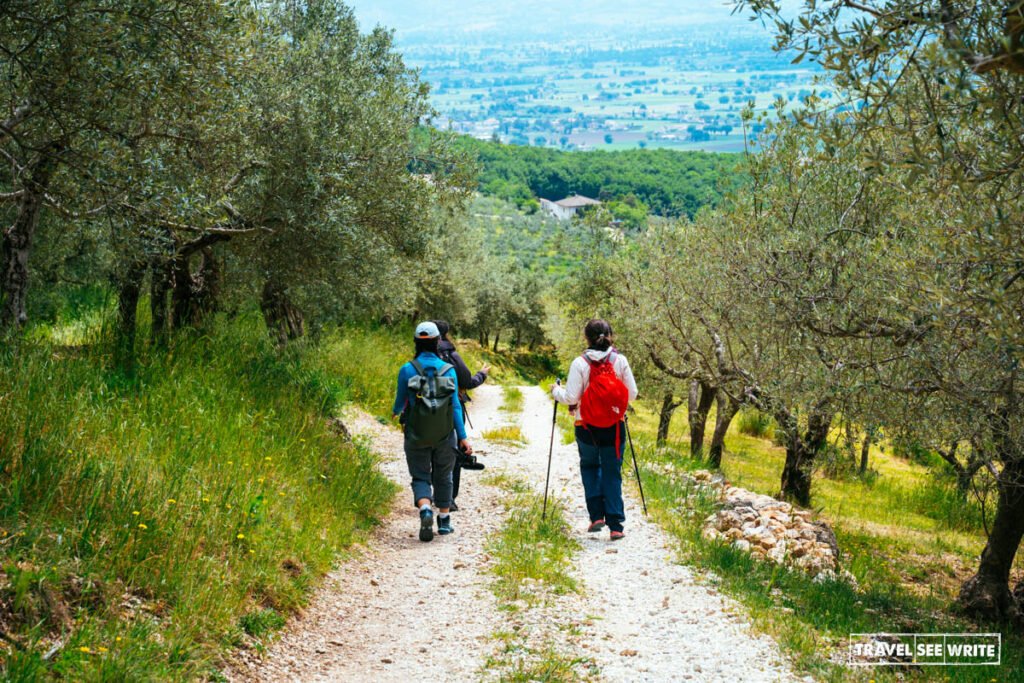
I’m hiking on a dirt track lined by vibrant wild mustard blooms, terraced olive groves, and deep green forests, all framed by crisp spring air and iconic medieval hilltop towns. Wherever I look, I find beauty. My feet have found a rhythm on the loose gravel. The only sound is wind through silver leaves and occasional birdsong. I try to locate a face to the sound, but I fail miserably.
And I’m thinking: why did I do this the other way for so long?
You know the other way. The Rome to Florence to Venice triangle, done at maximum speed. Hot cobbled streets, photo queues, alarm clocks at 6 am so you can beat the crowds to something you weren’t entirely sure you wanted to see in the first place. I’ve done that trip too. I’ve done versions of it in 30 different countries. And at some point, it stops feeling like travel and starts feeling like a performance of travel, which is a very different thing.
This trip, early May in Umbria, was the opposite of that. Three days on the Via di Francesco, St. Francis’s ancient pilgrim trail through the heart of central Italy, walking at whatever pace felt right, staying in small towns where the piazzas empty out by 7 pm and the only people left are the ones who actually live there.
It recalibrated something.
What Even Is the Via di Francesco Pilgrim Trail
Via de Francesco isn’t a Pilgrim trail to find God. It’s a pilgrimage to find yourself.
The Via di Francesco, the Way of St. Francis, is a pilgrimage trail running over 500 kilometres through central Italy, connecting the places tied to the life of St. Francis of Assisi. Hermitages, churches, forests, hill towns, spread across Umbria, Tuscany and Lazio.
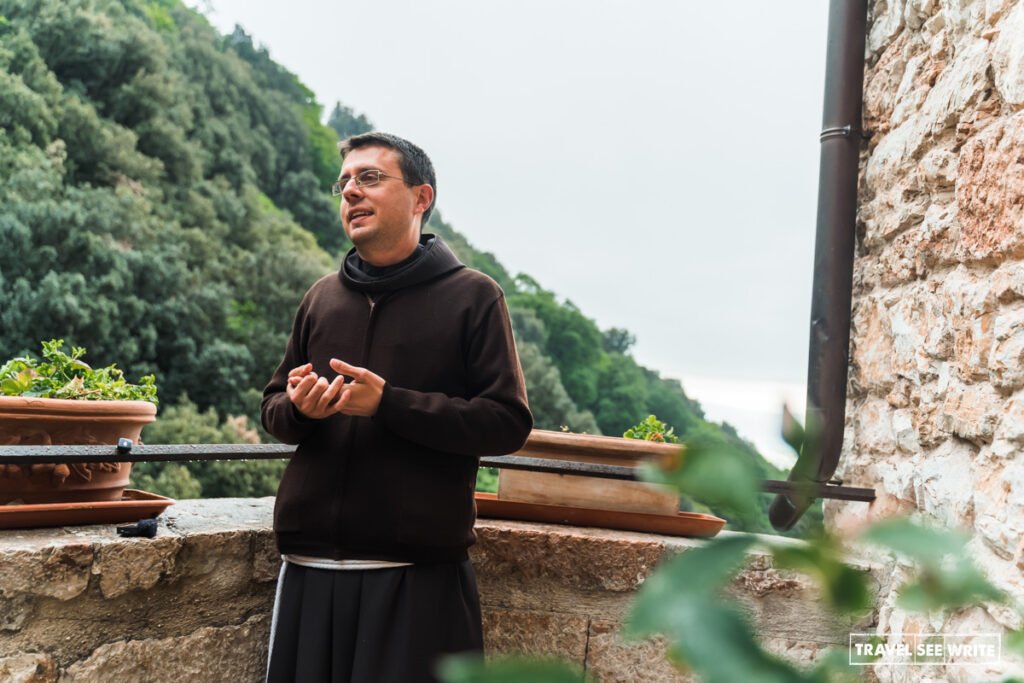
I met a friar named Matteo on the first day, and he told the story of Francis like he’d told it a thousand times before, except none of it sounded rehearsed. Francis was born into a wealthy merchant family in Assisi and walked away from all of it by his late twenties, trading silk and money for a robe and a begging bowl. He spent the rest of his life living in poverty and preaching to anyone who’d listen, founded the Franciscan order, and eventually became the patron saint of Italy. Everything I saw over the next three days, the caves carved into mountainsides, the obsessive attention to the exact angle of a valley view, traces back to that one decision he made eight centuries ago.
People have been walking versions of this trail ever since. It moves through terrain that looks almost deliberately cinematic, steep wooded ridges, valleys thick with olive groves, and stone towns that seem to grow out of the hillside rather than have been built on top of it. I say walking but that undersells it slightly. You’re moving through layers of human history that most tourists drive past at 130 kilometres an hour on the autostrada. The trail itself is well marked and genuinely accessible, not a hardcore trekking route. My longest single day on the trail was 12 kilometres. But moving through Umbria on foot versus moving through it in a car are basically two different countries.
SloWays Travel handled the logistics for my trip as part of the Italian Pilgrim Routes 2026 project, a collaboration between the European Association of the Via Francigena Ways (AEVF) and the Italian Ministry of Tourism. In practice, that meant my bags moved between hotels without me carrying them, transfers to trail starting points were already arranged, and each day’s route was planned to flow into the next. I showed up, walked, and ate. More than once, I thought, this might genuinely be the smartest way to travel.
Surprise Element: The All-women Group
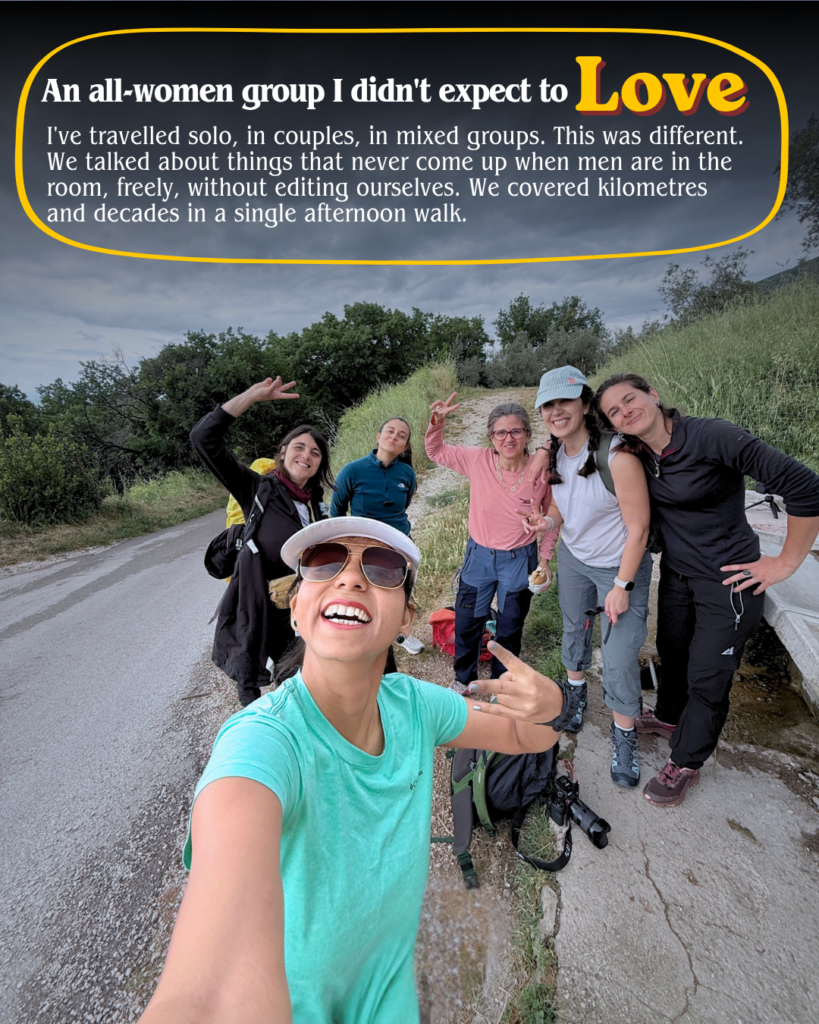
What I didn’t expect was the group itself. By complete accident, every single person on this trip was a woman. Tullia, who runs SloWays Travel, Simona from the AEVF team, our guide Barbara, and two other content creators, Mansoureh from the UK and Serena from Italy.
I’ve travelled in mixed groups my whole career and never once thought about it until I was suddenly in one that wasn’t. Somewhere on the second day, walking single file through an olive grove, the conversation turned to things that usually stay unsaid when there’s a man within earshot. Fear while travelling alone. What it actually costs a woman to build a business in a country that still expects her home by dinner. Tullia talked about the early years of SloWays like she was talking about raising a difficult, beloved child. Nobody performed any of it for an audience. There wasn’t one.
I didn’t plan for that to be part of this story. It became one of the best parts of it.
Now back on the trail.
Quick Facts Before You Go
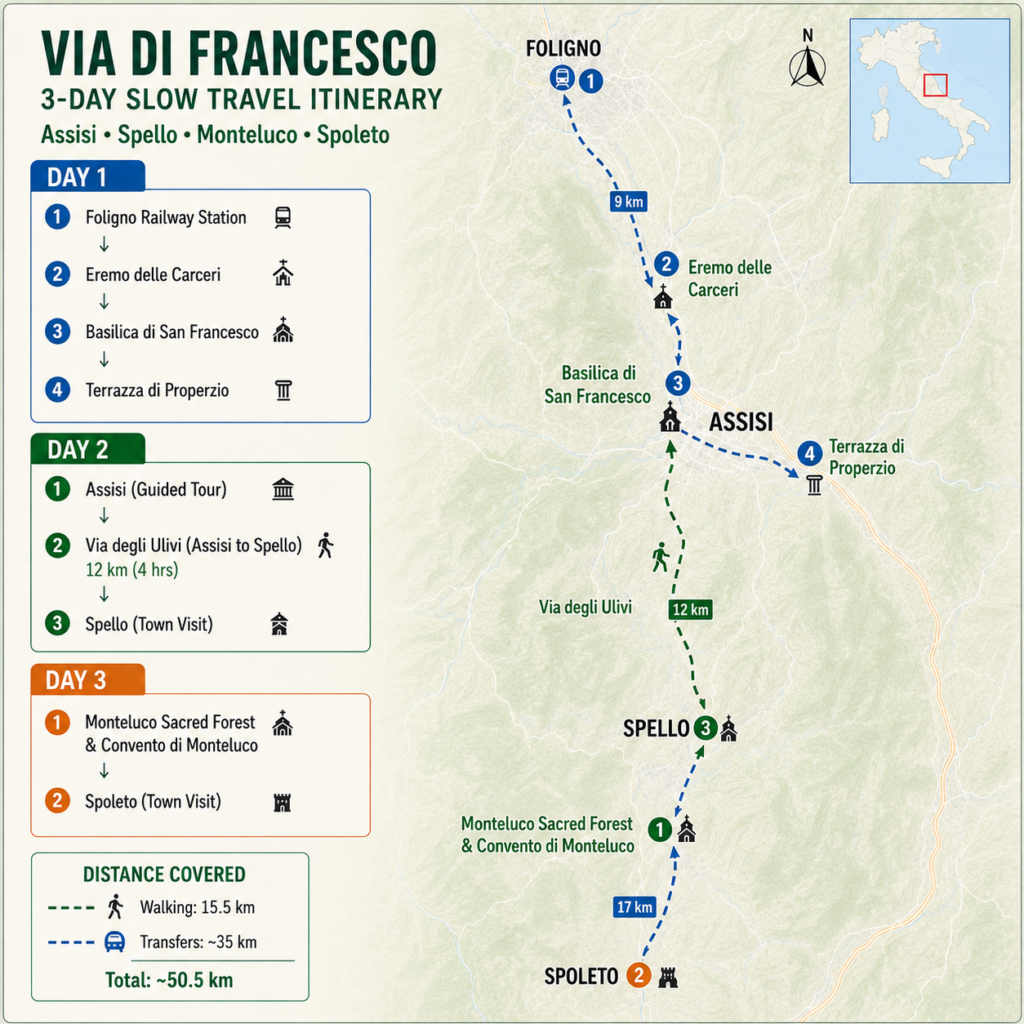
Trail length covered: 3 days, roughly 20 kilometres total
Longest single day: 12 kilometres, Assisi to Spello
Difficulty: moderate, no technical hiking experience needed
Best time to visit Umbria: May or October, for mild weather and fewer crowds
What to pack: proper walking shoes, layers for cool mornings, a refillable water bottle
Good for: anyone considering a self-guided walking holiday in Italy without committing to a multi-week pilgrimage
Day One: Arriving at the Hermitage
The Eremo delle Carceri is a hermitage built into the mountain’s rock, above Assisi
Matteo, friar at Eremo delle Carceri shared valuable insights about St. Francis’s life and philosophy
A bronze statue of Saint Francis of Assisi interacting with a young boyat Eremo delle Carceri
The trip began with a train ride from Rome to Foligno, a town that had existed since Roman times. The entire group of girls congregated here and walked around the town for a while before digging into an authentic Umbrian lunch at a local restaurant. Afterwards, we took a transfer to the Eremo delle Carceri on Mount Subasio.
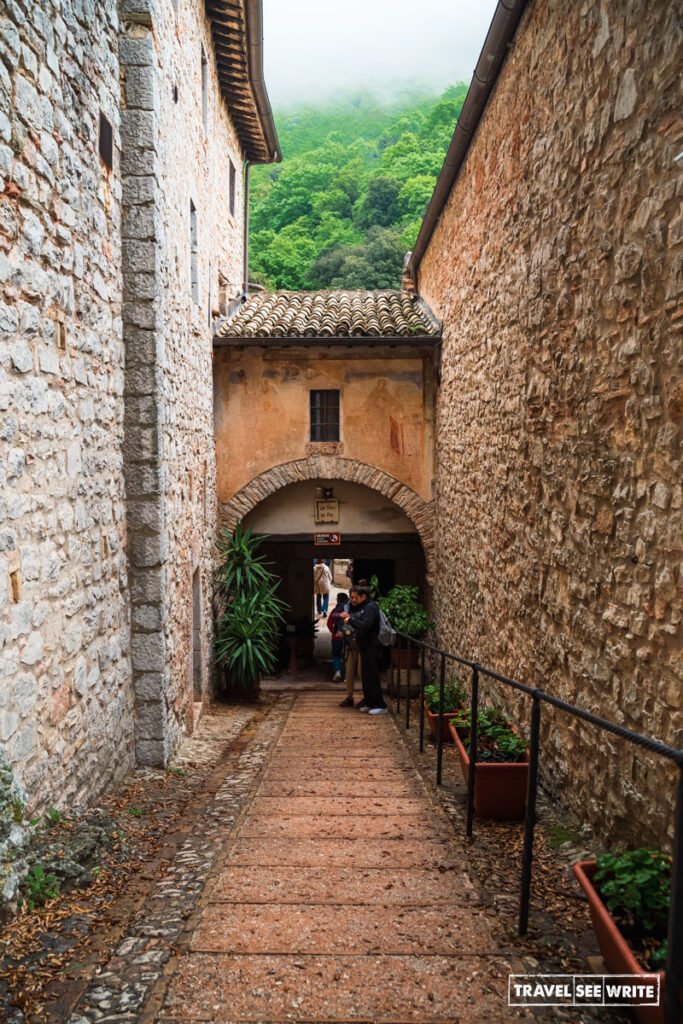
The Eremo delle Carceri is a hermitage built into the mountain’s rock, above Assisi, surrounded by a dense oak forest. St. Francis and his early companions used to come here to pray in the caves. Some of those caves are still there, tiny stone rooms barely big enough for a four-and-a-half-foot person to stand, where you can see where people slept and prayed. I was super lucky to meet a very polite and pleasant friar named Matteo, who walked our group through the place’s historical significance. A friar is a member of a religious order (like the Franciscans or Dominicans) who takes vows of poverty, chastity, and obedience and lives in a community. Matteo explained St. Francis’s love for nature,
“St. Francis used to live in several natural places (grottos), and he used to look for four things before choosing a place: always on the mountains, always surrounded by nature, always a grotto, and always facing the view of the valley.”
Honestly, I expected an old building with some historical signage. What I actually got was a place that still functions as a place of contemplation, not a museum. Friars still live there. The quiet is not the managed quiet of a tourist attraction; it’s the kind of quiet that accumulates over centuries, and you can actually feel it pressing against your ears.
I don’t follow any religion ardently. So, I’m not a pilgrim in that sense. But standing in one of those cave chapels, with the forest outside and the light coming in low and sideways, something about the accumulated intention of the place gets into you whether you ask it to or not.
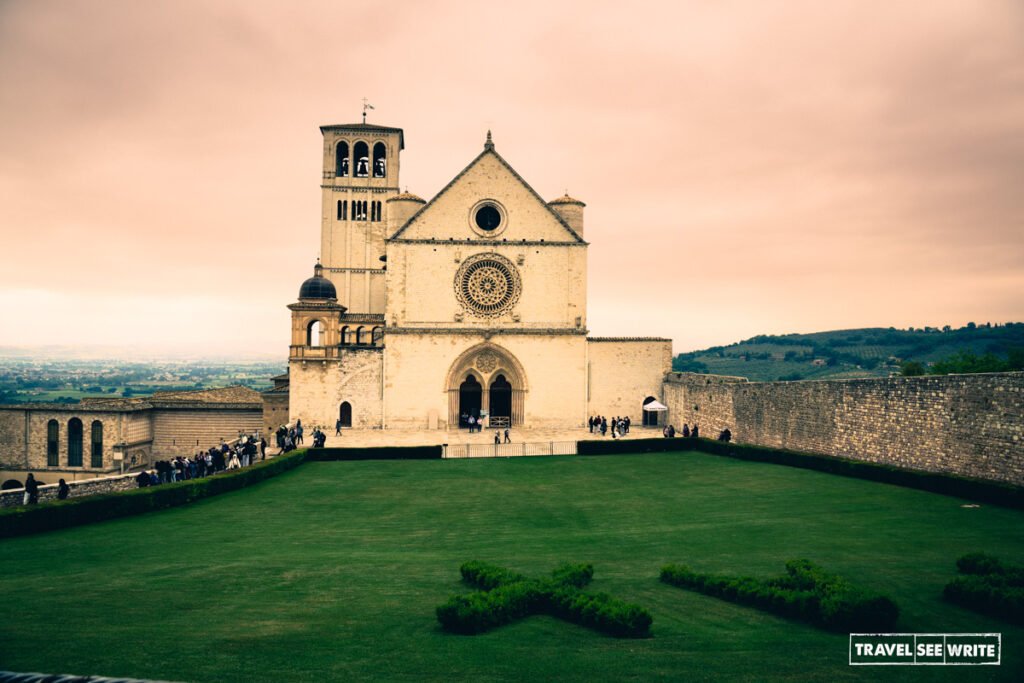
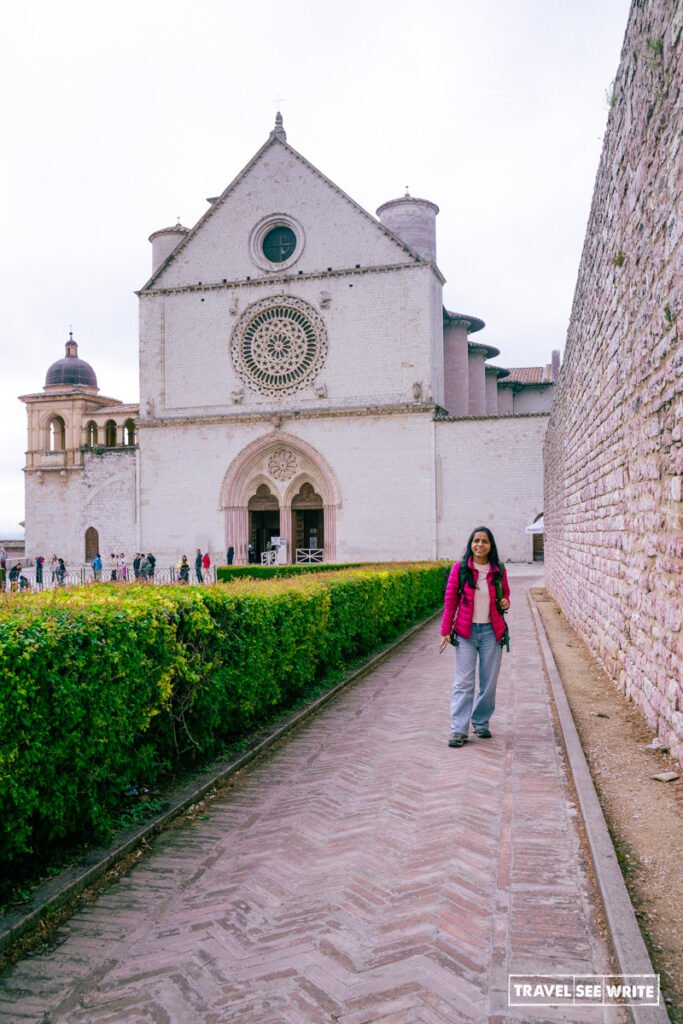
We came down to Assisi in the late afternoon for the Statio Peregrinorum, the traditional pilgrim welcome, and then into the Basilica di San Francesco with a local guide. The Basilica di San Francesco in Assisi is a masterpiece of art and architecture, uniquely built as two stacked churches—the dimly lit Lower Church and the bright Upper Church. It serves as a monumental shrine housing the saint’s tomb and played a pivotal role in the birth of Italian Gothic design and Western art. The walls feature 10,000 square meters of frescoes, serving as a massive open-air textbook of art history. It boasts works by towering medieval masters like Giotto, Cimabue, Simone Martini, and Pietro Lorenzetti.
The Basilica of San Francesco d’Assisi is one of the most visited pilgrimage sites and historical landmarks in Umbria, Italy.
I’ve been to a lot of famous churches. What struck me about this one was how much it still felt like it was being used for the thing it was built for. People were there to be there, not just to photograph the Giotto frescoes. I met so many modern-day pilgrims, who were walking for two months not for religious reasons but to connect with themselves and nature.
At the Statio, we got our pilgrim passports stamped. The credenziale, as it’s called, is a small booklet you carry and collect stamps in at each significant stop along the trail. I didn’t expect to care about this. I cared about it immediately and have no rational explanation for why.
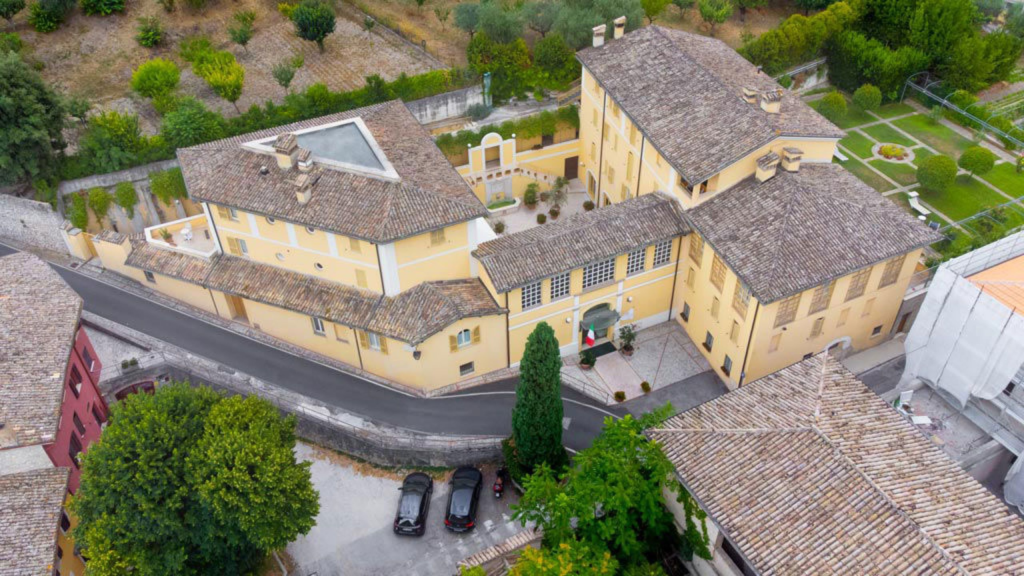
After spending a few hours at this monumental UNESCO World Heritage Site, we left for our hotel, Hotel Pax, a family-owned boutique property. Hotel located in the centre, convenient for visiting everything on foot. Very friendly staff starting from check-in, clean room with a bathroom, and very quiet.
For dinner, our Tullia had chosen Terrazza di Properzio, a restaurant with a panoramic terrace overlooking the Umbrian valley. The restaurant had a very intimate setting and was undoubtedly the go-to place for tourists as well as locals. The food was brimming with authentic Umbrian flavours, and the presentation was pretty creative too. It was here that I first tried the Sagrantino wine.
Day Two: The Olive Grove Walk to Spello
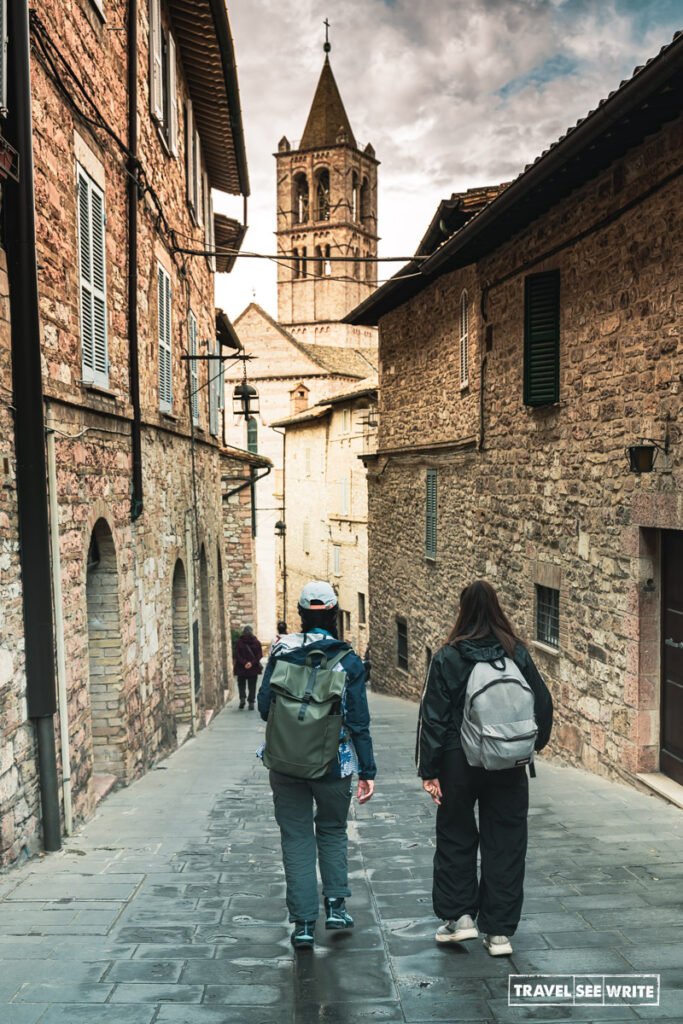
Despite gloomy weather, our brilliant guide Patricia led us past the famous Basilica and into the quiet, mist-shrouded backstreets of Assisi to uncover hidden Roman ruins and ancient, atmospheric medieval alleys.
The Assisi to Spello stretch on the Via degli Ulivi is the one I keep bringing up when people ask about this trip.
The trail itself runs 12 kilometres along mountain ridges and through olive groves, with the whole Valle Umbra spread out below for the entire walk. There’s 200 metres of climb and 345 metres of descent, and it takes around four hours at a pace that doesn’t rush anything, because rushing isn’t really an option out there. Add the walking we did inside Assisi that morning and inside Spello once we arrived, and the full day came closer to 19 kilometres on my legs, though the actual trail is the shorter number.
We’d done a short guided walk through Assisi first, so by the time we set off, I’d had a bit of time to let the town settle. We picked up a packed lunch to eat on the trail. The path moved quickly into olive groves, through terraced fields, past stone walls where you can tell someone has been farming this exact slope for generations.
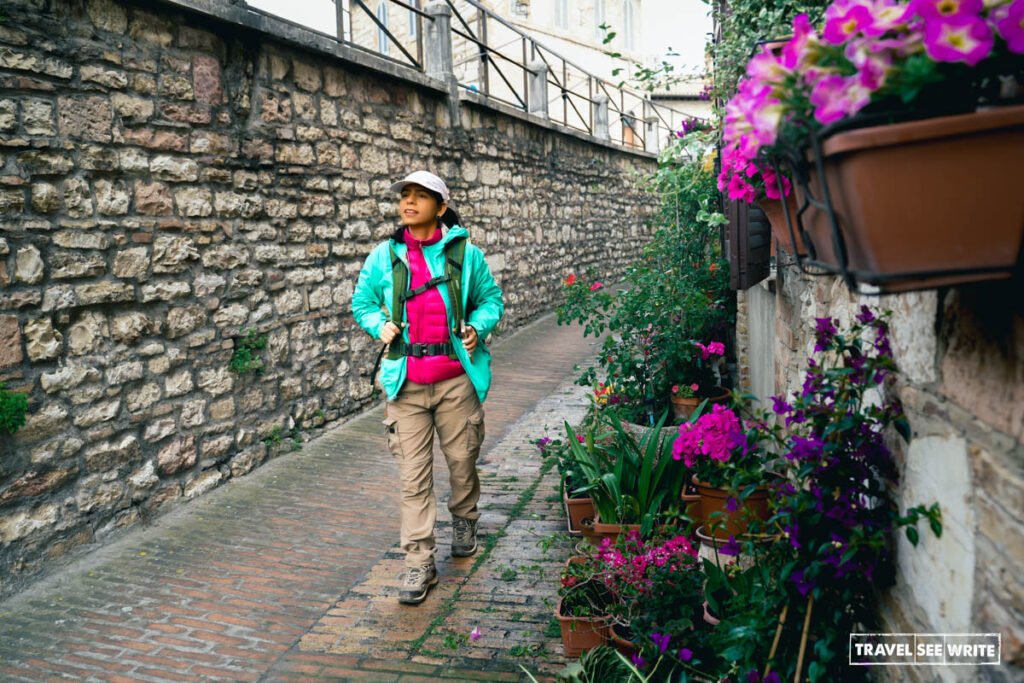
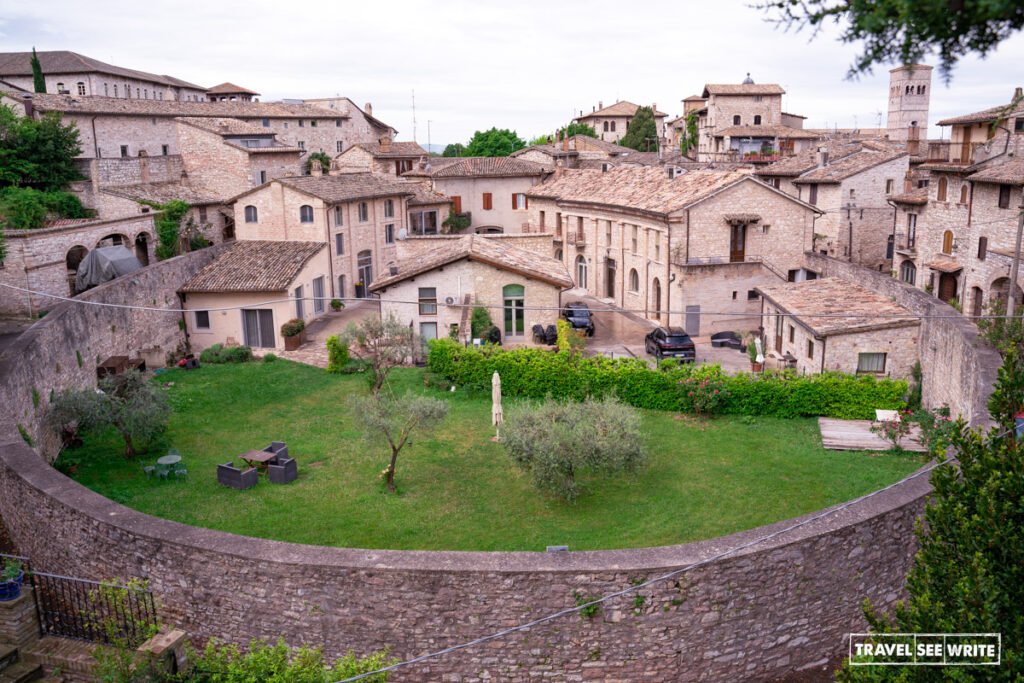
Assisi Streets that are barely discovered by tourists, Umbria, Italy
A photo point that is often missed by most tourists in Assisi, Umbria, Italy
The Basilica of San Francesco d’Assisi in Umbria, Italy.
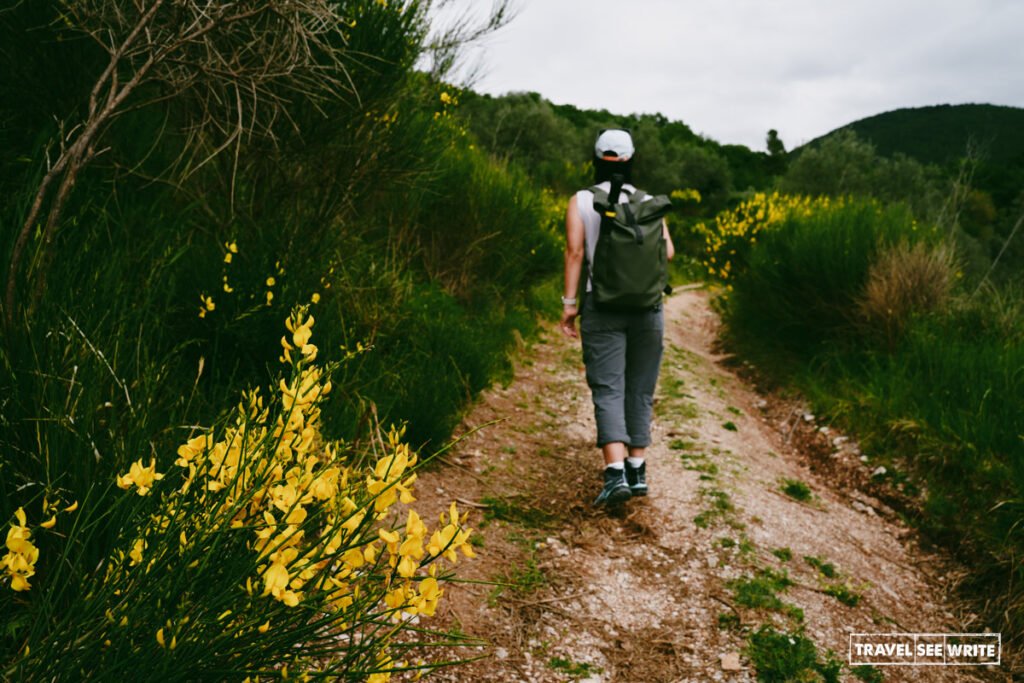
Early May here feels cinematic. Temperatures hover around 20°C, the breeze is cool enough for layers, and the countryside is exploding with wildflowers. Bright yellow broom bushes line the gravel trail, olive groves shimmer silver-green under stormy skies, and poppies appear unexpectedly beside old stone paths.
“When you start walking the trail, you start knowing yourself more. It’s like peeling an onion. Unwanted layers keep coming off. And by the end, you’re only left thinking about what’s actually important to you. That feeling only comes when you walk alone.”
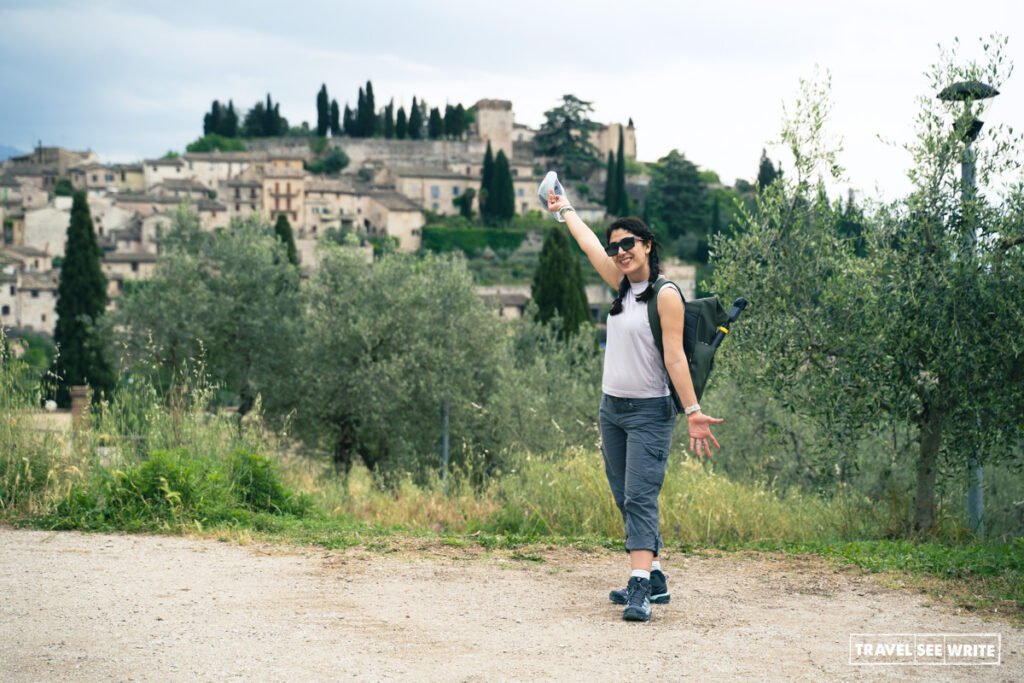
We stop three times during our 19 km walk. First for water and snacks under dramatic clouds, where strangers slowly become trail friends. Second, for a picnic lunch surrounded by olive trees and complete silence except for birds and wind moving through the valley. And the final stop — the one you never forget — just before entering Spello, where the medieval town suddenly appears in the distance like a painting beneath dark Umbrian skies.
Via degli Ulivi (Olive Grove Trail): The most iconic view. As the descent flattens, this mountainside path offers a spectacular, unobstructed view of Spello’s historic centre framed by centuries-old olive trees.
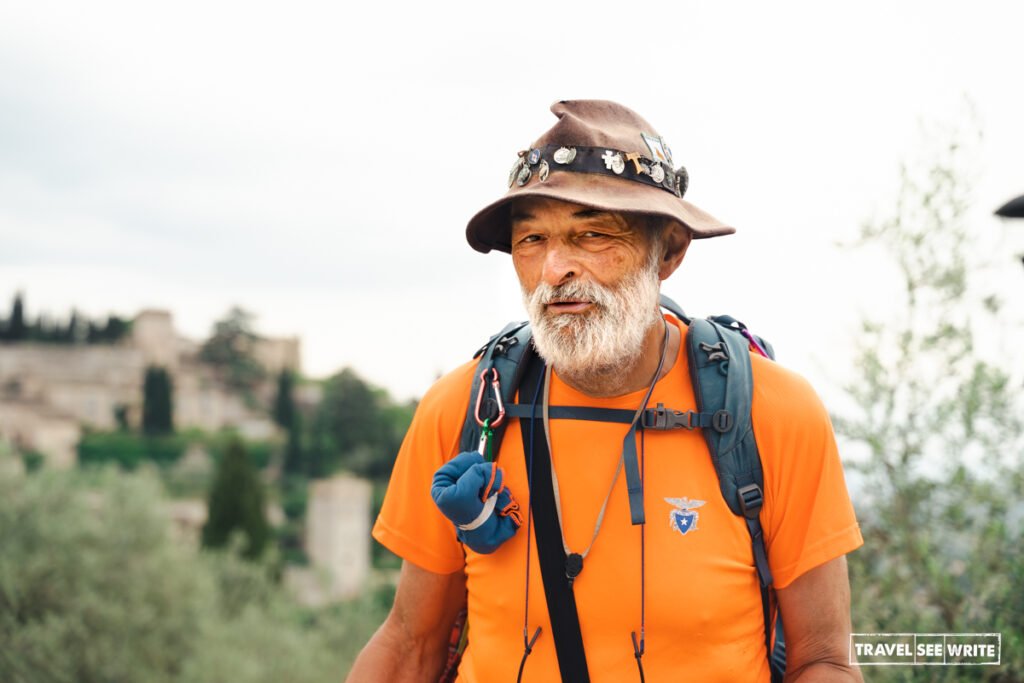
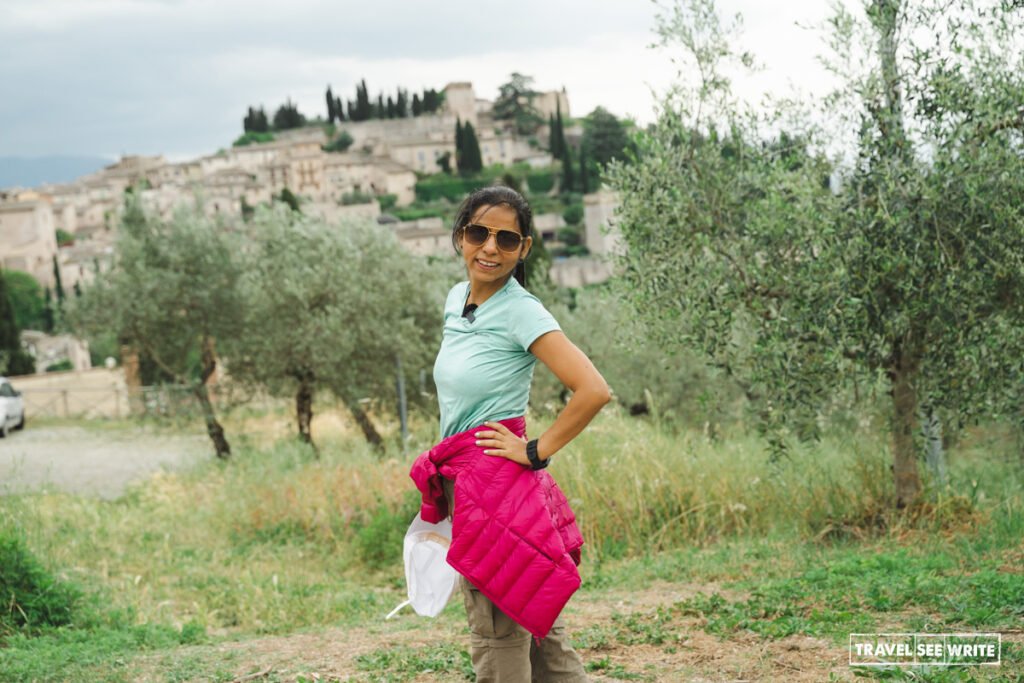
But the most unforgettable moment wasn’t the landscape. It was meeting a real pilgrim on the trail. He had started walking on 13th April and planned to reach Rome entirely on foot by 23rd May. Backpack, boots, quiet determination. A reminder that these paths are still lived, not just visited. Fiore, a 65-70-year-old gentleman from Padova. Following the St. Antonio path, he started in Bologna, reaching Assisi, then continuing on an onward journey to Rome, approximately walking 600 km in sixty days.
Fiore, a determined 65-year-old pilgrim from Padova, walks the historic St. Antonio path on an inspiring 600-kilometre journey from Bologna to Rome.
By the time we reached Spello, our legs were sore, our shoes dusty, and our shoulders aching. But mentally? We felt lighter. Maybe that’s what pilgrimage routes really do. They don’t just take you somewhere. They slow you down enough to actually arrive.
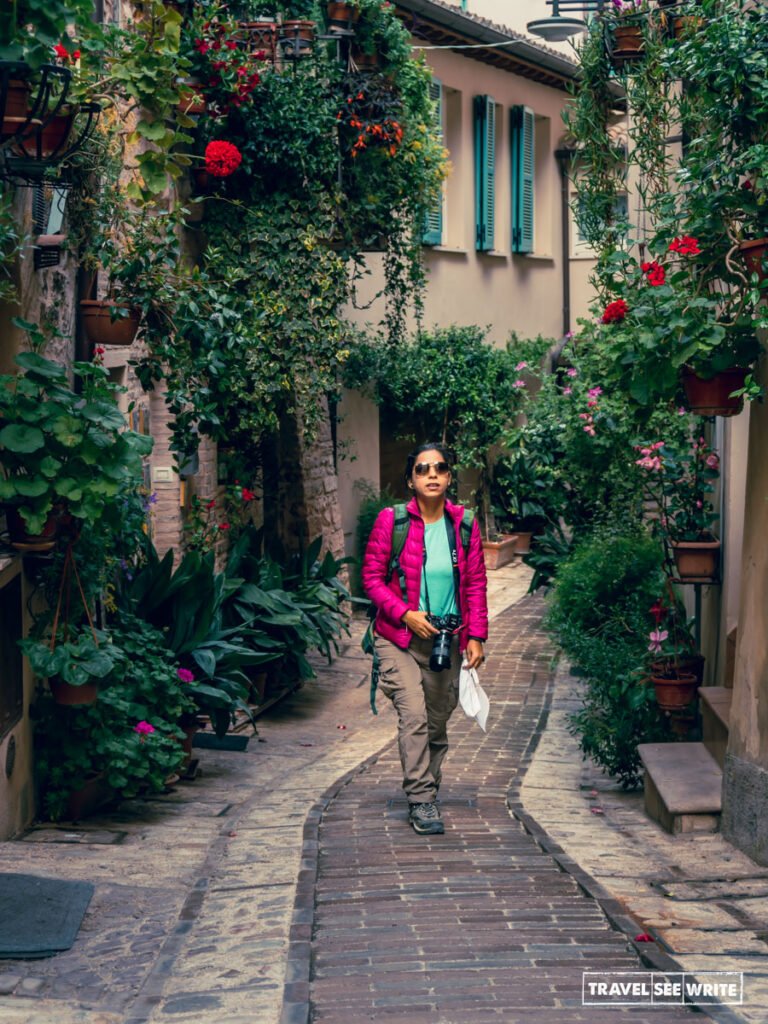
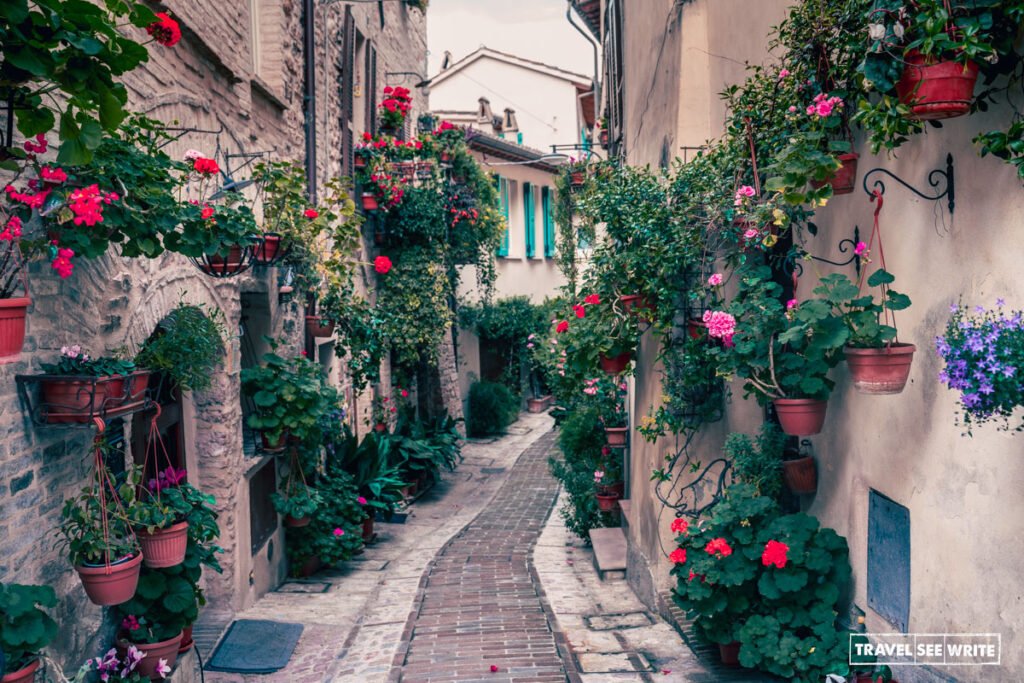
Arriving in Spello on foot is different to arriving any other way. You come down through the old walls into pink stone streets from above, your calves still aware of that descent, and the town just receives you. Spello is built from locally quarried rose stone, and every alley has flowers growing out of window boxes, up walls, through gaps in old gates. It’s hard to overstate how pretty it is, and it has almost no tourism infrastructure, which means you’re inside it rather than watching it from behind a barrier.
Bursting with colourful flowers, the winding stone alleyways of Spello, Italy, showcase the breathtaking, fairy-tale charm of this historic medieval town.
This is one of those Umbria hill towns that barely make it onto anyone’s Italy itinerary, sitting just 15 minutes south of Assisi. It’s known for its flower-covered cobblestone streets and the Infiorata, a festival dating back to 1778, where a sloping street called Via Italo Belardi gets paved entirely in flower petals, half a million of them, ending in a religious procession through the town. It happens every June.
Around 5:30 pm, we arrived at another boutique Hotel Cacciatore. Our bags were already waiting for us there. After a quick freshen up, I was out for dinner at La Cantina. But not before trying out the Gelato. Long table, good Sagrantino, nobody in a hurry.
I slept very well that night after a gorgeous day in Umbria.
Day Three: The Sacred Forest and Then Spoleto
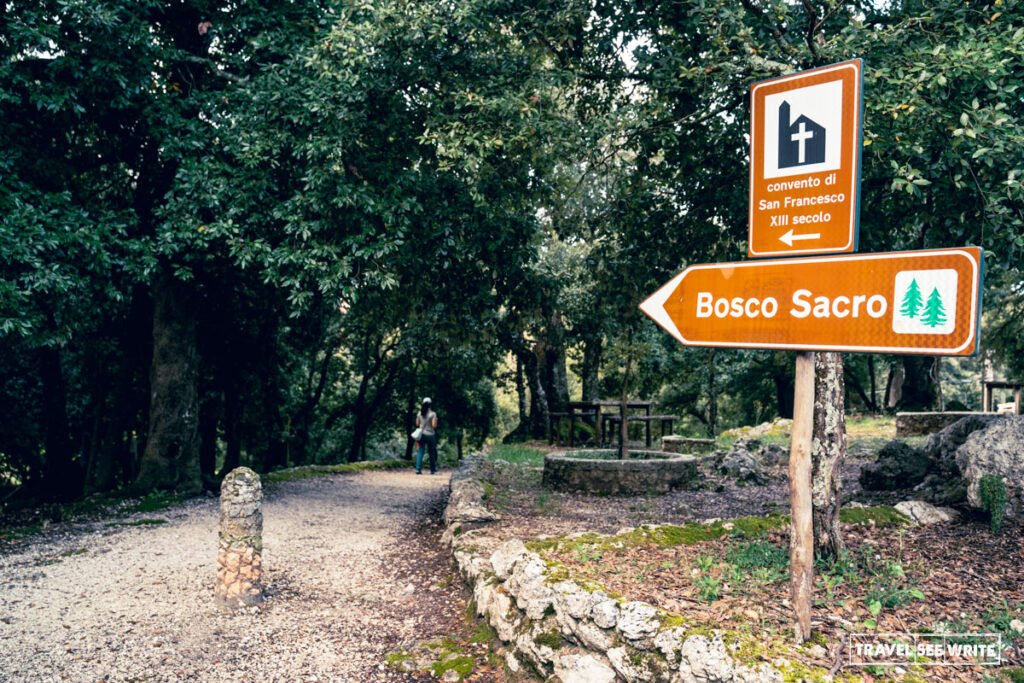
Nestled high above Spoleto, the Sacred Forest of Monteluco is an ancient ilex oak grove and spiritual sanctuary that is home to a historic Franciscan convent.
The final morning started with a drive up to Monteluco.
The Sacred Forest of Monteluco is an ancient grove of ilex oaks above Spoleto where the Franciscan convent sits. The forest has been considered sacred, going back to pre-Christian Roman times. There are signs at the entrance asking visitors for silence. This is not unusual near religious sites but here the request feels specific, like the silence is actually the point rather than just courtesy.
The convent itself is still active. We visited, then started walking down through the forest into Spoleto: 3.5 kilometres, steep in places, the trail moving through dense cool shade and then opening out above the city.
The Rocca Albornoziana fortress overlooks Spoleto while connecting directly to the Ponte delle Torri, a massive 14th-century aqueduct and bridge that spans a deep gorge to link the hill with Monteluco.
Ponte delle Torri – An awe-inspiring 14th-century medieval aqueduct-bridge stretching 230 metres long and soaring 80 metres high over the deep Tessino gorge
Spoleto stopped me. I wasn’t expecting it to, but it did.
It’s a town built almost entirely on top of its own history. Walk down one street, and you’re passing a 1st-century Roman house. Turn a corner, and there’s a 14th-century fortress. Look down through a grate in the modern street, and you can see a Roman bridge underneath. It’s not preserved the way a museum is preserved. It’s just accumulated there over two thousand years while people kept living above it. I find that more affecting than almost any formal heritage site.
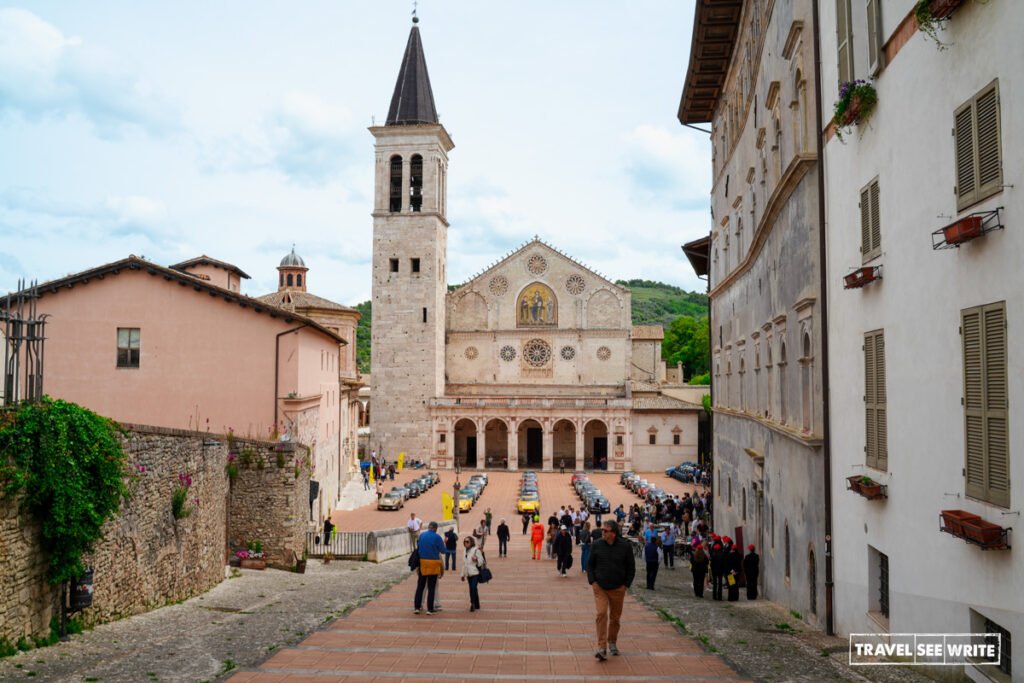
Piazza del Duomo in Spoleto, Umbria, Italy, looking directly down at the Cattedrale di Santa Maria Assunta (Duomo di Spoleto).
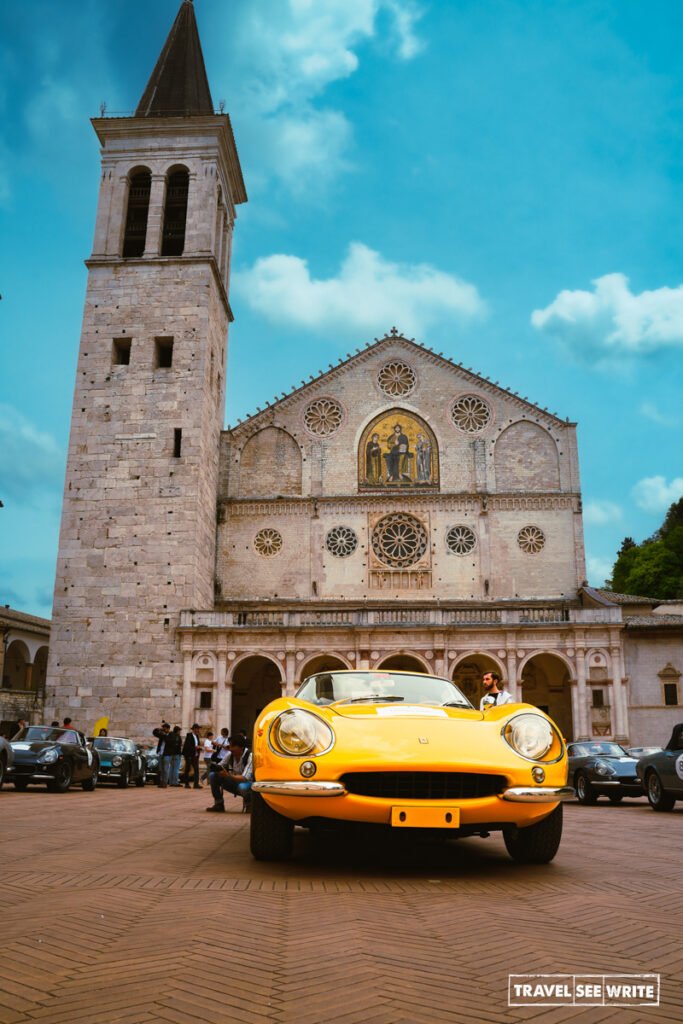
The view from the canyon edge towards the Ponte delle Torri is one of those things I genuinely wasn’t prepared for. A medieval aqueduct bridge crossing a deep mountain gorge, tall enough to make my stomach drop just looking at it. I stood there for a while. And, as we descended to the spectacular Piazza del Duomo, we were surprised to find 32 classic Ferrari 275s from around the world neatly parked. Apparently, they were participating in the 2026 Ferrari Legacy Tour, which ran from May 5 to May 8, 2026, centred on the Umbria region of Italy to celebrate the 60th anniversary of the classic 275 series.
32 classic Ferrari 275s from around the world neatly parked at Piazza del Duomo, Spoleto, Umbria, Italy
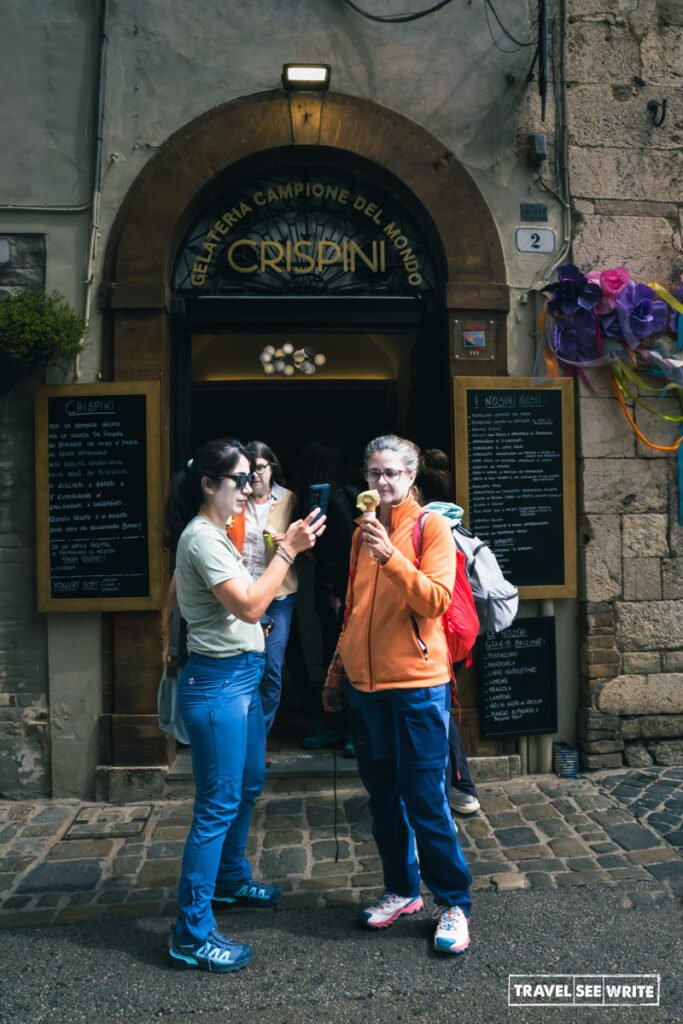
Do not leave Spoleto without trying pistachio gelato at Gelateria Crispini.
After marvelling at the beauty of the Ferraris, we went to cool down at Gelateria Crispini. Their pistachio gelato is award-winning, world-champion-level. I understood why after the first spoon. Do not leave Spoleto without having it.
After a quick walking tour around the medieval town, we had our group’s final meal together at Osteria dell’Enoteca. Strangozzi pasta with black truffle. This is a regional Umbrian pasta, thick hand-rolled strands, and the truffle here is local, which means it tastes like the soil smells on the trail. After three days of walking and eating my way through this region I was beginning to understand that the food and the landscape are the same thing presented differently.
The walking group wrapped up at Spoleto station. I checked into Hotel San Luca, collected my rental car keys, and sat with that for a moment.
Three days on foot to get here. Now I had a car and nine more days and the open road through Tuscany.
It felt like the right way to have earned it.
A Few Things Worth Knowing Before You Go
Things to keep in mind when visiting Umbria, Italy
You do not need to be a serious hiker.
The longest section is 12km, on well-marked paths with gentle terrain in most stretches. Proper walking shoes are more than enough in May. If you’re considering it and telling yourself you’re not fit enough, you probably are.
Carry the pilgrim passport.
The credenziale is available through AEVF at viefrancigene.org or from churches along the route. Get it stamped at every significant stop. I thought I wouldn’t care about this. I was wrong. There’s something about the physical proof of where you’ve been that stays with you in a way that photos don’t quite manage.
Trust the logistics to someone who knows the route.
SloWays moved my bags between hotels, arranged the transfers to trail starting points, and gave me a detailed route document for each day. Not having to think about the logistics meant I had three full days of just being somewhere rather than managing somewhere. That’s the difference.
Umbrian food is not the Italian food you think you know.
Strangozzi with black truffle. Norcineria meats from Norcia. Local Sagrantino wine that you will not easily find outside this region. When you sit down in a local trattoria in Spello or Spoleto, ask what’s local rather than ordering what’s familiar. Every answer will be better than what you were about to request.
May is the right time.
Everything is green, the weather is warm without being punishing, the villages are not yet at summer crowd levels, and the olive groves look exactly like they’re supposed to look. October works too, for different reasons. Avoid August if crowds and heat are not your idea of slow travel.
Why This Trip Specifically
I’ve been to 110 countries. I’ve walked on all seven continents. I’ve done Antarctic and Arctic expeditions, high altitude treks, and desert crossings. I say this not to boast but to explain something: the Via di Francesco was three days and roughly 20 kilometres, and I keep talking about it more than most of those bigger, harder trips.
There’s something about moving through a landscape at walking pace that forces a different kind of attention. You notice the soil changing colour underfoot. You notice the air smells different coming out of a forested ridge versus an olive grove. You end the day with an actual physical memory of the distance you covered, which is not something that happens when you arrive somewhere by car or train without your body having done any of the work.
And there’s something specific to Umbria, this landlocked region that doesn’t carry Tuscany’s fame or Tuscany’s crowds, where the towns are built from pink and honey coloured stone and the valleys smell faintly of truffle, and the local wine is one of Italy’s best-kept secrets. It asks less of you as a visitor than most of the famous Italian destinations do. It doesn’t perform for you. You just have to show up and actually pay attention.
Three days were enough to understand that. It was nowhere near enough of it.
Disclaimer: I was invited by SloWays Travel and the Italian Pilgrim Routes 2026 project, a collaboration between AEVF and the Italian Ministry of Tourism, for this experience. Every observation, every feeling, every photo in this post is mine. Nobody edited what I actually saw.
When you tie your boots at the end of a route that took you months to get there, something special occurs. No guided tours or groups, just you, a pack, and a landscape that seems like it was made especially for you. For a solo traveller, the best reward is a remote hiking route. The only real problem? Getting there without spending all your money before the fun begins.
Finding affordable flights to off-the-beaten-path places is a mix of science, instinct, and a lot of patience. But once you figure it out, you’ll see that the world’s most amazing trails are far easier to get to than the prices make them seem.
Start with Flexible Dates, Not Destinations
A lot of people who travel solo make the error of picking a place to go before looking for tickets. Change that way of thinking completely. Start with a date frame and let the pricing tell you where to go instead. There are tools that can help you find the cheapest flights from your home airport over a certain period of time.
This works well for trekking places that are hard to get to since the trailheads in Kyrgyzstan, Patagonia, Nepal, or the Canadian Rockies are usually close to tiny regional airports with prices that change a lot. If you’re willing to travel during the week, particularly on Tuesdays and Wednesdays, you may save 20 to 30 percent on your ticket compared to flying on the weekend.
Use Multi-City Routing to Your Advantage
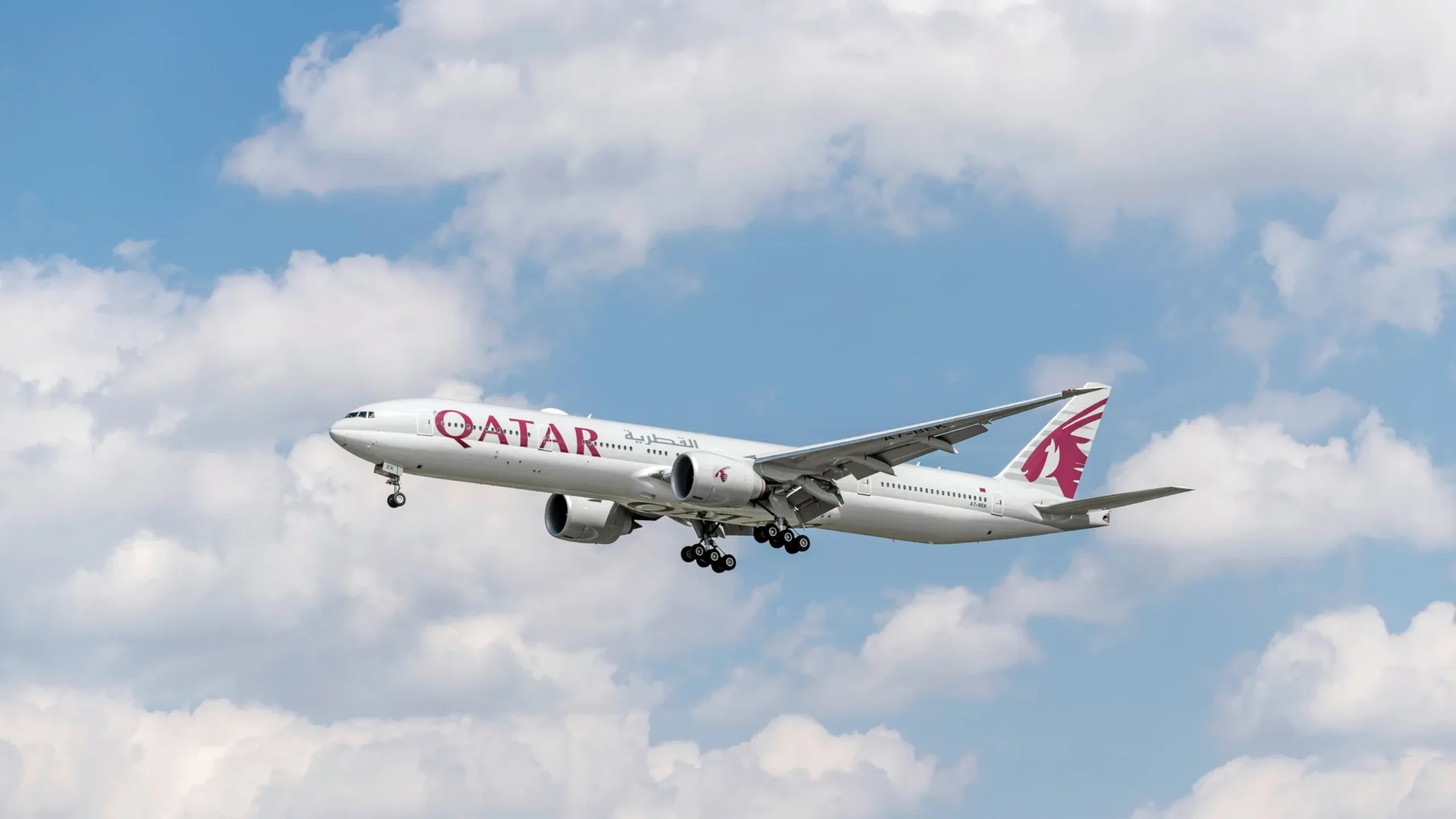
There aren’t many big international airports near remote routes. That is your best chance. Instead of looking for a single straight route, split your trip into parts. For instance, travelling to a big city like Istanbul, Doha, or Kuala Lumpur and then purchasing a separate budget airline to your target city is nearly always cheaper than buying a single through-ticket.
This plan works particularly well with the cheapest flight deals for international travel, which are usually found near key connecting hubs in the Middle East and Southeast Asia. Many of the airlines provide very low prices on regional routes that big airlines don’t even bother with.
Book each leg individually, and always allow at least six hours between connections to protect yourself from the trouble of lost baggage or late arrivals.
Set Price Alerts and Play the Waiting Game
Airfare changes all the time. An algorithm may decide to fill empty seats, so a journey that costs $800 today might reduce to $490 next week. Platforms keep an eye on these changes and let you know as soon as rates go down for you.
For hiking trips to faraway places, the best time to schedule international tickets is usually between two and four months before you go. If you book too early, you’ll have to pay more. You won’t be able to get a seat if you wait too long to book. Set your alert, believe the facts, and pull the trigger when the time is right.
Leverage Airline Miles and Credit Card Points
When you travel alone, you just need one seat, which is a big benefit over traveling with a group. Even when a flight indicates “limited availability” for numerous people, that one seat is usually always available for reward redemptions. If you don’t already have a travel credit card that lets you earn miles, you’re missing out on hundreds of dollars per year.
You may transfer points to partner airlines and book business or economy flights to faraway overseas locations for a lot less money using different programs. If you’ve been smart about how you earn points, a round trip to Bishkek (the entrance to the Tian Shan mountains) or Queenstown (New Zealand’s adventure capital) may frequently be paid for completely using points.
Think Beyond the Obvious Trailhead Airport
The most popular trails are close to airports that are easy to see. These airports also charge more for their services. Try to find other ways to get in. For example, hikers going to the Laugavegur Trail in Iceland typically find it cheaper to fly into Reykjavik’s Keflavik International and use local buses. On the other hand, some people spend too much because they just looked for “flights near Landmannalaugar” and didn’t look at the whole picture.
Trails in Bhutan, Lesotho, and distant sections of Colombia also have nearby airports in India, South Africa, or Panama City that are cheaper to get to. A short regional bus ride or even an overnight bus ride can get you there for a lot less than what you’d spend to fly there directly.
Time Your Searches Strategically
Search incognito. This is not up for discussion. Airlines and booking sites employ cookies to keep track of searches that happen more than once. When they see that someone is still interested, they may boost the price. If you want to view the real, unedited pricing, you need to open a private browser window every time you search.
Also, studies indicate that flights searched on Sunday nights and booked on Monday mornings tend to display the most recent price cuts that happened over the weekend.
The Real Competitive Edge
Reddit’s solo hiking forums (r/solotravel, r/hiking, and r/Shoestring) are great places to get real-time airline bargain ideas for hard-to-reach places. Other passengers provide tips on visa-on-arrival hacks, mistake prices, and regional carriers that no computer program can copy. Get involved with these communities early and frequently.
Conclusion
The best solo hiking trips start long before you get to the trailhead. They start the instant you decide to discover a better way to get there. Cheap flights to remote locations aren’t just a rumour; they’re a prize for open-minded travelers, think outside the box, and do the research that others don’t. The world’s wildest paths are just a well-timed booking away, whether they are on a volcanic ridge in Iceland or in a secluded valley in Kyrgyzstan. Start planning by opening that incognito tab, setting your notifications, and getting there. The mountain isn’t going away, but the price decrease won’t stay forever.
“Travelling – it leaves you speechless, then turns you into a storyteller.” — Ibn Battuta
If Morocco has been sitting on your vision board for years, this is your sign. Travel See Write’s TSW Signature Moroccan Journey isn’t just a trip — it’s a slow, soulful, deeply immersive experience designed for travellers who want more than photos. Think culture, creativity, community, cuisine, and landscapes that feel straight out of a movie.
Seven days. Six nights. A thousand stories waiting to be written.
Why This Journey Is Different
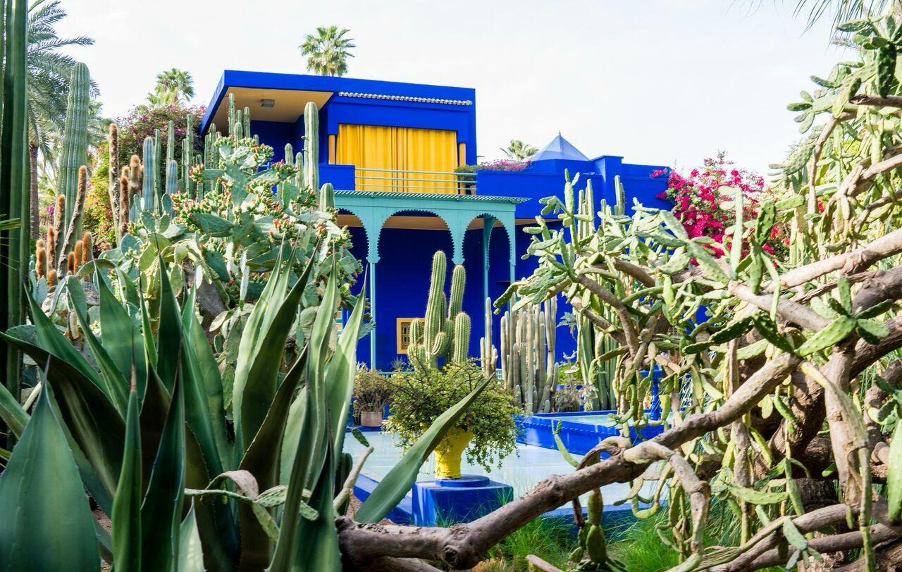
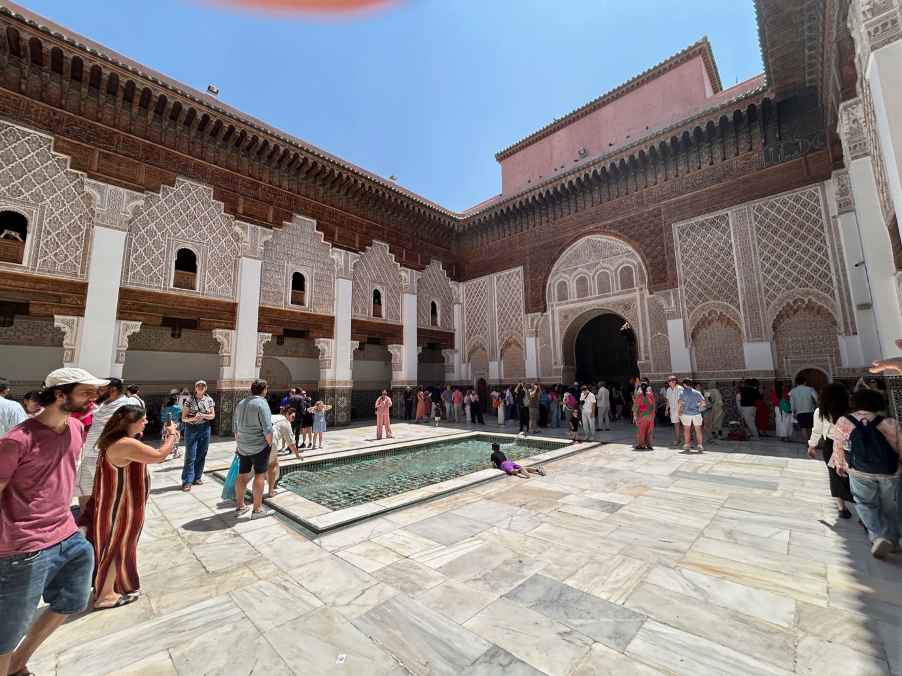
This isn’t a checklist tour. It’s a curated blend of heritage, hands-on experiences, meaningful local interactions, and stunning landscapes — all wrapped in beautiful, authentic stays. What makes this Moroccan journey iconic is how every experience flows into the next, creating something far deeper than a typical sightseeing trip. You stay in beautiful, authentic accommodations — from charming riads in Marrakech to a serene High Atlas retreat and a dreamy Agafay desert camp — where every night feels like a postcard moment. You wander the vibrant streets of the Red City, exploring hidden alleys, souks, palaces, and historic monuments, then slow down at the Majorelle Garden and the Yves Saint Laurent Museum, where art, colour, and fashion history quietly collide.
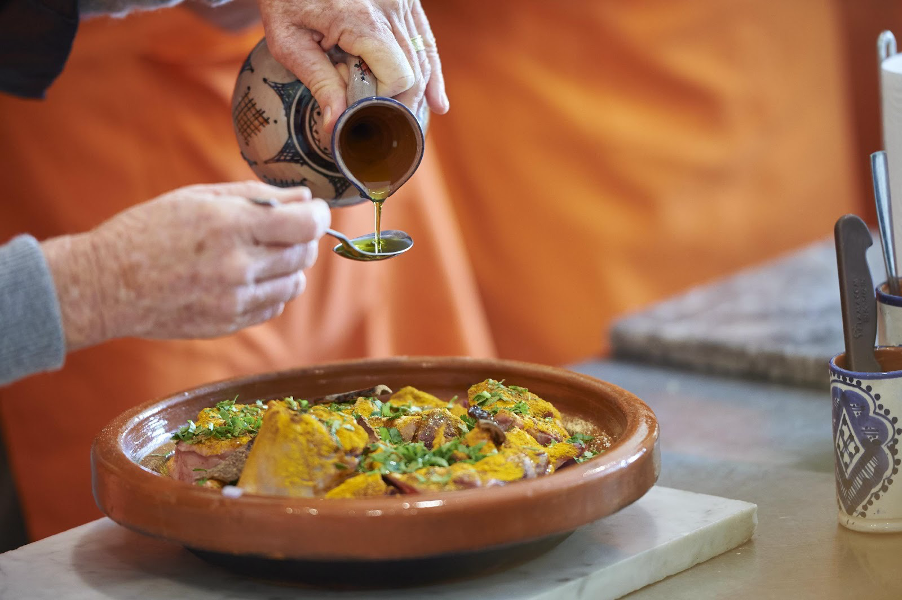
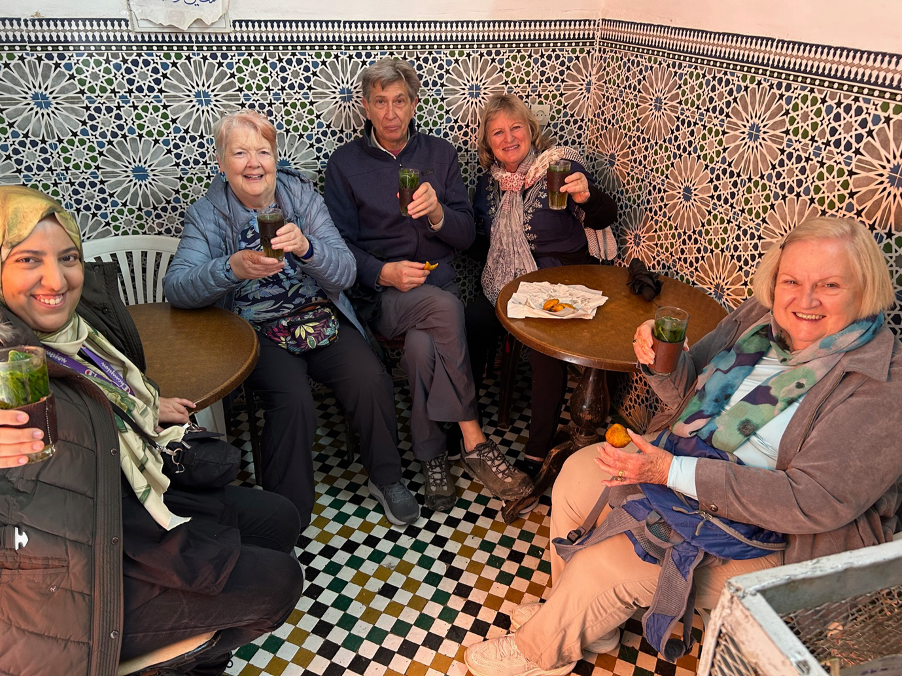
You cook alongside women at the Amal Center, learning Moroccan cuisine, sipping mint tea, and eating what you create, before tapping into your creative side at an Arabic calligraphy workshop and ending the day with a henna ceremony in a local family home. You step beyond the medina into the High Atlas Mountains for a day with the Amazighs — trekking scenic trails, visiting Berber villages, sharing a traditional lunch, and learning how mint tea is made. And finally, you ride into the golden hour on a camel in the Agafay Desert, watching the sun melt into the horizon before spending the night in an oriental-style desert camp under starlit skies.
Your 7-Day Moroccan Storyline
Day 1: Arrival in Marrakech
A warm welcome to Marrakech. Today you will be transferred to your accommodation.
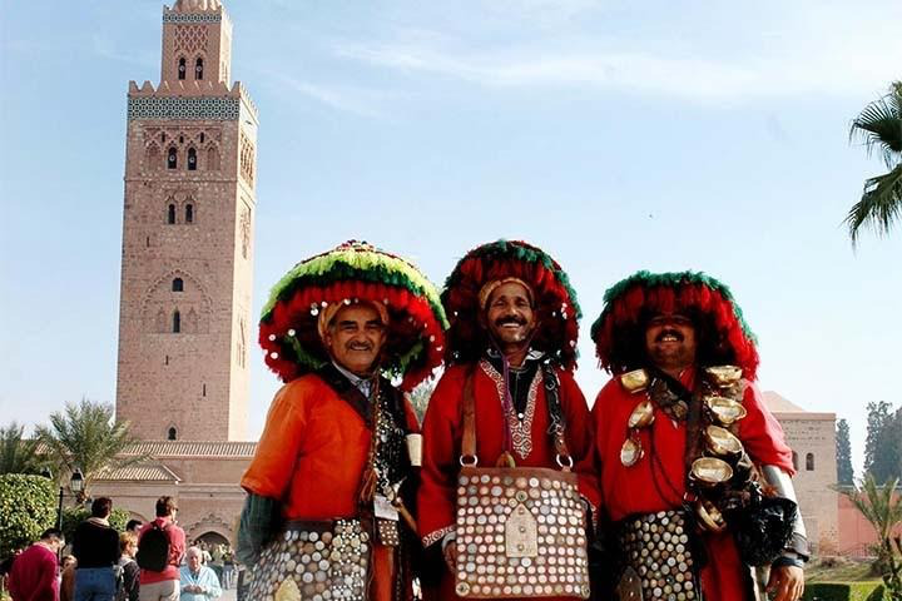
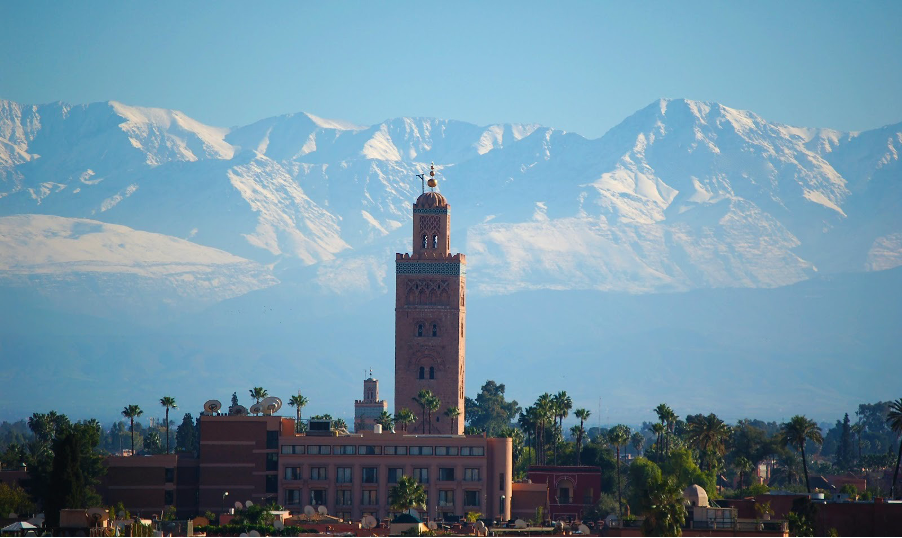
Marrakech was founded in 1070 as the capital of the Almoravid Empire, separating it from the Sahara Desert via the Atlas Mountains. Its name, The Red City, comes from the mud houses that look like they were formed right out of the earth. However, wealthy Sultans added to the architecture 500 years after its birth with grand palaces and magnificent tombs, making Marrakech a fascinating destination with a wide range of exciting activities.
Meet your guide this afternoon to enjoy an intro walk in this charming city.
Overnight: Marrakech
Day 2: full-day cultural Medina tour of Marrakech
TIP: Colourful dresses are recommended for today!
Discover the treasures of Marrakech, Morocco’s vibrant red city. Our Marrakech Guided Tour will take you away from the hustle and bustle of a large group tour and provide an intimate experience. Marrakech is home to stunning palaces and gardens, Islamic architecture, and contemporary art.
This private customized tour will offer you the opportunity to select the sites you wish to ranging from the Yves Saint Laurent museum, Majorelle Gardens to the Mosque of Koutoubia, Dar El Bacha Palace, El Bahia Palace and Gardens, the Saadian Tombs along with the Souks and local galleries or museums.
The three-hour class includes a traditional tea ceremony, and ends with you enjoying the most delicious Moroccan food you will have during your time in Morocco 🙂
Overnight: Marrakech
Meals Included: Breakfast & Lunch as part of your Cooking Class Cooking Class: Approx. 5 hours, inc Drive duration
Day 4: Calligraphy Workshop & Henna Ceremony
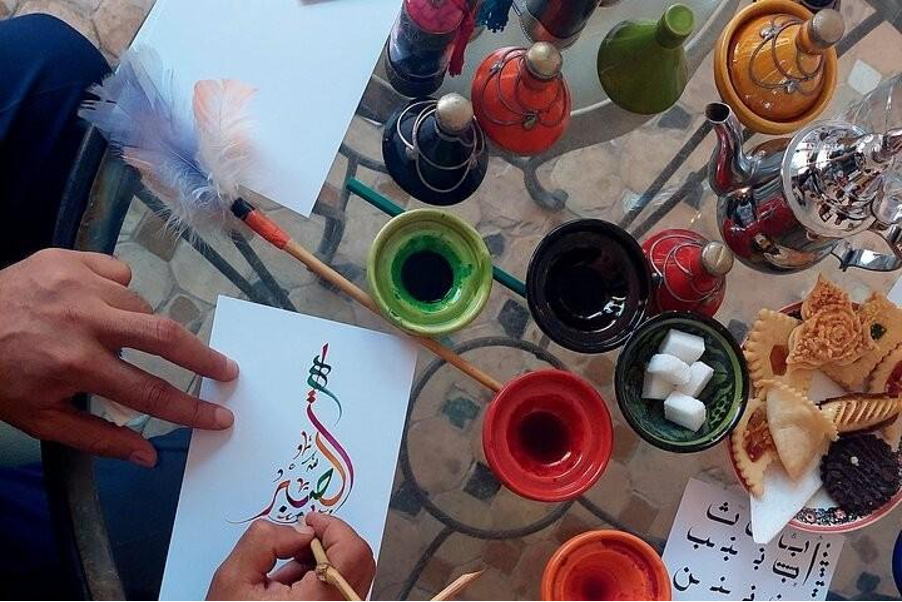
A calligraphy workshop in Marrakech offers a hands-on experience in Arabic calligraphy, focusing on traditional techniques and beautiful script. Participants, from beginners to experienced artists, will learn various styles, potentially using traditional tools like a bamboo “qalam”. The workshops typically culminate in the creation of a personalized piece of art, blending cultural immersion with artistic skill development.
Finishing off today with a mini ceremony in the heart of a local family home, enjoying Henna & Tea – one of the heart-warming experiences.
Overnight: Marrakech Meals Included: Breakfast
Day 5: High Atlas Mountains — A Day with Amazighs
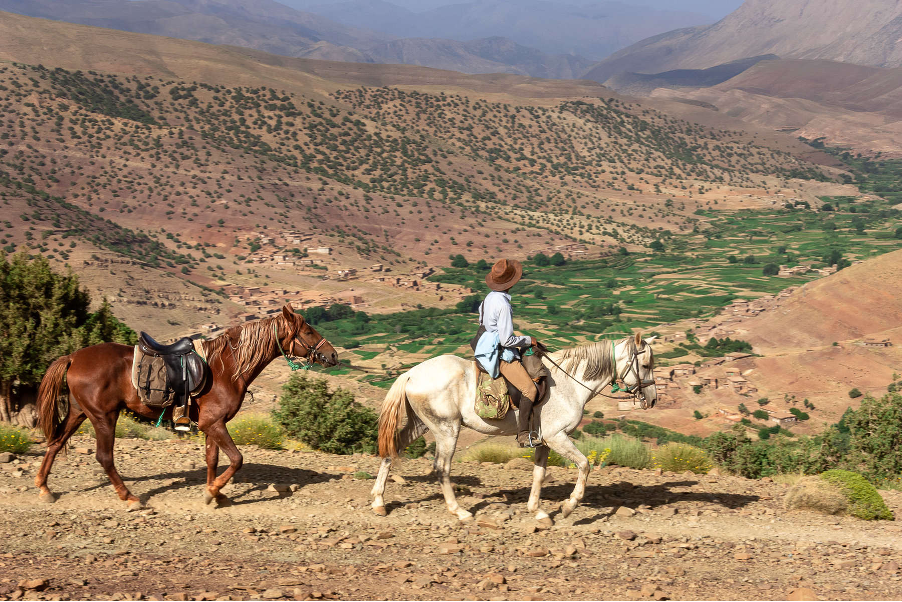
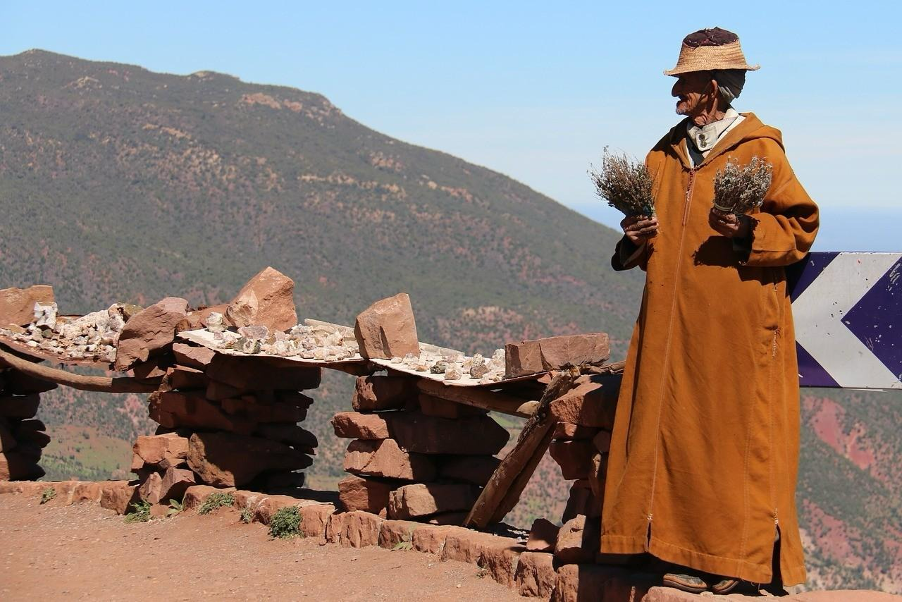
Spend Your Day Like a Berber! Both a beautiful natural setting and a thriving cultural history may be found in Morocco’s High Atlas Mountains. Spending a day as a Berber is one way to explore the highlands and become fully immersed in the Berber culture. The day will begin with you getting to know your Berber guide, who will accompany you on a light trek into the highlands and impart information about the customs and culture of the region. Morocco’s High Atlas Mountains are home to some of the country’s most beautiful hiking trails. Visit a Local Village: you will stop in a local Berber village along the journey to interact with the residents. You can discover their way of life and observe how they cultivate crops, prepare meals, and make textiles. Experience a traditional lunch: A traditional lunch that may include tagine, couscous, bread, and tea that is prepared for you by your guide. You may eat in a beautiful setting with a view of the mountains.
Learn to Make Tea: Traditional mint tea is a key component of Berber culture, and your guide will demonstrate how to do it. The relevance of tea in Berber social practices can also be discovered. In the afternoon, you will return to Marrakech.
Overnight: High Atlas Mountains Drive Duration: Approx. 2 hours
Meals Included: Breakfast, Lunch & Dinner
Day 6: Agafay Desert Adventure
Morning at leisure, enjoying the picturesque view of the Mountains!
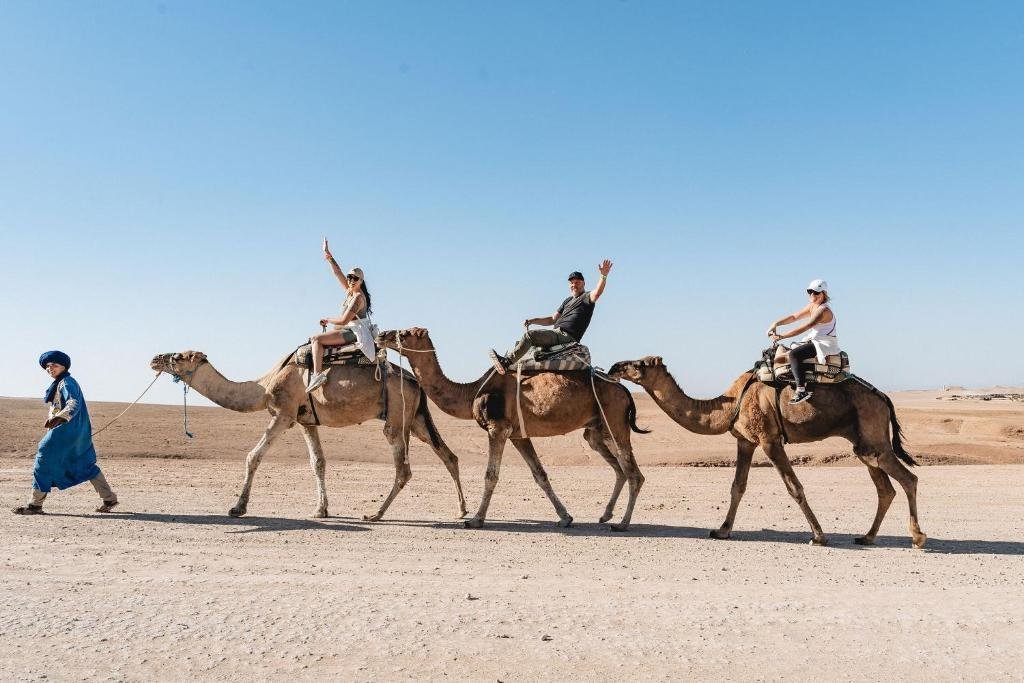
In the afternoon, unlike the dunes of the Sahara Desert, which take hours to reach, the Agafay, with its stony Hamada-style desert, offers a stunning landscape to relax, unwind, and watch the setting sun – you’ll feel a world away from Marrakech even though it’s only a 45-minute drive. The adventure starts with a Camel ride…enjoy the most beautiful sunset over the Agafay Desert overlooking the High Atlas Mountains.
Spend the night in a charming bivouac of a dozen oriental-inspired tents in the most beautiful corner of Morocco. Dotted amongst the desert landscape, the spacious and comfortable tents are decorated with uniquely sourced pieces and locally crafted artwork to form a harmonious whole with their surroundings, giving the impression of being on an expedition from another time.
Tonight, fire eaters and dancers are included.
Overnight: Agafay Desert Drive: Approx. 3 hours
Meals Included: Breakfast & Farewell dinner
Day 7: Departure
Private transfer to Marrakech Airport.
Practical Bits (So You Can Travel Stress-Free)
Duration: 7 Days / 6 Nights
Group Size: 4–10 people
Accommodation: Mid-range, authentic stays
Transport: Private deluxe air-conditioned van + driver
Guide: National English-speaking guide/host
Meals: Breakfasts daily + select lunches/dinners
Activities: All listed cultural experiences included
Dialling Code: +212
Credit Cards: Visa & MasterCard are widely accepted
Optional Fast Track assistance available at Marrakech Airport for smoother arrivals.
Pricing
Starts @2,500 USD per person
Excludes: Drinks, gratuities, additional activities, anything not listed above.
Who Is This Trip For?
This journey is for you if you:
Love culture, storytelling, and immersive travel
Want meaningful local interactions
Prefer boutique stays over big hotels
Care about art, cuisine, community & creativity
Want Morocco without the chaos of mass tourism
Basically — if you travel for depth, not just destinations.
Final Thought
Morocco doesn’t just give you memories. It gives you moments that stay stitched into your personality.
If you’ve ever dreamed of wandering Marrakech, cooking with locals, riding camels into desert sunsets, and sleeping under starlit skies — this is your moment.
Welcome to the TSW Signature Moroccan Journey. Come for the experience. Leave with stories you’ll tell forever.
Ready to join or want this customised for your dates? Contact us today. Your Moroccan chapter is waiting.
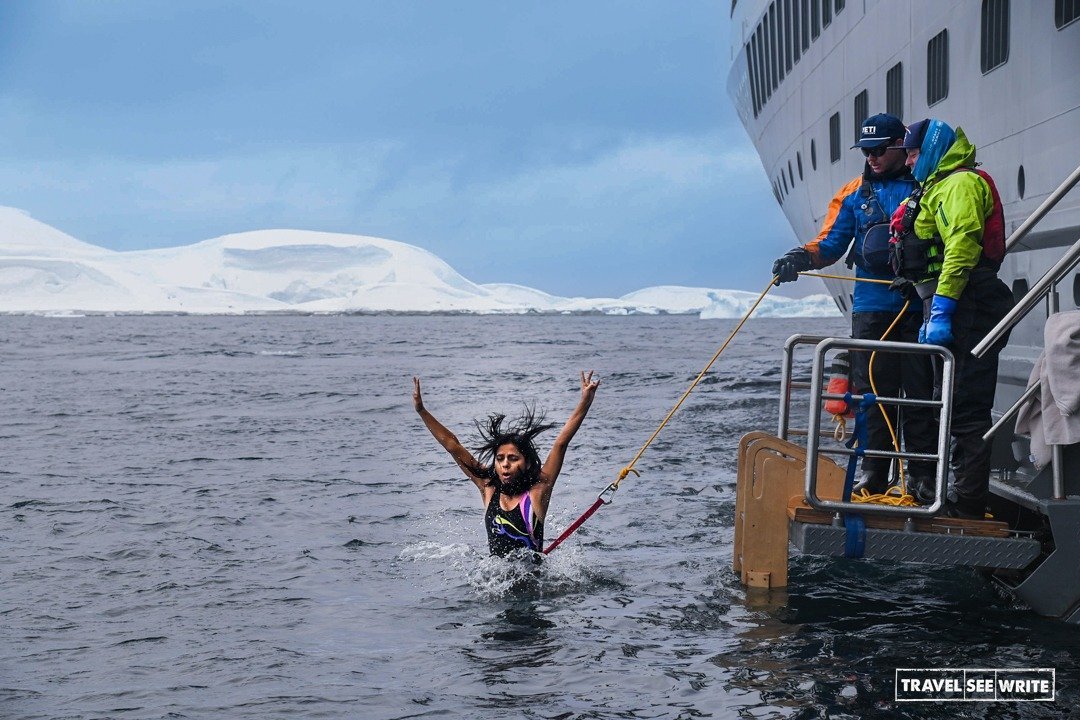
Which is the best Antarctica cruise vessel, and why?
This is the first question any potential Antarctica visitor asks when they start planning their trip. The answer isn’t simple. There are so many cruise liners that it can confuse even an Antarctica expert, let alone a first-time visitor. I have been to Antarctica myself and closely work with several cruise liners to send my clients to the frozen continent. Based on my Antarctica experience, here is my honest review of the most popular Antarctica cruise companies.
If you’re seriously considering Antarctica and want to choose the right ship—not just the cheapest or flashiest—this guide is for you.
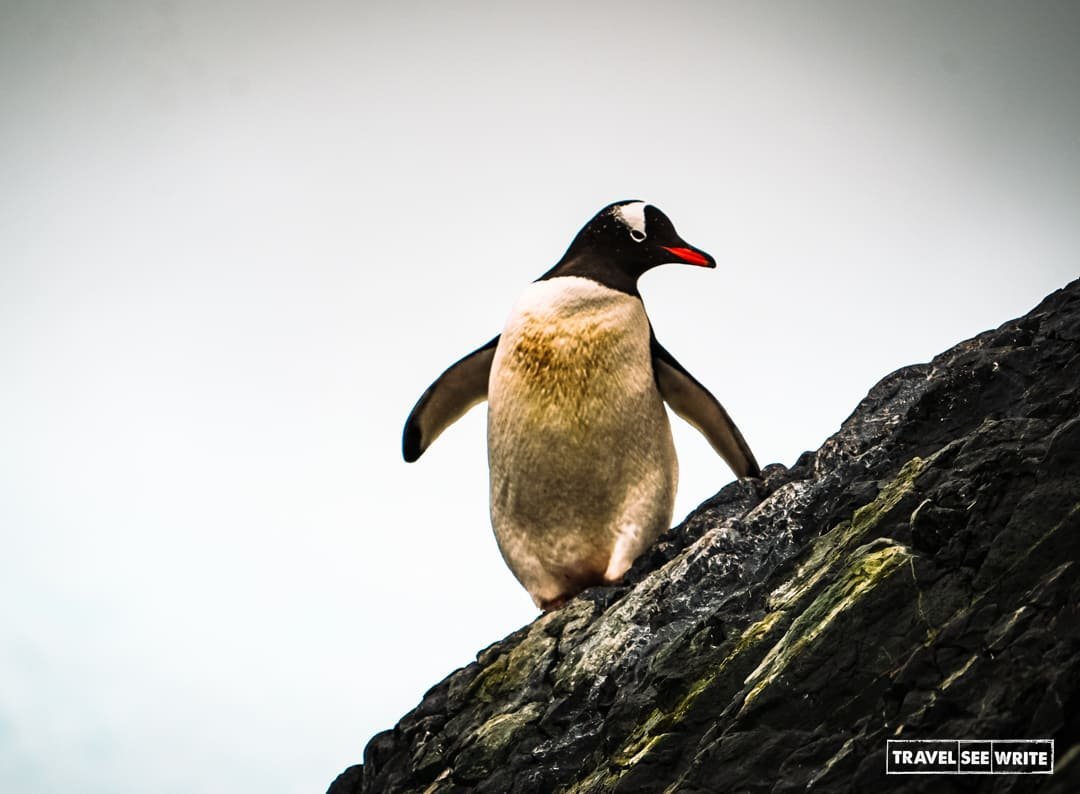
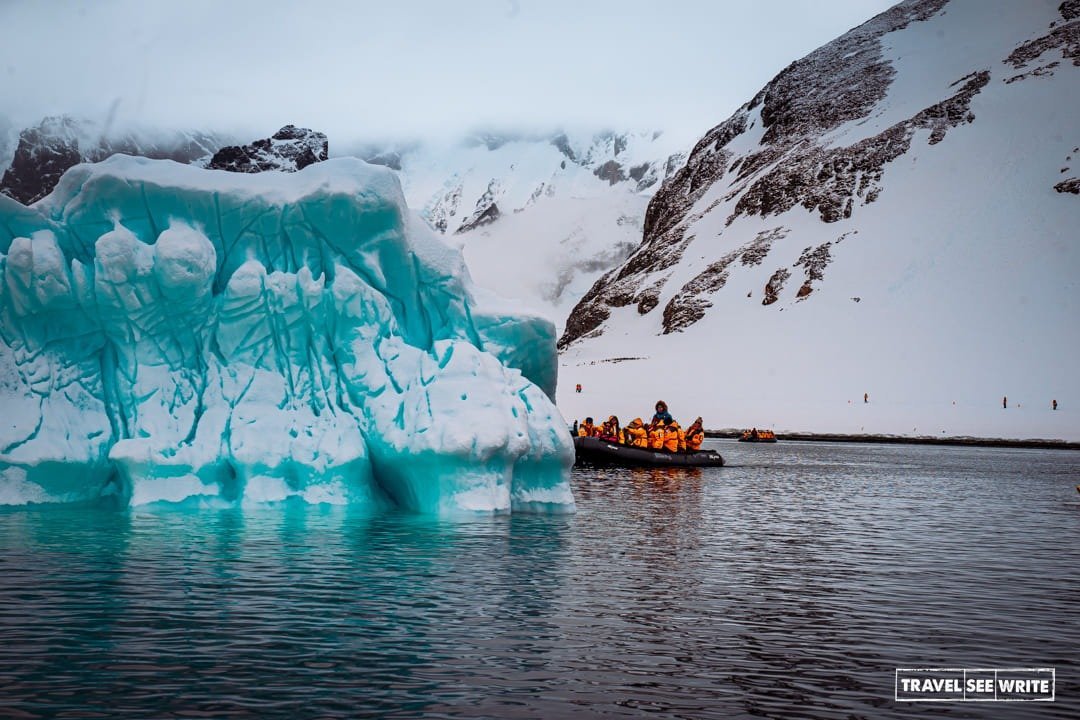
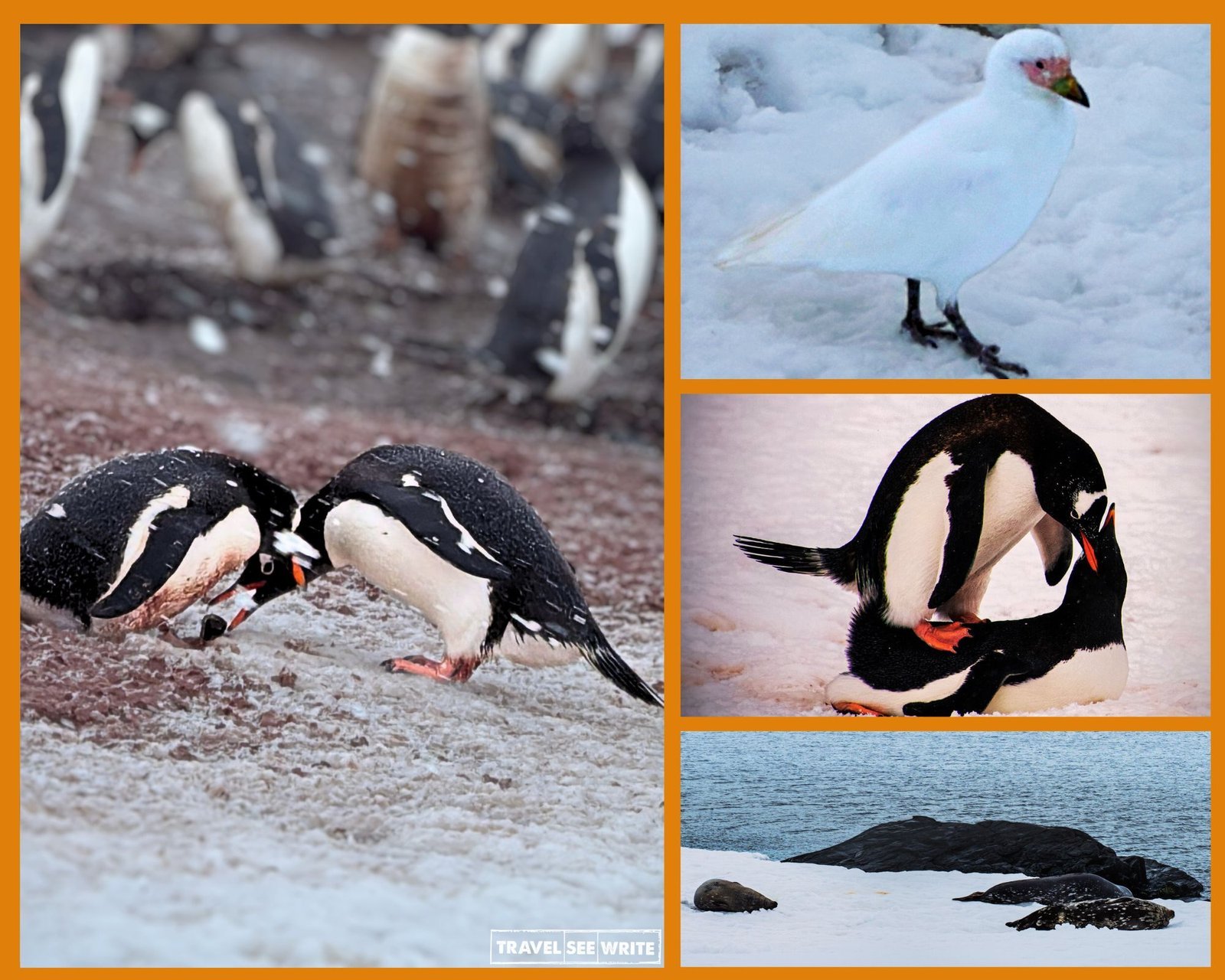
There is a specific kind of silence that only exists at the bottom of the world. It isn’t the absence of noise, but rather a profound, heavy stillness that makes you hold your breath. Then, the silence breaks—not by a car or a phone, but by the thunderous crack of a glacier calving into the Weddell Sea, or the frantic whoosh of a Gentoo penguin surfacing after a deep dive.
Visiting Antarctica isn’t just a vacation; it’s a sensory overhaul. But between the legendary storms of the Drake Passage and a dizzying array of cruise operators, the logistics of reaching the White Continent can feel as icy as the destination itself.
The Great Polar Showdown: Choosing Your Vessel
When you’re standing on the deck of a ship, the name on the hull dictates your entire experience. In the world of polar travel, operators are split between floating hotels and adventure hubs. And Antarctica? It rewards the latter.
The Case for Quark: The Adventure Heavyweight
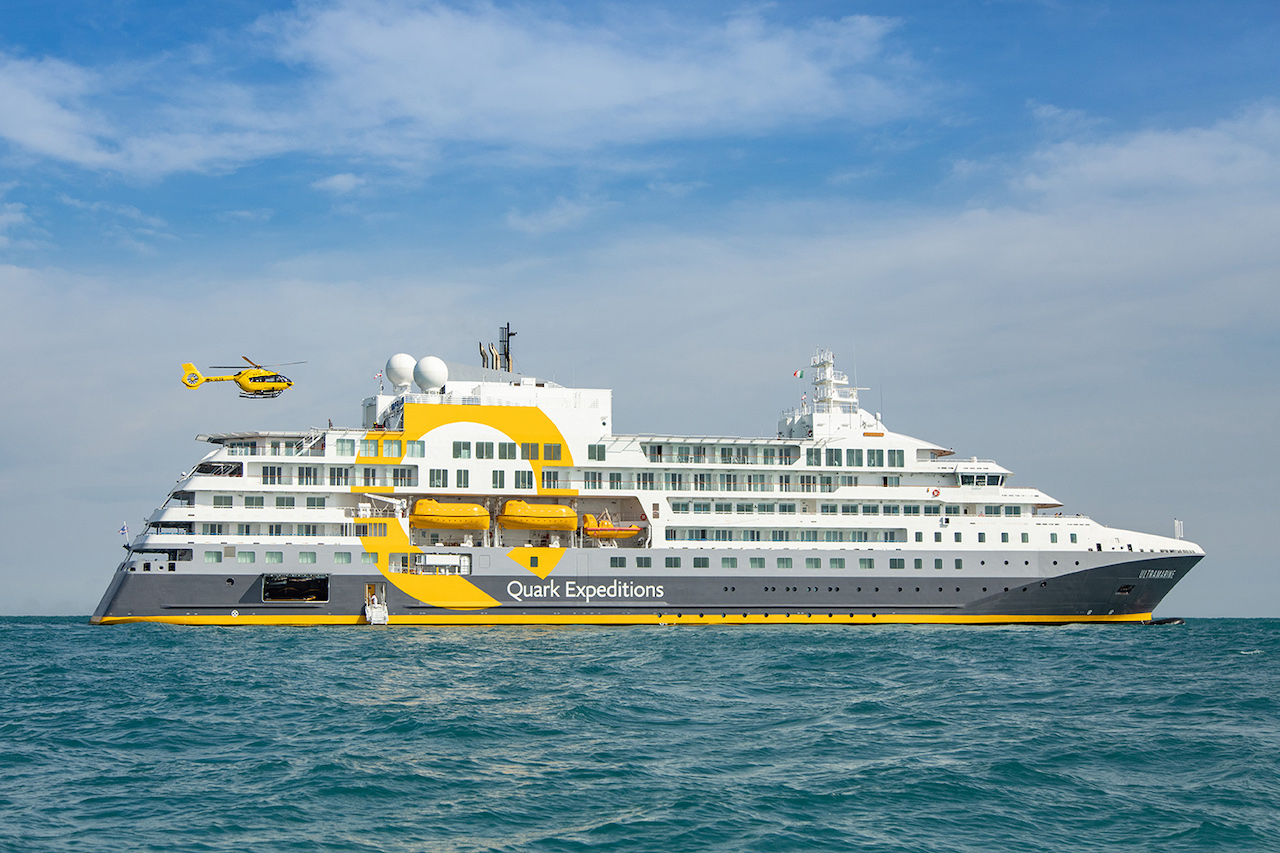
Flagship: Ultramarine (and World Explorer, Ocean Adventurer)
Quark Expeditions doesn’t do casual. They mean business when it comes to polar exploration. Considered the leaders in polar expeditions for the last thirty years, they know Antarctica like no one else.
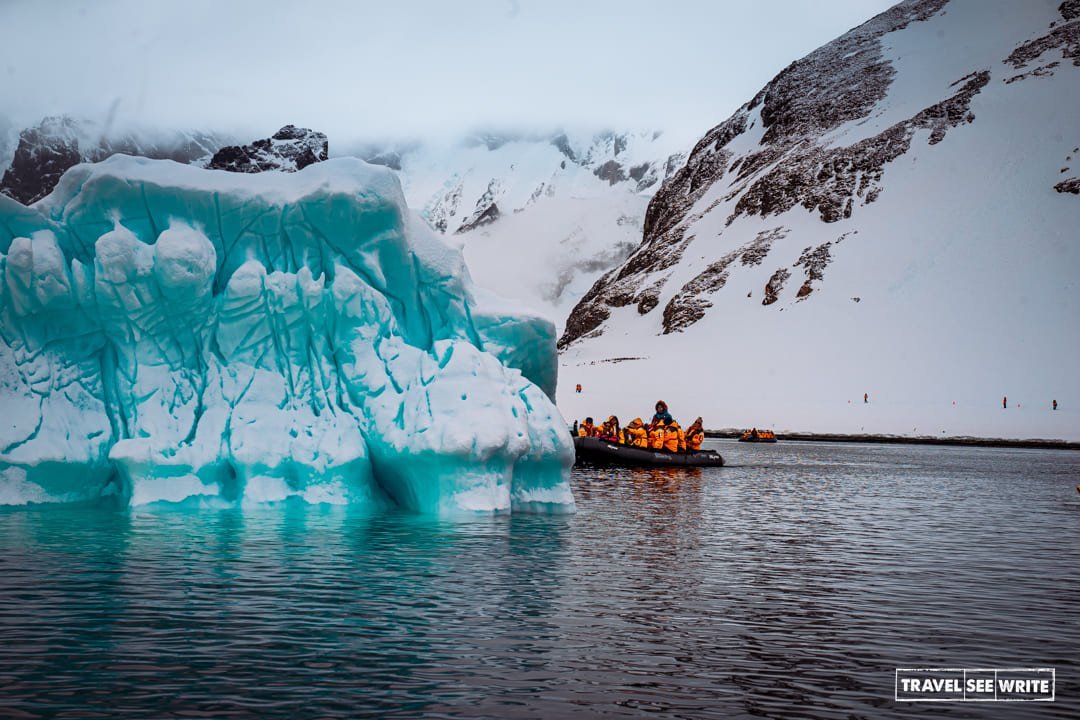
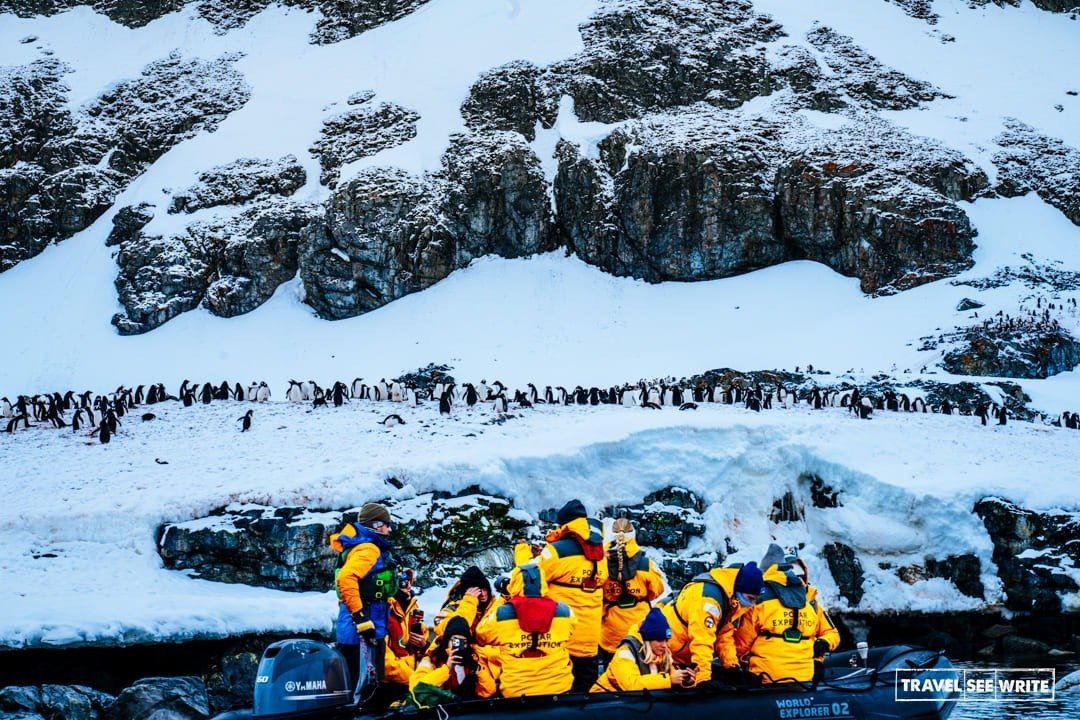
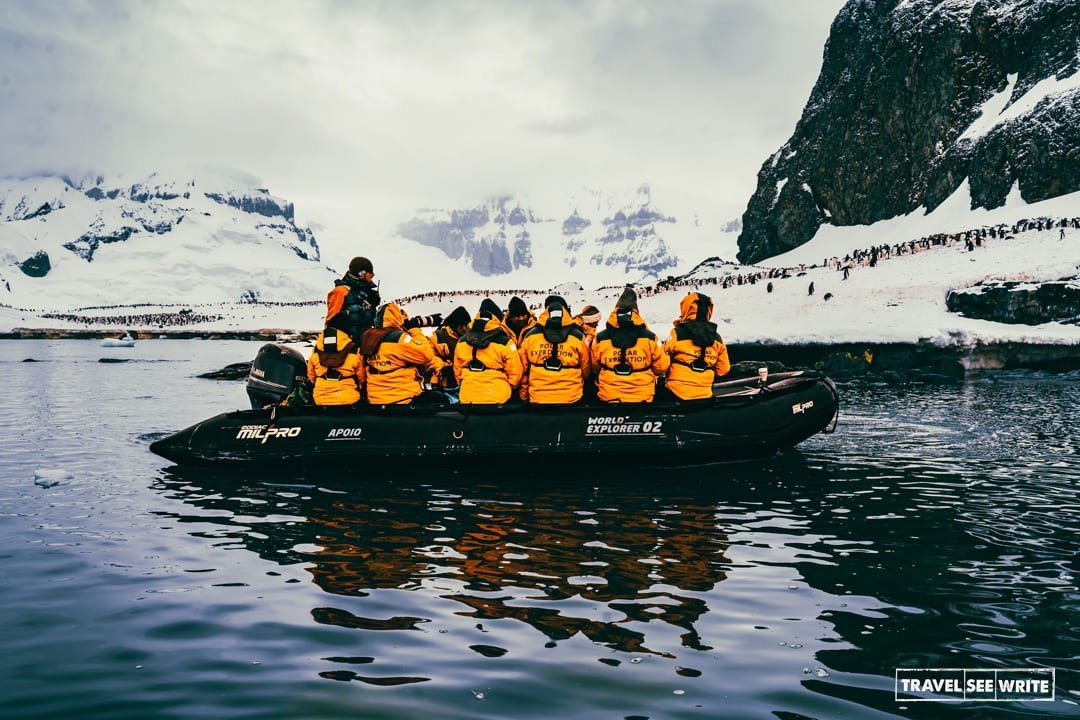
Their expedition ships are modern but not try-hard luxury: several observation lounges, a sauna and spa, a fitness room, a heated mudroom for gear, and massive Zodiac loading zones. From my own experience, Quark ensures that you spend more time on ice and less time waiting inside the vessel.
When you are not landing, you are still in for a treat. Quark’s expedition teams are stacked with glaciologists, marine biologists, mountaineers, and pro photographers who don’t just narrate—they lead actual off-ship missions. They are polar-only specialists. They don’t pivot to the Caribbean in summer. They live and breathe ice. If you want Antarctica to feel like an expedition, not a cruise, Quark holds the crown.
When it comes to versatility, Quark Expeditions is often considered the Swiss Army knife of polar travel. While other lines might have one or two ship styles, Quark operates a diverse fleet that allows them to offer everything from entry-level expeditions to high-altitude helicopter safaris.
To help you navigate their 2026–2027 season, here is a breakdown of how they use their different vessels to power their unique voyage types.
Quark’s Fleet
Quark’s fleet is strategically varied to match different travel styles:
The Ultramarine: The crown jewel. Carrying 199 guests, it features two twin-engine helicopters and a “ready room” that gets passengers into Zodiacs in half the time of other ships. It is the only ship used for the most intensive helicopter-based itineraries.
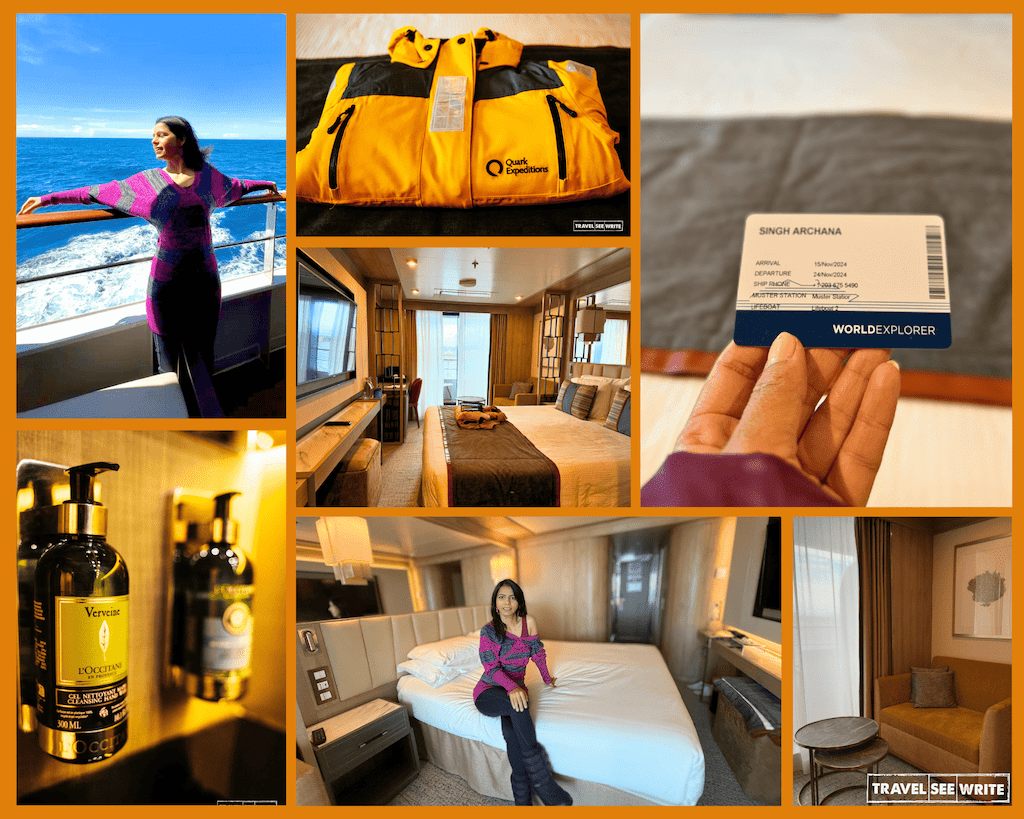
The World Explorer: For those who want luxury without sacrificing the explorer vibe. Every cabin is a suite with a private balcony, and the ship features a glass-domed observation lounge and a L’Occitane spa.
The Ocean Explorer: A modern, nimble ship with an X-BOW design that handles the rough Drake Passage with much more stability than traditional hulls. A favourite for Fly the Drake itineraries.
The Ocean Adventurer: The classic. Smaller (128 guests) and more intimate, perfect for those who want a rugged, traditional expedition feel where you really get to know the expedition team.
Quark’s Signature Voyage Types & 2026 Pricing
The Antarctic Explorer (11–12 Days) The quintessential Antarctic journey where you sail from Ushuaia, cross the Drake Passage, spend five days exploring the South Shetland Islands and the Antarctic Peninsula, and return to Ushuaia. The ships used are Ocean Explorer or World Explorer. Their 2026 Budget starts around $9,850–$25,500 per person.
The Helicopter Voyages (Flightseeing & Heli-Landings) These are exclusive to the Ultramarine. The experience includes landing on top of the ice. Their e026 Budget starts at approximately $25,400–$30,500.
The Antarctic Express (Fly South, Sail North) A hybrid for travellers who want to skip half the sea time. You fly over the Drake from Punta Arenas, Chile, to King George Island, explore the Peninsula, and sail back to Ushuaia, Argentina. You can either sail South and Fly North or fly the Drake. The Ships used for these voyages are Ocean Explorer or World Voyager. The 2026 Budget starts at approximately $11,200–$14,500.
Crossing the Circle (14 Days) In this voyage, you push past the Peninsula and cross the Antarctic Circle. You see thicker ice, jagged landscapes, and absolute isolation not seen in any other expeditions. Their 2026 Budget starts around $16,300–$21,700.
But Quark isn’t the only way to do Antarctica right—your perfect ship depends on your travel personality.
Silversea: The Endeavour of Ultra-Luxury
If you want to visit Antarctica, but do it in Michelin-style, Silversea is for you.
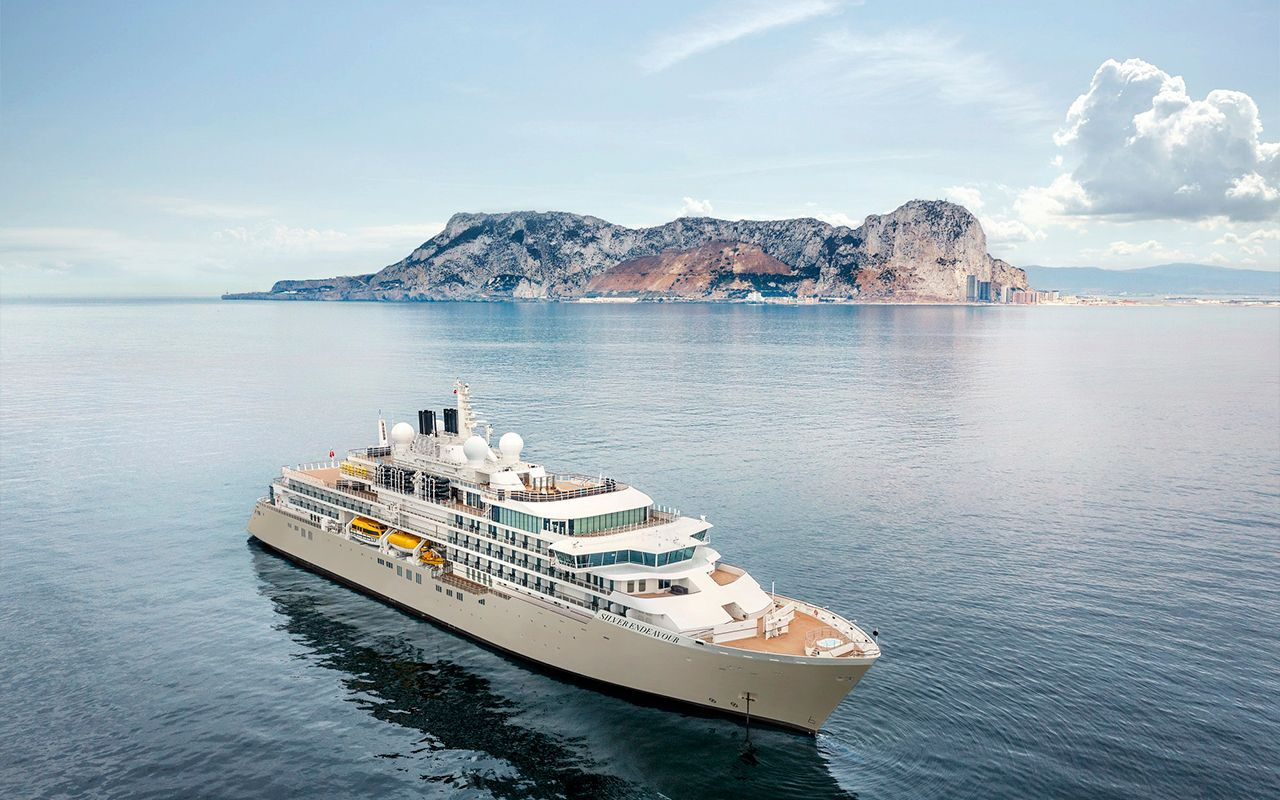
Silver Endeavour is one of the most luxurious polar ships afloat. Silversea offers a white-glove experience: your parka is pre-delivered to your suite, and your butler knows your drink order before you do. Think all-suite accommodations, private verandas, walk-in closets, rain showers, and heated bathroom floors.
Zodiac landings are followed by champagne, caviar, and spa treatments. Observation decks are heated. Lounges serve rare wines. The vibe is explorer, but cozy.
The Fleet Silver Endeavour is the star. They also operate Silver Cloud and Silver Wind, each carrying a maximum of 200 guests in polar waters.
Voyage Types
Antarctica Bridge (6–9 Days): Fly Business Class from Santiago to King George Island. 2026 Price: From $16,200.
Standard Expedition (10–12 Days): Sail from Puerto Williams. 2026 Price: From $15,400.
Deep South / South Georgia (15–18 Days): Includes the Falklands and South Georgia. 2026 Price: From $31,860.
Seabourn: The Ultra-Luxury Expedition Standard
Seabourn Venture matches that luxury energy but leans more expedition-forward. It features submarines on select itineraries, kayaking programs, Zodiac-heavy exploration, and Michelin-level dining.
The Fleet Seabourn Venture and Seabourn Pursuit carry 264 guests in all-suite, all-balcony accommodations and feature custom-built submarines.
Voyage Types & 2026 Prices
Antarctic Peninsula Explorer (11–12 Days): From $12,450–$16,500.
Original Fly & Cruise (8–11 Days): From $13,500–$22,850.
Ultimate Antarctica & South Georgia (23 Days): From $39,180–$44,390.
Perfect for: honeymooners, luxury travellers, retirees with elite taste, and anyone who wants Antarctica without sacrificing creature comforts.
For the Time-Crunched: Antarctica21
Ship: Magellan Explorer
This one is for people who hate the 48-hour date with the world’s roughest seas—the Drake Passage. Antarctica21 pioneered the fly-cruise model. You fly from Punta Arenas to King George Island in about two hours, skipping two days of stormy seas. Then you board the Magellan Explorer, a sleek boutique ship with Scandinavian interiors and floor-to-ceiling windows.
It cuts trip length to about eight days, avoids rough seas, and still delivers full Zodiac landings. The trade-off? Fewer landing days than longer sailings. The upside? Antarctica without the physical toll.
The Fleet Magellan Explorer (76 guests) and Ocean Nova (classic expedition feel).
Voyage Types
Classic Air-Cruise (8 Days): From $13,595.
Antarctica Express (6 Days): From $5,995.
Polar Circle Air-Cruise (10 Days): From $24,995.
Perfect for: busy professionals, first-timers, seasick-prone travellers, and anyone who wants efficiency over epic suffering.
For the Scholar: National Geographic / Lindblad Expeditions
This is Antarctica with a PhD. Lindblad created the expedition cruise category. Voyages feature resident National Geographic photographers and deep scientific immersion. Ships include hybrid-electric propulsion, hydrophones, ROVs, photo labs, and science briefings.
The Fleet NG Endurance and NG Resolution with X-BOW designs.
Voyage Types
Journey to Antarctica (12 Days): From $16,650.
Antarctica, South Georgia, and the Falklands (24 Days): From $41,380.
Perfect for: curious minds, photographers, families with teens, and educators.
Oceanwide Expeditions: The Basecamp Purists
This is the OG adventure brand. Oceanwide’s ships are ex-research vessels turned expedition rigs. Not flashy, but insanely capable. Their Basecamp voyages are legendary: kayaking, snowshoeing, mountaineering, Zodiac-only exploration days, camping on Antarctic ice, and even scuba diving on select sailings. If you don’t mind a smaller cabin in exchange for more time in a kayak or a sleeping bag, Oceanwide is your brand. They prioritise activity over amenities.
You’d be surprised to know that Metallica did a concert in Antarctica on December 8, 2013, setting a world record for being the only band to play all 7 continents. And, guess who brought them to the frozen continent? Oceanwide Expeditions
The Fleet Hondius (Polar Class 6), Ortelius (with heli-deck), Plancius.
Voyage Types
Antarctica Basecamp (13 Days): From $8,400.
Weddell Sea Explorer (12 Days): From $9,050.
Whale Watching Discovery (10 Days): From $8,450.
Albatros Expeditions: The Nordic Value Pick
Albatros is the newer, more stylish cousin. Ice-strengthened modern ships, stabilisers for smoother sailing, Nordic interiors, aggressive landing schedules, and budget-friendlier pricing. They typically carry between 174 and 199 guests.
However, I haven’t heard very good things about them. In 2024, Albatros Expeditions vessel, the Ocean Victory, sustained damage after hitting ice in the vicinity of South Georgia. They could not complete their voyage and had to return to Ushuaia.
The Fleet Ocean Albatros and Ocean Victory (X-BOW design).
Voyage Types
South Shetlands & Peninsula (10 Days): $8,050–$9,100.
Quest for the Circle (12 Days): From $10,995.
Antarctica All-Access (11 Days): From $10,595.
Epic Falkland Islands, South Georgia & Antarctica (19 Days): From $8,000 to over $26,000 per person
Perfect for: adventure junkies, budget-conscious explorers, and people who want maximum landings.
Hurtigruten (HX): The Science-Led Sustainability Giant
Hurtigruten (now branded as HX for its expedition arm) is the world’s largest expedition cruise line and a pioneer in green technology. Their voyages are heavily focused on “Citizen Science,” where guests actively participate in real-world research. This is Antarctica, but climate-conscious. Large observation decks, infinity pools with iceberg views, onboard science centres, interactive lectures, kayaking programs, and Zodiac operations define the experience. The vibe is relaxed, educational, and community-forward.
The Fleet MS Roald Amundsen, MS Fridtjof Nansen (hybrid-electric), MS Fram.
Voyage Types
Highlights of Antarctica (11–12 Days): $9,720–$11,000.
Antarctica & Falklands (16 Days): $11,000+.
Ultimate Antarctica & Circle (18–20 Days): $16,000+.
Perfect for: eco-conscious travellers, families, and people who want comfort with credibility.
TLDR Interpretation
Best for adrenaline and expedition depth:Quark
Top luxury on ice:Silversea & Seabourn
Fastest way to Antarctica:Antarctica21 (Fly-Cruise)
Deep science & storytelling:Nat Geo / Lindblad
Budget adventure without fluff:Oceanwide & Albatros
Green & family-friendly:Hurtigruten (HX)
How much does a trip to Antarctica cost?
A trip to the Seventh Continent is a significant investment. For a 2026-27 departure, expect to budget the following per person (based on a double-occupancy cabin):
Comparative Chart: Antarctica Cruise Operators
Operator / Ship
Vibe
Best For
Typical Duration
Price Range (2026)
Key Features
Quark Expeditions
All-Action Adventure
Hardcore explorers, photographers
10–14+ days
$10,500–$30,500
Helicopters (Ultramarine), high expedition focus, lots of landings
Silversea (e.g., Silver Endeavour)
Ultra-Luxury
Luxury seekers & honeymooners
6–18+ days
$15,500–$31,860+
Butler service, heated decks, premium dining
Seabourn (Venture / Pursuit)
Ultra-Luxury Expedition
High-comfort explorers
8–23+ days
$12,450–$44,390
Submarines on select sailings, Michelin dining
Antarctica21 (Magellan Explorer / Ocean Nova)
Time-Saver Fly-Cruise
Busy pros, seasick-averse
6–10+ days
$5,995–$24,995
Fly-cruise option, quick Drake skip
National Geographic / Lindblad
Science + Storytelling
Educators, photographers
12–24+ days
$16,000–$41,380+
Nat Geo experts, hydrophones, ROVs
Oceanwide Expeditions
Rugged Adventure
Activity-first explorers
10–13+ days
$8,400–$9,050+
Basecamp trips, camping, Zodiac-heavy
Albatros Expeditions
Nordic Value
Budget-minded adventurers
10–12+ days
$8,050–$10,995+
Aggressive landings, modern X-BOW ships
Hurtigruten (HX)
Eco-Conscious Expedition
Sustainable travel lovers
11–20+ days
$9,720–$16,000+
Hybrid propulsion, science centers
The Wildlife Calendar: When to Set Sail
The Antarctic summer is a short, dramatic window from November to March. Each month tells a different story.
November: The Pristine Wilderness Ice at its most sculptural. Snow still brilliant white. Penguin courtship season. Best time for massive tabular icebergs.
December & January: The Peak of Life Nearly 24 hours of daylight. Chick season. Thousands of fluffy penguin chicks. Warmest temps (0°C to 5°C). Peak pricing.
February & March: The Whale Watcher’s Dream Retreating sea ice. Humpback and Minke whales everywhere. Neon pink sunsets. Photographer’s paradise.
A Day in the Life: The Expedition Experience
07:00 – Wake-Up Call The Expedition Leader announces the weather and coordinates. Icebergs glow outside your porthole.
09:00 – First Landing You layer up, step into Muck boots, slide into a Zodiac, and hit a rocky shore buzzing with Adélie penguins.
12:30 – Lunch with a View World-class meal while navigating the Neumayer Channel.
14:30 – Afternoon Adventure Heli-flightseeing or Zodiac exploration.
17:00 – Polar Plunge Bravest souls jump into 1°C water.
I’ll be honest with you, it’s been too long since I used public transport in India. Most of the time, I prefer to fly, primarily due to the convenience and time factor. However, road travel in India has significantly improved, thanks to substantial infrastructure development, which has included a 60% increase in national highways and the construction of expressways and high-speed corridors over the last decade. Improved infrastructure and the ease of booking bus tickets have made road travel a lot easier than before. Now, whether you are travelling from Delhi to Jaipur or Hyderabad to Vijayawada, it can all be done in a click.
Booking bus tickets is no longer a complicated process. Whether you’re travelling within Andhra Pradesh, Telangana, or between the two states, government-run buses like APSRTC and TSRTC offer a reliable and affordable way to get around. The best part? You don’t have to stand in long lines at the depot anymore. Here’s how to book your tickets online without any hassle.
Why Choose APSRTC and TSRTC Buses?
Government buses have come a long way. Both APSRTC (Andhra Pradesh State Road Transport Corporation) and TSRTC (Telangana State Road Transport Corporation) operate a large fleet of buses, including standard, deluxe, and luxury options. They cover almost every route within the states and even connect major cities across South India.
The fares are reasonable, the schedules are frequent, and the buses are well-maintained. Plus, with online booking, securing a seat is easier than ever.
Steps to Book APSRTC or TSRTC Tickets Online
You don’t need to visit multiple websites to book these buses. Platforms like redBus and redRail have integrated APSRTC and TSRTC services, making the process simple. Here’s how it works:
Visit redBus or redRail – Open the website or download the app.
Enter Your Route – Choose your departure city (like Hyderabad or Vijayawada) and destination.
Select Travel Date – Pick your preferred date and check available buses.
Choose APSRTC or TSRTC Bus – Filter by bus type (Express, Sleeper, etc.) and operator.
Pick Your Seat – Select a seat from the available options.
Enter Passenger Details – Add names and contact information.
Make Payment – Pay securely via UPI, card, or net banking.
Get Your E-Ticket – The ticket will be sent to your email and SMS.
That’s it. No need to print the ticket—just show the SMS or email to the conductor when boarding.
Tips for a Smooth Journey
Book Early – Popular routes fill up fast, especially during weekends and holidays.
Check Cancellation Policy – Both APSRTC and TSRTC have different rules, so review them before booking.
Arrive Early – Government buses usually stick to their schedule, so be at the stop at least 15 minutes before departure.
Conclusion
Gone are the days of rushing to the bus stand for tickets. With online booking, you can reserve your seat in an APSRTC or TSRTC bus in minutes. Whether you’re heading home for the holidays or planning a quick getaway, the process is straightforward and stress-free. Next time you need to travel, skip the queue and book online. It’s the easiest way to ensure a comfortable and timely journey
Many individuals immediately think of the Pyramids of Giza and the Great Sphinx when they imagine Cairo; however, for visitors who are prepared to go beyond the colourful pictures, such ancient Egyptian sites are an absolute must-visit. Ancient Egypt presents everything from amazing towns and clean activities to artistic treasures along with special food experiences, while also carefully blending ancient times with the freshness of childhood. If you are thinking about an excursion quickly, this plan will assist in helping you experience Egypt in an entirely new manner by mixing popular sights with new ones. It is one of the great countries to explore nowadays.
Day 1–2: Cairo Outside the Pyramids
Image Resource: unsplash.com
Cairo hardly rests, thus begin the trip there right away, you possibly could. Given how incredible these structures are, you should definitely add the Great Pyramids to your wish list of locations to go. But, shortly after touring such places, invest some moments in places where individuals go about their daily activities at an entirely different rhythm. Visit Islamic Cairo, a network of narrow avenues packed with active shops, places of worship, mosques, chapels, and greenery. The Khan el-Khalili bazaar is even more appealing: the smell of sweet spices, the screams of sellers, and the flickering glow of brass bulbs will attract every sense.
The Egyptian Museum and the newly constructed Grand Egyptian Museum near Giza are not to be ignored. Treasures like Tutankhamun’s golden mask offer tourists an overview of the past of the entire country. For a last-minute meal, consider booking a Nile River cruise. Cairo’s structures glowing by the river act as proof that the town is both current and old.
Day 3: The Coastal Charm of Alexandria
Have a short flight or rail trip to Alexandria, which is a historic city on the Mediterranean coast. Alexandria, which is frequently referred to as the “Pearl of the Mediterranean,” is a more unique setting with a cooler climate compared with Cairo. The Bibliotheca Alexandrina is home to a number of the finest representations of current design and art. Also, going for a walk through the Corniche, a long canal, is an excellent way to breathe in the fresh sea air.
Day 4: Siwa Oasis Desert Adventures
Head westward towards the empty land from the coastline. One of the country’s most hidden locations is Siwa Oasis, located near the Libyan border. Compared to the tropical paradise, the noisy towns lined by coconut palms and organic hot springs look quite different. Void still covers what remains of the Oracle Temple, in which Alexander the Great once emerged as the supreme lord.
Visitors often take a 4-wheel-drive desert excursion right here in the hope of racing through golden dunes while watching the Great Sand Sea sunset. Similar to the Dead Sea, Siwa possesses other easily accessible underwater remains. A unique feature of Egypt is its peace, blue sky, and beautiful scenery.
Day 5–6: Luxor, the Greatest Outdoor Museum in the World
Image Resource: unsplash.com
Without Luxor, the journey to Egypt wouldn’t have proved interesting. Luxor, once known as the capital of Thebes, is filled with temples and graveyards. History seems to be alive due to these decaying structures. Along with additional pharaohs, Tutankhamun was laid to rest in the Valley of the Kings. Additionally, there may be equally amazing gems in the Valley of the Queens just around the next corner.
The Karnak Temple is yet another must-see attraction. The scale and enthusiasm of its earliest builders can be seen in its impressive lake, along with a rising base. In the late afternoon, enjoy a balloon flight across the Nile River and the Egyptian buildings.
For trips to the whole country, verify the times and any reductions in advance.
Websites for Egypt airline booking
often provide numerous choices and affordable rates, particularly if you’re coming from Europe, Asia, or the Middle East.
Conclusion
Egypt is a country that offers incredible scenery, an active culture, and hidden gems wherever you wander. With an organised approach, you will discover modern as well as conventional occupations that make your trip just as thrilling as it is satisfying.
A detailed 2025 review of Malaysia Airlines Business Class from Delhi to Kuala Lumpur. Compare the 737-800 vs. A330-300: flatbeds, lounges, meals, and tips.
TL;DR – Malaysia Airlines Business Class Experience (2025)
Best Aircraft: A330-300 on MH191 – lie-flat seats, mood lighting, luxe vibe 737-800 MH173: Regional configuration, comfortable but no flatbed or IFE screen Dining: Multi-course meals with Indian & global options on both flights Lounge Access: Encalm Privé (Delhi) & Golden Lounge (KLIA) = 💯 Pro Tip: Always check the aircraft type when booking Business Class on this route!
Greg Anderson once famously said, “Focus on the journey, not the destination.” These words hold a great deal of truth. However, I have often seen people prioritising the destination over the journey. I strongly believe in enjoying every moment, whether it involves the journey or the destination. This principle is especially true when you are taking long-haul flights. I recently flew Business Class with Malaysia Airlines from Delhi to Kuala Lumpur to attend the MATTA Fair 2025, and let me tell you — flying Business Class really made the difference. When I landed in KL, I was refreshed and recharged to handle the very hectic next few days. However, that’s a story for another time. In this article, I want to share my experience of flying business class on the same route but in two different aircrafts. This was not just another flight. It was a tale of two very different Business Class experiences.
Outbound: Flight MH173 | Delhi to Kuala Lumpur | Boeing 737-800
On-ground Experience of Malaysia Airlines
My experience with Malaysian Airlines began on a good note. Air India provides ground handling services at Delhi IGI Airport for Malaysia Airlines. This is a common practice. Foreign airlines often outsource their ground services to local partners, which enhances their operational efficiency. This strategy allows them to concentrate on their core competencies while reducing costs and improving service quality.
While not extravagant, the on-ground service was impressively efficient. The check-in process was swift, with no long queues or chaos. The staff at the check-in counter were not just polite and courteous but also provided a free porter, priority check-in, and complimentary lounge access, making the entire experience reassuring and confidence-boosting.
After passing through security clearance, I indulged in an hour at Encalm Privé, a luxury business-class airport lounge designed specifically for business and first-class passengers. The lounge offered a premium experience with amenities such as gourmet food, spa facilities, a children’s activity room, and a gym. The food was exceptional, offering a wide variety of cuisines including Mongolian, Italian, Indian, Mediterranean, a cheese and Salad Bar, Delhi’s street food, and more. A huge food section and a well-stocked bar with international and national labels made me feel like I was dining in a high-end, five-star hotel.
Business and first-class passengers can relax at Encalm Privé, a luxury airport lounge located at IGI Airport in Delhi.
After my stomach was full, I walked towards my boarding gate. The Malaysia Airlines boarding process was not only smooth but also stress-free. Despite a 45-minute delay, the airline’s efficiency and professionalism were evident, contributing to ease and relaxation.
Cabin & Seating in Malaysia Airlines Business Class from Delhi to KL
While booking my flight to Kuala Lumpur, I didn’t realise Malaysia Airlines operates two different aircraft for the Delhi to KL route. I discovered this as soon as I boarded the plane. I took the afternoon flight at 13:15, operated by Malaysia Airlines MH173, which uses a Boeing 737-800, a narrow-body aircraft commonly used for short to medium-haul routes. In contrast, the Malaysia Airlines MH 191 flight at 23:00 uses an AIRBUS A330-300, which is more spacious and better suited for night travel.
The Malaysia Airlines service was warm and efficient, but the business-class cabin felt more like a premium economy cabin due to the narrow-body aircraft. The seats were wide and provided good legroom, but there was no lie-flat option. The recline was limited, and the seat design felt more regional than luxurious. No in-flight entertainment was provided on a screen; however, you could connect to their onboard Wi-Fi and watch in-flight entertainment on your mobile device or tablet. I didn’t want to do that, so I chose not to connect to the Wi-Fi.
My honest Experience of flying with Malaysia Airlines
In-Flight Dining in Malaysia Airlines Business Class from Delhi to KL
I was welcomed with a cold towel and a welcome drink. After takeoff, alcoholic and non-alcoholic beverages were served. There was a good variety of champagne, wine, whisky, and beer. The food was also good—a proper multi-course meal with three options: two non-vegetarian and one vegetarian. I chose the vegetarian meal, which included flavourful dal makhani, mixed vegetables, beetroot rice, hot garlic bread, dessert and salad—surprisingly good for in-flight dining. After a hearty meal, I napped and didn’t realise when we reached KL.
Beverages served on Malaysia Airlines: Alcoholic and Non alcoholic
Three main course options available from a mix of veg and non-veg options
A multi-course meal was served during the Delhi to KL return flight
The journey was comfortable, despite the lack of flat beds on MH173 (737-800), an amenity kit, pyjamas, and Wi-Fi. The attentive staff made up for the lack of luxuries typically found in a wide-body aircraft’s business class. I realise now that it was my oversight not to check the aircraft type. It’s important to remember that the experience of a narrow-body aircraft differs from that of a wide-bodied one, and that’s perfectly okay! There is a significant cost difference between the business class on Malaysia Airlines, specifically on the Boeing B737-800, and the Malaysia Airlines flight MH 191, which operates on an Airbus A330-300. In short, Malaysia Airlines Business Class on the B737-800 is ideal for short-haul comfort, but don’t expect long-haul luxury.
The deboarding and immigration process was very quick. The MALAYSIA DIGITAL ARRIVAL CARD (MDAC) has simplified the immigration process for Indian travellers. No more visa hassles; now, Indian travellers can travel visa-free to Malaysia. The only thing you need to do is fill in your arrival details online before you arrive in Malaysia. This means you can skip the long queues at the immigration counters, making your arrival in Malaysia a breeze. The MDAC also allows for faster processing at the airport, reducing wait times and ensuring a smoother transition into the country.
Now, Indian travellers can travel visa-free to Malaysia
I spent the next three days attending the MATTA FAIR 2025, where Malaysia Airlines was a key sponsor. I had an opportunity to learn about their fleet of aircraft, including the All-New Airbus A330neo, new routes, and amazing offers. One such offer that caught my attention was the ‘instant savings of up to 30% on flights booked up to March 2026’. This offer applies to all classes, including Business Class, and can result in significant savings for anyone planning their travel in the coming months. The best part was meeting the Manchester United legends—Luis Nani, Vidic, and Berbatov—right at the MAG Arena. I will post more about my Malaysia trip in another post.
Coming to my return flight experience with Malaysia Airlines.
Return: Flight MH191 | Kuala Lumpur to Delhi | Airbus A330-300
Now, this is where things took a turn for the luxe. If you think business-class luxury begins only after takeoff, think again.
Malaysia Airlines Business Class On-ground Experience
Kuala Lumpur Airport is modern and well-managed.
With Malaysia Airlines, the premium experience starts as soon as you enter the Kuala Lumpur International Airport. From dedicated check-in counters to an exclusive lounge, the airport is designed to provide a seamless and luxurious travel experience for business-class passengers.
On-ground Check-in was a breeze. Again, no queues and no stress — just a seamless check-in process at Kuala Lumpur International Airport (KLIA). The Business Class counters were sleek, fast, and efficient, allowing you to breeze past the crowds like VIPS.
And just when I thought it couldn’t get more luxe, it did. After immigration, I was escorted in style via a private Mercedes-Benz vehicle directly to the departure gate. I felt like a celebrity walking on a red carpet—the only thing missing was a paparazzi. This high-touch treatment left an everlasting impression.
Malaysia Airlines offers a private Mercedes-Benz terminal transfer service at its Kuala Lumpur Airport hub for business class passengers.
Before boarding, I decided to relax at the Golden Lounge at KLIA, a destination in itself that delivers an experience worthy of a five-star hotel lobby. The lounge was bright and airy, filled with natural light thanks to its full-height glass panels that overlooked the tarmac. Floor-to-ceiling glass lets you watch aircraft take off and land — a true AVGeek bonus. It is one of the best places to see the aircrafts take off. The lounge was spacious, with multiple seating zones, a children’s room, and showers.
Golden Lounge at Kuala Lumpur International Airport
The lounge’s buffet had a decent spread of local and global cuisines, with multiple live food counters catering to every palate: a Salad Bar, a Japanese Raman Corner, an Indian Counter serving Comfort food like Kashmiri pulao and cholla, an Italian Pasta Station, and Local Malaysian Favourites to give you that true taste of Malaysian hospitality.
Right at the entrance of the Golden Lounge at KLIA, there was a full-service Bar serving signature cocktails as well as red, white, and sparkling wines—the bar was well-stocked, and the service was attentive.
In short, the Malaysia Airlines Business Class Lounge at KLIA helped me recharge, refuel, and relax before I flew back to India.
In-flight Experience – Cabin & Seating:
The Airbus A330-300 Business Class cabin was spacious, modern, and truly premium. The seats converted into fully lie-flat beds perfect for overnight travel. Privacy partitions, USB charging, large IFE screens — everything you expect from international Business Class was here.
Due to a short-haul flight, no Amenity kit or sleeping pyjamas were provided on this route. However, they did provide noise-cancelling headphones, a duvet, a blanket, and a pillow. The dinner menu again had three options, one of which was vegetarian.
Overall, what stood out
In a nutshell, flying with Malaysia Airlines Business Class was a good experience. It stood out remarkably on almost all parameters:
✔ Friendliness – From on-ground check-in to landing, the crew attended to passengers with a smile and were genuinely welcoming. ✔ Attentiveness – They checked on passengers regularly and responded quickly to requests. Being a vegetarian, I couldn’t eat Satay, and they were genuinely sorry for that and mentioned that if they had been informed earlier, they could have got a vegetarian option for me. ✔ Language Skills – The crew spoke English, Malay, and Hindi, making communication easy for international and local travellers. ✔ Professionalism – Their service was efficient, and they handled passenger requests politely and with patience.
Despite the vast cabin size and price difference, Malaysia Airlines’ business class was good on MH173 (Boeing B737-800) and MH191 (Airbus A330-300). Malaysia Airlines Business Class on wide-body aircraft has a whole different vibe compared to their narrow-body offering. If I were to rate them, I would give 7/10 to MH173 and 8/10 to MH191.
Business Class MH173 (B737-800)vs MH191 (A330-300)Comparison
Feature
MH173 (Boeing B737-800)
MH191 (Airbus A330-300)
Aircraft Type
Narrow-body
Wide-body
Flatbed Seats
❌ No
✅ Yes
Seat Recline
Standard Recline
Full Lie-Flat
Cabin Vibe
Premium Economy Style
Luxe & Spacious
IFE Screen
❌ None (BYOD)
✅ Large Display
Amenity Kit
❌ No
❌ No (But pillow/blanket)
Lounge Access
✅ Encalm Privé (DEL)
✅ Golden Lounge (KLIA)
Price Range (INR)
₹35,000 approx
₹56,000+ approx
Overall Rating
⭐️⭐️⭐️⭐️ (7/10)
⭐️⭐️⭐️⭐️⭐️ (8/10)
Final Verdict:
If you’re booking Malaysia Airlines Business Class, it’s important to check the aircraft type. Your experience on a BoeingB737-800 versus an Airbus A330-300 will differ significantly — in seat comfort, amenities, and overall vibe.
Still, the service was consistently warm, the meals delicious, and the journey smooth. Will I recommend flying business class with Malaysia Airlines? Absolutely!
Here’s a short video about my experience of flying business class with Malaysia Airlines.
Frequently Asked Questions About Malaysia Airlines
Being a frequent flyer, I’ve flown with more than 50 airlines, ranging from business class on Emirates, Singapore Airlines, Qatar, Turkish Airlines, and Air India to budget airlines such as Aerolineas Argentinas, JetSmart, LATAM, AirAsia, Cebu Pacific, RyanAir, and IndiGo, among others. Some were really good, and some were so bad that I vowed never to fly with them ever again. Nonetheless, if you are planning to fly Malaysia Airlines Business Class or Economy Class, you may come across these frequently asked questions:
What do you get in Business Class on Malaysia Airlines?
You get lounge access, priority boarding, gourmet meals, generous baggage (business-class passengers have a whopping 40kg check-in baggage allowance and can also take two 7kg cabin bags), and lie-flat seats on wide-body routes, which provide a comfortable sleeping experience during overnight or long-haul flights.
Does Malaysian Airlines have flatbeds in Business Class? क्या मलेशियाई एयरलाइंस के पास बिजनेस क्लास में फ्लैटबेड हैं?,
Yes — but only on select aircraft, such as the Airbus A330 and A350, and the Boeing 777 (used occasionally on longer routes).
Do you get pyjamas on Malaysian Business Class?
क्या आपको मलेशियाई बिजनेस क्लास पर पजामा मिलता है?,
Pyjamas are not usually offered on regional routes like Delhi-KL or nearby South East Asian countries.
How much does it cost to Fly Business Class with Malaysia Airlines?
Price varies based on route and aircraft. The 737-8 Business Class ticket was around ₹35,000 one way. The A330-300 return leg cost over ₹56,000 — a premium that reflects the improved experience.
If you like the post, save the below pins or do share your feedback in the comments section below.
I was in class three when I first heard about Kerala, a state located in the southwest corner of India, which is undoubtedly one of the best states in India for tourism and economic development. I distinctly recall how enthusiastically my childhood friend Dhanya would describe the tranquillity of her native state in tooti footi Hinglish. At that time, there was no internet, so she was my walking-talking Kerala Travel Guide. She would go on and on about palm-lined Kerala Backwaters, tea gardens, foggy hills, teak forests, virgin beaches, and cultural heritage. I’d eagerly wait for her to return from her annual summer break. We would huddle up to listen to her Achamma and Achachan stories while enjoying Kerala’s special Banana chips, Murukku, Pakkavada, Achappam, and other yummy snacks. At that time, I never thought my childhood curiosity would eventually become a full-blown eternal romance with “God’s Own Country.”
My healing trip to Kerala
Coincidentally, the iconic tagline for Kerala Tourism was coined in 1989. Today, labelling it merely a slogan would be incorrect. It marked a turning point in India’s tourism history—when a state looked inward and chose to embrace its roots rather than imitate Western models, offering travellers an experience that was refreshingly authentic and unique. That vision put Kerala on the global tourism map and continues to inspire its enduring appeal as one of the world’s top destinations.
Kerala Travel Guide: How was ‘God’s Own Country’ coined?
Since the 1990s, I’ve been to Kerala countless times. Still, my love for India’s magical, laid-back southwesternmost state grows deeper every time I visit it. While I can endlessly talk about how magical the state is or how there are so many things to do in Kerala, let me not get carried away. Let’s focus on just two things today – Backwaters and Ayurveda.
What is the importance of Backwaters and Ayurveda in Kerala?
Ayurveda and Kerala’s backwaters are the twin pillars of the state. They are closely integrated with the economy and culture of the state. Backwaters offer their inhabitants transportation, fishing, and tourism opportunities; Ayurveda, a traditional healing system, is a core part of Kerala’s identity and a major draw for international and domestic tourists seeking holistic wellness. Therefore, it is unsurprising that even British royalty, King Charles, has holidayed in Kerala.
Serene Kerala Backwaters
Soothing Kerala Ayurvedic Massage
My Ayurvedic Escape to Kerala Backwaters
When I arrived in Kochi from New Delhi, I thought I’d return with a photo gallery full of beautiful memories. However, I returned with something more profound: peace, healing, and a deeper connection to myself. As a digital nomad constantly travelling and living out of suitcases, I was tired of hopping from one place to another and was unknowingly craving a pause. Kerala gave me that pause and helped me slow down, offering a breather to step back, take a bird’s-eye view of my life, and rest my priorities.
A traditional houseboat in Kerala
Backwaters of Kerala
Arrival in Kochi: Gateway to God’s Own Country
Kochi: the queen of the Arabian Sea
As my plane began descending into Kochi, I could see the change in the landscape. The parched brownish terrain gave way to a sea of green consisting of tropical vegetation, rice fields, and coconut trees, which seemed to have been plucked from a painting. When I arrived, I couldn’t help but be struck by how progressive the state is—Kochi Airport is the world’s first solar-powered airport. That was my first realisation: Kerala isn’t just beautiful; it’s mindful.
Once I reached my hotel, instead of wasting my day cocooned in my hotel, I opted to explore the city, famously known as the “Queen of the Arabian Sea”. Thanks to its location on the west coast of India, Kochi, earlier known as Cochin, has been an important spice trade centre from the 14th century until now. Its cultural fabric has been shaped by explorers and traders worldwide, and that diversity is clearly evident in its architecture, food, and people. Stepping out into the sea breeze of Fort Kochi, the blend of fish markets, Portuguese-style architecture, spice shops, and slow-moving tuk-tuks seemed nostalgic yet exotic. I felt calm when sipping Kulaki Sharbat on the beach, looking at centuries-old Chinese fishing nets, and chatting with friendly locals. In the evening, I attended a highly engaging and immersive dance performance at the Kathakali Center in Fort Kochi, which has been nurturing and showcasing Ancient Arts and Culture since 1994. For three days, I relished Kochi’s coastal food and colonial vibes.
Centuries-old Chinese fishing nets of Kochi
A dance performance at the Kathakali Center in Fort Kochi
Santa Cruz Cathedral Basilica, Kochi
But my real transformative journey began on the fourth day when I drove towards Kumarakom—the heart of Kerala’s backwaters. Kumarakom is a small village located in the Kottayam district of Kerala. Despite its small size, it is world-famous for its scenic backwaters and Vembanad Lake.
What are Kerala backwaters?
While many people have heard of the Kerala backwaters, not everyone knows why they are called “backwaters.” Essentially, they are an interconnected ecosystem of lagoons, lakes, canals, and estuaries formed by sea waves and currents that have created sandbars or natural barriers at river mouths over millions of years. These backwaters are a mix of freshwater from rivers and saltwater from the coast. Running parallel to the Arabian Sea coast in Kerala, they are one of the top attractions in Kerala.
Kerala Travel Guide: What are the best places to experience the Backwaters of Kerala
There are many places to experience the Kerala backwaters, including Alleppey, Kochi, Kumarakom, Cherai Island, Kottayam, Kozhikode, and Kuttanad. I decided to experience them at Kumarakom. The best way to experience Kerala’s backwaters is in a traditional Kerala-style houseboat. The experience is enhanced by freshly prepared Kerala’s coastal cuisine and cold coconut water. You can go on a day excursion or stay on the boat overnight. Alternatively, like me, instead of staying full-time on a houseboat, you can stay at a backwater resort or homestay and go on a short houseboat sailing. Usually, many luxury resorts and hotels either own houseboats or partner with third-party houseboat operators, offering overnight and sunset cruises.
Exploring the unexplored backwaters of Kerala
The Backwaters of Kerala at Kumarakom
Kumarakom: The Backwaters Heaven on Earth
Kerala Travel Guide: Is Kumarakom worth visiting or just overhyped?
Around 9 am, I took leave of Kochi and set off for the two-hour ride to Kumarakom. Roads narrowed, and the fishy smell of Kochi turned into a sweet, earthy breeze. Coconut palms gracefully swayed back and forth like nature’s metronomes right up to where the horizon seemed to be.
My resort, Kumarakom Lake Resort, was on the shore of Vembanad Lake, the longest freshwater lake in India. I was welcomed by friendly staff, refreshing coconut water, and a cold hand towel. As I checked into my room, the vibe of the resort made me feel that the next few days were going to be quite memorable. My luxury villa with a private alcove opened right onto the 250-meter-long meandering pool.
Around 5 p.m., I took a traditional Kerala houseboat to enjoy the sunset from the balmy waters of Vembanad Lake. My houseboat was very comfortable and had all the modern facilities one could ask for—a bedroom with an attached bathroom and shower, a kitchen, a lounge, a sun deck, and eco-friendly cane and bamboo furniture. I even had a butler who cooked several delicious meals on the houseboat, including an Onam Sadhya.
Kerala Travel Guide: What’s so special about backwater houseboats?
The molten gold and red ball of the sun began to set lower into the horizon, creating long shadows on the rippling waters of the lake. The sky turned into a painter’s palette—blazing oranges, purple blues, and blazing reds bleeding one into another, reflected to perfection on the glassy water below. The emerald green waters of Vembanad Lake, serene and motionless in the afternoon, were now dancing like a romantic Kathakali dancer. The waves began swaying our boat more intensely than ever before. I doubted if I was on a sea or a lake for a while. But our boat captain allayed my fears that everything was fine.
Sunset at Lake Vembanad, Kumarakom, Kerala
Coconut palm trees stood tall along the bank, gently swaying in the warm air as birds returned home in graceful V-formations. It was all so picture-perfect that it felt less like watching a sunset and more like being a part of a cinematic masterpiece. It was nature’s way of demonstrating how goodbyes can be so enchanting. The golden hour over Kerala’s backwaters was among the best sunsets I have ever witnessed.
Ayurveda: Healing in God’s Own Country
After a stunning sunset, it was time to experience another speciality of Kerala—Ayurveda. This ancient system of medicine originated in India more than 3,000 years ago and has become very famous worldwide for aligning the well-being of mind, body, and soul. And, the best place to experience it is Kerala.
My Ayurvedic escape to Kerala Backwaters
Kerala is called the “Ayurveda capital of India” because it is deeply ingrained in the culture, and the state is known for its Ayurvedic hospitals and treatments. While other states such as Uttarakhand and Maharashtra also have prominent Ayurveda institutions, Kerala’s Ayurveda is distinctive due to its long monsoon season and the practice being closely tied to everyday life, but it’s not officially the only capital.
As per the BBC article, the southern state of Kerala has more than 100 Ayurvedic government-run hospitals, 800 Ayurvedic pharmaceutical factories and 800 Ayurvedic medicine dispensaries. Not just that, there are more than 120-holiday resorts and private wellness centres offering specialised massage treatments by highly skilled therapists.
Kerala’s Ayurvedic treatments work on mind, body and soul.
As I mentioned before, I was fatigued by nonstop travel and was looking for a pause to rejuvenate myself. Kerala’s Ayurvedic treatments helped me take that pause, detox, and recharge myself for future challenges. Upon my arrival in Kumarakom, I signed up for a two-day detox and relaxation program.
An Ayurvedic physician did a thorough check-up, identified my dosha (body type) and then tailored the treatment according to my requirements. My treatment consisted of Abhyanga(warm oil full-body massage) and Shirodhara (stream of medicated oil flowing on the forehead). In Abhiyanga, two highly qualified therapists massaged my entire body, from scalp to feet, with warm oil infused with medicinal herbs. Their four hands effortlessly moved in a rhythmic motion, improving my blood circulation, relieving pain and stiffness, and helping me de-stress. The treatment lasted for 90 minutes. After which, I took a herbal bath. Even though I could still feel the oil in my hair, my body felt feather-light and relaxed.
My experience of getting ‘Abhyanga’ and ‘Shirodhara‘ treatments done.
The next day, I experienced Shirodhara, in which a continuous stream of lukewarm medicated oil fell over my forehead for 30 minutes. After that, two therapists gave me a gentle body massage. Both treatments helped reduce my stress and anxiety. Along with the treatments, I was also given recommendations to improve my gut health by eating ayurvedically balanced meals.
Now, looking back on the treatments, I can confidently vouch that they were not only physical but spiritual. I felt lighter, healthier, and better than ever before. My skin glowed, and my mind became clear. Ayurveda was not only a treatment but a reboot button for my hyperactive and stressful life.
Conclusion: How Kerala Healed My Body and Soul
How Kerala rejuvenated me
A week in Kerala was definitely not a holiday but a much-needed break to find my balance back in life. I returned rejuvenated as a person from ‘God’s Own Country.’ Be it a digital detox, reconnection with Mother Nature, or just a visit to a place that speaks to your soul. I would highly recommend Kerala for Soul Therapy. Trust me. You may go for the backwaters, but you won’t leave without the healing Kerala has stored for you.
Kerala Travel Guide: Frequently Asked Questions about Kerala
Kerala Travel Guide: what’s there to see and do in Kerala?
What is the best time to visit Kerala?
October to March is the best time, with a good climate and verdant surroundings. The monsoon months (June to September) are the most favourable for Ayurvedic treatments.
How many days are enough for Kerala?
Kerala might be small in size, but there are tons of things to do there, so even months would be less to experience it deeply. But if you are constrained by time, a week should be enough to explore two to three popular attractions of Kerala, like Kochi, Munnar, and the Backwaters.
How can I get to Kumarakom from Kochi?
The journey by cab or private vehicle takes approximately 2 hours from the Kochi International Airport. Budget travellers can also use KSRTC buses.
What is Kerala famous for?
Kerala is famous for its backwaters, houseboats, Ayurvedic massages, tea gardens, spices, and cultural heritage, including Kathakali and Mohiniyattam dances.
Is it safe to try Ayurveda if I’ve never done it before?
Yes, Kerala’s Ayurvedic centres are highly regulated. Only go to a certified facility with a trained Ayurvedic doctor.
What should I pack for a Kerala trip?
Cotton clothes, sunscreen, mosquito repellent, a refillable water bottle, and flip-flops. If you’re practising Ayurveda, don’t use heavy perfumes and cosmetics.
How to plan a trip to Kerala?
Although I’m always here to answer any questions you have about a trip to Kerala, I believe the Kerala Tourism website is a treasure trove itself. I often use it to get ideas to plan my trip. Moreover, you can now Chat with Maya to get personalised travel planning.
Kerala Travel Guide: Most Frequently Asked Questions About Visiting Kerala
I am not a bucket list traveller, but Peru is one destination that I have always dreamt of visiting. Therefore, in 2024, when I was planning my six-month expedition from the Arctic to Antarctica, it was a no-brainer to include Peru. After all, from the Andes to the Amazon, Machu Picchu to Lake Titicaca, what does Peru not offer? Peru is one of the most geographically gifted places in the world, with 11 diverse ecological regions divided into three distinct areas: the coast, highlands, and Amazon, each with unique ecosystems and climates. I wanted to explore all of them within the short duration of time I had.
During an event, I was introduced to Mountain Lodges of Peru(MLP), and I instantly fell in love with their philosophy of promoting sustainable, active tourism in the underdeveloped Andes region of Peru. They are a locally owned company that redefines adventure — blending luxury, culture, and heart. Their journeys aren’t about rushing from one landmark to another. They’re about slowing down, walking the old trails, meeting people who still live the Inca way, and sleeping in lodges where mountains watch over you like old friends.
Mountain Lodges of Perunot only showed me the best places to visit in Peru that are very popular, but also introduced me to the hidden gems of Peru that showcased the soul of this Latin American jewel. More about that in my upcoming stories. Right now back to Amazon.
While I spent more than three weeks in Peru, I was most excited to visit the Peruvian Amazon because I was going to stay in the Tambopata Research Centre, arguably one of the remotest wildlife lodges in South America. In this blog post, I’ll be sharing my experience of staying at the Tambopata Research Centre in Peru and a complete travel guide for people who are interested in visiting this incredible place.
First, let’s start with the basics.
What makes the Peruvian Amazon unique?
The Amazon in Peru spans an extensive area of 782,880.55 km² east of the Andes, representing more than 60% of the country’s territory. What sets the Peruvian Amazon apart is its remarkable biodiversity, which includes more than 25,000 plant species (approximately 10% of the world’s total), 1,815 bird species (the second highest globally), over 2,000 fish species, more than 30 amphibian species (ranked third in the world), over 450 mammal species (also third in classification), and more than 350 reptile species (fifth in classification). Many of these species are endemic to the Amazon, and to safeguard this unique flora and fauna, Peru has established protected forest areas known as reserves. I wanted to experience this Biodiversity hotspot, so I planned a trip to the Peruvian Amazon.
People often ask, “Is the Amazon in Peru dangerous?” With proper planning and guides, it is quite safe. Numerous tour companies, such as Mountain Lodges Peru, offer Amazon tours from Cusco and Lima. You can join from anywhere.
Where is the Amazon Rainforest located in Peru?
Peru is situated along the western coast of South America, adjacent to the Pacific Ocean. It shares borders with Ecuador, Colombia, Brazil, and Bolivia, and, except for Chile, also shares the Amazon rainforests with these countries. Here is the Amazon Rainforest Map.
The Peruvian Amazon Rainforest is situated east of the Andes Mountains in the northeastern and southeastern parts of the country. The best places to visit are Iquitos in the north and Puerto Maldonado in the south. I visited the Tambopata Research Centre in Puerto Maldonado. Here is my detailed itinerary broken down day-wise:
Day 1: Lima to Puerto Maldonado – The Gateway to the Amazon (October 17, 2024)
My Amazonian adventure began in Lima. After a restful stay at the plush B Hotel in Lima, known for its impeccable service and comfortable accommodations, I enjoyed a leisurely breakfast before heading to the airport. The hotel staff had been incredibly helpful, ensuring a seamless start to my journey. A pre-booked cab conveyed me to the airport for $25 (a bit more than a direct airport transfer, but the convenience was welcome). Check-in was smooth, and soon I was airborne, watching the snow-covered Andes morph into the verdant expanse of the Amazon rainforest. The flight to Puerto Maldonado was brief, just 1 hour and 45 minutes.
Upon arrival at the small Puerto Maldonado airport, I was greeted by a representative from Rainforest Expeditions, who held a placard with my name. The adventure had truly begun! We boarded a bus where we were served lunch: Peruvian-Chinese rice, nuts, bananas, and orange juice. An hour’s drive brought us to the Tambopata River. Here, we transferred to a motorised wooden canoe, our vessel for the next three hours.
The river’s initial stretch was muddy, reflecting the lower altitude. As we journeyed upstream, the water gradually transformed into a vibrant green. We passed a large clay bank, a crucial spot for birds gathering minerals. The Tambopata National Reserve is a biodiversity hotspot: over 1,000 butterfly species, 100 mammal species, 600 bird species, and countless varieties of trees and plants. I was alert, hoping to catch sight of some of its famed residents. During the boat ride, we were fortunate to observe a Black Caracara and a majestic Harpy Eagle in flight.
At the meeting of two rivers, the boatman expertly steered through the shallows using a long pole. At last, we arrived at the Tambopata Research Center Lodge, one of the most secluded lodges in the Amazon. We were greeted by Tania, the lodge manager, who briefed us on the research centre and the planned activities for the upcoming days.
Established in 1989, the centre originated as a research site. Tania explained the three ongoing scientific projects: macaw conservation, primate research (focusing on eight species), and the study of tiger moths (since 2016). I was thoroughly impressed by their commitment to the conservation of the Amazon.
The lodge offered excellent facilities, including buffet-style meals, coffee available throughout the day and night, a bar, a hammock area, a massage room, and a gift shop. After the briefing session, I was assigned a personal Rainforests Expedition guide – Juan Jose – who would assist me in all my upcoming Amazon adventures.
Crossing a long wooden overbridge, raised at least 10 feet above ground, I reached my room. As I unlocked my room, I was greeted by a space that had an open wall facing the Amazon rainforest. While there was a wall and door on one side to maintain privacy, on the opposite side, the room was open-air, with mosquito nets draped over the beds. There was a hammock, a reading chair-table, a lounge settee kind of sofa, and 2 double size bed with mosquito nets. There was a fully furnished private bathroom with a hot shower, eco-friendly toiletries such as biodegradable shampoo, conditioner, and liquid soap. There was also a safe deposit box. My guide had specifically advised me not to keep any eatables in the room, as primates or rodents could be attracted by their smell.
The best part about my room was having an open view of the jungle. Daily, I was woken up with a unique bird song in the morning. In the morning, you can watch the howler monkeys climb over the trees from your bed. Believe me, this is a room you don’t want to leave anymore! It is unique that you can spend the night in such a luxurious way in nature.
Over the next few days, I immersed myself in an unforgettable adventure at the Tambopata Research Centre, nestled deep within the Tambopata National Reserve. Surrounded by the vibrant wildlife and lush plant life of the Amazon jungle, I experienced nature like never before. I enjoyed personalised activities led by expert guides from Rainforest Expeditions, ensuring that every moment was filled with discovery and wonder. I was ready to embrace the magic of the rainforest!
After lunch, around 3 pm, I went for my first guided walk with my guide, Juan Jose. We saw many primates and a variety of Amazonian birds returning to their nests. After climbing an observation deck above tree line, I saw my first sunset in the Amazon.
Day 2: Macaw Clay Lick and Rainforest Exploration (October 18, 2024)
My day started at 4:00 am to observe the macaws at a clay lick. A quick 5-minute boat ride followed by a 5-minute walk through a field of bitter cane brought us to the observation point.
The landscape was intriguing. Grass and creepers dominated the foreground, transitioning into bitter cane, then the distinctive sacrotius and pikous trees. Hundreds of birds filled the air with their calls. We saw Blue-headed Parrots, Yellow-crowned Parrots, White-bellied Parrots, Orange-cheeked Parrots, Chestnut-fronted Macaws, Blue and Yellow Macaws (larger than the Chestnut-fronted), Scarlet Macaws (the largest, with vibrant red, blue, and yellow plumage), Red and Green Macaws, Blue-throated Piping Guans (related to the wild turkey), Russet-backed Oropendolas, and a Lineated Woodpecker.
Several theories exist about why macaws consume clay. Some propose it supplements their diet with essential minerals, while others suggest it aids in removing toxins. The clay lick also functions as a social gathering place for these magnificent birds.
After 1.5 hrs of watching the macaws, we relished the breakfast in the wild.
Of the world’s 16 macaw species, six are found in Peru. We saw four species this morning – three large and one small. We also encountered a family of Howler Monkeys. The macaws flew in pairs. We even spotted a Capybara and a Striped Hog-nosed Skunk.
Peru’s exceptional biodiversity stems from its unique position between the tropics, the Andes, the Amazon, and the Peruvian sea. The country has 1,200 butterfly species, ranking second globally for bird species. It also has over 100 mammal species, the third highest worldwide.
On our return, we saw a Spectacled Caiman and Six-tubercled River Turtles.
Later in the morning, my 11:00 am walk revealed more: a Hornet Eagle, a Blue Morpho butterfly, Owl butterflies, more Macaws, a huge Renacho tree covered in orchids, a Mandy Lu nest (an artificial nest for macaws), Sikeda (large Amazonian flies), and numerous Pona and Shapaja palm trees.
Owl Buttery: their most distinctive features to startle birds and other predators, often with blue, yellow, or purple rings.
Amazonian tree roots often grow above ground due to the shallow nutrient layer. Vines twisted through the forest, and I saw a caterpillar preparing to become a butterfly. We also spotted a brightly colored, but poisonous, Dark Poison Frog.
An old Kapok tree stood tall above the forest. These massive trees are used to make boats. Large Turkey Tail fungi grew on the forest floor.
The Kapok tree is the second-largest tree after the Sequoia. It’s said to have inspired the “Tree of Souls” in Avatar.
Numerous mushrooms worked to decompose the vast amounts of organic matter produced by the jungle.
Day 3: Bamboo Walk and Monkey Encounters (October 19, 2024)
Capuchin Monkey of the Peruvian Amazon Rainforest
Despite the rain, I went on a bamboo walk. We hiked through the forest to a termite nest.
We encountered a Palosanto tree, its trunk meticulously cleaned by Fire Ants (known for their potent sting). A Golden Silk Orb-weaver spider lurked nearby. We also saw a large Ironwood tree.
Today’s highlight was seeing three monkey species: Howler Monkeys, Squirrel Monkeys, and Capuchin Monkeys. We even saw a rare sight – two different monkey species travelling together. Squirrel Monkeys are good at spotting predators, while Capuchin Monkeys are skilled at finding food.
A Stick Insect, perfectly camouflaged, resembled a twig. The Wimba Tree, covered in huge spikes, displayed its defence against animals. The Porotillo tree (Erythrina velutina) also uses thorns for protection. The Ceibo or Palo Borracho tree (Eriotheca discolour) is distinctive for its green trunk, which allows it to photosynthesize.
The Wimba Tree, covered in huge spikes in Peruvian Amazon
We spotted a Pale-winged Trumpeter (a bird that walks in groups), an Oriole Blackbird (a rare sighting!), an Osprey (a seasonal bird, present from May to September), Shiny Cowbirds (black birds on the river sandbar), a Black Caracara, a Pied Plover, White-banded Swallows, and two Burrowing Owls. I used the Merlin Bird ID app to identify some species.
Day 4: Farewell to the Amazon (October 20, 2024)
Exploring the Peruvian Amazon witrh Tambopata Research Center’s guide.
My final morning at the Tambopata Research Center was both joyful and melancholic. I enjoyed a last guided activity with Rainforest Expeditions before a scenic boat ride back to Puerto Maldonado. From there, I transferred to the airport for my flight to Cusco, the historic city in the Andes and the gateway to Machu Picchu. I planned to spend the day adjusting to the altitude before continuing my Peruvian journey. I checked into the Andenes Hotel, ready to explore Cusco.
Frequently Asked Questions about the Tambopata Research Center and the Amazon:
What to expect while staying at Tambopata Research Center, Peru
What is the Tambopata Research Center? It’s a remote eco-lodge within the Tambopata National Reserve, providing exceptional access to the Amazon rainforest’s remarkable biodiversity. It also functions as a research facility with ongoing scientific projects.
How do I get to Tambopata Research Center? You’ll typically fly to Puerto Maldonado and then take a combination of bus and boat transportation to the lodge. Rainforest Expeditions manages all the logistics.
What is the best time to visit Tambopata? The dry season (April to October) is generally considered the best time for wildlife viewing, as animals gather around water sources. However, the rainy season (November to March) offers a different perspective, with vibrant landscapes and opportunities for birdwatching.
What kind of wildlife can I see in Tambopata? The reserve is full of wildlife, including macaws, parrots, monkeys (howler, squirrel, capuchin), caiman, giant otters, tapirs, jaguars (though sightings are rare), and an incredible variety of birds, insects, and butterflies.
What activities are available at Tambopata Research Center? Guided activities include macaw clay lick visits, rainforest walks (day and night), boat trips on the Tambopata River, canopy tower climbs, and cultural experiences with local communities.
What should I pack for a trip to Tambopata? Pack light, breathable clothing in neutral colors, comfortable walking shoes, rain gear, a hat, sunscreen, insect repellent, a reusable water bottle, and a flashlight or headlamp. Binoculars are highly recommended for wildlife viewing.
Is it safe to visit Tambopata? Tambopata is generally safe for tourists. However, it’s vital to follow your guide’s instructions, be aware of your surroundings, and take precautions against mosquito bites and other insect stings.
What vaccinations are recommended for Tambopata? Consult your doctor or a travel clinic for the most up-to-date vaccination recommendations. Malaria medication may be advised.
Is there internet access at Tambopata Research Center? Internet access is limited due to the remote location. The lodge may offer some connectivity, but it’s best to be prepared to disconnect and appreciate the quiet of the rainforest.
What is the food like at Tambopata Research Center? The lodge offers buffet-style meals featuring a variety of Peruvian cuisine, including fresh fruits, vegetables, and local dishes. They can accommodate dietary restrictions with advance notice.
What is the Tambopata Research Center’s approach to sustainability? The center is dedicated to sustainable tourism practices and works closely with local communities to conserve the rainforest and its biodiversity. They employ local guides, support community projects, and minimize their environmental impact.
How can I contribute to conservation efforts in Tambopata? By visiting the Tambopata Research Center, you are directly supporting conservation efforts. You can also donate to organizations working to protect the Amazon rainforest and its wildlife.
What other Amazonian destinations can I combine with Tambopata? Many travelers combine Tambopata with visits to other parts of the Amazon, such as the Pacaya Samiria National Reserve or the Manu National Park.
How much does a trip to Tambopata cost? The cost of a trip to Tambopata varies depending on the length of your stay, the type of accommodation you choose, and the activities you participate in. Rainforest Expeditions offers various tour packages to suit different budgets.
What languages are spoken in Tambopata? Spanish is the official language of Peru. English is spoken at the Tambopata Research Center, but knowing some basic Spanish phrases will enhance your experience.
What currency is used in Peru? The official currency is the Peruvian Sol (PEN). US dollars are widely accepted in tourist areas, but it’s a good idea to have some Soles on hand for smaller purchases.
Are credit cards accepted at Tambopata Research Center? Credit cards are generally accepted at the lodge, but it’s always a good idea to check beforehand.
What is the tipping etiquette in Tambopata? Tipping is customary in Peru. It’s appropriate to tip your guides, boat drivers, and lodge staff for their services.
What is the altitude in Puerto Maldonado and Tambopata? Puerto Maldonado and Tambopata are located in the lowlands of the Amazon basin, so there is no significant altitude to worry about.
What is the weather like in Tambopata? The weather in Tambopata is hot and humid year-round, with average temperatures ranging from 80°F to 90°F (27°C to 32°C). Rainfall is common, especially during the rainy season.
Are there mosquitoes in Tambopata? Yes, there are mosquitoes in Tambopata. It’s essential to bring insect repellent and wear long sleeves and pants, especially in the evenings.
Is it possible to see jaguars in Tambopata? While jaguars inhabit the Tambopata National Reserve, they are elusive creatures, and sightings are rare. However, the possibility of encountering one adds to the excitement of exploring this incredible wilderness.
What’s Next:
Inca trail – on my way to Machu Picchu, Peru
My journey to Tambopata, expertly arranged by Mountain Lodges of Peru, was more than just a trip; it was a carefully curated experience. Their attention to detail, from the seamless transfers to the knowledgeable guides, truly elevated my Amazonian adventure. They understood the nuances of the rainforest and ensured that I had the best possible opportunity to connect with this extraordinary environment. I particularly appreciated their commitment to sustainable tourism, which resonated with my own values. Mountain Lodges Peru allowed me to focus on the wonder of the Amazon, knowing that all the logistics were handled with expertise and care.
This experience with Mountain Lodges Peru has ignited a deeper passion for exploring Peru’s diverse landscapes and cultures. In my upcoming posts, I’ll be sharing my journeys through the captivating city of Cusco, the mystical Sacred Valley, the awe-inspiring Machu Picchu, and the less-travelled Lares Valley. Join me as I continue to uncover the treasures of this remarkable country, revealing the stories and experiences that make Peru such a unique and unforgettable destination. From the heights of the Andes to the depths of the Amazon, the adventures continue!
Conquer the Inca Trail and unwind at the luxurious Inkaterra Machu Picchu Pueblo Hotel. My review covers the hotel’s location, amenities, dining, and FAQs to help you plan your perfect Machu Picchu travel itinerary.
Serendipity often leads to the most surprising and fulfilling journeys. Something that I experienced during my recent Latin America travels. Initially, I intended to continue my four-month expedition from the Arctic to the Antarctic by exploring Ecuador after visiting Panamaand Colombia. However, fate had some other plans – the frustratingly complex visa process for Ecuador forced me to change my travel plans at the last minute. With three unexpected weeks ahead, I felt uncertain about my next move. Then, by chance, Enrique Umbert from Mountain Lodges Peru contacted me, inviting me to discover the wonders of Peru instead. This unforeseen change took me on an incredible adventure, from the lively streets of Lima to the heart of the Amazon, through the historic beauty of Cusco, the enchanting Sacred Valley, and finally to the awe-inspiring Machu Picchu. More about that once-in-a-lifetime trip will be shared in my upcoming articles. Stay tuned.
My Peru Travel Itinerary will be through Cusco, Sacred Valley, Machu Picchu, and Lares Valley. Courtesy: Mountain Lodges of Peru.
Organised expertly by Mountain Lodges Peru, this three-week Peruvian adventure concluded with a memorable experience: a one-day hike on the Inca Trail followed by an overnight stay at the Inkaterra Machu Picchu Pueblo Hotel. In this article, I share my honest review of staying at this distinctive hotel and address some frequently asked questions about visiting Machu Picchu. When planning my Machu Picchu travel itinerary, I knew I wanted to experience the magic of the Lost City and then unwind in a special place. After intense hiking on the Inca Trail and visiting the Machu Picchu Citadel, a UNESCO World Heritage Site and one of the New 7 Wonders of the World, I needed a place to rest and extend that magical feeling. Inkaterra Machu Picchu Pueblo Hotel seemed like the perfect choice—a sanctuary promising luxury, comfort, and sustainability. And in many ways, it was. However, my only issue was that arriving exhausted after the trek meant I didn’t get to experience everything it offered. Nonetheless, I had a great stay at the property and here’s what I experienced first-hand.
Location: A Cloud Forest Oasis Near Machu Picchu Pueblo
Machu Picchu Pueblo (formerly Aguas Calientes) is the nearest settlement to the Machu Picchu ruins. Among the numerous hotels in the area, the Inkaterra Machu Picchu Pueblo Hotel stands out as one of the finest accommodations, with its unique location adding charm. This 85-room eco-resort is nestled within twelve acres of high-mountain cloud forest, teeming with diverse flora and fauna, wild birds, and exotic orchids. Being situated at the edge of the town means local bars and restaurants are within easy reach if you choose to explore. While I personally didn’t venture out much due to my exhaustion and limited time, it’s good to know the options are there.
Arrival: A Seamless Welcome After the Inca Trail (Thanks to Silvia!)
Arriving at Inkaterra Machu Picchu Pueblo Hotel was a huge relief. I was not in the best of health, and on top of that, midway through the Inca Trail, I accidentally fell into the waterfall. As a result, I trekked in wet shoes, had blisters on my feet, and was terribly exhausted when I reached Machu Picchu Pueblo. But thankfully, the hotel, just minutes away from the shuttle station, felt like a perfect place to rejuvenate. The staff greeted me with warm smiles and coca tea, which was a much-needed remedy for my post-trek fatigue. What was especially great was that my room was ready before my arrival. My guide, Silvia, had efficiently arranged for my luggage to be brought ahead, so I didn’t have to worry about a thing. This was a huge plus after a day of hiking. The hotel’s lush gardens, with over 200 bird species and 372 varieties of orchids, looked beautiful, but honestly, all I wanted was to get to my room and sleep. The check-in process was smooth enough, thanks to the pre-arrival arrangements.
The Room: Rustic Elegance and Thoughtful Touches (But I Barely Saw It)
My casita (Suite) was one of 85 rooms and suites located throughout the property, all adorned in a classic Spanish Colonial style. This boutique hotel, consisting of 85 rooms, was designed to evoke a charming Andean Village atmosphere and constructed from stone, adobe, stucco, and eucalyptus beams. It perfectly combines rustic charm with modern conveniences. The furnishings in my room were crafted by local artisans, and the warm blankets on my bed were made of alpaca wool. The inviting marble bathroom included a rain shower and eco-friendly bath products, although I mainly used it for a quick rinse before collapsing into bed. I especially appreciated the spacious panoramic windows offering a garden view, an outdoor tub, and a seating area.
A handwritten welcome letter along with goodies
Cosy and clean bed with warm lighting and alpaca wool blanket
My Inkaterra suite door opened to a garden and outdoor tub
The room welcomed me with a handwritten note from the hotel manager, delicious chocolates, a refreshing gooseberry, and a complimentary Pisco Sour bottle. It also featured a special award-winning organic black tea. Exclusively available at Inkaterra, this tea was honoured with the prestigious Medaille Gourmet Gold in 2023 and received a silver medal at the 7th Annual Teas of the World Awards in November 2024 in the ‘Black Tea with Buds’ category. Along with the tea, there were two small pouches, which came very handy in storing coins for the rest of my trip.
The thoughtfulness of the Inkaterra staff was evident everywhere (L to R): cosy room, eco-friendly pouches, bathroom, slippers and special award-winning black tea in-house.
Plush bathrobes and slippers (made from recycled materials, which I appreciated) were laid out on the bed, inviting me to relax and unwind. Even the key to my room was impressive—huge and ornate, it felt like a relic from another era. Despite the presence of wood-burning fireplaces in some rooms, the hotel maintains a carbon-neutral footprint, which is commendable.
Dining: A Culinary Journey I Did Manage to Enjoy
Even though I was tired, I truly enjoyed my dining experiences at Inkaterra. I had three meals there – dinner, breakfast, and lunch, each being exceptional. The hotel had two restaurants: a dining room cum bar and Café Inkaterra. I had dinner and breakfast in the dining room and lunch at Café Inkaterra.
Dining Room at Inkaterra Hotel, Machu Picchu
Inkaterra Cafe at Inkaterra Hotel, Machu Picchu
While both were excellent, Cafe Inkaterraparticularly stood out to me. Nestled between the train tracks and riverfront, it boasted the most elegant and intimate dining space in the area. As I crossed the train track to visit the café, I saw an Amazonian palm-thatched roof, large windows, and a contemporary design married with an Andean vibe. The service, mirroring that of the hotel, was impeccable. The restaurant, overlooking the Vilcanota River, showcased a menu ranging from Peruvian classics like lomo saltado (beef and potato stir-fry) to casual international favourites like lasagne and burgers. The breakfast buffet was equally remarkable, featuring fresh tropical fruits, pastries, and local specialities like tamales. The food truly stood out during my brief stay.
A small overhead bridge that connects the Inkaterra Cafe with the hotel
Inkaterra Cafe is nestled between the train tracks and the Vilcanota Riverfront
After exploring Machu Picchu Ruins, I enjoyed a sumptuous meal at Inkaterra Cafe.
Dinner at the Dining Room & Bar, Inkaterra Hotel
Desert at Inkaterra Cafe
Lunch at Inkaterra Cafe, Machu Picchu
Amenities and Activities: I Missed Out
Inkaterra is more than just a place to rest your head—it’s an experience. The property offers guided nature walks through its private ecological reserve, showcasing its commitment to sustainability. I was interested in the birdwatching tour and the on-site spa, with treatments inspired by Andean traditions, but unfortunately, my exhaustion and short stay meant I didn’t have time for any of these activities.
Sustainability: Luxury with a Conscience (But I Didn’t Investigate Deeply)
One of the reasons I chose Inkaterra was its dedication to sustainability. The hotel is a model of eco-tourism, using renewable energy, supporting local communities, and preserving the environment. I didn’t have the energy or time to investigate their practices in detail, but I appreciated their stated commitment.
Checking Out: Early Room Departure, But Luggage Well Taken Care Of
I checked out of my room early in the morning to explore the Machu Picchu Citadel, while the hotel graciously stored my luggage until my Vistadome train to Ollantaytambo at 1:30 pm. This was immensely helpful, allowing me to enjoy my visit without worrying about my bags. The staff expertly managed the luggage storage and ensured everything was ready for me upon my return. Additionally, their concierge service delivered my luggage directly to the railway station before my train’s arrival. Now, that’s what you call exemplary customer service.
Machu Picchu town Train station
Peru Rail from Machu Picchu to Ollantaytambo
Booking Your Inkaterra Machu Picchu Pueblo Hotel Stay & Understanding the Price
If you’re planning your own Machu Picchu travel itinerary and considering a stay at Inkaterra, booking can be done through several channels. You can book directly through theInkaterra website, which often has special offers and packages. Alternatively, you can book through online travel agencies like Booking.com, Expedia, or through luxury travel specialists. As my trip was organized by Mountain Lodges Peru, they handled the booking for me, which simplified the process considerably.
Understanding the price of Inkaterra Machu Picchu Pueblo Hotel is essential for planning your budget. As a luxury eco-lodge and one of the best places to stay in Machu Picchu, prices are on the higher end. The cost can vary significantly depending on the time of year (peak season vs. low season), the type of room or suite you choose, and any packages or inclusions you opt for (such as meals, spa treatments, or excursions). Generally, you can expect to pay several hundred dollars per night. It’s always best to check the official website or your chosen booking platform for the most up-to-date pricing and availability.
Casseta of Inkaterra Machu Picchu Pueblo Hotel
Is Inkaterra Machu Picchu Pueblo Hotel Worth the Price?
This is a common question (Inkaterra Machu Picchu Pueblo Hotel price). While Inkaterra is a luxury hotel, it is undoubtedly a unique experience that you pay for. Considering its unique setting within the cloud forest, the high quality of the food I experienced, and the potential for immersive experiences (which I didn’t fully utilise due to my limited time), it can be worth it for the right traveller. Reading Inkaterra Machu Picchu Pueblo Hotel reviews before finalising your Machu Picchu travel itinerary can definitely help set your expectations right.
Planning Your Machu Picchu Travel Itinerary: FAQs and Tips
Here are some frequently asked questions and tips for planning your Machu Picchu adventure:
Closest Town to Machu Picchu: Aguas Calientes (also known as Machu Picchu Pueblo) is the closest town.
Closest Hotel to Machu Picchu: Inkaterra Machu Picchu Pueblo Hotel is one of the closest, offering easy access to the site.
How to get to Inkaterra Hotel: The hotel is located 70 miles from Cusco, and the train journey takes approximately three and a half hours. However, many tourists choose to stay for a day or two in Ollantaytambo, from where they can enjoy a beautiful 1.5-hour train ride to Machu Picchu Pueblo. If you opt for the 15-km one-day Inca Trail to Machu Picchu (like I did), you will disembark at the KM 104 train station. After completing the trek, a shuttle will take you to Machu Picchu Pueblo (formerly Aguas Calientes), from where Inkaterra Pueblo Hotel is barely 3 minutes away.
Machu Picchu Itinerary/Machu Picchu Travel Itinerary: Plan your Machu Picchu itinerary in advance, including your Machu Picchu tickets (Boleto Machu Picchu). Consider spending at least two days in Machu Picchu (2 days in Machu Picchu) to fully appreciate the site.
Best Weather to Visit Machu Picchu: The dry season (April to October) is generally considered the best time to visit.
Machu Picchu Routes: There are various routes to Machu Picchu, including the Inca Trail and train journeys.
Machu Picchu Tickets Official Website/Machu Picchu Tickets Explained: Purchase your tickets in advance from the official website to avoid disappointment. Last-minute Machu Picchu tickets are very hard to get.
Where to Stay in Machu Picchu/Places to Stay in Machu Picchu/Best Places to Stay in Machu Picchu/Places to Stay Near Machu Picchu: Inkaterra Machu Picchu Pueblo Hotel is a fantastic option for a luxury experience.
Best Restaurants in Machu Picchu: Consider the restaurants at Inkaterra, which offer excellent dining options.
Is Machu Picchu Worth Visiting: Absolutely! It’s a once-in-a-lifetime experience.
Overall: A Place I’d Like to Experience Properly
My stay at Inkaterra was a bit of a mixed bag. The hotel itself is beautiful, and the food was excellent. However, my extreme exhaustion after the Inca Trail meant I didn’t get to fully appreciate everything it had to offer. I’d love to return someday when I’m not so tired and have more time to explore the grounds and participate in the activities. The location is undeniably fantastic for visiting Machu Picchu. If you’re looking for where to stay in Machu Picchu and want to be close to the entrance, this is a solid option.
So, when are you booking your stay at Inkaterra Machu Picchu Pueblo Hotel?
Are you wondering where to stay in Lima? Discover the luxury and artistic charm of Hotel B in Barranco, a top recommendation for an unforgettable experience.
Out of all the Latin American countries I was visiting as part of my Arctic to Antarctica journey, I was most excited about Peru, the land of the Incas. After all, it has so much to offer – Amazon Rainforests, Cusco, Sacred Valley, Machu Picchu, Salkantay, Lake Titicaca, Colca Canyon, Arequipa,and so on. But wherever you choose, you will undoubtedly have to spend at least one day (possibly longer) in Lima. Once you have booked your flight tickets to the lively capital of Peru, the most crucial decision you’ll have to make is where to stay in Lima. While there are dozens of amazing places to stay, according to Google, Chat GPT and Tripadvisor, the two most recommended neighbourhoods to stay in Lima are Miraflores and Barranco (you can readmore about them in the ‘frequently asked questions’ section below). I stayed at Hotel B in Barranco. Here’s my detailed first-hand experience of whether it’s worth staying at this stately white mansion.
Arrival in Lima
My journey began with a red-eye flight from Medellín, Colombia, at 3 am. Thankfully, the LatAm Airlines on-ground staff was very empathetic and gave me a spacious exit row window seat. Thanks to her generosity, I mostly slept through the 3-hour flight that flew on time. Upon arrival at Lima’s Jorge Chávez International Airport, everything was like clockwork– from immigration to luggage arrival. As soon as I collected my luggage, I booked a ‘Directo’ taxi next to the exit gate. The 22km journey cost me 80 Soles ($20-25 USD). Despite the morning rush hour, this seamless arrival set the tone for my exceptional stay.
Why did I choose Barranco over other places?
Choosing where to stay in Lima often comes down to location and the purpose of your trip. I was arriving after a two-month, hectic trip and had another one ahead. So, I decided to take it easy and put sightseeing on the back burner. I stumbled upon Barranco, known for its artistic vibe and stunning ocean views, offering a distinct experience. Unlike the bustling centre of Miraflores, Barranco exudes more relaxed and creative energy. Once I decided on the neighbourhood, another difficult decision was to choose the right hotel.
First Impression of Hotel B, Lima
I am not a fan of big chain hotels, such as Marriott, Hilton, IHG, Hyatt, Wyndham, Accor, Choice Hotels, and Best Western, as they all look identical. So, I decided to look for a hotel with more character, and Hotel B fit the bill perfectly. Set in the beating heart of the Bohemian art district, Hotel B provided easy access to art galleries, cafes, and the iconic Puente de los Suspiros (Bridge of Sighs), making it an ideal base for exploration. And it’s not just its location that impressed me. Originally a residential seaside mansion from 1920, Hotel B has been meticulously restored by skilled sculptors and carpenters, overseen by a master woodworker from Italy.
As my taxi pulled up to Hotel B, two uniformed doormen opened the mansion door with warm smiles, giving a vibe of “Welcome to your secret club.”The pristine, buttercream-coloured Belle Époque mansion transported me a century back. The intricately carved entrance led to another door, transporting me to a world where history, art, and modern swagger collided. The lounge had a huge vase of fresh roses, comfy sofas, warm lighting, and, most importantly, a curated art collection that showcased Peruvian and Latin American artists.
Entrance of Hotel B, Barranco, Lima
Hotel B –The all white look of the stately mansion
Reception cum lounge area of Hotel B, Lima
While I was busy checking out the hotel’s interiors, the receptionist did her magic. Realising I had just arrived from a red-eye flight, she expedited my check-in. Within five minutes, I was escorted to my room on the first floor.
As I climbed the arched staircase, I was thoroughly impressed by the mainly white interior, highlighted by graceful French windows, an Italian marble floor, and very, very high ceilings. Hotel B seamlessly blended European Belle Époque architecture with Peruvian design elements, particularly in its interiors. The entire hotel was artistically decorated with 350 stunning art pieces that added vibrancy and class. The Hotel staff informed me that each room at Hotel B is uniquely designed, offering a personalised experience for every guest. And, I must say, he was bang on!
Common sitting area outside my room at Hotel B, Lima
Rooms in Hotel B, Lima
Hotel B is a boutique hotel with 20 rooms and suites in three categories: Atelier (premium suite), Aposento (Junior Suite), and Alcoba. I stayed in Atelier, which was very plush and comfortable. The grand foyer led into a spacious room that featured floor-to-ceiling cupboards and a vintage leather trunk on one side. On the opposite side was a king-size bed next to large French windows adorned with sheer white drapes. The room was tastefully designed, showcasing several art pieces on the walls and a sitting area that included a two-seater couch with a desk chair and a table. My favourite detail was the two toy alpacas, fluffy symbols of Peruvian culture, lying on the bed. Even the in-room dining menu was elegantly designed in the shape of a bow tie.
The all white interiors of my suite at Hotel B, Lima
The spacious foyer of my room.
The vintage leather trunk
The colourful alpaca soft toys
On the left-hand side of the bed was a walk-through, open-format bathroom with twin vanity basins, a separate rain shower, and a WC. I even had a standalone bathtub, a luxury that I truly cherished after a red-eye flight. The attention to detail, from the high-quality 300-count Pima 100% cotton sheets to the curated artwork, reinforced why this hotel is a top choice for where to stay in Lima. I was super tired, so I dozed off. When I woke up, it was already tea time.
Experiences at Hotel B, Lima
After staying at Hotel B, Lima, it isn’t easy to decipher whether it’s a hotel or an art gallery. Instead, it was the best of both worlds. Like a high-end boutique hotel, their service was impeccable, but their vibe was of an art gallery. One of the reasons I felt that way was the unique experiences they offered. Every day, the hotel ran tours like ‘Art Tour & Tea Time at Hotel B’s Library’ and ‘Pisco Sour Making at Hotel B’s Bar.’ I chose the High Tea experience. Afternoon tea time is known as “El Lonche” in Peru and is a legacy of the English influence in Peru during the 19th century, following Peru’s independence. There was a wide array of teas, pastries, and savouries. But the best part is an impressive 150 art pieces adorning the library’s walls. It was an ode to literature, history and culture. While sipping my Earl Grey, I learnt from a staff member that one of the initial investors is the owner of the adjacent art gallery, making the hotel a natural extension of that gallery.
Art Tour & Tea Time at Hotel B’s Library, Lima
Relishing “El Lonche” at Hotel B Library in Lima, Peru
One of the 150 art pieces displayed in Hotel B’s Library
Somewhere between the modern sculptures and the Art Deco lighting, I realised this isn’t just a hotel; it’s a living, breathing love letter to Lima’s coolest neighbourhood, Barranco.
Food at Hotel B, Lima
Although food wasn’t a primary factor for me when I was looking for a place to stay in Lima, Hotel B surprised me here as well. Every meal I had at the hotel was extraordinary.
The breakfast at Hotel B was truly exceptional. The lavish buffet featured a variety of exotic fruits, fresh juices, artisanal bread, an Arabic platter, and local Peruvian dishes. In addition, guests were also offered an à la carte option to have their eggs prepared as they liked. Having breakfast here was like dining like royalty in an art gallery, with the waiters being the artists. Their culinary creations, both in presentation and taste, reflected the hotel’s commitment to quality and elegance.
Later in the day, I enjoyed the hotel’s afternoon tea in its library, another impressive spread of snacks and various tea selections.
I caught a breathtaking Pacific Ocean sunset at the Hotel B’s rooftop bar, which is exclusively available to in-house guests. The cosy space, made cosier with heaters and comfortable seating, provided the perfect immersive setting to unwind. The sundowner became an unforgettable evening, thanks to the exceptional and attentive staff who served great cocktails and delicious Peruvian-Mediterranean dishes. I didn’t have dinner here as I ate in the Brancoo art district.
Sunset at Rooftop Bar, Hotel B
Rooftop lounge bar of Hotel B
Overlooking the Pacific Ocean.
Staff at Hotel B, Lima
Often, unique architecture and furnishings add character to a building, but it’s always the staff that gives a place its soul. The staff at Hotel B were top-notch. They treated me like a family member. Their warm, friendly demeanour and impeccable professionalism shone through every time I interacted with them. From the friendly greetings of the doorman to the cooperative receptionist, I received local recommendations and assistance with travel arrangements, including arranging a direct taxi for my departure at a reasonable rate of $ 25.
Location: Exploring Barranco and Beyond
Although I was hard-pressed for time, with whatever little time I had, Hotel B’s location in Barranco made it easy for me to explore the neighbourhood’s attractions. I roamed around, checking out the nearby art galleries, cafes, and the coast. I really loved the iconic Puente de los Suspiros (Bridge of Sighs) and the street art. The cafes were atmospheric and artistically appealing. Some attractions I missed are the MATE Mario Testino Museum, the Pedro de Osma Museum, and the Bajada de Baños. Maybe next time!
Budget and Booking of Hotel B, Lima
Hotel B is a luxury boutique hotel, and its prices reflect its premium offerings. Depending on the season and room type, prices range from $400 to $900 per night. To book a stay, I recommend visiting the Hotel’s official website or using reputable online travel agencies.
How to book a room at Hotel B, Lima?
Frequently Asked Questions about Lima Travel
What is the best Time to visit Lima: Lima is a year-round destination. Still, the dry season (December to April) offers the most pleasant weather, perfect for enjoying Barranco’s outdoor spaces.
What are the must-see attractions in Lima: Barranco, Miraflores, the historic city centre, and the Larco Museum are all easily accessible from Hotel B.
How to commute in Lima: Taxis and ride-sharing services are readily available, and the Metropolitano bus system is also an option.
Is Lima safe to visit: Like any major city, vigilance is key. Barranco is considered a safe and tourist-friendly district.
Where to Stay in Lima / What part of Lima is best to stay in / What is the nicest neighbourhood in Lima/Where to stay in Lima for first-timers: As this article illustrates, Hotel B in Barranco is a prime choice. If you’re looking for more than just a place to sleep, but an experience, Hotel B delivers. Its unique blend of art, design, exceptional service, and prime location makes it a top recommendation for where to stay in Lima. For a blend of safety, accessibility, and vibrant atmosphere, Miraflores and Barranco are consistently recommended for first-time or repeat visitors to Lima. Miraflores offers stunning ocean views and a more modern vibe, while Barranco provides a bohemian and artistic experience. Many consider Barranco the nicest neighbourhood due to its artistic charm, beautiful architecture, and relaxed atmosphere. However, San Isidro is also a very upscale and attractive district.
What is the best location to stay in Lima, Peru: The “best” location depends on your preferences. For a vibrant, tourist-friendly experience, Miraflores is excellent. For a more artistic and bohemian vibe, Barranco is the ideal spot.
Is Lima a walkable city: Certain districts, like Miraflores and Barranco, are very walkable. It is best to explore their parks, promenades, and local shops on foot. However, for longer distances, taxis or ride-sharing services are recommended.
Hotels in Lima – Lima boasts a diverse range of hotels catering to all budgets and preferences. Hotel B in Barranco is a prime example of a luxury boutique hotel.
Where to stay in Barranco, Lima: Staying in the heart of Barranco, near the Puente de los Suspiros, allows you to immerse yourself in the district’s artistic atmosphere fully. Hotel B is an excellent option.
Where to stay in Lima – Best neighbourhoods of Lima? – As mentioned above, Miraflores, Barranco, and San Isidro are among the best neighbourhoods to consider when planning your stay in Lima.
Where to stay in Miraflores, Lima: Miraflores offers a range of hotels, from luxury options to budget-friendly accommodations, particularly along the Malecón (boardwalk) and near Parque Kennedy.
What to do in Lima: Lima offers a wealth of activities, including exploring the historic city centre, a UNESCO World Heritage site, visiting the Larco Museum, enjoying the coastal views in Miraflores, and immersing yourself in the artistic vibe of Barranco.
Where to stay in Cusco? – This is outside the scope of the main article, but it is worth noting that the historic centre of Cusco is the best place to stay for first-time travellers.
Further Reading
Since you enjoyed this article, you may like this:
Journey to Panama and discover its indigenous heart. Explore the Emberá and Guna cultures, hike the Camino Real, and experience regenerative travel at its finest. Book your adventure today!
Imagine a place where two oceans meet, ancient rainforests teem with life, and indigenous cultures thrive amidst unspoiled natural beauty. This is Panama, a country that captured my heart with its vibrant spirit and commitment to regenerative tourism. As a hosted media participant at the Adventure Travel World Summit (ATWS2024) held in October 2024 in Panama, I embarked on a journey to discover the unique things to do in Panama, venturing beyond the iconic canal to experience the true soul of this remarkable nation. Like my previous journeys with ATTA, this trip wasn’t just about ticking off tourist attractions; it was about connecting with the natives of Panama, understanding their deep connection to the land, and witnessing first-hand how tourism can be a force for good. I have already written a detailed post about my first day in Panama, covering the Panama Canal, San Lorenzo Castle and Gatun Lake. Do read it here.
Panama is most famous for the Panama Canal
Fort San Lorenzo is famous for Panama Heritage
Gatun Lake was once the largest man-made lake.
Panama, positioned between Costa Rica and Colombia, forms a vital land bridge between North and South America. This strategic location has shaped its history and biodiversity for centuries. Where else can you dive in both the Atlantic and Pacific in a single trip? This narrow isthmus boasts mountains, rainforests, pristine beaches, and over 1,500 islands. Remarkably, this nation, home to 4.5 million residents, boasts that 65% of its land is covered in rainforest. This unique characteristic has positioned it globally among just three carbon-negative countries, alongside Suriname and Bhutan.
Panama is one of the three carbon-negative countries in the world.
But perhaps Panama’s greatest treasure lies in its people: seven distinct Indigenous groups – the Ngäbe, Buglé, Guna, Emberá, Wounaan, Bri Bri, and Naso Tjërdi – who manage over a quarter of the country’s biodiverse land and hold the keys to a sustainable way of life. My adventure, curated by Cultour, was designed to showcase this unique blend of nature and culture. The itinerary was a tapestry of experiences: encounters with the Emberá and Guna people, explorations of the Panama Canal and its surrounding wildlife, visits to UNESCO World Heritage sites, and immersions into Panamanian and Afro-Panamanian traditions.
Indigenous tribes map of Panama
Awakening to the Rainforest: Birdwatching and Canal History
Climbing to the top of Panama Rainforest Discovery Centre
Over 260 bird species have been recorded at the Panama Rainforest Discovery Centre
The 32m observation tower is a great place to watch birds
After an amazing day exploring the Panama Canal and its diverse wildlife at Gatun Lake, my journey into Panama’s natural wonders continued on the second day with an early morning birdwatching excursion at the Panama Rainforest Discovery Centre. We departed from the comfortable Gamboa Rainforest Reserve hotel around 6:30 am, drove for 15 minutes, and then walked one kilometre through the Panama Rainforest Discovery Centre to reach the observation tower. Explaining the rich treasure of Panama wildlife, our birdwatching guide, Natalia, proudly shared,
In Panama, you can see 1020 species of birds, and in the discovery centre, a record was set of seeing 356 birds in a single day.
There are perks to waking up early, and I was surely enjoying one. The dawn chorus was a symphony of exotic calls, and our guide, Natalia, expertly pointed out a dazzling array of birds. We walked to the lakeside from the tower, where we saw several birds. From the comical Great Tinamou, resembling a plump chicken, to the vibrant Toucans with their oversized beaks, the rainforest was alive with colour and sound. We spotted the Rufus Motmot, known for its distinctive tail wagging, and learned about the fascinating life cycle of the Blue Morpho butterfly. Apparently, males are more colourful than females as they need to attract the latter. Females are usually black or brown in colour.
Birdwatching with our guide, Natalia, at Panama Rainforest Discovery Centre
During our trail walk, I noticed several huge ant nests. Natalia explained the crucial symbiotic role of ants in protecting trees from herbivores like caterpillars, birds, and other herbivores that like to snack on fruits, leaves, and flowers. Ants also work as natural mosquito repellents, a testament to the rainforest’s intricate ecosystem.
Later that day, around 10:30 a.m., we embarked on an hour-long dugout canoe trip on Alajuela Lake. The still water reflected the verdant hills of Chagres National Park. As we enjoyed the ride, Christian Strassnig, the owner of Cultour, who joined us for the rest of the trip, explained how this park is vital for conserving the Panama Canal watershed and providing fresh water for Panama City. Clouds and the sun kept playing hide and seek as we moved towards our destination – Quebrada Ancha. On our way to the community, we saw many birds – scavengers and ducks. The water was dark green in colour, and on both sides, there were green hillocks, which were grassy on top and lined by trees on the bottom.
Enjoying my dugout canoe trip on Alajuela Lake in Panama
Quebrada Ancha is a glowing example of how regenerative tourism can help marginalised communities.
While paddling, we came across a stretch of the historical Camino Real, a colonial road that formerly connected the Atlantic and Pacific coasts. Strassnig explained that this ancient route, now partially submerged, was crucial for Spanish conquistadors and pirates, facilitating the transfer of wealth between continents. The Camino Real represented more than a mere road; it served as a lifeline, a trade conduit, and a witness to centuries of history. Thanks to the devoted efforts of researcher Christian Strassnig, sections of this historic pathway have been rediscovered, enabling modern travellers to follow the legacies of the past. That’s precisely what I explored later that afternoon.
Hiking the Historic Camino Real: A Test of Endurance
Around 1 pm, we reached Quebrada Ancha, where we enjoyed a traditional Panamanian lunch. After stomachs full and a bit of rest, we embarked on a truly memorable experience: hiking a section of the Camino Real. The midday sun beat down relentlessly, pushing temperatures well above 40 degrees Celsius. With minimal shade, the 3 pm hike became a true test of endurance. Yet, despite the challenging conditions, the experience was profoundly rewarding. Silver and gold, extracted from mines and plundered from the Inca kingdoms of South America, were transported by mule along the cobbled stones of the Camino Real to Spain. Camino Real was lost to the jungle, and the path was disused due to the canal building. History books noted its existence and approximate location, but where exactly it was remained forgotten. Christian shared the historic significance of the trail and showed the marks of Spanish conquerors and horses that passed this route centuries ago.
Walking a section of the Camino Real, a 100 km long, four-foot-wide stone road paved by the Spaniards.
Some sections of Camino Real have been lost to the forest, and some are occupied by locals.
In 2003, an Austrian graduate student began a journey to rediscover a long-lost path. With the approval of the Panamanian government, Christian Strassnig explored the jungle, engaged with local inhabitants, and searched for traces of the historic path.
When I began in the early 2000s, there was no map of the Camino Real. I submitted a research proposal to the government and received a grant for fieldwork. Between 2008 and 2011, I hiked 300 km, averaging 10 km each day. This entire area was dense with trees and vegetation.
Ultimately, he succeeded in uncovering segments of the 100 km long, four-foot-wide stone road paved by the Spaniards. Today, parts of this trail, much of which lies within national parks, can be traversed on foot or by dugout canoe. This route intertwines history and culture while supporting indigenous and non-indigenous communities nearby. Walking along this historic path, imagining the countless footsteps that had traversed it centuries before, created a powerful connection to Panama’s past. The heat and the rugged terrain all added to the authenticity of the experience. This is one of the most adventurous things to do in Panama.
Around 5 pm, we were picked up by a dugout boat on the other side of the waterway to take us to Quebrada Ancha – our home for the night. After an hour’s journey, I was pleased to find clean bathrooms and a piping hot dinner made up of plantains, tapioca, and rice, along with local juice. Over the dinner table, Christian shared the achievements of the Camino Real project. It has reached significant milestones in preserving this historical treasure and benefiting local communities. These achievements include the construction of a ranch and communal house with a kitchen, the installation of a solar system, and common facilities such as hygienic bathrooms in the communities of Quebrada Ancha and La Tranquilla, as well as the donation of two outboard motors to aid transportation. More importantly, it has led to a collaboration with a UNDP project that provides infrastructure, training, exchanges, and interpretation boards. All these efforts have resulted in hosting over 2,000 visitors since 2011.
After dinner, I returned to my tent in Quebrada Ancha around 9 p.m. I also had the option of using a hammock.
Accommodation options at Quebrada Ancha
Accommodation options at Quebrada Ancha
Immersing in Embera Culture: A Lesson in Sustainable Living
The following day brought a profound cultural immersion: a visit to an Emberá community nestled along the Chagres River. The tribe calls the very dense and remote Darien region home. Even the Pan American Highway stops here, and the only way to reach it is on foot or by canoe, which was our preferred mode of transport.
Indigenous people of Panama – Emberá community boatman navigating the Chagres River.
Two Embera community members came to fetch us. Barring a red loincloth called guayucos, they wore nothing. Their bodies, from top to middle of the thighs, were adorned with intricate tattoos called jaguamade from plant-based dyes that last around two weeks. These tattoos are used for decoration and practical purposes, like insect repellent. They embody the Embera tribe’s deep connection to the natural world. The tribes live as large family groups in one settlement along riverbanks.
The main population of Emberá lives in the wild jungle of the Darien Gap that straddles the border between Panamá and Colombia. The Emberá occupy areas on both sides of the border, with 20,000 living in Panamá and another 40,000 in Colombia. To them, the international boundary between the two nations is just an imaginary line politicians drew across their almost impenetrably dense jungle.
Indigenous people of Panama – where Emberá-Wounaan Comarca live in Panama. Source: In Wikipedia. https://en.wikipedia.org/wiki/Ember%C3%A1-Wounaan_Comarca
The Emberá are riverine people who historically built their houses along river banks. The community we visited was one where the tribe had relocated along the Chagres River. The community grows plantains, bananas, yams, manioc, and rice. In addition, it is allowed to supplement its diet with fish caught in the Rio Gatun.
As our slender dugout canoe glided for one and a half hours through the tranquil waterways and untouched dense forest, the rhythmic splash of paddles was the only sound accompanying the calls of unseen birds.
After one and a half hours, we arrived at the Emberá village, where several villagers greeted us in an entrance hall featuring a spotless dirt floor. We settled onto a rustic wooden bench that encircled the communal building. The men were bare-chested, adorned only with long strands of beads draped across their chests like bandoliers. The women wore vibrant skirts known asparma, wrapped like sarongs. Hibiscus flowers adorned their straight black hair, and they displayed locally crafted silver necklaces and earrings. Some silver coins from the 19th century served as personal adornments rather than currency, and these coins are traditionally inherited from mother to daughter. Toplessness is common among many women and girls in the Emberá community, as they often do not cover their torsos unless in towns or around tourists. Children typically remain unclothed until puberty, and it is customary for no one to wear shoes.
Erito Barrigón, a leader within the community, shared stories of their history, traditions, and culture. Shedding light on the number of native people living here, he said,
In our community, there are 136 individuals from 34 families. But we are not the only ones. There are six more Embera communities, and more than 12 other communities live in the national park.
Erito Barrigón, a leader within the Embera community
Erito Barrigón’s wife shows us how Embera people make handicrafts using natural products.
They have been living in this area since the 1930s; however, this specific community was established in the 1970s. Most of the Embera migrated here from the border region with Puerto Rico after the war in the 20th century. Today, there are six Embera communities in this area and more than twelve other indigenous communities in the Chagres National Park.
Children remain unclothed until puberty in Embera culture, and typically, no one wears shoes in the village.
A child wearing a local Embera tattoo called jagua made from plant-based dyes that last around two weeks.
Embera Women and kids wear vibrant skirts known as parma, wrapped like sarongs.
Embera people are different from the other natives in terms of language, gastronomy, beliefs, and religious beliefs. Traditions – when the girl gets her first menstruation, it’s celebrated how they heal people (shamans & botanic healers) from diseases. Healers are different for embera – spirits-related diseases cured by someone, and diseases cured by plants are by a different person. The Guna people mix the two.
They plant bananas and plantains and live more on agriculture than hunting. Women have a good standing in society. They can stand in elections. If their kids get married outside, they can visit but must move out of the community. This is to protect their culture.
He described the building of their homes and their profound connection to nature.
Erito explained,
For us, every plant is a god. The forest is our pharmacy, our supermarket, our home. We protect it because it protects us.
Their knowledge of the jungle’s medicinal properties is vast and passed down through generations. After Erito briefly introduced the Embera history and traditions, one of the village women showcased how they dye plant fibres in different colours to create clothing and crafts.
Later, we met Aceroy Barrigón, Erito’s father and the community’s botanist. He showcased the remarkable healing powers of the rainforest flora, from remedies for snake bites to natural anaesthetics. He enthusiastically shared the plants used by the Embera people for making cocoa, Viagra, Panama hats, and even those with medicinal properties for treating snake bites, anaesthesia, diarrhoea, and type 2 diabetes. He explained that when he can’t find a specific plant nearby, he often has to venture deep into the forest to find it.
Indigenous people of Panama – Aceroy Barrigón, the Embera community’s botanist, showcased the rainforest flora used for medicinal purposes.
Once the village visit was over, we were invited for lunch in a typical house with thatched roofs raised about 8 feet off the ground. The trees and vines surrounding the house were used to construct all parts of the house. The only walls were the roof and floor. A sloped log with notches served as steps to climb the house. We were served freshly fried plantains, fish, and some local fruit called sapote – orange-fleshed fruit that tastes likebrown sugar-covered sweet potato, with notes of pumpkin, caramel and cantaloupe.
A traditional Embera Community lunch is served – fried fish and plantains.
Sapote grows abundantly in Central America.
Following the delightful feast, we were led to the communal hall, where we enjoyed local music and dance. The villagers played a flute, two drums, and a set of rattles, all crafted from forest materials. When invited, we joined in the dancing, savouring the spirit of togetherness at that moment.
Indigenous people of Panama – Embera community members presenting their dance and music.
Insights gained from visiting the Embera village
Most of the land where Embera traditionally lived (a large portion of the Darien, outside of the indigenous tribal homelands) is now considered a national park, which means they cannot hunt and do subsistence farming like they once used to. As a result, many tribes have turned to tourism in an effort to balance their indigenous way of life and support themselves. They allow people from all over the world to visit them and their homes. They showcase their talents by offering the foods they cook, sharing stories from their lives, and displaying and selling the jewellery and other handicrafts they make. They also offer a glimpse of their culture through dance and music.
The Emberá’s commitment to preserving their cultural heritage is inextricably linked to their environment. Responsible tourism provides a vital economic lifeline, allowing the Emberá to maintain their traditional way of life. This is a must-do for anyone interested in the Indigenous people of Panama.
Indigenous people of Panama – musical instruments used by the Embera community are crafted from forest materials.
Portobelo: Echoes of the Past, Rhythms of the Present
As I journeyed to Portobelo, a historic port city nestled on the captivating Caribbean coast, I found myself enveloped in tales of its rich past and vibrant present. This place, where the Camino Real—an important trade route—converged from the Pacific to the Atlantic, once thrived as Panama’s most significant colonial port. The majestic forts that line the bay stand as guardians of history, having protected bustling trade fairs where European goods were exchanged and where galleons heavy with gold and silver set sail for Spain.
Yet, Portobelo is more than just an echo of colonial times; it pulsates with the living essence of its Afro-Panamanian community, the descendants of resilient enslaved Africans. During my visit, I witnessed Congo culture in all its glory—music, dance, and storytelling come alive as powerful expressions of heritage and resilience, lovingly preserved through generations. Amidst the grandeur of the forts—now recognised as a UNESCO World Heritage site—I discovered a new treasure: the vibrant rituals and festive expressions of Congo culture.
Portobello, once an important colonial port for trade, is now a UNESCO World Heritage site
This culture is intricately woven into the fabric of Portobelo, stemming from the legacy of enslaved Africans who, through struggle, forged the first Maroon and free black communities in the Americas. They crafted a distinct identity, passing down their traditions orally due to the Spanish ban on African customs. Cleverly, they used code language and dance to ensure cultural continuity, embedding their history into every rhythm and movement. One inspiring figure stood out during my exploration: Mama Ari. As a custodian of this rich heritage, she passionately leads a dance group, teaching children their roots in a joyful and engaging manner. Her commitment to reviving the traditions and symbols of Congo culture is remarkable, transforming the next generation into proud bearers of their heritage.
“Dance is freedom,” Mama Ari proclaimed, her eyes alight with passion. Through her dance group, she embodies the spirit of Portobelo, helping children connect with their past while welcoming travellers to discover the richness of their cultural identity.
Mama Ari is an important person in Panama who is doing her best to keep the Congo culture alive.
Mama Ari, through her dance group, helps children connect with their past.
As I strolled along the nearby Caribbean beaches, the serenity of the waves provided a relaxing counterpoint to the historical intensity of the forts. Portobelo offers a seamless blend of stunning beaches and cultural immersion, making it an ideal destination in Panama for travellers seeking both relaxation and deep cultural insights.
Guna Yala: A Paradise Preserved
The final leg of my adventure took me to the San Blas Islands, the autonomous territory of the Guna people. The boat ride was an adventure in itself, navigating the turquoise waters towards a scattering of idyllic islands. The Guna have fiercely protected their autonomy, managing their territory and resisting outside exploitation. This self-governance has allowed them to preserve their unique culture and the pristine beauty of their island home.
Indigenous people of Panama – San Blas Islands is the autonomous territory of the Guna people.
Landing on one of these tiny islands felt like stepping into a postcard. Palm trees swayed in the gentle breeze, white sand met crystal-clear water, and the colourful “molas,” intricate textiles created by Guna women, added splashes of vibrant colour to the scene. These textiles, depicting geometric patterns and scenes from nature, are a testament to the Guna’s artistic talent and cultural heritage. We learned about their unique social structure, where men join their wives’ families after marriage, and witnessed their commitment to sustainable living. This is undoubtedly one of the most unique things to do in Panama.
Indigenous people of Panama – Guna
Indigenous people of Panama – Guna women displaying their mola art.
Christian Strassnig’s insights about the Guna’s resistance to mass tourism were particularly poignant. He explained:
The Guna people own and run the islands. No outsiders are allowed. If anyone tries to set up anything without their permission, it won’t last.
Their determination to control their own destiny has preserved these islands as a true paradise. However, the looming threat of climate change casts a shadow over this idyllic scene. Rising sea levels threaten these low-lying islands, a stark reminder of the global interconnectedness of our planet. According to climate scientists, rising sea levels threaten about a tenth of the world’s population, particularly people living in low-lying coastal areas and small island nations in the Caribbean, Maldives and Asia-Pacific.
Sunset at Guna Yala, Yanis island – one of the self-governed territories of the Indigenous people of Panama.
In Latin America and the Caribbean, sea levels in the region continue to rise at a faster rate than globally, at an average rate of 3.52 millimetres per year from 1993 to 2021, according to a 2022 report by the World Meteorological Organization.
Booking Your Panamanian Adventure
My trip was organised by Cultour, a company specialising in culturally immersive and sustainable travel experiences in Panama. They can be contacted through their website (https://www.cultour.info/welcome-en) for booking inquiries and customised itineraries. Other tour operators also offer similar experiences. It’s recommended that tours be booked directly to benefit local communities. When booking, inquire about vegetarian meal options if needed, as most tours can accommodate dietary restrictions with advance notice.
My water cabin on Yanis Island, which is part of the San Blas Islands, is owned by Guna Yala.
My accommodations throughout the trip provided a varied experience, ranging from comfortable rainforest lodges to basic but authentic community stays:
Day 1: Gamboa Rainforest Reserve
Day 2: Tent in community Quebrada Ancha
Day 3: Portobelo, Bongo Boutique Hotel
Day 4: Guna Yala, Yanis Island
Regenerative Tourism: A Path Forward
My time in Panama was more than just a trip; it was an education. I witnessed first-hand how regenerative tourism can empower Indigenouscommunities, preserve cultural heritage, and protect the environment. Panama’s commitment to this model offers a powerful example for the world, a testament to the transformative power of travel when done with respect and intention. As I left Panama, I carried with me not just memories of stunning landscapes and vibrant cultures but a renewed sense of hope for the future of travel. This is what makes Panama a truly special destination and a must-visit for those seeking uniquethings to do in Panamathat go beyond the ordinary.
Regenerative Tourism is the best way to support the indigenous people of Panama.
Frequently Asked Questions about Visiting Panama
What is Panama famous for? Panama is famous for the Panama Canal, its rich biodiversity, its indigenous cultures, and its commitment to regenerative tourism.
What is the number 1 tourist attraction in Panama? While the Panama Canal is a major draw, Panama offers a diverse range of experiences, from rainforest adventures to cultural immersions and island getaways.
Is Panama cheap or expensive? Panama offers a range of options for different budgets. While some areas, like Panama City, can be relatively expensive, other parts of the country offer more affordable experiences. The currency is the Panamanian Balboa, which is pegged to the US dollar, and US dollars are widely accepted.
Unique things to do in Panama/Things to do in Panama for adults/What to do in Panama for a week/Adventurous things to do in Panama: Panama offers a wide variety of activities, including exploring the Panama Canal, hiking in rainforests, visiting indigenous communities, exploring historical sites, relaxing on beaches, and diving or snorkelling. Hiking the Camino Real is a great example of adventurous things to do in Panama.
Natives of Panama/Indigenous people in Panama: Panama is home to seven distinct Indigenous groups: the Ngäbe, Buglé, Guna, Emberá, Wounaan, Bri Bri, and Naso Tjërdi. They play a vital role in preserving Panama’s cultural and natural heritage. You can find an Indigenous tribes map of Panama by searching online for resources from organizations like the Smithsonian Tropical Research Institute or the Panamanian Ministry of Culture.
Unique things to do in Panama: Visiting indigenous people of Panama like the Emberá and Guna, hiking the Camino Real, and exploring the remote San Blas Islands are just a few of the unique experiences Panama offers.
Is Panama safe? Panama is generally considered a safe country for tourists. However, as with any travel destination, it’s important to take precautions and be aware of your surroundings.
Where is Panama? Panama is located in Central America, bordering Costa Rica to the west and Colombia to the east.
Best beaches in Panama: Panama boasts beautiful beaches on both the Caribbean and Pacific coasts. The San Blas Islands and the areas around Portobelo are known for their stunning Caribbean beaches.
What about Vegetarian Food in Panama? Vegetarian food is generally available in tourist areas and often in local communities, but it’s always a good idea to inquire in advance, especially when visiting more remote locations. Plantains, rice, beans, and fresh fruits are common vegetarian staples.
What should I pack for Panama? Pack light, breathable clothing; moisture-wicking fabrics are ideal for Panama’s humidity. Look for quick-drying pants or shorts, especially those with UPF sun protection. A lightweight rain jacket or poncho is essential, even during the dry season. A hat, comfortable walking shoes or hiking boots (look for good traction and support), sandals, swimwear, sunscreen, insect repellent, sunglasses, a reusable water bottle, and a small backpack are also key. A light sweater or fleece is good for cooler evenings. For quality outdoor gear with features like moisture-wicking and sun protection, brands like Columbia offer good options.
Do Indian citizens need a visa for Panama? Yes, Indian citizens generally require a visa to enter Panama. It’s crucial to check the most up-to-date visa requirements with the Panamanian embassy or consulate in India or their official website well in advance of your trip, as regulations can change. I had a valid US visa, so I didn’t need a tourist visa for Panama.
How can I reach Panama from India? There are no direct flights from India to Panama. You’ll typically need to fly via connecting hubs in Europe (like Amsterdam, Paris, or Frankfurt) or the Middle East (like Dubai or Doha) or the USA and then connect to Panama City (PTY), Tocumen International Airport. Several airlines offer these routes, so compare options for the best fares and itineraries. I flew with United Airlines from India to Panama.
How many days are enough to explore Panama? To experience a good mix of Panama’s highlights, I’d recommend at least 7-10 days. This allows time for exploring Panama City and the canal, visiting indigenous communities, hiking, enjoying the beaches, and potentially exploring other regions like Bocas del Toro or Boquete if you have more time. A shorter trip of 5 days could focus on a specific region, like Panama City and the surrounding area or the San Blas Islands.
Hope this Panama Guide helps you plan unique things to do in Panama
Disclaimer
I was hosted by ATTA and Visit Panama for ATWS2024. However, I personally experienced everything, and I took all the pictures shared above. Please do not copy anything without any written permission.
Find out what makes Antarctica so special. Learn everything you need to know to plan your trip to the seventh continent of the world, including detailed itinerary, essential tips, cost insights, and unforgettable experiences with this comprehensive Antarctica Travel Guide.
Why visit Antarctica?
Antarctica Travel Guide: Is Antarctica worth visiting?
After months of exploring the extremes—from Greenland’s glaciers to the Amazon’s jungles—it all came down to this: Antarctica, the most remote, untouched place on Earth. This journey truly represented my final frontier — the last of the seven continents to visit. Visiting Antarctica was like stepping into a living science book—it’s a place that holds 90% of the world’s ice and about 69% of its freshwater. Standing among towering glaciers and massive tabular icebergs, I realized just how crucial this continent is for regulating our planet’s climate and sea levels. Seeing the incredible wildlife, like penguins, seals, and whales, thriving in this extreme environment was awe-inspiring. But what struck me most was learning about how fragile this ecosystem is and how quickly it’s changing. This journey from the Arctic to Antarctica has been a humbling experience, showing me just how much there is to learn—and protect—for future generations. Through this detailed Antarctica Travel Guide, I want to share how this expedition was less about just ticking boxes on a travel list and more about truly immersing myself in some of the world’s most pristine wildernesses. Join me as I reflect on my incredible 11-day Antarctic Expedition with Quark Expeditions and Adventure Life!
To begin with, let’s start with my Antarctica Travel Itinerary:
Antarctica Travel Guide – My Antarctica Trip Itinerary
Day 1 – Arrival in Ushuaia
Day 2 – Embarkation on World Explorer
Day 3 – Facing the Drake Passage Southbound
Day 4 – Entering the Antarctic Peninsula
Day 5 – Cuverville Island and Orne Harbour
Day 6: Danco Island and Paradise Harbour
Day 7: Charlotte Bay and Foyn Harbour
Day 8 – Cierva Cove and Mikkelsen Harbour
Day 9 & 10 – Facing the Drake Passage Northbound
Day 11 – Disembarkation in Ushuaia
In this Antarctica Travel Guide, I’ll share my entire journey from India to Antarctica, unique Antarctica experiences, why I chose to travel with Quark Expeditions and answer some frequently asked questions about travelling to Antarctica.
Travelling to Antarctica from India
Here is a detailed description of my trip to Antarctica from India. Exciting insights await in this Antarctica Travel Guide!
A Long Haul from India: Reaching the Southernmost City
The thrill of embarking on an exciting journey from Delhi to Ushuaia with Ethiopian Airlines wasn’t a bad start, especially since I was headed to the departure point of my dream trip to Antarctica – a journey that I had meticulously planned using a trusted Antarctica travel guide. Despite the long journey and jet lag, the adventure was exhilarating! My overnight flight from Delhi to Ushuaia at 2:50 am on November 13th had a tricky web check-in. Although I had booked a vegetarian meal, it didn’t show up in the airline system during the flight, but the airline staff took great care of me by providing a meal on board. There were no delays, and I reached Buenos Aires on time.
. Despite the long journey and jet lag, the adventure was exhilarating! My overnight flight from Delhi to Ushuaia at 2:50 am on November 13th had a tricky web check-in. Although I had booked a vegetarian meal, it didn’t show up in the airline system during the flight, but the airline staff took great care of me by providing a meal on board. There were no delays, and I reached Buenos Aires on time.
I stayed overnight at Carles Hotel Buenos Aires in Buenos Aires on November 13th. Located in the Retiro district of Buenos Aires, Carles Hotel was perfect for me due to its convenient location, immaculately clean and comfortable room that was tastefully designed, and helpful, friendly staff who ensured I didn’t go hungry despite having an early morning flight.
Day 1- Arriving in Ushuaia
The next day, I took an early morning Aerolineas Argentinas flight from Buenos Aires to Ushuaia. Quark Expeditions staff was waiting for me with my name placard at the airport’s arrival area. I checked in at Albatros Hotel with other fellow travellers on the same expedition. A one-night stay in Ushuaia was included as part of the 11-day Antarctic Adventure. The best part about this hotel was its central location. The food and staff were not bad either.
Day 2 – Embarkation on the World Explorer
The next day, November 15th, after breakfast at 9:30 am, I left my tagged luggage at the hotel reception area to be transferred to the ship. After the luggage deposit, I was free to explore Ushuaia, the world’s Southernmost City. I joined another traveller, Bobby from Australia, who was on the same expedition for a Ushuaia City Tour. Despite the rain, we enjoyed beautiful views of the Beagle Channel and rugged mountains during our city tour. The bilingual commentary provided fascinating insights into the city’s history. Overall, it was a memorable experience that showcased the unique charm of Ushuaia, a frontier town with a rich history and a vibrant culture that is sure to intrigue any traveller!
Bobby on Ushuaia City Tour
Then, Bobby and I wandered through the charming streets, soaking in the unique atmosphere of this frontier town. We first visited the local tourism office, eager to collect stamps in my passport as a souvenir of my journey. The office was bustling with visitors, and the friendly staff happily assisted me in adding the official stamps to my passport, marking this adventure in a memorable way. We had quite the adventure searching for the ‘End of the World’ sign! We passed it multiple times, but it turned out to be a simple little board. It’s fun how travellers can make even the smallest things seem grand!
Exploring Ushuaia – the southernmost city of the world.
Later, at 3:45 pm, we reached the designated Rumbo Sur bus parking lot meeting point, which transported us to the embarkation point of our World Explorer ship, a large ship with eight decks. I presented my passport and booking details and received my room key, which I was required to carry throughout the expedition for disembarkation and embarkation checks. I was super impressed by the facilities on board and my Veranda Suite cabin. Mycabin was spacious, well equipped with modern facilities and offered stunning views from a private balcony, enhancing the experience of the icy landscapes. There was a surprise waiting for each of the adventurers in their room – a specially designed bright orange colour Parka Jacket and a reusable water bottle for our Antarctica expedition.
Embarkation on the World Explorer of Quark Expeditions.
Here’s how my Veranda Suite looked in Quark Expeditions World Explorer Vessel
The vessel – World Explorer by Quark Expeditions – was designed for polar exploration and has a cosy capacity of around 180 guests. As I had read in other Antarctica travel guide, this ship was perfectly equipped for a journey to the world’s most extreme continent, with features like vibrant lounges, observation decks, and facilities like an ice-strengthened hull for safe navigation, zodiac shore landings, an interactive science centre, a gift shop, a salon, and a wellness centre. Dining included exquisite meals tailored to dietary needs while prioritising sustainability. It beautifully blended adventure and luxury. At the coffee station, one could get unlimited tea and coffee at any point in time. Both alcoholic and non-alcoholic beverages were free at deck number 4 lounge.
The ship held a Captain’s Welcome Party in the evening, followed by a safety briefing. The briefing included detailed information about the ship’s advanced stabilisers and the experienced crew’s preparedness for the often rough seas. We were also advised to collect any necessary medications from the reception.
In the evening, our vessel sailed down the historic Beagle Channel, which transects the Tierra del Fuego archipelago in the extreme south of South America. As we departed, our Tour leader told us that the next time we see land, we’ll be on the world’s most southern Continent!
Day 3 – Facing the Drake Passage: A Test of Endurance
The next day, November 16th, the Drake Passage certainly made its mark! When I awoke, the gentle sway of our ship had transformed into an adventurous rocking and rolling ride across these legendary waters. The waves crashed and tumbled around us, and I quickly realized this journey would be a true test of my endurance—one I had never expected! Despite the challenges, it became clear that the ocean’s dynamic nature was part of the adventure. However, I found myself needing to retreat to my cosy cabin, where I bravely battled a touch of seasickness.
After a light breakfast, I decided to embrace the comfort of my room instead of heading to the auditorium. Luckily, the Smart HD TV was my gateway to the ship’s exciting happenings, allowing me to catch a fascinating presentation by the talented ornithologist Corey Jones. He introduced us to the stunning “Seabirds of the Southern Ocean.” With every detail he shared, I felt my spirits lift as I thought about the incredible wildlife surrounding us—eleven magnificent bird species, including the Snow and Giant Petrels, danced through my imagination. The beauty of Antarctica kept me motivated, even while I faced my queasy challenges.
Though our plans for the day shifted with the postponement of the Sea Kayak, Paddle Excursion, and Stand-Up Paddle briefings due to the lively seas, I saw this as another chance to rest. I allowed myself to drift into a light sleep, filled with dreams of playful penguins and breathtaking icy landscapes waiting just ahead. The journey might be bumpy, but the thrill of what lay beyond was just too exciting to miss!
Day 4 – Entering the Antarctic Peninsula
The next morning, November 17th, I awoke feeling refreshed and ready to embrace the day. The ship had calmed, and a delicious breakfast buffet beckoned. After fueling up, I joined my fellow adventurers for a series of inspirational talks. One presentation delved into the rich history of AntarcticaExpeditions, while another shed light on the various types of icebergs—each more distinct than the last: the flat tops of tabular icebergs, the jagged edges of pinnacle icebergs, and even the curious shapes of dry dock icebergs.
Antarctica Travel Guide: Only about 0.4% of the surface of Antarctica is free of snow and ice.
Post-lunch, the excitement mounted as we gathered for the IAATO Landing & Zodiac Briefing, led by Expedition Leaders Shane Evoy and Adrian Boyle. They meticulously explained the zodiac operations and provided essential safety tips for our landings. Later, we were called to the mudroom on deck 3 to complete the Biosecurity checks and boot swap in case our shoe size and Parka size weren’t right.
Divided into four colour-coded groups—Blue, Green, Orange, and Pink— the 157 guests felt the thrill of anticipation build as we readied ourselves for our first encounters with this frozen wonderland.
Day 5 – Cuverville Island and Orne Harbour
Finally, the moment I had been waiting for arrived on November 18th. Our first zodiac landing at Cuverville Island took place against a backdrop of breathtaking scenery. As we disembarked, I was quickly captivated by a large colony of Gentoo penguins. The vibrant pinkish-orange beaks and the charm of their antics kept me entranced. Whether they were waddling, sliding on their bellies, or calling to one another, their energy was infectious. The sheer number of penguins was astonishing, and their playful antics provided endless entertainment. Along with the adorable penguins, we saw southern giant petrels, kelp gulls, Antarctic terns, snowy sheathbills, and skuas. The unique wildlife encounters on Cuverville Island were genuinely fascinating.
Our first zodiac landing was at Cuverville Island, where I first time saw Gentoo Penguins colony.
Adequate safety measures were taken while embarking and disembarking from the ship.
The highest number of penguin colonies belong to Gentoo Penguin.
Landing on islands was always in groups so that no wildlife is disturbed by the visitors.
In the afternoon, our zodiac cruise at Orne Harbour revealed more delights—a curious Leopard Seal pup and a bustling Chinstrap penguin colony greeted us. The only sounds we heard were the gentle lapping of the water and the occasional splashes as penguins dove into the frigid sea.
Gentoo Penguin getting ready to jump into the ocean.
A Leopard Seal pup inquisitively looks at human beings.
Day 6 – Danco Island and Paradise Harbour
On November 19th, I stood in awe as we landed on Danco Island, known for its stunning scenery and resident Gentoo penguins. The views were simply breathtaking—towering glaciers sculpted by millennia of wind and ice descended dramatically into the icy blue waters. It felt like stepping into a postcard.
Majestic iceberg in Antarctica – a must-see on any Antarctica travel guide.
In the afternoon, we ventured to Paradise Harbour, where the spectacular views of surrounding glaciers left me spellbound, and a visit to the Argentine Almirante Brown station added another layer of fascination to our day. Here, our in-house Polar History Guide, David Burton, shared the fascinating tale about how this station became a summer-only station. The Almirante Brown Antarctic Base began operations in April 1951 and operated continuously until 1984. On April 12th 1984, the base was burned down by the station’s doctor, who had been ordered to stay for the Winter. The staff were rescued by the USS Hero and taken to Palmer Station. Almirante Brown Antarctic Base was rebuilt but became a summer-only station thereafter.
Argentine Almirante Brown Station is a summer-only station in Antarctica
Day 7 – Charlotte Bay and Foyn Harbour
November 20th was a day driven by nature’s whims. Our planned landing at Portal Point was thwarted by fierce winds gusting at 60 knots per hour. As a Plan B, we enjoyed a scenic cruise around Charlotte Bay, taking in the mesmerising shapes and colours of the icebergs surrounding us. Also, to make up for the bad weather, our expedition team organised an impromptu fun game, “How Big It Is,” about the things we encountered on our Antarctica trip. It was super fun connecting with other travellers and making wild guesses.
Later, we navigated our way to Foyn Harbour on Enterprise Island, where we explored the area more leisurely, admiring the diverse shapes and sizes of the icebergs up close. Each moment felt like a cherished gift from this remote world.
Foyn Harbour on Enterprise Island had a lot of early season sea ice.
This was also the day of peak adventure as our Expedition team organised the much-awaited Polar Plunge when more than 120 people plunged into the freezing waters of Antarctica. From an 11-year-old kid to a 75-year-old boomer, nobody hesitated to show their adventurous side.
Polar plunges are typically offered once on every Antarctica expedition cruise.
Day 8 – Cierva Cove and Mikkelsen Harbour
We embarked on a zodiac cruise around Cierva Cove on the south side of Cape Herschel within Hughes Bay. The cove is named after Juan de la Cierva, the autogiro’s inventor—the helicopter’s precursor—first flown in 1923. Surrounded by glaciated peaks and valleys reaching heights of up to 2,000 meters, Cierva Cove felt like a department store of majestic icebergs. The area was filled with sea ice and giant icebergs that resembled works of art. Within this otherworldly pristine white landscape, we noticed a bright red-coloured Primavera Station, an Argentinian summer research facility.
During our visit, we spotted an elephant seal, which was quite rare given that it was not currently the season for their arrival. Several playful penguins approached us while porpoising. Adrian, our zodiac driver and guide, shared insights throughout the experience.
Antarctica Travel Guide: In Antarctica, you can see 6 species of seals – Antarctic Fur Seals, Leopard Seals, Ross Seals, Southern Elephant Seals, Crabeater Seals and Weddell Seals.
After lunch, we continued to Mikkelsen Harbour for our final landing of the trip. Mikkelsen Harbour is situated on the southern coast of Trinity Island at the northern End of the Palmer Archipelago. This region was first discovered during the Swedish Antarctic Expedition. The harbour was historically used by whalers to moor factory ships and is named after Norwegian whaling captain Klarius Mikkelsen. We found a large pile of whalebones on the island’s northeast shore alongside an old Whalers’ water boat. There was a large pile of whalebones alongside an old Whalers’ water boat buried in snow on D’Hainaut island’s northeast shore, where we made the zodiac landing.
As we hiked the D’Hainaut Island, we encountered a large colony of gentoo penguins and an Argentinian refuge hut.For more than an hour, we watched penguins interact at their nests. It was heart-melting to witness their playful scuffles and attempts to steal stones from one another. We also saw several Leopard Seals, Cape petrels, gulls, and their chicks and noted that a snowy sheathbill was feeding on the penguin droppings.
Adorable wildlife of Antarctica – Gentoo Penguins, snowy sheathbill, and Leopard Seals
After a heavy heart, it was time to bid goodbye to these lovely creatures.
Day 9 & 10 – The Drake Passage Northbound
As we began our northbound crossing of the Drake Passage on November 22nd, I took advantage of the calmer waters to reflect and deepen my understanding of this extraordinary ecosystem. I attended numerous presentations:
Greg Potter (Geologist & Glaciologist): “Antarctica’s Prehistoric Paradise”
Nick Englemann (Marine Biologist): “Adapt or Die: How Life Adapts to Antarctica’s Extreme Environment.”
Cory Jones (Ornithologist): “Seabird Threats and Hopes for the Future”
Adrian Boule (Assistant Expedition Leader): “License to Krill”
David Burton (Historian): “Melting Empires & Frozen Conflict: The Antarctic Treaty”
Day 11 – Disembarkation and Farewell
We enjoyed bridge tours, shared our photo journals, and even gathered for a movie matinee featuring “Happy Feet!” I loved the fundraising auction for Antarctic research, where priceless items such as a bottle filled with Antarctica water and an Antarctica flag signed by the Ship caption were auctioned. I wish I could have won something. Our trip culminated with Keith Thompson, the expedition photography guide, who shared the voyage slideshow and our Polar plunge pictures. For the entire hour, the clapping didn’t stop. The mix of fun and education was invigorating, culminating in a Captain’s Farewell Dinner and after-party dance filled with camaraderie and reflection.
November 24th arrived, and as I disembarked the ship back in Ushuaia, a wave of emotions washed over me. This journey had not just given me a glimpse into Antarctica’s wild, untamed beauty but also instilled within me a profound appreciation for the fragility of our planet.
With memories of curious Gentoo penguins, astounding icebergs, and the thrill of adventure etched in my heart, I returned home with a commitment to champion conservation and protect this incredible world for generations to come. Antarctica had shared its secrets, and I would always carry them with me.
Standout moments from my 11-day Antarctica Expedition
Chinstrap Penguins of Antarctica Peninsula
During our Antarctic expedition, we were fortunate to encounter an incredible array of wildlife. We spotted different types of penguins, Gentoo, Chinstrap, and Adélie, along with several species of birds and seals, including elephant and leopard seals. The highlight for me was the Gentoo penguins; they were particularly curious and often approached us quite closely, creating a delightful and memorable experience.
Leopard Seal of Antarctica
Gentoo Penguin of Antarctica
Chinstrap Penguin of Antarctica
Crossing the Drake Passage was an adventure, with mixed excitement and trepidation among everyone aboard. The rough seas were challenging, but the informative knowledge-sharing sessions truly utilised this time well and connected us more deeply with the frozen continent. Also, I had the opportunity to bond with other guests and the expedition team during this time.
What impressed me the most was the expedition team’s commitment to employing strategies to promote sustainable tourism practices. They emphasised the importance of respecting the pristine environment, minimising our footprint, and educating us about the delicate ecosystem. This commitment to sustainability not only enhanced our experience but also left us with a deep appreciation for the need to protect such an extraordinary part of the world.
Activities during the Antarctica Expedition
During our 11 days on the World Explorer vessel, we had a variety of off-ship activities that made my polar experience truly memorable.
Zodiac Cruising
Every day, we would get into rugged inflatable watercraft that would take us to places our big ship couldn’t access, allowing us to reach remote shorelines, explore shallow inlets and search for unique wildlife. Most of the time, we would land on the islands to get up close to the polar wildlife. Other times, when it was not safe to land, we would go cruising around icebergs and glaciers.
Zodiacs make iceberg cruising possible, and you can see penguin colonies and other wildlife closely.
Landing andHiking
We had both dry and wet landings, but Quark staff always ensured our safety. Hiking in Antarctica is free-form and was always supervised by Quark Expedition expert staff, who set out a perimeter or paths at each landing site within which we were free to explore. Additionally, Quark staff was always there to answer all our questions about the wildlife, history and geography of the area.
Polar Plunge
One of the most thrilling activities was the Polar Plunge in Antarctica, where 127 participants ranging in age from as young as 11 to as old as 75 jumped into the frigid waters of Antarctica, which were around -3 degrees Celsius. This provided an exhilarating experience for those brave enough to take the plunge! I am happy to say that after doing my Polar Plunge in the Arctic in September 2024, I was able to do it again, but this time, I was in Antarctica.
Additional Adventure Options
In addition to the above adventure activities and observing wildlife, several extra adventures were available for additional cost, such as Sea Kayaking, Paddle Excursions, Stand-Up Paddleboarding, and camping on the Antarctic ice.
Quark Expedition Team getting the kayaks ready for the guests amidst the sea ice.
Passengers on Board
You never know who you might meet on your ship or if you’ll connect with the group. Our ship hosted 157 guests from 24 nationalities, 108 crew members from 24 nationalities, and 26 members of the Quark Expedition team from 10 nationalities. Among the 157 guests, over 20 were earlier on an 18-day journey to the Falkland Islands, South Georgia, and Antarctica with Albatros Expeditions on the Ocean Victory vessel. Unfortunately, their adventure was abruptly cut short in the South Georgia Islands due to damage to their ship, forcing them to return to Ushuaia. Fortunately, they managed to secure a last-minute deal with Quark Expedition.
The average age of the guests was 45, with the oldest being 84 and the youngest 11. A group from China travelled with us. The rest consisted of couples, small groups of friends, and solo travellers from all age groups and around the globe. I met incredible people from everywhere. One person who left a lasting impression on me was Karla, a remarkable 75-year-old woman from the USA who travelled solo to Antarctica. Her enthusiasm was utterly infectious! She was always the first to seize any adventure, whether it was braving the icy waters for a polar plunge or lighting up the dance floor with her classic moves. Meeting her and the many other solo women travellers on the ship truly inspired me. I wish I could embody the same spirit and courage they displayed—it’s a reminder that age is merely a number when it comes to adventure!
Meeting travellers from different parts of the world and from different backgrounds was one of the highlights of my Antarctica trip (L to R)- Karla from the USA, a Dutch couple, and Mary from the UK.
Why Choose Quark Expeditions?
Moreover, the service aboard the World Explorer was akin to staying in a five-star hotel. With all-suite accommodations and exemplary food and service, comfort was guaranteed. Most importantly, safety was a top priority for Quark Expeditions, ensuring that we navigated the breathtaking wilderness with ease.
Having experienced both Arctic and Antarctic expeditions, I can wholeheartedly say that Quark Expeditions offers the most authentic and adventurous polar journeys. Their commitment to sustainable tourism and expert-led expeditions is evident in every aspect of the experience. It deepened my appreciation for the fragile polar regions and inspired me to advocate for sustainable travel in Antarctica.
Quark Expeditions are the leaders when it comes to polar expeditions.
While some may argue that all Antarctica expedition ships visit the same sites, Quark truly stands out due to its exceptional staff and facilities. My 11-day adventure was led by an incredibly experienced team, including the Expedition Leader Shane Evoy, who has dedicated 30 years to leading Antarctic trips. The Expedition Team at Quark is the best in the industry, bringing a wealth of knowledge in polar history, marine biology, glaciology, ornithology, and photography. Their passion made my journey richer and deepened my connection to this remarkable place.
Antarctica Travel Guide: While choosing a vessel, make sure to research the expedition team a bit. They make a huge difference in your experience.
About World Explorer Vessel by Quark Expeditions
The World Explorer ship, operated by Quark Expeditions, is genuinely a remarkable vessel crafted for those eager to explore the breathtaking polar regions, all while indulging in a world of comfort and luxury. Accommodating approximately 180 passengers, it provides a cosy and intimate atmosphere that’s a refreshing break from the crowds of larger cruise ships.
One of the ship’s most impressive features is its modern and chic design. With spacious cabins, many offering private balconies, guests can soak up the stunning views of the pristine, icy landscapes right from their own rooms. The well-appointed public spaces, including vibrant lounges and panoramic observation decks, create perfect settings for socialising and marvelling at the scenery.
Safety and adventure go hand in hand aboard the World Explorer, thanks to its ice-strengthened hull technology, designed to confidently navigate the icy waters of Antarctica and other polar destinations. Plus, the ship is equipped with cutting-edge expedition amenities, including zodiacs for seamless shore landings, a dedicated science center for engaging educational programs, and a wellness center for relaxation after a day of exploration.
Dining aboard is a true delight, with talented chefs crafting delicious meals catering to diverse dietary preferences. Imagine enjoying a gourmet meal while being surrounded by spectacular vistas—what an unforgettable experience!
With a strong commitment to sustainability and environmental responsibility, Quark Expeditions prioritises minimising the impact of its journeys on fragile ecosystems. Overall, the World Explorer harmoniously blends adventure and luxury, making it the perfect choice for travellers excited to uncover the extraordinary wonders of Antarctica and beyond!
Why Choose Adventure Life?
Adventure Life excels at understanding your specific needs and preferences. Its global partners bring a wealth of unique strengths, making it easy for them to craft a personalised itinerary just for you. They’ll be there for you every step of the journey—before, during, and after—providing peace of mind and support. Should any unexpected challenges arise, such as changes to your travel plans, you can rest easy knowing they are ready to assist.
Booking a trip to incredible destinations like Antarctica is an exhilarating opportunity. Anyone can book directly, but I highly recommend utilising a reputable travel agency such as Adventure Life. This type of adventure is truly a once-in-a-lifetime experience, and it’s essential to ensure everything goes smoothly.
Moreover, their services extend well beyond Antarctica. When I had an overnight layover in Buenos Aires, they arranged everything seamlessly—from accommodation to transportation. The quality of the hotel, local guide, and driver was outstanding. It’s impressive how they prioritise your comfort and experience.
How Much Does It Cost to Go to Antarctica?
If you’re planning a trip to Antarctica, one of the first questions you’ll likely ask is: what’s the cost of travelling to Antarctica from India? As outlined in many Antarctica travel guides, the expenses can vary greatly depending on the type of trip, month and activities you choose. While it’s possible to find budget-friendly options, the reality is that a very basic Antarctica trip can start at a minimum of $7,000 (with other operators, not Quark). For more comprehensive journeys that include destinations like the Falklands, South Georgia, and Antarctica, prices can soar to $50,000 or more. On average, be prepared to shell out $10,000 for a decent Antarctica trip. It’s worth noting that these estimates don’t include additional costs such as bigger cabins, helicopter service, extra activities, internet, flights, and other extras. If you’re looking for ways to travel to Antarctica for free, I’ve shared some insider tips and tricks in the Antarctica Travel Guide FAQs section below. However, for most travellers, it’s essential to be prepared for the significant expenses involved in exploring this incredible continent.
How much would it cost for a 11-day trip to Antarctica?
What to Pack for Antarctica
When venturing to Antarctica, it’s crucial to prioritize warm and waterproof clothing, as emphasized in the Antarctica Travel Guide. Dressing in layers is key, with essentials including:
Packing for Antarctica. Source: Quark Expeditions.
Warm wool or synthetic socks (keep a dry pair in your bag, and bring extras for layering)
Glove liners, Hand and feet warmers
Waterproof gloves or mitts (bring 2-3 extra pairs)
Scarf, buff, or other face protection
Warm hat that covers ears (bring an extra)
Polarized sunglasses with UV protection (consider bringing an eyewear retainer: string/clip etc.)
Ski goggles (for Zodiac cruising on snowy or windy days)
A swimsuit for polar plunge and spa
A broad-spectrum sunscreen with at least 50 SPF
Waterproof, lightweight backpack or dry sack and/or rain sleeve for camera or a waterproof phone case (to keep camera and gear dry)
Don’t forget to include other must-haves like binoculars, a camera, a travel adapter, medications, and toiletries to ensure a comfortable and enjoyable journey.
Comfortable casual clothing like lighter shirts, pants or jeans, etc. (in case the ship gets warm)
Comfortable, non-slip closed-toed, heelless shoes (flip flops, sandals or slip-on shoes should not be worn on board due to safety concerns)
Collapsible walking sticks for hikes (if required. They are provided by Quark as well)
Sturdy waterproof boots for Ushuaia excursions
A Note on Sustainability
The expedition took climate change challenges very seriously, as Quark Expeditions emphasised the fragility of Antarctica throughout our journey. Even before our trip started, we were provided with detailed guidelines on how to travel sustainably to Antarctica through documents such as the IAATO Clean Seas Guidelines for Visitors and IAATO Guidelines for Visitors to the Antarctic document. Once on board, the expedition teams delivered several impactful presentations that highlighted environmental issues affecting the region. For example, we learned about the detrimental effects of krill farming on local wildlife, the historical impacts of whaling, and how changing weather patterns are influencing ice sheet stability. To ensure we contributed to preserving this pristine environment, Quark Expeditions implemented strict biosafety and safety measures. We were instructed to maintain a respectful distance from wildlife (15 m) to avoid disturbing their natural behaviours. The expedition also emphasised that our access to wildlife came secondary to their safety and well-being. This responsible approach educated us about the region’s challenges. It reinforced the importance of sustainable tourism practices in such a delicate ecosystem.
Best Time to Visit: The optimal time to explore Antarctica is the Austral summer, spanning from November to March when temperatures are more pleasant and daylight is extended. During this period, you can choose what interests you most: November is perfect for viewing penguins, plentiful sea ice, and penguin courtship; December and January are best for observing penguins hatching and their chicks; while February and March are prime for spotting humpback whales.
Travel from India to Antarctica: I flew with Ethiopian Airlines from Delhi to Addis Ababa and then to Buenos Aires. From Buenos Aires, I took a connecting flight to Ushuaia. Alternatively, you could fly via Europe, the USA or other Asian airlines to Buenos Aires (Argentina) or Santiago (Chile). However, be prepared for a long and potentially tiring journey from India to Ushuaia. My entire journey took more than 36 hours, with an overnight layover in Buenos Aires. As mentioned in our Antarctica Travel Guide, it’s essential to plan your flights carefully to ensure a smooth journey.
How to go to Antarctica for free: Antarctic expeditions are very special expeditions and are limited in number. Moreover, the journey from Ushuaia to the Antarctic Peninsula via Drake passage is treacherous and requires special skills. Therefore, the only way to visit this continent is to sign up with Antarctica Expedition companies like Quark Expedition. Unless you are part of the crew or a big content creator/journalist, it is impossible to travel to Antarctica for free. However, there are ways to get a good deal. You could save money if you book in advance, take advantage of special promotion days like the Black Friday Sale or simply use my special coupon code to get an additional discount.
Is the Drake Passage Dangerous: While known for rough seas, modern ships like the World Explorer are well-equipped to handle the conditions but be prepared for potential seasickness. As mentioned in our Antarctica Travel Guide, it’s essential to choose a reputable tour operator that prioritizes safety and comfort.
Booking with Adventure Life: Working with a reputable travel agency like Adventure Life can make booking more manageable and ensure you get the best possible deal. They specialise in adventure travel and can provide expert advice on choosing the proper expedition for you. For more information on booking your Antarctica trip, consult their Antarctica Travel Guide for tips and recommendations.
Flight Considerations: Book flights in advance, especially during peak travel seasons. Consider utilising airline miles or travel points to reduce costs.
Jet Lag: Consult your doctor about jet lag remedies and consider adjusting your sleep schedule a few days before your flight.
Concluding Thoughts
Antarctica is more than a destination; it’s a transformative journey. From the mesmerising landscapes to the profound connections formed with fellow travellers, this expedition has been a once-in-a-lifetime experience. Whether you’re drawn by the promise of wildlife encounters or the allure of untouched wilderness, Antarctica offers an adventure like no other. I hope this Antarctica Travel Guide has been helpful in answering some of your queries regarding the seventh continent. So what are you waiting for? Book your trip, pack your bags, prepare for the Drake, and embark on a journey to the 7th Continent—a place where every moment feels extraordinary.
Celebrate the magic of Hong Kong WinterFest with dazzling Christmas Town, pyrotechnics, & New Year Countdown. Explore festive fun & year-round attractions!
Experience the magic of the Hong Kong WinterFest 2024 & New Year Countdown.
Christmas and New Year’s Eve celebrations are very special times of the year when everybody is in a joyous mood, and wherever you see, you only see decorations, celebrations and happy faces. People love to travel to different places to celebrate the holiday season and ring in the new year in style. I have religiously been following a tradition of celebrating the New Year in a new place. Unfortunately, this year’s travel quota is over for me with the culmination of my Arctic to Antarctica travels.
Despite travelling from one pole to another, I am suffering from FOMO. Yes, you heard it right. I never expected it, but I am suffering from the FOMO of the incredible Hong Kong WinterFest 2024 and New Year Countdown. Some of my friends are currently in Hong Kong, and they are teasing me in a big way through their stunning pictures and videos from the island. I really wanted to be with them, but due to some personal reasons, I couldn’t make it. And, to make it worse, hearing about all the incredible festivities from my friends in Hong Kong feels like I’m missing out on a magical wonderland. While I can’t be there physically, I thought I would live vicariously through them and share it with you. If you’re in Hong Kong this festive season, you’re in for an unforgettable treat.
Hong Kong WinterFest: Where Christmas Dreams Come True
While European Christmas markets and Times Square Ball Drop celebrations are world-famous, Hong Kong WinterFest and New Year Countdown are no less. Since 2002, The Hong Kong Tourism Board (HKTB) has been organising WinterFest and every year, it has grown bigger and better.
This year’s WinterFest is being held from November 22, 2024, to January 1, 2025. During this time, the city turns into a spectacular spectacle of holiday lights. The centrepiece of the celebration is Christmas Town, located at the Harbourside Lawn West in the West Kowloon Cultural District (WestK). My friends haven’t stopped raving about the centrepiece – the 20-metre Christmas tree with a 3D projection mapping that transforms into a visual masterpiece. They say the tree comes alive with colours and stories, making it feel like stepping into a holiday fairy tale. Their kids are particularly enjoying it.
The centrepiece of Hong Kong WinterFest 2024 celebrations is the 20-metre Christmas tree
Adding to the magic are the harbourfront pyrotechnics. I have always loved seeing the sound and light shows whenever I have visited Hong Kong. But these are no ordinary fireworks —they light up the iconic Victoria Harbour skyline, synchronised with music, creating a magical symphony of light and sound on one of Asia’s most famous skylines.
My friends checked the Hong Kong WinterFest 2024 schedule before visiting, and they told me that they were able to catch one of the four scheduled shows and described it as “unforgettable” and “completely worth braving the crowds.”
Their kids loved spending time in the Christmas town as there was always something or other happening to keep the families engaged and entertained – Santa-meet-and-greets, live entertainment, and immersive installations.
New Year Countdown: Welcoming 2025 with a Bang
The culmination of WinterFest happens on New Year’s Eve, which is the peak moment of the holiday season. This year’s New Year Countdown Celebration is going to be EPIC, featuring spectacular fireworks, a concert, and dance performances. According to The Hong Kong Tourism Board, it is going to be the largest countdown in the city’s history.
Hong Kong New Year’s Eve fireworks are expected to be EPIC this year.
This year’s celebration is titled “The Symphony of Happiness” and will feature fireworks from key buildings, song and dance performances, and a 12-minute fireworks finale. But the New Year’s Eve activities will start as early as 11 pm, with “Shooting Stars” igniting every 15 minutes from three buildings on Hong Kong Island. The midnight fireworks will introduce new elements inspired by the five natural elements of Chinese culture: fire, earth, wood, water, and metal. This includes a segment called “The Propitious Clouds,” which will display rainbow smoke and silver fireworks—a first for the city. A large countdown clock will be prominent on the Hong Kong Convention Centre, while musicians will perform on the Cultural Centre’s viewing deck in Tsim Sha Tsui.
I really regret not being able to see it in person, but don’t worry; we have a backup plan. Just like me, you can catch all the action live on Discover Hong Kong’s YouTube Channel for the Hong Kong New Year Countdown Celebrations Live Stream.
Beyond WinterFest: Hong Kong Buzzes Year-Round
Though WinterFest 2024 ends on January 1, 2025, the magic of Hong Kong does not stop there. In fact, it starts from there, as the city is an annual holiday destination that has a year-long line-up of attractions, events and experiences from January to December:
Hiking Adventures
Being an adventure junkie, I have always loved the hikes on the island. Hong Kong provides a treasure trove of scenic hikes along the trail between the Dragon’s Back Trail and the MacLehose Trail, with stunning vistas of mountains, forests and coastlines.
MacLehose Trail of Hong Kong
Culinary Delights
No travel is complete without exploring its culinary side. And, Hong Kong scores heavily on this. Experiencing authentic dim sum making, Michelin-starred street food markets, and international gourmet restaurants, the list is endless. And don’t worry if you are a vegetarian; there are enough options for people like us.
There is no dearth of good places to try out the famous Hong Kong dimsums.
Where to find Vegetarian and Vegan Food in Hong Kong: Grassroots Pantry
Theme Park Fun
Whether you have young kids or not, I bet it’s impossible to say no to a visit to Hong Kong Disneyland or Ocean Park Hong Kong, where you can meet the city’s first locally born pandas. Ying Ying and Le Le, the city’s pandas stars, after a long wait, gave birth to twin brothers this year, an unprecedented event in Hong Kong’s history!
Hong Kong Disneyland is always a crowd puller
Ocean Park Hong Kong
Cultural Festivities
If you can’t make it to Hong Kong during WinterFest and New Year Countdown, you have another chance to join in on the New Year fun about a month later. Hong Kong is considered to be one of the best places to celebrate Chinese New Year. As the Year of the Snake draws near, the city is getting ready to welcome visitors with a bunch of cool events for Chinese New Year. Make sure you don’t skip the Chinese New Year celebrations, which include a lively mix of parades, fireworks, and traditional lion dances.
Hong Kong is one of the best places to celebrate Chinese New Year in the world.
For more information and inspiration about must-visit attractions, Hong kong WinterFest 2024 tickets price, schedule etc, check out the Discover Hong Kong Attractions Guide.
Why Hong Kong is a Year-Round Destination
Hong Kong’s ability to combine traditionalism and progressivism makes it so special. From eating at a lively dai pai dong (street food stall) to hiking to secret waterfalls and to the hedonism of admiring the art scene at West Kowloon Cultural District, there’s something for everyone.
Hong Kong is also a shopper’s paradise. From luxury shopping malls to lively streets (such as Temple Street Night Market), designer products to crafts are all waiting to be discovered.
Plan Your Visit to Hong Kong
Hong Kong promises an unforgettable trip, no matter when you go. You can enjoy WinterFest2024, watch the New Year Countdown, or take part in the city’s year-round activities. If you can’t make it this season, like me, there’s always next year to look forward to. In the meantime, I’ll be glued to my screen, watching the celebrations live and marking off the days until I can revisit this lively city again.
Discover the wonders of the Panama Canal: a marvel of history, engineering, and nature. Learn about its pivotal role in global trade, explore visitor tips, and uncover the stories behind this iconic landmark. Plan your unforgettable visit today!
Controversy’s favourite child, Donald Trump, is the president-elect, and he is back with his controversial statements. Recently, he made headlines with provocative suggestions about US expansion in the Canadian territory, taking over the Panama Canal, and acquiring Greenland. Against this backdrop of uncertainty, I couldn’t help but remember my trip to Canal de Panama and reflect on my own fascination with the Panama Canal, which began over three decades ago when I was a kid. Having had the privilege of visiting this engineering marvel firsthand during the Adventure Travel World Summit (ATWS2024) in Panama just weeks before the US Elections, I was struck by its sheer scale and complexity.
As I stood at the edge of the canal, I was awestruck by the testament to human ingenuity and perseverance that it represents. The Panama Canal is a critical artery of global trade, shaving weeks off shipping routes and generating billions of dollars in revenue for Panama each year. In this article, I’ll delve into the canal’s rich history, explore the intricacies of its operation, and offer practical advice for visiting this modern wonder and what are the best tours to Canal de Panama. From its humble beginnings to its current status as a linchpin of international commerce, I’ll provide an insider’s perspective on what makes the Panama Canal tick – and what you need to know to make the most of your visit.
Where is the Panama Canal, and why is it so important for Global Trade?
Why are the Panama Canal and Suez Canal so important for Global Trade?
Spanning 82 kilometres, the Panama Canal connects the Atlantic and Pacific Oceans through the isthmus of Panama, the narrow strip of land that links Central America with South America.
The Panama Canal symbolizes Panama’s unique geographical importance as the ‘Hub of the Americas.’ With Panama City Tocumen International Airport offering direct flights to 83 cities across 36 countries, the country connects continents in a way no other place can. The canal, which earns Panama $7 billion annually, sees an average of 13,000 ships transit annually, making it a vital artery for global commerce. Panama Canal serves more than 180 maritime routes, connecting 1,920 ports across 170 countries. The Canal operates 24 hours a day, 365 days a year, and employs approximately 9,000 workers. It offers transit service to ships from all nations without discrimination.
How much time and distance is saved by the Panama Canal?
Ships sailing between the east and west coasts of the United States, which otherwise would be obliged to go from the Atlantic to the Pacific via Cape Horn in South America, effectively shortened their dangerous and treacherous voyage travel time by about 5 months and travel distance by about 8,000 nautical miles (15,000 km) by using the Panama canal.
It’s important to note that the Panama Canal is more than a commercial waterway—it’s a global sustainability asset. By shortening routes, it saves over 13 million tons of CO2 emissions annually. My local guide, Jordi, explained that the extremely hot summers caused by climate change create challenges for its reliance on rainfall, complicating its smooth operation. As it was evident, even during my visit, low water levels had reduced the daily ship count from 35 to 22, highlighting the delicate balance between nature and engineering.
History of Panama Canal
The Panama Canal is a striking testament to human engineering and resolve, serving a vital function in global trade. Although its construction highlighted our innovation, it extracted a heavy toll—approximately 25,000 lives were sadly lost during the endeavour.
The ambitious project commenced in 1880 under the guidance of Ferdinand de Lesseps, who had previously built the Suez Canal in Egypt. Unfortunately, the French faced unforeseen challenges, including the perils of malaria and yellow fever, which ultimately led to their withdrawal and the heartbreaking loss of about 20,000 lives after nine years of relentless effort.
However, one country’s loss became another’s gain. Theodore Roosevelt, who was the US President at the time, acknowledged the strategic significance of the canal and spearheaded the United States to take action in 1904. With a renewed sense of purpose, the canal was ultimately finished in 1914, costing the U.S. about $375 million, which comprised payments to both Panama and the French firm.
However, the narrative of the Panama Canal is layered, intersecting with the intricate realities of political dynamics and American imperial aspirations. Roosevelt’s commitment to the canal precipitated U.S. involvement in Panama’s independence from Colombia in 1903, resulting in a treaty that established an American-controlled zone, at times complicating Panama’s sovereignty.
In the years after the canal opened, tensions increased between America and Panama over control of the Canal Zone. The U.S. began to relinquish control in 1978 with the Torrijos-Carter Treaties, culminating in a full transfer back to Panama on December 31, 1999.
Before you visit the Panama Canal, it would be good to know about its history and relevance in the world trade.
Since then, Panama has dedicated over $5 billion to widening and deepening the canal to handle ships nearly three times larger than before. In 2016, it proudly unveiled a new set of locks.
Interestingly, the U.S. continues to be the canal’s largest user, representing about 70% of transits. The Panama Canal’s history and strategic value exemplify the incredible spirit and determination that brought this monumental project to life! Panama Canal is once again in the news – Donald Trump criticised Panama Canal fees as a ‘rip-off’ and raised alarms about China’s influence near the canal, sparking a renewed debate over its trade role and sovereignty. Only time will tell who wins this battle of control.
My Visit to the Panama Canal
First-time visit to the Canal de Panama
Morning Excursion – Agua Clara Locks and Miraflores Locks
My Panama Canal tour kicked off at 8:00 am from the Crowne Plaza Hotel in Panama City. By around 9:30 am, I arrived at the Agua Clara Locks, situated near Colón on the Atlantic side, where a new set of locks was installed in 2016 as part of the canal’s expansion. I was lucky to witness a ship from Hong Kong navigating through the locks. My local Panamanian guide, Jordi, provided numerous insights into the history of the Panama Canal, its revenue, and its operational processes.
How the Panama Canal Works
Before you visit the Panama Canal, it’s better to understand how it works. Source: Canal de Panama
Fascinated by the incredible engineering behind the Panama Canal, I observed the transit of ships through its waters. Jordi explained,
The Panama Canal employs a system of locks to raise and lower ships between the Atlantic and Pacific Oceans. Vessels are raised 85 feet (26 metres) above sea level to access Gatun Lake and gradually descend on the other side. This intricate process is managed by specialised personnel. Rather than large ship captains, highly trained pilots in small boats navigate the narrow canal locks, ensuring safety and efficiency.
Locks and Lifting: The Panama Canal uses a system of locks to lift ships 85 feet above sea level to Gatun Lake before lowering them on the other side to cross the isthmus
It was fascinating to note that, despite the Pacific side being higher than the Atlantic, everything functions seamlessly thanks to the cleverly engineered locks and a gravity-driven water system. The locks utilize gravity to draw water from lakes supplied by rivers. Each lock is constructed in pairs, with a control tower located on the dividing wall between them. This control tower manages the electric motors responsible for moving the lock gates, which measure 65 feet in width and 6.5 feet in thickness.
How Panama Canal Locks Work
Jordi further continued,
On average, a ship takes 8 to 10 hours to pass through the canal. The canal’s traffic management is equally impressive. Two lanes of locks switch directions every six hours to accommodate massive vessels. At night, smaller boats freely transit in both directions, showcasing the canal’s efficiency.
Fascinatingly, the canal relies on rainfall to fill its waterways, which adds a layer of vulnerability during dry spells. Overall, the Panama Canal is a triumph of engineering and a delightful spectacle to behold! The unique experiences it offers, from watching ships transit to exploring its intricate locks, make it a must-visit destination for any travel enthusiast.
After spending close to half an hour, we explored another key spot along the Panama Canal – Miraflores Locks Visitor Centre. This is the top location to watch ships transit through the Panama Canal. Among the three decks, I positioned myself on the observation deck nearest to the locks, attentively observing the functioning of the locks. A live bilingual commentary explained the lock operations in both English and Spanish. After witnessing a ship pass, I visited one of the exhibition halls at the Miraflores Museum and explored its gift shop.
Tip: To truly enjoy the magnificence of the Panama Canal, think about taking a cruise. You can also observe the canal’s operations live through the Panama Canal webcam, which further enriches the experience. Before your visit, I suggest checkingPanama Canal’stransit scheduletoday to plan your trip better. Additionally, you can look up the Miraflores Locks schedule to watch the ships pass through. For an enhanced experience, consider a Canal de Panama or Panama Canal boat tour.
Afternoon Excursion – Fort San Lorenzo
Around 11 am, we headed to the mouth of the River Chagres, which was dammed up to create Gatun Lake for the Panama Canal. We walked for half an hour in the Chagres National Park, where Spanish-colonial Fort San Lorenzo is located. It was declared a UNESCO World Heritage Site and is the starting point of the Camino de Cruces route. The fort was attacked and destroyed by English pirate Sir Henry Morgan in 1671 and later rebuilt. Around noon, we departed from the Caribbean for lunch and post that continued to the main part of the Panama Canal, Lake Gatún.
Fort San Lorenzo in Panama acted as both a stopping point and gateway for the transportation of riches from South America to Europe.
Evening Excursion – Boat Tour on Gatun Lake, Panama Canal
After lunch, we set off on a boat trip across Lake Gatún, which provided an immersive look at the canal’s breathtaking natural beauty and varied wildlife. This man-made lake covers roughly 525 square kilometres and is surrounded by dense rainforests. As our fishing boat zipped over the water, we saw large ships waiting to navigate the Panama Canal.
We made stops at several small islands to watch wild Capuchin monkeys, Howler monkeys, Geoffrey’s Tamarin monkeys, and a Tiger Heron. A particularly funny moment was when a monkey used a lemon as a natural insect repellent, rubbing it on its body! Our guide had brought snacks, which attracted the wild animals. While this allowed us to observe them closely, I personally oppose this practice as it poses safety risks to both humans and wildlife and is not sustainable.
Tamarin monkeys seen during the boat tour of Lake Gatun
Tiger Heron found in the rainforests surrounding the Gatun Lake
Capuchin monkeys are easy to spot on a boat tour of Lake Gatun.
During boat tours on Gatun Lake, you can spot a variety of wildlife, including:
Monkeys: Howler monkeys, capuchin monkeys, and spider monkeys.
Birds: Toucans, quetzals, eagles, and hawks.
Sloths: Two-toed and three-toed sloths.
Caimans: Small alligator-like reptiles.
Fish: Peacock bass, tarpon, and snook.
Butterflies: Blue morpho, monarch, and sulfur butterflies.
Remember that wildlife sightings can vary depending on the time of day, season, and weather conditions.
After exploring the Panama Canal and its surroundings, we drove to check in to our hotel in Gamboa to continue the rest of our adventure. (More about that in the next post)
How much does it cost a ship to cross the Panama Canal?
Navigating the iconic Panama Canal is an incredible journey, and the toll fees add an interesting dimension! American ships use the canal the most, followed by those from China, Chile, Japan, Colombia and South Korea. Every vessel that travels the canal must pay a toll. These fees depend on various factors like the ship’s type, size, and cargo. Here’s a quick snapshot of the approximate tolls for different vessels:
Container Ships: $300,000 – $500,000
Tankers: $200,000 – $400,000
Bulk Carriers: $150,000 – $300,000
Cruise Ships: $100,000 – $200,000
Private Yachts: $1,000 – $5,000
Small Vessels:$500 – $2,000
Large vessels certainly represent a substantial investment, paying around $450,000 in tolls and spending an additional $3-6 million to beat the logjam of the carriers waiting to sail through the canal of up to 8-10 days. They can bid for the daily transit slot, with the highest bidder being selected each day, but this bidding occurs only once per day, and there is only one winner. However, beginning in January 2025, under the new system, Long-Term Slot Allocation (LoTSA) will provide booking slot packages for various market segments. This will enable customers to secure multiple bookings in a single transaction up to one year in advance.
Frequently Asked Questions about Visiting the Panama Canal
Here are some practical tips and essentials for visiting the Panama Canal:
Is the Panama Canal worth visiting: Absolutely! It is an engineering marvel and a testament to human ingenuity.
Can tourists go through the Panama Canal: Yes, tourists can take a guided or boat tour to experience the canal’s locks and learn about its history and operations.
What is the best month to visit the Panama Canal: The best month to visit the Panama Canal is during the dry season, from December to April.
How to get to the Panama Canal: From Panama City, it is only a 30-minute drive to the Miraflores Visitor Center. You can drive down in a private car, take a taxi, or even opt for an organised tour.
Can I visit the Panama Canal on my own: Yes, you can see the Panama Canal independently, but study the Panama Canal map to better understand its layout and, if possible, go early in the morning to avoid the crowds.
Are guided tours worth taking: While self-guided tours are an option, I highly recommend taking a guided tour of the canal and a boat tour of Lake Gatun. The guides can answer all your questions and truly showcase the area’s wildlife. If you enjoy cruises, a cruise from Florida is a good choice.
What is the Panama Canal entrance fee: The entrance fee varies depending on the location and type of tour. Entry to Miraflores Locks is $15-$20 per adult, and boat tours are $100-$150 per person.
Book your tour in advance: Tours can fill quickly, especially during peak season.
Be prepared for crowds: The canal can be busy, especially during peak season.
How to see the Panama Canal for free: As an alternative to the Miraflores Visitor Centre, the Pedro Miguel Locks are an easy stop from the highway to Gamboa.
How much time do you need to visit the Panama Canal: I suggest dedicating at least a day to exploring the canal and its nearby areas. For an enriching experience, consider following my Panama Canal travel guide itinerary.
What to wear: Wear comfortable clothing and shoes, as you’ll be doing some walking and standing.
What to bring: Bring binoculars, a camera, sunscreen, a hat, and sunglasses.
Safety precautions: Be careful when walking near the canal, as the water is deep and the currents are strong.
Accommodations and dining: Near the canal, there are several hotels and restaurants, ranging from budget-friendly options to luxury resorts.
Respect the environment: The canal is a sensitive ecosystem, so please respect the environment and wildlife.
Unique things to do in Panama: While you must visit Panama Canal, there are a lot of unique things to do in Panama, such as experiencing the Indigenous culture of native tribes, immersing yourself in the Congo culture of Panama, seeing the biodiversity of Panamanian mountains, rivers and beaches, among others
Conclusion: Why the Panama Canal Should Be on Your Bucket List
Visiting the Panama Canal isn’t just about seeing an engineering wonder—it’s about understanding how history, commerce, and sustainability intersect. Whether watching ships traverse the locks, exploring the San Lorenzo National Park, or learning about the canal’s geopolitical significance, this experience offers a unique perspective on how one country can impact the world. With its rich history, stunning scenery, and exciting activities, the Panama Canal is a destination that has something for everyone. Whether you’re a history buff, a nature lover, or an adventure seeker, a visit to the Panama Canal is an experience you’ll never forget.
As I left the Panama Canal, I couldn’t help but feel a sense of awe and appreciation for this incredible feat of engineering. It’s a testament to human ingenuity and a reminder of the importance of preserving our planet’s natural resources. If you haven’t already, add the Panama Canal to your bucket list and experience it yourself.
Disclaimer
ATTA and Tourism Panama invited me to attend the Adventure Travel World Summit (ATWS2024) as a hosted media. However, I personally experienced everything expressed above during my visit to the Panama Canal. Please do not copy anything without any written permission.
A complete travel guide to exploring one of the Best Day Tours from Reykjavik – the Enchanting Snæfellsnes Peninsula Tour with Hidden Iceland. Uncover Iceland’s “miniature” landscapes, from dramatic coastlines to iconic mountains.
In 2010, a pivotal event changed the future of Iceland, a small European island nation located in the North Atlantic Ocean. Iceland’s Eyjafjallajökull volcano erupted in March 2010, spewing more than nine kilometres of volcanic ash into the sky. Although this eruption wasn’t the largest globally, its impact was profound. Europe experienced 39 consecutive days of air travel disruptions. Amid the chaos, Iceland emerged as the new poster child of global tourism, as people flocked to see the volcano. Statistics tell the story: from 2010 to 2018, Iceland saw an astonishing 378% surge in tourist arrivals. This is noteworthy, considering the nation, home to just 388,790 residents, receives approximately 2 to 2.5 million tourists annually. The land of fire and ice became a sought-after destination for many, myself included. The images of volcanic ash juxtaposed with glacial landscapes ignited my desire to visit this unique land. That dream materialised in September 2024 when I got an opportunity to explore East Greenland and the Sermilik Fjords. Since Reykjavik was my trip’s start and end point, it made sense to explore Iceland too. While most travellers explore Iceland by driving the Golden Circle route, I opted to join several small-group tours as a solo adventurer, which made perfect financial and logistical sense. One of these tours took me to the otherworldly Snæfellsnes Peninsula, often referred to as “Iceland in Miniature.” My day trip to the Snæfellsnes Peninsula from Reykjavik with Hidden Iceland turned out to be a memorable experience, highlighting the region’s diverse beauty. If you’re asking yourself, “Is a visit to Snæfellsnes Peninsula worthwhile?” the answer is a definite yes. Let’s start with recollecting my experience.
Why take the Snæfellsnes Peninsula day tour from Reykjavik?
If you are hard-pressed on time and budget, you’ll have a difficult time choosing what to see in Iceland. GOT was the main reason why I decided to visit Snæfellsnes Peninsula instead of other regions. The ‘Arrowhead mountain’ shown in the series is none other than Kirkjufell Mountain: This iconic conical-shaped mountain is the poster child of Iceland – one of the most photographed spots in Iceland. But it’s not the only attraction to see in Snæfellsnes Peninsula. The Peninsula is home to Iceland’s most famous glacier volcano, Snæfellsjökull, which is the centrepiece of Snæfellsnes National Park. The area boasts dramatic coastlines, lava fields, waterfalls, and picturesque fishing villages. Whether you are an adventurer, a nature lover, or someone seeking tranquillity, this tour has something for everyone.
A Sleep-Deprived Start from Reykjavik: My Snæfellsnes Adventure Begins
My Snæfellsnes Peninsula tour from Reykjavik began early from a central pickup point, Bus Stop 13 (Raudararstigur), conveniently located near the city centre and close to my hotel, Fosshotel Raudara. However, “early” was an understatement. I had just returned from East Greenland at 11:30 pm the previous night and had to check out of my hotel by 8:00 am to catch a tour shuttle. Needless to say, I was running on very little sleep. Despite the fatigue, I was determined to make the most of this day trip. It was grey and raining. After waiting for around 10 minutes, my driver and guide, Martin, arrived and greeted me warmly, and we set off on our adventure. I soon learned that “Snæfellsnes” translates to “snowy mountain,” a fitting name for this dramatic peninsula.
Our adventure commenced as we embarked on the ring road northward, passing beneath the impressive Hvalfjörður, the Whale Fjord, through a six-kilometre subsea tunnel. This was a unique experience in itself. As we approached Snæfellsnes, the scenery transformed into a mesmerizing display of drama. Enormous lava fields, mountains emerging from the ocean, and endless bays and beaches unfolded before us, promising a day of unparalleled exploration and awe. My Snæfellsnes Peninsula itinerary was perfectly crafted, ensuring we saw the highlights without feeling rushed.
Selvallavatn and the Hidden Waterfall: A Stunning Introduction
Our first stop was a lookout over Selvallavatn and its surrounding landscapes of mountains, lakes, and lava fields. It was here that we discovered a hidden waterfall, which just topped off this incredible introduction to the beauty of Snæfellsnes. The view was simply stunning. We then continued our drive along some incredible landscapes, past moss-covered lava fields and winding fjord roads on the way to one of Iceland’s most famed locations.
The hidden waterfall of Selvallavatn
The best way to explore Iceland is by road.
A stopover on our Snæfellsnes Peninsula Day Tour
Kirkjufell and Kirkjufellsfoss: A Game of Thrones Fan’s Dream (and a Windy One!)
The iconic Kirkjufell, or Church Mountain, rose nearly 500 meters up right above the seaside town of Grundarfjörður. As a huge fan of Game of Thrones, seeing this arrow-shaped mountain in person was a real thrill. It was famously depicted in the show, and standing there, I felt a sense of connection to the fictional world. The views from the picturesque waterfall of Kirkjufellsfoss were incredible; this viewpoint of this famed mountain is surely one of Iceland’s most iconic photos. I took countless photos, trying to capture its beauty from every angle. It was easy to see why this location is often a highlight on Snæfellsnes Peninsula tour highlights. However, it was incredibly windy! I had to hold on to my hat and camera to prevent them from being blown away.
Travel Tip: It’s not allowed to fly a drone here.
The iconic Kirkjufell, aka Arrowhead Mountain from GOT, is one of the most iconic spots on the Snæfellsnes Peninsula tour from Reykjavik.
Lunch at Sker Restaurant in Ólafsvík: A Taste of Local Flavors
From there, we continued to the seaside town of Ólafsvík, where we had lunch at one of Hidden Iceland’s favourite local restaurants, Sker Restaurant. The restaurant took advantage of local produce and seafood, all within the cosiest of settings. I enjoyed a delicious meal – a vegetarian burger – from their lunch menu (one main per person was included in the tour price). This was a welcome break and a chance to refuel for the afternoon’s adventures.
Djúpalónssandur, Arnarstapi, and Búðakirkja: Black Sands, Basalt Cliffs, and a Black Church (and a Minor Hiccup)
After lunch, we visited the black sand beach of Djúpalónssandur for views over the lava fields and the Saxhóll Crater in theSnæfellsnes National Park.
We had to drive for approximately 2 kilometres (1.2 miles) to reach the 45-metre high volcanic, oval-shaped Saxhóll crater located in the Snæfellsnes Peninsula. Once I arrived at the parking lot, It was just a 5-10-minute (depending on your fitness) walk to the top of the crater. The trail was well-maintained, with convenient stairs leading up to the crater rim. Once at the top, I felt I was on Mars. From the top, I could see endless lava fields, the Atlantic Ocean in the distance and the picturesque Snæfellsjökull-glacier. My guide told me that Snæfellsjökull’s peak rises about 5,000 feet above sea level and, on a clear day, you can see it from Reykjavík—some 75 miles to the southeast.
The Saxhóll Crater felt like an otherworldly attraction; the rim of this creator surrounded the collapsed core. I was really curious to check it out, so I spent half an hour viewing the surrounding dried lava fields and the inside of the crater. Its height of 358 feet above sea level means that on a clear day, you can even gaze over the Atlantic Ocean.
The hill is a popular goal with great views over endless lava, the Atlantic Ocean in the distance and the picturesque Snæfellsjökull-glacier. No wonder it is the inspiration behind Jules Verne’s sci-fi novels, ‘A Journey to the Centre of the Earth and A Journey into the Interior of the Earth.
Saxhóll Crater of the Snæfellsjökull volcano
Snæfellsjökull volcano
Saxhóll Crater felt like I was on Mars.
From one stunning location, we visited another equally gorgeous but contrasting location. We drove to the beautiful Djupalonssandur, where a series of rocks of mysterious shapes and forms emerged from the ocean. The contrast of the black sand against the crashing white waves and the imposing glacier in the distance was truly breathtaking. Although, it was also extremely windy here!
Djúpalónssandur is a beautiful black-sand beach located on the Snæfellsnes Peninsula in western Iceland.
Then, we walked along the basalt cliff formations at Arnarstapi, marvelling at the unique rock formations and coastal scenery. Our final stop was a brief visit to the iconic black church of Búðakirkja, a charming and picturesque landmark.
At Djupalonssandur, there was a slight mix-up. Marcin, our guide, had mentioned he would collect us from the other side of a certain point, but I hadn’t heard him clearly as I had my earpods in. So, I waited at the original drop-off spot. After a short wait, I emailed the Hidden Iceland team, and I was incredibly impressed by their responsiveness. Within five minutes, I received a reply, and an executive even reached out via WhatsApp, reassuring me that Marcin would be there within 10 minutes. True to their word, Marcin arrived shortly after. The Hidden Iceland team’s quick and efficient response was commendable and showed their commitment to customer service.
Basalt cliff formations at Arnarstapi
The black sand beach of Djúpalónssandur
basalt cliff formations at Arnarstapi
Black church of Búðakirkja – The last stop on my Snæfellsnes Peninsula tour from Reykjavik
A Memorable Snæfellsnes Peninsula tour from Reykjavikwith Hidden Iceland
Throughout the day, Martin, our Hidden Iceland guide, provided insightful commentary, sharing local legends, geological facts, and historical details. This personalized touch made the Snæfellsnes Peninsula day tour in Iceland reviews I had read before booking come to life. The small group setting also allowed for more interaction and a more intimate experience. Since it’s a small group tour, some people could feel that the price of the Snæfellsnes peninsula day tour in Iceland by Hidden Iceland is a bit on the higher side. But I felt the value they offered was totally worth the price.
We returned to Reykjavík in time for dinner in the city, concluding a truly memorable (and windy!) day. If you’re planning a trip to Iceland and have limited time, a Snæfellsnes Peninsula day tour from Reykjavik is an excellent way to experience the best of Iceland in a single day. From volcanic craters and black sand beaches to charming villages and the majestic Snæfellsjökull glacier, the Snæfellsnes Peninsula offers a diverse and unforgettable experience. Whether you opt for a Snæfellsnes peninsula self-drive or a guided tour like the one I took, be sure to add this incredible region to your Iceland itinerary. It is worth visiting the Snæfellsnes Peninsula. It is one of the best day tours from Reykjavik. In fact, it is one of the best Iceland day tours from Reykjavik. I would highly recommend this as one of the Iceland tours from Reykjavik. If you are looking for small group tours from Reykjavik, this is an excellent choice. This Snæfellsnes Peninsula day tour in Iceland was one of the best experiences of my life. I would highly recommend this Snæfellsnes Peninsula day tour.
Frequently Asked Questions about Snæfellsnes Peninsula tour from Reykjavik:
A day tour to Snæfellsnes Peninsula from Reykjavik is a must-do
Is it worth visiting the Snæfellsnes Peninsula? Absolutely! It’s often called “Iceland in Miniature” because it offers a diverse range of Icelandic landscapes in one area.
How much time do you need at Snæfellsnes Peninsula? A day tour from Reykjavik is a great way to see the highlights, but spending a few days allows for more in-depth exploration. If you can, I’d suggest spending at least two days in Snæfellsnes. This allows time to explore at a slower pace, perhaps catching the Northern Lights if you’re visiting in winter. However, the day trip from Reykjavik is perfect if you’re on a tight schedule, covering all the must-see attractions.
What is the best time to visit Snæfellsnes Peninsula: The Snæfellsnes Peninsula is accessible year-round. In the summer, you’ll experience the midnight sun and vibrant landscapes. In winter, the snow-capped mountains and the possibility of catching the Northern Lights create a magical setting. The Hidden Iceland day tour offers year-round options, but I found the autumn visit in September to be perfect for pleasant weather and fewer crowds.
How do I get to Snæfellsnes Peninsula? You can rent a car and self-drive or take a guided tour of Reykjavik.
What are some Snæfellsnes Peninsula tour highlights? Kirkjufell Mountain, Djúpalónssandur black sand beach, Arnarstapi basalt cliffs, and Snæfellsjökull glacier are must-sees.
What is the price of a Snæfellsnes peninsula day tour in Iceland? Let me be frank with you: Iceland is an expensive country to explore. Prices vary depending on the tour operator, and inclusions are between $100 and $500, but Hidden Iceland was slightly more expensive than the rest, and there are reasons for that. Hidden Iceland’s small group tours from Reykjavik have rave reviews for their intimate experiences, knowledgeable guides, and sustainable practices. The personal touches, like lesser-known stops and stories shared by the guide, made my trip memorable. My tour cost ISK 34,990 ISK (USD $249). Do check for discounts. Sometimes the operators give up to 40% discount, depending on the season and day of the week.
Are there Snæfellsnes Peninsula hotels? Yes, there are various accommodation options available on the peninsula.
Are there good Iceland day tours from Reykjavik that include Snæfellsnes? Yes, many tour operators offer excellent day tours from Reykjavik to Snæfellsnes, like Hidden Iceland, Arctic Adventures, Activity Iceland and many more. If you are looking for a small group tour from Reykjavik to Snæfellsnes for a more personalised experience, I would highly recommend Hidden Iceland.
What are the must-doIceland Day Tours from Reykjavik: The Snæfellsnes Peninsula day tour is one of the most popular small group Iceland day tours from Reykjavik, alongside trips to the Golden Circle and South Coast.
Can You Fly a Drone in Snæfellsnes National Park?: Yes and no. Drones are strictly prohibited at popular sites such as Kirkjufell Mountain, but at lesser touristy places in Snæfellsnes National Park, you can fly a drone, but always ensure you follow local guidelines and respect wildlife and privacy. The vast open landscapes are ideal for capturing aerial shots but check for weather conditions and restricted zones before flying.
Essential Iceland Information you need to plan your trip to Iceland:
Based on my personal experience, I have listed down a few important points that you must keep in mind while planning your trip to Iceland.
Layers are essential for Iceland Travel.
Do you need a Visa to visit Iceland: Yes, Iceland is part of the Schengen Area; therefore, as an Indian, you need a Schengen visa to visit the country
What is Iceland’s currency: The Icelandic Króna (ISK). Credit and debit cards are widely accepted. In fact, many places do not accept cash at all.
What language is spoken in Iceland: While Icelandic is the official language, English
Winter (September-April): Northern Lights viewing, ice caves (seasonal) and less tourists as compared to the summer season.
What to Pack for Iceland: Layers are essential! Waterproof and windproof outerwear, warm layers (fleece, wool), sturdy hiking boots, hat, gloves, scarf. If you are looking for one brand to sort out all our gear issues, I highly recommend investing in Columbia Sportswear. I have used them extensively in Iceland, Greenland, Antarctica, Patagonia and even tropical countries like Panama, Columbia and Peru. A camera with a wide-angle lens is also a must for capturing the beauty of the Snæfellsnes Peninsula.
E-SIM: Consider getting an e-SIM for convenient and affordable data access when travelling to Iceland. I used Hubbing E-com e-SIM, and it worked almost everywhere. It provides seamless global coverage in 20+ countries and ensures you get the best price as well, as it partners with multiple local partners for affordable rates. So, next time you go out of the country, make sure you don’t leave without Hubbing E-com e-SIM.
Where to Stay in Iceland: Options range from high-end five-star hotels and guesthouses in Reykjavik to farm stays and remote cabins around the country. Book in advance, especially during peak season. I stayed two nights at Fosshotel and 7 nights at HI Iceland hostels.
Is it still safe to travel to Iceland right now? Absolutely, Iceland is one of the safest and friendliest nations in Europe.
My first-hand account of why you should avoid United Airlines for international travel. From rude cabin crew and poor in-flight meals to inefficient service, learn why this airline fell short and why travellers should think twice before booking.
A first-person account of why you should avoid United Airlines for international travel
As a frequent flyer, I have travelled extensively on various airlines, from single-propeller planes to luxurious business-class services. However, my recent United Airlines international flight experience of flying economy for a Central and South American trip from Delhi to Panama in September 2024, with a layover in New York and back in October, was a gruelling experience that I feel compelled to share. I hope others won’t have to undergo what I went through when flying internationally with this airline.
Right from the beginning, I encountered indifferent behaviour, if not outright rude or hostile, from the cabin crew of United Airlines. For instance, when I requested assistance with my luggage, the flight attendant responded with a dismissive ‘It’s not my luggage. You can move it yourself.’ This lack of empathy and service was a stark contrast to the attentive and respectful service I had experienced with other airlines. The start wasn’t great for a trip that didn’t end well for me either. United Airlines’ in-flight amenitieswere far from comfortable, making it challenging to settle in for the long hours of travel. To make it worse, the airport procedures tested my patience. The on-ground staff could have been more organized and efficient, contributing to unnecessary stress during what should have been a smooth journey. I was already super tired from shuffling between flights from 30th October until the end of 1st November, travelling from Peru to India via Panama.
Overall, my experience of flying economy with United Airlines could have been more desirable. I was very disappointed with them. You expect better service from a major international carrier. I would not recommend them for international travel. I am sharing my experience with you so you don’t have to go through what I experienced. May this account be a cautionary tale for my fellow travellers considering United for their future international flights? Could
Rude and Unhelpful Cabin Crew
From the moment I boarded, I found United Airlines’ cabin crew’s attitude unpleasant. When I requested help placing my luggage in the overhead compartment, the flight attendant snapped back, “It’s not my luggage. You can move it yourself.” This was shocking on an international flight, especially compared to Turkish Airlines and ANA, where cabin staff are attentive, respectful, and willing to assist. The stark contrast in service quality was jarring and left a sour taste from the beginning of my journey, a feeling of disappointment that persisted throughout the flight. The inefficiency of the cabin crew was so pronounced that many passengers had to put their luggage at least ten rows ahead of them.
Poor In-Flight Food Quality, Especially for Vegetarians
I was tired from shuffling between flights from 30th October to 1st November, travelling from Peru to India via Panama. And the last thing I wanted was to have a bad meal experience. But United Airlines ensured I had precisely that. United Airlines has one vegan meal option, and even that option was terrible, especially the special vegetarian meal that I ordered. It was not only tasteless but also lacked variety and nutritional value. The quantity was insufficient for a long-haul flight, leaving me hungry and dissatisfied. For dinner, I was served a Vegetable and noodle dish, a side salad, a bread roll, and vegan butter. Before landing at around 7 pm, I was served a breakfast – oatmeal with raisins, bread, butter, apple sauce, and soggy cut fruits (pineapple and grapes). This was my least favourite of the United Airlines vegan meals. Despite several requests, I was denied an alternative option. This was starkly different from my previous experiences flying with other carriers such as Singapore Airlines, Turkish Airlines, ANA, and even Air India, which had better service than United Airlines. The food on United was the worst I have ever tried on an international route despite clearly mentioning my dietary preferences.
For example, the absence of a meal service on my leg from Panama to Newark, combined with the poor quality of food on other flights, was far below the standard I’d come to expect. On Turkish Airlines, even economy meals feel thoughtfully prepared. I still remember flying from Gothenburg to Istanbul; my travel agency still needed to mention my dietary requirements while booking. Despite no prior intimation, they arranged a delicious vegan meal for me, demonstrating their commitment to customer satisfaction.
Unfortunately, the vegetarian special meal I received on the Newark to Delhi flight was among the worst food I have ever encountered. It consisted of bread that felt like it could break someone’s head, sweet porridge that even animals wouldn’t eat, and a salad that left me puzzled about its contents. Since I was very hungry, I asked the air hostess to provide me with a regular vegetarian meal. The air hostess said, “Let me check,” but she never returned with an answer.
While I understand that airlines often have limited meal choices, most keep a few extra meals on hand for such cases. It’s frustrating that United Airlines doesn’t seem to follow this practice. With a little improvement in their catering service and a focus on customer feedback, United could enhance the overall travel experience, aligning it more closely with their positive aspects like connectivity and route options.
Poor Beverage Service and Cold Drinks
The meal service could have been better organized. Usually, after take-off, drinks and snacks are served first and then the main meal. However, the opposite happened with United Airlines. A very dry and tasteless ‘special vegetarian meal’ was served first and drinks arrived after half an hour of serving the food. And, guess what? The hot beverages, such as tea and coffee, were cold when they reached the passengers, showing a complete lack of coordination from the crew. The flight from New York to Delhi was 15 hours long, and water was served only twice during the journey. That too in small cups after meals, when specifically requested. No water bottles were given, adding to the inconvenience of the journey.
These small comforts make a huge difference on a long-haul flight. Turkish Airlines and ANA provide these essentials promptly, adding to the overall comfort experience.
It wasn’t my first United Airlines international flight experience. In 2023, I flew with ANA from Delhi to Tokyo andTokyo to San Francisco on United Airlines. Despite being code-shared partners, the difference in their service was so stark I can’t tell you. ANA looked premium and cared for its customers, whereas United was just the opposite. United Airlines staff should take classes in customer care, as their lack of customer care was evident in every aspect of the journey, a frustrating experience that I hope others can avoid.
Uncomfortable Amenities
The in-flight amenities on United felt basic and inadequate for a long-haul flight. The low-quality headphones, flimsy blanket, and barely usable cushion made the journey even more uncomfortable. In contrast, when I flew with ANA to the United States via Tokyo, I received high-quality headphones, plush blankets, and comfortable pillows—all essential for long-haul comfort. It was a code-shared flight, so United handled the journey from Tokyo to San Francisco. And, I can’t tell the vast difference in their service for everything – inflight entertainment, food, drinks and other amenities. United’s lack of attention to these details was glaring, making the journey feel even longer and more arduous.
Outrageous Paid Seating Options
United’s seating policy was another disappointment. Nearly every seat that offered even minimal legroom came with an extra charge. For instance, the seats with extra legroom were priced significantly higher than the standard seats. For international flights, basic seating options should not come at an added cost, especially when other airlines like ANA and Turkish Airlines offer seating selections without extra charges. When I flew with Copa Airlines from Medellin to Lima and Lima to Panama, they provided me with premium seats without additional cost.
In comparison, United wanted to charge me even for a middle seat in the last row. Nowadays, every airline tries to charge you for premium seats, but they offer you free if they cannot sell those before the flight. But not in the case of United. They would rip you off everything with their paid seating policy that felt like a cash grab.
Nightmarish Immigration and TSA Check at Newark
While my United Airlines international flight experience from Delhi to New York on 29th September was not terribly bad, returning from Panama to New York on 31st October was a nightmare. I had to wait for two hours at the immigration queue at Newark Airport. Out of 42 counters, only two were operational for foreign travellers. I spent nearly four hours in queues – immigration, security check-in and the TSA checkpoint, all while the ground staff seemed indifferent. This doesn’t fall under United’s area of operation but rubs off negatively on the airline. New York Newark airport is a major international hub, and you expect a global service at least at Doha Airport or Istanbul airport level if not Singapore or Dubai level. Compared to these global hubs, Newark’s immigration and security check-in setup was a logistical nightmare. And, to make it worse, it was the busy season of Halloween when airports were filled with travellers. You expect a better service during such a busy period. Despite having a 5-hour layover at Newark Airport, I felt as if I would miss my flight. Just a month ago, I had a fantastic airport experience at Oslo Airport despite having a short 40-minute layover when I flew with Qatar Airways. Americans can learn efficiency from the Nordic nations.
And it wasn’t a bad experience in the immigration and security area; there was total anarchy at the flight boarding space. No one had an idea which queue was starting where. The airline staff had put up signboards for boarding of separate groups, and following the guidelines, people queued according to their Groups. But guess what, at the very last moment the airline staff announced that people with non-Indian passports had to get their documents verified at the counter. People who had queued in lines meant for Group 1 and 2 signboards were forced again to stand in a long queue to get their documents verified. Everyone – whether Indian or foreigner was fed up with their confusion.
Overpriced Airport Amenities and Inaccessible Priority Pass Lounges
The food and drinks at Newark airport were unreasonably expensive, making necessities a costly experience. In addition, there was no accessible Priority Pass Lounge, meaning there was no comfortable waiting space between flights. For an international traveller, this is an added stress that should be avoided.
While most of my United Airlines international flight experience was terrible, there were also a few positives.
What I liked about United Airlines
Most notable was the convenience of free instant messaging onboard, which allowed me to stay connected with my friends and family during the flight through WhatsApp. Additionally, their extensive flight network makes reaching a wide variety of destinations easy, an aspect that many travellers appreciate when booking their long-haul trips. A network spanning over 300 destinations with 4500 flights across five continents is no tiny feet. I loved the fact that I could fly directly to New York from Delhi. I recently learned that United Airlines had launched a direct flight to Nuuk, Greenland, New York.
What do others have to say?
Do a simple search on Google, Tripadvisor, or X for customer reviews about United Airlines’ international flight experience. You’ll understand that my case is more than just a stand-alone one. United Airlines lacks in every department—especially the empathy department. Many customers complained about delays and cancellations. Have a look at what United Airlines customers have to say:
Final Thoughts: Why United Airlines Isn’t Worth the Hassle for International Travel
My United Airlines international flight experience from India to South America was one of my least pleasant travel experiences. Between high costs, poor service, and logistical chaos at Newark, I recommend looking at other airlines for international travel. United Airlines leaves much to be desired for anyone valuing comfort, respect, and quality. Airlines like Turkish, ANA or Air India provide a far better experience for international routes, making United a choice I’ll avoid in the future.
Venturing into East Greenland is like stepping into another world, where vast icebergs, mighty fjords, and an untouched wilderness await. Known for its remote, raw beauty, East Greenland is a paradise for explorers and photographers alike. Whether you’re intrigued by the Sermilik Fjords, the striking Northern Lights, or the distinct Inuit culture, this East Greenland Travel Guide covers everything you need to make your journey unforgettable—from tips on travel logistics and visa requirements to seasonal highlights and must-visit locations.
Why Visit Greenland?
Greenland is one of the most remote, unspoiled, and captivating destinations on the planet. Visiting Greenland feels like stepping into another world—one where nature dominates, and humanity adapts to the raw beauty and extreme conditions. I was drawn to Greenland for its magnificent icebergs, majestic fjords, Arctic wildlife, and the chance to witness the elusive Northern Lights. The sense of adventure in East Greenland, in particular, is unmatched. It’s a place where the quietness of nature speaks louder than any bustling city and where the untouched landscapes make you feel like you’re on the edge of the world.
Greenland Travel Guide: First, decide what area you want to visit in Greenland.
Where is Greenland?
Greenland is the world’s largest island and is located between the Arctic and Atlantic Oceans. Though it’s part of the Kingdom of Denmark, Greenland is geographically closer to North America, lying just northeast of Canada. It’s a vast and icy wonderland that stretches toward the North Pole, and its remoteness makes it a dream destination for adventurers like myself. The east coast, where I travelled, is one of the most isolated and rugged regions, adding to its allure.
Greenland Travel Guide: Many people won’t even be able to locate the country on a map.
What to See in Greenland?
Greenland is filled with natural wonders. From the massive glaciers and towering icebergs of the coastlines to the sprawling tundras of the interior, Greenland’s landscapes are breathtaking. Here are some highlights from my trip to East Greenland:
Sermilik Fjord: A strikingly beautiful fjord filled with icebergs surrounded by steep, rugged mountains and never-ending glaciers. It’s one of the best places to witness the dramatic forces of nature.
Tasiilaq: The largest town in East Greenland, it’s a charming settlement with colourful houses nestled against a backdrop of towering mountains.
Polar Wildlife: Polar bears, seals, musk oxen, whales, and Arctic foxes roam Greenland’s vast wilderness. Wildlife enthusiasts like me are in for a treat.
Northern Lights: From late August to early April, Greenland’s skies are often illuminated by the Northern Lights—a sight that will take your breath away.
Inuit Culture: Beyond the scenery, Greenland is rich in cultural history. You can visit traditional Inuit communities, discover Norse ruins, and learn about the ancient hunting traditions that have sustained the locals for centuries.
Regions of Greenland and Reasons to Visit
Greenland can be divided into four main regions: East Greenland, West Greenland, North Greenland, and South Greenland. Each offers a unique perspective on the island’s natural beauty and culture.
East Greenland: This is where I ventured, and it is by far the wildest and least visited. The untouched wilderness, glaciers, and Inuit culture make it a must for anyone seeking adventure.
West Greenland: This region is home to Nuuk, the capital, and offers a more cosmopolitan experience with museums and cultural sites. The Ilulissat Icefjord, a UNESCO World Heritage Site, is also located here.
North Greenland: The northernmost region is for those who truly want to experience Arctic isolation. Here you’ll find vast tundras, the Northern Lights, and endless ice sheets.
South Greenland: Known for its greener landscapes and warmer temperatures, it’s perfect for those interested in Norse history and farming settlements.
When Is the Best Time to Visit Greenland?
The best time to visit Greenland depends on what you want to experience. If you want to hike, go sailing through fjords or experience the midnight sun, the summer months of June to August are good. If you’re like me and want to explore Greenland’s glaciers and fjords and potentially catch the aurora Borealis dance across the Arctic sky, the autumn months of September and October are ideal. This is when the weather is milder, and the icebergs are still plentiful. If you prefer winter sports like dog sledding or want to experience Greenland’s snow-covered landscape, then visit during the colder months between November and March.
Greenland Travel Guide: Midnight Sun or Northern Lights? What do you want to see?
The best time to visit Greenland depends on what you want to experience:
Summer (June-August): Perfect for hiking, sailing through fjords, and experiencing the Midnight Sun.
Autumn (September-October): Ideal for spotting the Northern Lights. This is when I traveled and was lucky enough to witness the aurora dance across the Arctic sky.
Winter (November-March): Great for experiencing a true Arctic winter, dog sledding, and more opportunities to see the Northern Lights.
Do You Need a Visa to Enter Greenland?
Yes, depending on your nationality. Since Greenland is part of the Kingdom of Denmark, the visa requirements are similar to those for entering Denmark. If you need a Schengen visa to enter Denmark, you’ll need the same to visit Greenland. Citizens from the EU, US, Canada, Australia, and several other countries can enter Greenland without a visa for up to 90 days. However, travellers from some countries will need a visa. It’s essential to check specific requirements based on your nationality.
The Faroe Islands and Greenland are not part of the Schengen cooperation and not a member of the EU, therefore a visa to Denmark and a Schengen visa does not give access to entry into the Faroe Islands and Greenland. You must apply for a visa if you come from a country with a visa requirement.
How to Get a Visa for Greenland?
You can apply for a Greenland visa at any Danish embassy or consulate. To apply for a visa to the Faroe Islands and Greenland, you must apply and pay the fee on the Ministry of Foreign Affairs’ online application form – Click here.
After applying and paying the visa fee, you must print and sign the cover letter from ApplyVisa. The next step is to make an appointment with the embassy. Here, you must submit the cover letter, record your biometrics, and supply the following:
Your valid passport – Passport must be valid three months after departure from the Schengen area and must be issued within the last 10 years.
A colour copy of the data page in your passport, as well as pages with Schengen visas or stamps.
The Danish Embassy recommends waiting to buy a ticket before your visa is approved. Instead, you can submit a travel reservation or itinerary.
Proof of pre-booked accommodation
Bank statement. It must be no more than one month old on the day you apply for the visa. Please see the requirements for your financial means here.
Read more about the conditions for obtaining a visa and practical information on Greenland here: Visit Greenland.
My experience of getting a Greenland Visa from India
I applied through VFS, and I got my visa within ten days. Ensure you mention Greenland as your destination, as the visa must mention the territory. The process includes filling out a visa application form, providing proof of travel insurance, and submitting documents like travel itineraries and accommodation bookings. One critical blunder to avoid – you can get both a Schengen and Greenland visa from Denmark if you show Denmark as your first port of entry in Europe or your primary destination, spending the maximum time here from your intended stay in the Schengen area. If you show more days in Iceland, you’ll be asked to apply for a Schengen visa from Iceland. Avoid that mistake. I almost didn’t get a Schengen visa from Denmark. I had to change my itinerary (hotel and flights) from Iceland to Denmark to get a single visa to enter both the European Union and Greenland. You wouldn’t want to pay twice and waste double the time on the visa.
How to Reach Greenland?
Reaching Greenland is part of the adventure! There are no direct flights from North America or Asia, so you’ll typically need to fly via Copenhagen (Denmark) or Reykjavik (Iceland). I flew through Reykjavik, and from there, I took a flight to Kulusuk, the gateway to East Greenland, with Iceland Air. This flight itself felt like the beginning of an adventure, as the views of Greenland’s icy terrain from above were breathtaking.
There is a daily flight in summer, but in winter, there is only one flight once a week. There are also flights from Copenhagen, Denmark, to Greenland’s main airports in Kangerlussuaq and Nuuk. Once you arrive, smaller charter flights or boats are necessary to reach remote places like Kulusuk in East Greenland.
Can You Travel Solo to Greenland?
Yes, though it requires meticulous planning. While travelling solo to Greenland is possible, I recommend booking through experienced operators like PolarQuest for more isolated regions like East Greenland. Greenland’s rugged and remote nature makes it challenging for independent travel, but solo travel is possible in the more populated West.
How to Explore Greenland?
The best way to explore Greenland, especially remote areas like East Greenland, is through small-ship expeditions. I chose PolarQuest’s expedition to East Greenland, which took me through the mighty Sermilik Fjords. The ship offered access to isolated communities and stunning glaciers that are difficult to reach by land. Those who prefer to plan independently can book flights between towns and take day tours from places like Nuuk or Ilulissat, but expeditions provide a more immersive experience.
How many days are enough for Greenland Travel?
Based on my own experience, I recommend spending at least a week around East Greenland and the Sermilik Fjords. Preferably, you should have more days to ensure you will beat the bad weather. The main means of transportation around East Greenland would be by boat. The road network doesn’t extend beyond Tasiilaq, but most of the water in the fjords is relatively calm and, therefore, perfect for both transportation and sightseeing.
What Is Greenland’s Currency and Language?
Greenland uses the Danish Krone (DKK) as its currency. While many places accept credit cards, it’s advisable to carry cash, especially in smaller towns. Greenland’s official languages are Greenlandic (Kalaallisut) and Danish, though many locals, especially in the tourism sector, speak English. Locals in remote areas primarily speak Greenlandic.
Is Greenland Expensive to Explore?
Yes, Greenland can be quite expensive due to its isolation and the cost of importing goods. A trip to Greenland can cost anywhere from $8,000 to $15,000, depending on the duration and activities. Small-ship expeditions, like the one I took with PolarQuest, can cost upwards of $9,000, but the unique experience of visiting such untouched wilderness is worth every penny.
How Much Does a Trip to Greenland Cost?
The cost of a trip to Greenland varies depending on your style of travel. Flights from Copenhagen or Reykjavik can range from $800 to $2,500, and accommodation in Greenland can be limited and expensive. Expect to pay $200-400 per night for hotels in larger towns like Nuuk or Ilulissat.
For a week-long expedition trip, including flights, accommodation, tours, and meals, you can expect to spend anywhere from $8,000 to $15,000 USD. My PolarQuest expedition was on the higher end, but it provided an all-inclusive, seamless experience in some of the most remote parts of the world.
What to Pack for a Greenland Travel?
Packing for Greenland requires careful consideration due to the harsh climate. Here’s what I packed:
Clothing: Layered clothing, waterproof outerwear (jacket & trousers), thermal base layers,and insulated jackets.Gloves, scarves, and hats to protect from the wind.
Shoes: Waterproof boots for trekking and boat rides, flipflops for the boat,
Sunglasses: Yes, even in icy Greenland, the sun reflects off the snow
Gear: A camera, tripod, and gimbal are a must for capturing the beauty of Greenland and the Northern Lights, as well as binoculars for wildlife spotting.
Tech: Portable charger, power bank, and universal adapter.
Essentials: Sunscreen (surprisingly necessary!), travel-sized toiletries, and a reusable water bottle.
When packing for a trip to Greenland, it’s essential to be prepared for extreme weather conditions. I mostly used Columbia Sportswear winter gear. I wore a Columbia Marquam Peak Fusion Parka to combat the cold and unpredictable elements. For my lower body, I chose Columbia Bugaboo II Pants, which offered waterproof and windproof protection, making them ideal for winter hikes. On my feet, I opted for Columbia Minx Slip IV Boots that provided warmth and durability on the snowy landscapes, along with Columbia OutDry Waterproof Shoes, which were lightweight and breathable, perfect for wet trails. Additionally, I brought along a Columbia Green Evaporation Rain Jacket, which was light and packable, ideal for unexpected rain showers. Completing my outfit was a Columbia T-shirt, perfect for layering in various climates.
Greenland is home to unique wildlife adapted to Arctic conditions. You might see polar bears, musk oxen, reindeer, Arctic foxes, and an array of birdlife like puffins and eagles. Marine life includes seals, whales, and walruses. I saw seals, humpbacks, and minke whales, along with different kinds of birds. Watching these animals in their natural habitat was one of the highlights of my trip.
Greenland Travel Guide: How, When, and Where Can the Northern Lights Be Seen?
The best time to see the Northern Lights (Aurora Borealis) in Greenland is between September and April. I was fortunate to visit in September, where clear skies in the evenings revealed nature’s most spectacular light show. East Greenland, in particular, is known for its excellent viewing opportunities. Clear, dark skies are essential, and remote areas like Kulusuk or Sermilik offer some of the best spots. Greenland’s remote location means little to no light pollution, making it one of the best places to view the aurora borealis. I was lucky to experience them thrice.
Greenland Travel Guide: Exploring the Cuisine and Culture of Greenland.
Greenlandic cuisine is heavily influenced by its environment, with prominently featuring fish and game like reindeer, musk ox, and seal. If you’re a vegetarian like me, options are limited, but it’s not impossible. Many places serve vegetable-based dishes and can accommodate dietary restrictions if informed beforehand.
Since I stayed onboard the Polarquest expedition ship, I didn’t have to worry about food at all. Chef Alan and Exy served me a three-course meal daily. Not a single dish was repeated in eight days. I was mighty impressed by their culinary skills and meticulous planning to serve even a vegetarian like me in the harsh conditions and limited resources.
Culturally, Greenland is rich with Inuit traditions. During my visit, I witnessed traditional drumming anddeep-throat singing and learned about the spiritual significance of hunting and fishing in Inuit life.
Can Vegetarians Survive in Greenland?
Yes, but it can be challenging. Greenlandic cuisine is very meat-heavy, but as tourism grows, more restaurants are offering vegetarian options. It’s always a good idea to inform your accommodation or guide in advance so they can make arrangements for vegetarian meals.
What Not to Do in Greenland?
Greenland is fragile, both environmentally and culturally, so here are a few tips on what not to do:
Don’t leave waste behind: Pack out what you pack in, as waste disposal is difficult in remote areas.
Don’t wander off alone: It’s easy to get lost, and help can be far away. Always let someone know where you’re going.
Don’t disturb wildlife: Respect the animals and observe from a distance.
Don’t forget to support local businesses: Greenland’s economy relies heavily on tourism. Buying locally supports the community and keeps your travel sustainable.
Do not disrespect Inuit culture; hunting practices like seal hunting are a way of life and should be respected.
Greenland Travel Guide: Do’s and Don’ts of travelling to Greenland
Exploring East Greenland and Sermilik Fjords was an experience that left me humbled and in awe of the natural world. The raw beauty, rich culture, and isolation made it unlike any other destination I’ve visited. This Greenland Travel Guide is based on my East Greenland and Sermilik Fjords expedition, but it applies to anyone looking to explore Greenland’s vast beauty and cultural richness. I hope this Greenland Travel Guide inspires you to plan your next trip there. Whether you’re sailing through the fjords or standing beneath the Northern Lights, Greenland offers a journey into a world of extremes that few ever experience. I’m already planning my next trip!
Further Reading
While I have tried to list all the relevant questions in this Greenland Travel Guide that may come to your mind while planning your trip, if you have any more questions, feel free to ask them in the comment section or read these posts for more detailed answers.
I have explored Spain, Kenya, Sri Lanka, and Switzerland with Travel See Write. Every experience was customised as per my family’s requirements, and each trip was fully customised.
Vaibbhav Sud
Delhi
I travelled with my family to Finland using Travel See Write. The team went above and beyond to make our stay enjoyable. They were even available at 3 am for services beyond their usual duties. ”
Gautam Kriplani
Jakarta, Indonesia
This is not a typical luxury travel agency — this is travel with soul. They take care of the minutest details and customise the tiniest things for us. I have travelled with them to Japan, Finland, Costa Rica, Russia and the Philippines.
Vineet Nanda
Delhi
I have explored Spain, Kenya, Sri Lanka, and Mongolia with Travel See Write. Every experience was customised for my family, and each trip was special
Sunil Sharma
Delhi
This is not a typical luxury travel agency — this is travel with soul. They take care of the minutest details and customise the tiniest things for us. I have travelled with them to Japan, Finland, Costa Rica, Russia and the Philippines.
Aman
Mumbai
Latest Travel post
Lorem Ipsum is simply dummy text of the printing and typesetting industry. Lorem Ipsum has been the
industry's standard dummy text ever since
The ultimate 6-night Central India safari itinerary through Pench and Tadoba. Learn about top lodges, route map details, and the new safari phone ban rules.
Skip Rome, Florence, Venice, and drive through a quieter Italy. My 15-day slow travel itinerary through Umbria, Tuscany, Cinque Terre and Rome — trails, wine, olive oil, and zero tourist mobs.
I walked the Via di Francesco through Umbria — Assisi, Spello, Spoleto — and found the Italy nobody puts on a highlight reel. Here's what that actually looks like.
Discover how solo travelers find cheap flights to remote hiking trails — from flexible dates and multi-city routing to miles, price alerts, and budget airline hacks.