
Inspired? Pin these to your Pinterest boards |
||
 |
 |
 |
You Enquire
Begin with our online form. We then connect for a detailed conversation

A few years back, I had booked my parents on a Cathay Pacific Airlines return flight from India to the Philippines. In the beginning, I was little apprehensive as they were flying on that sector for the first time with the airline and I myself had never experienced their service before. But my parents had only good things to say about the airline. Recently I got an opportunity to fly economy class return from Delhi to Hong Kong with the carrier and here’s my honest Cathay Pacific Airlines Review.

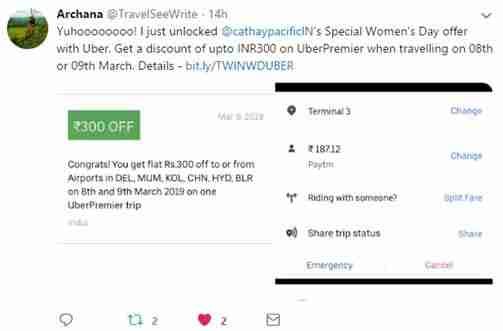
1) Being the moth of International Women’s Day, a lot of good offers are announced for women
2) When spring hits the city, it means only one thing – time for the annual Hong Kong Arts Month. This is a perfect time to experience the diverse
3) During most of March, the weather is very pleasant and comfortable with temperature oscillating between 11 °C – 28 °C. Therefore, one light sweater and a rain jacket are enough to keep you outdoors for long. Also, the misty and drizzly weather with alternate dry and clear spells is great for taking dramatic pictures.

I am a firm believer of the fact that your experience with a service provider starts much before your actual physical experience. And, I have to give 100% marks to Cathay Pacific for a great start. Right from availing the Uber offer to online check-in, everything was butter smooth. While there was a long queue at the check-in counter (because the Delhi-Hong route is a very busy route), it hardly took me five minutes to get my documents checked and get the boarding pass.

The ground staff was very courteous and wore a big smile. They even obliged me with a good aisle seat. Due to some airport issue, the flight was delayed by an hour, still, they managed to get everyone on board quickly. I even got lucky to board before other passengers.

While Cathay Pacific has a lot of good options to keep you entertained throughout the journey, I prefer taking night flights to catch up on my sleep and wake up fresh the next morning. An early arrival in the city gave me ample time for sightseeing.

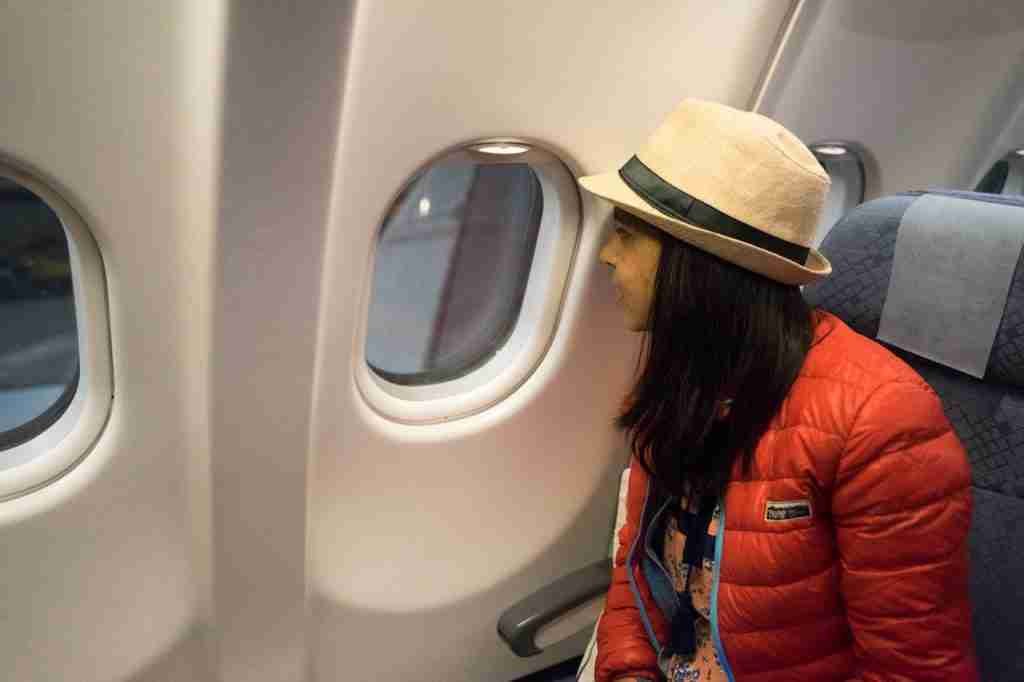
The airline has recently upgraded its fleet with Boeing 777-300ER, which means the seats are wider and more comfortable with customized seat cushioning. I could adjust the headrest four ways – up, down, and sideways. As a result, I didn’t wake up with a cramped neck. Each seat was supplied with a small pillow, plastic-wrapped blanket and headphones. The seats reclined well and I was pleasantly surprised by the leg room; I could easily stretch out my small legs and store a small bag underneath the seat in front.

Being a frequent flier, this is where I get my entertainment fill. I was so glad to find a nine-inch touchscreen TV loaded with a wide selection of 52 movies and 90 TV shows to fuel my binge-watching. And, for people who are not interested in movies and TV, there were games, music, ‘Discovery’ in-flight magazine, ‘Discover the shop’ shopping catalogue and a wide variety of daily newspapers and magazines.

Also, the USB charging port located at the bottom of every personal TV was pretty neat. However, a point to be noted is that in-flight charging works only after take-off. Another small but thoughtful feature I loved was the small dedicated shelf below the screen at eye-level to keep my gadgets. I comfortably placed my mobile phone there.

For me, they are the real deal. I found the cabin crew extremely warm, friendly and very helpful. They even had a Hindi-speaking cabin crew to help communicate with the people who can’t speak in English or Mandarin. They served everyone attentively. Since I had eaten just before the flight, therefore I requested them to serve me late dinner. And, they didn’t bat an eyelid.

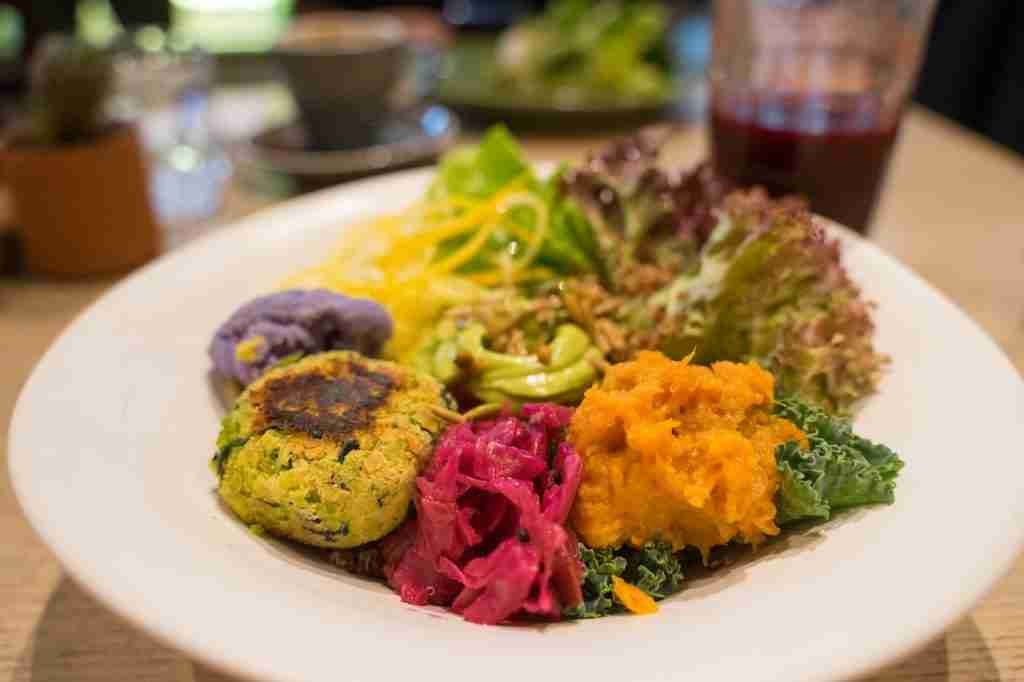
If you fly with Cathay Pacific, your fantastic experience continues long after your journey. Usually, as soon as I get out of the airport I throw away my boarding pass but flying with them gave me a reason to keep it safely. I had one of the best organic vegetarian meals (yes, Hong Kong has fabulous vegetarian options. Detailed post coming soon) at Grassroots Pantry, where I got 15% discount on my food and drinks bill by just flashing my Cathay Pacific Boarding pass. And, that restaurant is not the only one, there are many restaurants where you can get up to 20 % discount on food and beverages.

While I was traveling with no check-in luggage, my friend could check-in her bag at Kowloon Airport Express station early in the morning for an evening flight. Apparently, if you take the Airport Express (AEL) to Hong Kong International Airport, you can take advantage of Cathay Pacific’s in-town check-in facilities at either Hong Kong or Kowloon Airport Express/MTR stations. You can check in and collect your boarding pass as early as one day in advance or as late as 90 minutes before departure.
For more information check https://tiny.cc/FBININTOWNCHKIN )

Cathay Pacific is one of the world’s leading flying carriers with services to 232 cities in 53 countries and territories across Asia, North America, Europe and Africa. Being a frequent flier on international routes, I prefer flying with airlines that are a member of some alliance as you can accumulate Frequent flier miles that you can redeem later. Cathay Pacific is the founding member of the Oneworld global alliance that serves more than 1,000 airports in over 150 countries. You can also join Cathay’s own royalty program – Marco Polo Club.
Hope you liked my honest Cathay Pacific Airlines Review. I had a good time with them and I am already looking forward to flying again with them for my next international travel.
Have you ever flown with them? If yes, I would love to hear from you.
Interested to know more about Hong Kong, check out the following articles:


I was hosted by Cathay

I have just returned from four-month solo budget travel in Europe and still within a week, the post-travel depression kicks in. And, to make it worse, my morning sneezes induced by a smog-smothered Delhi becomes a routine. I am craving to get back to nature at the slightest possibility. I start looking for options – the hills of Himachal, desolate land of Ladakh the pristine beaches of Kerala or the sand dunes of Rajasthan. After pondering for a few days, the decision is made. I am going to visit the forests that inspired Rudyard Kipling’s Mowgli. At the end of November, I set off from Delhi to explore wildlife tourism in India. While there are many options to choose the best jungle safari in India, I settle for a five days Tiger Trail in Madhya Pradesh.
At 5:30 am on a misty morning in November, I leave for the Pench National Park in an open-jeep along with my Naturalist, Alwyn from Jamtara Wilderness Camps. Before starting our Jungle adventures, we are treated to a hot cuppa coffee and tea along with home-baked cookies. Our naturalist reminds us to leave behind all electronic equipment at the lodge barring our cameras and binoculars. The chilly wind stings my cheeks and makes my eyes water but I am well-prepared with several layers of winter clothing, woollen cap, muffler and a hot water bottle tucked under my blanket.

As we enter the park, I see langurs jumping from tree to tree, birds tweeting in unison, chital and sambar herds gingerly grazing in the grassland. We move along the jungle and I smell the sweet aroma of the damp earth at daybreak. I see the morning dew dripping from the trees onto the lush undergrowth. Before I could capture any of those, the jeep moves and the smells and sights disappear. The silence of the jungle is occasionally broken by Alwyn and the local park guide, who encyclopedically and passionately tells us about the flora and fauna of the jungle. They share tales of the forest that are an intriguing mix of scientific facts gleaned from their training and the books they have reading, and local lore from the area.

Suddenly Alwyn hears an alarm call of a langur followed by the grunting of a deer. It is a signal that a tiger is on a prowl. A sense of alertness grips the group as we drive towards the distress call. As soon as our jeep comes to a halt, we cram onto one side of the Jeep to look outside.

After 10 minutes, our patience is suitably rewarded when the majestic cat reveals itself to us from the thick foliage. My heart is forever gripped by the shiny orange coat with black stripes. Just a few feet away…the Royal Bengal Tiger crosses the dirt road…gives us a disdainful look…and vanishes again in the dense forest. My day is made!

We then move on to explore the park’s large diversity of wildlife, including Leopard, Tiger, Jungle Cat, Dhole (Wild Dog), Sloth Bear, Wild Boar, Mongoose, Gaur, Cheetal (Spotted Deer) and Sambar. Once our hunger for Tiger satiates, hunger pangs kick in. At around 9:30 am a picnic breakfast is served in the middle of the jungle with a cup of hot tea or coffee. We then stay in the park until 11 am before returning to our base camp at Jamtara.

In the evening, we had an option to either go for the afternoon Safari from 3:00 pm to 6:00 pm or immerse ourselves in the tribal lives of the Jamtara village. We walk through the village market selling all kinds of knick-knacks – from silver jewellery to fresh vegetables. Hawkers earnestly call us as we pass through the mud path with our eyes stuck on the cobs of corn, which grow abundantly in the area, dry in courtyards. Bottle gourd vines climb wooden fences and tiled roofs. We are invited for a cup of piping hot tea in a local house made up of wood and mud. As the sun sets, we return to our camp witnessing the domestic cattle coming back home with their herders.
This was my first day of a five-day Tiger Trail in Madhya Pradesh, where Rudyard Kipling got inspired to write the Jungle Book. While visiting the two key national parks, Pench and Satpura, I saw a variety of animals and birds including tigers, leopards, wild dogs, wolves, sloth bears, bisons, wild boars to name a few. Alwyn and Aly Rashid (naturalist and the owner of Reni Pani) kept sharing the in-depth knowledge about the undulating topography and wildlife.


There are over 1,200 species of plants in Pench and 1300 in Satpura including several rare and endangered ones. We passed through an array of vegetation ranging from moist, sheltered valleys to open, dry deciduous forest. Satpura is unlike Pench, though they are just a few hours drive from each other. The former is lusher and has trees greener and taller than Pench. In Pench, there are higher chances of Tiger sighting, while Satpura has plenty of leopards, sloth bears, giant Malabar squirrels, and migratory birds. Pench is best explored on jeep safaris, Satpura can be explored on foot, boat, jeep or elephant.
Every evening, we shared our stories of animal sightings as the snacks and drinks made the rounds around the bonfire. And, each night a lucky person got a chance to sleep under the stars in the Star Bed – a glamorous machan in the middle of fields at Jamtara Camps. The Star Bed experience is a source of income for local farmers, and 80 per cent of the staff are hired from surrounding villages.

In fact, it was here I got to know how deep-rooted company’s history is in conservation. Owner Amit Sankhala’s grandfather – Kailash Sankhala – was the one who started Project Tiger, a conservation programme in India in 1973. And, the legacy has grown ever since then with his son Pradeep Sankhala taking over the charge of the Tiger Trust after his father’s death and setting up eco-friendly Jungle lodges. And, now Amit is holding the fort successfully.
Food is either grown on-site or sourced locally from the surrounding farmlands. Furnishings are made from recycled wood, all-natural products are used where possible, and guests are given a stainless-steel bottle for filtered water.

However, it wasn’t just the national parks and camps that impressed me. I was amazed by the genuine conservation and community development works of Jamtara Wilderness Camps and Reni Pani Jungle Lodge. Not only do they provide a great Jungle safari experience but also connect you with the local communities that call these remote areas home and play a vital role in safeguarding the national forests. Both Jamtara and Reni Pani resorts supply school desks and other items to the community and play an active role in Tiger conservation.
I had gone to central India to get rid of my travel blues but I ended up seeing so much natural beauty and glimmers of hope in wildlife tourism – thanks to enlightened law-making, a few committed individuals, and some truly wonderful lodges.

So, when are you heading on a Tiger Trail in Madhya Pradesh?

While there are all kinds of accommodation options available in the Pench National park area, I highly recommend staying at eco-friendly resort Jamtara Wilderness Camps situated in the Village of Jamtara, near Pench National Park. There are 10 luxury safari tents with en-suite bathrooms and private verandah, outdoor and indoor lounges, library, valet parking, swimming pool and laundry. Rooms are equipped with free filtered water, tea- and coffee-making facilities, hot-water bottles, air-conditioning and Soultree bath products. There are no TVs and no WiFi or mobile signal throughout this remote, eco-friendly camp.


In recent years, the Satpura National Park has seen the blossoming of several boutique jungle lodges. Among these, the Reni Pani Jungle Lodge is second to none. Located in a pristine forest typical of the Satpuras, it gets its name from the neighbouring tribal village. Reni Pani features twelve luxury cottages encompassing three distinct architectural designs.


The nallah units, the forest units and the hill units are all built using local/indigenous material and are characterized by viewing decks, large lounging bay-windows and luxury bathrooms. The ‘GolGhar’ or the meeting place, has a fascinating and unique design and features a dining area, a bar, a library and a lounge set in its various corners. Its true forest environment coupled with neighbouring patches of agricultural land make Reni Pani and its surrounding areas a hotbed for animals and birds.
The Pench National Park is well connected by air, road and railways
The Satpura National Park is a 3.5hr/130km drive from Bhopal. Bhopal is well connected by air, rail and road to major Indian cities.
In case you are interested in wildlife tourism in India and how to behave responsibly in the National parks, do read
Into the wild – Chitwan National Park, Nepal
The abridged version of this story was published in Malindo Air inflight magazine


I was invited by MP Tourism as a part of Adventure Next India event organised by MP Tourism in collaboration with the Adventure Travel Trade Association (ATTA). However, all the views expressed above are based on my personal experiences in the region during my visit. Please do not copy anything without written permission.
In 2012, when I visited Tuscany for the first time, I did things that most first-timers do – tick marking all the attractions, travelling everywhere by car, shopping at Florence’s Via de’ Tornabuoni boutiques, eating four-course Italian meals with a bottle of Brunello di Montalcino, climbing the Leaning Tower of Pisa, and spending hundreds of euros staying in the heart of Florence. I did all this, and it was worth it. It really was.

However, when I returned to Italy after six years, my travel goals had changed. I no more longed to see everything in three days. Sure, I could zip from one place to another. But why let FOMO dictate my travels when there’s a better choice available? The Tuscan countryside is like the Chianti produced there – meant to be savoured rather than gulped. While there is no dearth of interesting ways to explore Tuscany, I decide to walk an ancient pilgrimage route – the Via Francigena Toscana (pronounced Fran-Chee-ge-na). The 1300-miles long route ran in the Middle Ages from Canterbury through France, Switzerland and Italy before reaching the Eternal City, Rome.

Almost forgotten for centuries, the route has been given a new lease of life in recent decades by the fervent efforts of locals and the government. In 2009, the Italian government decided to revive the whole Italian leg of the route based on the journal written by Sigeric, archbishop of Canterbury, on his way back from visiting the Pope in AD 990. However, the revival process was a bumpy ride. Roadblocks existed in the landscape and mindscape alike.

Alberto Conte, Founder of
Ten years ago when I started walking Via Francigena with a group of
travellers , a BMW stopped and said, “we don’t want you here.
With a big smile on his face and a twinkle in his eyes, he continues,
But now the attitude of the locals has changed completely. They have seen the cultural and economic benefits of having modern pilgrims in areas that never saw tourists. Now they even offer free water, coffee
and food to the pilgrims.
One day before my trail begins, I arrive in Montecatini Terme, an 18th century Spa town famous for the healing mineral water. Sloways, the local company managing my travel, preps me well in advance.
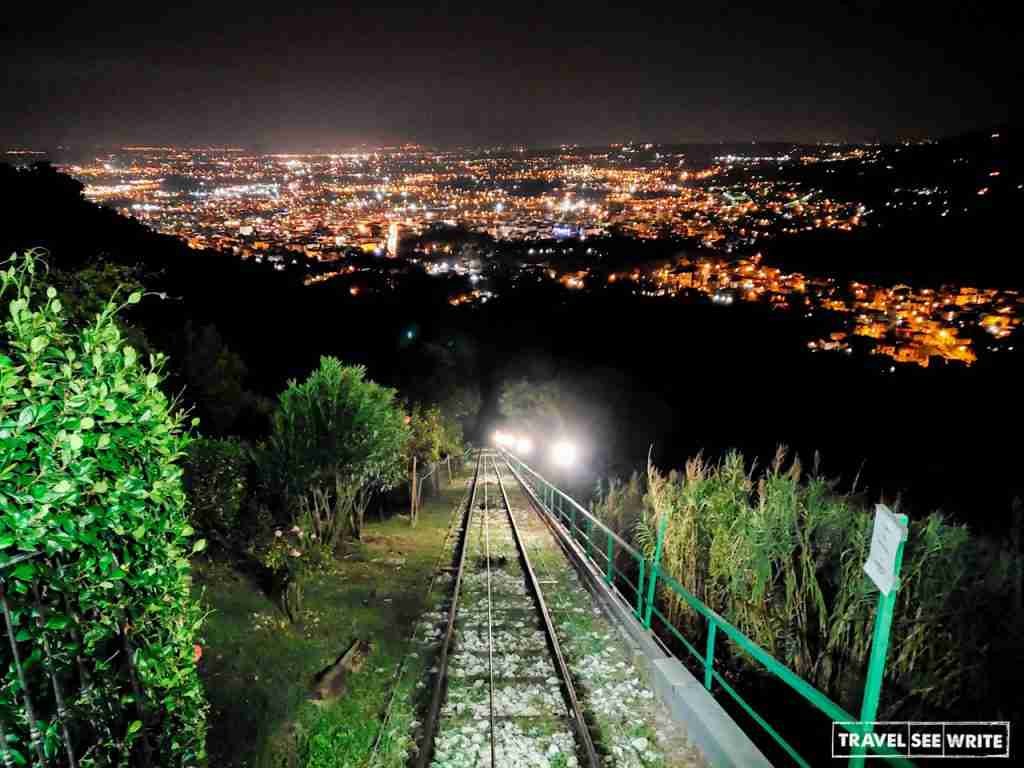
As the evening befalls, I reach the old funicular tram that goes to Montecatini Alto, an ancient hamlet where our group dinner is planned. During the ice-breaker session, I ask Tullia Caballero, the Director of
The Via Francigena is different from other long-distance trails because it has been in use for nearly 2000 years. This succession of
civilisations , history, architecture, culture, traditions, food and wine, and the constantly changing landscape is a treasure trove for all your seven senses.
Recalling the heydays of the route, Tullia shares how this route was once used by Europe’s best and the greatest minds. Thriving commerce transformed the hamlets into beautiful and powerful cities, many of which are now UNESCO world heritage sites. You’ll see the beauty of this pilgrimage yourself in the next few days.

The next day after driving for two hours, a group of ten people from all around the world – Norway, Sweden, Canada, USA, Australia, Brazil, Japan, India, and Jordan along with three local experts start walking the trail near the hilltop town of San Miniato. I see a tiny image of a pilgrim welcoming us, which later appeared almost on every patch of the trek – whether, on a lamppost, small sign or spray-painted on the pavement – to guide the modern pilgrims like me.
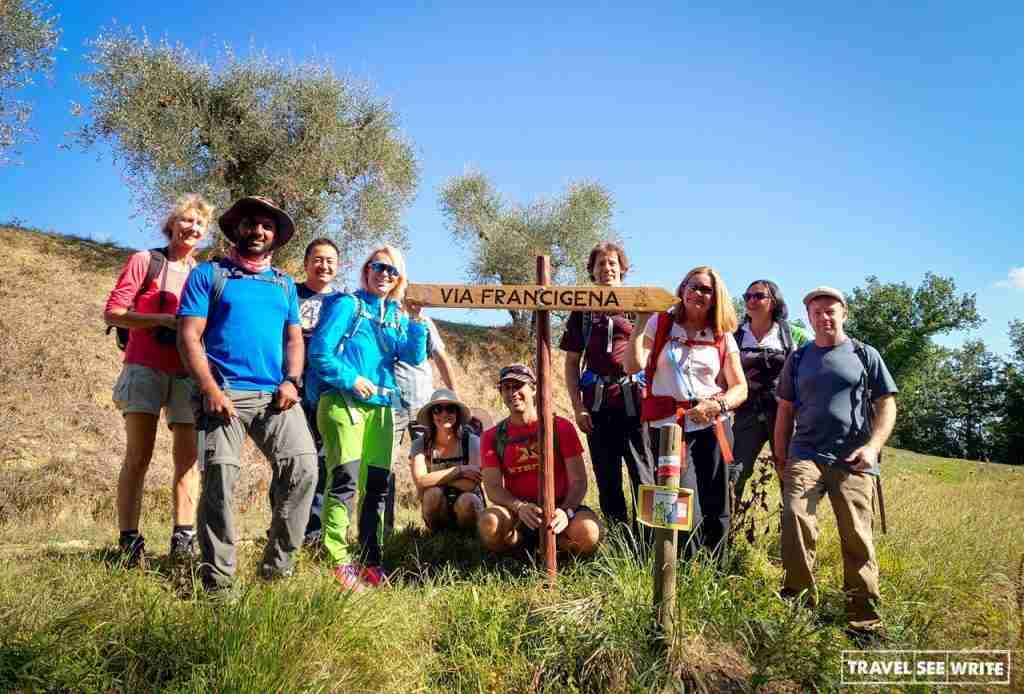
Erica Masini, our environmental guide, talks

As I begin my pilgrimage through a classic Tuscan landscape of quilted green hillocks, freshly harvested golden wheat fields and olive groves, I try to take in the beauty around. Despite walking with a group of people the ringing in my ears stopped – and I was stunned by the silence. The music of no sound, after the clamour of tourist-rundown cities, was so pleasant it was almost overwhelming. Then like an orchestra tuning before a concert, isolated notes started reaching my ear, one by one: the harmonic melody of far off birds, a tractor mowing a field in a distance, a vagabond breeze rustling the olive trees. I am lost in a world where everything is beautiful.

After three hours of walking in 24-degree Celsius temperature on a snaky path stitched with the folds of hills and skirting vineyards, we reach the cool surroundings of a recently restored 1100-year-old Romanesque Church – Pieve a Chianni. It was here, where Archbishop Sigeric stopped on his way from Rome to Canterbury. While we take a tour of the church, Ernesto, our Italian host and trek guide, prepares our picnic lunch of bread, salads, fruit, crackers, meats, cheeses, olives, and wine.

After a hearty Italian meal, we continue our journey to Gambassi Terme.
We spend the night at Ostello Sigerico, a friendly pilgrims’ hostel from the 13th century where we are treated to a delicious homemade Italian meal by our local host Franco and his family.

The next day our eyes and limbs are all set to reach San Gimignano, arguably the most beautiful hill town in Tuscany and a UNESCO World Heritage site worthy of the nickname ‘Medieval Manhattan’ for the 14 towers that adorn its skyline.

Though the route was shorter than the earlier day but more diverse in appeal – we pass through freshly overturned fields with earthy fragrance, golden-yellowish vineyards where most grapes have been harvested, dry sunflower fields, long avenues of cypresses, rolling hills, lush green forests which have started flaunting fall colours. In mid-afternoon, a view of San Gimignano’s famous spires peeks through the trees, and soon we join a road filled with cyclists in bright outfits.

After settling down in our 3-star centrally-located Hotel La Cisterna, we set out to explore the UNESCO city of 100 towers. Our guided tour of the town starts with climbing up the tallest tower of the “Medieval Manhattan” – the Torre Grossa. I travel back in time looking at the panoramic view of the sky-piercing stone towers, and narrow cobbled-stone streets surrounded by an expansive countryside filled with vineyards. Suddenly I am jolted back into reality when Erica narrates the history of the town,

The patrician families who controlled the town built around 72 tower-houses as symbols of their wealth and power. Although only 14 have survived, San Gimignano still has that feudal atmospheric vibe.
Listening to the power struggles of the middle ages, we walk down the stairs to see some of the most beautiful medieval palaces in Tuscany, like Palazzo del Popolo and Palazzo del Podestà.
The star highlight of the day was a wine tasting at the Museo del vino Vernaccia di San Gimignano. As the Tuscan sun hugged the whole valley into its golden dust, an expert sommelier took us on a sensual journey of Vernaccia, a fruity local dry white wine produced only in Tuscany since the 13th century. We wrap up the day by enjoying a typical homemade Tuscan dinner at Osteria delle Catene.

San Gaminino is one of my favourite places in Tuscany partly because it is so emphatically not a ten-minute tourist stop. Every street, every tower, every art piece, every glass of wine compels you to spend some more time here.
With a reluctant heart, I leave San Gimignano to pay a short visit to a completely off-the-beaten-track Agriturismo farmhouse, who’s owners are keepers of the keys to an ancient Etruscan altar normally closed to the public. Torraccia di Chiusi is a 1,030 years old refurbished cosy country house with seven guest rooms, its own restaurant, panoramic pool and picturesque surroundings hard to beat.

And, it’s not just the surroundings, but the owner Donatella, and her staff that makes you feel so welcomed. With glittering eyes, filled with childlike excitement, she passionately shows us around the house, its grounds and the
On the property, we’ve found Roman coins,
jewellery , small marble markers with Roman etchings, and other Etruscan structures.
Before bidding goodbye, we are treated with coffee and homemade snacks.
From here we trudge through vineyard-covered rolling hills, cross the Elsa river valley, jump into the freshwater stream, and rest for a while in historic but abandoned villages before reaching Abbadia Isola, a 1000-year-old abbey. This large Romanesque abbey was covered with marshlands until the 11th century and then Benedictine monks took charge and built an important monastery and church, which is still recognised as a masterpiece of Romanesque art. Hence the town got its name Abbadia Isola which translates to ‘abbey island’. It was an important town in medieval times due to its strategic position right on the border of Florence and Siena territories. Like Archbishop Sigeric, we too take solace here, rejuvenating our body and soul with a hearty meal and a comfy bed in Ostello Contessa Ava.

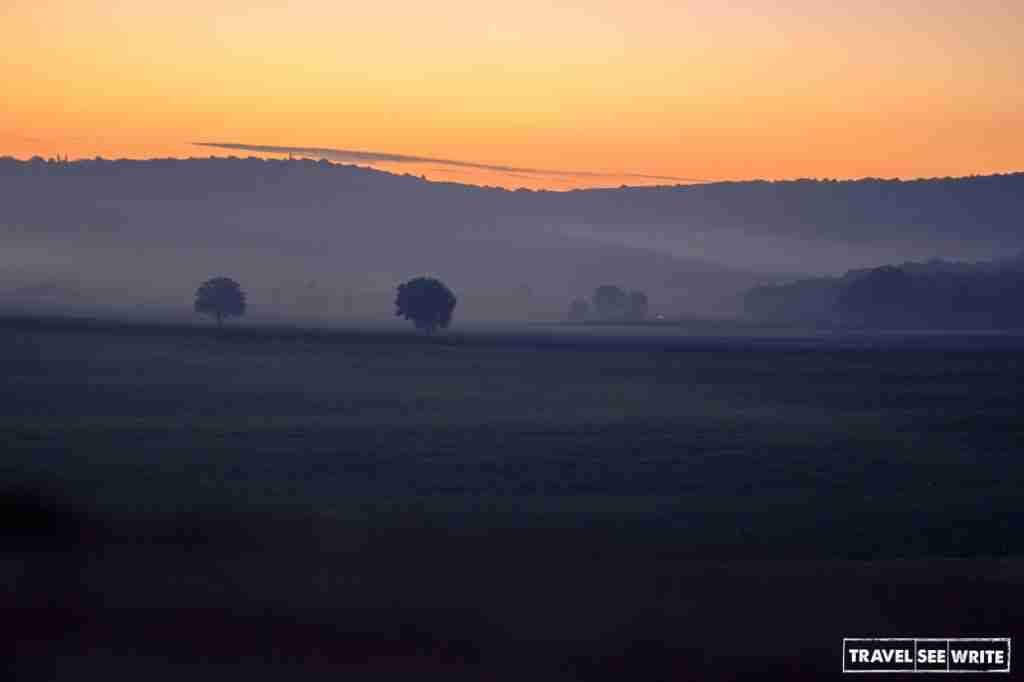
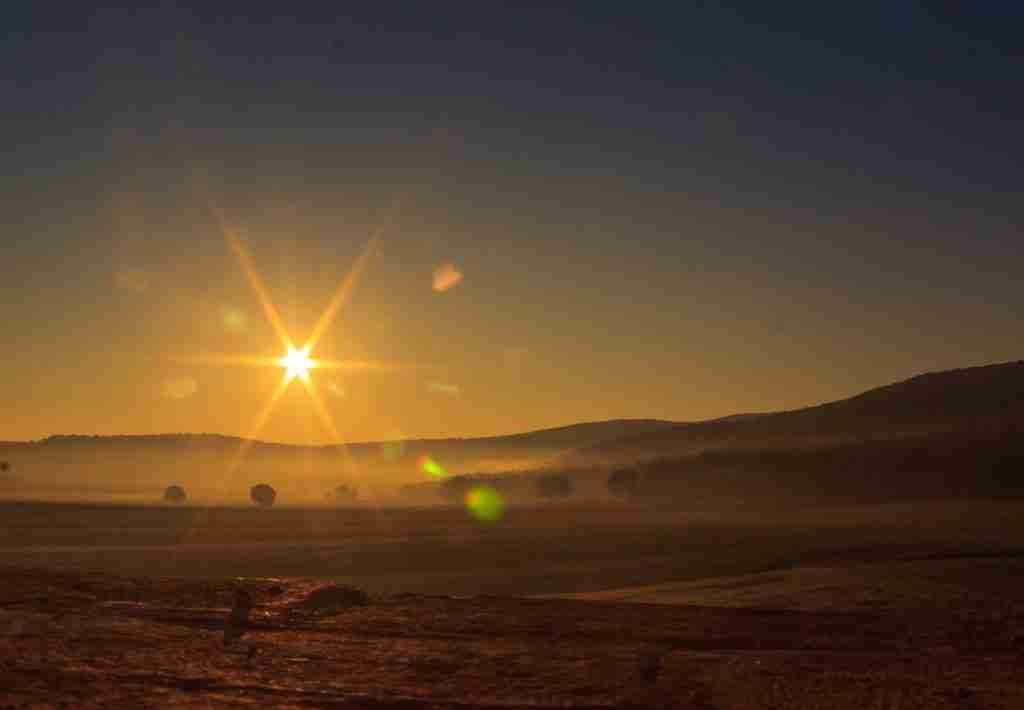
From Abbadia Isola we walk to the perfectly preserved tiny medieval walled town of Monteriggioni. Despite power changing hands several times, Monteriggioni hasn’t lost a bit of its Medieval character. As we reach the castle, the Mayor of the town greets us and gives a peek into the history of the place,
The castle of Monteriggioni has never been conquered. And, that’s why nothing has changed here – from compactly woven cobbled streets to its city walls. The castle was once surrounded by coal,
that would be lit in case of attack.
We spend a bit of time in the castle gazing at the Armoury Museum and treating ourselves to gelatos and cakes before heading onwards to Siena

We walk through a landscape that changes outfit every five kilometres – from lush green forest to brown hillocks. The beauty of this landscape is enhanced by scattered castles, fortified farms and forests that witnessed many legendary battles between Florence and Siena.

For lunch, we stop at the ‘Punto Sosta’ (means stopping point), a wooden picnic shelter beside a ring of tree-stump seats in the front yard of a house halfway between Monteriggioni and Siena. Soon we were welcomed by one of the most generous persons we met on the pilgrimage – Marcello Pagnini, the house owner.

Starting in 2012, Marcello has dedicated his life to serving the Via Francigena pilgrims. No one goes hungry from his humble abode. Every single day he wakes up early in the morning to bake his bread, curate meats, makes wine, cleans the place, does the dishes, buys new books for visitors and entertains them with his stories. He works on a donation basis and considers pilgrims as his source of positive energy. He recently lost his wife, which made him a little lonely and sad but that didn’t stop him from serving the pilgrims. For the first time in Via Francigena Toscana, I get teary-eyed when Marcello gives me a hug. My heart swells with the generosity shown by a stranger. It is people like him that make Via Francigena a true pilgrimage.
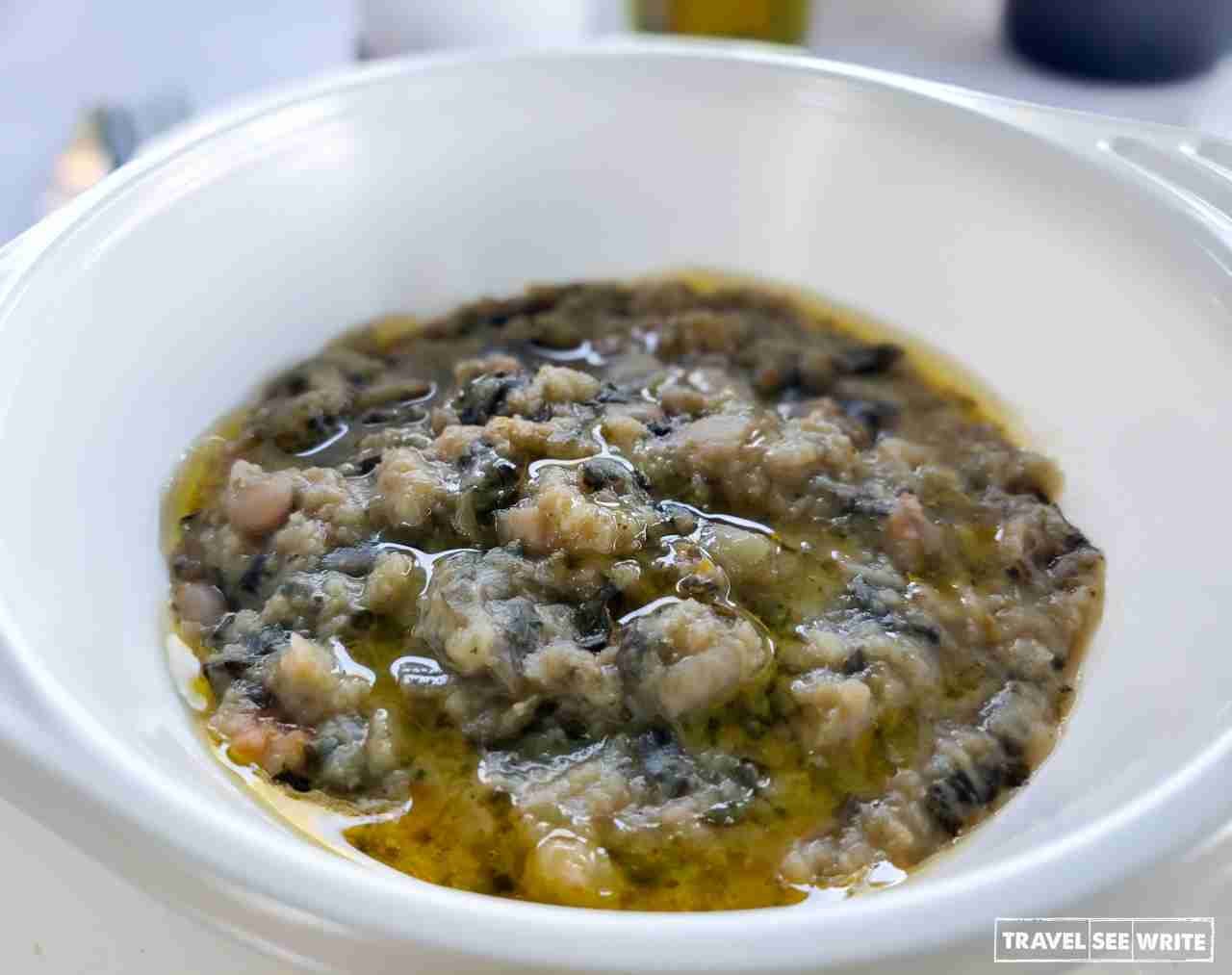

We walk for a while amidst a forest of oak trees before reaching the Hermitage of San Leonardo al Lago, which has treasures from the 14th and 15th centuries – beautiful frescoes – that come alive when the hermitage’s custodian narrates the bygone era tales.
We then get transferred to jaw-dropping Siena, one of the loveliest and busiest towns in Tuscany. In the heart of Siena lies Piazza del Campo, famous for the world-renowned “Palio” (a historic horse race) held twice in the square every Summer. I walk around the cobbled streets gazing at the beauty of the Gothic architecture of the middle ages.
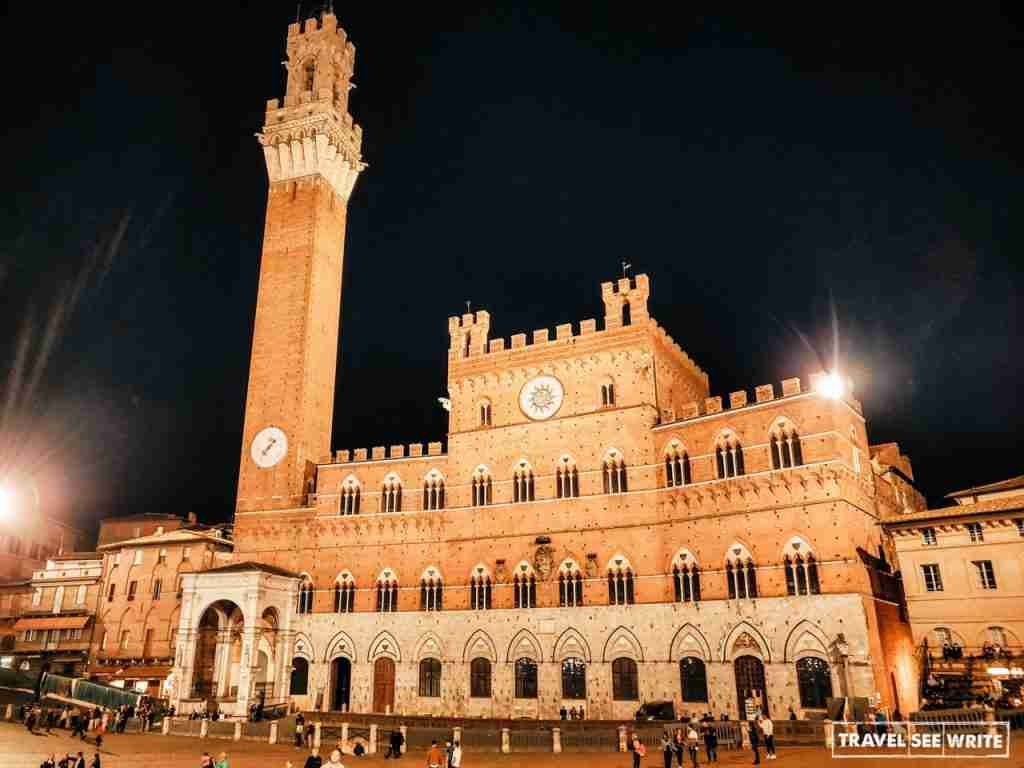
The day ended with us relishing one of the best pizzas in Siena at Il Pomodorino while overlooking the Duomo of Siena.
The last day of the trek is fairly easy. From south of Sienna, we take a shuttle to Lucignano and from there we walk on the soft ochre-coloured Sienese clay hills topped with a line of cypresses leading to isolated farms. After walking for a few hours, we reach our lunch spot – Fattoria Pieve a Salti near Buonconvento, a 700-hectare Agritourism organic farm, from where Barilla, Ferraro and others get the grain for their different kinds of pasta and cereals.


A scrumptious lunch is further accompanied by a great Tuscany wine tasting at Italy’s first all-woman run vineyard – Donatella Cinelli Colombini. We taste various wines of different ages with different pairings, the most thrilling being tasting wine with music. That is a first for me.

The last leg of our trip is on a bus that brings us back to Montecatini Terme where our trip ends.
Before I embarked on the Via Francigena pilgrimage I had no idea what was in store. Frankly, I was more worried about the physical aspect of the journey than the emotional journey. However, once I started walking I realised this trail is no ordinary trail, it changes you from deep within. There are geographical hubs and there are spiritual hubs, and then there are hubs in a completely different sense – places that ground you, that bring you back in touch and balanced with something deeply important inside you.

It was here I met and bonded with people I could have never crossed paths with in ordinary life – who don’t just talk about bringing a change in the world – they walk the talk. Through the rolling hills and heritage sites, the wines and the bites, the sore thighs and the soaking rain, we bonded as a group. Life stories and future plans were discussed over long dinners filled with laughter and unlimited Tuscany wine.

Although, I did meet a lot of interesting people, enjoyed gastronomic delights, saw many exciting places nothing extraordinary happened during the entire trail, and that was precisely the point: the trail gave me a great chance to connect with the heart and soul of Tuscany, and in doing so, offered enlightening insights into the simple pleasures of Tuscan life.

I might not be a classic pilgrim but you don’t even have to be religious to experience the joy of walking the Via Francigena Toscana.
So, when are you walking the 1200-year old pilgrim path to Rome?
Fly from any Indian metro city to Florence or Pisa and then take public transport to reach San Miniato.
May-June and September.
You can stay at pilgrim hostels, monasteries or 3-star hotels on the trail. I stayed at La Cisterna in San Gimignano, Pilgrim Hostel Sigerico in Gambassi, Ostello Contessa Ava in Abida Isola and Hotel Italia in Siena
A self-guided tour for three days starts at €140pps and guided group tour for five days start at €570pps with Sloways (https://www.sloways.eu). Prices exclude flights.
Well-fitted hiking shoes, comfortable clothing and a hat are vital things to carry. Keep your daypack light with a reusable water bottle, snacks, sunscreen and camera.
For more information on the Via Francigena see viefrancigene.org
PS: I am sure many of you have followed by
An edited version of this story was published in the following publications:


I was invited as a hosted media to attend the Adventure Travel Summit Tuscany 2018 by the Toscana Promozione. This pre-adventure trip was part of my vist. All the views expressed above are based on my personal experiences in the country during my visit. Images used are shot by me. Please do not copy anything without written permission.

The Czech Republic and Slovakia peacefully uncoupled in 1993 after Czechoslovakia’s Velvet Revolution in 1989. 26-years after their velvet divorce, Slovakia is slowly and steadily attracting
BTW here are the 11 reasons why you should never visit Slovakia
One such place is the town of Banska Stiavnica, a Slovakian jewel in the Carpathian Mountains of Central Slovakia. This small-town is off the main tourist path, and was once the Eldorado of the Great Hungarian Empire. These days, the town offers a gentle pace of life that is downright serene. However, if you dig deeper, you see how the town of Banska Stiavnica changed the world.

It once used to be just as rich in silver and gold as rich it is now in interesting legends, astonishing places,

On a pleasant autumn morning in October 2018, I landed in Slovakia. Bewitched by the untouched beauty around, I developed a genuine connection with the land of Tatras and healing waters. While I absolutely loved the virgin mountain beauty, it was the people who won me over. One such friendship was with Andrea-Tomas, a beautiful couple from Bojnice. I instantly hit off with them as they made me see Slovakia in the most genuine way – unpretentious and raw.

At that time, I almost made it to Banska Stiavnica but because of a tight schedule, I couldn’t make it. Anyway, better late than never. After nine months, I was at a place where I wanted to be.

Before visiting this ancient mining town, I was treated to an experience, which till date remains one of my

Today, I am here to share my experience in the former ‘Silver Town’ of the Hungarian Empire.
Sometimes high expectations can put undue pressure on others. And, that’s what unknowingly happened to Banska Stiavnica. I arrived with sky-high expectations. Jiri and his team had handpicked the activities for me to experience the true soul of their region – climbing the Carpathian Mountains, trying adrenaline activities at Donovaly and Jasenská Ski resorts, hiking to Harmanecka cave, paying homage at the Museum of the Slovak National Uprising, reviving the medieval memories of castles, mining towns, and steam trains. I was convinced no experience can top the experience I had in Banska Bystrica. As he dropped me at my new exploration site, a tear rolled down my cheeks.

Moreover, the journey didn’t start on a good note. The zig-zag hilly turns made me nauseated and when I arrived in the town I had no energy left to climb up and down the city centre from my AirBnB, perched on a hill top. So, I decided to vacate the place to find myself in a deeper trouble – no rooms available due to a long holiday weekend. Suddenly the reality dawned on me – I was homeless in a foreign land.
And, then a superhero emerged without a cape – Igor Kuhn. He offered me his place and graciously showed me around his place. What I liked the most about him was his attitude towards life. He is a marketing man during the day, a musician during the weekends and a dotting husband and father 24×7. The next few days I explored the vital mining and historical relics of the oldest mining town of Slovakia – Banska Stiavnica.
Banska Stiavnica region sits atop the ore veins – one of the world’s biggest deposits of precious metals in the Middle Ages. And, it would have been blasphemous to visit the town and not retrace its mining heritage. So, Igor and Viki, my local friends, suggested a few important historical places and events

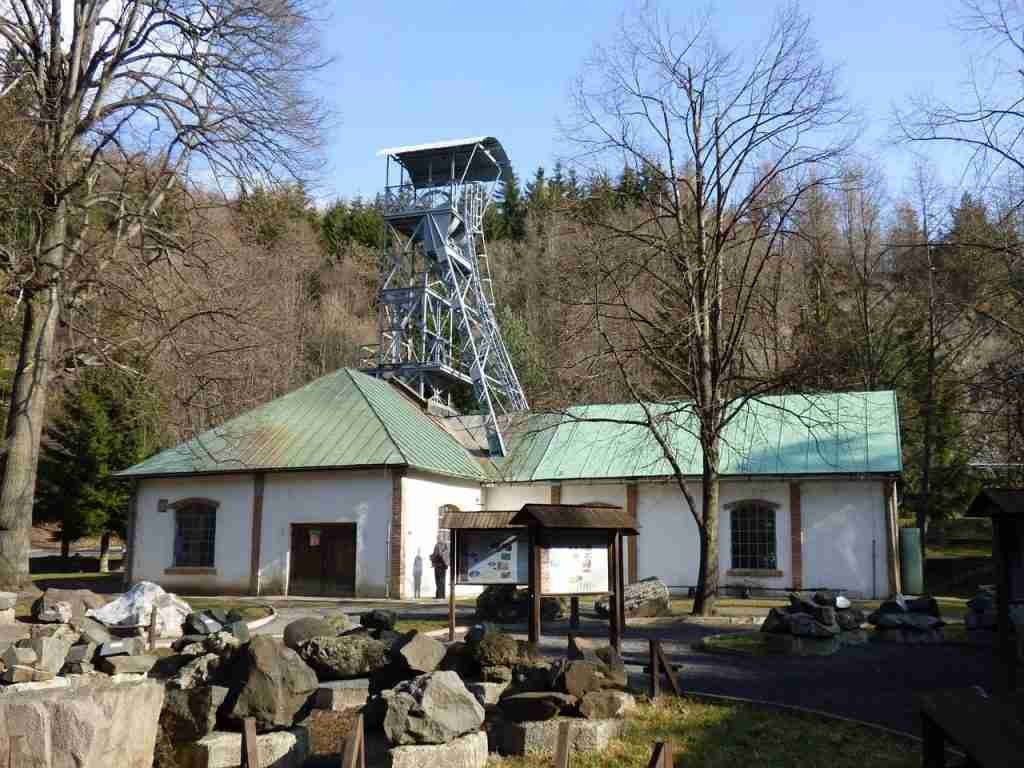
We drove about one and a half kilometre out of town to the Slovak Open-Air Mining Museum, where through a guided tour we learned about the technical and historical aspects of mining in the region. Banska Stiavnica was awarded a UNESCO World Heritage Site title, both for the medieval architecture as well as for its mining contributions. An introductory video and our guide explained,
“The year 1627 was a golden year in the history of Banska Stiavnica – for the first time, gunpowder and explosives were used in mining. And, that was just the start. Over the next 200 years, many of the world’s ground-breaking innovations in mining, metallurgy and forestry took place in this tiny little valley.”
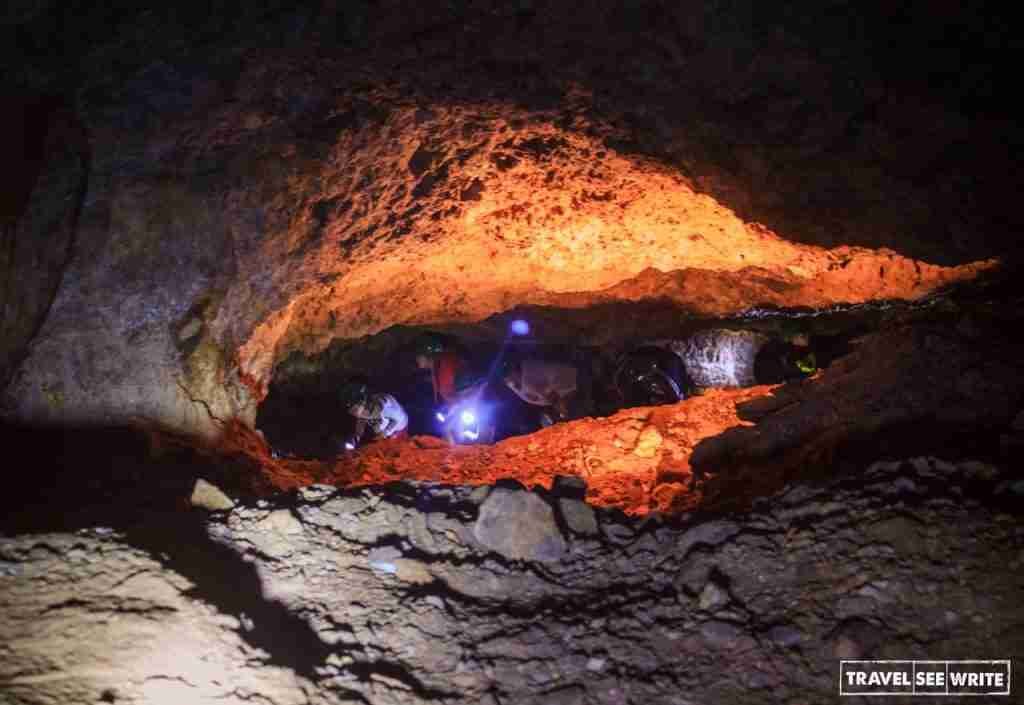
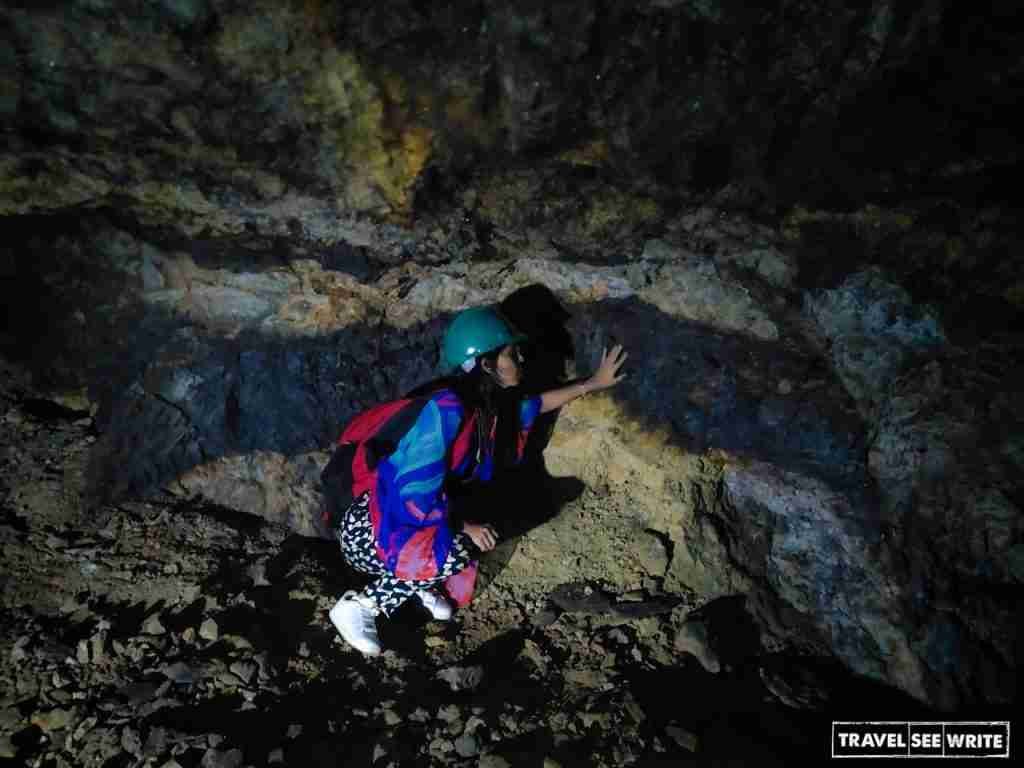


I spend half an hour looking around the ground-level mining exhibits at the

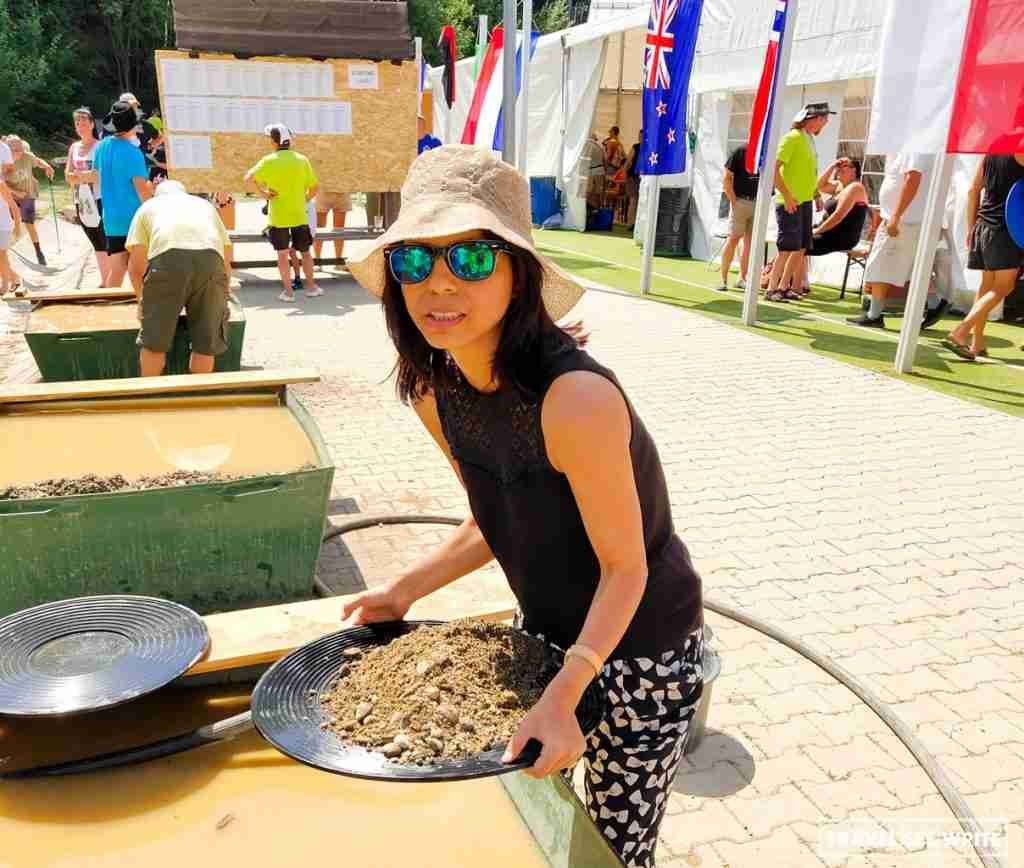
Despite being a sports lover, I had never heard about the World Gold Panning Championship. Therefore, I was very excited to see hundreds of people from around the world – as far as Australia, Canada, South Africa – from all age groups fight for the caveated titles in the Silver town with a golden history. We drove through the Hodruša-Hámre village to reach the SALAMANDRA Ski Resort situated in the middle of the Štiavnické

The Celts, Slavs, Saxons, Turks, Poles, Hungarians, Slovaks, and Czechs all settled here and worked together in the mines of the mountainous region. As a result, the wealth in the veins underneath the town of Banská Štiavnica translated on the surface in the form of opulent buildings lining the town square and central streets. Most of these restored bourgeois houses were built in the 15th and 16th centuries, and now house galleries and restaurants.

The UNESCO protected town


From whichever direction you may arrive, it’s impossible to miss the centerpiece of the square – the Holy Trinity column, a baroque sculpture featuring seven saints. It commemorates the end of an 18th-century plague that wiped out nearly half of the town’s population.

Among all this street splendour, Banská Štiavnica’s old castle stands tall on an incline up from the main square, gazing down on the town like a hawk-eye. Considered as a “stone chronicle of the town” it holds the oldest secrets of Štiavnica. From being a Romanesque basilica in the 13th century to getting fortified 300 years later to defend against Ottoman invaders; the castle is now well restored. It now offers a melange of architectural styles and is home to several exhibits, including a medieval jail.

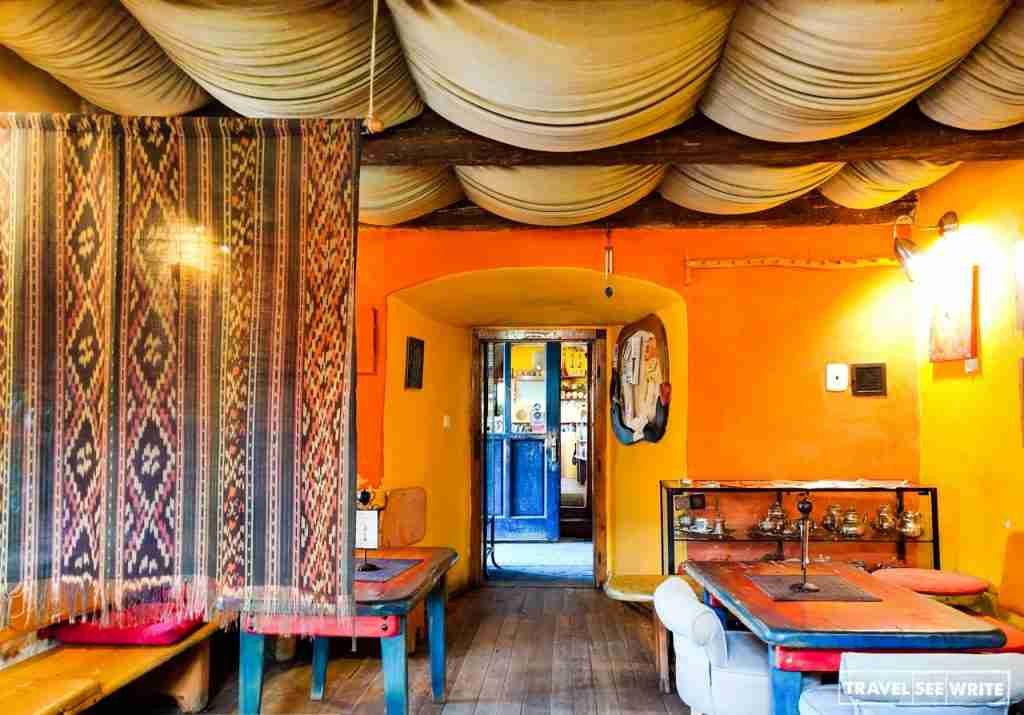
Not too far away from the Old Castle, the 17th century Klopačka (knocking tower) contains a giant black tower that was used by miners as their alarm-clock, prison, and insurance office. Today, there is an amazing teahouse in this building with

As I continued my hike up the hill, I reached the New Castle (Nový Zámok), a white Renaissance fortress occupying a far more tactically savvy position than the old castle with a commanding view of the town as well as the entire valley.
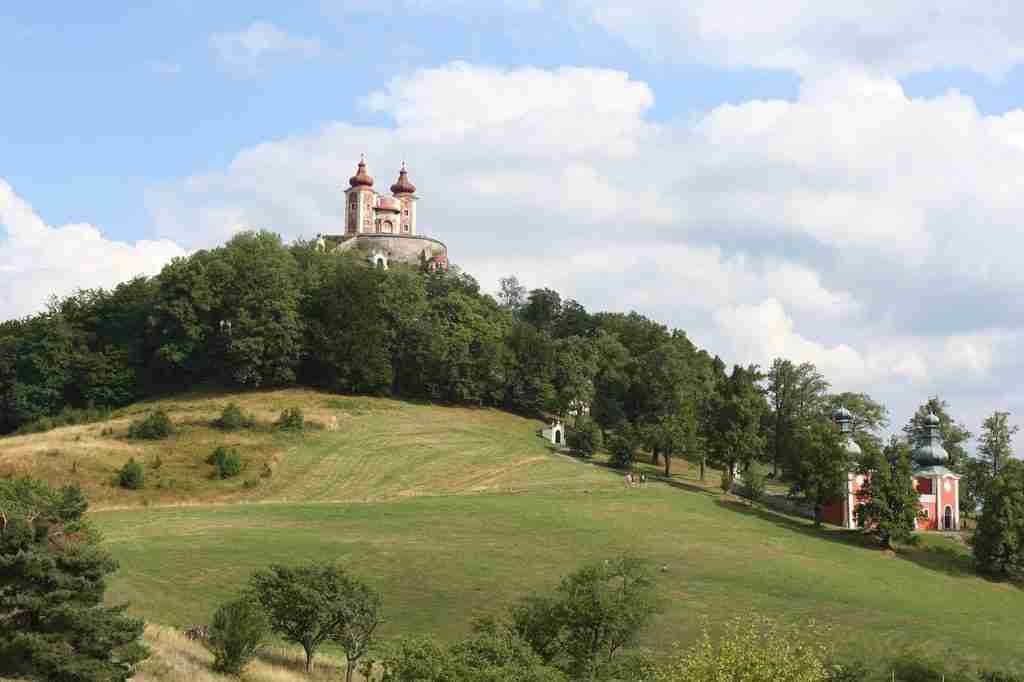
When I asked Igor and Viki, one place that I should definitely visit, both of them replied instantaneously – Calvary (Kalvária). A great specimen of baroque art perched on a volcanic hill, led through a series of chapels and sacral buildings. The crimson hilltop church with magical panoramic views of the surrounding hills is a great place for sightseers and pilgrims alike.
As I walked through the town centre I stumbled upon the world’s only “Love Bank” where couples can deposit small cherished tokens of their love in lovers’ vault made up of 100,000 tiny drawers. However, behind this Love Bank lies the tragic tale of Marína Pischlová and Andrej Sládkovič, the lovers who made the MARINA house famous.
Marina’s affluent parents — in keeping with the age-old poor boy-rich girl trope — decided to separate the teenaged lovers by getting their daughter married to a wealthy gingerbread maker. A heartbroken Andrej, who was Marina’s tutor, turned to priesthood for solace. His love for Marina found expression in a poem (titled Marina) he wrote for her in 1846. The “world’s longest love poem” runs into 2,910 lines and is read widely across Slovakia.
While the legendary love story is impressive, I was intrigued to know how the idea of Love Bank came into existence and so I approached Katarína Javorská, the Museum Manager for details.
“The love bank is a fundraising project to save and restore the historic House of Marína, and bring more love to the world through Andrej’s poem. We have created love boxes from the poem. Each Love Box bears a piece of the original manuscript and can be taken by anyone for €50 for a year and €100 for a lifetime.” says Javorská
This Valentine’s Day, however, many visitors can get a chance to be a part of the world’s biggest love experiment for 100,000 love seekers. Anyone from around the globe can go on their website www.RealLoveBank.com and share their love wish. They will print the wish without revealing the sender’s identity and store it in the Love Bank. The museum will continuously evaluate the results of the experiment on their website and will publish the final results on Valentine‘s Day in 2020.”
Excited by the idea I then move on to check other interactive exhibits – ‘love-o-meter’ that claims to measure the strength of a couple’s love and the talking portraits that bring alive the eternal love story through emotions of yearning, wrath, jealousy, and passion.
Although, the eternal love story of Andrej and Marina didn’t end on a happy note, till date they inspire lovers to believe in the power of love and work towards preserving it.
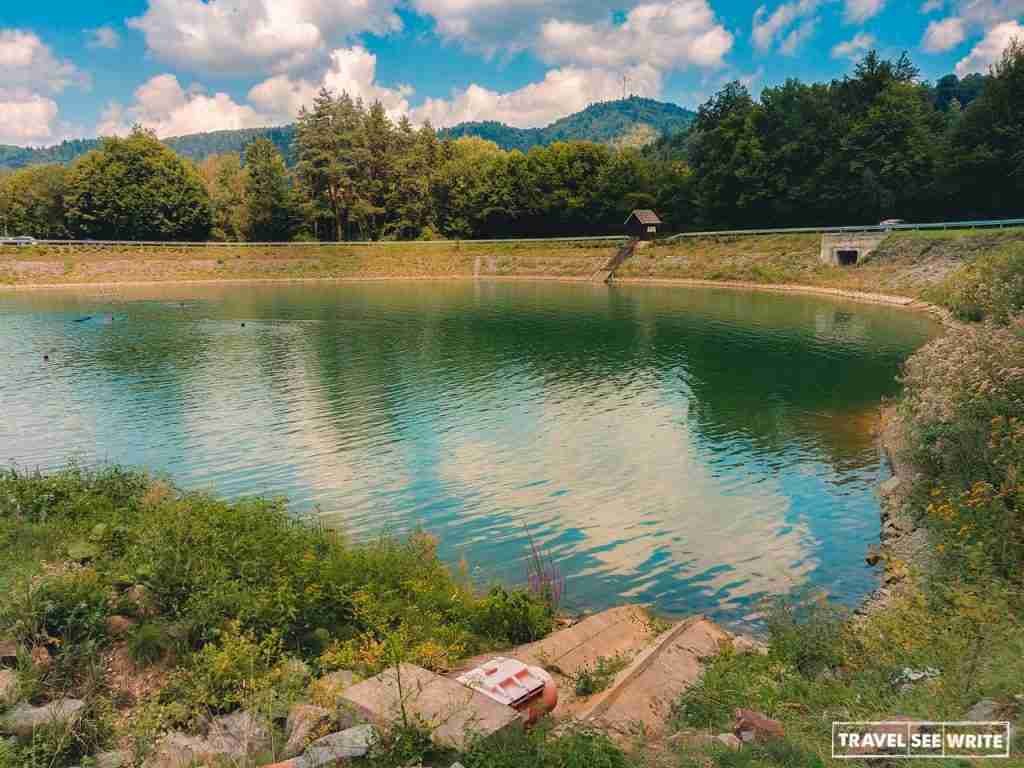
Banská Štiavnica is all year-round destination. However, the best time to visit is at the end of summer or during non-touristy season, when temperatures start to cool, days are long, and shops are open till late. In the summer, you can swim in the tajchs (reservoirs). In winter, you can ski or cross-country ski on many kilometres of maintained tracks. Hiking is great in every season.
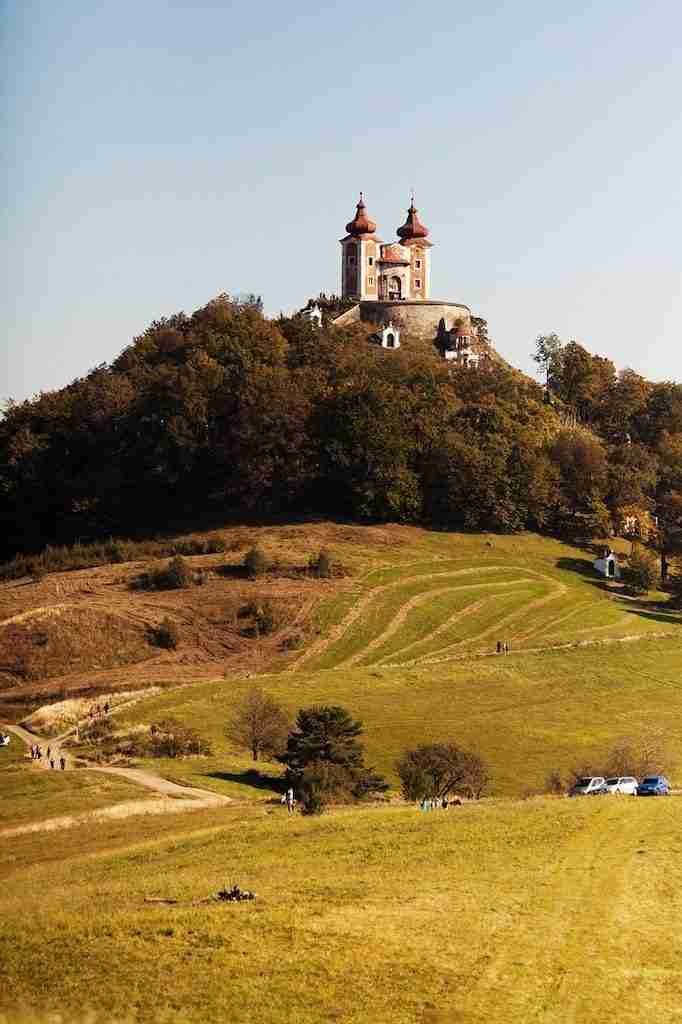
Banska Stiavnica, the Slovak City of Culture for 2019, urges you to slow down and walk around its churches and mansions that once belonged to rich miners. Cowering in the hills above it are small houses that were home to the ordinary miner. No one knows if love stories — of the kind that the museum celebrates — blossomed in the lanes that led to the mines. But once you are in Banska Stiavnica, love will find you.
Hope you now have an answer on things to do in Slovakia. So, when are you booking a trip to Banska Stiavnica?
PS: I am sure many of you have followed by #OffbeatEuropeWithTSW journey on my social media channels. In case you want to know more, do read
An edited version of this story was published in the following publications:



I was invited by the Banska Stiavnica Tourism in 2018. However, everything expressed above is based on my personal experiences in the country during my visit. Images used are shot by me. Please do not copy anything without written permission.
The down under city on a rise

Ten years back when I was planning my first trip to Australia and asked for recommendations, hardly anyone recommended the Queensland capital. However, a lot has changed in the last decade.
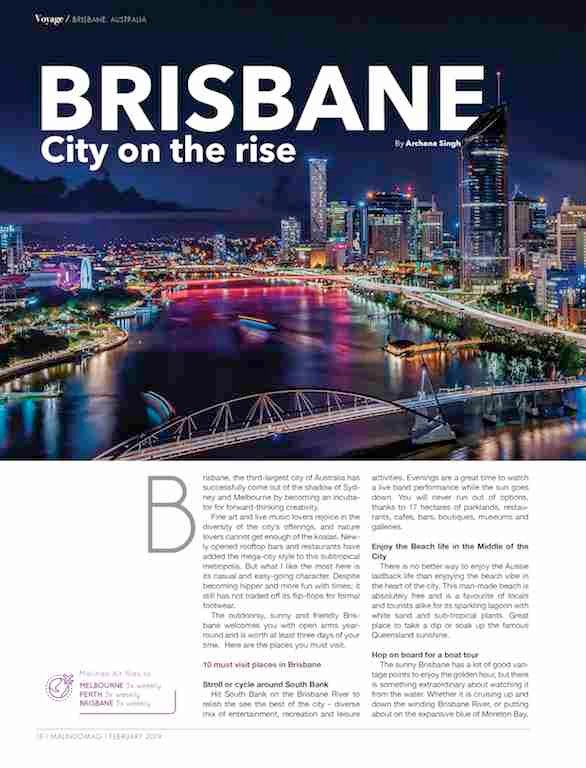
Brisbane, the third-largest city of Australia has successfully come out of the shadow of Sydney and Melbourne by becoming an incubator for forward-thinking creativity. Fine art and live music lovers rejoice in the diversity of the city’s offerings, and nature lovers can’t get enough of the koalas. Newly opened rooftop bars and restaurants have added the mega-city style to this subtropical metropolis. But what I like the most here is its casual and easy-going character. Despite becoming hipper and more fun with times; it still hasn’t traded off its flip-flops for formal footwear.

The outdoorsy, sunny and friendly Brisbane welcomes you with open arms year-round and is worth at least three days of your time. Here are the places you must visit.

Hit South Bank on the Brisbane River to relish the see the best of the city – diverse mix of entertainment, recreation and leisure activities. Evenings are a great time to watch a live band performance while the sun goes down. You’ll never run out of options, thanks to 17 hectares of parklands, restaurants, cafes, bars, boutiques, museums and galleries. While the city is beautiful during the day I love exploring various things to do in Brisbane at night when its cooler and looks very romantic with all the lights.

There is no better way to enjoy the Aussie laidback life than enjoying the beach vibe in the heart of the city. This man-made beach is a top draw in free things to do in Brisbane. No wonder it is a favourite of locals and tourists alike for its sparkling lagoon with white sand and sub-tropical plants. Great place to take a dip or soak up the famous Queensland sunshine.
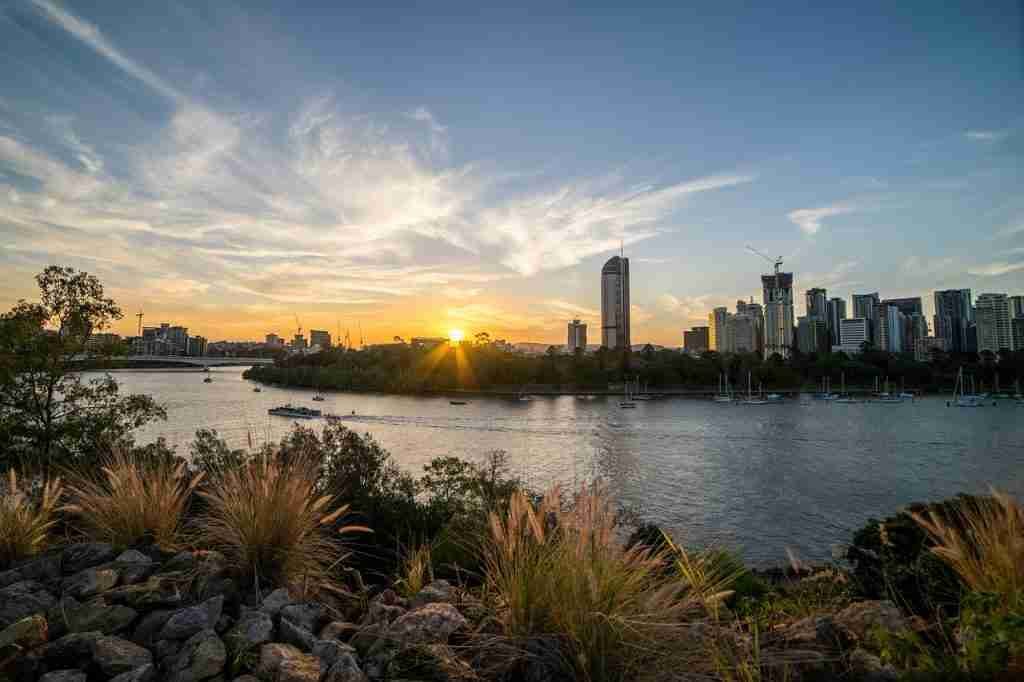
The sunny Brisbane has a lot of good vantage points to enjoy the golden hour, but there’s something extraordinary about watching it from the water. Whether it’s cruising up and down the winding Brisbane River, or putting about on the expansive blue of Moreton Bay, being out on the water is a real treat. You can choose a boat tour as per your liking – lunch, high tea and dinner cruises or a wildlife boat cruise to cuddle the koalas of Lone Pine
Art lovers will have a great time exploring GoMA, Australia’s largest gallery of modern and contemporary art and Queensland Art Gallery. The galleries are loaded with an assorted range of Australian, international and indigenous art.
If you are a someone who likes smaller but more specialist art shows then visiting Brisbane universities is not a bad idea. Interesting art exhibitions and collections can be found at the University of Queensland, the Queensland College of Art and the Queensland University of Technology’s Art Museum.
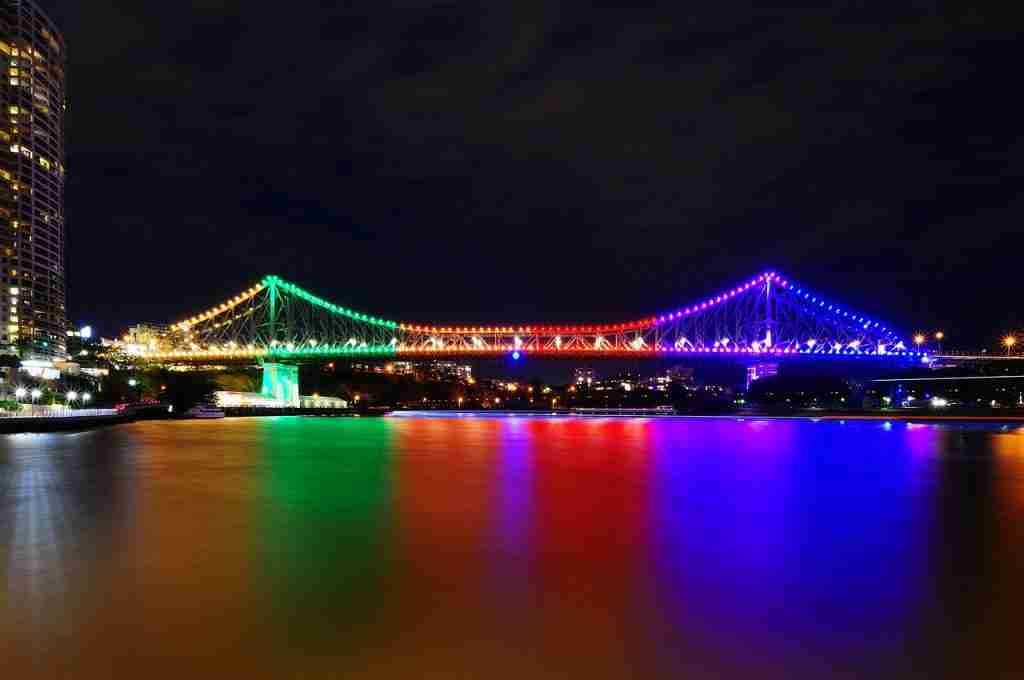
Brisbane looks extremely picturesque when you climb its iconic Story Bridge. Whatever daypart you climb, the exhilarating views will take your breath away – Glasshouse Mountains in the north to Moreton Bay in the east and stretching towards the Scenic Rim Mountains in the south along with the brilliant views of the Brisbane skyline and its environs. The adventurous souls can try 30-metre abseiling back down. While it doesn’t fall in the category of free things to do in Brisbane today but it is definitely worth the price.
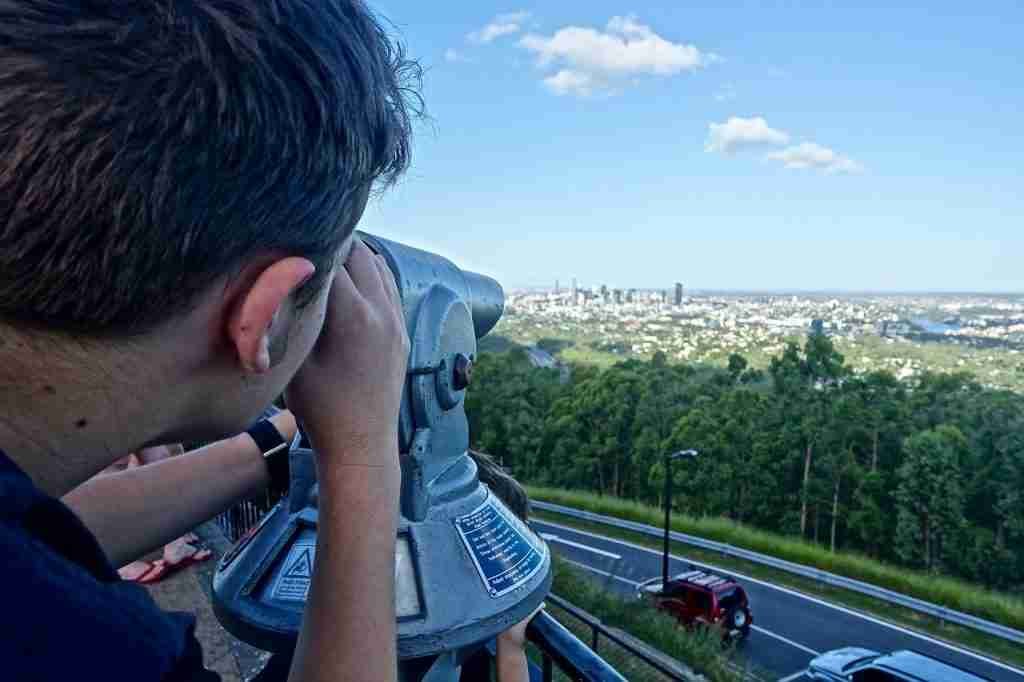
Unlike its uber-popular cousins, Melbourne or Sydney, Brisbane is much more diverse in its elevation. Within 15 minutes of short drive from the city
If you are a person who loves forests then you’ll love the Lamington National Park, which is home to some of the oldest trees in Australia. And not just that, the Park is filled with flowing waterfalls, lush Gondwana Rainforest and trails suitable for all. Pitch a tent in the wilderness or retreat to O’Reilly’s Rainforest Retreat. This is one of my favourite things to do in Brisbane today, tomorrow and forever.

Brisbane is great for adrenaline junkies to get over their fear of heights and take in the adrenaline rush of a lifetime at Skydive Ramblers in Toogoolawah. The parachute centre is Queensland’s largest and longest established operation, where you can go for a tandem skydive.
No other area in Brisbane can match Kangaroo Point and Woolloongabba for its natural beauty, laid-back vibes and location. Decked with unmatched river and city views, the beautiful Kangaroo Point cliffs is a great place to have a barbecue get together. It’s a place where you find everything under the sun – a haven for food lovers, sports fanatics, keen shoppers, cultural experiences, socialites, thrill seekers and outdoor enthusiasts.
Hope you liked the things to do in Brisbane today. If you have suggestions on free things to do in Brisbane tonight or tomorrow, please don’t hesitate to share. So, when are you booking a trip to the down under city on a rise?
Have you been to Brisbane or Australia? I would love to know about your experience. In case you are planning to visit, don’t forget to read these Australia travel guides:
Why Melbourne is the most liveable city in the world
10 reasons why Adelaide is a must-visit in Australia
Travel guide for your first time visit to Australia
10 reasons why I love Australia

Malindo Mag: February 2019 issue


Is Buddhism a religion or a way of life?
This question has hounded me for long. And, finally, I decided to find the answer.
Whether you are religious or not, you cannot remain unfazed by the beauty of the Buddhist temples, monasteries, stupas and Pagodas found almost everywhere in the world – from India to Indonesia, Thailand to South Korea, Tibet to Japan. There’s no dearth of Buddhist shrines, especially in Asia. But none of these places holds the symbolic and historical value of Lumbini, the birthplace of Buddha located in the foothills of southern Nepal.
What Mecca is to Muslims or Jerusalem to Christians, Lumbini is to 488 million Buddhists worldwide. A World Heritage Site since 1997, it attracts travellers and worshippers from around the globe for various reasons – one of the four major pilgrimage sites for Buddhists, a place to find inner peace, world-renowned UNESCO

In my case, my visit was primarily driven by the search for spirituality and to attend the first-ever Buddhism Travel Mart (BITM). No cocktail of words can exactly comprehend the inner harmony I experienced at the birthplace of spirituality. It was quite a journey to experience the calm environs of Lumbini after the frenzied hullaballoo of Kathmandu and the fun-filled jungle adventure of the Chitwan National Park. While the distance from Chitwan National Park to Lumbini is only four hours, we took a lot of time because en route, we made many mini stops.
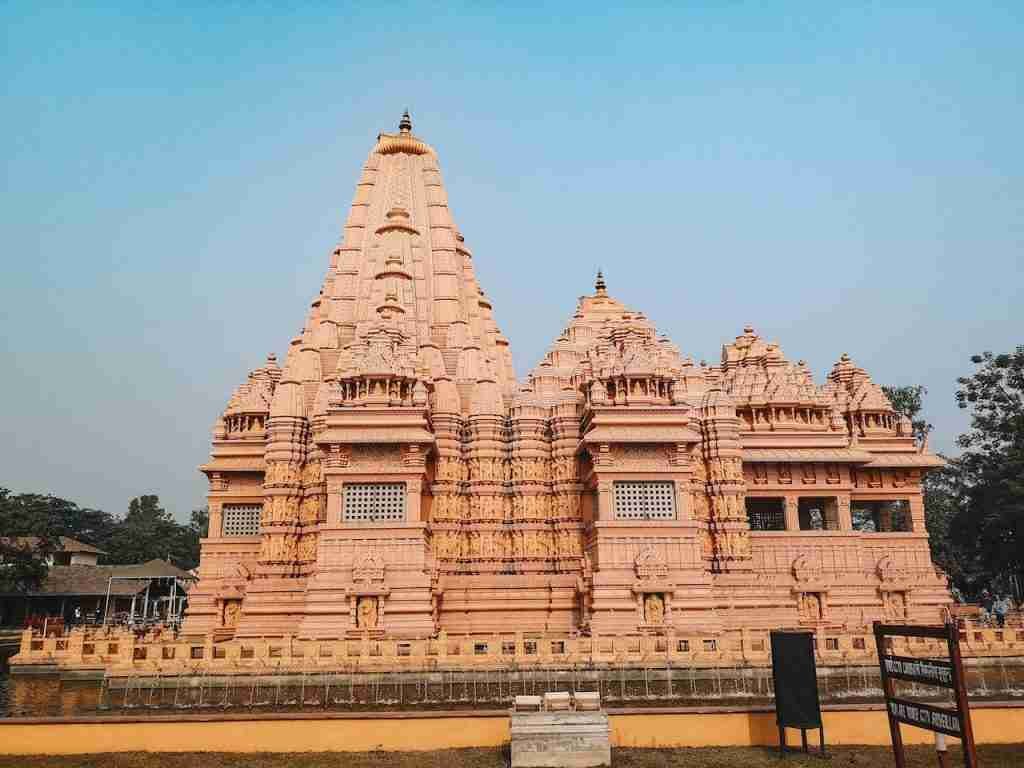
Amid the scenic locale of Devchuli and Barchuli hills of Nawalparasi district in central Nepal lies Sashwat temple that was originally established as a platform for Hinduism but later expanded to include more faiths. As I walked through the old temple, I couldn’t stop myself from being in awe of artists who created such intricate carvings and details on its pillars. And, it’s not just the pillars that are attention worthy.
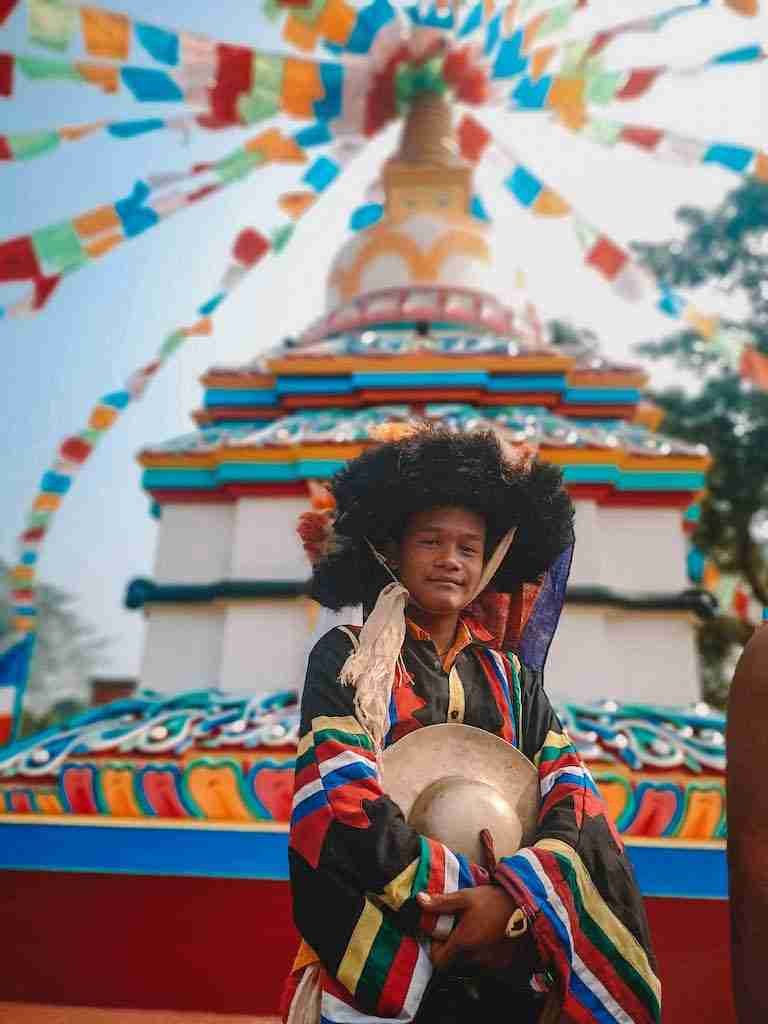
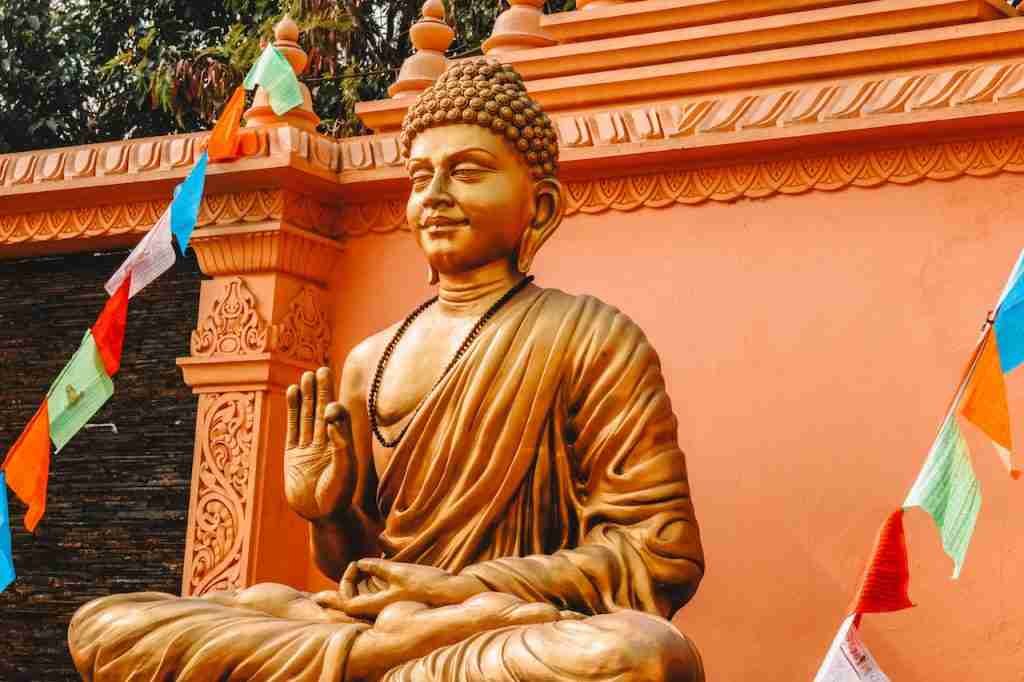

Spread over 12 acres of land, this Dham houses Ekambareshwor, a Shiva temple, surrounded by a pond which has holy water from famous shrines such as Badrinath, Kedarnath, Haridwar, Muktinath and Pashupatinath.
Shashwat Dham is primarily a place for Hinduism worshippers, but soon, it will have a Buddhist
Being a nature lover, I loved visiting the 12-acre lush green grounds, and the icing on the cake is that there is no entrance fee. If someone would ask me what is the best time to visit the place, I would say at night, when the temple is lit up.
Apart from the temple, the Dham has the Vaidik Karmakanda Gurukul, Sri Sri Centre for Meditation and Yogic Sciences, a heritage store, an organic and pure vegetarian restaurant, a manuscript resource centre, a museum, a spiritual souvenir store and organic farm.
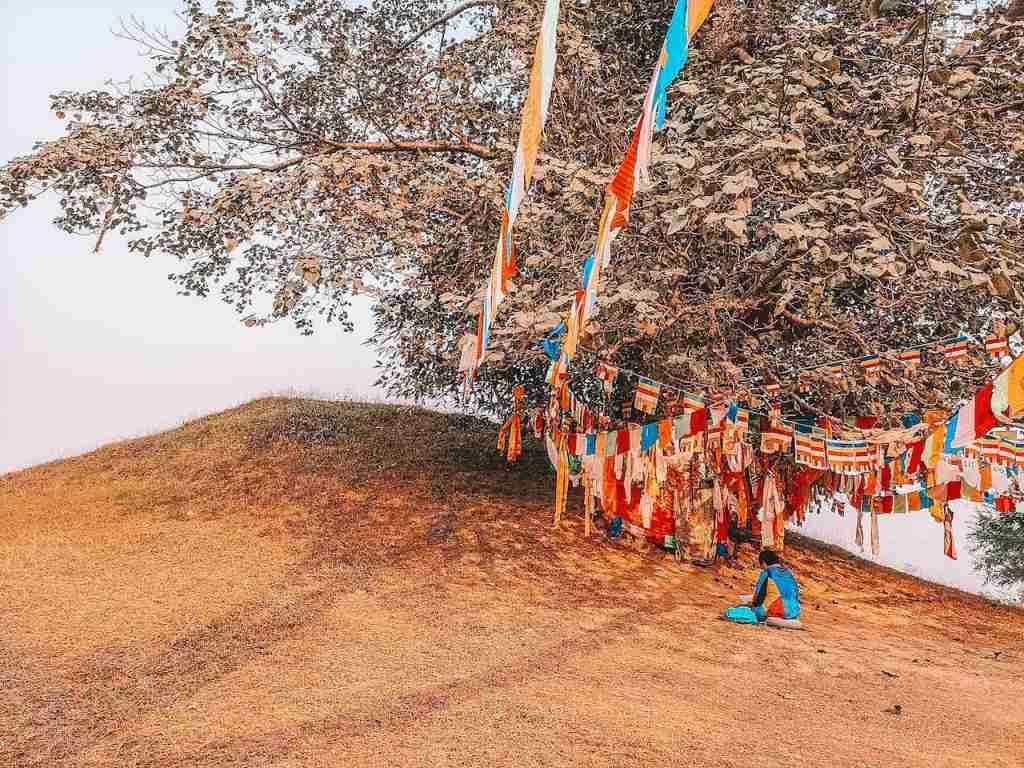
This is a stupa—another word for large, spherical structure. The Ramagrama stupa is a Buddhist pilgrimage site which holds relics significant to the Buddhist Faith. In fact, it’s the only stupa still containing relics from Gautama Buddha, also known as the Lord Buddha. What’s interesting about it is that it is located underground, only marked by a sign. You don’t see much, but the history and trivia behind it is what makes the place fascinating.

The birthplace of Buddha, also known as the gardens of Lumbini, was our third stop during the event. The Lord Buddha, Siddhartha Gautama was born a prince and lived a privileged life before he set off to live a simple and minimalistic life, and finally achieving enlightenment. In present times, it is a Buddhist pilgrimage area and is said to be one of the holiest places in the world.

The main temple in Lumbini is the Maya Devi temple. Other important structures in the area include the Shakya Tank, the Ashoka Pillar, and the monasteries and memorials where the remains of important Buddhist figures are laid to rest. There is also the Holy Pond, where birth rituals were performed upon the infant Lord Buddha, and it is where he took his very first bath as well.
In order to preserve all of the archeological items in the area, there are boundaries in place that allow visitors to observe, but not come too close.
Important points to note:
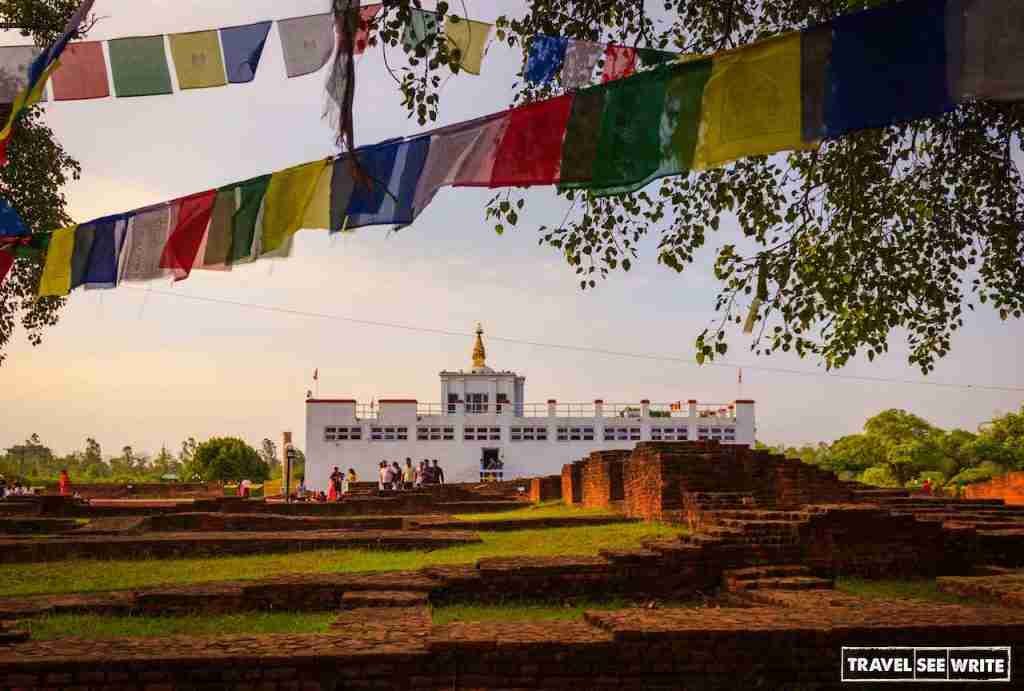
The sacred heart of Lumbini, Maya Devi Temple marks the spot where Queen Maya Devi gave birth to Siddhartha Gautama in around 563BC. After walking inside the brick compound, I strolled in the adjoining holy garden decked with several important features like the pillar of Ashoka, ancient ruins of stupas, and maroon- and saffron-robed monks congregating under a sprawling Bodhi (pipal) tree decorated with colourful prayer flags.
Important points to note:
As the day was coming to an end and I started walking from the Maya Devi Temple to the Lumbini Museum, I crossed numerous temples and stupas constructed by numerous nations from around the world in Buddha’s honour. My heart was full and eyes were awestruck marvelling at Thailand’s ornate white marble Royal Thai Buddhist Monastery, Myanmar’s eye-catching Golden Temple, Vietnam’s pagoda-style Phat Quoc Tu Temple with dragons on the roof, and Germany’s Lotus Stupa with its colourful frescos of Buddha’s teachings.


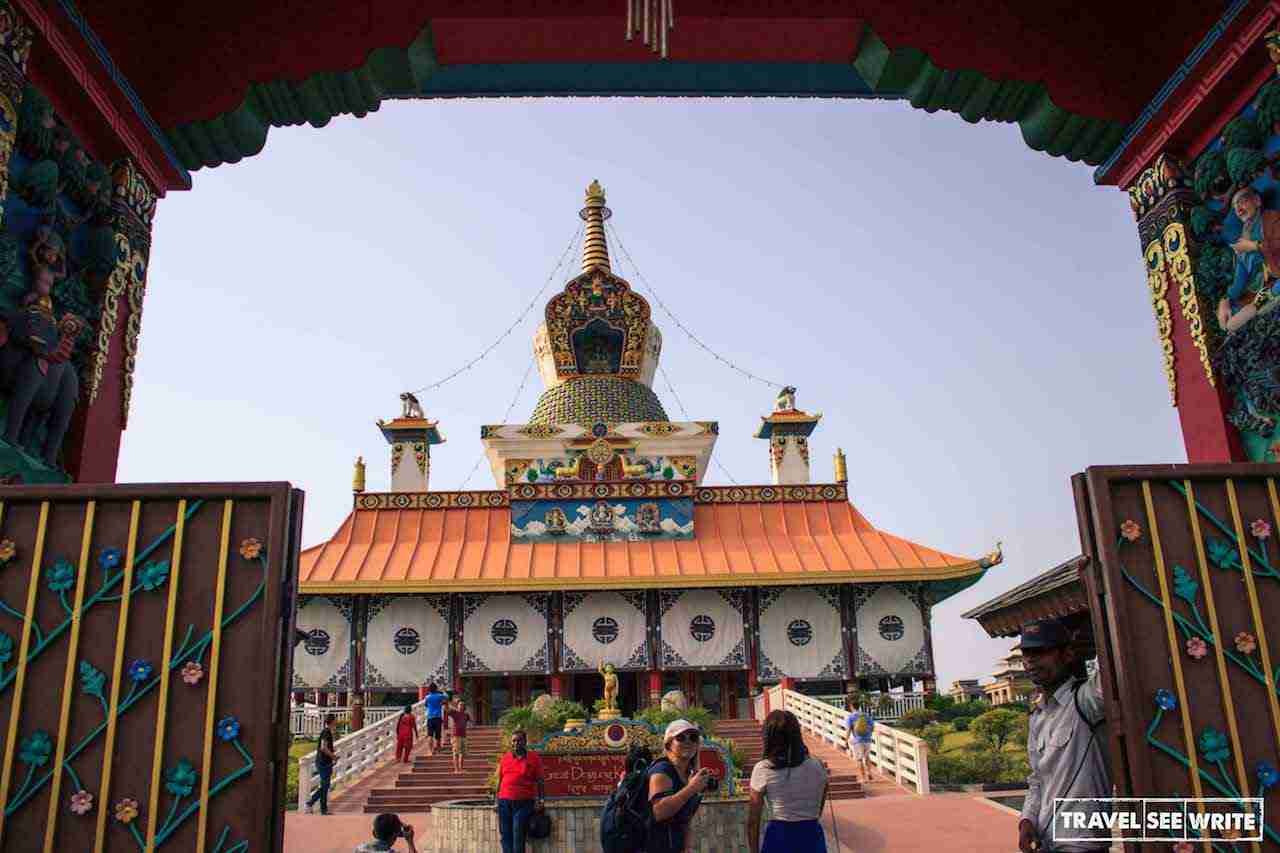
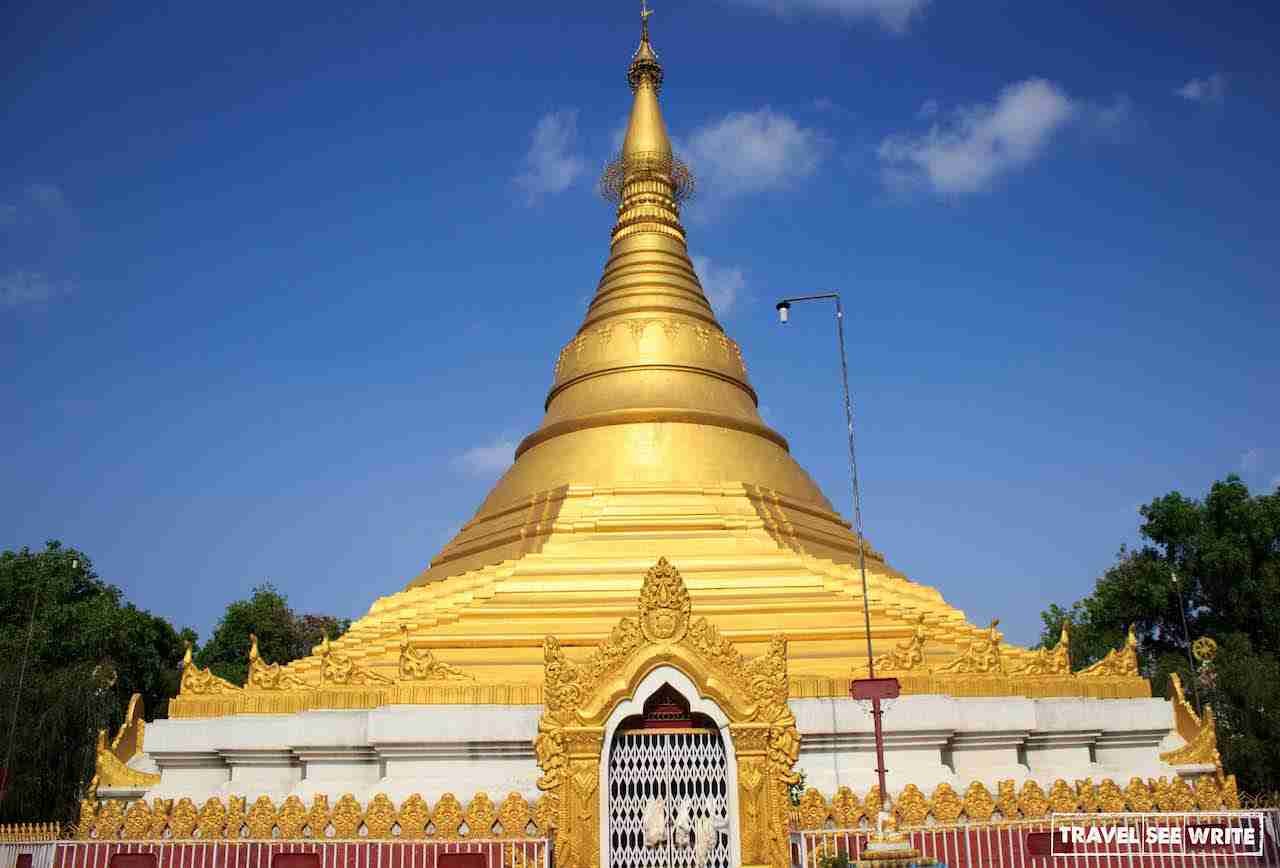
By the time I reached the museum, I felt I’d taken a spiritual walk around the globe. One single day had expanded my horizon, broadened my knowledge and made me more compassionate and tolerant towards others.
This amazing experience was all made possible thanks to BITM 2019, which gave us a chance to see all of the terrific Buddhist monasteries and pilgrimage locations that the country has. In addition to showing the religious and spiritual side of Nepal, the event was also aimed at promoting the tourism goals and plans of Nepal for the year 2020.
Hope this experience on visiting Lumbini, the birthplace of Buddha, inspires you to visit it soon. Also, I would urge you to check out the following articles:
Have you ever visited the


Travel See Write was invited by the Nepal Tourism Board to attend #BITM conference in 2019 and #HTMNepal in 2017. Karla Ramos from Karla Around the World represented TSW in 2019 and Archana in 2017. Everything expressed above is based on their personal experiences in the country. Images used are shot by them. Please do not copy anything without written permission.

What’s the best time to visit Europe?
If you’ll ask this question, most people will say summers. But there’s something truly magical about snowy season. Europe gets a complete makeover in winters. Overcrowded and overpriced cities become refreshingly crowd-free and inexpensive. Moreover, Christmas and New Year Celebrations lend some seriously unforgettable experiences. Experiences that become conversation starters again and again in get-togethers, marriages, and any small or big gatherings. Despite the mercury touching sub-zero temperature, there’s something about Christmas that makes even locals gawk like tourists. Every tree, and storefront sparkles like a star. People are in a jolly mood. Honestly, if you can brave the cold, Christmas holidays are the best time to see Europe on
While there’s no place like home to celebrate Christmas, these five places are my absolute favourite places to spend Christmas holidays:
Paris is never a bad idea but Lille is even better Christmas destination. As the holiday season kicks in, the capital of the Hauts-de-France gets decked up in lights and

More than 900,000 visitors come to Lille’s Christmas Market every year to enjoy the magic of the “Grande Roue” at the heart of the Grand Place. In the Grand Place, a giant 18-meter tall fir, the 50-m high big Wheel, and its 36 nacelles dominate the Christmas decorations offering a beautiful panorama of the city. It’s the best time to relish the irresistible aroma of cinnamon and roasted chestnuts in the Place Rihour, where 80 decorated chalets welcome you with open arms 7 days a week for over a month.
Lille’s privileged location in the heart of the Paris-London-Brussels triangle attracts tourists from all corners. With a great railway network, you can reach Lille in 1 hour from Paris, 2 hours from London, and just 35 minutes from Brussels.
When your city is known as the ‘the Magic city’, you have a reputation to live up to. No city can wear the crown of a winter wonderland like Prague when a dusting of snow coats the ‘city of a hundred spires’.

Prague Christmas markets are legendary, thanks to Gothic backdrop and Czech treats. Even the most jaded traveler like me succumbed to the excellent mulled wine, barbecued sausages and fragrant
The Czech treats and gothic architecture set Prague apart from the rest of European Christmas destinations. Moreover, the five-minute walking distance between the two biggest Christmas markets makes it more irresistible and convenient for visitors to stay outside.
Many people would be clueless when asked to point Banska Bystrica on the map. And, that’s what attracted me to this pocket-size fairytale town of Central Slovakia. The atmosphere is very romantic, festive and cozy like home. You can feel the true sense of Christmas spirit wherever you go.


Folk dancers, actors, and musicians take the
The town is just a snowball’s throw from Jasná, the best Slovakian Ski resort offering high-quality skiing at affordable prices. In the morning, the lovely Tatra Mountains could be your adventure playground and in the evening, Banska Bystrica could be your social ground.
Few cities can look as beautiful as “the most livable city in the world” during Christmas. Following a vintage tradition of organizing Christmas market since 1298, today more than 25 Christmas markets are held on chocolate-box squares across the city.

The festive beauty of Vienna is swelled by a hot punch, mulled wine, roasted chestnuts and stalls selling local handicrafts and homemade goodies. Christkindlmarkt (in front of the City Hall) is the biggest Christmas market with the biggest Christmas tree.
The traditional Christmas markets with reindeer rides create a contrasting image with curling (winter sport) on the ice rink.
Zagreb’s Christmas markets were once Croatia’s best-kept secret. But thanks to modern explorers, Zagreb’s advent scene has been discovered. The city is loved so much for the holiday celebrations that it has been voted as the “best Christmas market destination” by European Best Destinations for two years in a row.

Jelačić Square becomes the congregation point where a huge Christmas tree stands tall, the fountain is transformed into a light display and live music is played every day. King Tomislav Square remains abuzz with skaters, live ice sculptures are made, pop-up bars and street food stands serve lip-smacking food. There’s even an area dedicated to “fooling around” (
The Jolly Christmas Tram is tough to beat. Here kids (and big kids) zip through the city center along with Santa and his elves.

Offers a lavish German spread consisting of the Glühwein, the crafts, the twinkling lights and entertainment of 100 performances against the backdrop of Cologne’s landmark cathedral
The oldest and the biggest Chrismas market in Eastern Germany is all about celebrating the traditions. The highlight is a 45-feet high Christmas pyramid and the “Stollen” (buttery fruit cake) representing the entrance to the mines in the nearby Erzgebirge range.
Germany is all about celebrating the traditions. The highlight is a 45-feet high Christmas pyramid and the “Stollen” (buttery fruit cake) representing the entrance to the mines in the nearby Erzgebirge range.
Every year the Belgian capital transforms into a Winter Wonderland. The city puts together an impressive setup with 200 wooden chalets, a covered ice rink, a Ferris wheel, and a light and sound show projected onto the Grand-Place.
The heritage city of Eastern France is home to one of Europe’s oldest Christmas markets dating back to 1570. Today it has expanded to 10 locations and 300 stalls. It’s a great place to enjoy year-end festivities while sipping the local Alsatian wine and enjoying the decorations.
Finland never ceases to surprise – even during their Christmas celebrations. From playing bingo to win a vegan ham to watching a holiday outfit contest for dogs; Finns add a dose of quirkiness to their holidays. Not to forget the wood-heated unisex sauna set in the of the market in Senate Square
The extremely photogenic city of Budapest looks even more photogenic during Christmas time. St. Stephen’s Basilica, Hungary’s largest cathedral becomes the
The pint-sized Slovenian capital is a charming place to spend Christmas. With
With its cobbled medieval streets, awe-inspiring Gothic architecture, and the dramatic Mt Tâmpa towering above, the gorgeous Transylvanian city is a perfect place to spend your winter holidays. Additionally, Poiana Brasov, Romania’s best and most exclusive ski resorts, is only 12 km away.

Have you ever visited any of the above 15 best Christmas destinations or took part in the 10 best New Year Celebrations around the world? If yes, I would love to hear your views. Please do share your feedback in the comment box below.
Related: 4 months solo Europe travel on budget


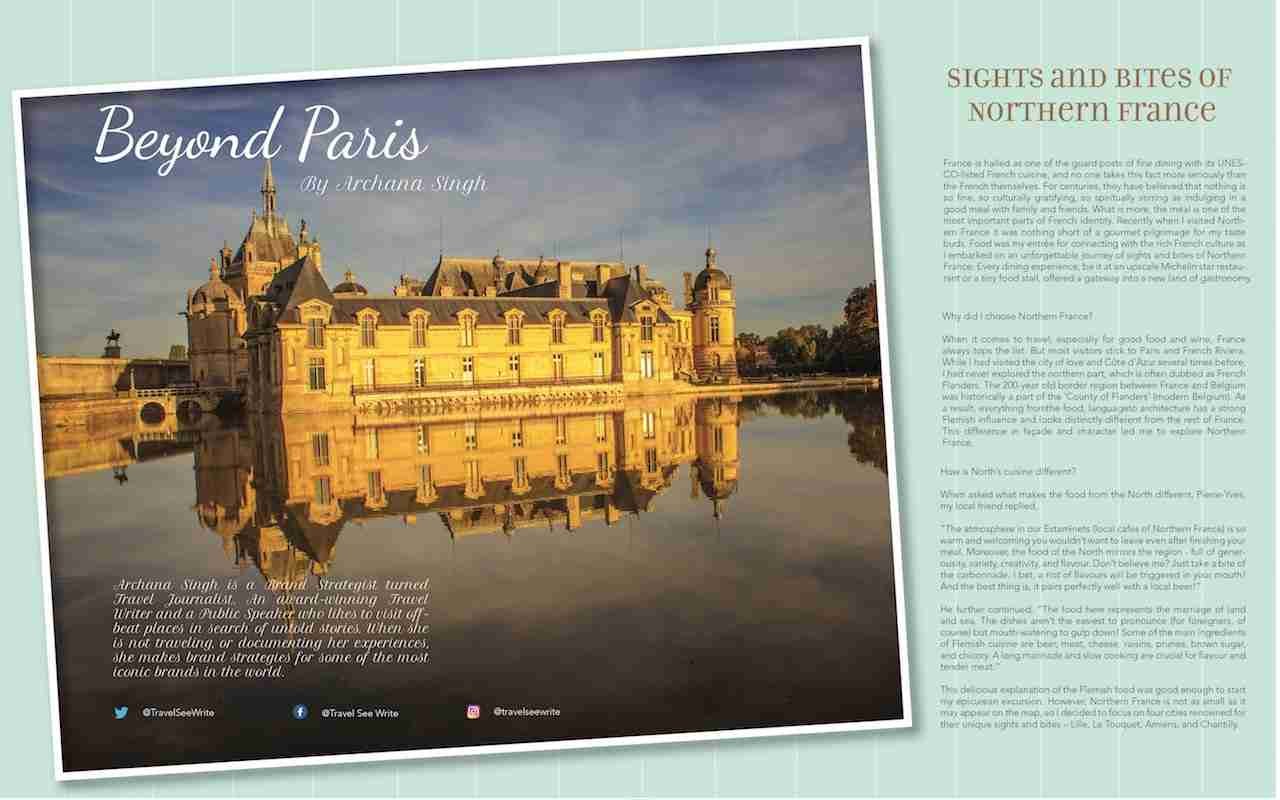
France is renowned for its UNESCO-listed French cuisine. Move beyond Paris and find out what to see and where to eat in the major cities of Northern France.

The world will congregate in France for the upcoming Paris Olympics in 2024. So, while sports will be your main agenda, it won’t be a bad idea to enjoy the world-famous French cuisine on your next trip to one of the most visited countries in the world by travellers. France is hailed as one of the guard posts of fine dining with its UNESCO-listed French cuisine, and no one takes this fact more seriously than the French themselves. For centuries, they have believed that nothing is so fine, so culturally gratifying, so spiritually stirring as indulging in a good meal with family and friends. What is more, the meal is one of the most important parts of French identity.
Recently, when I visited several cities in Northern France, it was nothing short of a gourmet pilgrimage for my taste buds. Food was my entrée for connecting with the rich French culture as I embarked on an unforgettable journey of sights and bites of Northern France. Every dining experience, be it at an upscale Michelin-star restaurant or a tiny food stall, offered a gateway into a new land of gastronomy.
As I explored the best cities in Northern France, I discovered that each location had its own unique charm and culinary delights. From medieval French villages to beautiful coastal towns in Northern France, every hidden gem has a story to tell through its food and culture. Chantilly, known as France’s Horse Capital, Amiens, often referred to as the Venice of the North, and Le Touquet, where the rich come to relax, were just a few of the top 5 places to visit in Northern France. As I studied the Northern France map, I realized how diverse and rich this region is, filled with major cities of Northern France that are famous for their historical and cultural significance.
When it comes to travel, especially for good food and wine, France always tops the list. But most visitors stick to Paris and the French Riviera. While I had visited the city of love and Côte d’Azur several times before, I had never explored the cities of Northern France, which is often dubbed as French Flanders. The 200-year-old border region between France and Belgium was historically a part of the ‘County of Flanders’ (modern Belgium). As a result, everything from the food and language to architecture has a strong Flemish influence and looks distinctly different from the rest of France. This difference in façade and character led me to explore different cities of Northern France.
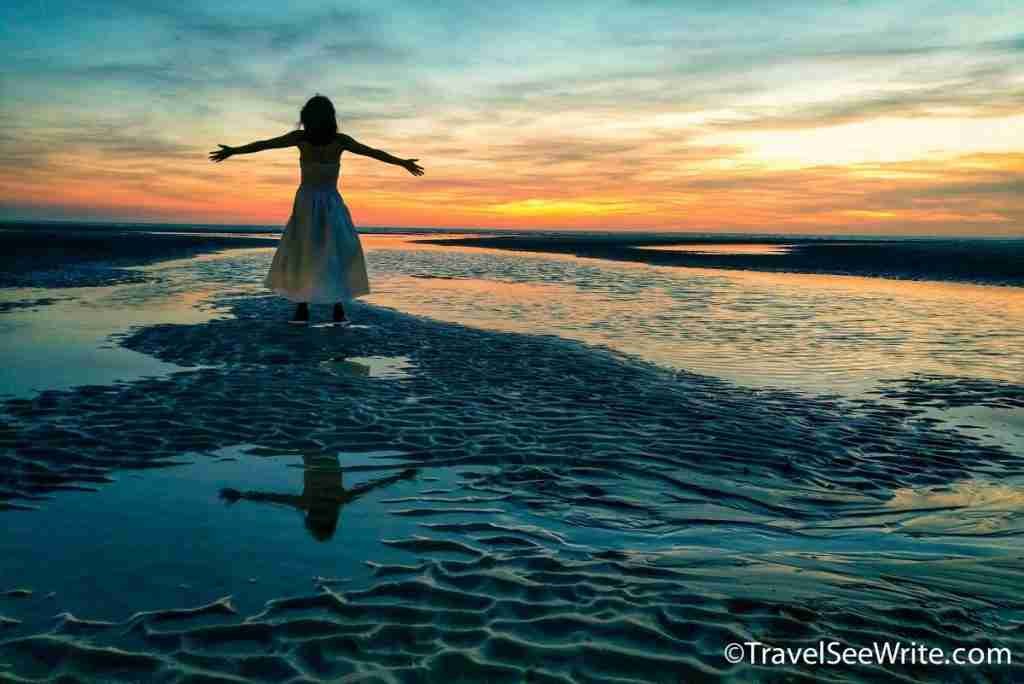
“The atmosphere in our Estaminets (local cafes of Northern France) is so warm and welcoming you wouldn’t want to leave even after finishing your meal. Moreover, the food of the North mirrors the region – full of
He further continued,
“The food here represents the marriage of land and sea. The dishes aren’t the easiest to pronounce (for foreigners, of course) but mouth-watering to gulp down! Some of the main ingredients of Flemish cuisine are beer, meat, cheese, raisins, prunes, brown sugar, and chicory. A long marinade and slow cooking are crucial for
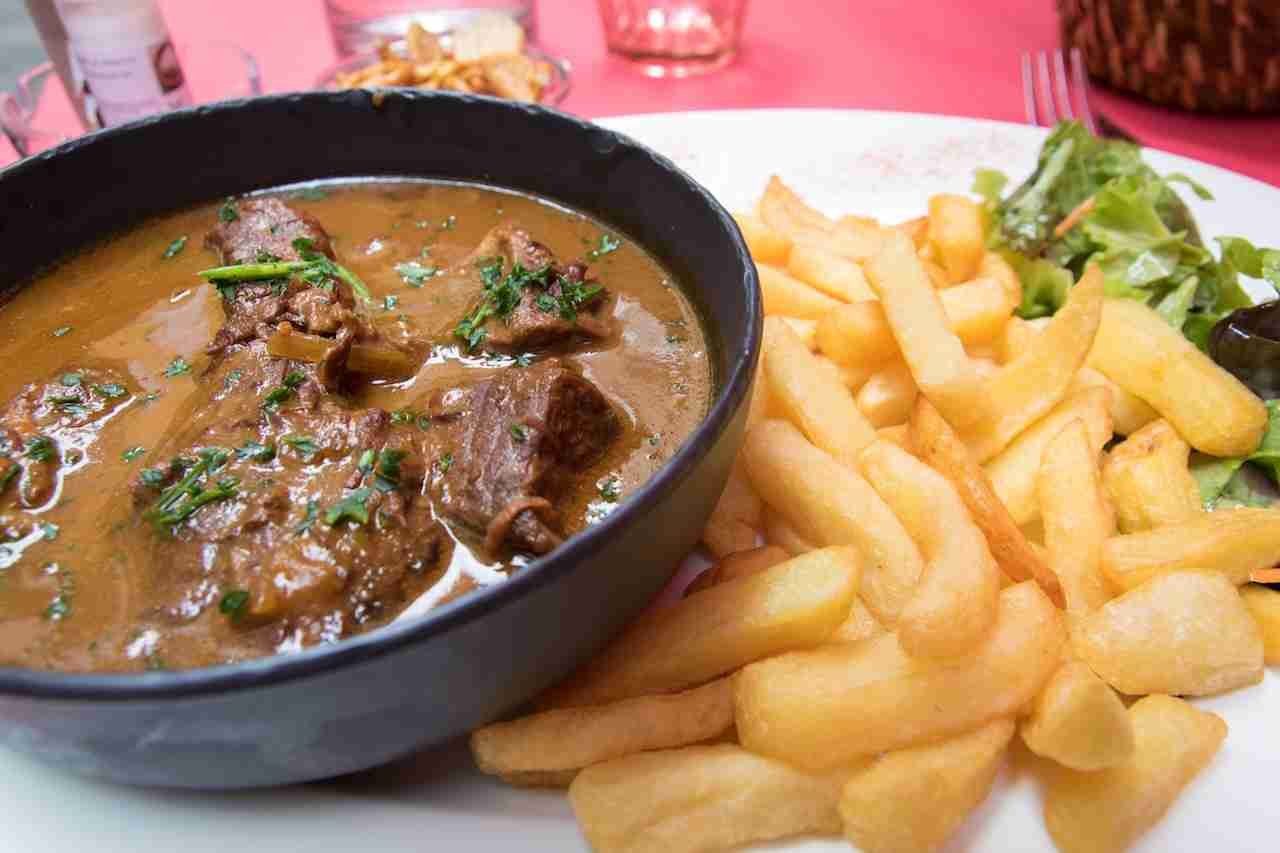
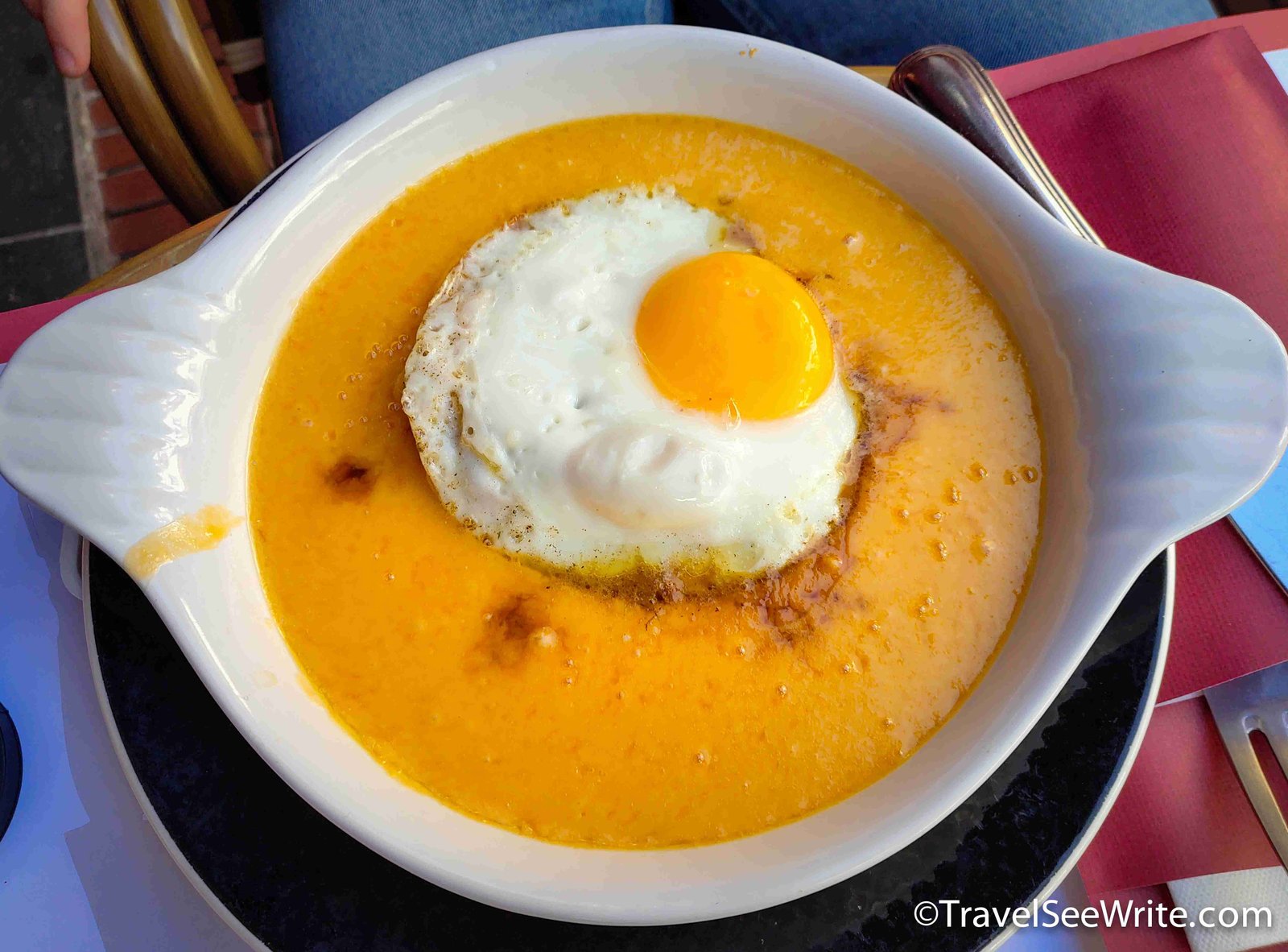
This delicious explanation of Flemish food was good enough to start my epicurean excursion. However, Northern France is not as small as it may appear on the map, so I decided to focus on four cities renowned for their unique sights and bites: Lille, Le Touquet, Amiens, and Chantilly.

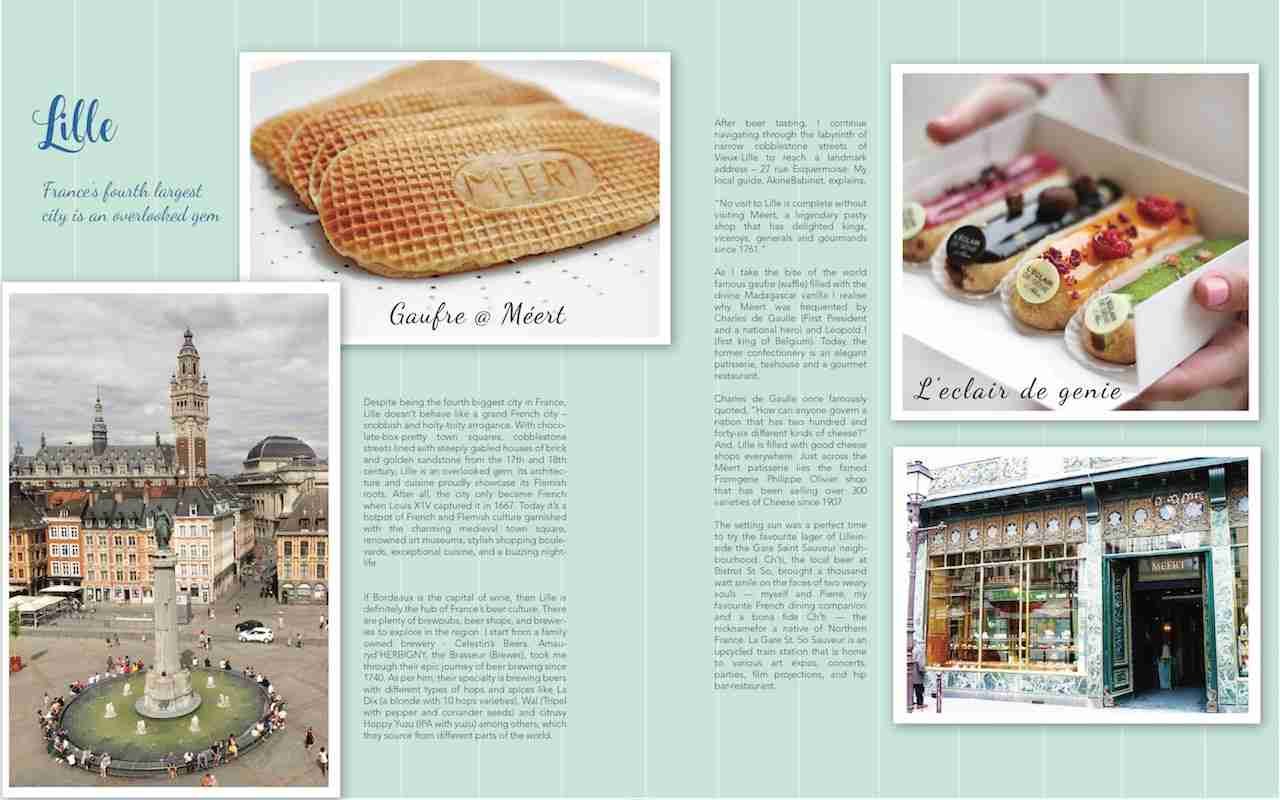
Despite being the fourth biggest city in France, Lille doesn’t behave like a grand French city – snobbish and hoity-toity arrogance. With chocolate-box-pretty town squares and cobblestone streets lined with steeply gabled houses of brick and golden sandstone from the 17th and 18th centuries, Lille is an overlooked gem. Its architecture and cuisine proudly showcase its Flemish roots. After all, the city only became French when Louis X1V captured it in 1667. Today, it’s a hotpot of French and Flemish culture garnished with the charming medieval town square, renowned art museums, stylish shopping boulevards, exceptional cuisine, and a buzzing nightlife.
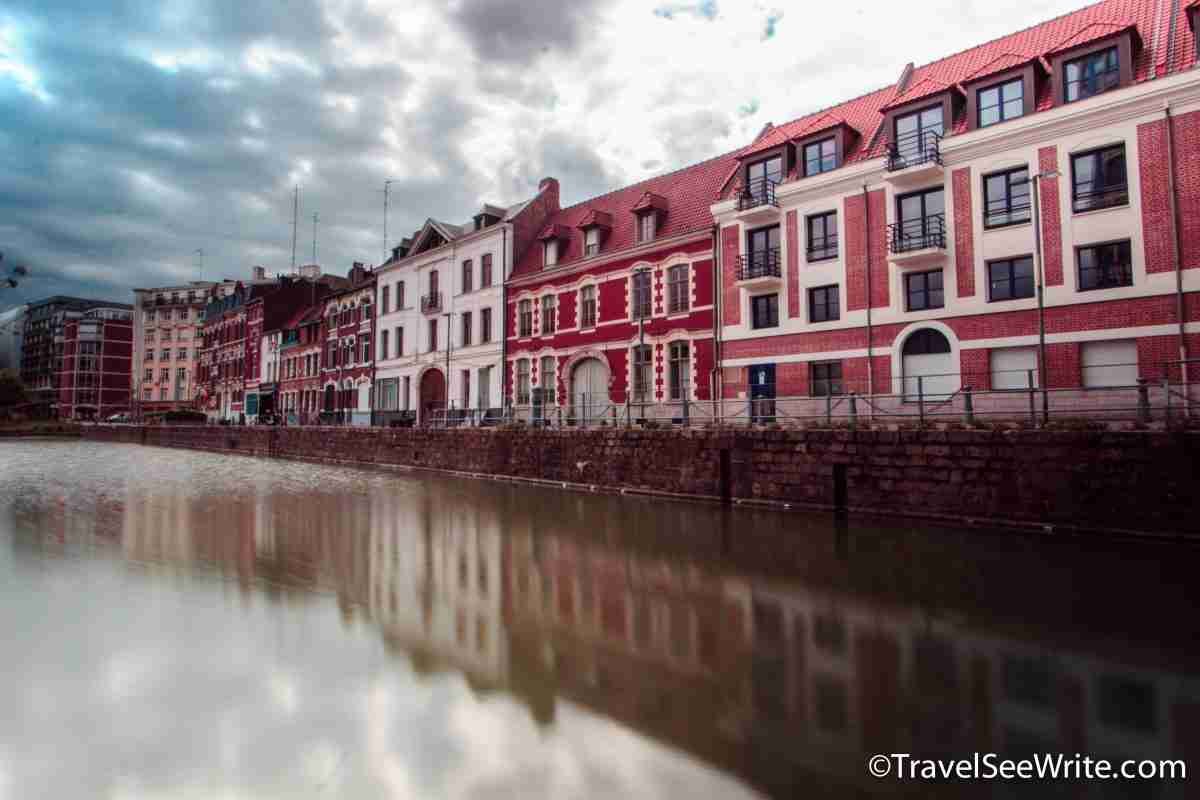

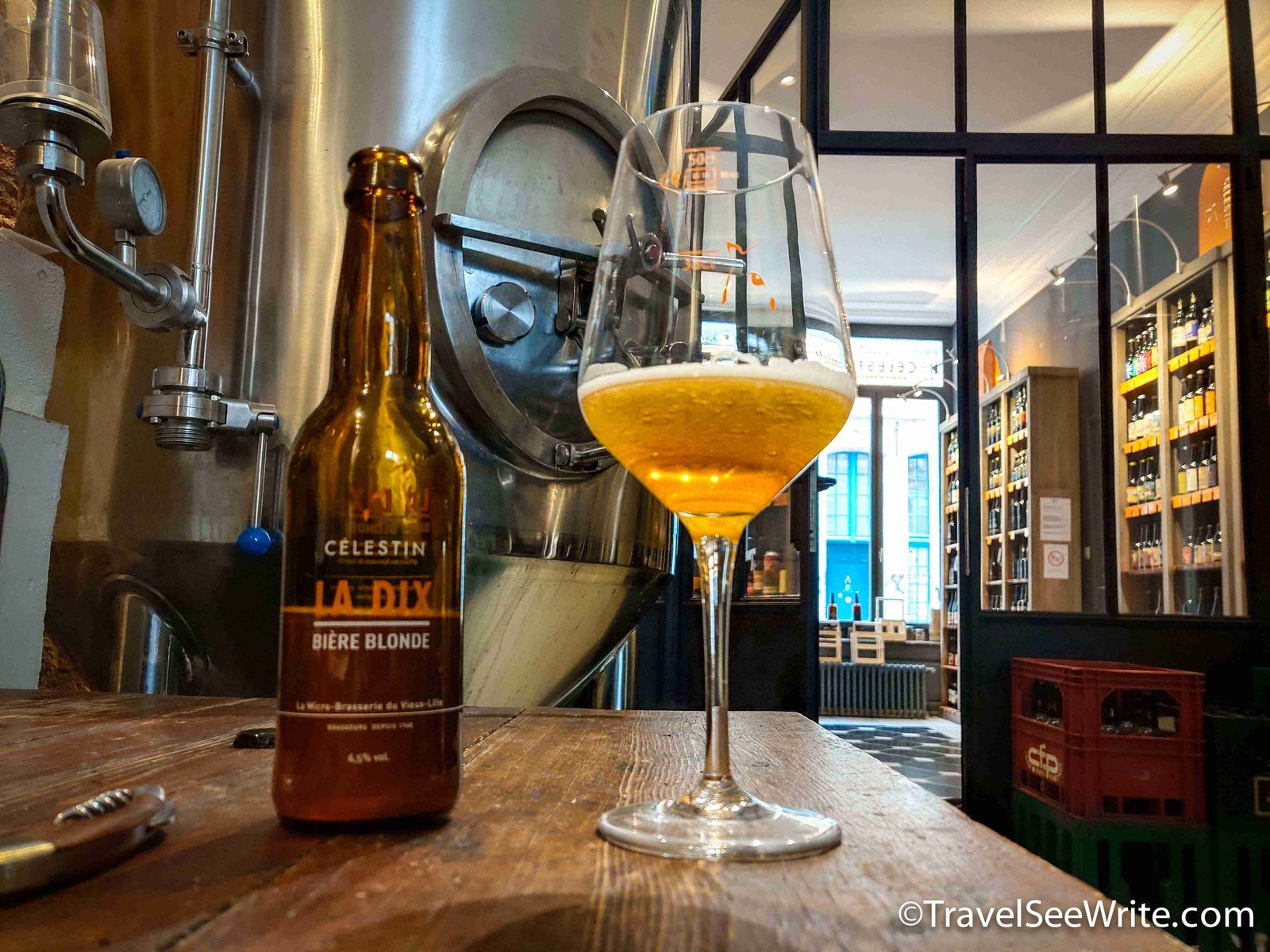
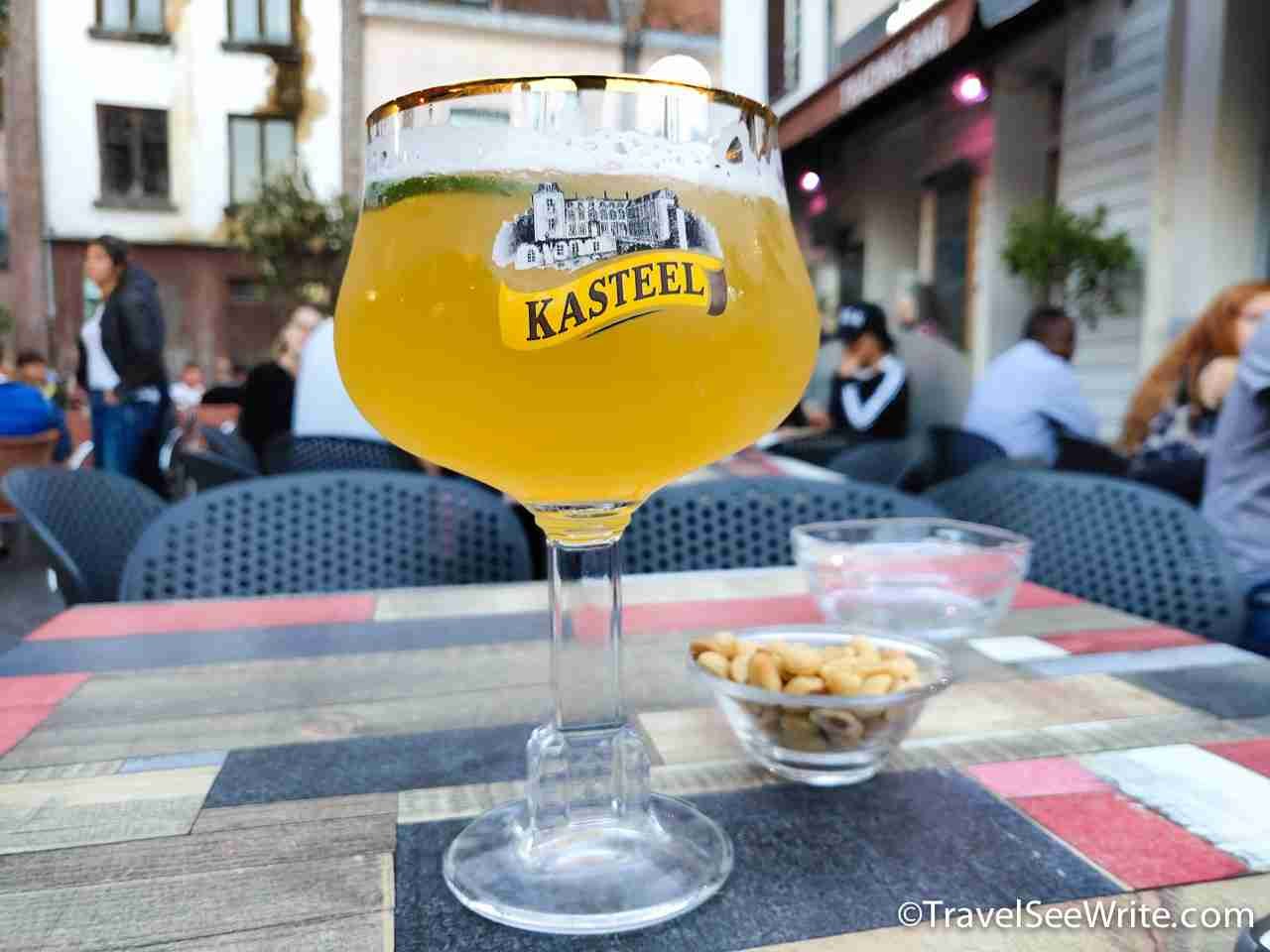
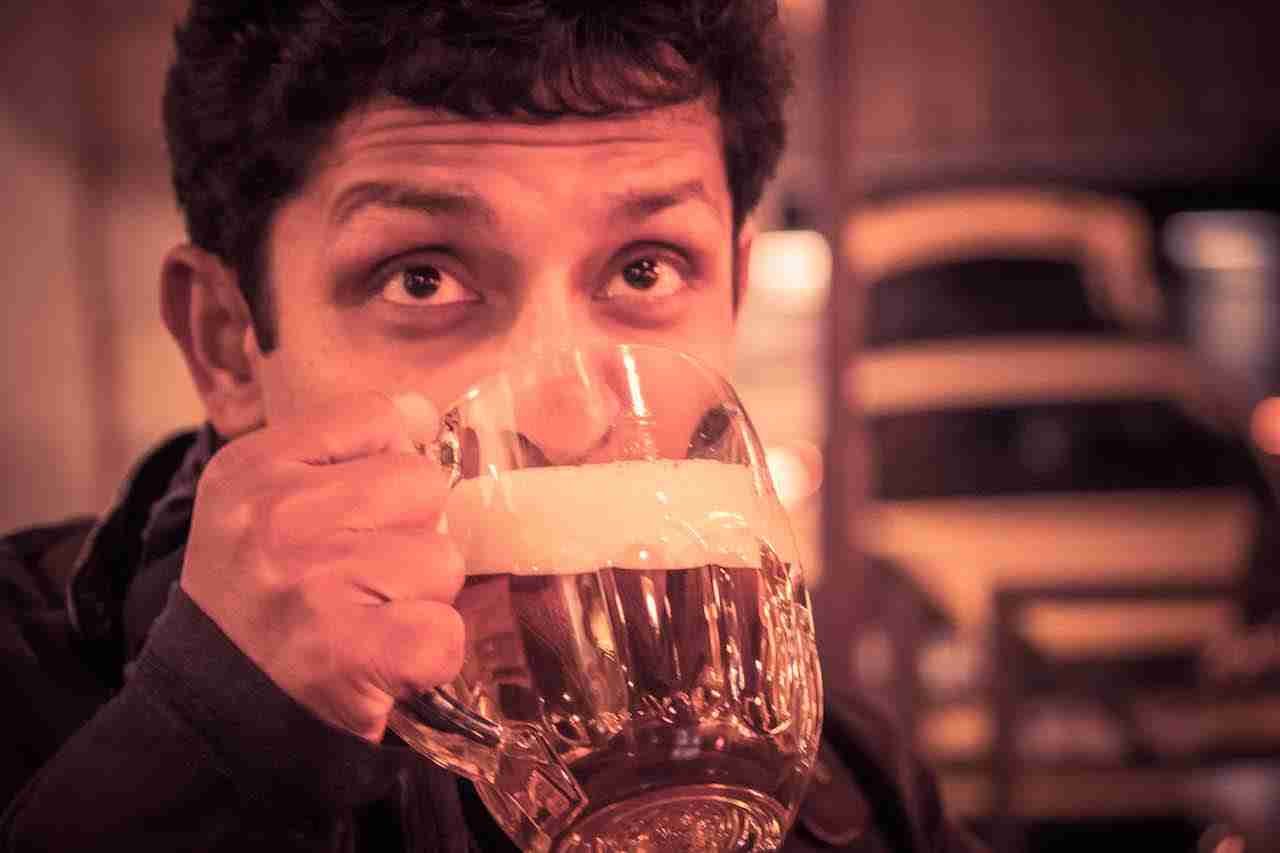
If Bordeaux is the capital of wine, then Lille is definitely the hub of France’s beer culture. There are plenty of brewpubs, beer shops, and breweries to explore in the region. I started with a family-owned brewery, Celestin’s Beers. Amaury d’HERBIGNY, the Brasseur (Brewer), took me through their epic journey of beer brewing since 1740. As per him, their speciality is brewing beers with different types of hops and spices like La Dix (a blonde with 10 hops varieties), Wal (Tripel with pepper and coriander seeds) and citrusy Hoppy Yuzu (IPA with yuzu), among others, which they source from different parts of the world.

After beer tasting, I continue navigating through the labyrinth of narrow cobblestone streets of Vieux-Lille to reach a landmark address – Méert, 27 rue Esquermoise. My local guide, Akine Babinet, explains,
“No visit to Lille is complete without visiting Méert, a legendary pasty shop that has delighted kings, viceroys, generals and gourmands since 1761.”
As I take a bite of the world-famous gaufre (waffle) filled with divine Madagascar vanilla, I realise why Méert was frequented by Charles de Gaulle (the First President and a national hero) and Léopold I (the first king of Belgium). Today, the former confectionery is an elegant patisserie, teahouse, and gourmet restaurant.
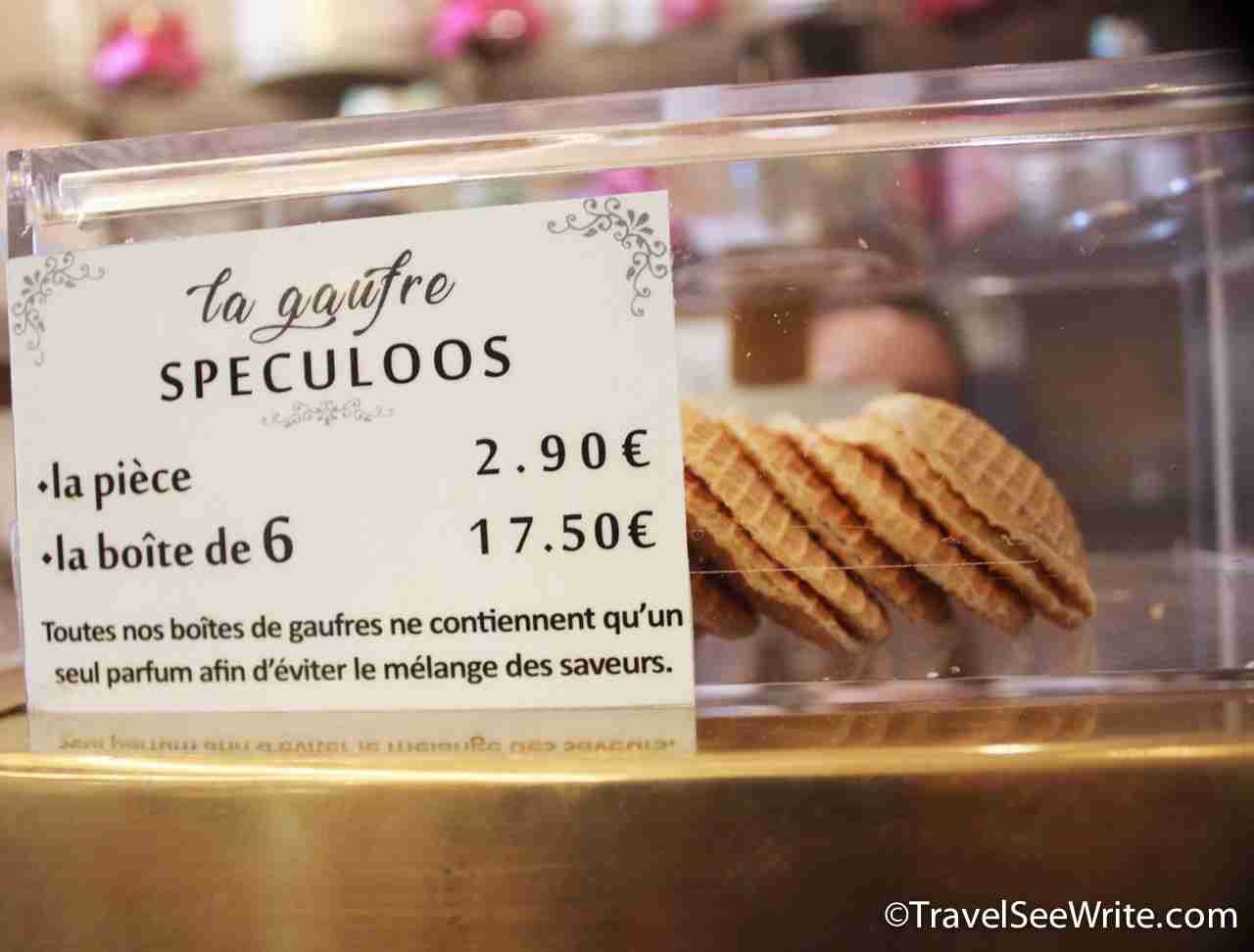
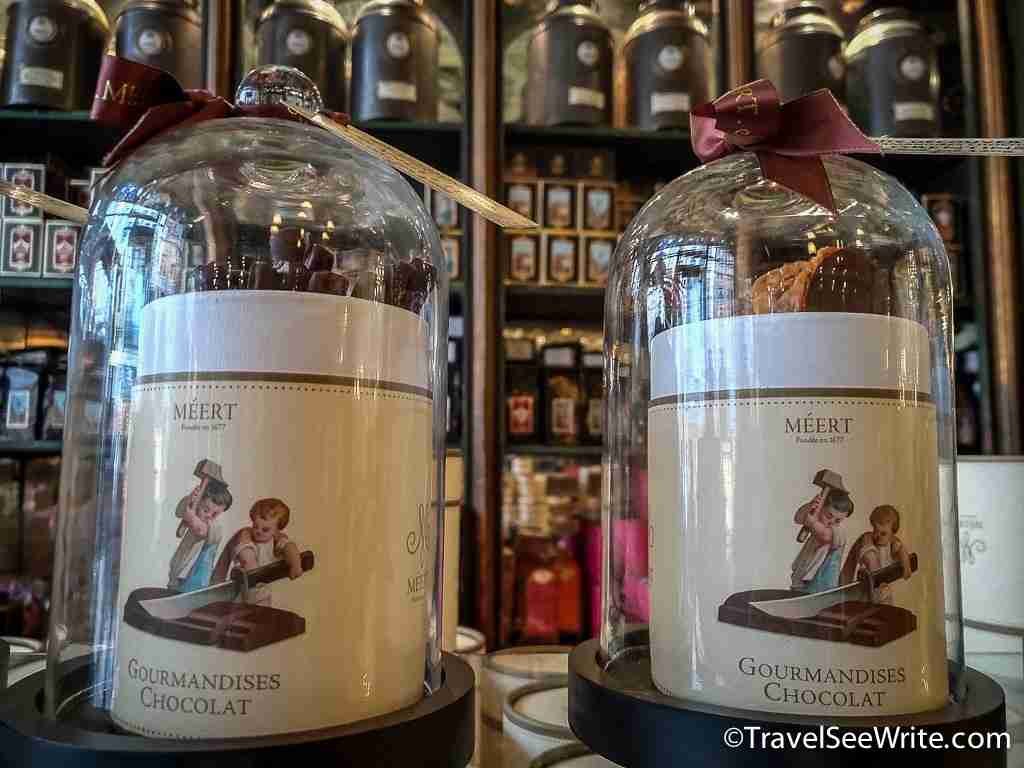
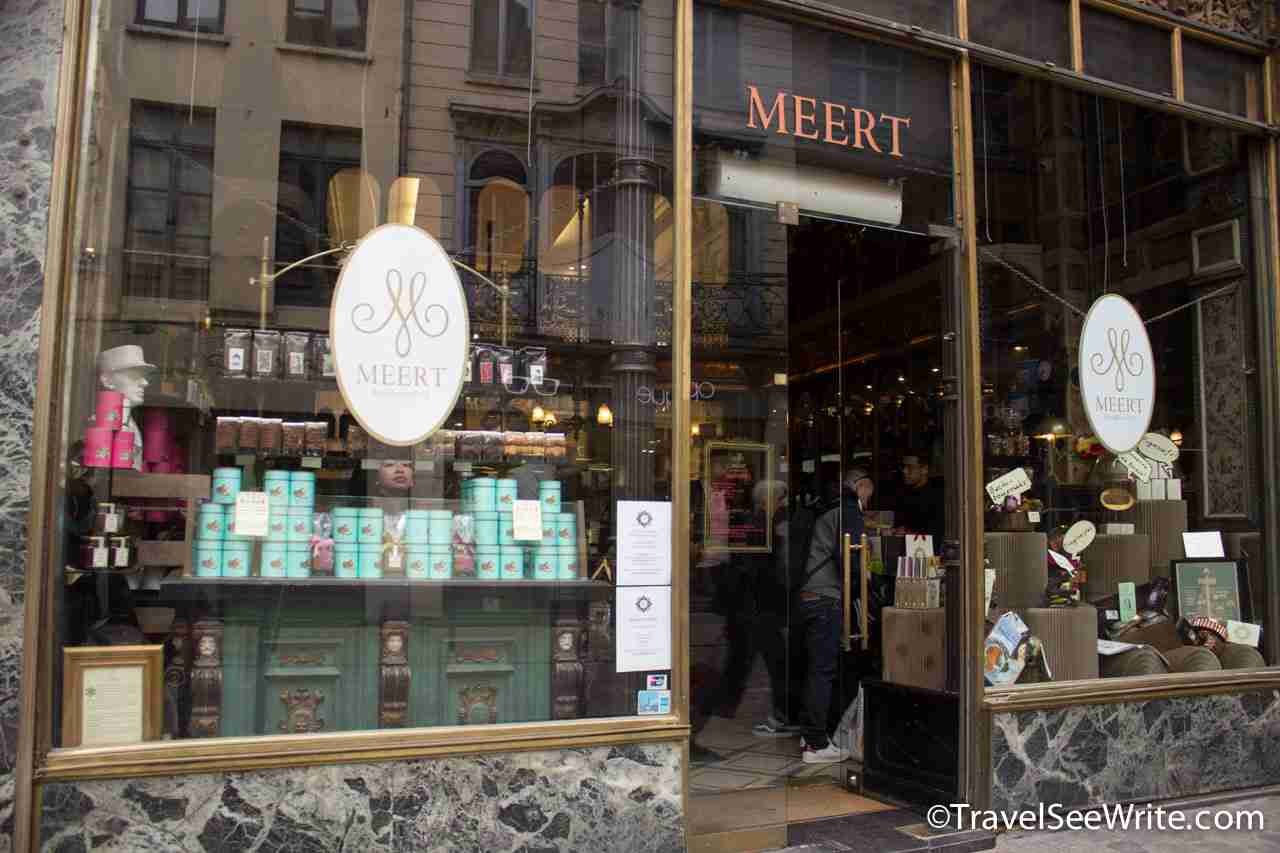
Charles de Gaulle once famously said, “How can anyone govern a nation that has two hundred and forty-six different kinds of cheese?” Lille is filled with good cheese shops everywhere. Just across the Méert patisserie lies the famed Fromgerie Philippe Olivier shop, which has been selling over 300 varieties of Cheese since 1907.

The setting sun was a perfect time to try the

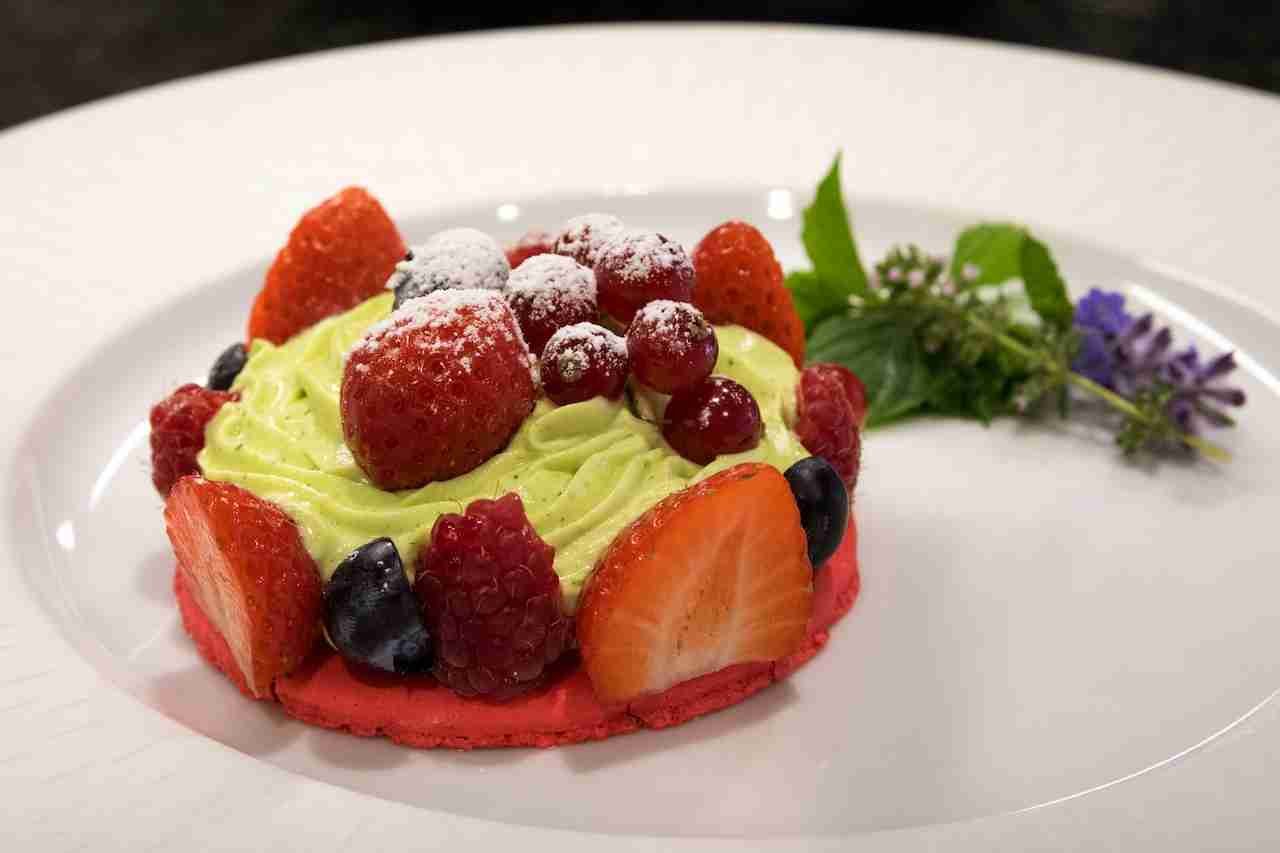
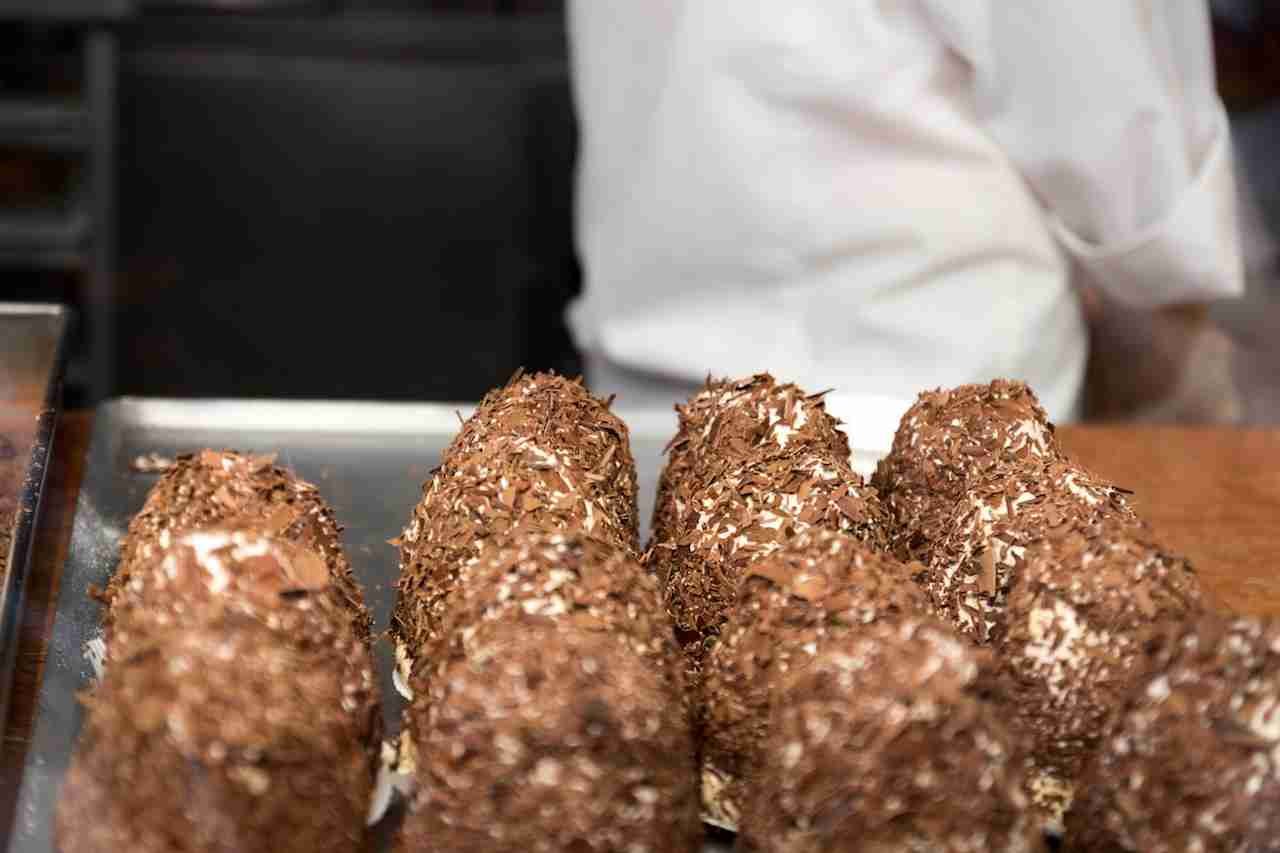

The next day, we headed west to the colourful, affluent coastal seaside town of northern France – Le Touquet. Driving through lush pastures and occasional windmills, we soon arrived at seven kilometres long soft golden sand beach dotted with rainbow-coloured beach huts. While walking on the beach, Pierre-Yves shared the historical relevance of the town,

“Le Touquet has long been a playground of the rich, not just from France but from all over the world, where famous figures like French President Emmanuel Macron own a home. In the past, frequent visitors included Winston Churchill, Prince Edward, and even James Bond’s creator Ian Fleming, who lived here and drew inspiration for Casino Royale from the town’s Casino. There’s no dearth of action here – endless sandy beach, horse riding, tennis, golfing, racing, gambling, and sand-yachting.“
I spent a few hours strolling along the promenade and beach before moving away from the seafront to explore famous sites like Phare Le Touquet (a red-brick lighthouse), Eglise Sainte-Jeanne d’Arc Church and Marche Couvert (fresh food covered market). Lastly, I arrived at the Rue St Jean I, which is the most happening part of the town, lined with classy French boutiques, specialist food shops and classy eateries serving the wealthy Parisians who now own most of the villas and come here for the weekend.

Pierre and I settle down to have lunch at Cafe des Sports, a traditional and the busiest brasserie in the whole town that has been serving a wide variety of French and English dishes since 1915. The Menu is extensive, and we order the local specialities – ‘Le Welsh’ (toasted bread, ham, egg and cheese melted in beer), Choucroute de la Mer (sauerkraut and fresh seafood) along with mussels and fries (mussels are to Northern France what Butter Chicken is to Punjab). The restaurant had a huge VIP cocktail bar and a wine bar that offered a selection of more than 48 wines by the glass.

After visiting the two drop-dead gorgeous towns of Lille and Le Touquet, it was time to visit the historic town.
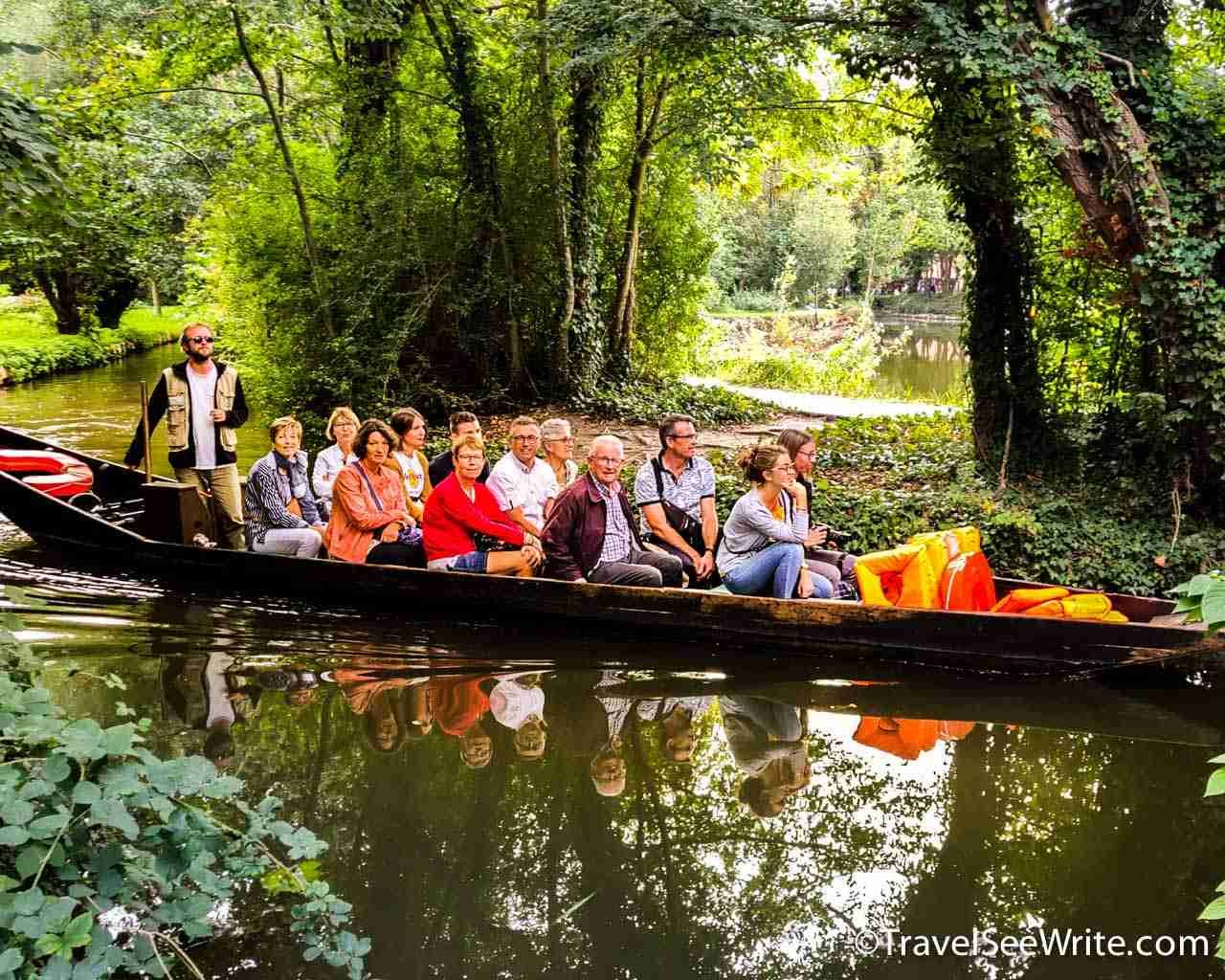
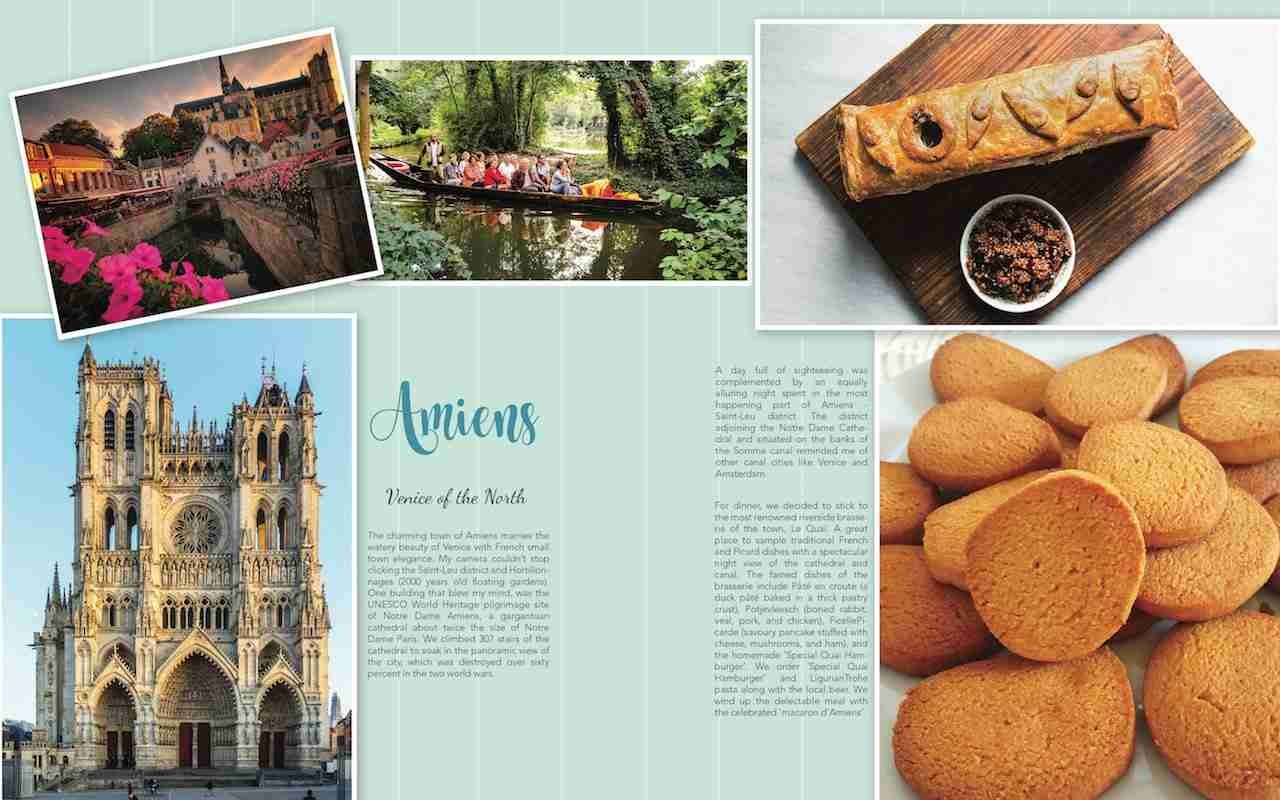
The charming town of Amiens marries the watery beauty of Venice with French small-town elegance. My camera couldn’t stop clicking the Saint-Leu district and Hortillonnages (2000-year-old floating gardens). One building that blew my mind was the UNESCO World Heritage pilgrimage site of Notre Dame Amiens, a gargantuan cathedral about twice the size of Notre Dame Paris. We climbed 307 stairs of the cathedral to soak in the panoramic view of the city, which was destroyed over sixty per cent in the two world wars.

A day full of sightseeing was complemented by an equally alluring night spent in the most happening part of Amiens – Saint-Leu district. The district adjoining the Notre Dame Cathedral and situated on the banks of the Somme canal reminded me of other canal cities like Venice and Amsterdam.

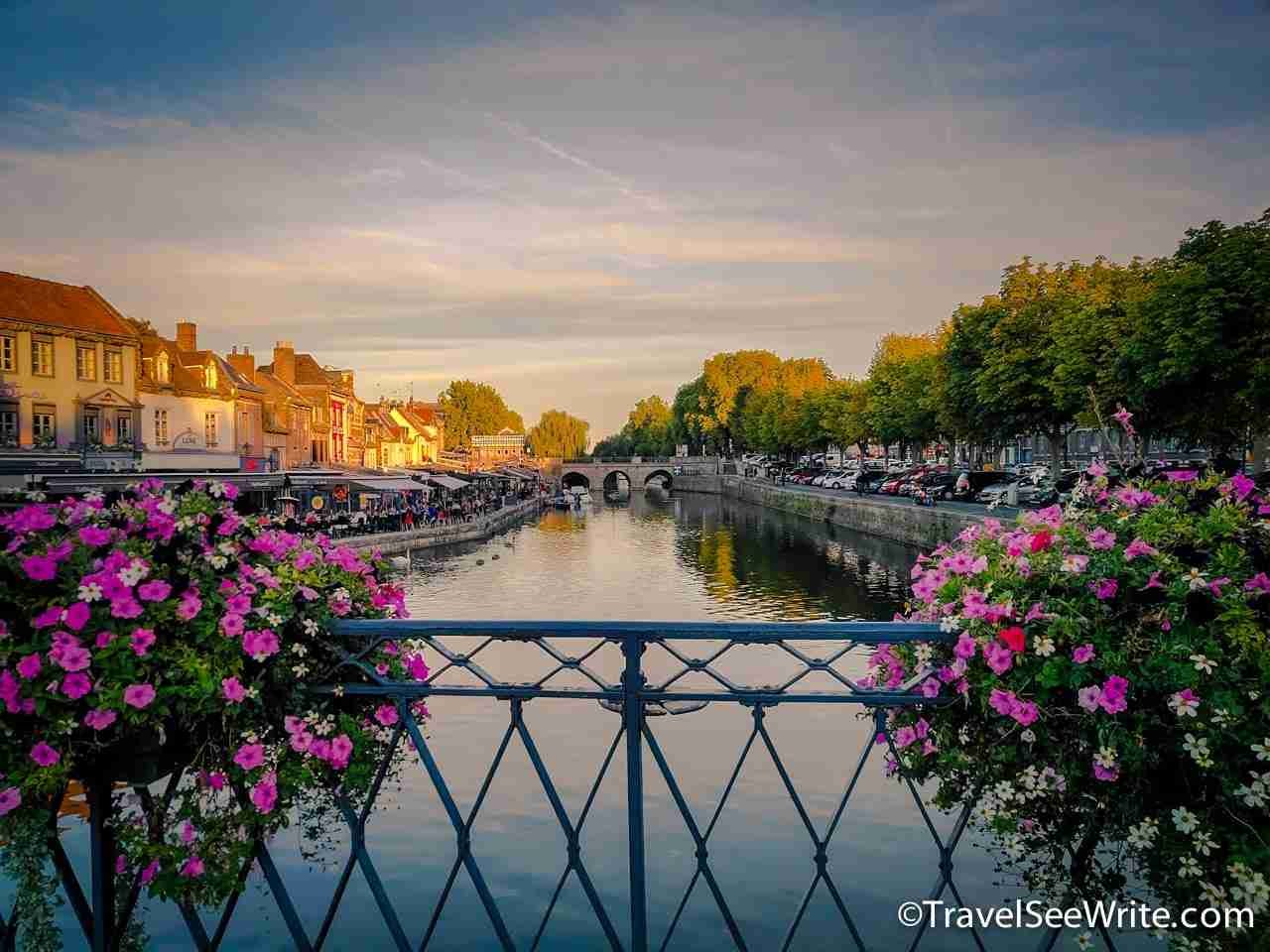
For dinner, we decided to stick to the most renowned riverside brasserie of the town, Le Quai. A great place to sample traditional French and Picard dishes with a spectacular night view of the cathedral and canal. The famed dishes of the brasserie include Pâté en croute (a duck pâté baked in a thick pastry crust), Potjevleesch (boned rabbit, veal, pork, and chicken), Ficelle Picarde (savoury pancake stuffed with cheese, mushrooms, and ham), and the homemade ‘Special Quai Hamburger’. We order ‘Special Quai Hamburger’ and Ligurian Trofie pasta along with the local beer. We wind up the delectable meal with the celebrated ‘macaron d’Amiens’.
After spending two hearty days in Amiens, I continue my journey to the last destination.
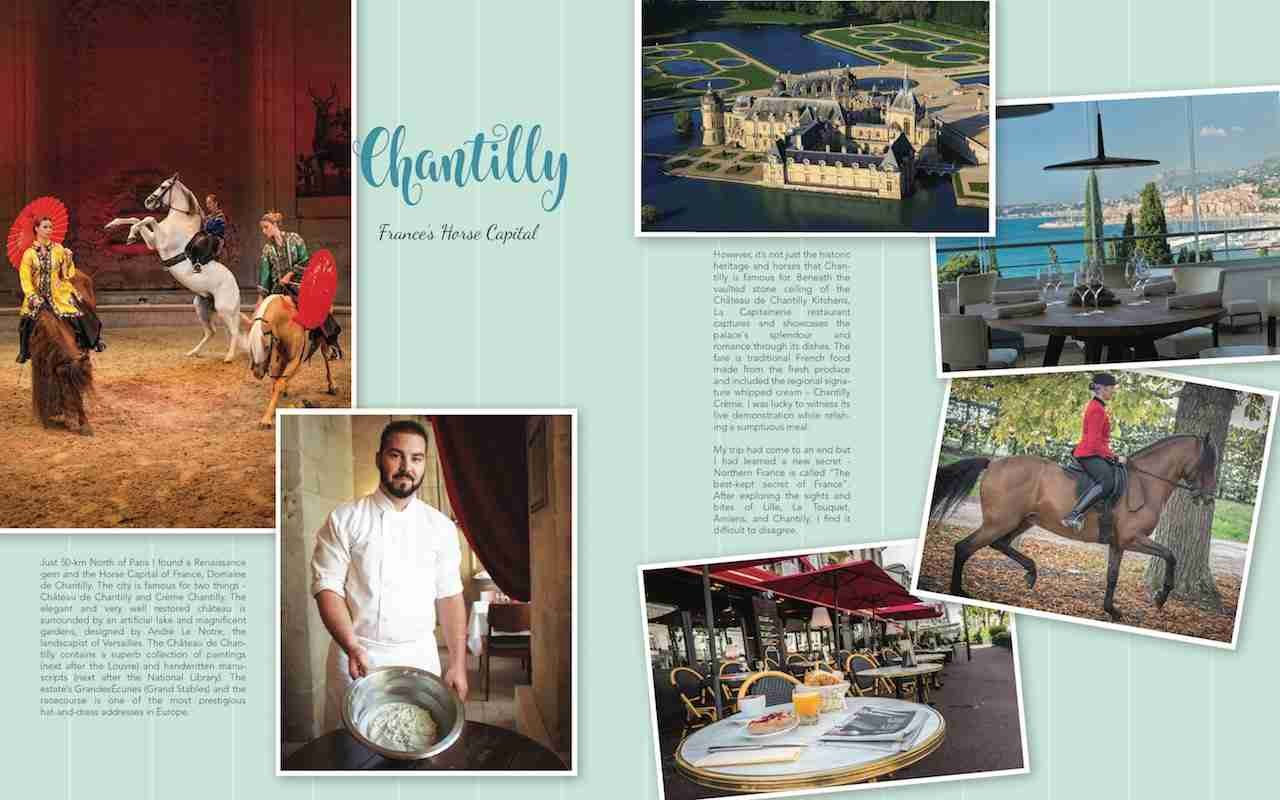
Just 50-km North of Paris I found a Renaissance gem and the Horse Capital of France, Domaine de Chantilly. The city is famous for two things – Château de Chantilly and Crème Chantilly. The elegant and very well restored château is surrounded by an artificial lake and magnificent gardens, designed by André Le Notre, the landscapist of Versailles. The Château de Chantilly contains a superb collection of paintings (next after the Louvre) and handwritten manuscripts (next after the National Library). The estate’s Grandes Écuries (Grand Stables) and the racecourse are some of the most prestigious hat-and-dress addresses in Europe.
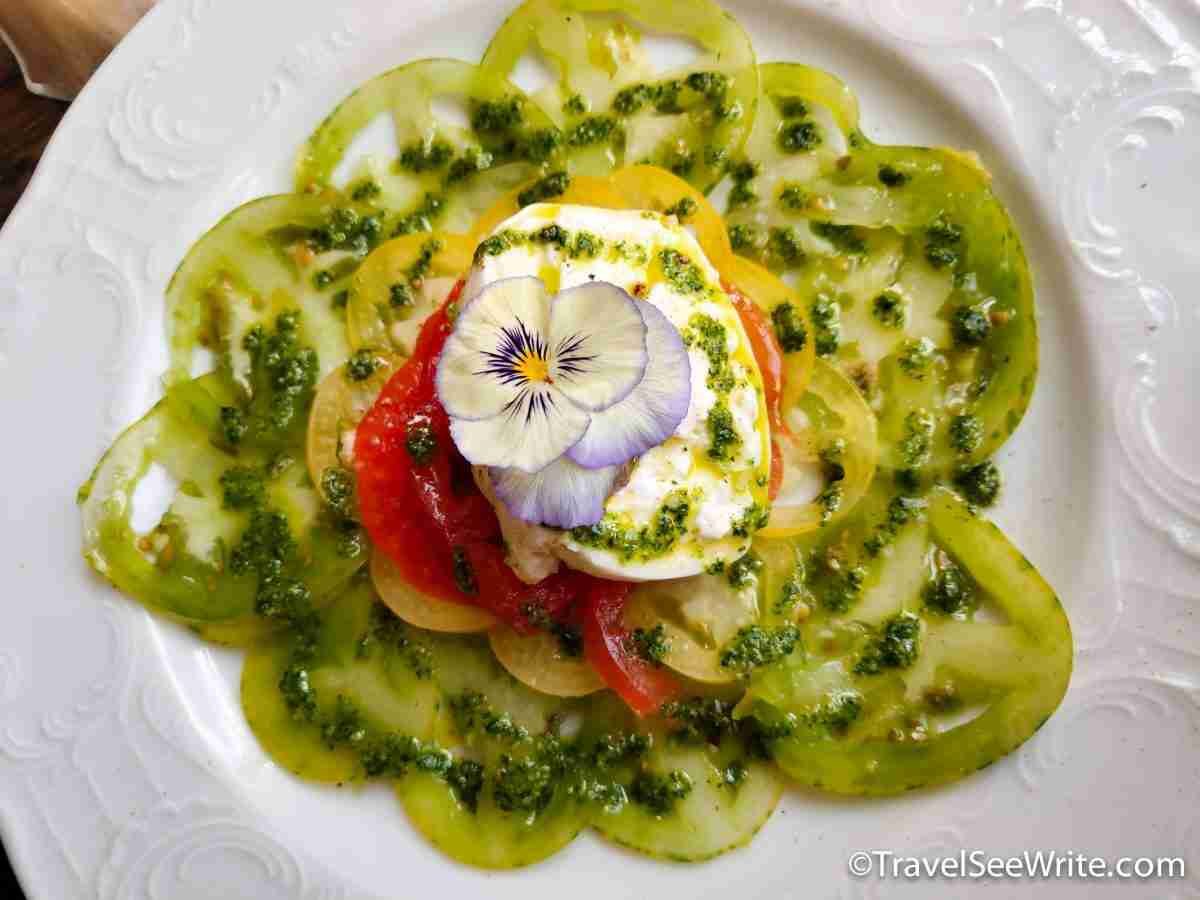
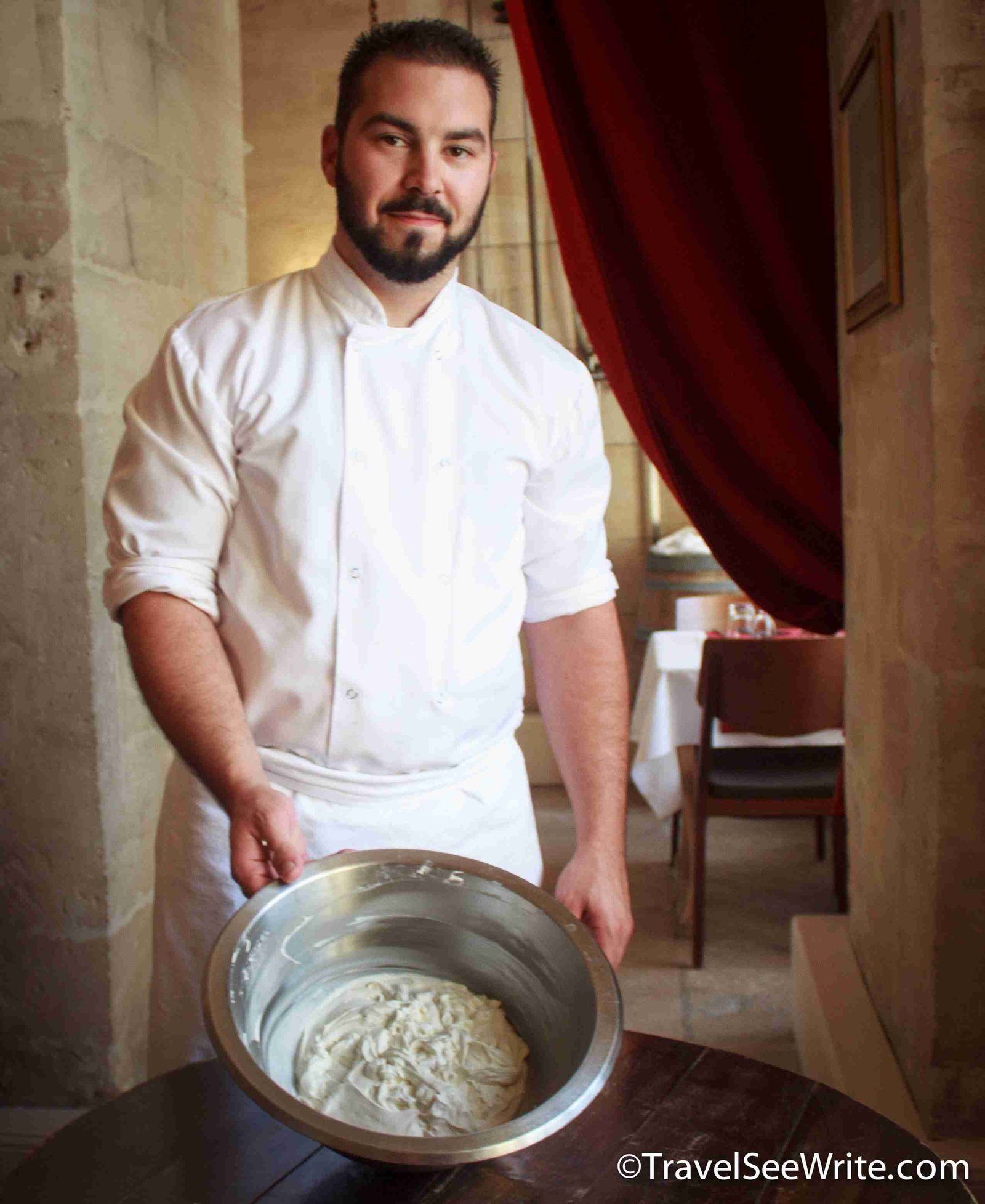
However, it’s not just the historic heritage and horses that Chantilly is famous for. Beneath the vaulted stone ceiling of the Château de Chantilly Kitchens, La Capitainerie restaurant captures and showcases the palace’s splendour and romance through its dishes. The fare is traditional French food made from fresh produce and includes the regional signature whipped cream – Chantilly Crème. I was lucky to witness its live demonstration while relishing a sumptuous meal.

My trip had come to an end, but I had learned a new secret—Northern France is called “the best-kept secret of France.” After exploring the sights and bites of Lille, Le Touquet, Amiens, and Chantilly, I find it difficult to disagree.
So, when are you booking a trip to Northern France? Have you ever visited the region? If yes, I would love to hear from you.

Exploring the towns near Paris and beyond, I found quaint northern French towns and medieval French villages that transported me back in time. The Northern France coastal towns, with their serene beaches and picturesque views, were perfect for a relaxing retreat. Each northern French town had its own speciality, whether it was a local dish, a historical site, or a cultural festival. From the offbeat places to explore in Northern France to the best and prettiest towns in Northern France, my journey was filled with delightful surprises. Whether you’re solving a city in northern France crossword clue or visiting a northern France coastal town, you’ll find that the best places to visit in Northern France are a blend of culinary excellence, historical richness, and cultural depth. So, how many cities of Northern France should you visit? As many as you can because each city, town, and village offers something uniquely enchanting.
In conclusion, Northern France is not just a region; it’s a tapestry of flavours, history, and beauty waiting to be explored. Whether you’re in a major city of northern France or a hidden northern French town, the sights and bites will leave an indelible mark on your soul.
An edited version of this story was published in Food and Wine Magazine – Dec 2018-Feb 2019 issue

Inspired? Pin these to your Pinterest boards. |


Prague or Praha, the capital city of the Czech Republic, is rightly nicknamed as the ‘Mother of Cities’. A city that has two faces. The first face is of an ancient city attracting eight million tourists every year. The second face is of a modern pulsating city experienced by its one million residents every day. Whether you are seeking cultural immersion or unbridled fun, you will find yourself easily succumbing to its atmospheric life. Frankly, first time I found it too overwhelming. There were too many tourists wherever I went. But then I found a method to the madness and discovered many fun things to do in Prague, which were both popular as well as offbeat. And, in the end, I too succumbed to the magic of Prague.


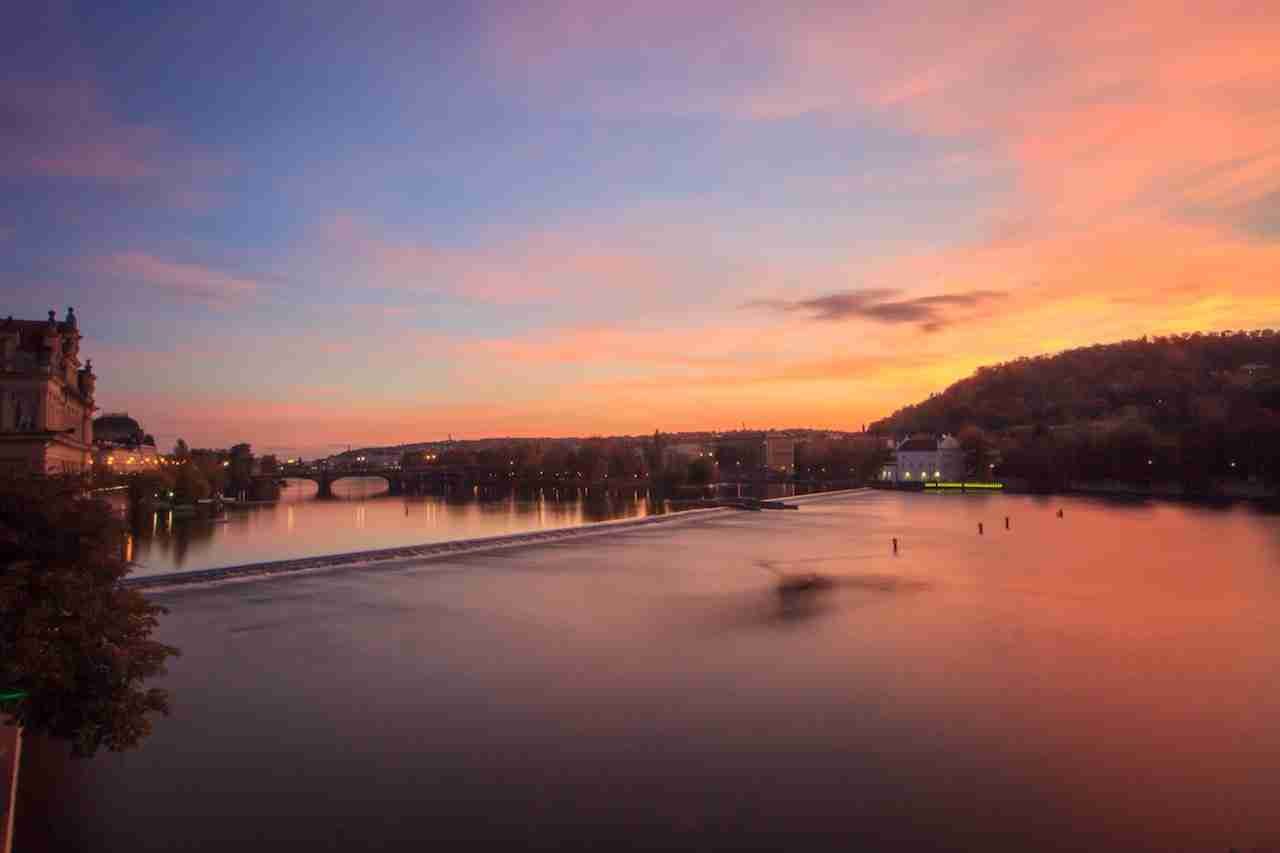


One thing that I loved the most about the “City of a Hundred Spires” was its tolerance towards freedom of speech and action of its citizens. And, that explains why so many great men lived here – Franz Kafka (one of the major fiction writers of the 20th century), Tomás G. Masaryk (Philosopher, professor, and Czechoslovakia’s first president), Václav Havel (Author, dissident and first president after Velvet Revolution) and David Černý (sculptor renowned for his modern and provocative works set in contrasting traditional places).

During my several visits to the Golden Prague I realised the city has as many attractions you could wish of a European capital; avant-garde architecture from every era, countless lively pubs and restaurants serving world’s best beers and cuisines, and plenty of museums, cathedrals, theaters, opera houses, gardens, and other attractions to treat every visitor. If you are planning to visit Prague soon, make sure you bookmark this article.

The world’s largest coherent castle complex is a UNESCO world heritage containing nearly every architectural style of the last millennium. From the gothic St. Vitus Cathedral to the Romanesque Basilica of St. George, Bohemian baroque buildings to early 20th century renovations, the complex brings alive the history of the city and its many layers. Visit early morning to avoid crowds or at sunset at getting a great panoramic view of the old town and bridges of Prague.

One of the world’s most beautiful libraries, the Strahov Library is the largest monastic library in the country, with two stunning baroque halls from the 17thand 18th centuries. Thanks to numerous renovations it remains strikingly well-preserved, perched atop a hill with magnificent views of the city.
The 10thcentury citadel atop Vyšehrad hill overlooking the River Vltava is a complex of building and structures full of history and legends. It has played a pivotal role for 1000-years in Czech history – as a royal residence, military fortress

The 14th-century bridge is the oldest functional bridge on the Vltava river in Prague and is the second oldest stone bridge in the Czech Republic. Interestingly, King Charles IV, who had it built, had it finished on 9th July 1357, at 5:31. So, the exact time and date of it being finished

Enclosed by buildings of different architectural styles ranging from Gothic to Baroque, the Old Town square or Staroměstské náměstí is a must visit historical central plaza of Prague. Listen to the oldest mechanical clock of its kind in the world – the astronomical clock that has chimed every day since1410. The clock has recently been refurbished and is surrounded by four statues representing four cardinal sins: vanity, greed, death

Located just a stone’s throw from the Old Town Square, the Jewish quarters have magnificent old-new synagogues and old Jewish symmetry with 12,000 tombstones.

This 318m-high hill is the green heart of Prague. Perfect for someone looking for quiet, tree-shaded walks and fine views. Don’t forget to visit the lookout tower and mirror maze.

A modern architecture piece of the architects Frank Gehry and Vlado Milunić from the 1990s that faced a lot of flak initially but is now a famous landmark and even won an award by the TIMEmagazine. The two towers of the building are a reminiscence of the dancers Ginger Rogers (the glass tower) and Fred Astaire (the concrete one).
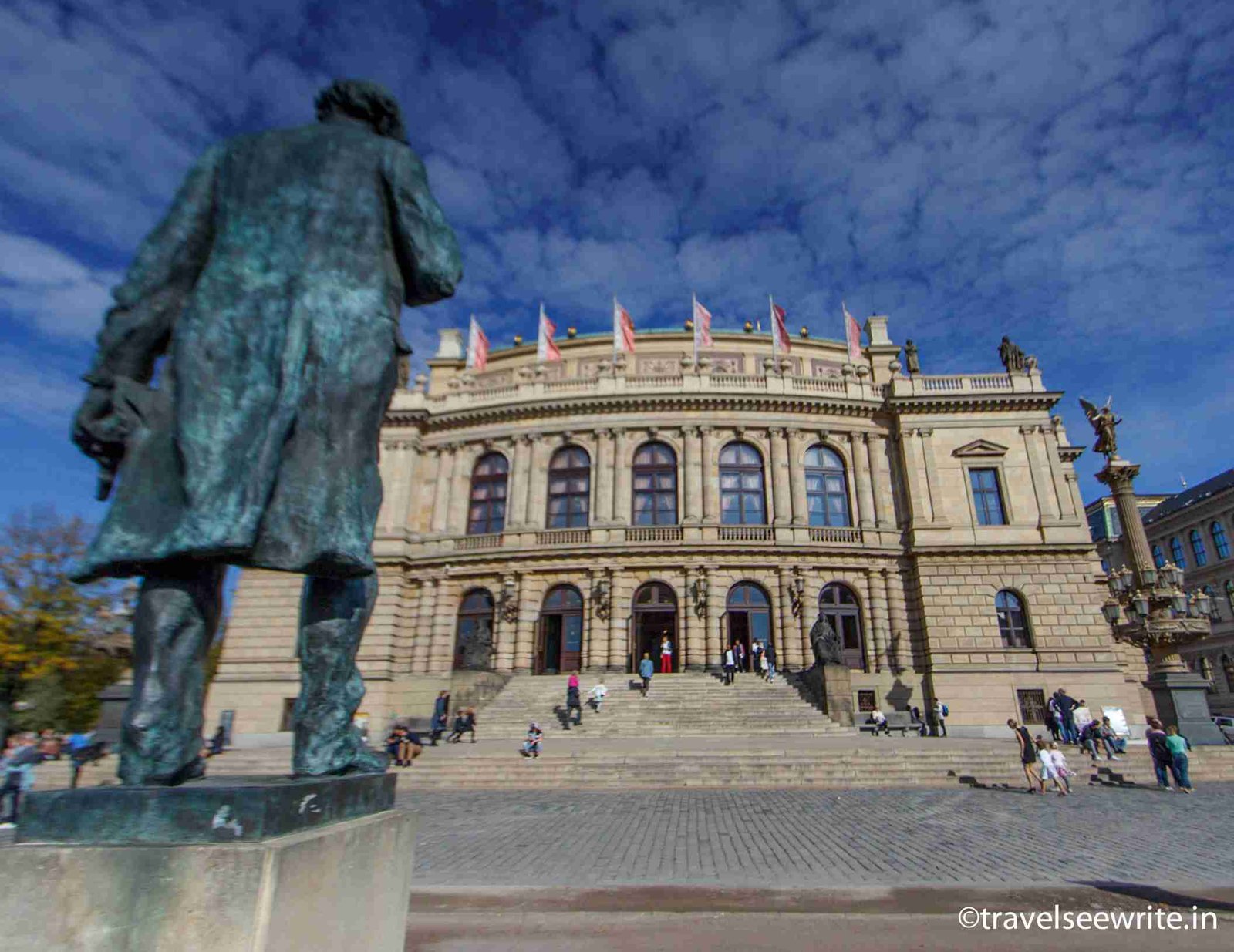
With a tradition spanning over 130 years, the National Theatre is not only one of the symbols of national Czech identity but is also an important part of the European cultural space. Contrary to its name, the National Theater is made up of four artistic companies– the Opera, Drama, Ballet and Laterna

At first glance, the Lennon Wall is like any graffiti-covered wall you see around the world. But this wall is special, thanks to its unique history – Prague’s equivalent of the Berlin Wall. John Lennon Peace Wall helped inspire the non-violent Velvet Revolution that led to the fall of Communism in former Czechoslovakia in 1989. Even though JohnLennon never lived in Prague but after his


Prague is divided into areas 1 to 10 with two clear demarcations- “upriver” and “downriver”. If you stay in Prague 1 or 2, you stay close to many attractions and public transport is always easy to find. Here are the suggested accommodations for every budget:


Hope these Fun things to do in Prague in 3 days inspire you to visit the heart of Europe soon. While I recommend visiting Prague, I would urge you to also Czech out other chapters of the land of stories – Czech Republic.
For more info, don’t forget to read:
Have you ever visited Prague or Czech Republic? If yes, I would love to hear from you.


I was invited by the Czech Tourism as a featured speaker at the TBEX Europe Conference. However, everything expressed above is based on my personal experiences in the country during my several visits. Images used are shot by me. Please do not copy anything without written permission.
In my previous post on Plitvice Lakes, I shared 10 compelling reasons to go from Zagreb to Plitvice Lakes and explore the offbeat gems of the National Park Region. Now since you are interested to know more, let me share a complete travel guide on things to do in and around Plitvice Lakes National Park Croatia. But before that here’s a trailer of why you should spend a few days in the park.
Plitvice Lakes National Park, a UNESCO World Heritage Site, is a verdant maze of trails, bridges, woods, and meadows encircling the 16 sparkling turquoise lakes and over90 crashing waterfalls. These lakes are divided into two groups: 12 UpperLakes and 4 Lower Lakes. Both the lakes are accessible on foot via dirt paths and walkways. For people who don’t prefer walking too much, there are Shuttle buses every 20 minutes along with designated areas of the park. Also, to save time you can take a boat ride too.

Plitvice Lakes National Park, Croatia
The Upper Lakes are larger than the Lower Lakes but the latter is more crowded. It takes roughly around 2-3 hours to walk the entire 5.2 km trail of the Lower Lakeswhereas Upper Lakes takes around 4-6 hours to cover 8.9 km. What made my hiking in the upper lakes so interesting was my interaction with a very knowledgeable and lively local guide, Ana Udovicic, who is a teacher and a dance instructor.

Plitvice Lakes National Park, Croatia is not all about lakes. There are many caves too.
I had a two-day pass to the park, therefore, one day I just did Upper Lakes and another day just the Lower Lakes. Boris and Ana were great guides who not only made me see the highest waterfall (76 metres tall Veliki Slap) and the highest lake (Prošćansko 134 metres) above the lowest lake (Novaković Brod) but they also made me hike to the secret viewpoints that only locals know. There are also several caves, springs and flowering meadows in the park. Don’t follow the crowd all the time. Explore the upper and non-touristy parts too but stay on the marked trails. Don’t fall into the water or off a cliff taking a dangerous selfie.

Plitvice Lakes National Park, Croatia: 16 cascading lakes and over 90 waterfalls
One day pass costs 55 HRK (7.40€) per person in the offseason and goes up to 250 HRK (34€) in peak season. A 2-day pass costs 90 HRK (12€) in the offseason and 400 (54€) in peak season. For more info, check Plitvicka Jezera
There are many places around Plitvice where you can explore the unscathed beauty of the National Park region by riding a horse under the watchful eyes of shepherd dogs and a trainer. My horse trainer, Andrej, had spent 10 years at the Ranch Equus Igni in Rakovica taking care of 12 beautiful horses. Here you can choose to ride from 1 hour to a full day. The horses are well taken care of and are a beauty to ride.
The price starts at 200 HRK (27€). For more info, check Horse Riding Croatia
Croatia, like many countries, is facing the problem of villages getting abandoned. Youth are moving to cities in search of better work opportunities and old people can’t keep them alive for long. But thanks to people like Branko Sokač, an ex-army person and renowned hunter, who are creating sustainable tourism opportunities for their kids and other youth in the area by running an Airbnb and adventure company.

Branko Sokač: A veteran creating sustainable tourism opportunities in Plitvice, Croatia National Park
He along with his wife Sonja and kids provide you with an unforgettable experience of exploring the real offbeat Croatia by taking you on Quad bike through abandoned villages, virgin forests and rolling hills from where you can enjoy the panoramic views of the entire valley. On the way, he makes many stops to tell you the history and cultural relevance of the place.

Wanna go offroad? Try Quad biking in Plitvice, Croatia
And, even makes you taste the wild berries and fruits, which only an expert like him can spot who have learned the techniques to survive in extreme conditions under his military training. And, once you return home you are treated with a variety of homemade jams, homemade cheese, and cured meat cuts. Besides Quad biking, he also offers activities like horseback riding, cycling, hunting, rafting, fly-fishing, kayaking and other activities.

Quad Biking Plitvice National Park, Croatia
Two hours of Quad biking tour costs 400 HRK (54 €). For more info, check Mrzlin Grad
Croatia, in particularly, Lika-Senj County, has been able to build a strong reputation as a leading European cycling destination, thanks to the country’s incredible natural wealth. Cycling paths are clearly marked in the national parks and Plitvice Lakes has one of the most beautiful cycling paths in Europe. While pedalling you can relish the surrounding beauty, smell the flowers and feel the freshness of the waterfalls, hear the birdsongs or taste freshwater directly from springs. Village roads, forest paths, and field cycling paths will reward you with visits to areas that are completely off the beaten track.
There are many local companies offering organised cycling tours who know the area inside-out and will provide the best excursions and routes you might otherwise not be able to access yourself. If you want to explore on your own, check cycling routes in the area at Lika-Senj County Tourist Board website.
A guided tour costs around 40€ per person. For more info, check Bike and Bed Travel Agency or Discover Plitvice.
Sometimes you neither need wings nor aeroplanes to fly, a simple Zipline is a good option. What if that happens to be Europe’s longest and fastest Zipline with the magnificent scenery of Lika below you? When I visited ‘Zipline Beware of the Bear’ at the western edge of the national park, I was jumping with excitement like a kid. The line is 1,700 m long, 80 metres above the ground and can fly up to 120 km/h (when pushed by the north wind from the back). The Zipline was started by a young and adventurous local called Sasha in cooperation with the local municipality.
https://www.facebook.com/travelseewrite/videos/308106989741009/?
Besides Zipline, there are other activities that you can enjoy like climbing, cycling and disc golf. As per Sasha, the park has some promising future plans like constructing three hostels, 5km of skiing and downhill bike paths, the world’s longest zip line (2950 m) and1250m long Air Bike.

Beware of the Bear: the highest and the fastest zip line in Europe
Price is 240 HRK (32€) per person (Sep-May) and 280 HRK (38€) per person (June-Aug). For more info, check Zipline Plitvice.
Gospić is tucked in the mountainous and sparsely populated region of Lika. My trip started with a quick stopover at a retreat like place called Majerovo Vrilo, the source of Gacka River, where 20th-century flour mills dot the River Gacka Springs. It’s a great place for day picnics. There is a small restaurant run by an elderly couple where you can have lunch and buy souvenirs.


Being an adventure junkie I next headed 70 km southwest from Plitvice Lakes National Park to Adrenalin Park Gospic at Rizvan City, where I freefell from Croatia’s highest giant swing (17 metres). The park is a great weekend getaway for families, friends and corporate team building as it comes equipped with a lot of adrenaline and adventure activities like zip line, climbing, paintball, airsoft shooting, archery, Fussball, kayaking, quad biking, cycling and abseiling.

Free falling from Croatia’s highest swing is a must-do when in Plitvice
But my adventure didn’t end here, it continued at the Kajak Kanu Klub Gospic where I enjoyed kayaking on the calm waves of River Korana and relishing some pears straight from the garden trees. I still can’t forget the smile of the gentleman who picked the best fruit from his garden to give it to me. A priceless gift indeed.

Kayaking in the calm water of Korana River is super fun
For more info, check Visit Gospic, Adria Velebitica and Kajak Kanu Klub Gospic
65km away from Plitvice Lakes and 5km west of Gospić lies the tiny village of Smiljan, the birthplace of one of the greatest minds of the modern world who brought electricity into our homes and invented wireless technology. That person was Nikola Tesla and his home is now converted into a museum displaying key moments of his life and working replicas of some of his most famous inventions. The complex consists of his birth house, a Serbian Orthodox Church (his father was an Eastern Orthodox priest), a multimedia centre, an old barn, and a children’s playground. Every two hours there’s a guided tour that shows a couple of his experiments and a video about the great scientist himself.

Nikola Tesla’s birthplace is a must-visit in Croatia
Ticket costs 50 HRK (7€) For more info, check Nikola Tesla
This was the first place I visited when I was travelling from Zagreb to Plitvice Lakes. Located roughly midway between Zagreb and the Northern Dalmatian coast, it is just 25 km from the Plitvice Lakes National Park. A watermill village is situated where the blue-green water of river Slunjčica flows into the Korana river. Rastoke is famous for its historic houses, well-preserved mills and the picturesque little waterfalls along the Slunjcica river, which flows into the river Korana at this place.

Rastoke: Perfect place for a break when traveling from Zagreb to Plitvice Lakes or vice versa
For more info, check: Slunj Rastoke
It’s hard to imagine that a fairy-tale-like place could be so close to an underground bunker, which is one of Europe’s largest and most expensive military airbases. Zelijava Underground Airbase is situated on the border between Croatia and Bosnia and Herzegovina and was built by the Yugoslav government between 1958 and 1968. It was extensively used in 1991, during the Yugoslav Wars.

Things to do in Plitvice Lakes National Park Croatia: visit an abandoned army base
As per Boris, my de-facto local guide, the facility was like an underground city where no one except for the higher officials knew all details about the airbase. At any given time two MIGs were ready to take off within 5 minutes. The bunker was coated with concrete shields to protect it from airstrikes and nuclear attacks. There are four main entrances (only one is open) in the 3.5kms long tunnels. The underground tunnels housed aircraft and entire squadrons, as well as an underground water source, power generators, crew quarters, barbers, and a mess hall that could feed 1,000 people. It also stocked food, fuel, and arms to last 30 days without resupply. It was like a full-fledged city.

Things to do in Plitvice Lakes National Park Croatia: visit an abandoned army base
The underground base once housed dozens of MIG Fighter Jets but was destroyed in conflicts in the region after the fall of Communism. Many of the aircraft, including MIG Fighter Jets, were destroyed in the Yugoslavian war and many were abandoned to rot away. While their original purpose is lost, today they make up for a good Instagram post 🙂

Exploring the abandoned Yugoslavian warplane near Plitvice Lakes, Croatia
Croatians are one of the most hospitable people in Europe. If you get invited to a local’s place, brace yourself to hear “Jesti! Jesti! Jesto!” (eat eat eat) a lot. You will be welcomed with a hearty flow of ‘Rakija’ (homemade brandy). And, you won’t be allowed to leave without a few drinks.

Things to do in Plitvice Lakes, Croatia: drink Rakija like a local
When in Lika county, you must try ‘Peka’. A peka is a domed iron lid or “bell”, used to cover a pot, which is then buried into the embers of a fireplace to create a slow-cooking micro-oven. It’s mostly used for cooking veel, lamb, or octopus, along with potatoes and vegetables, with wine and olive oil. Since it involves slow cooking, you need to order Peka dishes at least one day in advance. And, it’s not just the Peka dish that is special, the places where it is served act as community centres where people gather to talk and have a good time.

From Zagreb to Plitvice Lakes: relish traditional Croatian cuisine
Barać caves, Una National Park and Bihac in Bosnia and Herzegovina. Here’s a video about my experience of visiting one of the prettiest National Park not just in Bosnia but maybe in Europe. If you are looking for some offbeat adventure, this is the park you must visit. For more info check, Una National Park website.
The park is located between Zagreb and Zadar, very close to the Bosnian border (that’s why it makes sense to do a day tour to Una National Park). The park is easily accessible from all directions. The best way to get to the National Park is by road. Here’s an average bus journey duration:
If you’re travelling from elsewhere in Croatia to Plitvice, take a bus to one of the above places and change for another bus from there.

Buses are one of the cheapest and the best ways to travel from Zagreb to Plitvice Lakes in Croatia


Spend more time in Upper Lakes, Plitvice, Croatia
Summer can get very crowded, peaking at up to 10,000 people a day and winters can get very harsh. Therefore, if possible, plan a visit during shoulder season (April-June or Sept-Oct) when the weather is still pleasant, the park is less crowded and open for relatively long hours.
Duration depends on your interests and how much time you have in hand. For all the places mentioned above, stay at least 10 days. If possible, start from Zagreb and end your trip at Dubrovnik
Activities: You can choose as per your liking – nature and adventure, urban explorations, beach time or exploring ancient ruins.
Hope this detailed Travel Guide from Zagreb to Plitvice Lakes could help you find the right things to do in and around the National Park. Don’t forget to read Plitvice Lakes: 10 reasons why this is a must-visit Croatia National Park.
Have you ever visited Croatia? If yes, I would love to hear from you.
I was invited by Plitvice Lakes Tourism Board. However, everything expressed above is based on my personal experiences and conversations I had in the country. The images used are shot by me. Please do not copy anything without written permission.
Balmy crystal-clear sapphire waters of the Adriatic coast or the ancient walled city of Dubrovnik? Little unexplored hamlets and remote islands of Zadar and Split or the cascading waterfalls and lakes of Croatia National Park? Gastronomic delights and wines of Istria or Zagreb’s unrivalled café culture and festivals?

Croatia has all this and a lot more. Living up to its slogan, “Croatia – Full of life”, this tiny young nation is filled with attractions of unimaginable beauty and diversity. No wonder, it draws visitors five times more than its own population(18.5 million vs 4 million).
Instagram updates, Facebook galleries, and glossy travel magazines had put Croatia on top of my wish list. Finally, in August 2017, I decided to find out what the fuss was all about. I am happy to say I am bewitched by Croatia, and it is now one of my favourite countries in Europe (I will share that in another post).
While most people spend the majority of their time on its glorious 1778 km-long coast and a staggering 1185 islands, I decided to go offbeat (like always). Instead of running from pillar to post in 10 days, I chose to travel slowly but deep in two places – Plitvice Lakes National Park region and Zagreb. The reason to do that was simple – I didn’t want to be a part of the problem (Over tourism in a few places) but wanted to play a constructive role in finding a solution (under tourism in unexplored regions). You can soon read about that in my upcoming story on how Croatia is fighting Over tourism.
Today, I am here to share why this beautiful Croatia National Park should be on your travel map.
Plitvice Lakes is in the Lika county, which is bejewelled between Zagreb and Zadar and located a stone’s throw-away distance from the Bosnia Herzegovina border. Whether you are coming by road, train or air, getting here is a child’s play. It takes just two hours to reach the park from Zagreb or Split. More info here.


Plitvice is the oldest and the most well-known Croatia National Park. As you walk through the maze of paths, woods, and meadows in Croatia’spostcard-image of Paradise on Earth, you
Spread over a green valley in the Croatian interior, a series of over 90 waterfalls tumbledown from one spectacular cascade to the next, pausing in the 16 sparkling turquoise lakes before disappearing into a sheer karst canyon. These lakes took shape only 12,000 years ago, but even today, Plitvice’s landscape is one of Mother Nature’s ongoing works in progress. Not only is it loved by visitors, but it is also much loved by its resident bears and wolves and over 120 species of birds.
The Lika region is blessed with modest Continental and mild Mediterranean climates, which makes it an ideal adventure playground for various activities that can be enjoyed throughout the year. You can bike the forest trails or hike the mountain peaks, ride a horse or swoosh through a zip line, buggy ride or ride the waves. The possibilities are endless. All you need is an adventurous spirit and let your curiosity be your guide. Wherever you go, the memories will follow.
Locals are the unsung heroes of your travels. They can make or break your trip. Luckily, Croatians tend to be friendly, generous, well-read and bred, culturally conscious and English-speaking, and funny and hospitable. One of the reasons why I can’t stop raving about Croatia is because of the likes of Boris (the funny, caring, intelligent and well-connected man), Maja (beautiful and elegant lady from Plitvice as well as Gospic), Ivica (the man behind the trails of Plitvice Lakes National Park) and many others who went out of their way to make me feel at home.

I was welcomed with open arms and a heart filled with love wherever I went. Whenever I dinned with Boris, he didn’t let me pay even once for my drinks or food. And, not just that. He even took me to his folk’s place to try homemade ‘Rakija’ (fruit-based alcoholic beverage). His sense of humour and caring personality was the reason my trip became so memorable. Never even once did I have a dull moment during the entire trip.
65km away from Plitvice Lakes in the tiny village of Smiljan, the greatest mind of the modern world, Nikola Tesla, was born. Thanks to him, we can enjoy electricity and wireless technology today. Therefore, visiting the Plitvice Lakes and not visiting his birthplace would be a crime. His home is now converted into a museum displaying key moments of his life and working replicas of some of his most famous inventions.

While Istria is the undisputed leader when it comes to the culinary delights of Croatia, the Lika region is second to none with its traditional dishes and drinks. It is impossible not to lick your fingers when the ‘Peka’ dish arrives on your table along with the ‘Rakija’ (local homemade brandy). A Peka is a Dalmatia region signature dish made with a blending of vegetables and meat, drizzled with olive oil, sprinkled with herbs, and then baked to perfection under a bell-like dome, or ispod čripnje in embers of a fireplace.
When offered a Rakija, always clink glasses, look into your fellow drinker’s eyes, and shoot it down. It is not meant to be sipped.
And, don’t forget to enjoy Medica(honey liqueur) or digestives after meals.
While the Plitvice Lakes are the biggest draw for the Lika region, other important historical war sites are worthy of a visit. For example, the town of Udbina and Gospic in Lika county, have been military frontiers in many important wars like the Hungarian war with the Turks in the 15th century, WWII between the Axis and Allied forces, and the latest Yugoslavian war fought between Serbs and Croats in the 90s. The wars were so brutal that much of the region and its records were destroyed. The tragic and bloodiest battle on Croatian soil was fought at Krbavsko polje valley with the Turks in 1493. Today there is a Church of Croatian Martyrs and a Croatian National Shrine in Udbina to honour and pay tribute to known and unknown victims of historical misfortunes.
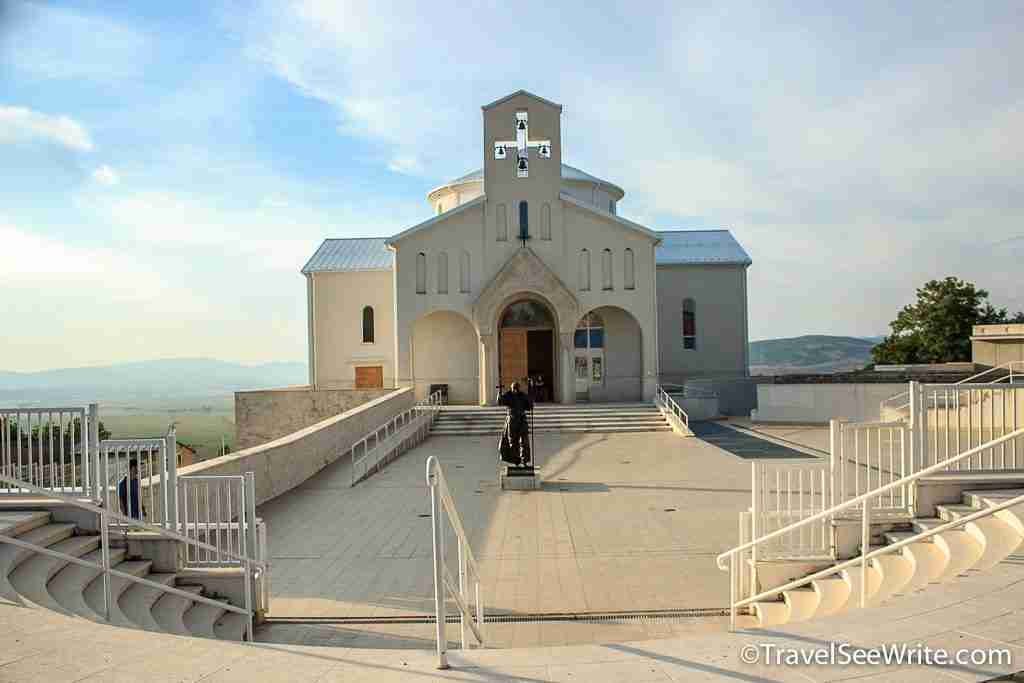
On the brighter side, did you know that Udbina is also the sunniest part of Croatia? It could be raining in the neighbouring Plitvice Lakes, but it will be sunny here.
Just next to the lakes lies Zelijava UndergroundAirbase, built by the Yugoslav government between 1958 and 1968 and extensively used in the Yugoslav war in 1991. The bunker is one of Europe’s last remaining underground airbases built to withstand a nuclear attack. It was like an underground city equipped with all facilities to last for months in case war erupted.
The underground base once housed dozens of MIG Fighter Jets, but it is left abandoned today.
Just a 20-minute drive from the lakes lies the underground world of stalactites, stalagmites, and stagnates in the village of Nova Krslja. There is a 45-minute long guided tour available to help you uncover the underground treasures of Barac Caves.
Just 40 km from the Plitvice National Park lies Una National Park, which is the youngest and one of the prettiest of the three national parks in Bosnia and Herzegovina. While Plitvice is overrun by hordes of tourists, nearby Una National Park is still an offbeat gem and fairly unknown.

As per Amarildo Mulic, the Director of the National Park Una,
The main purpose of the park is to protect the extraordinary river scenery of waterfalls that lie on Una and Unac rivers running through the park.
The showstopper of the park is 24.5 meters high, Štrbački Buk waterfall, the highest and most spectacular waterfall of National Park Una. The best thing is you can raft on the waterfall itself. A 9-km long 2-hour rafting tour starts below Strbacki Buk and continues downstream until Loskun. Here’s a video about my experience. PS: Getting to Una National Park is a little bit difficult if you don’t have a private car. However, you can always rent a car in Bosnia or Croatia.
So, as you might have gauged by now, Plitvice National Park region is a perfect playground for nature lovers, landscape photographers, Instagrammers, wildlife enthusiasts, history diggers and anyone who likes to connect to nature and people. Forests, caves, crevices, waterfalls, lakes, rivers, mountains and hidden treasures mean that at the extremely picturesque Plitvice National Park region, even the most ham-fisted amateur can leave feeling like Ansel Adams.
I hope these 10 reasons inspire you to visit the Plitvice region beyond the lakes. Don’t forget to read the Complete Travel Guide: From Zagreb to Plitvice Lakes.
Have you ever visited Croatia National Park or any other sight? If yes, I would love to hear from you. Also, don’t forget to check the rest of the stories from my 4 months solo budget travel in Europe.
 |  |  |
I was invited by Plitvice Lakes Tourism Board. However, everything expressed above is based on my personal experiences and conversations I had in the country. Images used are shot by me. Please do not copy anything without written permission.
Kolkata, the 350 years old second largest metropolis of India, manifests itself differently from other metros. Being the former capital of British India, Kolkata still has the bearings of colonial-era in the form of trams and architecture. The city has always been regarded as India’s intellectual, artistic and cultural capital. No wonder it has produced several Nobel Laureates like Rabindranath Tagore, C.V. Raman and Amartaya Sen among others.
Friendlier than India’s other metropolises, this is a city you ‘feel’ than simply visit. Whether you are visiting for work or leisure, the city of joy will enthrall you with its laidback character and specialties that you can only get in Kolkata. Here are the ten places to visit in Kolkata:


| Inspired? Pin these to your Pinterest boards |


France needs no introduction when it comes to travel. Despite being one of the world’s most famous holiday destinations, 95% of France remains largely off the tourist map, more so in the case of Indians. Traveling to France usually means a visit to Paris and French Riviera. However, just one hour away from the home of Eiffel Tower lies “France’s best-kept secret”.
Northern France, an under-the-radar region has always remained in the shadow of the glamorous capital. However, once you visit the region, it’s impossible to not become its diehard fan. Northern France has an astoundingly rich and diverse historic heritage and its range of natural environments in unrivaled by any other region in France or even Europe.
Here are the 10 reasons to visit Northern France:
There are a very few places that can boast of the connectivity as Northern France has. 1 hour from Paris, 30 minutes from Brussels and 1.5 hours from London. You can use Eurail Global Pass to get from anywhere in high-speed trains like TGV. The best part is you don’t have to travel a lot from the airport to get to a train station. Within 4 minutes of coming out of the Paris Airport, I could board a high-speed TGV train to Lille. Yes, it’s that easy. The other option is self-drive. Personally, that’s my favourite as you can pull over anywhere to admire the French dreamscapes.

Whether it was the French revolution or the two world wars, Northern France has always been in the thick of the action. The famous battles of Normandy and Dunkirk were fought in the region. And, one can still see the relics of the glory as well as horrid past juxtaposed next to the modern world. And, it’s not just war relics that are preserved. French are very passionate about their past and culture. And, that’s the reason why you can still hear classical songs on the radio or in restaurants. And, traditional cuisine is not limited to annual events.

Northern France has an astoundingly rich and diverse historic heritage, and its range of natural environments is unrivaled by any other region in France or even Europe. Lille impressed me with its Flemish-Spanish influence, cool brasseries, and swanky shopping streets while Le Touquet simply swept me off my feet with its coastal glamour. Amiens bewitched with its heritage-nature charm and Chantilly doled out a royal carpet. It’s difficult to encapsulate the sheer variety in the region.

French people are misjudged to be unfriendly and cold. But, I experienced the opposite. Not only are they friendly and funny but they go out of their way to make you feel comfortable and welcomed. Here’s an example.
I was on a self-drive trip through Northern France when on one fateful day I forgot my laptop charger in the hotel. I was 115-km away and was running on a tight schedule. To make the matters worse, I had a flight next day and my charger was of an old make that wasn’t available in stores. It was a catch-22 situation with no feasible solution in sight. At that time, a local friend, Pierre, came to my rescue. Without batting an eye, he spent a day on the road correcting my mistake.
Paris’ Notre Dame might be the most popular cathedral in France, but Notre Dame Amiens gargantuan cathedral is about twice the size. It is impossible to not get impressed by this twice conferred UNESCO World Heritage site, which is one of the largest medieval cathedrals in the world, filled with jaw-dropping sculptures and soaring gothic spires.
Just an hour’s drive from Paris or 30 minutes by train— I found a Renaissance gem and the Horse Capital of France, Chantilly. A city that has been built around racehorse and no wonder Chantilly Racecourse is home to two of France’s most important races – the Prix du Jockey Club and, the Prix de Diane. Not only does it have the largest racehorse-training community in France but is also a home to the Living Museum of the Horse at Great Stables.
The charming town of Amiens in the Hauts-de-France region combines the watery beauty of Venice with French small town elegance. The Saint-Leu district with its canals and the 2000 years old floating gardens (hortillonnages) are a must-see attraction. Rustic cottages, colourful flower beds, and activity areas dot islands along the canals, with ducks and swans playing along peacefully.
Le Touquet, an affluent coastal town, has long been a playground of the rich, not just from France but from all over the world, where famous figures like French President, Emmanuel Macron, owns a home. In the past, frequent visitors included Winston Churchill, Prince Edward, and even James Bond’s creator Ian Fleming, who lived here and drew inspiration for Casino Royale from the town’s casino. There’s no dearth of action here – endless sandy beach, horse riding, tennis, golfing, racing, gambling, and sand-yachting.
Saint-Valery-sur-Somme’s name was written in history books because of Joan of Arc, one of the greatest Lady General in the world and the National Heroine of France, who led the country to many victories in the 15th century. In 1431, she has held a prisoner in the local prison before being dispatched to Rouen for her execution.
Eating in Northern France is a voyage for your taste buds. Whether you love sweet or savoury, fine dining or quick bite; your food will always delight you. It would be a crime to not try local signature dishes like the Carbonnade Flamande (Beef stew), Méert waffle (a favourite of General Charles de Gaulle), Welsh (Ham, bread, beer and cheese), pot’je vleesch (rabbit, veal, chicken meat, served cold in a pot of savoury jelly with French fries) and Mussels. Northern France is not a wine-growing country and locals prefer beer. Do try Célestin’s beers. And, like other parts of the country, cheese is very good here. You can find over one thousand variety of cheeses here.
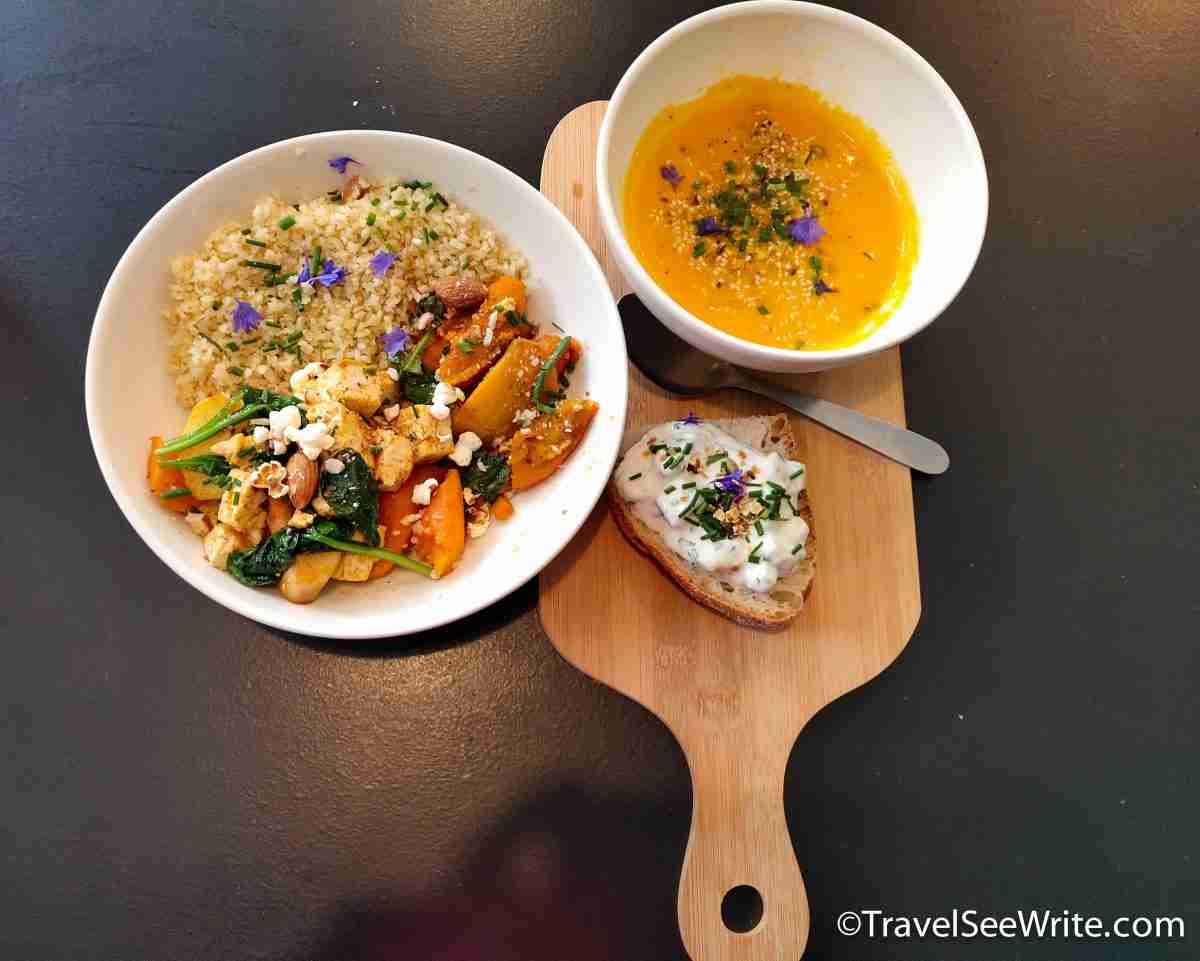
Last but not
So, when are you booking a trip to #Northern France? And, don’t forget to visit three Villages along the Saone River as well.
An edited version of this story was published in Sakal Times
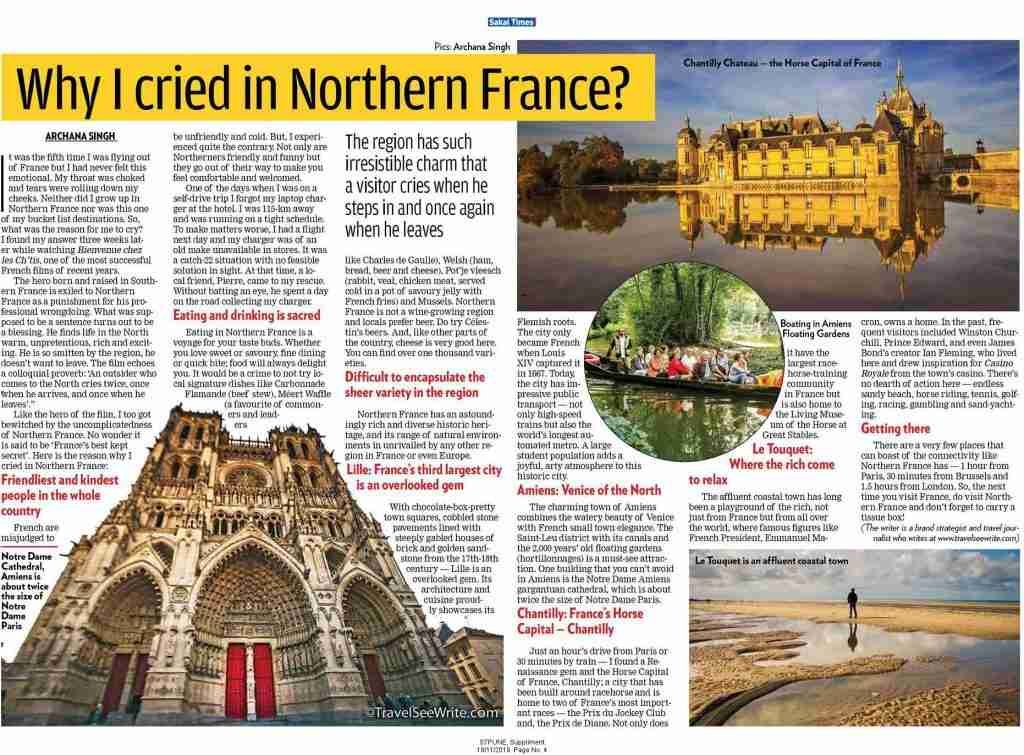
Have you ever visited Northern France? If yes, I would love to hear from you.
PS: I am sure many of you are following my ongoing #OffbeatEuropeWithTSW journey on my social media channels. In case you want to know more, do read how I am managing 4 months Solo Budget Travel in Europe and stay tuned for upcoming posts.
Inspired? Pin these to your Pinterest boards |
||
 |
 |
 |
I was in Northern France at the invitation of the region Hauts-de-France. Everything expressed above is based on my personal experience and conversations I had in the region. All images used were shot by me. Please don’t use any image or text without written permission.
Europe on a shoestring budget seems like mission impossible but with a little bit of smart planning, 4 months of Solo Budget Travel in Europe is completely doable. And, that’s exactly what I am aiming to achieve with my upcoming 4 months of solo travel in Offbeat Europe. A solo trip across Europe – mainly Central, Southern, Western, and Eastern Europe. Here is what I am planning to do in the upcoming 4 months of Solo Budget Travel in Europe:
When you travel with a super tight deadline you are forced to do the touristy stuff and there is nothing wrong with that. However, I am over that phase. Now my travel goals have changed. I no longer travel to tick-mark destinations or fulfil bucket lists. I travel with a purpose – to explore and promote offbeat places through sustainable tourism practices. The fun lies in being a local than being a foreigner. That is when you become a part of the social fabric and connect with the soul of a place.
I am invited as a guest speaker at TBEX Ostrava, Czech Republic where I’ll be sharing my experience of working in emerging markets and how to pitch successfully. Since I’ll be in the region, it makes sense to explore the neighbouring countries instead of planning separate trips.
July to October are the best months to explore Europe as the days are long, the weather is pleasant, people are in an upbeat mood and lots of festivals are held during these months. And you get many good deals on Europe Trip Packages.
Instead of making multiple trips to Europe with several long-haul flights throughout the year, I prefer one mega trip, flying just once. Also, I chose Eurail over shorter flights as trains
Summers are unbearable in Asia, especially in Delhi. It’s a good time to escape the heat and enjoy the European sojourns.
Explore the interiors of the Czech Republic, Slovakia, Poland, and Bulgaria to connect the past with the present.
1. Czech Republic (4 weeks)
The land of stories is going to be my center point. I’ll begin and end my first leg of travel here. I’ll be spending over three weeks in the Czech Republic exploring popular and offbeat places. Don’t forget to read about the five fantastic Czech Republic

2. Slovakia (7 days)
The allure of the Tatra mountains and rustic castles invites me again to Slovakia. I’ll be exploring off-the-radar regions of Banska Bystrica and Región Banská Štiavnica in one of the most beautiful parts of Slovakia – Central Slovakia.
3. Poland (7 days)
I’ll be travelling to three main cities – Krakow, Auschwitz, and Katowice to see World War II sites.

4. Bulgaria (6 days)

There’s more to Western Europe than uber-popular cities like Paris, Berlin, and Vienna. I’ll be exploring Northern France, Northern Germany and various regions of Austria to uncover their hidden gems and unique cultures.
1. Germany (4 days)
The Vogelball music festival will be my primary reason to visit the vibrant city of Hamburg.

2) Austria (10 days):
Although Austria is not really a budget destination to explore in Europe a little bit of splurge is okay at times. This beautiful country will beckon twice – once to explore the Cafe culture of Vienna and next time to explore the adventure and cultural sights of Tyrol, Salzburg and Vienna regions.

3) France (7 days)
French Riviera and Paris might not fall under my plan of doing budget travel in Europe but I have a solution for that too – I’ll take a detour from Paris to visit the charming cities and vibrant villages of Northern France to understand why the Hauts-de-France region is known as “France’s best-kept secret”.

1) Slovenia (7 days):
The postcard country renowned for its green cover will be my home for 10 days where I’ll be visiting Ljubljana, Lake Bled and Big Berry Kolpa River resort.
2) Croatia (9 days):
Going off the grid in search of offbeat fun activities to do in the Plitvice National Park and the Croatian capital, Zagreb. Read more about my experience and plan a trip with these two highly detailed and insightful posts: Plitvice Lakes: 10 reasons why this is a must-visit Croatia National Park and Things to do in and around Plitvice Lakes National Park, Croatia Don’t forget to see the video about my experience.
3) Bosnia and Herzegovina (1 day)
Visiting the
4) Serbia (9 days)
Being a die-hard fan of Novak Djokovic, Serbia has been high on my list for a long. Besides visiting my idol’s hometown (which has been bombed 36 times), I’ll be visiting the Eastern and Western sides of Serbia renowned for archaeological, natural and cultural treasures.

5) Italy (15 days)
I had been to Italy before but this time I’ll be exploring it in a different way as I’ll be attending my first ever ‘Adventure Travel World Summit’ in Tuscany, Italy. The Tuscan countryside is like the Chianti produced there – meant to be

All the places in my journey are well thought off and have been planned almost six to eight months in advance. I’ll be working with the National and Regional Tourism Boards in most of the countries I am planning to visit. All the activities, places and experiences are carefully chosen as per my interests. While 80% of my trip is planned, 20% is left open to serendipity.
It is the biggest hurdle for long-term solo travellers like me whose passport is a week passport. Therefore, I focused on securing a Schengen visa first, which is valid for all European countries I plan to visit. Since I’ll be in the region for 110 days I have planned my travel in a way that I don’t exhaust all my 90 days in the Schengen region. I’ll be visiting non-Schengen countries to stay within the limits of my visa.

Here is a list of documents I submitted for my Schengen visa:
Tip: please apply at least three weeks in advance. My case was directly handled by the Tourism Board yet I almost gave up on my trip.
The best way to explore Europe is through the comfort of a Eurail. And, that’s why I have taken a continuous 2-month Eurail Global Pass that allows me to travel across 28 European countries on any train/bus/ferry listed in the pass. I can board any train anytime from anywhere. Now isn’t that cool? And, wherever Eurail is not available I’ll be using private transport. I’ll also be taking a few flights to save time.

I am super excited about my solo Europe budget travel and I can’t wait to TRAVEL, SEE and WRITE for you. Have you ever done budget travel in Europe? if yes, please do share your stories in the comment section below.
 Experimenting With Panasonic Lumix GH5 at Bir Billing, Himachal
When it comes to adventure travel in India, the country is slowly but steadily rising its game. From paragliding in Bir-Billing to mountain biking in West Bengal; bungee jumping in Rishikesh to caving in Meghalaya; scuba diving in Andamans to trekking in the Himalayas; India is becoming a favourite playground for adventure enthusiasts from all around the world. Here’s my experience of Paragliding in the second highest paragliding destination in the world – Bir-Billing.
Showing is better than telling.We all have grown up hearing this quote and I truly believe in it. So, when Panasonic Lumix Cameras India team reached out to join their Adventure excursion to the world’s second highest paragliding destination, Bir-Billing, and experience their mirrorless cameras range, I jumped at the offer. I mean can you say no to two things you love the most – adventure and photography? I bet not. The trip to the Paragliding capital of India was very well organised and packed everything I love – paragliding, hiking, waterfall chasing, camping, visiting monasteries, enjoying local food and, of course, relishing the crisp and fresh Himalayan air. Paragliding is a thrilling sport and gives adrenaline rush like no other. Here’s a detailed breakdown of my three-day adventure travel to one of the best Paragliding destinations not just in India but in the world – Bir-Billing


 Monastary at Bir-Billing, Himachal, Incredible India


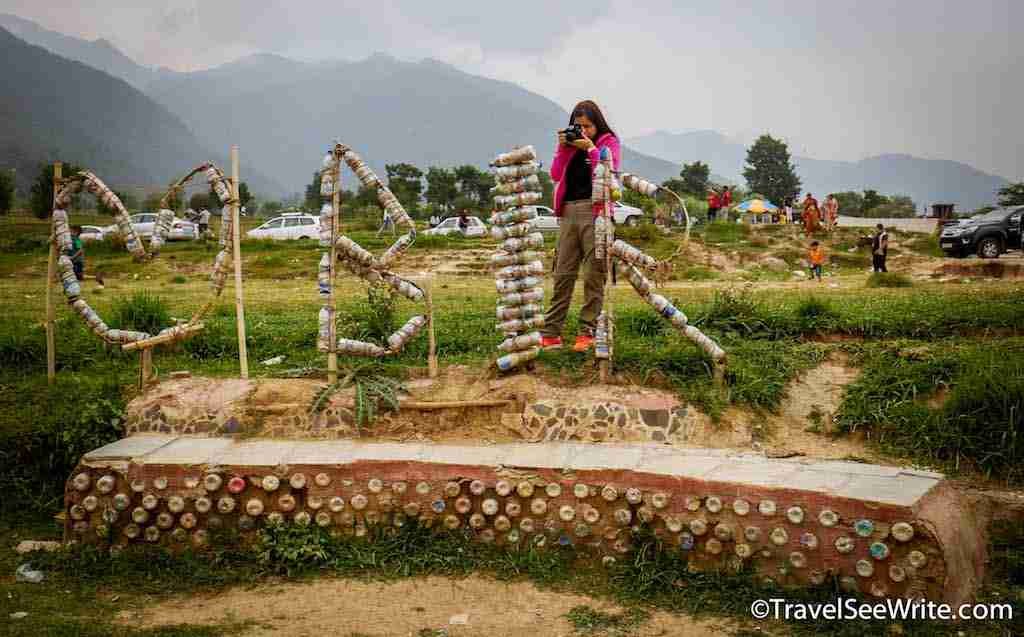


When you think about the best hill stations in Tamil Nadu, very few can match the charm of Ooty. Nestled in the Nilgiri Hills of Tamil Nadu, it is one of the most popular tourist destinations of South India. The lush green tea plantations, towering mountains, dense eucalyptus and pine trees and sparkling lakes make this hill station worth visiting. No wonder the Britishers called it the ‘Scotland of the East’ and since then the hill station of Tamil Nadu has lived upto that reputation. Not only this beautiful hill station of Tamil Nadu is great to look at but offers endless things to keep you busy.
It is indeed a fun experience to sit on a train right in the lap of nature. Declared a World Heritage Site by UNESCO, the Mountain Toy Train was built by the British in 1908. The train journey will take you through tunnels, curves, and bridges.
Built in 1847 by the British the gardens are massive and cover more than 22 acres of land and boast of over a thousand species of flowers. The garden is a horticulturist’s delight and a 20 million years old fossil tree is the highlight of the garden.
A 2.5-kilometre long lake which is a popular destination for picnicking. Built in 1825, people come here to enjoy paddle boating and the magnificent views of the scenic beauty of the Nilgiris.
is the first bungalow of Ooty and is a must-visit for history buffs. Built by John Sullivan in 1822, it displays impressive architecture and some great relics. Today, the Stone House functions as the Government Arts College of Ooty.
Surrounded by pine trees and glistening lake, this is a graet place to go for a family picnic or on a romantic date. Even though it is about 20 kilometers from Ooty, tourists love coming here to enjoy the breathtaking nature and indulge in the thrill of the speedboat rides available at the lake.
Located in Coonoor, Sim’s Park is a beautiful botanical garden, home to a wide variety of unusual species of plants. In 1874, Sims and Major Murray developed this sprawling 12-acre land into a beautifully landscaped park.
Climb the highest summit in the Nilgiris District to get a mesmerizing panoramic view from the top of the mountain.
Bejwelled with towering Pine trees, the Pine Forest of Ooty is an enchanting place to relish the delightful scenic view. A place to connect with the nature and oneself. It is also an ideal place to enjoy picnics at the Kamaraj-Sagar Dam.
Contrary to its name, there are no avalanches here. In fact, it is a place to enjoy the calmness of the hills of Tamil Nadu. Along with the nearby Emerald Lake, it is a great place for families, friends or couples.
Ooty, the resort town of Tamil Nadu, is not just about calmly enjoying the nature but you can also invoke the adventurer in you by participating in activities like fishing, rafting, and camping.
So, when are you going to visit Ooty: one of the best hill stations in tamilnadu?

If you have more time in hand, and wants to have a taste of Tamil Nadu tourism beyond hillstations near chennai, do check out the following:
The first thing that comes to mind when you think about Dubai is Luxury. The largest and most populous city in the United Arab Emirates (UAE) is one of the world’s most expensive, lavish and fashionable city. Its central location on the world map makes it an ideal city-break destination. You can enjoy an all-action day out in the desert, shop till you drop in the designer malls, get an adrenaline rush at Skydive Dubai, relish the old Dubai charm at Al Bastakiya Quarter or simply stroll on the Jumeirah Beach. While doing all this, don’t miss out on staying at one of the best 5-star hotels in Dubai.

During my last few visits, I have stayed at all kinds of 5-star hotels in Dubai – iconic landmark hotels, beachfront retreats with authentic Arabian architecture and buzzing spots with experimental restaurants and bars right in the heart of the action. While all hotels had something unique to offer, my experience at the Mövenpick Hotel was totally unexpected.
In a city where loud luxury is a norm, Mövenpick Hotel Jumeirah Beach comes across as a breath of fresh air. Like the country of its origin, the hotel appreciates the understated and quality of living. It creates an unforgettable holiday experience by pairing the exceptional luxury, contemporary design, and high-end service. This 5-star hotel is second to none in any department – the location, service, food, views and above all – a sense of belonging.
Here are my reasons to choose Mövenpick Hotel Jumeirah Beach over other 5-star hotels in Dubai.
Imagine waking up to a view of endless blue horizon hugging an emerald green Arabian Sea. Mövenpick Hotel Jumeirah Beach is ideally situated in Dubai’s Jumeirah Beach Residence close to the Arabian Gulf. Located on ‘The Walk’, it is only a few steps away from the prime beachfront mall known as ‘The Beach’ mall, which features beachfront shops, restaurants, and the UAE’s first outdoor cinema. And, in case you want to shop more, just walk for 10 minutes to reach Dubai Marina Mall or drive for 25 minutes to the Dubai Mall, the world’s largest mall.
You won’t even have to worry about missing your flight as it is just 30 minutes’ drive away from Dubai International Airport and 20 minutes from Dubai World Central-Al Maktoum International Airport. The commute is never a problem at Movenpick with 24-hour taxi service right at the doorstep and the nearest Tram station is just 500m away.

And, as you step out of your hotel you can enjoy the bustling yet relaxed resort vibes of the idyllic beachside with a contemporary Arabian touch, which is coincidentally named as the BEACH. The golden sand beach can give Boracay’s White Beach run for its money when it comes to the powdery smoothness of the sand. There’s plenty to do – from a wide selection of beachside dining and shopping to water sports such as parasailing and wakeboarding. There’s also banana boat rides and even a train for the kids to enjoy. If you’d prefer to keep your feet dry, you can take a camel ride along the beach – and all with the iconic city landscape in the background.
The four dining options at Mövenpick Hotel Jumeirah Beach combine taste, variety and vibrant atmospheres.
For me, Breakfast is the most important meal of the day and Mövenpick knows how to delight its customers. Fresh food, elaborate buffet, interactive live cooking stations and world flavours blended in to give me an ideal kind of start I wish for my mornings. The most touching part happened when one day I woke up after the breakfast hours. However, the staff was so sweet and helpful that despite me being late, they prepared a fresh breakfast and didn’t even charge me extra. Now, aren’t these small things make a big impact on customer loyalty?
The restaurant is famous for having theme-night dinner buffets (where the theme changes daily from an Italian night to a BBQ night and many more) and the award-winning Talk & Soul Friday brunch (featuring specialty food and drinks from different countries every week). The all-day dining restaurant has an open kitchen and offers indoor and outdoor terrace seating.

The Talk, Mövenpick Hotel Jumeirah Beach, Dubai
Being a New York lover, this stylish New York restaurant became one of my favourite during my stay at the hotel. Relishing the vibrant flavours here made me undertake a culinary journey through the finest “foodie” neighbourhoods of Manhattan. The food that I had here sounded common but was finger-licking good in taste. I am not a fan of tomato soup but I couldn’t stop gulping when I sampled the one made here with roasted tomatoes, brown onions, tomatoes juice, basil pesto, salt, and pepper.
The crab salad made with Jumbo lump crab, Australian avocado, ripe mango and sweet melon dressed in passion fruit dressing still brings back delish memories. My friend who enjoyed Short Ribs said he never had better ribs before than here. My exquisite meal was complimented with Reserva Cabernet Sauvignon red wine.

Thanks to Chef Valerie, Restaurant and Lounge Manager Nadia Moujahid and the restaurant Captain Laxmi, I had a great evening dining at the al fresco poolside of the Soul Restaurant and Bar. It is a place I would recommend to anyone who loves good food and great ambiance.
This seductive and sizzling outdoor lounge comes with over 30 different shisha flavours, an a la carte mezze menu, live charcoal BBQ and Saj bread stations, complimented with oriental tunes. The contemporary poolside cabanas make the setting even more romantic at night.

Poolside cabanas at Layali Sisha Pool Lounge, Mövenpick Hotel Jumeirah Beach, Dubai
If you are a sports fan like me and don’t want to miss the game of your favourite team or player, head to West Beach Bistro and Sports Lounge, one of Dubai’s favourite sports bar. The multiple screens, the longest Happy Hour on the Walk and a pool table for entertainment will keep you hooked for the night. The bar is open seven days a week and is on first come first serve basis.

Staying true to its brand promise of ‘making moments’, the hotel very well know that small gestures make a big difference to people. Their Swiss roots and brand philosophy of ‘doing ordinary things in an extraordinary way’ has brought them a lot of success and accolades. Year-on-year the highly rated hotel has been winning awards and customers love alike. Upon searching online I hardly came across any negative review about the property. Here are some of the awards they have won lately.

Mövenpick Hotel Jumeirah Beach, Dubai won/nominated following awards:
As I walked into my Executive lounge on the eighteenth floor, I was greeted with sumptuous surroundings, mood lighting and exceptional views of Dubai seaside. There were 294 well equipped, and superbly comfortable rooms and suites with balconies and sea view. In the white, brown and golden tones, my room appeared very therapeutic in nature. I am a huge fan of service with an additional personal touch and I was delighted to find a welcome reception basket comprising of a beautifully hand-made Swiss chocolate basket, fresh fruit basket and a fruit wine. Along with this beautiful reception, I had an exclusive access to the Executive Lounge that came with benefits of breakfast, afternoon refreshments, evening drinks and canapés, newspapers, and business services. The lounge had an outside terrace with views of the Palm Jumeirah.

Happy Hours at the Executive Lounge, Mövenpick Hotel Jumeirah Beach
I had a very relaxing stay in my My 70 sqm suite that came with a king bed, a spacious living room and a private balcony in both the rooms. The best part about my suite was the en-suite bathroom that came with a separate bathtub and walk-in shower. Other in-room facilities included free high-speed internet, air-conditioning, a working desk, a safe, LCD TV, tea and espresso making facilities and the well-stocked minibar. A beach kit (a towel, an umbrella and a beach mat) was also available on request at the public beach counter.

Welcome Basket, Executive Suite, Mövenpick Hotel Jumeirah Beach, Dubai

Executive Suite, Mövenpick Hotel Jumeirah Beach, Dubai

The best 5-star hotels of Dubai: Master Bedroom of Executive Suite, Mövenpick Hotel Jumeirah Beach
Let me warn you beforehand – staying Mövenpick Hotel Jumeirah Beach is spoiling yourselves with the sophisticated Swiss luxury. The sense of belonging is so much here, you wouldn’t ever want to leave. While I have already discussed many of the Hotel facilities above, let me talk about few other things that stood out for me.
Mövenpick Hotel Jumeirah Beach cares not only for your wellbeing but for your kids too. That’s why besides an outdoor pool there’s a kid’s pool as well. You can grab a coffee at the café located in the main lobby or relish the world famous Mövenpick ice-creams. The property also has a nearby snack bar/deli. You can enjoy your drinks at any of the 2 hotel bars or at the poolside bar. Public areas are well equipped with complimentary Wi-Fi. You can use the business centre, a limo/town car service and a meeting room. Event of any scale can be organised in smaller conference rooms or in a 5920 square feet area. Here is a list of all the facilities available at the hotel:

Poolside Mövenpick Hotel Jumeirah Beach
The best part of Mövenpick Hotel Jumeirah Beach is its signature Swiss service. The staff remembers you by name and are genuinely warm, helpful and professional. Their personal touch is of a different class. Whether it was Louana who handled my booking or the front office staff who suggested me a cheaper way to commute than using a taxi, the servers at the restaurants who remembered my meal preferences or even the housekeeping staff who kept my room spic and span; everyone made me feel at home. Interacting with them was like interacting with a family.
You can book directly on the hotel website Mövenpick Hotel Jumeirah Beach or you can also book through a third-party website like tripadvisor.com or booking.com
They have a lot of exciting offers to choose from like the Summer sunrise, Stay & Save, Your family summer stay, Your summer couple’s retreat, Go Weekend, All-inclusive Package, Romantic Retreat and Spa-rkling Escape amongst many more. Before booking, don’t forget to glance through those. The offers start at as low as 338AED and go up to 1700 AED.
Have you ever stayed at Mövenpick Hotel Jumeirah Beach or any other best 5-star hotels in Dubai? If yes, I would love to hear from you.

Srilankan Airlines Business Class flying experiences
Whether it’s a quick business trip to a city less than two hours away or boarding a long-haul transcontinental journey, a good or a bad flying experience can set the tone for the rest of your trip. Here’s my experience of flying both Srilankan Airlines Business Class as well as Economy from Delhi to Colombo and back.
I would rather fly on a budget than spend money on a more comfortable but an expensive flight
I don’t waste my money on expensive flights and hotels
Flights are just meant to transfer you from one place to another. Why waste my money on them? But when I fly on work, I insist to fly only on a full-service carrier.
These are some of the usual responses I get when I ask people about their preferences for flights. Low-cost airlines have definitely changed the game and democratised the flying experience, which was a privilege of few before the no-frill airlines entered the scene – 70s in the US, 90s in Europe and 2000s in Asia. However, with the competition sky-high in the aviation industry, there is not much difference in the fares of the budget and full-service carriers. And, I always say that paying a bit extra for added comfort is not an expense but a wise investment. Also, my experience with an airline doesn’t begin at bag drop – it begins online when I book my flight. A comfortable journey in the air directly impacts your next day. So, I always choose comfort over saving a few bucks.

I recently flew Srilankan Airlines Business class. Here is what I experienced.
Honestly, I had heard very little about the airline before I started planning my trip to Sri Lanka. Additionally, being an Asian Carrier, I wasn’t expecting much from the airlines. I thought Srilankan Airlines would be either worse or at par with other Asian Airlines (except Singapore Airlines, which is in a different league altogether). I was mentally prepared for having bad food, congested seats, and late departure.

Srilankan Airlines Business Class experience
I was super delighted with their service and it set a beautiful precursor to my unforgettable trip to the island nation.
Despite having a long queue of customers and serving at an odd hour i.e. 2:30 am, the ground staff was very warm, courteous and checked in with a big smile. The check-in was quick and flawless. Luckily, I was flying Business Class so the process was even smoother. There was a separate entry for business class.

Srilankan Airlines Review: Abhinav and I before the take-off of our flight
As I boarded the plane, a hostess with 100 watts CFL bulb smile wearing the country’s national costume, the osariya based on the pattern of a peacock welcomed me with both her hands held together close to the heart and softly said “Ayubowan”(the word used in Sri Lanka to greet someone).

Srilankan Airlines Air Hostess greets you warmly as you enter the aircraft
I kept my luggage in the spacious overhead cabin and comfortably settled in the reclining seats that could fit a person double my size. The welcome continued with the amazing drink choices and warm towel. And that was just the beginning of the amazing service to follow, their food and beverage collection was impressive.

Srilankan Airlines Review: Beverages
I ordered a vegetarian meal prepared with lip-smacking Sri Lankan curry flavours. There was also a provision to pre-order meals in case you have dietary restrictions.

Srilankan Airlines Flight Review: Enjoying my in-flight meal

Srilankan Airlines Flight Review: Inflight meal
At the back of the seat, there was a state of the art AVANT in-flight entertainment system with the latest blockbusters from Hollywood and Bollywood, and a collection of classics and favourites. I felt I was sitting in my living room with a 15.4-inch screen with over 50 TV channels, 120 movies, an extensive library of audio CDs and radio channels, and many games for all age groups.

Srilankan Airlines Flight Review: Inflight Entertainment & cabin space
There was also a USB outlet to charge your phone or iPad. Headphones were noise-cancelling so you really get transported into your entertainment zone. I usually fill up my movie quota during my flights but it was an odd hour of flying and I hadn’t slept for a second in the last 48 hours, so I decided to give my eyes a bit of rest and be in the dream world by listening to the soothing instrumental music playing on the noise-cancelling headphones provided by the Sri Lankan Airlines.
Along with the Business Class travel, comes the added benefit of Lounge Access at Colombo. I was a bit late reaching the airport, therefore, I couldn’t spend as much time at the Lounge as I wanted. Located on the first floor of the departure hall at BIA, overlooking the Aircraft Parking Bay, “Serendib” is an exclusively branded SriLankan Airlines Lounge for its most valued premier customers. There was a good variety of food like pasta, loaves of bread, curry etc. to choose from. Also, a big bonus was the complimentary 15 min massage sessions. All the stress of airport walking and carrying around bags vanishes with the most rewarding foot massages and Ayurvedic balms. Unfortunately, I had to miss this one too.

Srilankan Airlines Flight Review – Business class lounge at the airport
While returning from Colombo, the flight was completely booked and I couldn’t get a business class, so I flew in Economy. The experience was good. Although, I did feel a bit cramped in the seats, which is common for flying economy with any airline. I was flying early morning, so I gave my dinner and in-flight entertainment a miss.

Srilankan Airlines Flight Review – in-flight food
The landing and cabin service was fantastic. The icing on the cake was the magical sunrise with cloudscape from my window seat at 37,000ft above ground level. The majestic rays illuminated the horizon in yellow-orange light and the fluffy clouds danced in choreographed steps.

Srilankan Airlines Flight Review/ sunrise from the window.jpg

Srilankan Airlines Flight Review: sunrise from the window

Srilankan Airlines Flight Review: Sunrise view
Having flown on some of the best airlines, I have experienced more luxuries, better gadgets, and amenities. However, when it comes to hospitality, Sri Lankan Airlines Business class can match any top carrier with its warm hospitality. And, it wasn’t just business class, even in the economy, the staff made sure my journey was comfortable.
Have you flown with Srilankan Airlines Business class? How was your experience? I would love to know your thoughts.

Srilankan Airlines business class experience
PS: In my next article I am going to share my experience of visiting the Pearl of the Indian ocean and how every nationality that has visited and traded over the years has left its mark – the Dutch, Portuguese, English, Arabs, Malays, Moors, and Indians.
Inspired? Pin these to your Pinterest boards |
||
 |
 |
 |
I went to Sri Lanka on invitation from Srilankan Airlines with Outbound Konnections. The views expressed above are mine and based on my personal experiences. All the photos posted are either clicked by me or provided by the airlines.

Things to do in Ireland: Visit an Irish Pub
It was one of the most arduous days of the lung-burning and nerve-fraying Everest Base Camp Trek. Despite wearing heavy layers a frosty, thin and crisp air was pricking me all over the body. The urge to turn back was Everest-high but something caught my attention. ‘The World’s Highest Irish Pub’ signboard at the entrance of Namche Bazaar stared right into my eyes. Dusting my fatigue off, I rose from the ground like some undead, iron-legged avenger. Reaching the Irish Pub at the dizzy height of 3,440m was the hardest I have ever worked for a pint of beer. But then Irish Pubs are no ordinary pubs and finding one at such a remote place was no coincidence.

EBC Trek: Irish Pub at Namche Bazaar, Nepal
Some countries send you a signal to tell you that it’s time to visit them. Three months later, I was in the birthplace of Pub Culture – Ireland. I was intrigued to know what makes an Irish Pub so great that over 80% of the tourists visit Ireland in search of Irish “Craic”. There must be something special about them that there are over 7000 Irish Pubs in over 53 countries from Mongolia to Iraq, Australia to Canada, Bolivia to Russia.
When it comes to a great pub, Ireland wrote the book. The pub has been at the centre of Irish life since the 10th century. Nowhere in the world pubs have played so many roles: funeral home, restaurant, grocery shop, music venue, job centre and meeting place for everyone from poets to revolutionaries. Often basic and unpretentious, it is a neutral ground, a level playing field – a home away from home. The story of the Irish pub is the story of Ireland itself.

Trad session is an important part of Irish Pub Culture
With a basic question in my mind “What makes an Irish Pub so great?”, I visit pubs of all shapes, sizes, and styles. A quest that takes me from North to South, East to West, from bustling bars in Dublin to quiet hole-in-the-wall taverns in coastal fishing villages and from traditional Irish living room bars to Victorian salons.
My pursuit begins from Killarney, a charming town in the South of Ireland set amidst the sublime scenery of emerald lakes, cascading waterfalls and lush woodland beneath a skyline of 1000m-plus peaks. As the evening unfolds, I venture out to enjoy some “Craic” (the Irish word for fun) at the Murphy’s Bar, a centrally located family run traditional Bar since 1955.

Things to do in Ireland: Visit the Murpheys Bar, Ireland
I take a moment to appreciate the lively and homely character of Killarney’s beloved Public House (that’s where the word “Pub” comes from) matched only by its coveted reputation for good food and traditional music. Its stone built walls, wooden beams and local historic decor create a conventional-meet-contemporary atmosphere which attracts locals and visitors alike. Its extensive menu is a dream come true for foodies – you can choose from the traditional dishes like Beef and Guinness Casserole, Irish Stew to fresh seafood like Kerry Mussels. The must haves are the homemade desserts and fine Irish cheese varieties. I walk in as a solo traveler but end up making a lot of friends.

Things to do in Ireland: Visit the Johnie Fox’s bar, the highest Irish Bar in Ireland
There are no strangers here, only friends you haven’t met yet
This famous quote by Irish poet William Butler Yeats must have referred to an Irish pub. With the evolution of time, the Irish pub has evolved into a global institution that’s synonymous with hospitality, camaraderie and, most of all, community. As I sip my Guinness, Tom Kennedy, who runs Experience Ireland Golf & Travel company, joins me and explains what makes an Irish Pub so great,
One word really, the “craic”! It’s tough to quantify this, is it the people that frequent the pub or the atmosphere or the quality of the pint you are served? Is it live music, or the welcome you receive from the locals and the staff or that random stranger who will chat to you for hours at the bar about even more random topics? It’s all of this really, plus a roaring turf fire as well!
After enjoying an evening of the delish food, interesting conversations and live Irish music over few pints of Guinness, I call it a night.

Trad session at Reiddy’s Bar, Killarney, Ireland
Next day begins with a visit to one of the prime destinations on Ireland’s Wild Atlantic Way – the Dingle Peninsula. A sleepy town brought to limelight by its legendary resident – ‘Fungi’ – the dolphin who made the town his home over a quarter of a century ago. Dingle tugs my heart with its splendid seacoast vistas, pristine beaches, rugged mountain passes, deep green valleys, colorful little towns, lively fishing ports, and of course great Irish Pubs. Pubs that made Dingle a center of literary and creative culture. Music plays long into the night, and festivals are held throughout the year.

Things to do in Ireland: Visit the Murphys at Dingle, Ireland
As I relish the stunning views of Dingle Harbour from the cozy setting of Boatyard restaurant and Bar, Peter McMohan, an executive with Failte Ireland, adds to my topic of interest,
Irish pubs are known for a great character – and nightly sessions of traditional music and lots of “craic”. Even if it is pouring rain, Ireland will warm your heart with its convivial pub houses. Here new acquaintances are made, old friendships are rekindled and family lore is passed on to new generations.

Things to do in Ireland: Visit the Boatyard Restaurant and Bar, Dingle
On our way back to Killarney, we take a small break at the Dingle Whiskey Distillery, an artisan distillery that rekindled the tradition of independent distilling in Ireland. Two hundred years ago, this small island had over a hundred officially recognised distilleries; by twenty-first century there were just two. Dingle distillery was established to revive a dying tradition. Now, isn’t that a testament to an Irish Character?

Things to do in Ireland: Take a Tour of Dingle Distillery, Ireland

Things to do in Ireland: Go for Whiskey Tasting at Dingle Distillery, Ireland

Things to do in Ireland: Visit the Dingle Distillery, Ireland
Irish pubs go beyond alcohol as they are the melting pots of social encounters, in which all social ranks come together. At the time of the Irish Revolution, bars became the springboard of social movements giving everyone a voice. Pubs in the Emerald Isle carry distinctively Irish flavor that is not limited to alcohol, age, gender, status or any other bias. A fact further expounded by Sarah Dee, the Global Digital PR & Content Marketing Head, Ireland Tourism. She beautifully narrates,
The Irish pub is never just a place to grab a pint. It’s the heart of the community, where family and friends come together (children are allowed until 9 pm, as most places serve food, too). It’s where local stories flourish and grow, where legends come to life, and where the craic flows freely. Interested in Titanic? How about meeting a ghost? Whatever you’re in to, in Ireland, there’s a pub for that.

The Temple Bar Pubfront in close up with artwork of medieval characters
Pubs in Ireland are not limited to “craic” alone but are a talent breeding ground too. Interwoven into the country’s cultural, intellectual and social fabric, they are what Vienna’s coffee-houses are to its golden age, or the classic cafes of Paris are to its great period. Many great writers like James Joyce, Samuel Beckett, Oscar Wilde and Brendan Behan got their inspiration in Literary Bars. When I ask Sarah for a recommendation, she says
A must-visit is Grogan’s of Dublin where from regulars nursing their favourite stout, to the city’s most talented young writers and artists – you’ll meet more than a character or two. With no TV or stereo (and no plans to install one, either), the air buzzes with chat and laughter. Grab one of their legendary toasties, made with succulent ham and gooey melted cheese, and watch the world rush by!
And, it’s not just literature that has gained from the Pub Culture. The Traditional Irish Music and Dance has penetrated the most impermeable walls of the world. Musicians and dancers have found unwavering support in these unusual institutions of creativity. Musicians of all kinds come together for sessions where anyone can join in at any time.

Things to do in Ireland: Attend the Temple Bar Trad Fest
When my effervescent guide, Barbara, takes me to the Merry Ploughboy Bar in Dublin for a “Trad session” (musical evening) combined with a ceilidh (traditional Gaelic dancing), I have no clue what I am in for. Later I discover the Merry Ploughboy Bar is the only pub in Ireland owned and managed by Traditional Irish Musicians. For more than five hours I swing and sing to the tunes of the award-winning traditional Irish Dance and Music show while enjoying my three-course meal scrumptious dinner.

Things to do in Ireland: Watch the Traditional Irish Dance Show at Merry Ploughboy, Ireland

Things to do in Ireland: Watch the Merry Ploughboy Pub Trad session, Dublin, Ireland
Dublin architect Mel McNally who started the Irish Pub Company that designs, manufactures and installs authentic Irish Pubs and Bars globally believes authenticity is the key to a successful Irish pub,
Authentic design; authentic Irish food; authentic Irish beverages; Irish music and entertainment; and employees and management training ‘the Irish way’.
Pubs are the heart of the Irish social scene, and whether you’re a teetotaller or a beer-guzzler, they should be a part of your travel here. Even Barrack Obama, the ex-President of the United States, couldn’t say no to sláinte!

Ex. US President Barak Obama enjoying his pint of Guinness

Oliie Hay’s Bar where Barack Obama had a Guinness, Ireland
So, when are you going to experience the great Pub Culture in Ireland?

The Shire Bar, Killarney, Ireland

Dan O’Connell’s Bar, Ireland

Guinness is a must when visiting an Irish Pub, Ireland
Interested to know more about Ireland, don’t forget to read
Things to know before you visit Ireland
Why visitors never want to leave Ireland
Have you been to this beautiful island nation? What things did you do in Ireland? I would love to know your thoughts.
A section of this story has been published in several publications like:
Inspired? Pin these to your Pinterest boards |
||
 |
 |
 |
I was in Ireland to attend TBEX Europe 2017 where I was a featured Speaker. I was hosted by Tourism Ireland. Everything expressed above is based on my personal experience and conversations I had in the country. Images used are either shot by me or provided by Ireland Tourism with due permissions.
When the London journalist George Sala conferred the title ‘Marvellous Melbourne’ on a visit to the city in 1885, the down under city was the biggest and wealthiest city in the British Empire after London. Ever since the phrase struck a chord with everyone. And, it comes as no surprise why the ‘Queen of the South’ has been named the world’s most liveable city consecutively for the record 7th time by the Economist.

Melbourne City, Australia
The second largest city in Australia (after Sydney) is both dynamic and cosmopolitan. On one hand, it is Australia’s sporting and culture capital and on the other hand, it is recognised as a UNESCO City of Literature. Known as a leading financial city in the Asia-Pacific region, Melbourne is home to some of the Southern Hemisphere’s best art, food, and music. The city grows on you like a fine wine – from timeless trams to stroll-worthy laneways binding you in the social fabric and culture of the city. No one ever wants to leave the city and if reluctantly they do, they leave with a promise to return soon. So, let’s find out what’s so enchanting about ‘Marvellous Melbourne’ that tugs your heart.

Melbourne has something for any culture hound, from the majestic National Gallery of Victoria to the colourful graffiti-filled laneways containing some of the best street art in the world. From weekly festivals to quirky fashion shows, there is always a show, exhibition or performance going on. One thing that shouldn’t be missed at any cost is its artistic graffiti laneways. Walk into any famous laneway and you’ll see droves of the camera-wielding crowds snapping graffiti, and art installations.

And, why not? The hive of the bustling, creative laneways of Melbourne are iconic and form the throbbing heart of the city. Unused laneways have been given a new lease of life by transforming them into trendy hole-in-the-wall cafes, famed restaurants, astonishing bars, stunning art galleries, covert boutiques and a larger than life canvas for street artists. It’s a crime to leave Melbourne without paying homage to these modern temples of creativity – the ACDC lane, Hosier Lane, Centre Place, Flinders Court, Union Lane, Presgrave Place, Russell Place, Stevenson and Tattersalls Lane, Drewery and Sniders Lane and Blender Lane.

Additionally, it’s not just the laneways that are given a facelift. The city is equally passionate about maintaining, restoring and sharing its heritage and culture. The beautiful old arcades sandstone heritage listed buildings, decadent theatres, and old government buildings are well taken care of and are open to the public. Near the historic Flinders Street Station in Melbourne’s Central Business District (CBD), the decade-old Federation Square has become a hotspot for performances and cultural events. The square is now considered one of the world’s best public spaces hosting more than 2,000 events a year.

Things to See and do in Melbourne: Visit the Flinders Street Station
It’s not the high-rises that will catch your attention when you first land in Melbourne but the sporting culture that is the lifeblood of the city. Melbourne is officially recognised as the sporting capital of the world and that explains why ‘Sports Business’ named Melbourne as the Ultimate Sporting City in 2006, 2008, 2010 and 2016. Here, the sport is not passively watched but passionately worshipped.

Things to do and see in Melbourne: Watch Ashes
In fact, sporting events have nearly as many public holidays allotted to them as religion – everyone gets the day off for the Melbourne Cup horse race and the Friday before the AFL Grand Final! Attending the Boxing Day Match at Melbourne Cricket Ground (MCG) is as revered as a Christmas midnight mass. Melburnians are passionate about AFL football, cricket, and horse racing, while grand-slam tennis and Formula One car racing draw visitors in droves.

Things to See and do in Melbourne: Watch a match at MCG
So, when you book your ticket to down under, do take a look at the annual sporting calendar of Melbourne. Some of the key events are the Australian Open, Australian Formula 1 Grand Prix, the Boxing Day Test, the Spring Racing Carnival and the AFL Grand Final. The city is also home to superb state-of-the-art facilities like the MCG, AAMI Park, Etihad Stadium and Melbourne Park.

Things to See and do in Melbourne: Watch Australian Open Match at Melbourne Park
Melbourne is a serious culinary hotspot, with everything from burger joints to posh restaurants. The influence of multiple waves of immigration can be felt at every level, from the city’s longstanding obsession with coffee to a European drinking culture, to a lifelong affair with the flavours and spices of Asia. Basically, any kind of food you want, Melbourne has it. Whether you’re craving for modern, traditional, exotic or homespun flavours – Melbourne’s eclectic dining scene will satiate your hunger with a startling array of the world’s greatest cuisines.

Ethnic communities have settled together in some areas, and as a result there’s a neighbourhood for each cuisine – head to Victoria St in Richmond for Vietnamese food, Lygon St in Carlton for old-school Italian, Balaclava for Jewish bakeries, Fitzroy for Spanish, Brunswick for Lebanese, Footscray for African and Chinatown for Asian cuisine.

Fruit & Vegetables Market, Queen Victoria, Melbourne
And, when it comes to dining, drinks can’t be left behind. Being close to the wine region, Melbourne serves up some of the best quality wines in the world. Try wine at St Jude’s Cellar where bare-bricked walls are stacked with myriad wine bottles.
There are certain cities that can turn even non-shoppers into shoppers. Melbourne is one such example. There are bargains galore at the inner-city outlets – DFO South Wharf, Harbour Town Docklands. If you are looking for designer bargains head outside of the city on Bridge Road, Richmond and Smith Street in Collingwood. Between the bargains, haggling and hidden treasures, markets in Melbourne are a must-visit for tourists. For the largest open-air market in the southern hemisphere visit the historic 140 years old Queen Victoria Market. For vintage trinkets, knickknacks, and hot jam donuts visit Camberwell Market and for one-of-a-kind, artistic creations take a stroll through Rose Street Artists’ Market.

Shopping is therapeutic in Melbourne where the laneways and historic arcades are pieces of artwork themselves and exploring them is like going on a treasure hunt. You can either explore them on your own or join a shopping tour and shop till you drop at warehouses, outlets and little-known boutiques.
The meandering Yarra River is the undisputed social heart of ‘Marvellous Melbourne’. Lined with restaurants, shops, and footpaths the banks are always bustling with action. The banks of the river have many barbecue and picnic facilities, fishing platforms, and jetties. You can either take a boat ride, go on a picnic stroll or enjoy a meal with a view at Southbank’s entertainment precinct.

Things to See and do in Melbourne: Take a boat ride in Yarra River
In addition, there are trails and paths for the cyclists, walkers, and joggers. Also, Yarra River functions as the backdrop for numerous spectacular events like the famous Moomba festival, Rowing Regattas, the Melbourne Festival and Dragon Boat Festival.

Love locks on Yarra River Bridge, Melbourne
Melbourne is gifted to have so many beaches right on its doorstep. Drive six kilometers south-east of the city and you reach the St Kilda Beach. Travel further down the coast and you’ll reach Dendy Street Beach which offers panoramic views of the city and is home to Brighton’s historic bathing boxes.
Few cities are as perfectly positioned for day trips as Melbourne. In an hour to a day’s drive out of town, you can find yourself watching wild penguins and koalas, admiring world-class wineries, rejuvenating at thermal hot springs, walking through ancient rainforests, or relishing the spectacular Grand Ocean Road views.

Things to See and do in Melbourne: Go on Great Ocean Road Drive
The jewel attraction of Victoria, Great Ocean Road, is best explored over a couple of days; however, if you only have a day, you can still take in the highlights of the eastern end of the route. Other must visit places are Mornington Peninsula for pretty seaside villages, superb wineries, fine hot springs, great restaurants and a whole lot of golf, Philip Island to join the penguin parade when hundreds of little penguins come ashore at Summerland Beach after a day swimming at sea and Yarra Valley to savour the world-class wine and wildlife.
Related: Wanna read more about the Philip Island? Don’t forget to check out the Penguin Parade on Philip Island.

Things to see and do in Melbourne: watch Penguin Parade

Things to do and see in Melbourne: Hit the beach
While Melbourne is an exciting destination to travel throughout the year, it is most fun during the summer months of December to March. The weather is pleasant and warm – perfect for sightseeing and other activities. However, be warned, it’s best to always take a pullover and an umbrella wherever you go. It won’t be wrong to say you can see four seasons in one day here. Interestingly, ‘Melbourne’s temperamental weather’ inspired the Crowded House to come out with a hit song Four Seasons in One Day.

Things to See and do in Melbourne: explore the city with train
It’s very easy to see all of the city’s best attractions, sporting venues and shopping precincts by trains, trams or buses. All you need is a myki card and you’ll be ready to travel around the city. Downtown is pedestrian-friendly, with one of the world’s most extensive tram networks. The City Circle tram is a free tram that travels around the city in both directions taking you to the tourist hotspots. Melbourne’s tram system connects the CBD with the city’s suburbs and there are many dedicated bike paths and bike lanes on the roads.

Have you been to Marvelous Melbourne? I would love to know your experience.
Malindo Mag: Cover Story for the Month of May 2018
Inspired? Pin these to your Pinterest boards |
||
|
|
|
I have explored Spain, Kenya, Sri Lanka, and Switzerland with Travel See Write. Every experience was customised as per my family’s requirements, and each trip was fully customised.
Vaibbhav Sud
Delhi
I travelled with my family to Finland using Travel See Write. The team went above and beyond to make our stay enjoyable. They were even available at 3 am for services beyond their usual duties. ”
Gautam Kriplani
Jakarta, Indonesia
This is not a typical luxury travel agency — this is travel with soul. They take care of the minutest details and customise the tiniest things for us. I have travelled with them to Japan, Finland, Costa Rica, Russia and the Philippines.
Vineet Nanda
Delhi
I have explored Spain, Kenya, Sri Lanka, and Mongolia with Travel See Write. Every experience was customised for my family, and each trip was special
Sunil Sharma
Delhi
This is not a typical luxury travel agency — this is travel with soul. They take care of the minutest details and customise the tiniest things for us. I have travelled with them to Japan, Finland, Costa Rica, Russia and the Philippines.
Aman
Mumbai

Lorem Ipsum is simply dummy text of the printing and typesetting industry. Lorem Ipsum has been the industry's standard dummy text ever since
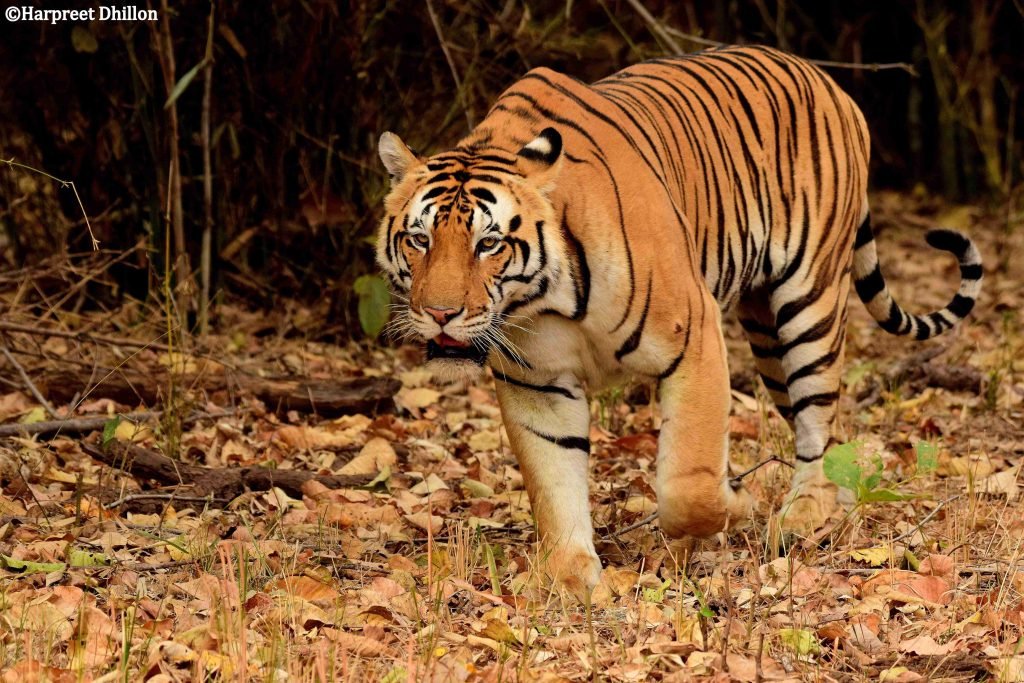
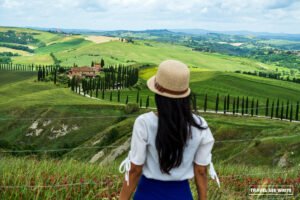
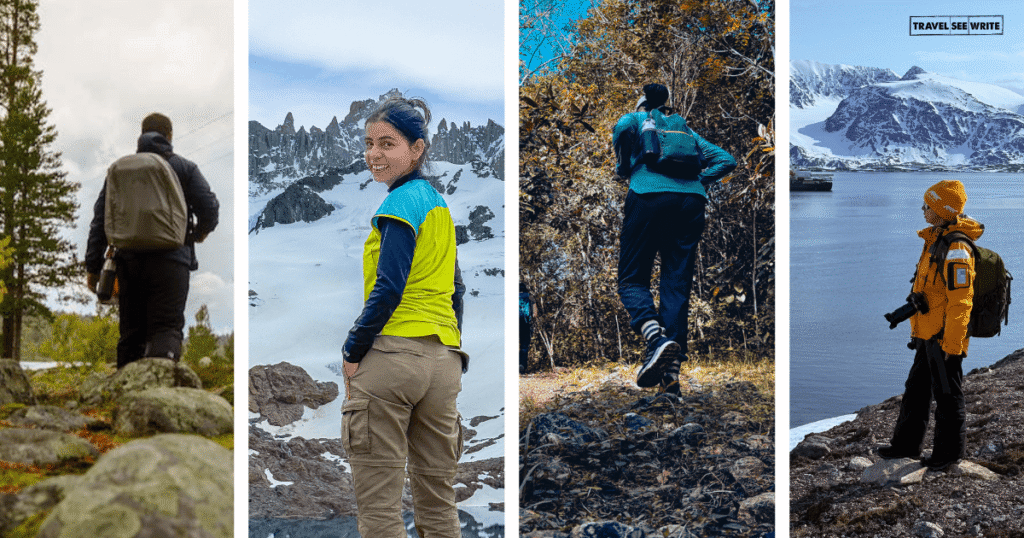
Luxury travel should feel seamless from start to finish.

Begin with our online form. We then connect for a detailed conversation
No booking fees. Ever.
We fine-tune your bespoke itinerary until it feels perfect.
With confidence, care, and 24/7 on-ground support throughout your journey.