


You Enquire
Begin with our online form. We then connect for a detailed conversation
Sometimes when you are in a long distance relationship, you miss out on the daily moments of happiness. But that doesn’t mean your feelings change. In fact your feelings grow stronger and fonder with each passing day. If presence strengthens love, absence sharpens it. And when you meet again magic unfolds. Love and magic have a great deal in common. They mesmerize the eyes, enrich the soul and delight the heart. And they both take a sincere effort to make it work.
26th January 2015 was one such moment, when I again met my first love – Pangong Tso. Love is like pi — natural, irrational and never ending. And so on the day when our forces and paramilitary forces were displaying their military prowess and love for the nation, I was parading my unflinching love for the Himalayan masterpiece – Pangong Tso, the highest saline water lake in India. As they say, sweet are the fruits of adversity. Despite the harsh cold weather and bad health, I treaded on the difficult but heavenly path to embrace my love.
Leh to Chang La – Road to both Heaven and Hell

Frozen shores of Indus enroute to Pangong
With my travel buds, Sidd and Rutwik, I embarked on the beautiful journey, which was ready to enthrall us in a way that no one had imagined. But not before setting a foundation of a great adventure. Thanks to extreme cold (-20 degree C), our car – Xylo got extremely lazy. Chucking our early start plans out of window, it refused to wake up until 9:30 am. With empty stomach but starry eyes we finally started off our journey, when the reticent sun was out to give us company. Our first pit stop was at Punjabi Dhaba at Karu. Aloo parathas with cholle and curd were delicious; service was quick and price was economical. The landscape was breathtaking – frozen Indus shores with emerald green water, sleepy golden brown valleys, mountains decked up in white, brown, grey, purple attire, mud houses adorned with colourful ‘Om mani padme hum’ prayer flags, serpentine buttery roads, locals greeting us with a friendly Julle. Very soon our car crossed the plains and cautiously entered the frozen zone. It was skating on first and second gear on freshly powdered snow. Before starting our final ascent to the mighty Changla Pass at Zingral, we had a heart-in-a-mouth experience when our car skidded and turned by 120 degrees. Few inches here and there and this article would have never seen the light of day but thankfully our experienced Ladakhi driver saved the day and we were back on track.

Zingral Army Base camp where our car skid
Chang La to Pangong Tso – Summer Hues changed to Ice Age Setup

Frozen Changla – The Third Highest Motorable Pass
As our car stopped at Changla, a furry Himalayan fox look alike dog came to welcome us. Changla normally has snow always on top but this time it was different, the whole landscape was white and barring a few army personnel and few dogs there was no living being in sight. I was running high fever and wasn’t in a condition to step out but how can you miss posing at world’s third highest motorable road pass? So I stepped out, only to realize that the blizzard was too much to handle for a city slicker like me. Within two minutes I was back in our car. After the mandatory photo-op for ten minutes we started our onward journey to the brackish lake. The down slope towards Durbuk has changed from what I had seen in August. The whole stretch of sand zones and glacial streams was covered by snow. Looked like God had put a pause button on everything. Pagal Nallah looked like a piece of cotton ball – so beautiful and so pristine that you couldn’t possibly imagine what it becomes in summers. Instead of the lichen and wild grasses in shades of reds, golds and lime greens there was just one shade – frozen white snow. No friendly marmots or Bar Headed Goose or Brahmini Duck was in sight. However, there were wild horses and pashmina goat running around.
Around 2’o’clock, I saw Pangong Tso, my first love again. The first view of the lake was unbelievable. My love was a little off colour. Where had the colourful lake vanished? Did Chinese steal it overnight? Did Monday blues suck the blues out of the most beautiful blues? Thankfully none of it happened. Only Pangong Lake was trying a new outfit – a pristine white suit. I was so excited seeing the first glimpse of the lake that I was dying to hug it tightly and to never let it go. At last, the long parted lovers had met. I had fallen in love with my first love, again.

First glimpse of Pangong Tso, Ladakh

Two shades of Pangong Tso – Frozen and Non Frozen
We reached the 3 idiots point, usually a spot bustling with tourists and makeshift dhabas in summers, transformed into a land without a trace of civilisation. It was just the three itinerant travelers and my first love – Pangong Tso. Though the lake was not completely frozen, the tapestry of blue was missing, which usually reflects seven shades on a sunny day in summer. But it still looked amazing. Pangong Tso is not called the ‘enchanted lake’ for nothing. Whether summer or winter, it doesn’t fail to startle you. Though it was drop-dead gorgeous, the -20 degree Celsius weather and wind-chill was acting a spoilsport. Much against my will, I had to get back to the comfort of my car. However, the heart wasn’t yet ready to bid adieu to my love. So we requested our driver to take us on the frozen part of the lake. We were driving on the frozen lake. Taking careful steps, we first walked then jumped then summersaulted like excited little kids. Our cameras went click…click…click. After spending some quality time, with heavy heart I said bye to my love with a promise to come soon.

The non-frozen part of Pangong Tso
Our next pit stop was Tangtse where we had the most awesome momos, fried rice and thukpa in the only open restaurant – Peace Restaurant. Like the restaurant, peace was all over the place.
Changla to Leh – The Adventure of our life
Traffic jams are dreaded everywhere but nothing comes closer to a traffic jam at 17,800 ft. We had the misfortune of getting stuck in one. Thanks to the stupidity of a Xylo driver, we were stuck in a traffic jam for 2.5 hours. The guy had blocked one way on an icy narrow mountaintop and then its diesel froze. Four cars with tourists from different places were praying for their life. All the drivers were trying their best to move the vehicle. Finally it did move on a side but its engine stopped working. All other cars had put iron wheel chains to cut ice on the road and avoid falling in the deep valley. Darkness along with heavy snowfall and winds had engulfed the valley. After reaching Changla, our car abruptly broke down. Our driver removed the wheel chain which has damaged in the descend. While we were praying for our car to start, the driver from the stranded Xylo came and requested us to give lift to their passengers. We agreed but three hours of standing still in the extreme cold had taken a toll on our car too. Our fuel pump had given up. Our driver had to burn his gloves to heat the diesel pipe so that diesel could flow into the engine cylinders. After soaking in the heat from the gloves, the pump started working and we were ready to go. We waited for half an hour but when the other Xylo passengers’ did not show up, we decided to descend as our own safety was in jeopardy. But God had other plans. Hardly had we moved one and a half kilometers, our car broke down again. We were fervently praying and somewhere cursing our decision to come to Pangong Lake. We were in deep trouble. The snow-clad mountains that looked so beautiful during the day were scaring the hell out of us at night. There was no light, no sound, no connectivity, and no human in sight. Our extra diesel was about to get over. Cold was tearing us apart. I was now running very high fever. Just the thought of spending the night in that goofy extremely cold world’s third highest motorable road was sending chills to my bones. I was scared for my life. Our driver took off his jacket and was planning to burn it too to heat the diesel pipe but thanks to a bunch of helpful locals, who were coming upwards, helped us start the car and advised the driver to cover the front of the engine with his jacket and drive the car in first gear only. Thanks to their sound advise, we managed to reach safely to the valley. And all of us heaved a sigh of relief. We reached the comforts of Leh at 10.30 pm.
The Pangong experience can’t be described in words or pictures. It is a lifetime experience, which must be in everyone’s to-do list.

The real voyage of discovery consists not in seeking new landscapes but in having new eyes.
I understood the true meaning of Marcel’s words when I saw Ladakh in a completely new light, in its harshest but truest form. This was when the roof of the world was cut off from the rest of the world and was wrapped in a blanket of snow, ice and hardship.
A visit to Ladakh in winters is a digital detoxification trip where time and space bear no relevance. A million emotions erupted as I stood admiring the frozen Ladakh’s incredible beauty. Like hundreds, my initial plan was to do the glamorous Chadar Trek but the creator had a better plan in store for me. On reaching Leh airport, I got the news that Chadar Trek has been called off. I was heartbroken but instead of whining about it, I decided to do an alternate trek, Sham Valley. Though the trek was fairly easy and not as half renowned as Chadar , it bought me face to face with the real beauty of the land, which is hardly known or explored. Ladakh in winters is an intimidating yet overwhelming experience. Temperature in winters drop to -30 degree Celsius and the definition of basic amenities gets redefined.
Why did I plan my Ladakh trip in winters? Well I take pride in calling myself as a TRAVELER and not a TOURIST. I chose to explore Ladakh in its harshest times because I wanted to connect with the soul of the place and wanted to explore what is usually not seen. And I must say the reward was beyond anything that I have seen.
HERE ARE 10 REASONS WHY YOU SHOULD PLAN A LADAKH TRIP IN WINTERS:
Unlike west, Ladakh is not geared to have comfortable winters. But it is the time when you get to see the genuine beauty of the roof of the world. The only way to enjoy this beauty is to acclimatize to the local culture and habits as fast as you can. Most of the hotels in Leh are closed during winters and the only option available are the frugal Home stays – traditional Ladakhi houses. The Home Stays are basic. Most of the time, you would end up sleeping in a sleeping bag or a mattress on the floor. The water pipes freeze and water (hot and cold) is provided only by bucket. Bathing is a luxury, which no one dares to dream. No flush toilets. Only ‘compost toilets’— usually a hole in the floor on one level, where ‘excreta’ drop to ground level below, after which a liberal sprinkling of soil is deposited on top of the growing pile. Food is cooked by the local family and is mostly traditional Ladakhi meal – butter tea, kahwa, thukpa, noodles and soup served in common dining room with Bukhari.

Ladakhi ‘Compost Toilet’ at Khaltse Village (Pic courtesy Rutwik)

Hot Water is a real luxury in Frozen Ladakh
Travel tip: Stay in a kitchen instead of a room for a warm cosy night.
Walking in the Bong Bong La Snow Valley was a setting straight out of ice age or a science fiction movie. Everything was frozen – mountains, valleys, waterfalls, river shores, and vegetation. With temperature plummeting to less than -35 degree and wind chill adding another -10 degree Celsius, it was nothing less than a dream. If you are suitably covered with at least four layers of warm clothing then there is no better sight than being in Frozen Ladakh. The Khaltse to Lamayru way is incredulously beautiful where you’ll come across moon land, frozen waterfalls and frozen Indus Shores.

Bong Bong La, Sham Valley Trek

View of the the frozen village from Lamayru Gompa
Travel tip: Explore this area in a small group with a good local guide.
In summers, Mountain lakes of Ladakh act as a teaser of nature’s craftsmanship. The brackish water plays with sunlight to produce different shades of blue. In winters, almost all the water bodies freeze, yet the effect they create is unrivaled. The tranquil, azure blue waters of lake become a thick layer of ice sheet on which you can play cricket, drive your car or even do a somersault. The temperature is around -30 degrees Celsius even during the day and hence nobody spends more than half an hour there.

Tso Moriri or the Moon land in Changthang, Ladakh

Pangong Tso Lake in December
Travel tip: Start your day trip before 7 am and try to cross the Changla pass as soon as possible. Diesel freezes at that point, there is no network coverage and seeking help becomes a nightmare.
Ladkh tests your mental and physical toughness in winters. Besides doing the world famous Chadar Trek, one can also do other fairly lesser known but more challenging treks like Stok base camp trek, Markha Valley Trek, Sham valley trek at a very cheap price like 10K. They are not at all monotonous and everyday presents a different kind of an experience. When in Leh, don’t forget to watch the Leh Ice Skating rink. From December until March, Ladakh lives and breathes ice hockey.

Bong Bong La – Trekking in -35 degree celsius

Trekking on a Frozen river is both exciting as well as challenging

Travel tip: Don’t take trekking in Ladakh casually, train hard, acclimatize well and stay away from heated rooms.
Ladakh has very short but busy summers when most locals earn their yearly living from tourism. During summers, they are extremely busy making money out of tourists (not from travelers). Nobody has time to have laid back conversations. Winter is a time when they are looking for company to talk. Soft spoken and polite, a smile is there to greet you no matter which part of Ladakh you travel. Kids have school holidays therefore are always on the lookout of playmates. Also, you get to meet very interesting and diverse variety of like-minded fellow travelers (not tourists) from across the world that inspire you in more ways than you can ever imagine.

Strike a conversation with a Bhikkhuni, buddhist nun at Hemis Monastery

In the middle of a conversation with a Lama

Spend a night in the Rebo Tent of a Chang Pa (Pastoral nomads of Changthang)
Travel tip: Say Julley and strike a conversation with friendly strangers to peak into their local culture and make friends for life.
Winter is a celebration time in Ladakh. Locals have very little to do during winter months, so free time is turned into celebration time. Tourists and wannabe photographers usually dominate summer festivals. Winter festivals are of different league. Ladakhi Losar, Spituk Gustor, Thiksay Gustor, Stok Monastery Festival, Matho Monastery festival, Dosmoche all fall in winters. Many senior lamas visit key monasteries during winters. Locals come from far away lands to have heart-to-heart conversations with their spiritual gurus.

Lamas at Kitchen area of Hemis Monastery where free food is served to all

Travel tip: Have a meal with the lamas in a monastery. You’ll be blown away not just by the simplicity of the tasty food but also how tech savvy and worldly aware those monks are.
Winters is a great time for photography in Ladakh. With barren land completely covered with white sheet, frozen rivers, frozen waterfalls, frozen shores, wilted tress, blue skies, no tourists interfering in pictures, lots of local festivals, Ladakh is a heaven for photographers in winters. If you can brave cold at night then you can have star trail time-lapse videos that will make your peers go gaga over your photography skills.

Frozen Waterfall at Khalatse, Indus accompanies throughout the Leh-Lamayuru highway

Marvel the frozen Indus

Frozen Temisgam

View from Leh Palace in winters

Landscape beauty of Ladakh in winters is unparalleled
Travel tip: With frequent power cuts and temperature getting below -20 degree c, batteries drain out too quickly therefore carry lot of spare batteries, 10000mAh power bank and keep them in your jackets or sleeping bags.
As the harsh winters set in, most Himalayan animals tend to come down to lower altitudes, making it easier to spot them. Winters is the best time to spot the elusive “Ghost of the Mountains”, the Snow Leopard. While spotting a snow leopard is not easy, you will definitely spot lot of mountain fauna like Ibex, Blue sheep, mountain wolf, wild hares, magpies etc.

Capture the flight of Black-billed Magpie

See the Double Hump Camel without harassing them at Chochot Farm, Near Leh
Travel Tip: Look out for the flora fauna map in outskirts
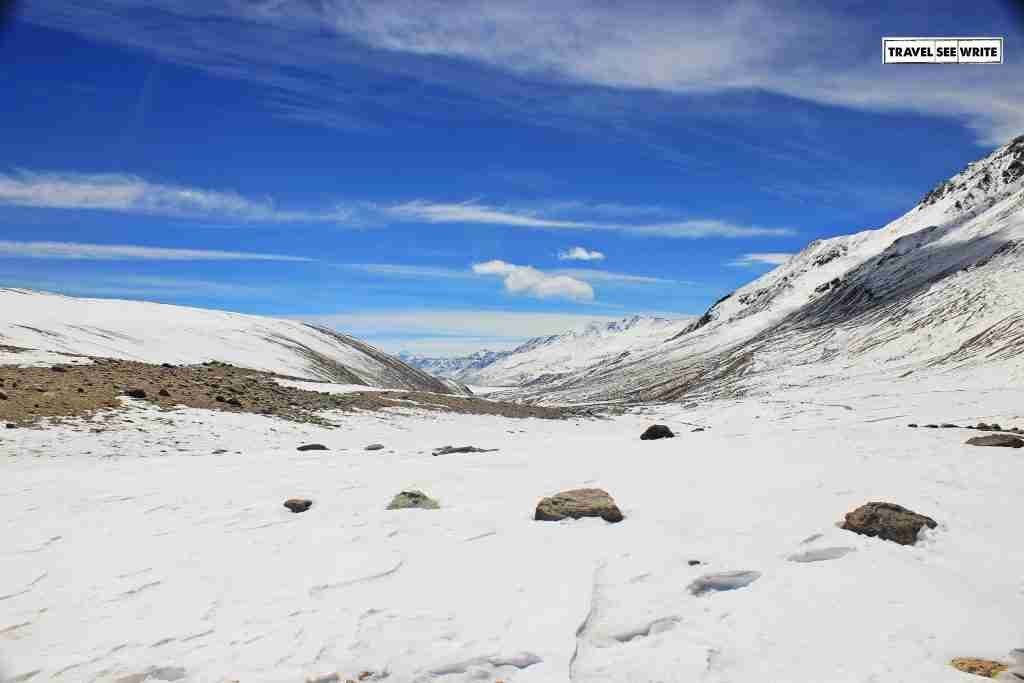
Though it was my bad that because a natural calamity, Chadar Trek was called off but it is a great experience that one should have before it becomes a distant memory. Once the road from chilling to Padum gets constructed, there are chances that Chadar might not form and hence Chadar Trek won’t happen. Hence, do it before it’s too late. I am going to attempt it next year again. Will you?

The Frozen River Trek
Travel tip: Go via a local trek agent. Travel agents from plains have shallow knowledge and might dupe you.
There is nothing like romancing in the coldest region of India. A kiss under a sky full of billion stars or a hug at 18,000 ft above sea level or making love in bone-chilling cold is something that you will not forget till the last breath of your life. You won’t need a lip-balm or multiple layers of clothes when you would have your special one around. If you don’t have one, then you will surely find one. So make the most of it. Go ahead and rekindle your romance.

Travel tip: Before expressing your love, make sure you are wrapped up in multiple layers otherwise be prepared to get a severe cold and cough.
Visiting Frozen Ladakh is like freezing time or existence itself. I discovered the undying spirit of Ladakh. I had relished every bit of the indescribable beauty of the coldest desert. No words or pictures can do justice to what I saw and experienced.
Still thinking to visit Ladakh in winters or sticking to a comfortable summer trip?
All I can say is – let go of the fear of cold and immerse in the insurmountable beauty of God’s favorite masterpiece.

Ladakh in Winters
A poem by Siddarth Dudheria on his experience of visiting Ladakh in Winters
Icy cold winds, dry sand
Tall peaks and low valleys
Trees bereft of leaves, standing tall and gaunt
Animals grazing on the barren land, thick hides to flaunt
Humans, young and old, all huddled near the flaming bukhari,
to earn some heat for the heart and for the body
Water knows no destination as it turns into ice, stays put
Kahwa and thukpa, the only food that counters the shiver
By foot is the only journey possible, for it unfurls nature’s harsh beauty,
the undulating sand dunes and the ever unassailable peaks
Such is Ladakh in Winters where only the best of friends or the worst of enemies dare appear,
Such is the warmth in winters that once you befriend the cold, everything else is present and clear.
If you too are planning to visit Ladakh in Winters, my experience of visiting Changthang would come handy for you. And, if you are still undecided these 10 reasons to visit Ladakh in Winters will definitely help you.


This was the scene I saw when I landed in Baler, the Super Typhoon ‘Lando’ hit area, in October 2015. Philippines, the pearl of Oriental Seas, was once again hammered, whacked, bruised and tattered but it’s not the type that surrenders. And that is what makes it so unique. Filipinos are like the Phoenix, which rise from the ashes. They are strong and resilient people who never surrender to their adversary, even though they are regularly hit by natural disasters. They’ll rock a smile, even if their entire life’s hard work is gone in seconds. I was shocked to see their optimism and never-say-die attitude when I visited Baler just few days after a Grade 4 Super Typhoon hit Baler. In midst of destruction Baler was still beautiful and warm.
It took me a long time to pen down this story because I wasn’t sure how to describe beauty and beast in the same breath. Finally I have summoned courage. Here is my experience of visiting Baler during crisis hour – Super Typhoon. A time perfect for finding beauty amidst destruction. Confused? Do read below to find more:
Being just six hours away from Metro Manila I was enticed to visit the surfing capital of Philippines – BALER. So I booked myself for a weekend trip to Baler with a friend. Getting out of Manila is a nightmare, especially on a Friday night. It took me four hours to just get out of Manila. The van journey was neither bad nor good. A sleeper bus might have been a better deal.
I reached Baler early morning. I was supposed to camp on the Sabang beach but because of the Typhoon, camping wasn’t allowed. So I took shelter in a local’s house to perch my tent.

My first pit stop was Diguisit Beach, which is 15 minutes tricycle ride away from the town centre. Giant waves were crashing into the rocks, forming an emerald green starfish like design flanked by dark chocolaty sand and rocks. Hopping from one rock to another, I was literally living on the edge. One slip could have given wings to my hospital dreams. But my local guide was around so I could afford to fool around. Thanks to last week’s Typhoon, the beach had transformed into a marshland, roofless Nipa huts were longingly looking for their saviour, tree branches and seaweed had encroached the beach area. I was dumbfounded with the “Good cop/bad cop” routine of the nature.

Typhoon wrecked Digisuit Beach & Rock formations, Baler

After wandering around the Diguisit Beach, I made way to the Dicasalarin cove, one of the best kept secrets of Baler. A stunning white sand beach bordered by rock formations on both sides. To get a panoramic view from a vantage point, I climbed up to the lighthouse. The lighthouse wasn’t far off but the steep mountain ascent with 1050 watts /m2 sunlight bulb made it harder. It took me a while to get to the lighthouse. But my tiredness vanished as soon as I reached the summit and looked around. The Pacific was looking majestic with the Aniao Islets in the backdrop. The Aniao Islets are huge rock formations that look like twin islands in the sea.

On the way to the lighthouse

Panoramic view of the Pacific from the Lighthouse (please look in full screen)

When everything fails, God makes its presence felt. Ermita hill is a testament of that fact. Baler has been God’s favourite child. He loves to dismantle Baler every now and then. On December 27, 1735, a great Tsunami had swept away Baler. At that time, people had taken refuge at Ermita Hill. That incidence had carved Ermeta Hill’s place in history books forever. After climbing the 250+ steps hike under shady trees I reached the top of the hill. The view wasn’t as great as at the start of the stairs. I was drinking in the magnificent view of the bay below, including the Baler fish port from the Baler view deck at the hill. There were hardly any tourists at that time. I spoke to a group of locals about the recent typhoon. They said, “Natural disasters are a part of our life. You really can’t control them. But you can control how you respond to them. Whining about them will not do any good. Best is to move on with a smile.” Isn’t that gem of an advice?

Baler View Deck, Ermita Hill, Baler

After a sleepless night and a busy sightseeing day I wanted to relax a bit so I retreated to my hole. There was no electricity since all the Electricity poles were uprooted in Baler. And no internet. I was happy to be in nature’s lap without any distractions. A tented accommodation in a lush green garden with coconut trees was my abode tonight. Gulping the freshly plucked coconut water I indulged in a small talk with the caretakers of the property. I did not want to miss the Golden Hour so I headed to the beach. The entire beach was covered in the golden paint. Kids and their pets were enjoying their play time. Couples were walking hand in hand. It was hard to believe the waves which looked so calm at that moment were 20 feet high just few days back. But that’s how unpredictable nature can be.

Sabang Beach sunset , Baler
Baler is not Baler without the swells and breaks of Sabang Bay. Surfing is the main reason why tourists flock to the town. I was already too tired so I did not try my hand at surfing. Instead I walked capturing the sights and sounds of Baler. Besides glorious sunrise and sunsets Baler is famous for its nightlife and astounding variety of food. Being a vegetarian I opted for a safe option – Costa Pacifica, a high end Beach resort. The food was yummy but the best part was the fire dance performance.

Sabang Bay as seen from Costa Pacifico Resort, Baler

Fire dancing at Costa Pacifica Beach Resort, Baler

Fire dancing at Costa Pacifica Beach Resort, Baler

Mist surrounded scene before the sunrise, Baler
The day started with me sacrificing my sleep to witness the sunrise. And trust me when I say sacrificing my sleep I truly mean it. It’s the most difficult thing for me to do. But the pacific sunrise was totally worth it. So after spending some time at the beach relishing the morning mist and observing the young surfers taming the waves I was ready to explore the historical side of the town.

Newbies busy in taking the surfing lessons from instructors, Sabang Beach, Baler

I don’t want to contaminate my travel experience with preconceived notions therefore I usually take impromptu trips without asking Google. This time was no different. With the help of locals I ended up taking the Historical Walk of Baler through San Luis Obispo Church, the Baler Park, the house of Doña Aurora, the wife of former president Manuel L. Quezon, and the Museo de Baler. Literally there were footstep-shaped markers on the street to find your way from one place to the other. A walk in the downtown was like a walk in a museum and gave a good crash course into Baler’s history and the lifestyle of the former President of Philippines.

Baler Museum
I had been to lot of hanging bridges earlier so this wasn’t something unique to me. However, what I liked about it was that it wasn’t for tourists. This rickety bridge patched together from rusty wire, weathered planks of wood and fragile bamboo railings is used by locals. On both sides of the river lay decapitated Nipa plants. Nipa plants are used to make Nipa huts. I failed miserably in learning the art of weaving the Nipa leaves. But it’s better to fail then give up.

Trying to learn the Nipa Hut making technique, Baler

The last pit stop on my weekend wanderlust was the “Millennium Tree”. Popularly referred as the Balete tree (relative of Banyan tree) it is said to be 600-years old and considered to be the largest Balete tree in Asia. I channelised the ‘Mogli’ inside me to climb up and down, walk inside and outside through the hollow openings and massive roots of the tree. Like Banyan Tree in India, Balete Tree is infamous for jaadu-tona (witchcraft) in Philippines. Superstitions are a common currency across the world that feeds on people’s fear of the unknown.
So this was my experience of visiting Baler at the wrong time – Super Typhoon time. A time perfect for finding beauty amidst destruction.
Are you up for the challenge? Will you do the same or wait for the right moment?


Rock formations, Baler


The Famous Baler Food Grill, Sabang Beach, Baler

Inside the house of the former first lady of Philippines, Baler
I have explored Spain, Kenya, Sri Lanka, and Switzerland with Travel See Write. Every experience was customised as per my family’s requirements, and each trip was fully customised.
Vaibbhav Sud
Delhi
I travelled with my family to Finland using Travel See Write. The team went above and beyond to make our stay enjoyable. They were even available at 3 am for services beyond their usual duties. ”
Gautam Kriplani
Jakarta, Indonesia
This is not a typical luxury travel agency — this is travel with soul. They take care of the minutest details and customise the tiniest things for us. I have travelled with them to Japan, Finland, Costa Rica, Russia and the Philippines.
Vineet Nanda
Delhi
I have explored Spain, Kenya, Sri Lanka, and Mongolia with Travel See Write. Every experience was customised for my family, and each trip was special
Sunil Sharma
Delhi
This is not a typical luxury travel agency — this is travel with soul. They take care of the minutest details and customise the tiniest things for us. I have travelled with them to Japan, Finland, Costa Rica, Russia and the Philippines.
Aman
Mumbai

Lorem Ipsum is simply dummy text of the printing and typesetting industry. Lorem Ipsum has been the industry's standard dummy text ever since
Luxury travel should feel seamless from start to finish.

Begin with our online form. We then connect for a detailed conversation
No booking fees. Ever.
We fine-tune your bespoke itinerary until it feels perfect.
With confidence, care, and 24/7 on-ground support throughout your journey.