Walking the Via di Francesco: Why Umbria is Italy’s Best Kept Secret
Walking the Via di Francesco Pilgrim trail in Umbria, Italy
There’s a moment on the trail, maybe 40 minutes outside Assisi, where modern travel just stops making sense to me.
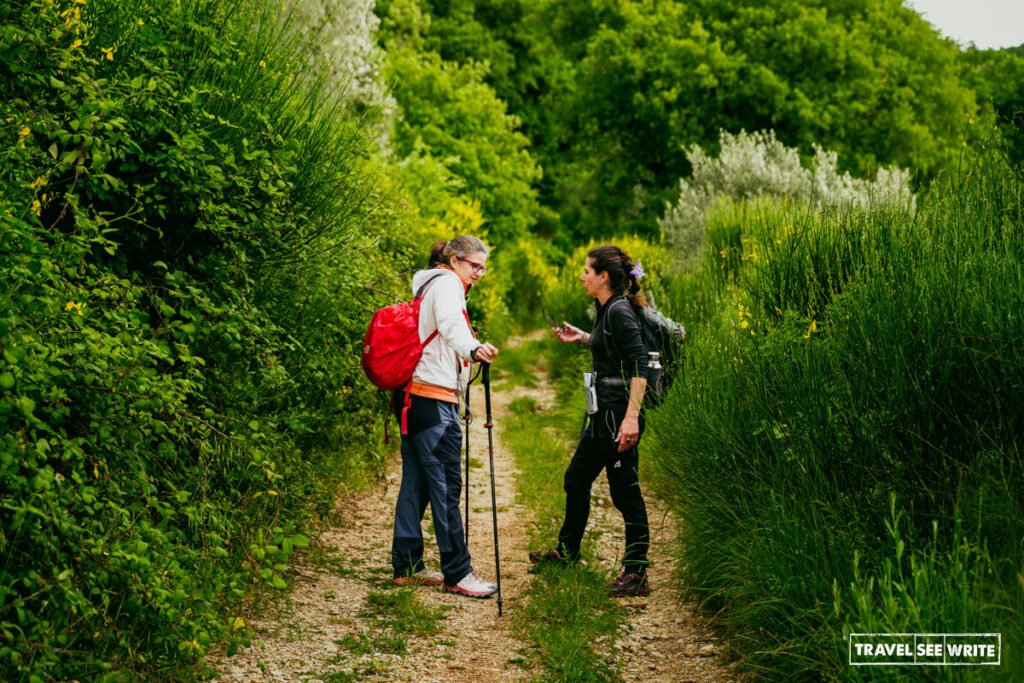
I’m hiking on a dirt track lined by vibrant wild mustard blooms, terraced olive groves, and deep green forests, all framed by crisp spring air and iconic medieval hilltop towns. Wherever I look, I find beauty. My feet have found a rhythm on the loose gravel. The only sound is wind through silver leaves and occasional birdsong. I try to locate a face to the sound, but I fail miserably.
And I’m thinking: why did I do this the other way for so long?
You know the other way. The Rome to Florence to Venice triangle, done at maximum speed. Hot cobbled streets, photo queues, alarm clocks at 6 am so you can beat the crowds to something you weren’t entirely sure you wanted to see in the first place. I’ve done that trip too. I’ve done versions of it in 30 different countries. And at some point, it stops feeling like travel and starts feeling like a performance of travel, which is a very different thing.
This trip, early May in Umbria, was the opposite of that. Three days on the Via di Francesco, St. Francis’s ancient pilgrim trail through the heart of central Italy, walking at whatever pace felt right, staying in small towns where the piazzas empty out by 7 pm and the only people left are the ones who actually live there.
It recalibrated something.
What Even Is the Via di Francesco Pilgrim Trail
Via de Francesco isn’t a Pilgrim trail to find God. It’s a pilgrimage to find yourself.
The Via di Francesco, the Way of St. Francis, is a pilgrimage trail running over 500 kilometres through central Italy, connecting the places tied to the life of St. Francis of Assisi. Hermitages, churches, forests, hill towns, spread across Umbria, Tuscany and Lazio.
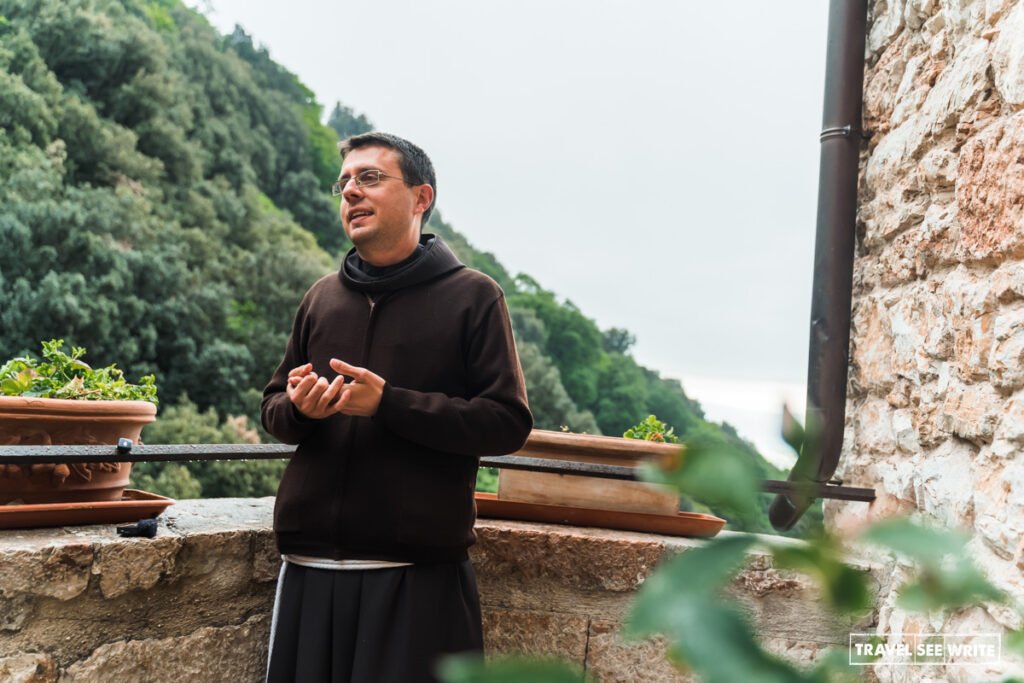
I met a friar named Matteo on the first day, and he told the story of Francis like he’d told it a thousand times before, except none of it sounded rehearsed. Francis was born into a wealthy merchant family in Assisi and walked away from all of it by his late twenties, trading silk and money for a robe and a begging bowl. He spent the rest of his life living in poverty and preaching to anyone who’d listen, founded the Franciscan order, and eventually became the patron saint of Italy. Everything I saw over the next three days, the caves carved into mountainsides, the obsessive attention to the exact angle of a valley view, traces back to that one decision he made eight centuries ago.
People have been walking versions of this trail ever since. It moves through terrain that looks almost deliberately cinematic, steep wooded ridges, valleys thick with olive groves, and stone towns that seem to grow out of the hillside rather than have been built on top of it. I say walking but that undersells it slightly. You’re moving through layers of human history that most tourists drive past at 130 kilometres an hour on the autostrada. The trail itself is well marked and genuinely accessible, not a hardcore trekking route. My longest single day on the trail was 12 kilometres. But moving through Umbria on foot versus moving through it in a car are basically two different countries.
SloWays Travel handled the logistics for my trip as part of the Italian Pilgrim Routes 2026 project, a collaboration between the European Association of the Via Francigena Ways (AEVF) and the Italian Ministry of Tourism. In practice, that meant my bags moved between hotels without me carrying them, transfers to trail starting points were already arranged, and each day’s route was planned to flow into the next. I showed up, walked, and ate. More than once, I thought, this might genuinely be the smartest way to travel.
Surprise Element: The All-women Group
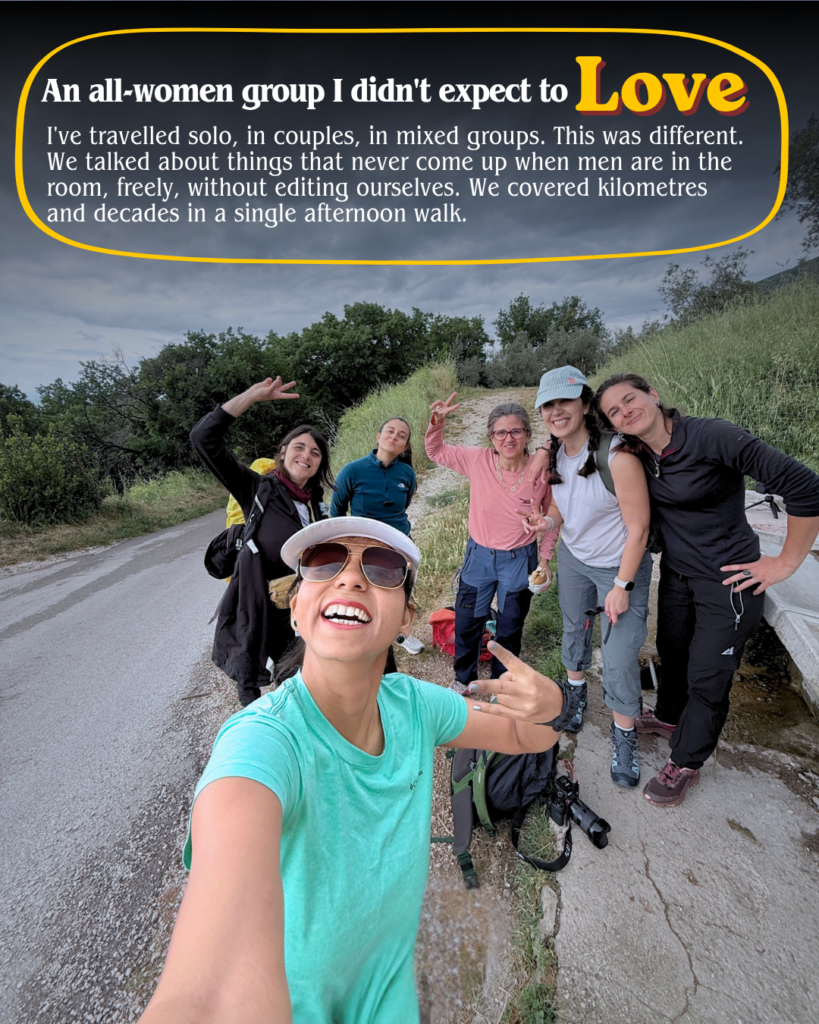
What I didn’t expect was the group itself. By complete accident, every single person on this trip was a woman. Tullia, who runs SloWays Travel, Simona from the AEVF team, our guide Barbara, and two other content creators, Mansoureh from the UK and Serena from Italy.
I’ve travelled in mixed groups my whole career and never once thought about it until I was suddenly in one that wasn’t. Somewhere on the second day, walking single file through an olive grove, the conversation turned to things that usually stay unsaid when there’s a man within earshot. Fear while travelling alone. What it actually costs a woman to build a business in a country that still expects her home by dinner. Tullia talked about the early years of SloWays like she was talking about raising a difficult, beloved child. Nobody performed any of it for an audience. There wasn’t one.
I didn’t plan for that to be part of this story. It became one of the best parts of it.
Now back on the trail.
Quick Facts Before You Go
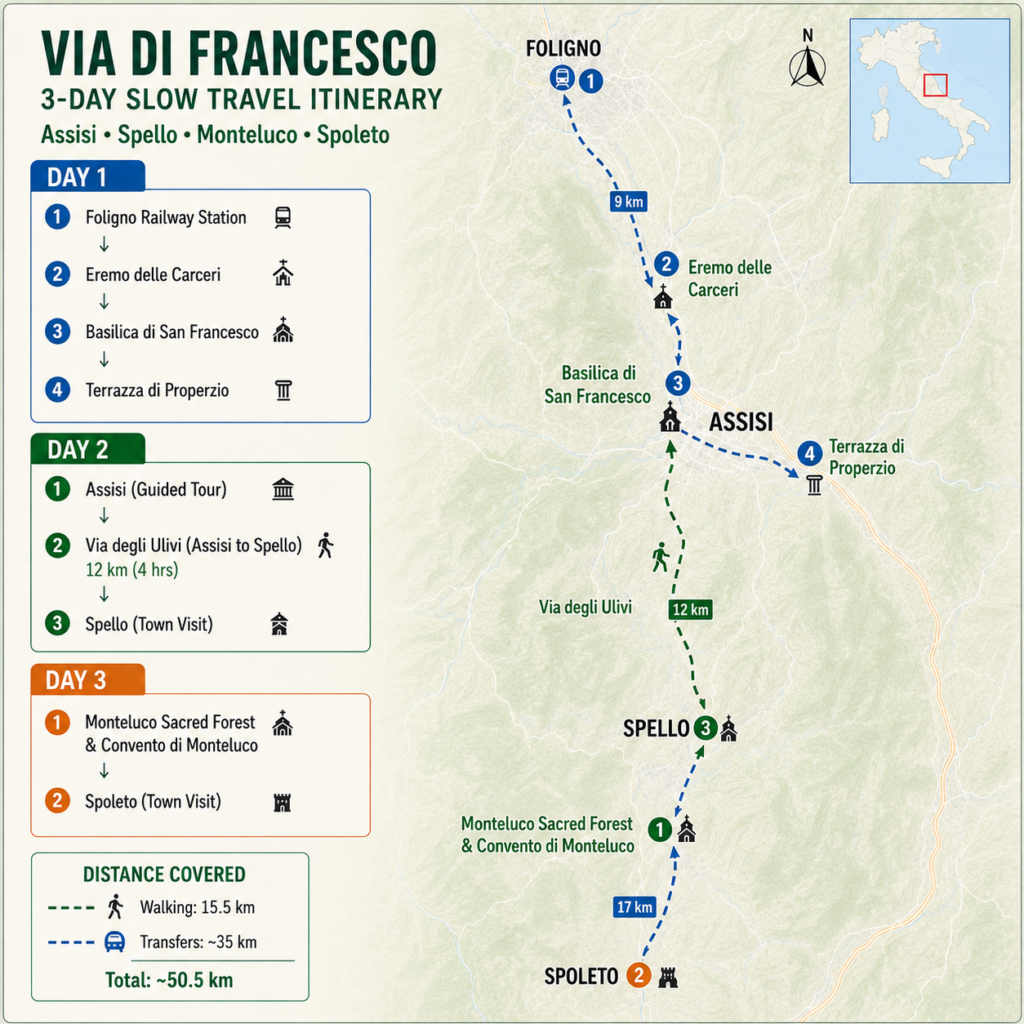
Trail length covered: 3 days, roughly 20 kilometres total
Longest single day: 12 kilometres, Assisi to Spello
Difficulty: moderate, no technical hiking experience needed
Best time to visit Umbria: May or October, for mild weather and fewer crowds
What to pack: proper walking shoes, layers for cool mornings, a refillable water bottle
Good for: anyone considering a self-guided walking holiday in Italy without committing to a multi-week pilgrimage
Day One: Arriving at the Hermitage
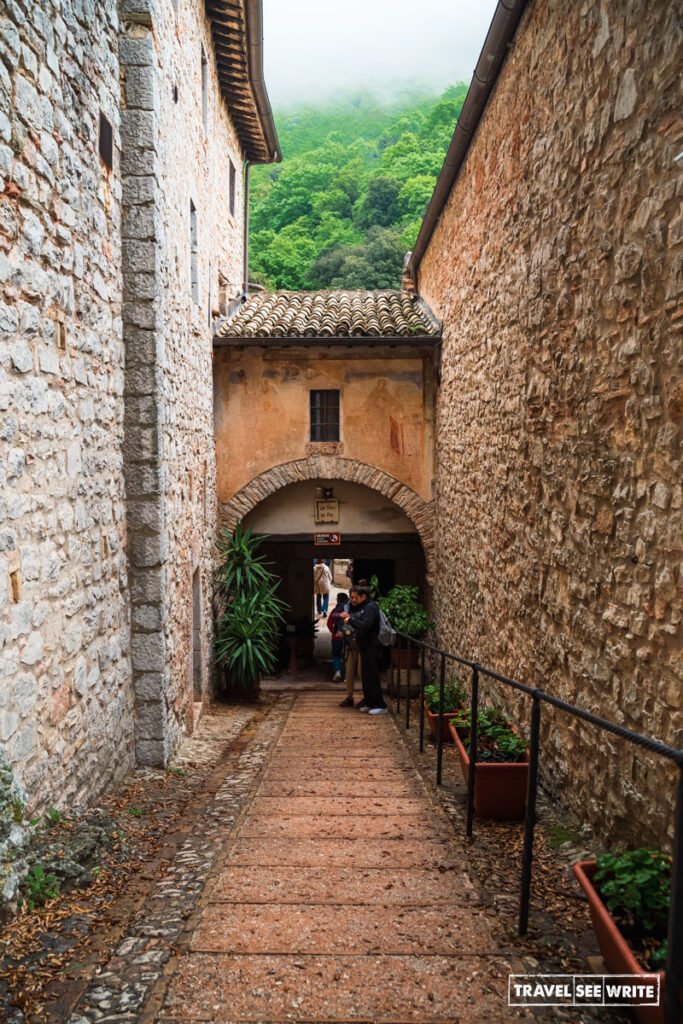
The Eremo delle Carceri is a hermitage built into the mountain’s rock, above Assisi
Matteo, friar at Eremo delle Carceri shared valuable insights about St. Francis’s life and philosophy
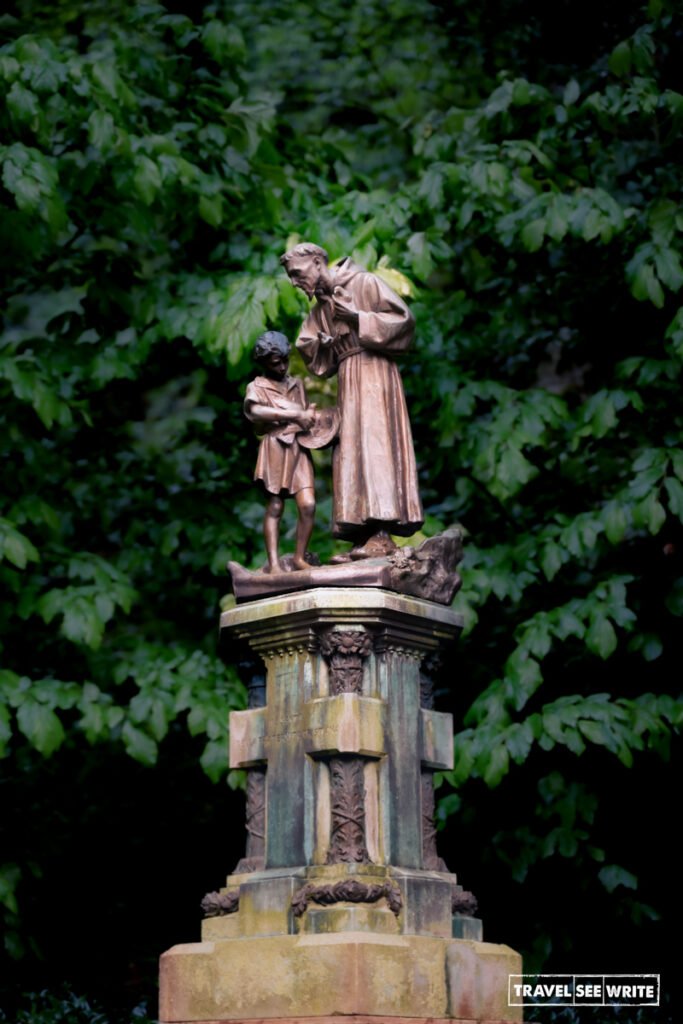
A bronze statue of Saint Francis of Assisi interacting with a young boyat Eremo delle Carceri
The trip began with a train ride from Rome to Foligno, a town that had existed since Roman times. The entire group of girls congregated here and walked around the town for a while before digging into an authentic Umbrian lunch at a local restaurant. Afterwards, we took a transfer to the Eremo delle Carceri on Mount Subasio.
The Eremo delle Carceri is a hermitage built into the mountain’s rock, above Assisi, surrounded by a dense oak forest. St. Francis and his early companions used to come here to pray in the caves. Some of those caves are still there, tiny stone rooms barely big enough for a four-and-a-half-foot person to stand, where you can see where people slept and prayed. I was super lucky to meet a very polite and pleasant friar named Matteo, who walked our group through the place’s historical significance. A friar is a member of a religious order (like the Franciscans or Dominicans) who takes vows of poverty, chastity, and obedience and lives in a community. Matteo explained St. Francis’s love for nature,
“St. Francis used to live in several natural places (grottos), and he used to look for four things before choosing a place: always on the mountains, always surrounded by nature, always a grotto, and always facing the view of the valley.”
Honestly, I expected an old building with some historical signage. What I actually got was a place that still functions as a place of contemplation, not a museum. Friars still live there. The quiet is not the managed quiet of a tourist attraction; it’s the kind of quiet that accumulates over centuries, and you can actually feel it pressing against your ears.
I don’t follow any religion ardently. So, I’m not a pilgrim in that sense. But standing in one of those cave chapels, with the forest outside and the light coming in low and sideways, something about the accumulated intention of the place gets into you whether you ask it to or not.
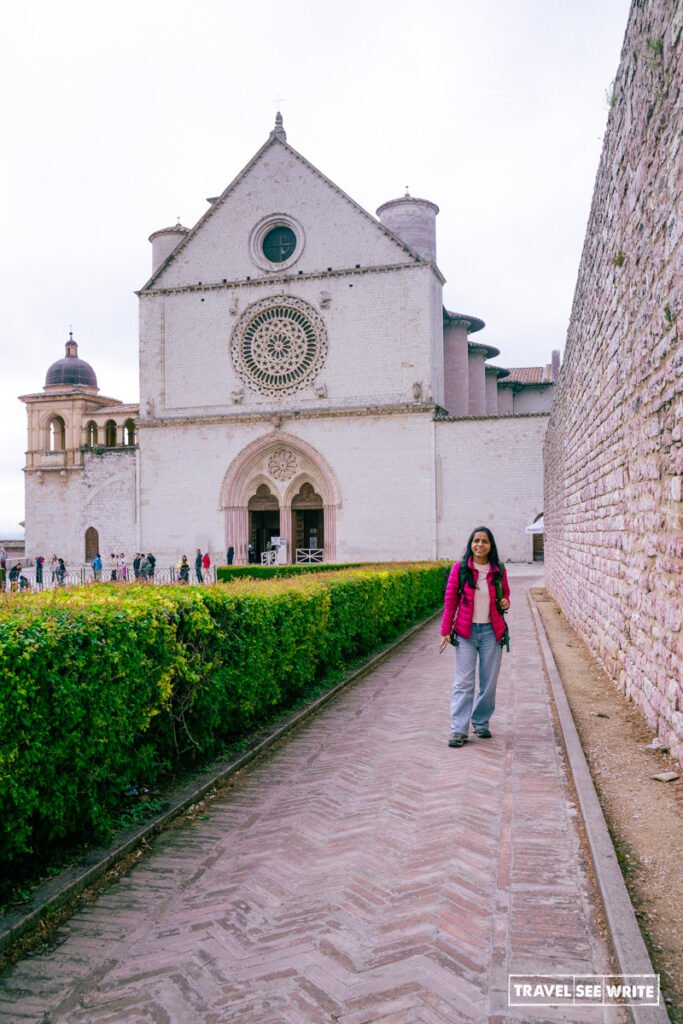
We came down to Assisi in the late afternoon for the Statio Peregrinorum, the traditional pilgrim welcome, and then into the Basilica di San Francesco with a local guide. The Basilica di San Francesco in Assisi is a masterpiece of art and architecture, uniquely built as two stacked churches—the dimly lit Lower Church and the bright Upper Church. It serves as a monumental shrine housing the saint’s tomb and played a pivotal role in the birth of Italian Gothic design and Western art. The walls feature 10,000 square meters of frescoes, serving as a massive open-air textbook of art history. It boasts works by towering medieval masters like Giotto, Cimabue, Simone Martini, and Pietro Lorenzetti.
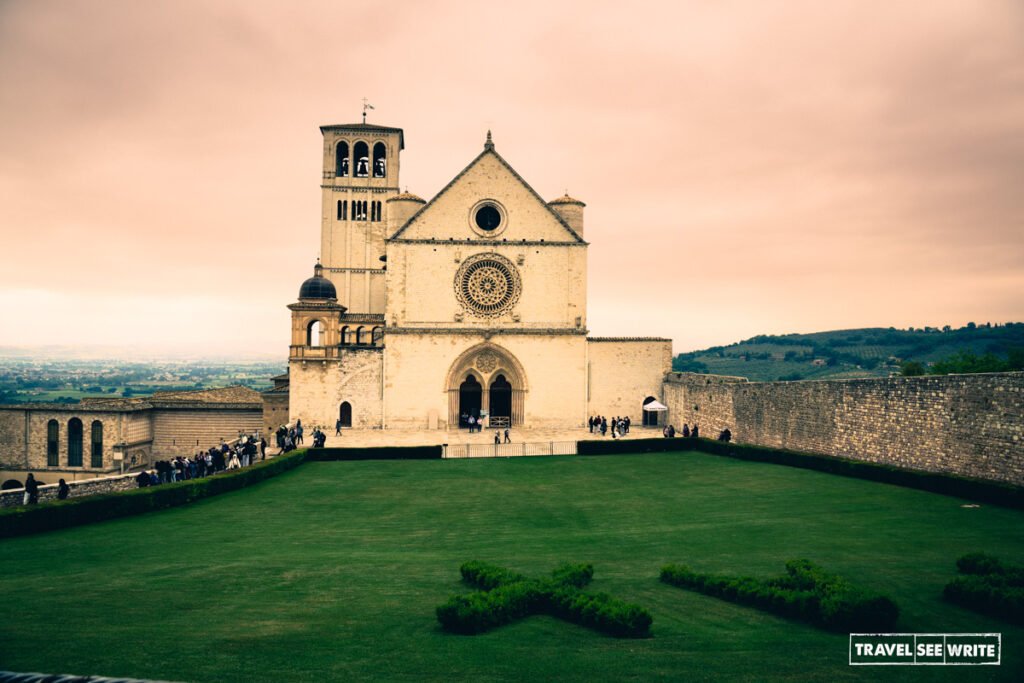
The Basilica of San Francesco d’Assisi is one of the most visited pilgrimage sites and historical landmarks in Umbria, Italy.
I’ve been to a lot of famous churches. What struck me about this one was how much it still felt like it was being used for the thing it was built for. People were there to be there, not just to photograph the Giotto frescoes. I met so many modern-day pilgrims, who were walking for two months not for religious reasons but to connect with themselves and nature.
At the Statio, we got our pilgrim passports stamped. The credenziale, as it’s called, is a small booklet you carry and collect stamps in at each significant stop along the trail. I didn’t expect to care about this. I cared about it immediately and have no rational explanation for why.
After spending a few hours at this monumental UNESCO World Heritage Site, we left for our hotel, Hotel Pax, a family-owned boutique property. Hotel located in the centre, convenient for visiting everything on foot. Very friendly staff starting from check-in, clean room with a bathroom, and very quiet.
For dinner, our Tullia had chosen Terrazza di Properzio, a restaurant with a panoramic terrace overlooking the Umbrian valley. The restaurant had a very intimate setting and was undoubtedly the go-to place for tourists as well as locals. The food was brimming with authentic Umbrian flavours, and the presentation was pretty creative too. It was here that I first tried the Sagrantino wine.
Day Two: The Olive Grove Walk to Spello
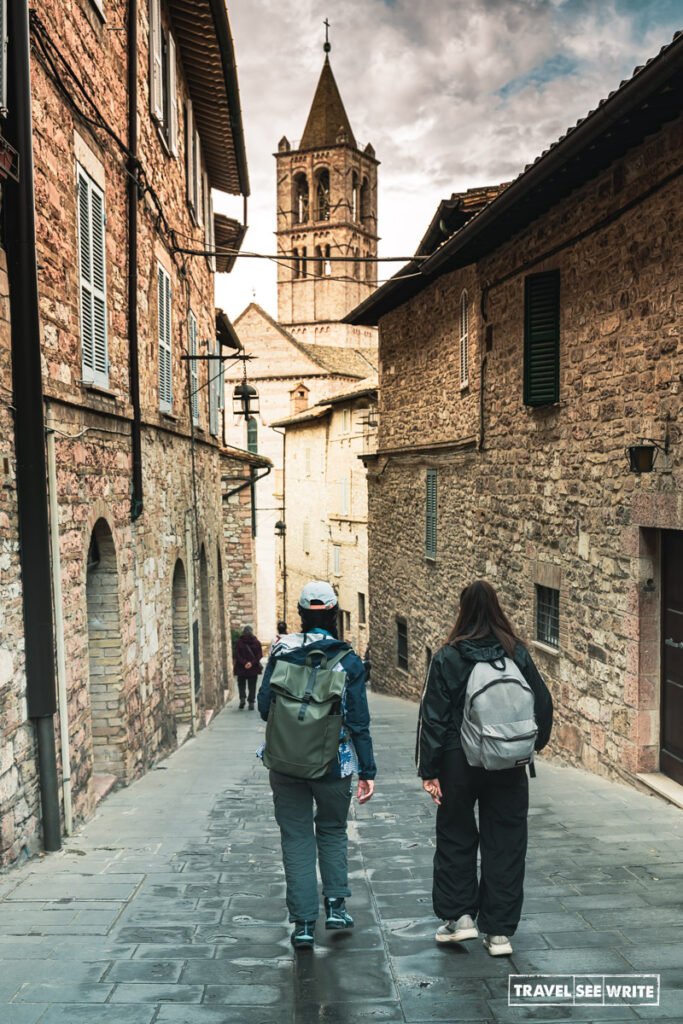
Despite gloomy weather, our brilliant guide Patricia led us past the famous Basilica and into the quiet, mist-shrouded backstreets of Assisi to uncover hidden Roman ruins and ancient, atmospheric medieval alleys.
The Assisi to Spello stretch on the Via degli Ulivi is the one I keep bringing up when people ask about this trip.
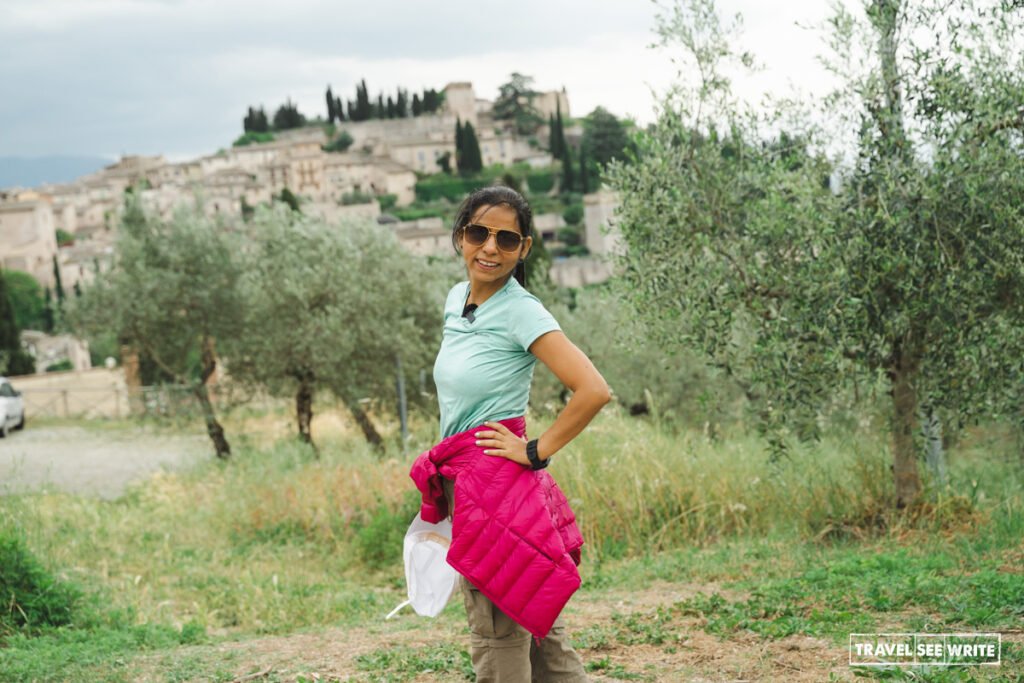
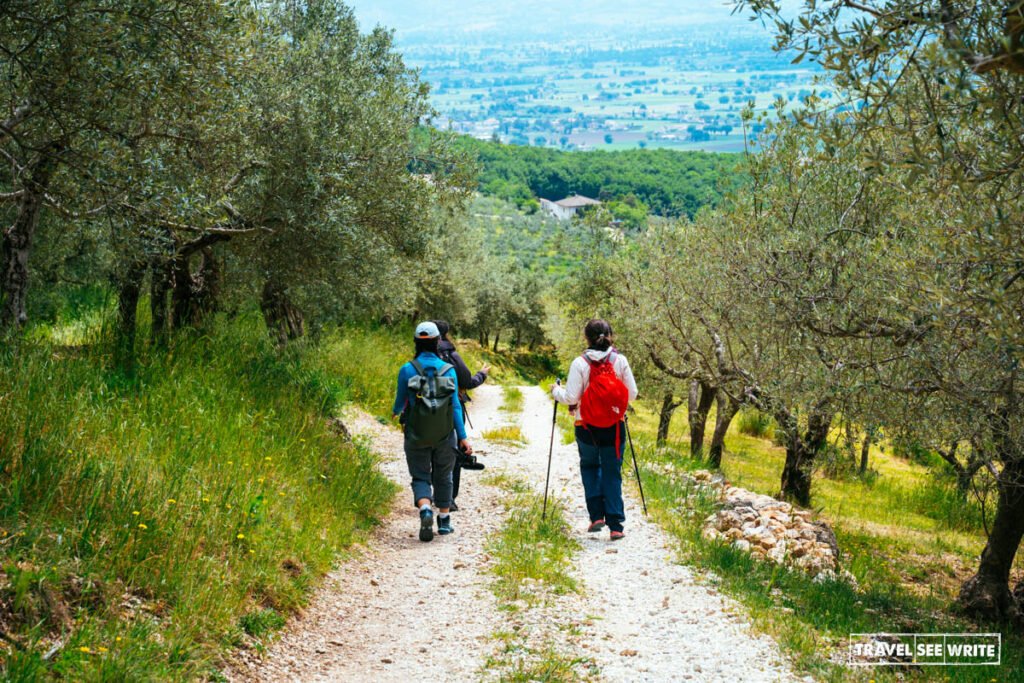
The trail itself runs 12 kilometres along mountain ridges and through olive groves, with the whole Valle Umbra spread out below for the entire walk. There’s 200 metres of climb and 345 metres of descent, and it takes around four hours at a pace that doesn’t rush anything, because rushing isn’t really an option out there. Add the walking we did inside Assisi that morning and inside Spello once we arrived, and the full day came closer to 19 kilometres on my legs, though the actual trail is the shorter number.
We’d done a short guided walk through Assisi first, so by the time we set off, I’d had a bit of time to let the town settle. We picked up a packed lunch to eat on the trail. The path moved quickly into olive groves, through terraced fields, past stone walls where you can tell someone has been farming this exact slope for generations.
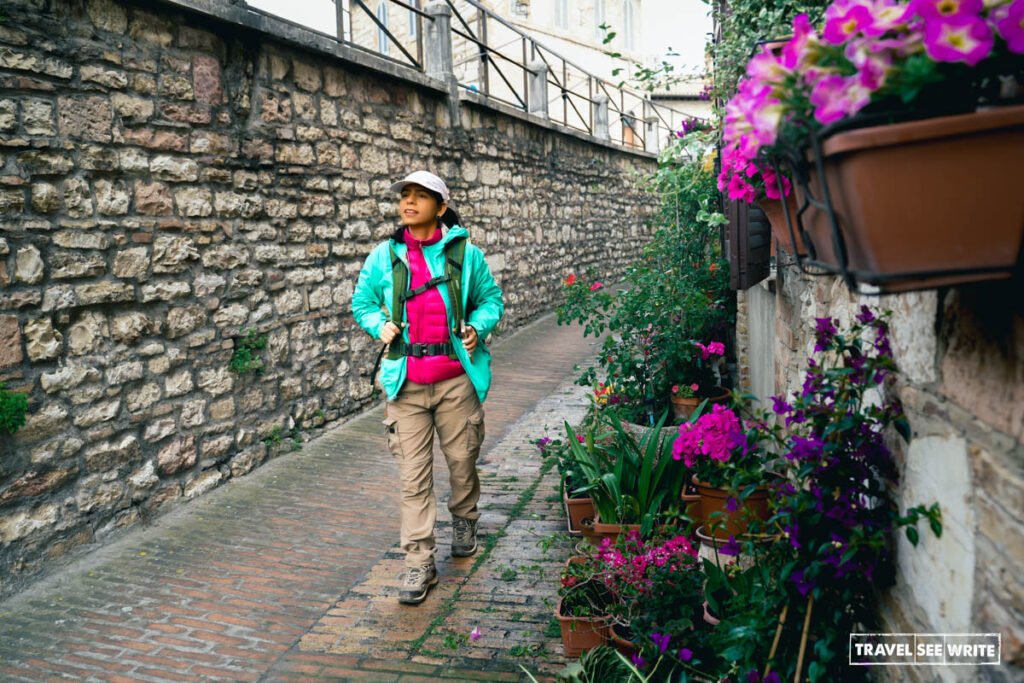
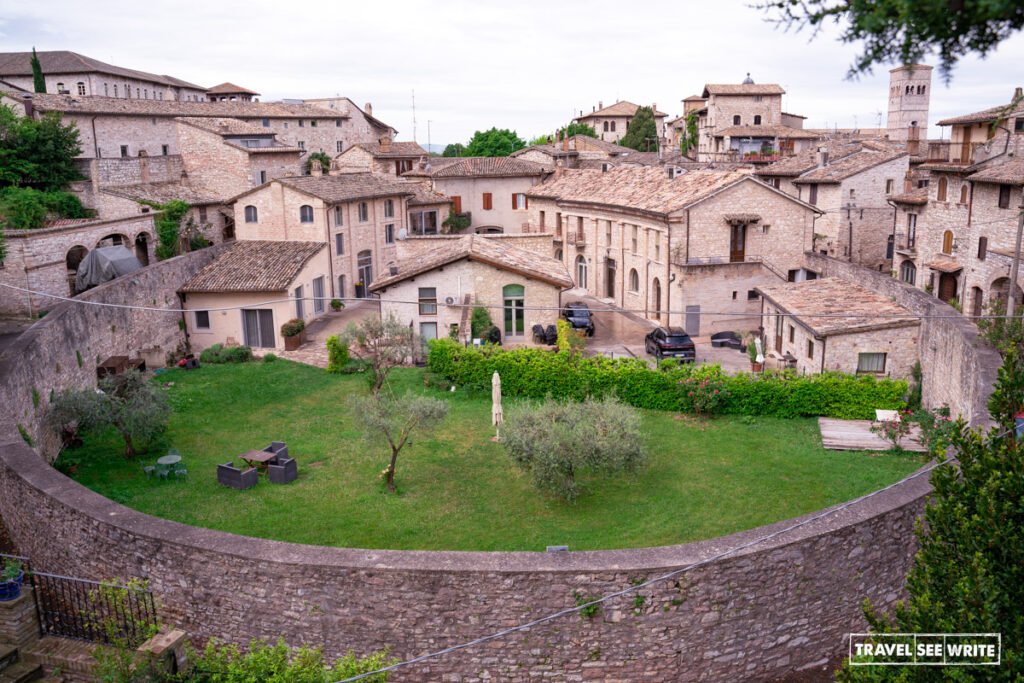
Assisi Streets that are barely discovered by tourists, Umbria, Italy
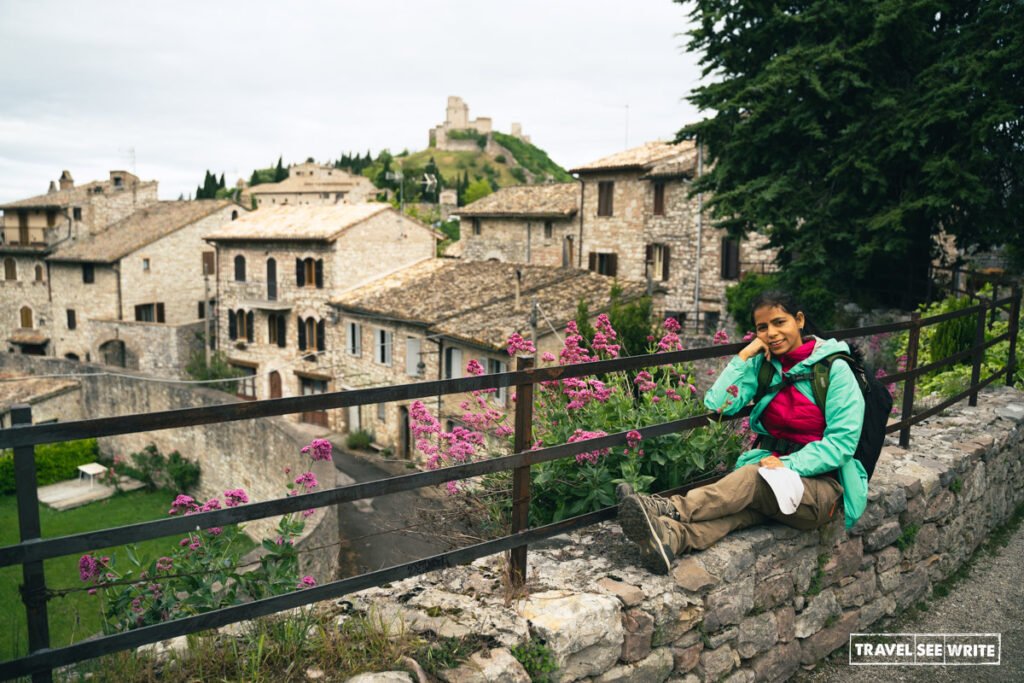
A photo point that is often missed by most tourists in Assisi, Umbria, Italy
The Basilica of San Francesco d’Assisi in Umbria, Italy.
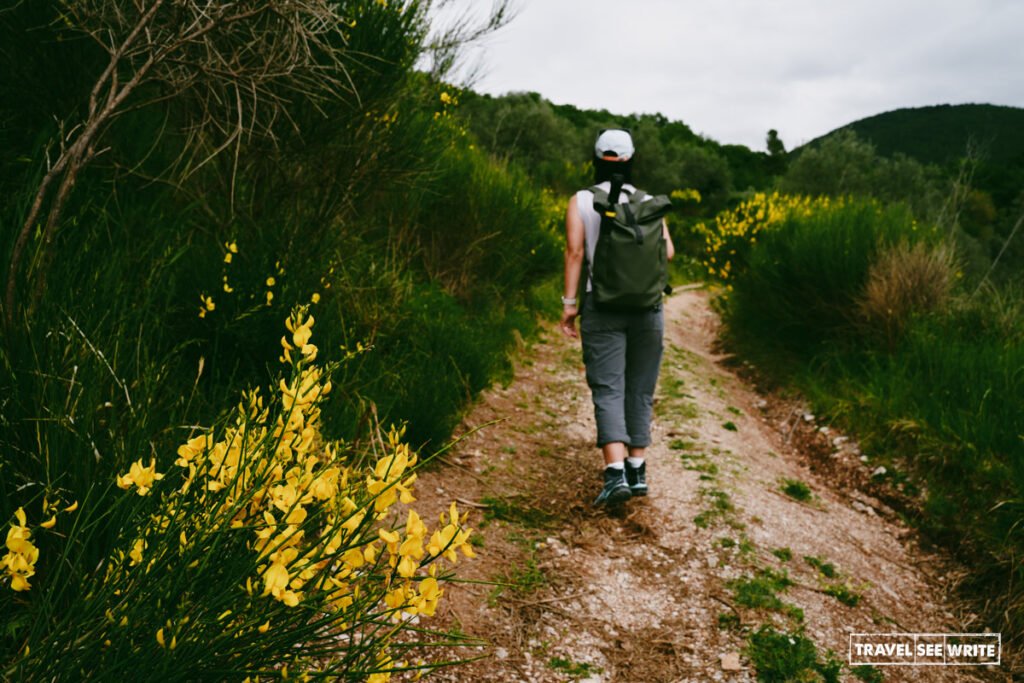
Early May here feels cinematic. Temperatures hover around 20°C, the breeze is cool enough for layers, and the countryside is exploding with wildflowers. Bright yellow broom bushes line the gravel trail, olive groves shimmer silver-green under stormy skies, and poppies appear unexpectedly beside old stone paths.
“When you start walking the trail, you start knowing yourself more. It’s like peeling an onion. Unwanted layers keep coming off. And by the end, you’re only left thinking about what’s actually important to you. That feeling only comes when you walk alone.”
We stop three times during our 19 km walk. First for water and snacks under dramatic clouds, where strangers slowly become trail friends. Second, for a picnic lunch surrounded by olive trees and complete silence except for birds and wind moving through the valley. And the final stop — the one you never forget — just before entering Spello, where the medieval town suddenly appears in the distance like a painting beneath dark Umbrian skies.
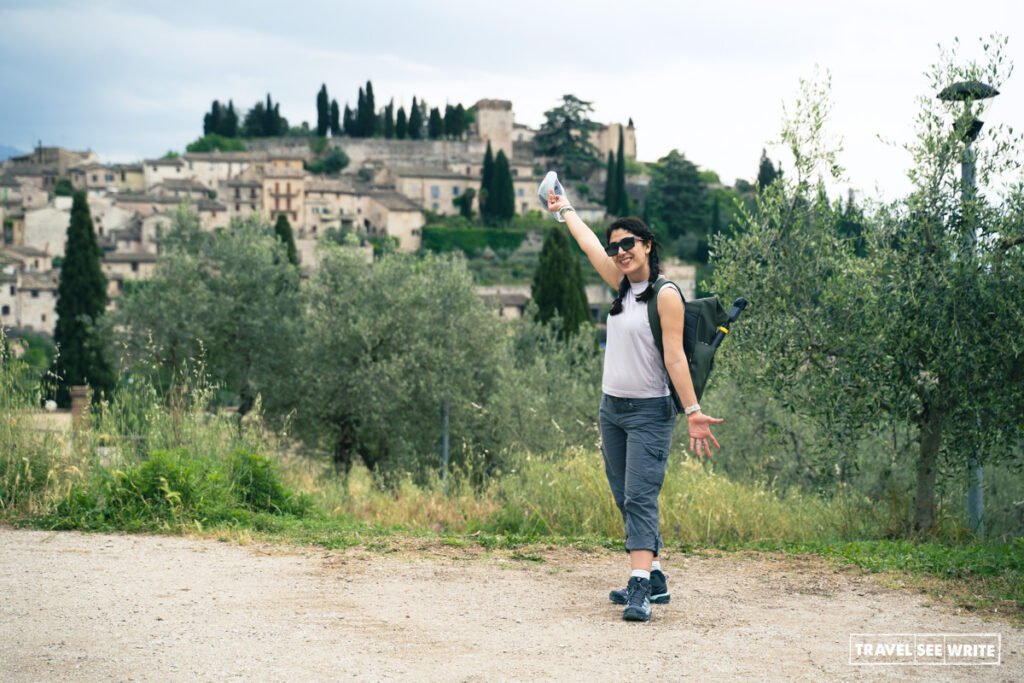
Via degli Ulivi (Olive Grove Trail): The most iconic view. As the descent flattens, this mountainside path offers a spectacular, unobstructed view of Spello’s historic centre framed by centuries-old olive trees.
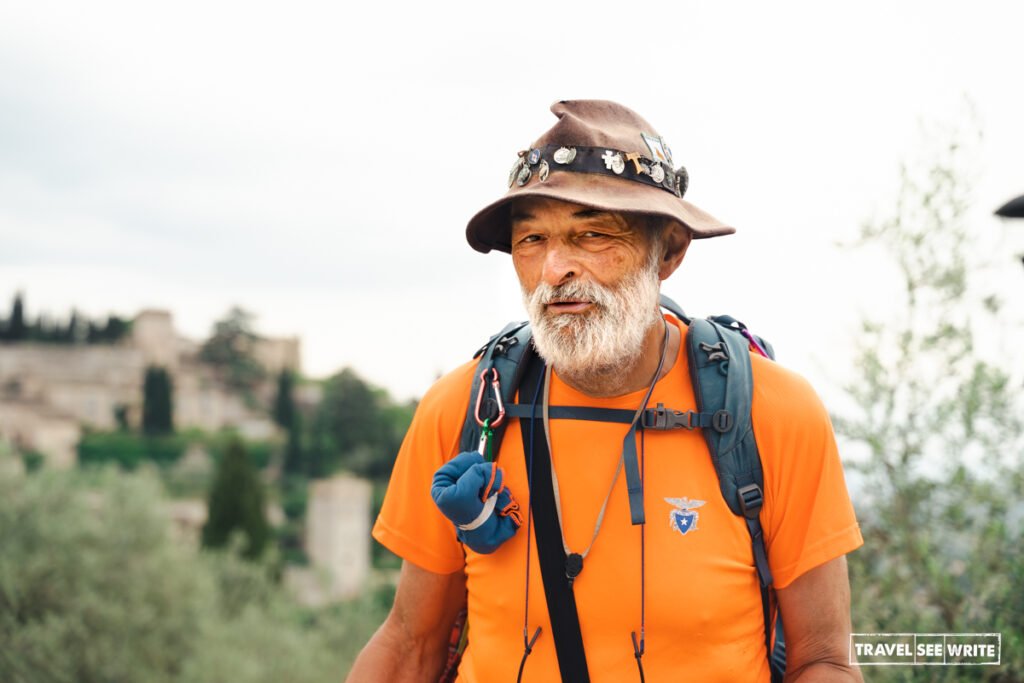
But the most unforgettable moment wasn’t the landscape. It was meeting a real pilgrim on the trail. He had started walking on 13th April and planned to reach Rome entirely on foot by 23rd May. Backpack, boots, quiet determination. A reminder that these paths are still lived, not just visited. Fiore, a 65-70-year-old gentleman from Padova. Following the St. Antonio path, he started in Bologna, reaching Assisi, then continuing on an onward journey to Rome, approximately walking 600 km in sixty days.
Fiore, a determined 65-year-old pilgrim from Padova, walks the historic St. Antonio path on an inspiring 600-kilometre journey from Bologna to Rome.
By the time we reached Spello, our legs were sore, our shoes dusty, and our shoulders aching. But mentally? We felt lighter. Maybe that’s what pilgrimage routes really do. They don’t just take you somewhere. They slow you down enough to actually arrive.
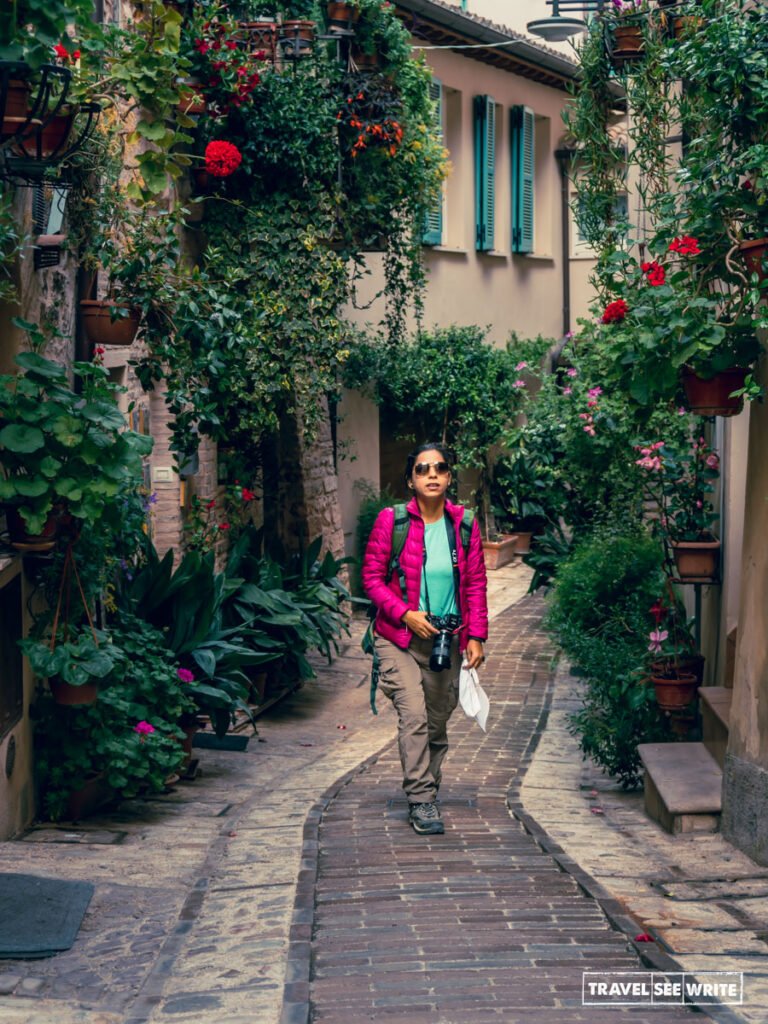
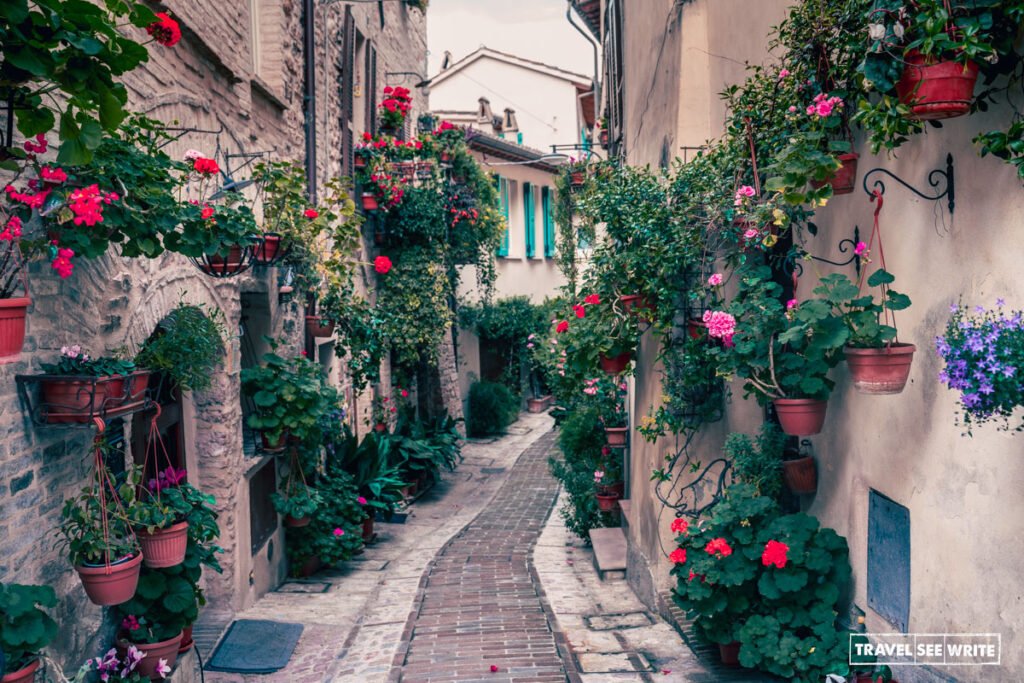
Arriving in Spello on foot is different to arriving any other way. You come down through the old walls into pink stone streets from above, your calves still aware of that descent, and the town just receives you. Spello is built from locally quarried rose stone, and every alley has flowers growing out of window boxes, up walls, through gaps in old gates. It’s hard to overstate how pretty it is, and it has almost no tourism infrastructure, which means you’re inside it rather than watching it from behind a barrier.
Bursting with colourful flowers, the winding stone alleyways of Spello, Italy, showcase the breathtaking, fairy-tale charm of this historic medieval town.
This is one of those Umbria hill towns that barely make it onto anyone’s Italy itinerary, sitting just 15 minutes south of Assisi. It’s known for its flower-covered cobblestone streets and the Infiorata, a festival dating back to 1778, where a sloping street called Via Italo Belardi gets paved entirely in flower petals, half a million of them, ending in a religious procession through the town. It happens every June.
Around 5:30 pm, we arrived at another boutique Hotel Cacciatore. Our bags were already waiting for us there. After a quick freshen up, I was out for dinner at La Cantina. But not before trying out the Gelato. Long table, good Sagrantino, nobody in a hurry.
I slept very well that night after a gorgeous day in Umbria.
Day Three: The Sacred Forest and Then Spoleto
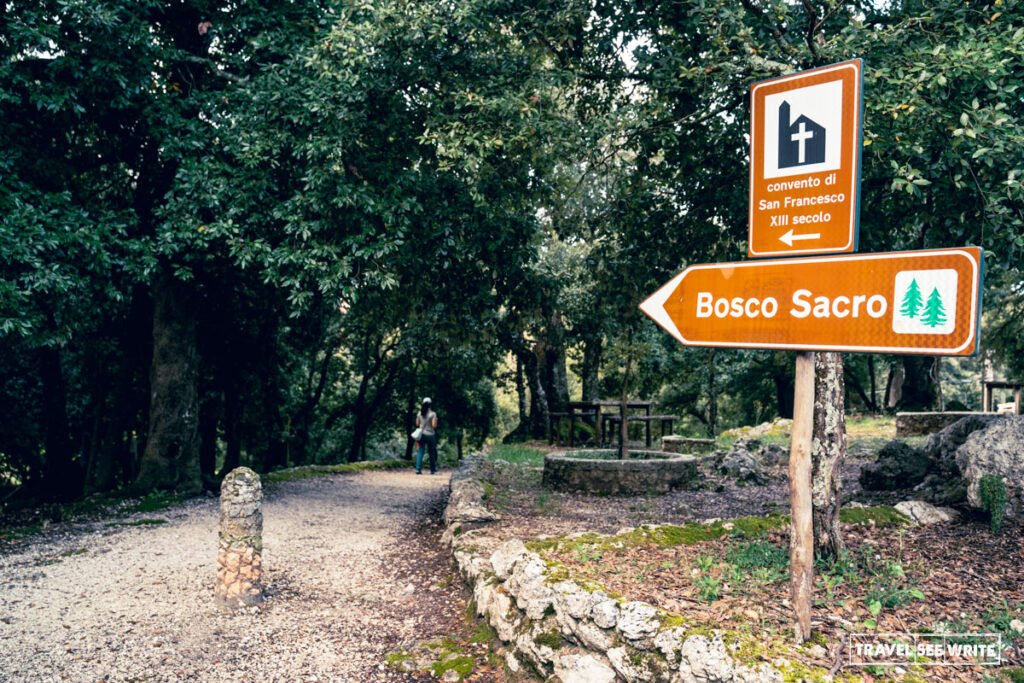
Nestled high above Spoleto, the Sacred Forest of Monteluco is an ancient ilex oak grove and spiritual sanctuary that is home to a historic Franciscan convent.
The final morning started with a drive up to Monteluco.
The Sacred Forest of Monteluco is an ancient grove of ilex oaks above Spoleto where the Franciscan convent sits. The forest has been considered sacred, going back to pre-Christian Roman times. There are signs at the entrance asking visitors for silence. This is not unusual near religious sites but here the request feels specific, like the silence is actually the point rather than just courtesy.
The convent itself is still active. We visited, then started walking down through the forest into Spoleto: 3.5 kilometres, steep in places, the trail moving through dense cool shade and then opening out above the city.
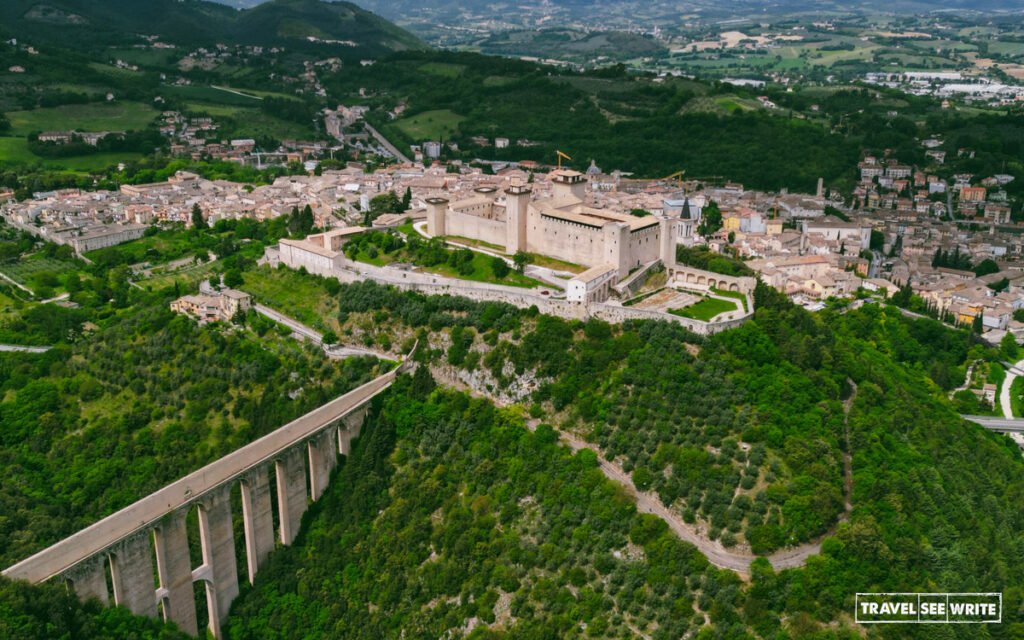
The Rocca Albornoziana fortress overlooks Spoleto while connecting directly to the Ponte delle Torri, a massive 14th-century aqueduct and bridge that spans a deep gorge to link the hill with Monteluco.
Ponte delle Torri – An awe-inspiring 14th-century medieval aqueduct-bridge stretching 230 metres long and soaring 80 metres high over the deep Tessino gorge
Spoleto stopped me. I wasn’t expecting it to, but it did.
It’s a town built almost entirely on top of its own history. Walk down one street, and you’re passing a 1st-century Roman house. Turn a corner, and there’s a 14th-century fortress. Look down through a grate in the modern street, and you can see a Roman bridge underneath. It’s not preserved the way a museum is preserved. It’s just accumulated there over two thousand years while people kept living above it. I find that more affecting than almost any formal heritage site.
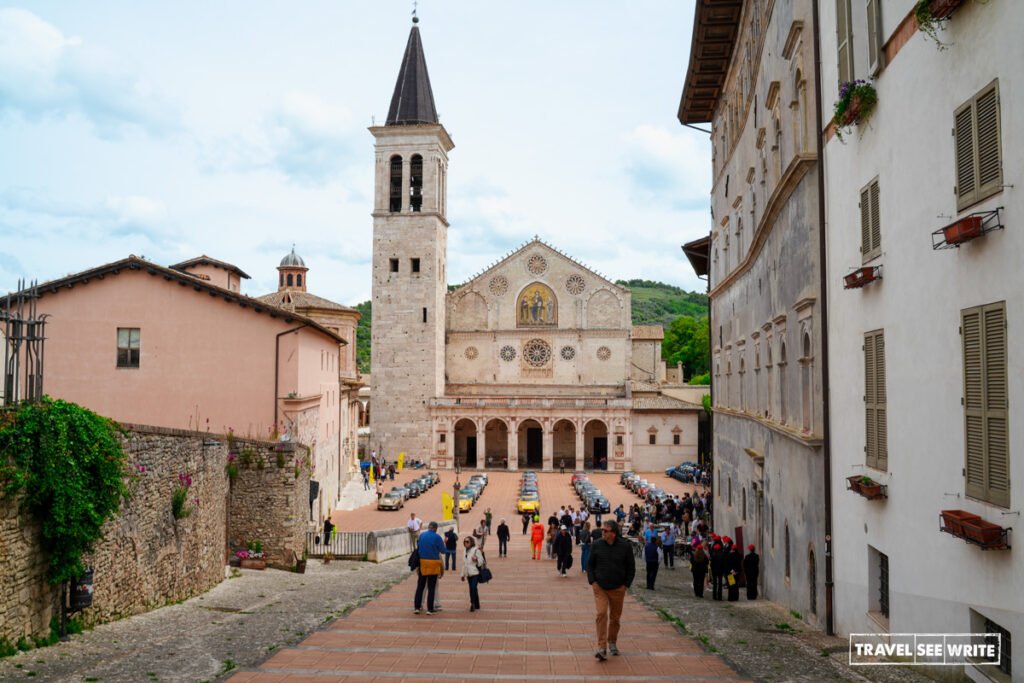
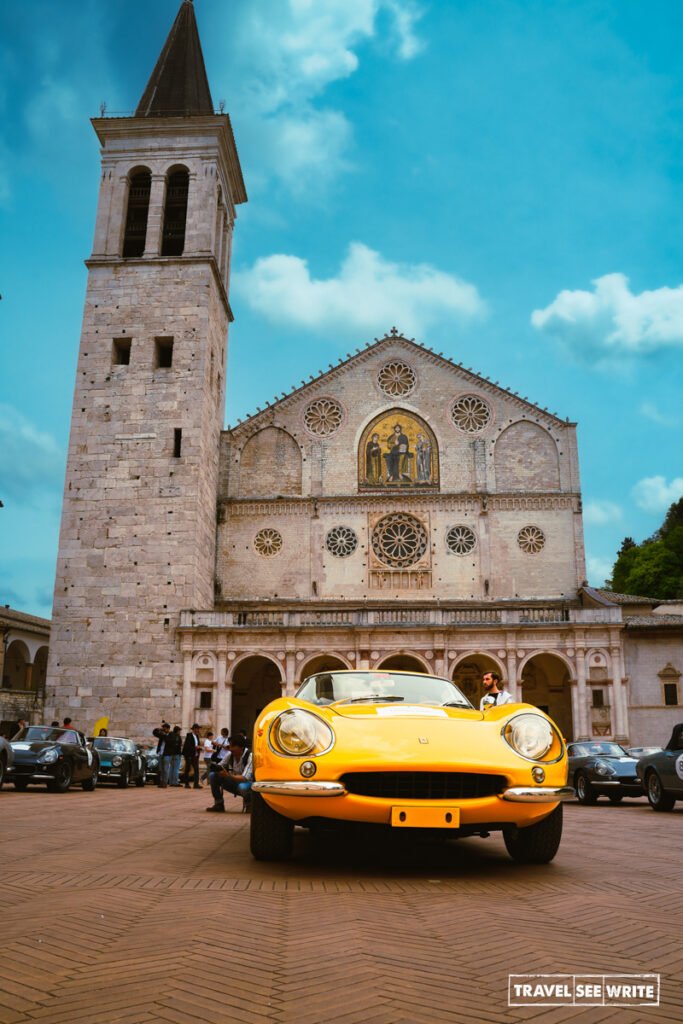
Piazza del Duomo in Spoleto, Umbria, Italy, looking directly down at the Cattedrale di Santa Maria Assunta (Duomo di Spoleto).
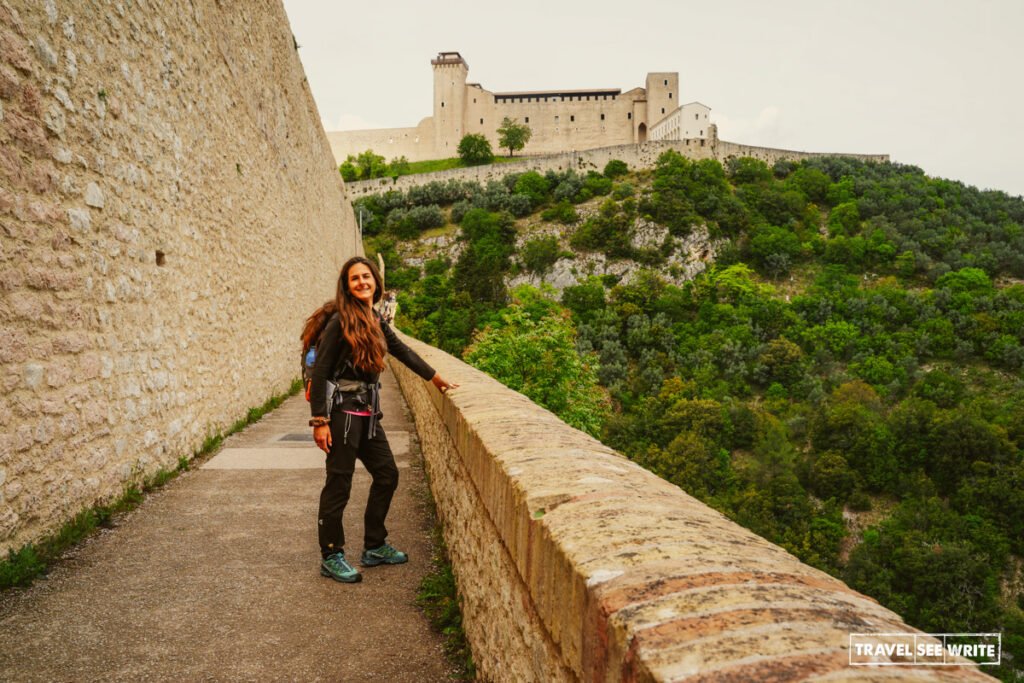
The view from the canyon edge towards the Ponte delle Torri is one of those things I genuinely wasn’t prepared for. A medieval aqueduct bridge crossing a deep mountain gorge, tall enough to make my stomach drop just looking at it. I stood there for a while. And, as we descended to the spectacular Piazza del Duomo, we were surprised to find 32 classic Ferrari 275s from around the world neatly parked. Apparently, they were participating in the 2026 Ferrari Legacy Tour, which ran from May 5 to May 8, 2026, centred on the Umbria region of Italy to celebrate the 60th anniversary of the classic 275 series.
32 classic Ferrari 275s from around the world neatly parked at Piazza del Duomo, Spoleto, Umbria, Italy
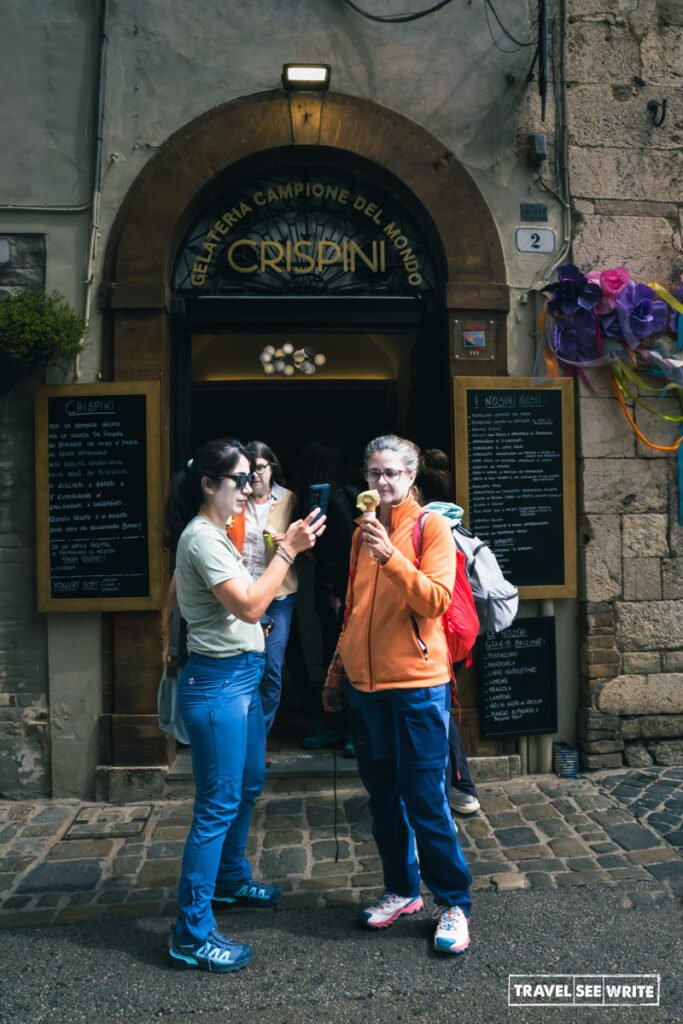
Do not leave Spoleto without trying pistachio gelato at Gelateria Crispini.
After marvelling at the beauty of the Ferraris, we went to cool down at Gelateria Crispini. Their pistachio gelato is award-winning, world-champion-level. I understood why after the first spoon. Do not leave Spoleto without having it.
After a quick walking tour around the medieval town, we had our group’s final meal together at Osteria dell’Enoteca. Strangozzi pasta with black truffle. This is a regional Umbrian pasta, thick hand-rolled strands, and the truffle here is local, which means it tastes like the soil smells on the trail. After three days of walking and eating my way through this region I was beginning to understand that the food and the landscape are the same thing presented differently.
The walking group wrapped up at Spoleto station. I checked into Hotel San Luca, collected my rental car keys, and sat with that for a moment.
Three days on foot to get here. Now I had a car and nine more days and the open road through Tuscany.
It felt like the right way to have earned it.
A Few Things Worth Knowing Before You Go
Things to keep in mind when visiting Umbria, Italy
You do not need to be a serious hiker.
The longest section is 12km, on well-marked paths with gentle terrain in most stretches. Proper walking shoes are more than enough in May. If you’re considering it and telling yourself you’re not fit enough, you probably are.
Carry the pilgrim passport.
The credenziale is available through AEVF at viefrancigene.org or from churches along the route. Get it stamped at every significant stop. I thought I wouldn’t care about this. I was wrong. There’s something about the physical proof of where you’ve been that stays with you in a way that photos don’t quite manage.
Trust the logistics to someone who knows the route.
SloWays moved my bags between hotels, arranged the transfers to trail starting points, and gave me a detailed route document for each day. Not having to think about the logistics meant I had three full days of just being somewhere rather than managing somewhere. That’s the difference.
Umbrian food is not the Italian food you think you know.
Strangozzi with black truffle. Norcineria meats from Norcia. Local Sagrantino wine that you will not easily find outside this region. When you sit down in a local trattoria in Spello or Spoleto, ask what’s local rather than ordering what’s familiar. Every answer will be better than what you were about to request.
May is the right time.
Everything is green, the weather is warm without being punishing, the villages are not yet at summer crowd levels, and the olive groves look exactly like they’re supposed to look. October works too, for different reasons. Avoid August if crowds and heat are not your idea of slow travel.
Why This Trip Specifically
I’ve been to 110 countries. I’ve walked on all seven continents. I’ve done Antarctic and Arctic expeditions, high altitude treks, and desert crossings. I say this not to boast but to explain something: the Via di Francesco was three days and roughly 20 kilometres, and I keep talking about it more than most of those bigger, harder trips.
There’s something about moving through a landscape at walking pace that forces a different kind of attention. You notice the soil changing colour underfoot. You notice the air smells different coming out of a forested ridge versus an olive grove. You end the day with an actual physical memory of the distance you covered, which is not something that happens when you arrive somewhere by car or train without your body having done any of the work.
And there’s something specific to Umbria, this landlocked region that doesn’t carry Tuscany’s fame or Tuscany’s crowds, where the towns are built from pink and honey coloured stone and the valleys smell faintly of truffle, and the local wine is one of Italy’s best-kept secrets. It asks less of you as a visitor than most of the famous Italian destinations do. It doesn’t perform for you. You just have to show up and actually pay attention.
Three days were enough to understand that. It was nowhere near enough of it.
Disclaimer: I was invited by SloWays Travel and the Italian Pilgrim Routes 2026 project, a collaboration between AEVF and the Italian Ministry of Tourism, for this experience. Every observation, every feeling, every photo in this post is mine. Nobody edited what I actually saw.
A Brand Management Expert by profession and a Travel Journalist by passion, who loves to explore offbeat places in search of untold human stories. With over 15-years of Marketing experience under her belt in India and abroad, she works as a Brand Consultant, Influencer, Photographer and a Public Speaker. She is a multiple award-winning writer, who is committed to working on issues like women empowerment, responsible tourism and social inclusion of the underprivileged.
She is considered as one of the top Travel Influencers of India and regularly speaks at prestigious global conferences like WTM ATM, HTM, PATA, TBC-ASIA, ATWS, TBEX, Photo tourism Conference & Awards, and IAMAI among others. Besides documenting her experiences on travelseewrite.com, she regularly writes for global publications in India, US, UK, South East Asia, and the Middle East. Currently, her focus is on working with emerging Markets of Asia, Eastern Europe, and the Middle East to help them grow their tourism market. Having worked on both sides of the table, she provides useful information to the armchair and aisle-seat travellers alike; and help brands plan and execute strong insight led campaigns.


leave a comment